Vol. 22, No. 3, pp. 268-277, May 31, 2016, ISSN 1229-3431(Print) / ISSN 2287-3341(Online) http://dx.doi.org/10.7837/kosomes.2016.22.3.268
A Study on the Development of Educational Programs for LNG Bunkering in Consideration of the Safety System
Se-Hyun Han Yong-Sup Yun Jong-Su Kim Young-Chan Lee
* Korea Institute of Maritime and Fisheries Technology, 367 Haeyang-ro, Yeongdo-Gu, Busan 49111, Republic of Korea
** Korea Maritime and Ocean University, 727 Taejong-ro, Yeongdo-Gu, Busan 49112, Republic of Korea
Abstract : This paper aims at presenting bunkering educational programs for LNG fueled ship taking into consideration existing similar education programs and safety systems at the international level in order to enhance both seafarers' and vessels' safety. Heavy fuel oil has typically been used as fuel of ship propulsion. The competitiveness of the fuel oil is recently getting weak in terms of cost and environmental aspects. Liquefied natural gas is introduced for ship propulsion in the maritime field as a new energy source replacing heavy fuel oil. In order to prepare for installation and operation of LNG fueled propulsion ship on board, International Maritime Organization has discussed this subject for about 10 years. As a result of the discussion on such ships in IMO, the International Code of Safety for Ships Using Gases or Other Low-Flash-Point Fuels entered into force on the year 2015.
International organizations and several countries therefore drives actively entire researches and other businesses with a view to providing equipment and system of LNG bunkering. The systems are divided into ship-to-ship transfer, terminal / pipeline-to-ship transfer and truck-to-ship transfer. By adopting transfer system of LNG bunkering, many human resources will be needed in these areas on scene as well as on managing, operating, trading, finance, design of LNG bunkering industries. LNG bunkering is just in the beginning stage. Hence, this paper reviews and proposes professional educational programs of LNG bunkering in consideration of technical aspects of the safety system of LNG bunkering based on the types of bunkering systems.
Key Words : Liquefied Natural Gas, LNG bunkering, Educational program, International Maritime Organization, Safety system
1
1. Introduction
LNG, a ship-propelling fuel, is used in North European countries including Norway for LNG carriers along the coastal area, small RORO vessels, ferry and shore supporting vessels.
These ships are being bunkered from tank trucks and shore terminals (Kim and Cheon, 2014)
In order to comply with international environmental provisions recently revised, many scholars conducting researches and projects are going to adopt LNG fuel on large vessels. As long as large vessels are bunkered from oil truck or shore terminal oil station, it is limited to deliver for large vessels due to time constraint and space constraint for LNG bunkering. Hence, as an alternative way, the method of ship to ship bunkering is suggested to solve shore side bunkering problems. As well, specialized ships for LNG bunkering have been constructed around the world (Evangelos, 2015).
There are no instances for existing ships to use the way of ship to ship LNG fuel bunkering. Because it needs special safety
* First Author : [email protected], +82-51-620-5404 Corresponding Author : [email protected], +82-51-410-4661
equipment for the bunkering. In particular, seafarers on board LNG fueled ship have to be qualified for transferring LNG fuel safely.
In addition to the method of ship to ship LNG bunkering, terminal / pipeline-to-ship and truck-to-ship transferring methods are also adoptable for middle or small size vessels (Swedish Marine Technology Forum, 2015).
Currently, developed countries such as the UK, the USA and North European countries are implementing specialized LNG bunkering educational programs (USMRC, 2016; LMA, 2016;
GTT, 2016; STC B.V., 2016).
Even though the STCW Convention prescribes the qualifications of seafarers on board liquefied gas carriers, professional training courses of the existing liquefied gas carriers pursuant to the convention do not cover characteristics and risks of LNG bunkering (IMO, 2007a; IMO, 2007b).
Besides, there is no unified educational program at the international level regarding LNG bunkering. Therefore, this paper proposes to develop qualification requirements for seafarers and relevant personnel on board LNG bunkering at the international maritime provisions, especially focusing on safety systems (Han and Lee, 2015).
2. Current Situations of LNG Bunkering Infrastructure
2.1 Perspective for Ports on the Provision of LNG Bunkering Facilities
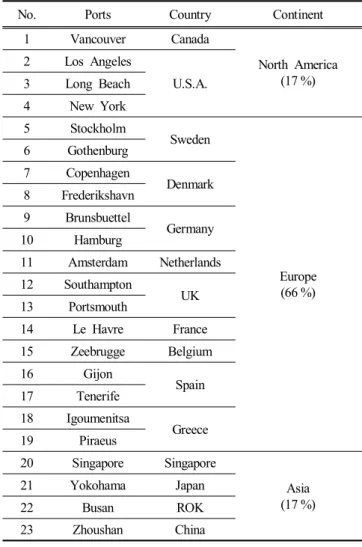
According to Lloyd's Register Marine in the year 2014, there are 23 ports in the world preparing for LNG bunkering facilities including mainly such countries in Europe, North America, and East Asia as shown in Table 1.
No. Ports Country Continent
1 Vancouver Canada
North America (17 %) 2 Los Angeles
U.S.A.
3 Long Beach
4 New York
5 Stockholm
Sweden
Europe (66 %)
6 Gothenburg
7 Copenhagen
Denmark 8 Frederikshavn
9 Brunsbuettel
Germany
10 Hamburg
11 Amsterdam Netherlands
12 Southampton 13 Portsmouth UK
14 Le Havre France
15 Zeebrugge Belgium
16 Gijon
Spain
17 Tenerife
18 Igoumenitsa
Greece
19 Piraeus
20 Singapore Singapore
Asia (17 %)
21 Yokohama Japan
22 Busan ROK
23 Zhoushan China
Table 1. Responding ports of LNG bunkering infrastructure (Lloyd's Register Marine, 2014)
As given in Figure 1, there are mainly methods of ship to ship, terminal / pipeline to ship and truck to ship transfer for LNG bunkering.
Fig. 1. Typical Methods of Bunkering LNG Fueled Ship (ABS, 2015).
In particular, the ship to ship bunkering method is chiefly used.
The ship to ship bunkering requires some flexibilities concerning the type of bunkering ship, the position of bunkering, and operation time. With this method, the delivery of LNG can be carried out very efficiently.
As shown in Table 2, LNG bunkering business is getting bigger in each ports of world.
Periods
Expected LNG proportion of the total bunkering
volume (%)
by short sea by deep sea
by 2015 17 % 1.7 %
0.0 %
by 2020 13.4 % 12.0 %
1.4 %
by 2025 24.0 % 17.0 %
7.0 % Table 2. Expected LNG proportion of the total bunkering
volume (Swedish Marine Technology Forum, 2015)
As given in Table 3, some facilities are required in accordance with types of LNG bunkering.
No. Type of LNG bunkering facilities Average Proportion (%)
1 Barge (Ship-to-ship) 33 %
2 Road tanker (Truck-to-ship) 33 %
3 Pipelines at berths
(Terminal / Pipeline-to-ship) 17 %
4 130435 17 %
Table 3. Type of LNG bunkering facilities (Swedish Marine Technology Forum, 2015)
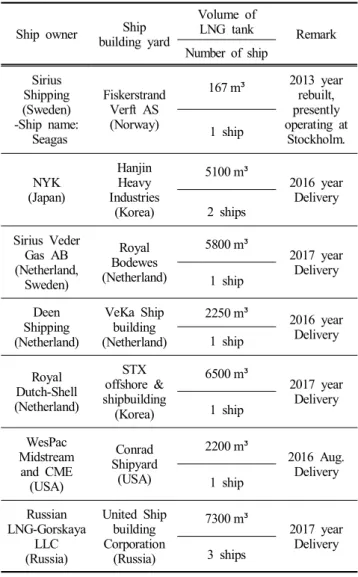
As shown in Table 4 with respect to current shipbuilding situation and outlook for LNG bunkering, as of Feb. 2016, many shipbuilders deliver LNG fueled propulsion ships and therefore, it is a hot issue among shipbuilders.
Ship owner Ship
building yard
Volume of
LNG tank Remark Number of ship
Sirius Shipping (Sweden) -Ship name:
Seagas
Fiskerstrand Verft AS (Norway)
167 mᶾ 2013 year rebuilt, presently operating at
Stockholm.
1 ship
NYK (Japan)
Hanjin Heavy Industries
(Korea)
5100 mᶾ
2016 year Delivery 2 ships
Sirius Veder Gas AB (Netherland,
Sweden)
Royal Bodewes (Netherland)
5800 mᶾ
2017 year Delivery 1 ship
Deen Shipping (Netherland)
VeKa Ship building (Netherland)
2250 mᶾ 2016 year Delivery 1 ship
Royal Dutch-Shell (Netherland)
STX offshore &
shipbuilding (Korea)
6500 mᶾ
2017 year Delivery 1 ship
WesPac Midstream
and CME (USA)
Conrad Shipyard
(USA)
2200 mᶾ
2016 Aug.
Delivery 1 ship
Russian LNG-Gorskaya
LLC (Russia)
United Ship building Corporation
(Russia)
7300 mᶾ
2017 year Delivery 3 ships
Table 4. Current situation of shipbuilding contracts on LNG fueled propulsion ship (Feb. 2016)
3. Differences between Existing LNG/LPG Carriers and LNG Fueled Ships
Taking the ship to ship bunkering method for LNG fueled propulsion ships into consideration, it is recognised as a very useful and practical way and is different from the bunkering of existing LNG and LPG carriers in some aspects. Existing gas carriers are loaded or unloaded as part of cargo operation. LNG fueled propulsion ships are capable of carrying out the bunkering operation with general cargo and container ships. Therefore, LNG
bunkering facilities to be adopted have to be reviewed it terms of their characteristics and functions.
Fig. 2 shows about a typical arrangement of ship-to-ship bunkering.
Fig. 2. Typical arrangement of Ship-Ship Bunkering (STC B.V., 2014).
3.1 LNG Bunkering Hose
Special hoses are used to transfer LNG liquid and vapour under the condition of temperature -196℃. Seafarers should use MBR (minimum bending radius) hoses under the very low temperature condition.
Fig. 3. LNG Bunkering Hose (ABS, 2015).
For the easy hose connection, quick connect / disconnect coupling types are used for drip free and safety reason. Also, a water pressure test should be executed within 6 months. Hoses should be produced to meet users’ purpose considering their retirement age.
Such hoses need to be marked with the maximum allowable working pressure, date of manufacture, minimum bending radius
and certification number in accordance with ISO 14276:2008.
Maintenance of the hoses should be strictly recorded on document.
And seafarers are sufficiently and clearly able to understand related regulation and maintenance systems. During LNG ship to ship transferring, hoses are recognised as the weakest point. Hence, it is essential to deliver proper and quality contents of education regarding hoses.
3.2 Emergency Release System
In case of ship to ship LNG bunkering operation, both the LNG delivering ship and the receiving ship must stay on either an anchored condition or a drifting condition. Such state of both ships can be influenced in their movements by external weather conditions and outside power. In case of emergency situation such as fire or explosion accident, the LNG bunkering ship need to be unberthed without a partner ship.
In order to cope with emergency situations, large LNG tankers and dedicated terminal have adopted shore loading arm with PERC (Powered Emergency Release Coupling) and hydraulic double ball valve. The LNG bunkering operation needs to be equipped with LNG bunker hoses and a break-away coupling between the manifold and the receiving ship. The coupling is the weakest part in the bunker hose connection due to its design. Having limited extension to a part of connection, the coupling part may be broken and disconnected. In case the coupling is partly disconnected, two quick-closing valves should be shut off to prevent any LNG spill (Ryu et al., 2015).
Fig. 4. Emergency release system (ABS, 2015).
3.3 Differential Pressure Measuring System
A differential pressure measuring system for ESD (Emergency Shut Down), which existing LNG carriers are not equipped with, is installed in the LNG bunkering ship.
Fig. 5. Overall of Differential Pressure Measuring System (Kang et al., 2012).
Both LNG delivering and receiving ships are equipped with a pressure sense. When differential pressure on either ship happens owing to leakage and breakage of the hose, the differential pressure transmitter (DPT) transfers a signal to the ESD system leading to the shutting related manifold and cargo valve. The cargo pump will stop for safety reason with an audible alarm signal to others. If the pressure measuring system malfunctions, the hose may break and LNG spill will occur. Existing LNG tankers should also be installed with the DPT with ESD as safety equipment for the ship to ship bunkering transfer. Any LNG bunkering ship must be installed with safety equipment, hence it will protect seafarers on board the ship (Kang et al., 2012).
3.4 Communication Device
Both ships need to have cable links for the purpose of communication as an option condition. The communication link is largely conceived as a way of ship / shore communication for LNG carriers including a direct telephone system in order to notify the temperature and pressures of the receiving tank, deliver emergency alarms from both ships and make the emergency stop control possible.
3.5 LNG Bunkering Line Inerting System
The bunker receiving ship must implement an inerting operation for the LNG bunkering line prior to the departure of ship. On disconnecting between the bunkering manifold and the bunker hose, the inerting operation must immediately be carried out for the gas free condition. However, the bunkering ship takes hose parking connections after the disconnection between the LNG bunkering hose and the bunkering line. It leads to ventilation through the vent mast and the ship do not require the inerting operation. The LNG bunkering ship is installed with the hose parking connection. After the ship departs, the inerting process of LNG bunkering hose should start. Also, in case the inerting
process of LNG bunker hose doesn’t begin after the departure, and the inerting valve is not in operation within 60 minutes after the cargo pump stops, the main switchboard alarm will be rung. The above-mentioned procedure should be maintained with bunkering check-list and ISM system (Bae et al., 2014).
3.6 Fuel Quantity Measuring System
For ordinary ships, it is really vital that the total supply quantity between both ships should be written in the form of the bunker delivery receipt after completion of HFO bunkering operation.
Sometimes, the delay of ship departure and P&I Claim can occur due to different opinions on the fuel quantity on board.
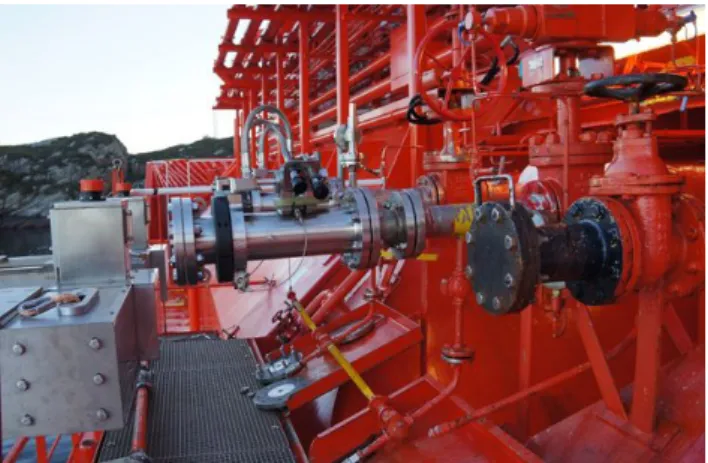
LNG bunkering must not be stopped during the operation, and both ships must not be separated, either. It is dangerous to use a quantity measuring method like the in-tank measuring of ordinary LNG carriers. The LNG bunkering ship must use the method of flow meter on bunker hoses for quantity measurement. The flow meter should function highly accurately in the cryogenic state.
Such types of flow meters producing boil off gas owing to the resistance of internal pipes are improper to be installed in the LNG bunkering ship. It is recommended to install a type of Coriolis mass flow meter. Hence, seafarers on board both ships should be informed of characteristics, usage, calibration, trouble shooting of the flow meter to prevent delays of ship and claims of bunkering (Yun, 2015; Yun, 2016).
3.7 Fuel Quality Measuring System
LNG generally consists of 90 % methane, 6 % ethane, 2 % propane, 1 % butane, 1 % nitrogen and 1 % miscellaneous gas. But the composition may differ depending on liquefaction methods and production areas. Even the same of cubic meter (volume) and metric ton (weight) of LNG is transferred, BTU quantity may differ in LNG components. Therefore, MMBTU (Million Metric British Thermal Unit) is one of the standards for the final transfer quantity on LNG shipping business between supplier and receiver.
A model procedure of current LNG carriers is executed during the unloading operation. An analysis of LNG components is conducted after the departure of ship. Based on the component analysis within 7 days after the departure, the final transfer quantity is determined by calculating BTU quantity.
Considering that LNG bunkering ships receive various types of LNG from various regions, it is possible to mix up remaining LNG with new LNG from other regions. It may be blended.
Hence, it is necessary to analyze the components of blended LNG whenever the ship to ship bunkering is carried out. The LNG
bunkering ships are required to carry LNG analysis equipment on board. The analysis is related to the next cargo quantity. To conduct the analysis, Gas Chromatograph is needed for LNG bunkering ships. Officers in charge of the bunkering operation on board LNG bunkering ships must measure BTU and record the result of gas sampling analysis. Contents newly obtained from gas chromatograph should be inserted into the curriculum of seafarer education in term of its usage. However, if the case is currently being used in some LPG vessel gas changes that work strictly confined to a portion of training, it is also required for the new usage, management, and maintenance of this equipment (ABS, 2015).
3.8 Bunker Station System
The manifold zones of LNG bunkering ships are collectively known as the bunker station, and the presence of large LNG vessels and similar LNG liquid line, LNG vapour return line and nitrogen supply line have been configured. Besides, there is an additionally arranged high pressure tank to store the GNG (Gaseous Natural Gas / LNG vapor), and store the GNG from LNG storage tank piping system with high pressure. The high pressure of GNG is used when LNG remains in the transfer hose and piping of each ship and its LNG storage tank should be blown for line stripping after LNG transfer operation is terminated. So using the GNG minimizes the LNG remaining in the transfer hose and piping, and purging the piping and each transfer hose with nitrogen thereafter to below LEL (Lower explosive limit) is to prevent an explosion that may occur during line disconnection. While progress in conventional large LNG carriers in line stripping and purging work equipment and personnel land-terminal side are organized as above, the LNG bunkering ship personnel must go performing between the bunkering ship and the receiving ship as the initiative of this role.
In addition, compared to traditional large LNG carriers and onshore terminals, LNG storage tanks of the LNG bunkering and receiving ship are relatively small, even LNG in storage, because it is the fuel that should be used immediately in the ship engine.
Hence, if the nitrogen in line stripping operation is excessively used, it can lead to problems such as fuel contamination. Therefore, LNG bunkering ship personnel should consider both ships in term of the capacity of LNG bunker hose and piping, line bending shape (lines curving or not) and valve positions, including the line stripping operation when the minimum dose to nitrogen utilization by purging can be planned and practiced whether properly or not (Bae et al., 2014).
3.9 Cargo Systems
LNG bunkering ships have a variety of sizes and specifications compared to the receiving ship, so ship to ship operations can be conducted with the required versatility and, therefore, amounts of LNG transfer rate between two ships can be adjusted in a wide range of skills that are needed. To this end, LNG bunkering ships have two major systems compared to the existing large LNG carriers.
(1) LNG bunker recirculation line (Kick back line)
The liquid bunker line in the near manifold to the LNG storage tank will be directly accessible and attached to the control valve.
Some of the LNG flowing is transported to the LNG storage tank of the bunkering ship and its transfer rate can be adjusted by the recirculation to the storage tank.
(2) Frequency converter of electric LNG cargo pump
Considering LNG cargo nature, in-tank retractable submerged motor pump is used. Discharging rate of most pumps on LNG and LPG vessels is regulated simply by the opening degree of the outlet valve. The RPM adjustment of electric pump is difficult. To do so, an expensive equipment frequency converter is needed. But the LNG bunkering and receiving ships have a wide discharging rate according to the work done, A frequency converter of electric pump needs to be equipped with. Therefore, the crew of the LNG bunkering ship should have business skills of using, maintaining the equipment with precaution tips. Most of the existing LNG and LPG applications do not require such equipment. Then the educational program should include sufficient preliminary training before embarking (Yun, 2015; Yun, 2016).
3.10 Safety Valves
The LNG bunkering ship also has two equipment safety valves for each cargo tank like usual LNG and LPG carriers. But here an interlock system is added to protect the safety valve of the LNG cargo tank. Some accidents on LNG cargo tank will happen due to overpressure caused by safety valve misuses. Pursuant to the IGC code, 2 safety valves of each cargo tank are strictly prohibited from closing by any equipment and any worker. LNG bunkering ship interlock system is a safety device that must be controlled to close only one of the safety valve for each cargo tank (ABS, 2015).
4. Review of STCW Convention
4.1 Background
The ship to ship LNG bunkering operation is done between LNG bunkering vessels and LNG fueled propulsion ships in
compliance with the IGC Code. Therefore, in accordance with the existing STCW regulations, Crews on LNG bunkering ship is needed to complete a basic education covered by the IGC Code.
4.2 Current Related Training Course
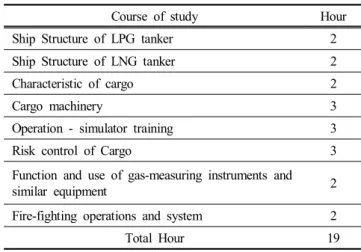
The basic training for liquefied gas tanker cargo operations pursuant to STCW Convention is explained in Table 5 (KIMFT, 2015).
Course of study Hour
Ship Structure of LPG tanker 2
Ship Structure of LNG tanker 2
Characteristic of cargo 2
Cargo machinery 3
Operation - simulator training 3
Risk control of Cargo 3
Function and use of gas-measuring instruments and
similar equipment 2
Fire-fighting operations and system 2
Total Hour 19
Table 5. Basic training for liquefied gas tanker cargo operations (KIMFT, 2015)
Advanced training for liquefied gas tanker cargo operations by STCW Convention is configured as Table 6 (KIMFT, 2015).
Course of study Hour
Summary
(production / demand / supply chain of liquefied gas) 1 Ship structure of liquefied gas tanker
(Kind of cargo Tank) 2
Rule and regulation (SIGTTO, ICS / OCIMF Guide) 1 Basic chemistry or physics theory for liquefied gas 2 Characteristic and risk of liquefied gas 2 LPGC / LNGC Cargo Operation procedure 7 Emergency response on liquefied gas tanker 3 Cargo measurement and calculation of LPG 1 Cargo machinery and equipment, Pollution prevention
(MARPOL and Chemical Pollution) 2
Custody Transfer Measurement System for LNG 2
Gas / oxygen detector and analyzer 3
Integrated Automation System 2
Total Hour 28
Table 6. Advanced training for liquefied gas tanker cargo operations (KIMFT, 2015)
Looking at the curriculum set forth in the Table 5 and Table 6, basic and advanced education programs in relation to liquefied gas can be seen as designed to focus on professional skill formation for right operations of large LNG and LPG supply vessels.
Therefore, the information and materials in the training course of the existing liquefied gas don't include the various peculiarities and unique risks of LNG bunkering ship.
LNG bunkering ships have compact sizes compared to existing ships. And this is a clear difference from other types of current ships considering they frequently carry out ship to ship transfer operations at sea. Accordingly, the vessels have unique risks. These differences depending on the new trading pattern of LNG bunkering ships are difficult to experience in the existing LNG and LPG transport ships. As a result, a number of equipment and operating procedures, risk factors can be dealt with.
Based on these reasons, the developed countries in North America and Europe go ahead to establish and operate LNG bunkering professional trainings. Therefore, there is a need to address the professional education program for the LNG bunkering sector.
5. Analysis of Current Educational Program
5.1 United States Maritime Resource Center (USMRC) Since April 2015, the USMRC has opened a five-day training course regarding LNG vessels and six offshore LNG bunkering operation management personnel as Table 7 Harvey Gulf International Marine Inc. in collaboration with relevant education experts developed simulation tool for LNG bunkering system (computer program) in term of hands-on training and the implementation and evaluation. Also, it is to be carried out as intensive training for emergency response and fire fighting LNG in conjunction with the MFA (Massachusetts Fire fighting Academy) (USMRC, 2015).
Course of study Day
Introduction to LNG and the Carriage of LNG as a
Marine Fuel 1
Characteristics of LNG, LNG Hazards, LNG Safety, Fire and Pollution Prevention and an Overview of the LNG Fueled Propulsion System
2
Hands on LNG Safety and Response Training at
Massachusetts Firefighting Academy (MFA) 3 PIC Responsibilities and Procedures During Transfer 4 PIC Simulation and Assessments LNG Bunkering
Operations 5
Table 7. Advanced training for liquefied gas tanker cargo operations (USMRC, 2015)
5.2 Lloyd's Maritime Academy (LMA)
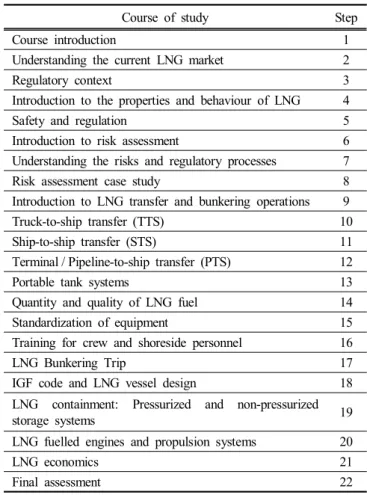
As given in Table 8, the LMA provides a comprehensive guide to LNG bunkering operation, regulations, safety and vessel design for 3 days in the theoretical and practical training on LNG bunkering work. LNG Bunkering Training Course designed by the LMA for performing the operation is not limited to the professional manpower, but includes relevant personnel for ship-to-ship, truck-to-ship or terminal / pipeline-to-ship and the LNG. It includes all the training for a thorough understanding of the bunkering industry. Training subjects are not limited to site operations personnel, either. They are designed for all personnel involved in the whole LNG bunkering industry. They are targeted at industry personnel of various levels, according to the needs of trainees.
Several types of customized educational plans to promote the LNG bunkering industry are key factors at present (LMA, 2016).
Course of study Step
Course introduction 1
Understanding the current LNG market 2
Regulatory context 3
Introduction to the properties and behaviour of LNG 4
Safety and regulation 5
Introduction to risk assessment 6
Understanding the risks and regulatory processes 7
Risk assessment case study 8
Introduction to LNG transfer and bunkering operations 9
Truck-to-ship transfer (TTS) 10
Ship-to-ship transfer (STS) 11
Terminal / Pipeline-to-ship transfer (PTS) 12
Portable tank systems 13
Quantity and quality of LNG fuel 14
Standardization of equipment 15
Training for crew and shoreside personnel 16
LNG Bunkering Trip 17
IGF code and LNG vessel design 18
LNG containment: Pressurized and non-pressurized
storage systems 19
LNG fuelled engines and propulsion systems 20
LNG economics 21
Final assessment 22
Table 8. Curriculum of LNG Bunkering Training Course (LMA, 2016)
5.3 Gaztransport & Technigaz (GTT)
In addition to all the expertise available within GTT, GTT Training consists of a small team of specialist instructors who
together have more than 30 years experience sailing on board gas carriers of various types or 40 years experience in delivering courses specializing in LNG Cargo Operations. Besides providing training, GTT Training also have their own in-house software team who specialized in the development of real time simulation of the movement of liquids and gasses in the enclosed environment, and who developed the new ‘Liquid Gas Handling Simulator’ located at our training centre at GTT’s headquarters near Paris.
Providing a deeper understanding and skills for those persons who will be directly or indirectly involved in the bunkering and use of LNG as a marine fuel. This two day course in Table 9 is designed for those who require a deeper understanding for using LNG as a marine fuel, the associated bunkering operation and the management of LNG bunker tanks.
Course of study Day
Introduction to LNG
1 Drivers for using LNG as a fuel
Properties of LNG Hazards of LNG
Regulations applicable to the use of LNG as a fuel Types of tank used for storing LNG
LNG Bunker delivery methods Safe Bunkering
2 Bunkering Operation
Gas Fuelled Engines
Maintenance of LNG Fuel Tanks Gas Measuring Instruments Emergency Response
Table 9. Curriculum of LNG as a Marine Fuel and Bunkering Operations Course (GTT, 2015)
5.4 STC B.V.
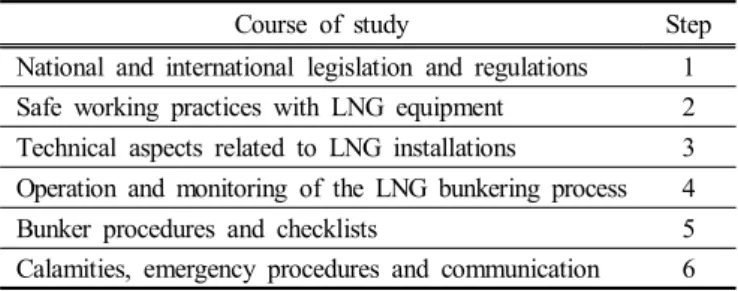
Within the EU funded project 'LNG Master plan Rhine-Main -Danube' STC-Group has developed the LNG bunkering training course as shown in Table 10. This course is developed for participants who have their roles in the LNG bunkering operations.
Crew on board the bunker vessels, operators of bunker stations and any end-users are invited to join this training.
The training starts with several e-learning modules, which participants can complete independently. These modules teach about the characteristics of LNG and daily practice. Liquefied natural gas has a few specific properties which require special working procedures and checklists. After completion of each module, a test will be given. When all modules and tests are
successfully completed, lessons continue in class. Practical skills can be developed and trained by using a simulator or tanker training facilities. A final written test completes the training. If this test is passed, a certificate will be awarded.
Additionally, this training has been developed together with relevant authorities and industrial partners. Theoretical parts of this course can be given on location or on board. On request, the training can be tailored to trainee's needs, and customized for any company's specific processes, protocols and equipment (STC B.V., 2016).
Course of study Step
National and international legislation and regulations 1 Safe working practices with LNG equipment 2 Technical aspects related to LNG installations 3 Operation and monitoring of the LNG bunkering process 4
Bunker procedures and checklists 5
Calamities, emergency procedures and communication 6 Table 10. Curriculum of LNG bunkering training (STC B.V., 2016)
6. Development of Educational Program
6.1 Types of Trainee
In many institutes of foreign countries, training programs on the LNG bunkering field can be divided into 2 kinds by onshore side or offshore side as shown Table 11.
Category Business pattern Trainee's detail
Field staff of bunkering operation
Ship to ship transfer
Seafarer of LNG bunkering ship Truck to ship
transfer
Operator (Field staff) of tank lorry truck Terminal / Pipeline
to ship transfer
Operator (Field staff) of shore terminal or sea
platform
Office worker involved in
LNG bunkering industries
Ship owner or charterer
Management, operation and trade part Bunker supplier
LNG Terminal company Tank lorry truck
company Shipbuilding and equipment maker
Design, construction and production part Financial investor Investment and analysis part
Relevant public official
Part of providing an institutional strategy and
the legal system Table 11. Classification of Trainees of LNG bunkering
Course of study Step Introduction for LNG bunkering
- Current LNG shipping and bunkering market - LNG chemical and physical characteristics - Current and future LNG marine fuel regulatory
schemes, policies, guidance and industry practices - LNG bunkering project including the new port
1
Knowledge of LNG bunkering machinery and equipment
- Information about gas fueled vessel with IGF code - Information about LNG bunkering ship
- LNG marine fuel loading, storage, transfer and distribution systems.
2
Knowledge of procedures on STS, TTS, and PTS 3 Knowledge of safety rules and regulations
- International regulations for LNG bunkering including SIGTTO and class
- Safety design and operation procedures for the cryogenic and flammable nature of LNG - Gas detection and control systems
- Safety considerations of LNG and gas containment systems
- Vapour control to minimize venting
4
Simulator training for bunkering operation
- Introduction to hands-on LNG bunkering simulator - Critical interface between gas fuelled vessels and
floating / shore-based LNG bunkering facilities - LNG bunkering normal and emergency procedures - Hands-on LNG bunkering operations exercises using
simulators including normal and emergency cases - Assessment for competence to LNG bunkering
operations
5
Risk assessment and case study
- Understanding the risk for various methods and steps including STS, PTS and TTS cases - Case study of real accidents or possible scenarios
6
Safety and emergency response
- Procedures on various emergency cases including fire and spill
- Hands-on field exercises for below cases ; · Hands-on exercise for fixed and portable fire
extinguishing system to LNG fire · Drill for LNG flange pressure fire
· Drill for LNG pool fire (Small and extensive fire)
· Drill for LNG liquid spill · Drill for LNG vapor release
7 Table 12. Curriculum of the seafarer training on LNG
bunkering operation
6.2 Minimum Competence
Table 12 shows the curriculum of the seafarer training on LNG bunkering operation. The most important requirements of capabilities for the training bunkering operation will be performed on board for the immediate response emergency situations.
In order to improve the bunkering operation performance, there is a need for comprehensive and practical simulator exercises, such as a higher level of knowledge about each STS, TTS, PTS scheme for LNG bunkering machinery and equipment.
Safe handling of explosive cargo of LNG cryogenic also basically needs physical and chemical understanding of LNG, functions and operation of each safety equipment, emergency- specific scenarios and understanding practical emergency training exercises for the efficient response emergency situation.
In particular, a real emergency training to respond to the fire pool and flange in accordance with the mass flow of LNG is needed. Reviewing foreign educational institutions, it is believed that the LNG bunkering training and fire emergency response training are very important elements.
7. Conclusion
It is essential that the support to the LNG bunkering industry meets educational needs of the global competitiveness of the management, suppliers, shipbuilding workers, equipment makers, financial investors, and related public officials. Hence, the educational program for the LNG bunkering is very important as it introduces to personnel the above-mentioned various fields at the international institutions and provides customized training to meet each consumer's needs.
The trainees need to understand various practical procedures including the LNG bunkering operation performance and overall LNG bunkering industry rather than special practices. In particular, the training program should deal with LNG bunkering hose, emergency release system, differential pressure measuring system, communication device, LNG bunkering line inerting system, fuel quantity measuring system, fuel quality measuring system and bunkering station system.
For this purpose, on the basis of the field staff's job training, it is necessary to provide a customized training course to meet the needs of each customer. In addition to some indirect experiences and emergency procedures for bunkering operations considering the risk of LNG, understanding the operation situation of the scene is important for trainees to take advantage of a variety of tasks of
each person. Therefore, the LNG bunkering simulator training and emergency response drill for indirect experiences can help trainees understand further LNG bunkering industry's overall theory and LNG bunkering terminal, ship and tank lorry truck.
Also, the open discussion forum as an opportunity in a variety of fields related to the LNG bunkering industry should be considered with the expertise. The seminar structure to facilitate mutual opinion exchanges on each side of the field is needed. The UK and Singapore has opened an LNG bunkering education expert forum with participants of various nationalities. The initiative to encourage a new business model is certainly worth considering.
References
[1] ABS(2015), American Bureau of Shipping, LNG Bunkering : Technical and Operational Advisory, pp. 25-38.
[2] Bae, J. H., B. C. Park, S. C. Shin and S. Y. Kim(2014), Risk assessment of Ship-To-Ship LNG bunkering at BUSAN NEWPORT, Proceedings of the 2014 Spring Korean Society Of Marine Environment & Safety Conference, pp. 300-302, http://www.dbpia.co.kr/Article/NODE02442060.
[3] Evangelos, B.(2015), LNG Bunkering & Training Challenges, University of Strathclyde Technology and Innovation Centre, pp. 2-13.
[4] GTT(2016), Gaztransport & Technigaz training, LNG as a Marine Fuel and Bunkering Operations Course : GTT training Ltd., http://www.gtt-training.co.uk/.
[5] Han, S. H. and Y. C. Lee(2015), A study on the developments of STCW training of seafarers on ships applying in the IGF Code, Journal of the Korean Society of Marine Engineering, Vol. 39, No. 10, pp. 1054-1061.
[6] IMO(2007a), Liquefied natural gas tanker cargo and ballast handling simulator (Model course 1.36), pp. 8-22.
[7] IMO(2007b), Liquefied petroleum gas tanker cargo and ballast handling simulator (Model course 1.35), pp. 11-29.
[8] Kang, H. G., H. S. Kim and G. P. Kim(2012), Proposal for Development and Base Institution-building of LNG Bunkering Ships, Proceedings of the 2012 Fall Korean Society Of Marine Environment & Safety Conference, pp. 100-103, http://www.dbpia.co.kr/Article/NODE02046754.
[9] Kim, J. H. and K. W. Cheon(2014), Technical trend for LNG fuelled ship and LNG bunkering, KEIT (Korea Evaluation Institute Of Industrial Technology) PD Issue Report, Vol.
14-10, pp. 31-39.
[10] KIMFT(2015), Korea Institute of maritime and fisheries technology, Total course of study, pp. 227-318.
[11] Lloyd’s Register Marine(2014), LNG Bunkering Infrastructure Survey 2014 - The outlook of Ports on provision of LNG bunkering facilities : LR, pp. 3-28.
[12] LMA(2016), Lloyd's Maritime Academy, LNG Bunkering Training Course - A comprehensive guide to LNG bunkering operations, regulation, safety and vessel design : LMA, http://www.lloydsmaritimeacademy.com/event/lng-bunkering-tra ining-course.
[13] Ryu, W., Y. S. Lee, S. Y. Kang and Y. J. Ahn(2015), A research for optimum proposed site of floating LNG bunkering terminal, Proceedings of the 2015 Spring Korean Society Of Marine Environment & Safety Conference, pp.
272-274, http://www.dbpia.co.kr/Article/NODE06296043.
[14] STC B.V.(2016), LNG bunkering training : STC B.V., https://www.stc-bv.nl/.
[15] Swedish Marine Technology Forum(2015), LNG bunkering Ship to Ship procedure", vol. LNG02, pp. 34-51.
[16] USMRC(2016), United States Maritime Resource Center, LNG Bunkering PIC (Combined Basic and Advanced) Course : USMRC, http://usmrc.org/training/lng/.
[17] Yun, S. K.(2015), Thermal analysis of LNG storage tank for LNG bunkering system, Journal of the Korean Society of Marine Engineering, Vol. 39, No. 9, pp. 876-880.
[18] Yun, S. K.(2016), Characteristics of boil-off-gas partial re-liquefaction systems in LNG ships, Journal of the Korean Society of Marine Engineering, Vol. 40, No. 3, pp. 174-179.
Received : 2016. 05. 03.
Revised : 2016. 05. 18. (1st) : 2016. 05. 25. (2nd) Accepted : 2016. 05. 27.