126 This is an Open-Access article distributed under the terms of the Creative Commons Attribution Non-Commercial License (http://
creativecommons.org/licenses/by-nc/3.0) which permits unrestricted non-commercial use, distribution, and reproduction in any medium, provided the original work is properly cited.
J. Mushrooms 2021 September, 19(3):126-133 http://dx.doi.org/10.14480/JM.2021.19.3.126 Print ISSN 1738-0294, Online ISSN 2288-8853
© The Korean Society of Mushroom Science
Si Young Ha(Ph.D), Ji Young Jung(Research professor), and Jae-Kyung Yang(Professor)
*Corresponding author E-mail : [email protected]
Tel : +82-55-772-1862,Fax : +82-55-772-1869 Received July 5, 2021
Revised August 18, 2021 Accepted August 24, 2021
Optimization of Monochamus alternatus media and culture period for cordycepin production in Cordyceps militaris culture using solid-state fermentation
Si Young Ha, Ji Young Jung, and Jae-Kyung Yang*
Division of Environmental Forest Science, Institute of Agriculture and Life Science, Gyeongsang National University, Jinju, 52828, Republic of Korea
ABSTRACT: In this study, we investigated the effect of solid culture medium on the production of cordycepin in Cordyceps militaris. The regression equation was expressed as follows: Y1= 755.3-58.6625X1+4.79432E-14X2-46.6625X3-5.66269E-14X1X2- 0.025X1X3+1.62475E-14X2X3-160.6625X12
+0.0125X22
-206.9625X32, where, Y represents the value of cordycepin content (μg/g), X1 corresponds to the weight of M. alternatus in solid culture medium (g/bottle), X2 to the water content of the solid culture medium (%), and X3 to the culture period (day). The solid culture medium was optimized using the response surface methodology, and the optimal medium composition was as follows: the weight of M. alternatus in solid culture medium and water content were 16.2%
and 100.7% (20.14 mL water/20 g solid culture medium), respectively, with a culture period of 39 days. Under these conditions, the cordycepin content of the fruiting bodies reached 150.0μg/g (actual value). The supplementation of M. alternatus in solid culture for improved cordycepin content of C. militaris seems to be a promising alternative to wild and solid cultivation.
KEYWORDS: Cordycepin, Cordyceps militaris, Monochamus alternatus, Response surface methodology, Solid-state fermentation
INTRODUCTION
Currently, Cordyceps militaris is used as a functional food and medicine in Southeast Asia (López Rodríguez and Burrola-Aguilar, 2019) with the potential to become a medicinal fungus with largest production and popularity in the future. C. militaris is at present used as a substitute for C. sinensis in traditional medicine as well as in health foods, as the latter is very expensive (Liu et al., 2021). Compared to C. sinensis, C. militaris possesses
similar bioactive components; however, it produces a greater quantity of cordycepin (Zhang et al., 2020).
Furthermore, its significant pharmacological activity has resulted in an increased market demand for C. militaris (Li et al., 2021).
C. militaris is known for the production of an impressive range of bioactive compounds including polysaccharides, cordycepin, and ergosterol, with significant pharmacological effects (Wu et al., 2019). In recent studies, hemagglutinin (Quan et al., 2020) and a cytotoxic antifungal protease have been shown to be purified from the dry fruiting body of C. militaris (Yu et al., 2021).
Cordycepin is a nucleoside derivative isolated from the spent culture media of C. militaris, that has drawn considerable interest due to its potent antitumor (Khuntawee et al., 2021), and hypolipidemic (Zhang et al., 2021) properties. Recently, research has shown that many of the reported bioactive effects of cordycepin are likely to be due to its effects on mammalian target of rapamycin (mTOR) and AMP-activated kinase (AMPK) signaling (Hawley et al., 2020).
Techniques for the synthesis of cordycepin involve chemical and biological pathways. Since cordycepin obtained by chemical pathways is difficult to purify with
the cost of production being much higher than the biological pathways, the biological pathways have become a major research concern (Zhao et al., 2019). There have been many studies that have highlighted the significance of the culture requirements for secondary metabolite production by filamentous fungi (Wösten, 2019).
Similarly, in vitro mycelium growth and fruiting body formation in C. militaris have attracted the interest of mycologists, entomologists, and biotechnologists. There have been studies on optimizing the culture conditions (Raethong et al., 2020) and medium composition (Xu et al., 2019) to increase the yield of cordycepin in liquid culture. However, there are only a few reports on the solid-state fermentation of C. militaris using insects, except for silkworm pupae.
Monochamus alternatus (Coleoptera: Cerambycidae; M.
alternatus) popularly known as the Japanese Pine Sawyer, is a vector of pinewood nematode (Bursaphelenchus xylophilus) that causes pine wilt disease. This disease is also known as the cancer of pine trees and is responsible for significant environmental and economic losses worldwide (Kim et al., 2020). Therefore, controlling M.
alternatus will help to prevent the spread of pinewood nematodes (Su et al., 2020). Moreover, in Korea, M.
alternatus is currently caught using traps. Rendering the resources of captured M. alternatus has numerous advantages, including environmental friendliness, high specificity, and little influence on off-target organisms.
So far, there have been no investigations on using M.
alternatus as growth media on fruiting body formation and cordycepin production in solid-state fermentation by C. militaris.
Accordingly, the objective of this study was to optimize M. alternatus media and culture period on solid-state fermentation of the growth of C. militaris to increase cordycepin via a statistically based experimental design. Medium optimization (M. alternatus weight in media, water content of media, and culture period) was performed by a one-factor-at-a-time method, which involved changing one independent variable at a time.
Hence, as a more practical method, the orthogonal matrix method was employed to study the relationships between the medium components and their effects on cordycepin production.
MATERIALS AND METHODS
Fungal strains
The C. militaris strain (KCCM 60304) was purchased from the Korean Culture Center of Microorganisms (Seoul, South Korea). Fungi were maintained in potato dextrose agar (PDA) medium. C. militaris was cultured in PDA medium for 20 days and then subcultured to expand its population for further experiments.
Inoculum preparation
Potato dextrose broth (PDB) medium (50 mL) was poured into 250 mL flasks and autoclaved using pressurized steam at 121oC for 15 min. Each flask was inoculated with the three core mycelial discs (5 mm) of C. militaris from growing mycelia on PDA medium. The inoculated media were cultured under static conditions at 25oC for 10 days. The cultured media were then homogenized at 150,000 rpm for 5 min with a homogenizer (AM-11;
Nihonseiki Kaisha Ltd., Tokyo, Japan) and filtered through sterilized gauze to remove entangled hyphae.
Solid-state fermentation for growth of fruiting body In this study, the M. alternatus imagos obtained from the Gyeongsangnam-do Forest Environment Research Institute, Jinju, 52615, Republic of Korea were inoculated with C.
militaris mycelia. M. alternatus, with a body length of 20- 28 mm, was used as a component of the solid culture medium (Fig. 1). To investigate the effect of M. alternatus in solid medium on fruiting body formation, oat solid medium and adults (original or powdered) were mixed with dry weight in the ratios of 7:3 (w:w), 5:5 (w:w), 3 and 7 (w:w). The powder-type M. alternatus was obtained after grinding for 60 s using a grinder, and the uniform powder size of 150 μm diameter was prepared using a mesh screen. The solid culture medium of C. militaris was prepared in a 300 mL cylindrical plastic bottle (8 cm in diameter and 12 cm in height), sealed with a plastic cap, and autoclaved for 30 min at 121oC. At this time, the water content of the solid culture medium was adjusted to 50%. The solid culture medium with 50%, 75%, and 100% moisture content was prepared by adding 50, 75, and 100 g of distilled water to 20 g of solid culture medium, respectively. The medium was cooled to room temperature, inoculated with 5 mL seed culture, incubated at 24oC for 21 days, and incubated in the dark to promote vegetative growth. The solid culture medium full of hyphae was kept at 20oC under 12 h light and 12 h dark, with light intensity at 1,000 lx for primordial fruiting bodies. The growth chamber for fruit body formation was controlled at a relative humidity of over 60%. The
cultivation conditions were maintained until the top of the fruiting bodies became round and covered with spores. The fruiting body formation was considered to be complete when it no longer grows and there is a head at the end of the fruiting body.
Analytical methods
Fresh weight of the fruiting bodies was determined immediately after harvesting. Fruit bodies obtained from different substrates were dried to a constant weight at 60oC. Dried samples were pulverized to a particle size of less than 20 mesh. For cordycepin extraction, dry powder of 0.5 g (accurate up to 0.0001 g) was suspended in 50 mL of double deionized water and sonicated for 3 h in an ultrasonic bath at 50 kHz, 400 W. The supernatant was obtained by centrifugation at 1,740 x g for 15 min and filtered through a 0.45 μm membrane filter. High- performance liquid chromatography (HPLC) analysis was carried out using an HPLC system (YL9100 plus, YOUNG IN Chromass, Gyeonggi-do, South Korea). An HPLC system with a vacuum degasser, quaternary pump, UV/Vis detector, and analytical software was used for the detection and analysis of cordycepin. The HPLC conditions were as follows: column, Agilent Eclipse plus C18 (250 mm × 4.6 mm, 5 μm); mobile phase, methanol: water (20:80, v/v); flow rate, 1.0 mL/min; UV detection at 260 nm; and injection volume, 10 μL. The samples were filtered through a 0.45 m membrane filter before injection.
Cordycepin was quantitatively analyzed using the peak area based on their standard curves. The peaks for cordycepin in the samples were identified by their retention times. At least five replicates were performed for each treatment group. The Box–Behnken design (BBD) of response surface methodology (RSM) was used for optimization of M. alternatus weight in solid culture medium, X1; water content of solid culture medium, X2;
culture period, X3 and study their interactions. Each effective variable in the design was studied at three different levels (coded as -1, 0, and +1). A total of 17 experiments were conducted, and the entire experimental design considered three center points. The experimental results were fitted with a multiple regression analysis, as explained by a quadratic polynomial equation (Eq. (1)):
(1)
where, Y is the predicted response (cordycepin content of C. militaris fruiting body, μg/g), β0, βi, βii, and βij are constant coefficients, and xi and xj are the coded independent variables or factors. The fitness of the second-order polynomial model was expressed via the regression coefficient R2, and a detailed analysis of variance (ANOVA) was conducted at a coded level of variables to determine their individual effects. SAS software (version 11.0, SAS Institute Inc., Cary, NC, USA) was used for regression and graphical analysis of the experimental data.
Statistical analysis
Data are presented as mean ± standard deviation (n=
3). Statistical analyses of the results were performed at a 5% significance level using the Statistical Analysis System software (SAS Institute, Inc., 2000). Differences between the means of individual groups were assessed using SAS with Duncan’s multiple-range test.
RESULTS AND DISCUSSION
Influence of M. alternatus form on cordycepin content of fruiting bodies
In this study, the solid culture medium for improved cordycepin content of C. militaris fruiting bodies in
Y=β0+Σi 14= βixi+Σi 14= βiixi2+Σi 13= Σi j4< βijxixi Fig 1. M. alternatus used substrate of solid culture medium for C. militaris formation.
solid-state fermentation, including the original and powdered form of M. alternatus, was tested (Table 1). Our results showed that the mycelia entirely colonized 300 mL bottles containing 20 g of solid culture medium within 14 days of inoculation.
The oat, including the original form of M. alternatus, was found to be the best solid culture medium for improved cordycepin content in the C. militaris fruiting body (Table 2). Among the three kinds of solid culture medium, oats with the original form M. alternatus gave the highest cordycepin content (82.13 μg/g), while it was 30.91 μg/g when oats including the powder form M.
alternatus was used. The oats sole had the lowest cordycepin content (0.63 μg/g. In addition, the oats sole or oats including powder from M. alternatus was not found to be a good solid culture medium for improved cordycepin content in the C. militaris fruiting body. In particular, oats, including the original form M. alternatus, were more effective in improving the fruiting body production-based fresh fruit body weight than other solid culture media. Wen et al. (2014) have reported that C.
militaris may find it difficult to utilize grain. Furthermore,
in this study, the lowest cordycepin was found to be produced in the solid culture medium using oats alone, which is consistent with previous studies.
Effect of M. alternatus supplements weight on cordycepin content of fruiting body
In this study, the solid culture medium for improved cordycepin content of fruiting bodies in solid-state fermentation, including various supplements of M.
alternatus, was tested (Table 3). The cordycepin content of C. militaris fruiting body was found to be highest in cultures of C. militaris supplemented with oats and 15 g/
bottle M. alternatus (Table 4). Conversely, the fruiting body yields (based on fresh weight) and cordycepin content were significantly lower (P = 0.05) in oats only cultures. It is noteworthy that the fresh weight of the fruiting body was found to be decreased as the feeding weight of M. alternatus increased in the growth medium. The fact that the weight of fruiting bodies and cordycepin are inversely proportional has been reported in previous studies as well (Cohen and Nachshol, 2014).
Table 1. Test groups according to the form of M. alternatus supplement for improved cordycepin content of fruiting bodies Media1) Oats,
g/bottle
M. alternatus original form,
g/ bottle
M. alternatus powdered form,
g/ bottle
Total, g/bottle
C1 20 0 0 20
T1 10 10 0 20
T2 10 0 10 20
1) C1: only Oats; T1: Oats +M. alternatus original form (1:1, w:w based on dry weight); T2: Oats +M. alternatus powdered form (1:1, w:w based on dry weight)
Table 2. Effect of M. alternatus supplemental form on the cordycepin content of fruiting bodies during solid state fermentation
Media1) Fresh fruiting bodies, g/ bottle
Cordycepin content, μg/ g
C1 19.6 ± 1.1b 0.63 ± 0.00c
T1 52.8 ± 1.5a 82.13 ± 0.05a
T2 14.4 ± 0.1c 30.91 ± 0.01b
1) C1: only Oats; T1: Oats + M. alternatus original form (1:1, w:w based on dry weight); T2: Oats + M. alternatus powdered form (1:1, w:w based on dry weight)
Each value is expressed as mean ± SE (n = 5). Different superscripted letters represent statistically significant probability level at 5%.
Table 3. Test groups according to the weight of M. alternatus in media for improved cordycepin content of fruiting bodies
Media1) Oats, g/ bottle
M. alternatus original form, g/ bottle
Total, g/ bottle
C1 20 0 20
T1-1 15 5 20
T1-2 10 10 20
T1-3 5 15 20
1) C1: only Oats; T1-1: Oats +M. alternatus original form (3:1, w:w based on dry weight); T1-2: Oats +M. alternatus powdered form (1:1, w:w based on dry weight); T1-3: Oats +M. alternatus powdered form (1:3, w:w based on dry weight)
Table 4. Effect of M. alternatus weight in media on the cordy- cepin content of fruiting bodies during solid state fermentation
Media1) Fresh fruit bodies, g/ bottle Cordycepin content, μg/ g
C1 19.6 ± 1.4d 0.63 ± 0.00d
T1-1 55.0 ± 2.1a 26.28 ± 0.01c
T1-2 52.8 ± 1.6b 82.13 ± 0.05b
T1-3 35.0 ± 1.3c 135.55 ± 0.01a
1) C1: only Oats; T1-1: Oats + M. alternatus original form (3:1, w:w based on dry weight); T1-2: Oats + M. alternatus powdered form (1:1, w:w based on dry weight); T1-3: Oats + M. alternatus pow- dered form (1:3, w:w based on dry weight)
Each value is expressed as mean ± SE (n = 5). Different superscripted letters represent statistically significant probability level at 5%.
Therefore, the weight and cordycepin content of the C.
militaris fruiting body should be optimized, and hence this study focused on improving the cordycepin content.
Effect of solid culture medium water content on cordycepin content of fruiting body
The gas phase, and thus gas exchange, can be altered by adding defined amounts of water to the solid culture medium, which can affect the content of bioactive compounds in the fruiting bodies in mushrooms. Therefore, in this study, changes in the cordycepin content of C.
militaris fruiting bodies were assessed in relation to the water content of the solid culture medium (Table 5).
Our results revealed that water content is a significant parameter affecting the cordycepin content of the C.
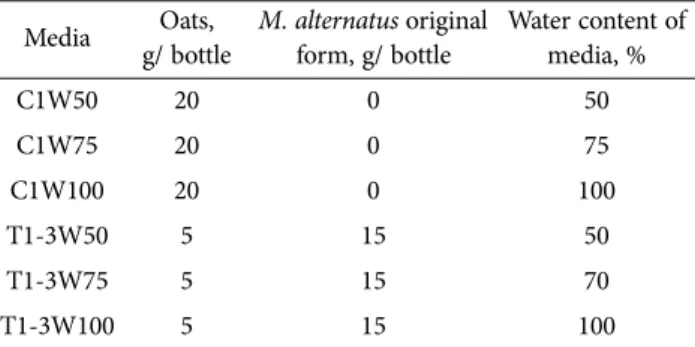
militaris fruiting body (Table 6). Unfortunately, no fruiting bodies were formed in the solid culture medium with 50% water content. However, when the effects of solid culture medium with 100% water content was compared, the cordycepin content of the fruiting body was found to be increased as the water content in the culture medium increased. Zadrail and Brunnert (1981) have reported that the changes in the substrate caused by the metabolic activities of the fungi were related to the water content of the substrate. In our study, the water content of the solid culture medium also influenced the cordycepin content of C. militaris. Accordingly, we performed response surface methodology (RSM) based on water content data to find the optimal culture conditions to increase the cordycepin content of fruiting bodies of C.
militaris using M. alternatus.
Table 5. Test groups according to the water content of M.
alternatus supplemented culture media for improved cordycepin content of fruiting bodies
Media Oats, g/ bottle
M. alternatus original form, g/ bottle
Water content of media, %
C1W50 20 0 50
C1W75 20 0 75
C1W100 20 0 100
T1-3W50 5 15 50
T1-3W75 5 15 70
T1-3W100 5 15 100
1) C1: only Oats, 50% water content; C2: only Oats, 75% water con- tent; C3: only Oats, 100% water content; T1: Oats +M. alternatus original form (1:3, w:w based on dry weight), 50% water content;
T2: Oats + M. alternatus original form (1:3, w:w based on dry weight), 75% water content; T3: Oats + M. alternatus original form (1:3, w:w based on dry weight), 100% water content
Table 6. Effect of water content of M. alternatus supplemented media on the cordycepin content of fruiting bodies during solid state fermentation
Media Fresh fruit bodies, g/bottle
Cordycepin content, μg/g
C1W50 Not primordium Not primordium
C1W75 Not primordium Not primordium
C1W100 19.6 ± 1.4c 0.6 ± 0.0c
T1-3W50 Not primordium Not primordium
T1-3W75 20.4 ± 5.1b 111.9 ± 0.0b
T1-3W100 55.0 ± 2.1a 135.6 ± 0.0a
1) C1: only Oats, 50% water content; C2: only Oats, 75% water con- tent; C3: only Oats, 100% water content; T1: Oats + M. alternatus original form (1:3, w:w based on dry weight), 50% water content;
T2: Oats + M. alternatus original form (1:3, w:w based on dry weight), 75% water content; T3: Oats + M. alternatus original form (1:3, w:w based on dry weight), 100% water content
Each value is expressed as mean ± SE (n = 5). Different superscripted letters represent statistically significant probability level at 5%.
Table 7. Results of three factor Box–Behnken experimental design
Run Coded Cordycepin
content, μg/g
X1 X2 X3 Y1
8 -1 -1 0 64.1
15 1 -1 0 81.5
11 -1 1 0 64.0
4 1 1 0 95.8
1 -1 0 -1 66.9
7 1 0 -1 100.2
3 -1 0 1 60.7
9 1 0 1 75.3
6 0 -1 -1 71.5
16 0 1 -1 72.6
10 0 -1 1 65.3
12 0 1 1 69.8
2 0 0 0 137.2
5 0 0 0 135.9
13 0 0 0 141.1
14 0 0 0 129.5
17 0 0 0 133.5
Independent variables Code
-1 0 1
X1: M. alternatus weight in media, g 10 15 20 X2: Water content of media, % 75 100 125
X3: Culture period, day 30 45 60
Optimization of screened variables using RSM (BBD) for improved cordycepin content of fruiting body
RSM analysis was performed to obtain the maximum fruiting body dry weight of C. militaris using our previous results. The BBD was used to optimize the levels of significant variables (M. alternatus weight in solid culture medium, water content of solid culture medium, and culture period). The actual values of the 17 BBD experiments are listed in Table 7.
Our analyses revealed that a second-order polynomial equation provided a mathematical model to describe the relationship between the variables and the response. The regression equation is expressed as follows:
Y1= 755.3-58.6625X1+4.79432E-14X2-46.6625X3- 5.66269E-14X1X2-0.025X1X3+1.62475E-14X2X3- 160.6625X12+0.0125X22-206.9625X32
where, Y represents the value of cordycepin content (μg/g), X1 is the M. alternatus weight in solid culture medium (g/bottle), X2 is the water content of the solid culture medium (%), and X3 is the culture period (day).
The ANOVA of the optimization indicated the response surface model terms, which are enlisted in Table 8. The coefficient of determination (R2) for the model was 0.9772, which could explain the 97.72% variability in the modeling data. The F-value of the model was 46.20, and the p value was < 0.0001, which indicates that the experimental data fit well with the quadratic model. The
regression coefficients F value, p value and standard error were summarized and selected for ANOVAs of the model to analyze the relationship between the cordycepin content and each variable (Table 8), indicating the variables of square interaction (A2, B2 and C2 source) were all significant on the cordycepin content.
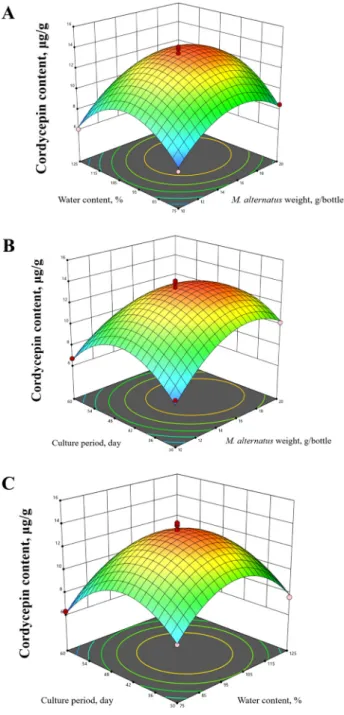
Three-dimensional response surface plots and corresponding contour plots were used to optimize the levels of all variables for cordycepin content in the C.
militaris fruiting body (Fig. 2). From the response surface plots and contour plots, the cordycepin content of the fruiting body was found to be highest in the tested range.
Based on the aforementioned equation and the response surface plots, the optimum levels of the three variables were as follows: the M. alternatus weight in solid culture medium and water content were 16.2% and 100.7% (20.14 mL water /20 g solid culture medium), respectively, and the culture period was 39 days. The maximum value of cordycepin content in the fruiting body, which could be obtained by the model, was 148.2127 μg/g. Accordingly, the final optimized medium contained 16.2 g/bottle M. alternatus weight in solid culture medium, 3.8 g oats, and 100% water content. In order to validate the predicted results of the statistical model, experiments using the optimized medium composition were conducted, which yielded a cordycepin content of 150.0 μg/g. This result thus, confirms the validity of the Table 8. ANOVA results of the fit model from Box-Behnken design
Source Sum of Squares Degrees of Freedom Mean Squares F-Value p-Value
Model 145.49 9 16.17 46.20 <0.0001 significant
A - X1 12.75 1 12.75 36.44 0.0005
B - X2 0.41 1 0.41 1.16 0.3177
C - X3 3.25 1 3.25 9.29 0.0186
AB 0.49 1 0.49 1.40 0.2753
AC 1.82 1 1.82 5.21 0.0565
BC 0.04 1 0.04 0.11 0.7452
A2 27.54 1 27.54 78.70 <0.0001
B2 45.37 1 45.37 129.65 <0.0001
C2 40.66 1 40.66 116.19 <0.0001
Residual 2.45 7 0.35
Lack of Fit 0.86 3 0.29 0.72 0.5909
Pure Error 1.59 4 0.40
Corrected Total Sum of Squares 147.94 16
model in simulating and predicting the value of cordycepin in the C. militaris fruiting body upon using the optimized growth media and conditions. Until recently, relatively low levels of cordycepin content have been produced in solid-state fermentation of Cordyceps sp.; 98.0 μg/g cordycepin content was
reported in solid-state fermentation (solid culture medium containing 15 g pupae) of Cordyceps (Kim et al., 2018). The maximum cordycepin content (150.0 μg/
g, actual value) of the fruiting body obtained in the present study is significantly higher than those reported previously. In conclusion, supplementation of M.
alternatus for improved cordycepin content in Cordyceps militaris is a promising alternative to wild and solid cultivation.
ACKNOWLEDGEMENTS
This study was carried out with the support of ‘R&D Program for Forest Science Technology (Project No.
"2020253B10-2021-0001")’ provided by Korea Forest Service (Korea Forestry Promotion Institute).
REFERENCES
Hawley SA, Ross FA, Russell FM, Atrih A, Lamont DJ, Hardie DG. 2020. Mechanism of activation of AMPK by cordycepin.
Cell Chem Biol 27(2): 214-222.
Khuntawee W, Amornloetwattana R, Vongsangnak W, Namdee K, Yata T, Karttunen M, Wong-ekkabut J. 2021. In silico and in vitro design of cordycepin encapsulation in liposomes for colon cancer treatment. RSC Adv 11(15): 8475-8484.
Kim BN, Kim JH, Ahn JY, Kim S, Cho BK, Kim YH, Min J. 2020.
A short review of the pinewood nematode, Bursaphelenchus xylophilus. Toxicol Environ Health Sci 12(4): 297-304.
Kim SY, Shrestha B, Sung GH, Han SK, Sung JM. 2018.
Optimum conditions for artificial fruiting body formation of Cordyceps cardinalis. Mycobiology 38(2): 133-136.
Kosaka H, Ogura N. 1990. Rearing of the Japanese pine sawyer, Monochamus alternatus (Coleoptera: Cerambycidae) on artificial diets. Appl Entomol Zool 25(4): 532-534.
Li X, Wang J, Zhang H, Xiao L, Lei Z, Kaul SC, Wadhwa R, Zhang Z. 2021. Low
dose of fluoride in the culture medium of Cordyceps militaris promotes its growth and enhances bioactives with antioxidant and anticancer properties. J Fungi 7(5): 342.
Liu Y, Xiao K, Wang Z, Wang S, Xu F. 2021. Comparison of metabolism substances in Cordyceps sinensis and Cordyceps militaris cultivated with tussah pupa based on LC‐MS. J Food Biochem 45(6): e13735.
López Rodríguez L, Burrola-Aguilar C. 2019. Parasite fungi of insects and other mushrooms: a functional food alternative.
Agro productividad 12(5): 57-62.
Park BT, Na KH, Jung EC, Park JW, Kim HH. 2009. Antifungal and anticancer activities of a protein from the mushroom Cordyceps militaris. Korean J Physiol Pharmacol 13(1): 49-54.
Park JP, Kim SW, Hwang HJ, Yun JW. 2001. Optimization of submerged culture conditions for the mycelial growth and exo‐biopolymer production by Cordyceps militaris. Lett Appl Microbiol 33(1): 76-81.
Quan X, Kwak BS, Lee JY, Park JH, Lee A, Kim TH, Park S. 2020.
Fig. 2. Regression analysis of the Box–Behnken design experiments.
A: response surface graphs for cordycepin content as a function of M. alternatus weight in media and water content of media; B: response surface graphs for cordycepin content as a function M. alternatus weight in media and culture period;
C: response surface graphs for cordycepin content as a function of water content of media and culture period.
Cordyceps militaris induces immunogenic cell death and enhances antitumor immunogenic response in breast cancer. Evid Based Complement Alternat Med 9053274: 1-11.
Raethong N, Wang H, Nielsen J, Vongsangnak W. 2020.
Optimizing cultivation of Cordyceps militaris for fast growth and cordycepin overproduction using rational design of synthetic media. Comput Struct Biotechnol J 18: 1-8.
Su C, Ji Y, Liu S, Gao S, Cao S, Xu X, Zhou C, Liu, Y. 2020.
Fluorescence-labeled abamectin nanopesticide for comprehensive control of pinewood nematode and Monochamus alternatus hope. ACS Sustain Chem Eng 8(44): 16555-16564.
Wen TC, Li GR, Kang JC, Kang C, Hyde KD. 2014. Optimization of solid-state fermentation for fruiting body growth and cordycepin production by Cordyceps militaris. Chiang Mai J Sci 41(4): 858-872.
Wösten HA. 2019. Filamentous fungi for the production of enzymes, chemicals and materials. Curr Opin Biotechnol 59:
65-70.
Wu XF, Zhang M, Bhandari B. 2019. A novel infrared freeze drying (IRFD) technology to lower the energy consumption and keep the quality of Cordyceps militaris. Innov Food Sci Emerg Technol 54: 34-42.
Xu L, Wang F, Zhang Z, Terry N. 2019. Optimization of polysaccharide production from Cordyceps militaris by solid- state fermentation on rice and its antioxidant activities. Foods 8(11): 590.
Yu XY, Zou Y, Zheng QW, Lu FX, Li DH, Guo LQ, Lin JF. 2021.
Physicochemical, functional and structural properties of the major protein fractions extracted from Cordyceps militaris fruit body. Food Res Int 142: 110211.
Zhang H, Deng L, Zhang Z, Guan Y, Li B, Yang J, Fan H, Yang G, Chen X, Zhang J, Xin X, Vriesekoop F. 2020. Enhanced cordycepin production in caterpillar medicinal mushroom, Cordyceps militaris (Ascomycetes), mutated by a multifunctional plasma mutagenesis system. Int J Med Mushrooms 22(12): 1147- 1159.
Zhang J, Jian T, Zhang Y, Zhang G, Ling J. 2021. Dynamic content changes of cordycepin and adenosine and transcriptome in Cordyceps kyushuensis Kob at different fermentation stages.
Bioprocess Biosyst Eng 44: 1-11.
Zhao X, Zhang G, Li C, Ling J. 2019. Cordycepin and pentostatin biosynthesis gene identified through transcriptome and proteomics analysis of Cordyceps kyushuensis Kob. Microbiol Res 218: 12-21.