http://dx.doi.org/10.12925/jkocs.2018.35.4.1327
국내 항공유(Jet A-1) 품질모니터링을 통한 물성 변화 특성 연구
도진우 * ․연주민․전화연․임의순․이정민․강형규 ✝
한국석유관리원 석유기술연구소
(2018년 12월 3일 접수: 2018년 12월 22일 수정: 2018년 12월 25일 채택)
Study on Characteristics of Change of Physical/Chemical Property in Domestic Aviation Fuel by the Quality Monitoring Analysis
Jin-woo Doe․Ju-min Youn․Hwa-yeon Jeon․Eui-soon Yim Joung-min Lee․Hyung-kyu Kang
✝
Research Institute of Petroleum Technology Korea Petroleum Quality & Distribution Authority
(Received December 3, 2018; Revised December 22, 2018; Accepted December 25, 2018)
요 약 : 항공유는 문제가 발생 시 대형사고로 이어질 수 있기 때문에 다른 수송용 연료보다 더 엄격히 관리되고 있다. 항공유의 품질기준은 국내의 한국산업표준(KS), 미국재료협회(ASTM)와 국제운송협회 (IATA)에서 각각 규정하고 있다. 2016년부터 2017년까지 국내 정유사의 5개 공장에서 생산되는 항공유에 대하여 방향족 함량, 황 함량 및 증류성상 등 6개 항목에 대하여 품질분석을 실시하였다. 국내에서 생산된 항공유는 품질기준에 적합한 것으로 나타났으며, 연간 일정하게 유지되고 있었다. 국제기준인 ASTM과 IATA의 품질기준과 비교했을 때, 방향족 함량은 국내 KS 기준이 ASTM 및 IATA 설정기준보다 1.5 wt%
엄격하게 설정되어 있으나 이 기준을 충분히 만족시키는 것으로 나타났다. 또한, 황 함량, 증류성상 및 인 화점 등 나머지 항목들도 국내와 국제기준을 모두 충족하는 것으로 나타났다.
주제어 : 항공유, 품질모니터링, 방향족 함량, 증류성상, 어는점
Abstract : Aviation fuel oil is more strictly controlled than other transport fuels because it can lead to major accidents in the event of a problem. The quality standards of the aircraft are specified by the domestic Korean Standard, the American Society for Testing and Materials and the International Air Transport Association, respectively. From 2016 to 2017, the quality analysis of 6 items such as aromatic content, sulfur content and distillation characteristics was carried out on the jet fuel produced at five domestic refineries. Domestic production of jet fuel has been shown to be in conformity with the quality standards and has been maintained at a constant level throughout the year. Compared with the specification of ASTM and IATA the aromatic content of domestic KS specification is set to be strictly 1.5 wt% higher than the ASTM and IATA setting specification, but
✝ Corresponding author
(E-mail: [email protected])
it satisfies this specification sufficiently. In addition, other items such as sulfur content, distillation property and flash point satisfied both domestic and international specification.
Keywords : Aviation fuel, Jet A-1, Quality monitoring, Aromatic content, Distillation
1. 서 론
비행체 추진기관의 연료로 사용되는 탄화수소 계열 연료는 액체상태의 연료가 지닌 열용량을 이용하여 기체 내부의 전자장비나 윤활계통 부품 등을 냉각하는데 널리 사용되어왔다[1][2]. 나로 호 이후 개발 중인 한국형 발사체는 연소기 및 엔진 개발 초기 러시아나 미국과 같이 로켓 엔진 용으로 고밀도 연료유를 개발하는 노력이 진행되 어 충분한 성과가 있었으나 양산에 따른 비용 증 가로 결국 상용의 항공유를 채택하였다[3]. 항공 기는 비행 중 연료에 의한 문제가 발생할 경우 즉각적인 대처가 어렵고 대형 사고로 이어지기 때문에 항공유의 품질은 수송용 연료보다 더 엄 격히 관리되고 있다. 국제적으로 제트 엔진이나 항공 터빈엔진을 장착한 민간 항공기의 연료로 사용되는 항공터빈유(Aviation turbine fuel, AVTUR)는 특정 지역을 제외하고는 대부분 Jet A-1 규격의 연료를 사용하고 있다[4]. 항공유의 대표적인 품질규격은 미국재료시험협회(American Society for Testing and Materials, ASTM)의 D1665, 「Standard Specification for Aviation Turbine Fuels」[5]과 국제항공운송협회 (International Air Transport Association, IATA) 에서 제정한 「Guidance Material for Aviation Turbine Fuels Specifications」에서 제시하고 있 다[6]. Jet A-1은 등유 기반의 항공유로 높은 고 도에서 고속으로 장거리 비행하는 항공기와 함께 열악한 외부 환경에 지속적으로 노출되기 때문에 다른 연료유 대비 더 많은 품질관리 기준이 있 다. 특히 항공유를 대량으로 사용하는 공항은 항 공유의 운송, 보관, 취급 및 급유 시 외부로부터 수분이나 이물질의 혼입 방지와 처리에 많은 시 설 투자와 노력을 기울이고 있다[4].
본 연구에서는 국내 4개 정유사의 5개 공장에 서 생산 및 유통되고 있는 항공유에 대해 약 1년 간 품질모니터링을 실시하여 항공유 품질 동향을 분석하고, 해외 항공기 품질기준과의 비교분석을
실시하였다.
2. 실 험
2.1. 실험대상 및 항공유(JetA-1) 물성 분석방법
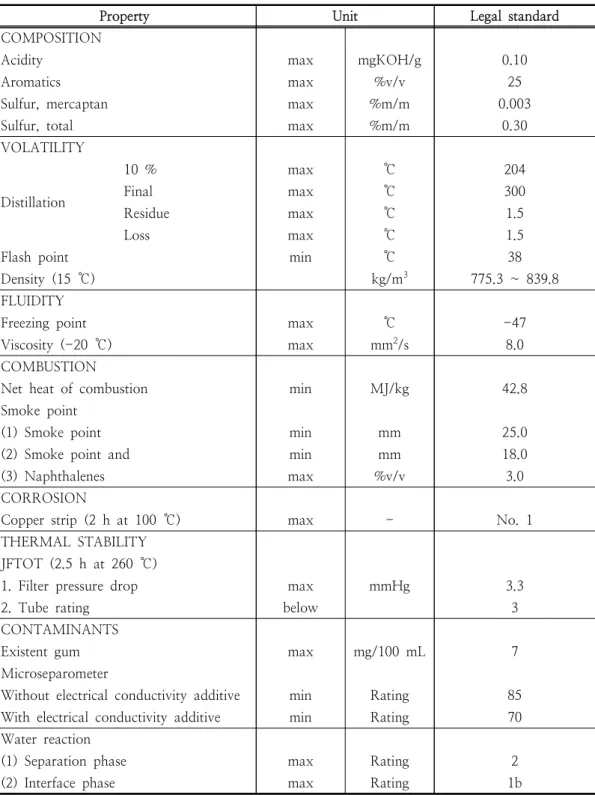
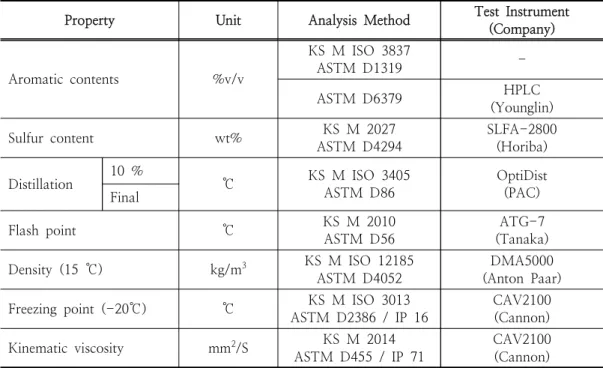
2016년부터 2017년까지 국내 정유사 5개 공장 에서 생산 및 유통되는 항공유(Jet A-1)를 금속 제 캔을 이용하여 채취하였다. 채취한 시료는 시 험분석 전에 상온의 냉암소 보관하였다. 국내에서 는 항공유를 한국산업표준(Korean Standard)에서 품질기준을 설정하고 있으며[7], 미국의 재료시험 협회인 ASTM(American Society for Testing and Materials) 규격에서 정하고 있는 품질기준 및 시험방법을 이용하여 항공유의 방향족 함량, 황 함량 및 증류성상 등 총 6가지 항목에 대하여 분석하였다. 항공유의 국내 품질기준은 Table 1 에, 각 항목별 분석법과 장비는 Table 2에 나타 내었다.
3. 결과 및 고찰
3.1. 국내 항공유(Jet A-1)의 품질기준 및 물성 변화 추이 분석
3.1.1. 방향족 함량(Aromatic contents) 시료의 방향족 함량은 ASTM D6379 시험방법 을 사용하였으며[8], RI(Refractive Index) 검출기 가 장착된 고성능 액체 크로마토그래피(High Performance Liquid Chromatography) 시험기기 를 이용하여 분석하였다. 고함량 방향족 탄화수소 는 탄소나 soot 퇴적물 형성 및 스모크 발생에 직접적으로 관여하고, 연료시스템 내 고무재질 (elastomer)의 팽윤에 영향을 미칠 수 있다. 또한, 방향족 함량이 높으면 코킹(coaking)을 유발할 수 있다. Table 3은 2016 ~ 2017년까지 국내에
Property Unit Legal standard COMPOSITION
Acidity max mgKOH/g 0.10
Aromatics max %v/v 25
Sulfur, mercaptan max %m/m 0.003
Sulfur, total max %m/m 0.30
VOLATILITY
Distillation
10 % max ℃ 204
Final max ℃ 300
Residue max ℃ 1.5
Loss max ℃ 1.5
Flash point min ℃ 38
Density (15 ℃) kg/m
3
775.3 ~ 839.8FLUIDITY
Freezing point max ℃ -47
Viscosity (-20 ℃) max mm
2
/s 8.0COMBUSTION
Net heat of combustion min MJ/kg 42.8
Smoke point
(1) Smoke point min mm 25.0
(2) Smoke point and min mm 18.0
(3) Naphthalenes max %v/v 3.0
CORROSION
Copper strip (2 h at 100 ℃) max - No. 1
THERMAL STABILITY JFTOT (2.5 h at 260 ℃)
1. Filter pressure drop max mmHg 3.3
2. Tube rating below 3
CONTAMINANTS
Existent gum max mg/100 mL 7
Microseparometer
Without electrical conductivity additive min Rating 85 With electrical conductivity additive min Rating 70 Water reaction
(1) Separation phase max Rating 2
(2) Interface phase max Rating 1b
Table 1. Quality specification of aviation fuel(Jet A-1) in Korea Standard(KS M 2608)
Table 2. Test methods and equipment criteria for analyzing the aviation fuel(Jet A-1) Property Unit Analysis Method Test Instrument
(Company)
Aromatic contents %v/v
KS M ISO 3837
ASTM D1319 -
ASTM D6379 HPLC
(Younglin)
Sulfur content wt% KS M 2027
ASTM D4294 SLFA-2800
(Horiba) Distillation 10 %
℃ KS M ISO 3405
ASTM D86 OptiDist
(PAC) Final
Flash point ℃ KS M 2010
ASTM D56 ATG-7
(Tanaka) Density (15 ℃) kg/m
3
KS M ISO 12185ASTM D4052 DMA5000
(Anton Paar) Freezing point (-20℃) ℃ KS M ISO 3013
ASTM D2386 / IP 16 CAV2100 (Cannon) Kinematic viscosity mm
2
/S KS M 2014ASTM D455 / IP 71 CAV2100 (Cannon)
Periods Company
A B C D E
2016
Winter 22.37 20.09 21.86 20.55 20.83
Spring 22.63 18.63 19.35 20.20 18.73
Summer 20.37 20.63 20.51 18.09 20.17
Autumn 20.68 19.05 21.03 16.85 20.33
2017
Winter 19.36 18.68 21.42 18.84 20.10
Spring 21.03 17.90 20.10 16.62. 19.62
Summer 19.03 17.94 19.55 16.81 18.49
Autumn 19.83 18.30 19.85 17.52 18.81
Table 3. Results of aromatic contents analysis in aviation fuel(Jet A-1) by domestic refineries
서 생산된 항공유의 방향족 함량 분석결과를 나 타내었다. 대부분의 공장에서 연간 일정한 함량을 유지하는 것으로, 최대 22.63에서 최소 16.62 wt% 함량을 나타내었다.
3.1.2. 황 함량(Sulfur contents)
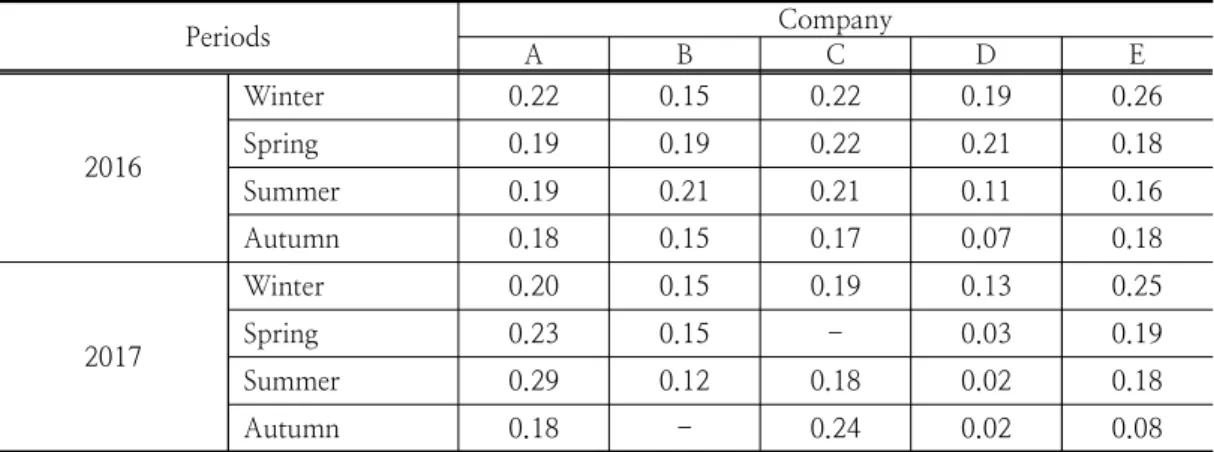
황은 연소과정에서 산소와 결합하여 황산화물 (SOx)을 생성하고 터빈 금속부의 부식을 유발할 수 있다. 시료의 황 함량은 ASTM D4294 시험
방법을 사용하였으며[9], 석유계 연료유 중의 황 성분은 재생냉각 로켓엔진 연소기의 냉각채널에 서 내벽의 주성분에 해당하는 구리(Cu)와 반응하 여 침착물을 생성하는 코킹 현상을 발생시키는 것으로 알려져 있다[10]. Table 4는 2016 ~ 2017년까지 국내에서 생산된 항공유의 황 함량 분석결과를 나타내었다. 대부분의 공장에서 연간 일정한 함량을 유지하는 것으로 나타났다.
Periods Company
A B C D E
2016
Winter 0.22 0.15 0.22 0.19 0.26
Spring 0.19 0.19 0.22 0.21 0.18
Summer 0.19 0.21 0.21 0.11 0.16
Autumn 0.18 0.15 0.17 0.07 0.18
2017
Winter 0.20 0.15 0.19 0.13 0.25
Spring 0.23 0.15 - 0.03 0.19
Summer 0.29 0.12 0.18 0.02 0.18
Autumn 0.18 - 0.24 0.02 0.08
Table 4. Results of sulfur contents analysis in aviation fuel(Jet A-1) by domestic refineries
Periods Company
A B C D E
2016
Winter 167.4 165.3 166.9 169.6 166.4
Spring 168.3 164.3 166.4 166.9 167.2
Summer 166.7 162.1 164.9 166.0 166.6
Autumn 166.5 162.8 165.4 168.5 165.5
2017
Winter 164.7 162.8 164.9 165.3 165.7
Spring 169.2 164.2 - 164.2 169.7
Summer 167.3 164.6 167.7 161.6 166.2
Autumn 167.4 - 165.8 - 168.6
Table 5. Results of the distillation analysis(10 %) in aviation fuel(Jet A-1) by domestic refineries 3.1.3. 증류성상(Distillation)
시료의 증류성상 분석은 ASTM D86 시험방법 을 사용하였으며[11], 항공유의 비점 범위(150 ~ 270 ℃)를 측정하는 항목으로 연료의 휘발성은 증류에 의해 결정된다. 또한, 10 % 유출온도는 기기의 초기 시동성과 관련이 있고 90 % 유출온 도가 너무 높으면 완전연소에 부적합한 고비점 유분이 남아 탄화물의 부착이 일어나고, 너무 낮 으면 발열량이 감소하여 단위 시간당 연료 소비 량이 증가한다[12]. 종말점은 증발되기 어려운 고 비점 유분의 함량과 관련이 있다. Table 5와 Table 6은 2016 ~ 2017년까지 국내에서 생산된 항공유의 증류성상(10 %, 종말점) 분석결과를 나 타내었다. 대부분의 공장에서 연간 매우 일정한 함량을 유지하는 것으로 나타났다.
3.1.4. 인화점(Flash point)
시료의 인화점 분석은 ASTM D56 시험방법을 사용하였으며[13], 항공연료의 취급 및 저장성과 관련된 항목으로 휘발성 및 연소성에 영향을 미 친다. Table 7는 2016 ~ 2017년까지 국내에서 생산된 항공유의 인화점 분석결과를 나타내었다.
대부분의 공장에서 기준인 38 ℃이상에서 연간 일정한 함량을 유지하는 것으로 나타났다.
3.1.5. 밀도(Density)
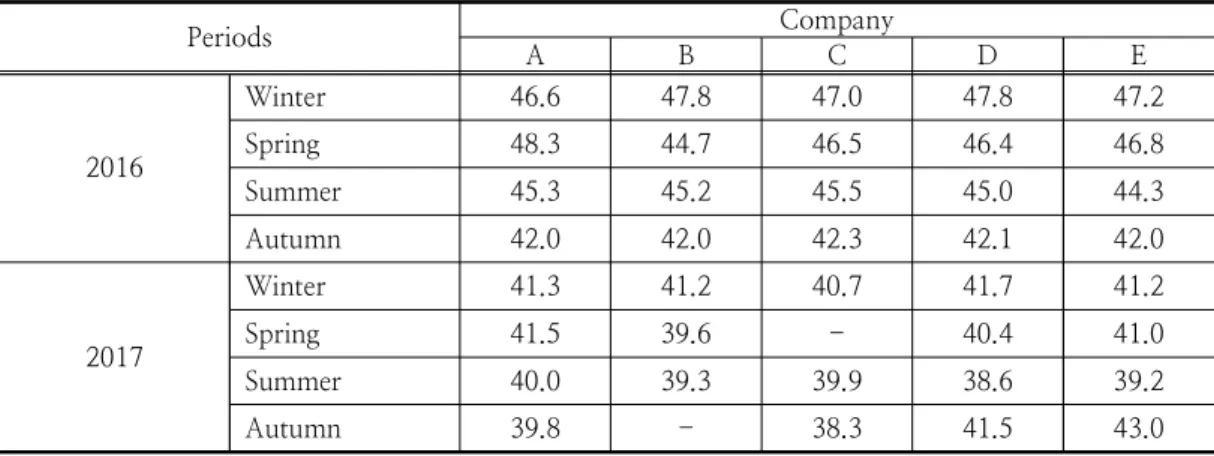
시료의 밀도 분석은 ASTM D4052 시험방법을 사용하였으며[14], 밀도는 온도의 함수이므로, 온 도가 상승하면 연료의 밀도는 감소한다. 연료의 경우에서도 밀도 변화는 연료 충전 무게와 충전 가능량을 결정하는 인자이다. 또한 밀도는 비에너 지(Specific energy) 및 참발열량과 관련이 있어 대개 밀도가 낮으면 단위부피당 발열량도 작다
Periods Company
A B C D E
2016
Winter 253.5 262.0 260.5 262.0 257.3
Spring 250.7 259.2 261.2 263.7 259.0
Summer 256.7 257.9 257.9 260.1 255.3
Autumn 258.4 259.6 261.8 261.4 256.0
2017
Winter 255.1 257.5 258.7 259.2 255.2
Spring 258.8 265.1 - 261.6 260.4
Summer 260.8 265.3 265.7 259.6 254.4
Autumn 259.0 261.0 - 252.0
Table 6. Results of the distillation analysis(final) in aviation fuel(Jet A-1) by domestic refineries
Table 7. Results of the flash point analysis in aviation fuel(Jet A-1) by domestic refineries
Periods Company
A B C D E
2016
Winter 46.6 47.8 47.0 47.8 47.2
Spring 48.3 44.7 46.5 46.4 46.8
Summer 45.3 45.2 45.5 45.0 44.3
Autumn 42.0 42.0 42.3 42.1 42.0
2017
Winter 41.3 41.2 40.7 41.7 41.2
Spring 41.5 39.6 - 40.4 41.0
Summer 40.0 39.3 39.9 38.6 39.2
Autumn 39.8 - 38.3 41.5 43.0
[12]. Table 8는 2016 ~ 2017년까지 국내에서 생산된 항공유의 인화점 분석결과를 나타내었다.
대부분의 공장에서 연간 일정한 함량을 유지하는 것으로 나타났다.
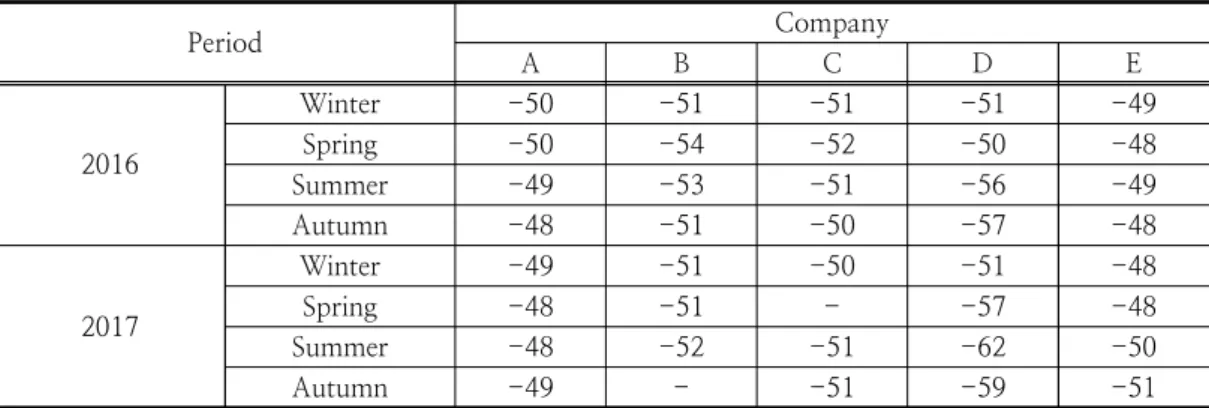
3.1.6. 어는점(Freezing point)
시료의 어는점 분석은 ASTM D4052 시험방법 을 사용하였으며[15], 항공유는 고고도의 온도에 서 필터를 통과한 연료의 흐름이 방해 받지 않도 록 충분히 낮은 어는점이 필요하다. 비행 도중 최저 온도는 외부 공기온도, 비행 기간 및 항공 기 속도에 의존한다. 항공기 연료탱크의 연료 온 도는 외부 온도가 낮아짐에 따라 낮아진다. 저온 에서 결정화되는 분자량이 큰 탄화수소는 어는점 에 영향을 미치므로 제한된다. 항공유 중 고분자 량의 탄화수소는 비행 도중 저온에서 펌프 작동
에 영향을 미친다. Table 9는 2016 ~ 2017년까 지 국내에서 생산된 항공유의 인화점 분석결과를 나타내었다. 대부분의 공장에서 연간 일정한 함량 을 유지하는 것으로 나타났다.
3.2. 국내 항공유(JET A-1)의 연간 품질변화와 미국재료협회(ASTM) 및 국제항공운송협 회(IATA) 품질기준과의 비교 분석
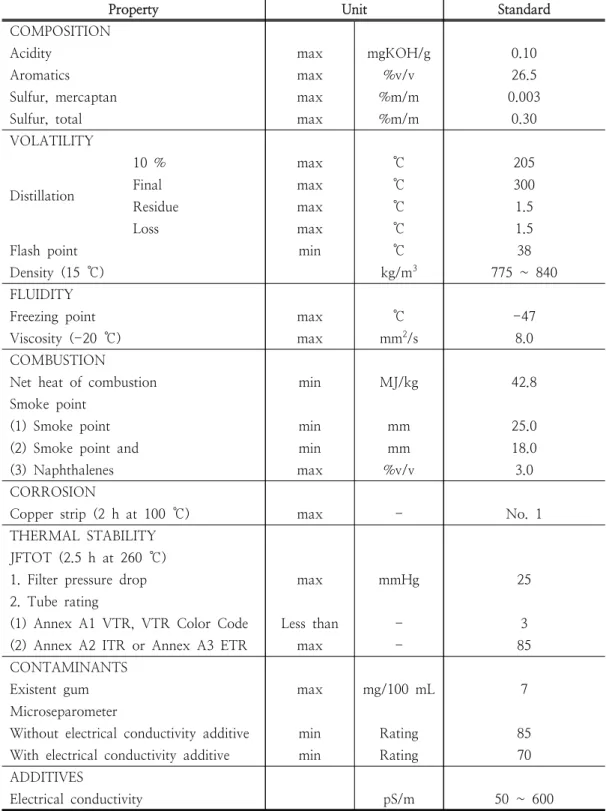
항공유는 주로 ASTM 및 IATA와 같은 민간 기구에서 품질기준을 제시하고 있다. 따라서 본 연구에서는 국내 항공유의 연간 품질모니터링 결 과를 바탕으로 국제적으로 통용되고 있는 ASTM (미국재료협회)과 IATA(국제항공운송협회)에서 규정하고 있는 품질기준과 비교분석을 실시하였 다. Table 10과 Table 11는 ASTM과 IATA에서 규정하고 있는 항공유의 품질기준을 나타내었다.
Table 8. Results of the density analysis in aviation fuel(Jet A-1) by domestic refineries
Periods Company
A B C D E
2016
Winter 795 798 795 792 795
Spring 794 794 795 793 791
Summer 795 791 793 795 793
Autumn 795 793 793 794 792
2017
Winter 792 792 793 791 792
Spring 795 792 - 790 792
Summer 795 791 795 791 793
Autumn 792 - 793 793 788
Table 9. Results of the freezing point analysis in aviation fuel(Jet A-1) by domestic refineries
Period Company
A B C D E
2016
Winter -50 -51 -51 -51 -49
Spring -50 -54 -52 -50 -48
Summer -49 -53 -51 -56 -49
Autumn -48 -51 -50 -57 -48
2017
Winter -49 -51 -50 -51 -48
Spring -48 -51 - -57 -48
Summer -48 -52 -51 -62 -50
Autumn -49 - -51 -59 -51
Fig. 1.은 항공유 내 방향족 함량에 대하여 KS, ASTM 및 IATA 기준과의 비교결과를 나타내었 다. ASTM 및 IATA와 비교하여 국내의 기준이 1.5 (wt%) 정도 낮은 기준으로 설정되어 있으며 실제 항공유 제품은 그 보다 더 낮은 함량을 유 지하고 있다.
0.0 5.0 10.0 15.0 20.0 25.0 30.0
2016 winter
2016 spring
2016 summer
2016 autumn
2017 winter
2017 spring
2017 summer
2017 autumn
C o n te n ts o f A ro m at ic ( % v/ v)
A B C D E
KS ASTM, IATA
Fig. 1. Results of aromatic content analysis of aviation fuel(Jet A-1) according to the domestic refineries.
Fig. 2., Fig. 3. 및 Fig. 4.는 항공유 내 황 함 량, 증류성상 10 % 유출온도 및 종말점 유출온 도에 대하여 KS, ASTM 및 IATA 기준과의 비교 결과를 나타내었다. ASTM, IATA과 KS 모두 동 일한 기준을 설정하고 있으며 실제 국내 5개 공 장에서 생산된 항공유 제품은 그 보다 더 낮은 함량을 유지하고 있다.
0.00 0.05 0.10 0.15 0.20 0.25 0.30 0.35 0.40
2016 winter
2016 spring
2016 summer
2016 autumn
2017 winter
2017 spring
2017 summer
2017 autumn
C o n te n ts o f S u lf u r (w t% )
A B C D E
KS, ASTM, IATA
Fig. 2. Results of sulfur content analysis of aviation fuel(Jet A-1) according to the domestic refineries.
Property Unit Standard COMPOSITION
Acidity max mgKOH/g 0.10
Aromatics max %v/v 26.5
Sulfur, mercaptan max %m/m 0.003
Sulfur, total max %m/m 0.30
VOLATILITY
Distillation
10 % max ℃ 205
Final max ℃ 300
Residue max ℃ 1.5
Loss max ℃ 1.5
Flash point min ℃ 38
Density (15 ℃) kg/m
3
775 ~ 840FLUIDITY
Freezing point max ℃ -47
Viscosity (-20 ℃) max mm
2
/s 8.0COMBUSTION
Net heat of combustion min MJ/kg 42.8
Smoke point
(1) Smoke point min mm 25.0
(2) Smoke point and min mm 18.0
(3) Naphthalenes max %v/v 3.0
CORROSION
Copper strip (2 h at 100 ℃) max - No. 1
THERMAL STABILITY JFTOT (2.5 h at 260 ℃)
1. Filter pressure drop max mmHg 25
2. Tube rating
(1) Annex A1 VTR, VTR Color Code Less than - 3 (2) Annex A2 ITR or Annex A3 ETR max - 85 CONTAMINANTS
Existent gum max mg/100 mL 7
Microseparometer
Without electrical conductivity additive min Rating 85 With electrical conductivity additive min Rating 70 ADDITIVES
Electrical conductivity pS/m 50 ~ 600
Table 10. Quality specification of aviation fuel(Jet A-1) in ASTM(D1655)
Property Unit Standard COMPOSITION
Acidity max mgKOH/g 0.015
Aromatics max %v/v 26.5
Sulfur, mercaptan max %m/m 0.0030
Sulfur, total max %m/m 0.30
VOLATILITY
Distillation 10 % max ℃ 205.0
Final max ℃ 300.0
Residue max ℃ 1.5
Loss max ℃ 1.5
Flash point min ℃ 38.0
Density (15 ℃) kg/m
3
775.0 ~ 840.0FLUIDITY
Freezing point max ℃ -47
Viscosity (-20 ℃) max mm
2
/s 8.000COMBUSTION
Net heat of combustion min MJ/kg 42.8
Smoke point
(1) Smoke point min mm 25.0
(2) Smoke point and min mm 18
(3) Naphthalenes max %v/v 3.00
CORROSION
Copper strip (2 h at 100 ℃) max - No. 1
THERMAL STABILITY JFTOT (2.5 h at 260 ℃)
1. Filter pressure drop max mmHg 25
2. Tube rating
(1) Annex A1 VTR, VTR Color Code Less than - 3 (2) Annex A2 ITR or Annex A3 ETR max -
CONTAMINANTS
Existent gum max mg/100 mL 7
Microseparometer
Without electrical conductivity additive min Rating 85 With electrical conductivity additive min Rating 70 ADDITIVES
Electrical conductivity pS/m 50 ~ 600
Table 11. Quality specification of aviation fuel(Jet A-1) in IATA
150.0 160.0 170.0 180.0 190.0 200.0 210.0
2016 winter
2016 spring
2016 summer
2016 autumn
2017 winter
2017 spring
2017 summer
2017 autumn
D eg re e of 1 0 % D is ti lla ti o n ( ℃)
A B C D E
KS, ASTM, IATA
Fig. 3. Results of distillation(10 %) analysis of aviation fuel(Jet A-1) according to the domestic refineries.
230.0 240.0 250.0 260.0 270.0 280.0 290.0 300.0 310.0
2016 winter
2016 spring
2016 summer
2016 autumn
2017 winter
2017 spring
2017 summer
2017 autumn
D eg re e o f Fi n al D is ti lla ti o n ( ℃)
A B C D E
KS, ASTM, IATA
Fig. 4. Results of distillation(final point) analysis of aviation fuel(Jet A-1) according to the domestic refineries.
Fig. 5.는 항공유 내 인화점에 대하여 KS, ASTM 및 IATA 기준과의 비교결과를 나타내었 다. ASTM, IATA과 KS 모두 동일한 기준을 설 정하고 있으며 실제 국내 5개 공장에서 생산된 항공유 제품은 최저 기준이상으로 유지하고 있으 나 연간 10 ℃ 내외에서 변화를 나타내었다.
0.0 10.0 20.0 30.0 40.0 50.0 60.0
2016 winter
2016 spring
2016 summer
2016 autumn
2017 winter
2017 spring
2017 summer
2017 autumn
Fl as h p o in t (℃)
A B C D E
KS, ASTM, IATA
Fig. 5. Results of flash point analysis of aviation fuel(Jet A-1) according to the domestic refineries.
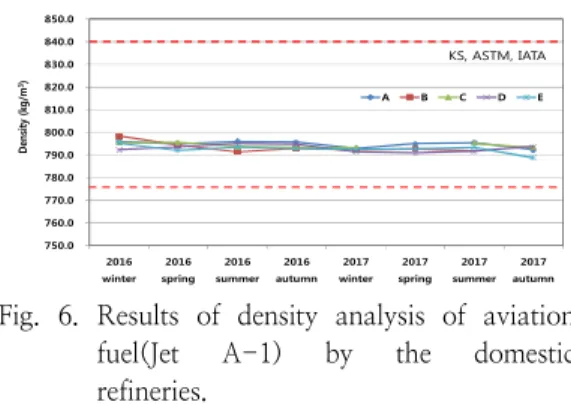
Fig. 6.은 항공유 내 밀도에 대하여 KS, ASTM
및 IATA 기준과의 비교결과를 나타내었다.
ASTM, IATA과 KS 모두 동일한 기준을 설정 (775 ~ 840 ℃)하고 있으며 실제 국내 5개 공장 에서 생산된 항공유 제품은 최대 및 최소값 사이 에서 연간 일정하게 유지하고 있다.
750.0 760.0 770.0 780.0 790.0 800.0 810.0 820.0 830.0 840.0 850.0
2016 winter
2016 spring
2016 summer
2016 autumn
2017 winter
2017 spring
2017 summer
2017 autumn
D en si ty ( kg /m
3)
A B C D E
KS, ASTM, IATA
Fig. 6. Results of density analysis of aviation fuel(Jet A-1) by the domestic refineries.
Fig. 7.은 항공유 내 어는점에 대하여 KS, ASTM 및 IATA 기준과의 비교결과를 나타내었 다. ASTM, IATA과 KS 모두 동일한 기준을 설 정(-47 ℃)하고 있으며 실제 국내 5개 공장에서 생산된 항공유 제품은 그 보다 더 낮은 값을 연 간 비교적 일정하게 유지하고 있다.
-80.0 -70.0 -60.0 -50.0 -40.0 -30.0 -20.0 -10.0
0.0 2016 winter
2016 spring
2016 summer
2016 autumn
2017 winter
2017 spring
2017 summer
2017 autumn
Fr ee zi n g p o in t (℃)
A B C D E
KS, ASTM, IATA
Fig. 7. Results of freezing point analysis of aviation fuel(Jet A-1) by the domestic refineries.
4. 결 론
본 연구에서는 2016년부터 2017년까지 국내에 서 생산된 항공유에 대해 방향족 및 황 함량 등 총 6 가지 항목에 대하여 품질모니터링 분석을
실시하고 한국산업표준(KS), 미국재료협회
(ASTM) 및 국제항공운송협회(IATA)에서 규정하 고 있는 항공유 품질기준과의 비교 분석을 실시 하였다.
1. 국내 정유사의 5개 공장에서 생산된 제품들 은 각 분석 항목별로 연간 일정한 품질을 유지하는 것으로 나타났다.
2. 또한, 한국산업표준(KS), 미국재료협회 (ASTM) 및 국제항공운송협회(IATA)에서 규정하고 있는 품질기준과의 비교에서도 대 부분의 항목은 기준을 충분히 충족하였으며, 방향족 함량의 경우 국내 품질기준이 해외 에 비해 다소 낮게 설정되어 있고 실제 제 품도 기준에 만족하였다.
본 연구는 국내에서 생산 및 유통되는 항공유 에 대하여 일부 항목에 대한 연간 품질모니터링 결과로, 보다 많은 항목에 대한 장기적인 실측 데이터를 통한 항공유 특성 변화를 관찰할 필요 가 있다.
References
1. H. Choi, H. J. Lee, K. Y. Hwang, D. C.
Park, “A Testing on Injection and Combustion Characteristics of Aviation Fuel at High Temperature”,
The Korean Society of Propulsion Engineers Spring Conference
, pp. 705-710, (2016).2. T. Edwards, “UASF supercritical hydrocarbon fuels interests”, AIAA-93- 0807, (1993).
3. S. L. Kim, J. M. Youn, I. H. Hwang, Y.
M. Han, “An Comparison of Physical and Chemical Characteristics of Aviation and Rocket Fuels using their Specifications”,
KSPE(The Korean Society of Propulsion Engineers) Fall Conference
, pp. 1250- 1255, (2016).4. J. M. Youn, J. W. Doh, I. H. Hwang, S.
L. Kim and Y. Kang, “Determination of Fatty Acid Methyl Esters (FAME) Content in Aviation Turbine Fuel using Multi-Dimensional GC-MS”,
Journal of Oil & Applied Science,
Vol.34, No.4 pp.717-726, (2017).
5. ASTM D1655, “Standard Specification for Aviation Turbine Fuels”,
ASTM
International,
(2015).6. IATA, “Guidance Material for Aviation Turbine Fuels Specifications”,
International Air Transport Association,
8th
Ed., Montreal, CANADA, June (2017).7. KS M 2608, “Aviation Turbine Fuels”,
Korea Standard,
(2010).8. ASTM D6379, “Standard Test Method for Determination of Aromatic Hydrocarbon Types in Aviation Fuels and Petroleum Distillates – High Performance Liquid Chromatography Method with Refractive Index Detection”,
ASTM International,
(2011).9. ASTM D4294, “Standard Test Method for Sulfur in Petroleum and Petroleum Products by Energy Dispersive X-ray Fluorescence Spectrometry”,
ASTM International,
(2016).10. B. Lim, K. J. Lee, J. G. Kim, S. H. Yang, H. T. Kim, D. H. Kang, H. J. Kim, Y.
M. Han, H. S. Choi, “Hydrocarbon Fuel Heating Experiments Simulating Regeneratively Cooled Channels of LRE Combustor”,
Journa
lof Korean Society of Propulsion Engineers
, Vol.11, No.5, pp.79-84, (2007).
11. ASTM D86, “Standard Test Method for Distillation of Petroleum Products and Liquid Fuels at Atmospheric Pressure”,
ASTM International,
(2017).12. CRC Report No. 663, “Handbook of Aviation Fuel Properties”,
Coordinating Research Council(CRC),
4th
ED., USA, (2014).13. ASTM D56, “Standard Test Method for Flash Point by Tag Closed Cup Tester”,
ASTM International,
(2016).14. ASTM D4052, “Standard Test Method for Density, Relative Density, and API Gravity of Liquids by Digital Density Meter”,
ASTM International,
(2016).15. ASTM D2386, “Standard Test Method for Freezing Point of Aviation Fuels”,