The Influence of Convergence Characteristics of Social Economy Internet Shopping Malls on Customer Trust and Loyalty
Eun-Jeong Kim1*, Yen-Yoo You2
1Ph.D. Candidate, Dept. of Knowledge Service & Consulting, Hansung University, Seoul, Korea
2Professor, Dept. of Knowledge Service & Consulting, Hansung University, Seoul, Korea
사회적경제 인터넷 쇼핑몰의 융합 특성이 고객 신뢰도, 충성도에 미치는 영향
김은정1*, 유연우2
1한성대학교 지식서비스&컨설팅학과 박사과정, 2한성대학교 지식서비스&컨설팅학과 교수
Abstract Korea's social economy promotion policy is a government-led policy, and its success or failure depends on how well it is known to the residents. The Jeonnam Social Economy Internet Shopping Mall was also established as a government-led road, but its popularity is low. This study examines the influence between reliability and loyalty of the'Jeonnam Social Economy Shopping Mall'. 267 samples were used and verified with the SPSS 22.0 program. As a result of the study, the characteristics of shopping malls had a significant effect on customer trust and loyalty, and played a mediating role between reliability and loyalty. The residential area and the purpose of purchase had a moderating effect. The limitation of research is that comparative research with other shopping malls is insufficient.
In the future, comparative evaluation should be carried out in relation to research on social economy enterprise products by region.
Key Words : Social economy, internet shopping mall, trust, loyalty, convergence characteristics
요 약 한국의 사회적경제 육성정책은 관주도 정책이며, 이것은 얼마만큼 주민들에게 알려졌냐에 따라 성패가 좌우된 다. 전남사회적경제 인터넷쇼핑몰도 관주도로 성립됐으나, 인지도가 낮은 편이다. 본 연구는 전국 최초 사회적경제 인 터넷 쇼핑몰인 ‘전남사회적경제쇼핑몰’의 고객신뢰도와 충성도간의 영향을 알아보고, 대중적 홍보방향에 대해 살펴본 다. 사회적 경제 인터넷 쇼핑몰 회원 267개 표본을 활용하여 SPSS 22.0 프로그램으로 검증했다. 연구결과, 쇼핑몰 특성은 고객 신뢰도와 충성도에 유의한 영향을 미쳤고, 신뢰도와 충성도간에 매개역할을 수행하였다. 거주지역, 구매목 적은 쇼핑몰특성, 신뢰도, 충성도간에 조절효과를 가졌다. 전남 사회적경제 쇼핑몰만을 대상으로 했으므로, 타 쇼핑몰 과의 비교연구가 부족하다는 연구한계가 있다. 향후 지역별 사회적경제 기업제품 연구와 관련하여 비교평가가 이뤄져 야 할 것이다.
주제어 : 사회적경제, 인터넷쇼핑몰, 신뢰도, 충성도, 융합 특성
*This study was financially supported by Hansung University
*Corresponding Author : Eun-Jeong Kim([email protected]) Received March 30, 2021
Accepted June 20, 2021 Revised May 11, 2021
Published June 28, 2021
1. Introduction
Since the first use of the term “social economy”
by the French economist Charles Dunois in 1830, social economy has been regarded as an alternative system for solving ethical and social problems under the capitalist system. It was recognized legally and institutionally in the late 19th century [1,2].
In Korea, a'social economy' system was established by enacting the Social Enterprise Act in 2007, fostering village businesses in 2010, and enacting the Basic Act on Cooperatives in 2012 [3].
Korea's social economy (social enterprise, village enterprise, cooperative, independent enterprise) is close to a government-led policy delivered to residents through the government's active fostering policy. The success or failure of these government-led policies depends on how well known it is to the people. No matter how good a policy is, it will be difficult to achieve the policy goals unless it is seen as an improvement in the level of awareness of the social economy [4].
Jeollanam-do has been running an internet shopping mall since 2013 to promote and sell products of social economy companies in Jeollanam-do. This is meaningful in that it is the first internet shopping mall dedicated to products of social economy enterprises led by large local governments in Korea.
Internet shopping malls are popularized and generalized, and can increase the purchasing power of online-preferred consumers, and are effective for promotion/marketing.
However, there are many Internet shopping malls for individual social economy companies, such as social enterprises and village companies, but the Internet shopping malls that integrate social economy companies are'Jeonnam Social Economy Shopping Mall (https://greenanum.co.kr) and Seoul Social Economy Shopping Mall.
The Jeonnam Social Economy Internet
shopping mall has been in operation for 8 years since 2013, and is managed by a shopping mall operator. However, the recognition of the site itself and the sales of the companies that have entered the store are low.
As of June 2020, 175 social economy enterprises in Jeollanam-do have entered stores, and a total of 349 items are being sold. The number of members on the site is 3,691, with an average of 285 visitors per day. The main items are 7 items, including processed agricultural and fishery foods, and the average annual sales for the last five years(2015~2019) have remained at around 28 million won.
The ‘Jeonnam Social Economy Internet Shopping Mall’ attempted to make changes such as renovating its homepage design in 2018. Since then, it is working to increase new members and increase sales by attracting new corporate members, providing mileage, and coupons.
This study aims to analyze the effect of the characteristics of social economy internet shopping malls on customer trust and loyalty. In fact, I would like to think about ways to increase customer awareness in the future by analyzing the effects of the characteristics of the Jeonnam social economy shopping mall, customer trust and loyalty.
Unlike the previous studies on social economy enterprise products, most of the studies on offline store customers, this study is differentiated in that it targets customers of social economy internet integrated shopping malls.
2. Theoretical background
2.1. Social economySocial economy is defined as 'all economic activities in the private sector that create social value through the production and sale of goods and services based on cooperation and self-help
among members'.
Kim & Ko (2019) analyzed that although Korea is making policy efforts to revitalize the social economy, it is still insufficient, and the perception of Korean consumers about the social economy is quite low [5].
However, it was found that consumers who experienced social economic enterprise products had a high intention to purchase the product in the future. The higher the satisfaction with the product, the higher the consumer's willingness to pay in the future (for the product of a social economy company), according to the research results [5].
On the other hand, Kang & Lee (2019) analyzed that the level of social economy awareness in local communities was generally higher, and the higher the understanding of value consumption, the higher the participation rate in the social economy. Many of the experiences of purchasing social economy products were found to be at a low level, but the purchase intention was high [6].
Park (2019) stated that the pro-social behavior of consumers in social economy organizations has a positive effect on repurchase and promotes ethical consumption. He also analyzed that pro-social behavior mediates ethical consumption and influences repurchase intentions [7].
2.2 Internet shopping mall characteristics Lyu (2019) stated that the digitality of information, high security, freedom of time and place, convenience of transaction cost, and a drop in shopping experience as the characteristics of internet shopping malls [8].
Zeithaml and Bitner (2002) pointed out that when evaluating service quality, quality is a major factor in customer satisfaction from a service point of view, and product quality and price are also important factors in customer satisfaction [9]. Bitner (1995) argued that the perceived quality of products and services in
internet shopping malls positively influences the purchase satisfaction and purchase intention of consumers [10].
Yoon (2019) considered ubiquity, convenience, customization, instant access, and security as factors as the service characteristics of mobile shopping malls [11]. Ju&Choi (2018) analyzed product quality, product price, and product diversity as factors of product characteristics, and these characteristics all have an effect on purchase satisfaction [12].
In this study, based on previous studies, the characteristics of Internet shopping malls were divided into service characteristics and product characteristics [8,11,12,13].
2.3 Trust
Jarvenpaa et al. (1999) proved that the trust of internet shopping malls has an effect on internet purchase intention and perceived risk reduction in previous studies [14]. Lee (2016) analyzed that factors such as customized service, design, and information quality of the app affect the definition of information quality and online review in a study on mobile apps for purchasing fresh food [15]. Ji et al (2019) confirmed that quality attributes positively affect food trust in the effects of quality attributes on trust, satisfaction, and reuse intention for consumers using platform-based online food shopping malls [16].
2.4 Loyalty
Customer loyalty is an act of using a product of a specific company and then using the product again. There are several research papers showing that it is not a one-off purchase behavior but a continuous repurchase behavior [7,17]. Rust & Zahorik (1995) argues that the loyalty of an internet shopping mall is linked to the direct profit of the company through repurchase behavior in the relationship between
the company and the customer, and positive word of mouth, repurchase intention, and marketing cost when a company secures loyal customers It is said that there can be effects such as savings [18].
2.5 (ethical) Purchase purpose
Ethical purchase purpose refers to whether the purchase purpose for a product of a social economy enterprise has an ethical orientation.
Lee (2013) found that product purchase and repurchase intentions had a positive effect at a high level in social economy and ethical consumption propensity [19]. Shin (2012) found that consumers who are aware of their responsibilities and obligations as consumers have a high ethical attitude toward consumption [20]. Kang & Kim (2014) analyzed that ethical consumption propensity for social enterprise products has a moderating effect between attitude toward social enterprise and customer satisfaction, and also has a moderating effect between attitude toward social enterprise and repurchase intention [21].
3. Research Model and Hypothesis
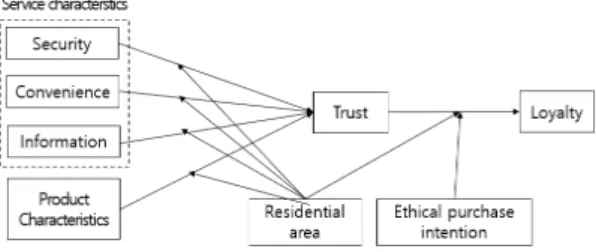
3.1 Research Model and HypothesisThe research model of this paper is composed of factors such as service characteristics, product characteristics, trust, and loyalty of Internet shopping malls, as shown in Figure 1.
Fig. 1. Research Model
In this study, variables were set as security, convenience, and information based on various prior studies on the service characteristics of Internet shopping malls [8,9,11]. Dau (2019) found that the factors of product characteristics of internet shopping malls have a positive effect on repurchase intention [13]. A hypothesis was established based on the analysis of existing studies on the effect of service characteristics and product characteristics on trust and loyalty [11,15,16,18].
H1. Among the service characteristics, security will have a significant effect on trust.
H2. Among the service characteristics, convenience will have a significant influence on trust.
H3. Among service characteristics, Information will have a significant influence on trust.
H4. Product characteristics will have a significant effect on trust.
H5. Trust will have a significant effect on loyalty.
The mediating effect of the characteristics and trust of internet shopping malls was hypothesized based on the research of Yoon (2019) [11].
H6. Trust will play a mediating role between service characteristics and loyalty.
H7. Trust will play a mediating role between product characteristics and loyalty.
It was difficult to find a study on the moderating effect on the residential area. Considering that the Internet shopping mall in this study is a Jeonnam social economy Internet shopping mall, the products are limited to the products of social economy enterprises in the Jeonnam region, and the customers are nationwide, so we set a hypothesis to find out whether or not there is a moderating effect according to the residential area.
Continuous interest in social economy products can
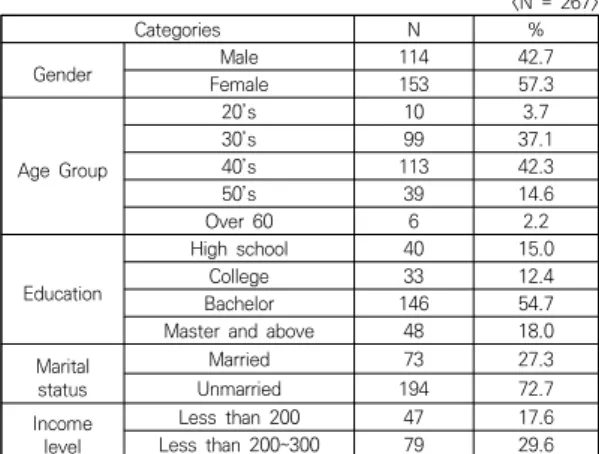
<N = 267>
Categories N %
Gender Male 114 42.7
Female 153 57.3
Age Group
20’s 10 3.7
30’s 99 37.1
40’s 113 42.3
50’s 39 14.6
Over 60 6 2.2
Education
High school 40 15.0
College 33 12.4
Bachelor 146 54.7
Master and above 48 18.0
Marital status
Married 73 27.3
Unmarried 194 72.7
Income
level Less than 200 47 17.6
Less than 200~300 79 29.6
Table 1. Respondents’ General Characteristics be a factor affecting the ethical consumption
tendency of customers. In a study by Kang &
Kim (2014), it was analyzed that there is a moderating effect between social enterprise products, customer satisfaction, and repurchase intention [21]. Therefore, this study hypothesis was established.
H8. The residential area will act as a moderator between service characteristics and trust.
H9. The residential area will act as a moderating action between product characteristics and trust.
H10. The residential area will act as a moderator between trust and loyalty.
H11. (Ethical) Purchasing intention will play a moderating role between trust and loyalty.
3.2 Research Methods
For the data collection of this study, an online survey was conducted for members of the Jeonnam Social Economy Internet Shopping Mall from May 25 to June 20, 2020, and a total of 267 respondents.
For the measurement of this study, the questionnaire was composed of measurement items based on existing studies. The scale was composed of a Likert 5-point scale. Excluding general characteristics and demographic variables, the questionnaire was composed of 5 constituent concepts and 24 questions. Four questions were organized for each measurement variable.
This study performed frequency analysis, descriptive statistics analysis, exploratory factor analysis, and correlation analysis using the SPSS 22 program. To verify the hypothesis, multiple regression analysis, mediating effect analysis, and moderation effect analysis were conducted.
4. Research Results
4.1 Basic statistical analysisFor demographic characteristics, frequency analysis was used. Of the total 267 people, 42.7%
were male and 57.3% were female. As for the age, 42.3% of them were in their 40s and 54.7%
of them were college graduates.
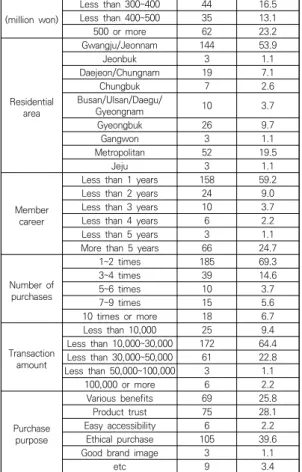
Gwangju/Jeonnam area occupied the largest number of shopping mall purchasers at 53.9%.
The experience of using the site was 59.2% for less than a year and 24.7% for more than 5 years.
It can be seen that the number of new members has increased due to the improvement of the shopping mall homepage, and it can be assumed that members over 5 years have high loyalty to the product.
The number of purchases was 69.3% at 1~2 times, and less than 10,000~30,000 won for one purchase.
As for purchase intention, ethical purchase (of social economy products) was 39.6%, product trust 28.1%, and various benefits 25.8%.
The descriptive statistics analysis results for the measured variables showed a standard deviation of 3 or less, and skewness and kurtosis were each absolute value of 3 or less, showing that the variables had a normal distribution.
Table 1 is as follows.
(million won)
Less than 300~400 44 16.5
Less than 400~500 35 13.1
500 or more 62 23.2
Residential area
Gwangju/Jeonnam 144 53.9
Jeonbuk 3 1.1
Daejeon/Chungnam 19 7.1
Chungbuk 7 2.6
Busan/Ulsan/Daegu/
Gyeongnam 10 3.7
Gyeongbuk 26 9.7
Gangwon 3 1.1
Metropolitan 52 19.5
Jeju 3 1.1
Member career
Less than 1 years 158 59.2 Less than 2 years 24 9.0 Less than 3 years 10 3.7
Less than 4 years 6 2.2
Less than 5 years 3 1.1
More than 5 years 66 24.7 Number of
purchases
1~2 times 185 69.3
3~4 times 39 14.6
5~6 times 10 3.7
7~9 times 15 5.6
10 times or more 18 6.7
Transaction amount
Less than 10,000 25 9.4
Less than 10,000~30,000 172 64.4 Less than 30,000~50,000 61 22.8 Less than 50,000~100,000 3 1.1
100,000 or more 6 2.2
Purchase purpose
Various benefits 69 25.8
Product trust 75 28.1
Easy accessibility 6 2.2
Ethical purchase 105 39.6
Good brand image 3 1.1
etc 9 3.4
4.2 Validity and reliability evaluation
This study conducted exploratory factor analysis on system characteristics (security, convenience, information), product characteristics, trust, and customer loyalty to verify the validity of variables. For all measured variables, principal component analysis was used to estimate the constituent factors. In order to simplify the factor loading value, a varimax was adopted, and variable selection was based on an eigenvalue of 1.0 or more and a factor loading value of 0.5 or more.
The total variance explained was 82.66%, and it was extracted as a total of 6 factors. The extracted factors were named as trust, security, convenience, customer loyalty, information, and product characteristics. It consists of 4 items for each factor, and information 4 and product characteristic 1 have been removed. The Cronbach's α value for each variable was .765~.950, showing reliability
(Cronbach's α>0.7). The analysis results are shown in Table 2.
Factor commu
nality Cronba ch's α
1 2 3 4 5 6
TRU
T1 .838 .223 .074 .210 .171 .073 .836 T2 .840 .249 .189 .228 .097 .129 .881 .955 T3 .883 .203 .054 .227 .125 .081 .899 T4 .897 .231 .025 .227 .104 .040 .923 SEC
S1 .278 .771 .234 .234 .140 .145 .877 S2 .214 .895 .212 .122 .086 .054 .917 .940 S3 .222 .843 .163 .089 .199 .040 .836 S4 .208 .875 .207 .091 -.006 .132 .877 CON
C1 .051 .366 .776 .171 .187 .221 .852 C2 .108 .125 .867 .183 .172 .184 .877 .931 C3 .085 .177 .775 .131 .296 .162 .770 C4 .099 .255 .843 .139 .201 .133 .862 LOY
L1 .294 .179 .178 .839 .125 .075 .875 L2 .299 .138 .186 .816 -.043 .134 .829 .909 L3 .095 .146 .137 .746 .112 .320 .720 L4 .234 .060 .101 .833 .229 .131 .833 INF I1 .335 .040 .243 .042 .702 .198 .706
.860 I2 .078 .172 .218 .156 .849 .016 .829 I3 .081 .121 .247 .123 .868 .183 .885 PRO P2 .045 .079 .266 .165 .019 .766 .694
.765 P3 .215 .061 .213 .321 .394 .553 .660 P4 .104 .160 .148 .193 .207 .816 .804 Eigen Value 3.662 3.481 3.281 3.213 2.574 1.975 variance (%) 16.645 15.821 14.914 14.605 11.699 8.977
Cumulative
variance (%) 16.645 32.467 47.380 61.985 73.684 82.662 Kaiser-Meyer-Olkin = .855 χ²= 5681.386, df = 231, P= .000 TRU: Trust, SEC: Security, CON: convenience, LOY: Loyalty, INF:
Information PRO: Product characteristics
Table 2. Exploratory factor analysis result
4.3 Correlation analysis
Correlation analysis was performed to find out the relationship between variables, and Pearson correlation coefficient was used. According to the results, the correlation was found to be significant at the 0.01 level for all variables. The coefficient of correlation with the magnetic variable is always 1 and appears on the diagonal of the matrix table. Table 3 is the result.
Mean Std.
Deviation CON INF SEC PRO TRU LOY CON 3.3184 .90204 1
INF 3.4145 .84099 .543** 1 SEC 3.6423 .86378 .522** .353** 1 PRO 3.0112 .87924 .539** .485** .357** 1 TRU 3.9981 .78010 .320** .389** .527** .352** 1 LOY 3.8633 .79828 .432** .362** .399** .526** .538** 1
**. The correlation is significant at the 0.01 level (both sides).
Table 3. Correlation analysis result
4.4 Hypothesis test
4.4.1 Regression analysis result
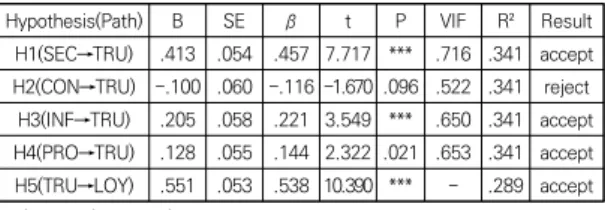
For hypothesis testing, multiple regression analysis and simple regression analysis were performed. To carry out regression analysis, the autocorrelation of the dependent variable and the multicollinearity between the independent variables were examined. Durbin-Watson index was used for autocorrelation of the dependent variable, and Durbin-Watson index was 1.949 in multiple regression analysis, and 2.168 in simple regression analysis. The multicollinearity (VIF) between independent variables was 1.387~1.722, less than 10, indicating that there was no multicollinearity. Therefore, this data is suitable for performing regression analysis. Convenience was excluded as a result of multiple regression analysis. The remaining independent variables, security (p <0.001), information (p <0.001), and product characteristics (p <0.05), had a significant effect on trust (p <0.001). Table 4 shows the test results for the H1~H5 hypothesis in this study.
Hypothesis(Path) B SE β t P VIF R² Result H1(SEC→TRU) .413 .054 .457 7.717 *** .716 .341 accept H2(CON→TRU) -.100 .060 -.116 -1.670 .096 .522 .341 reject H3(INF→TRU) .205 .058 .221 3.549 *** .650 .341 accept H4(PRO→TRU) .128 .055 .144 2.322 .021 .653 .341 accept H5(TRU→LOY) .551 .053 .538 10.390 *** - .289 accept
*P<.05 **p<.01 ***p<.001
Table 4. Results of basic hypothesis test
4.4.2 Mediated effect test
Baron&Kenny's mediating effect test was performed to find out whether trust mediates the effect of security, convenience, information, and product characteristics on customer loyalty.
Before the parameterization effect test, the autocorrelation of the dependent variable and the multicollinearity between the independent variables were reviewed, and the Durbin-Watson index was 1.939, independent without
autocorrelation, and the VIF was 1.387~1.722, indicating that there was no multicollinearity. An effect test was conducted.
As a result, information (p<.001), security (p<.001), and product characteristics (p<.001) significantly affected trust in the first stage. The higher the information (B=.240), security (B=.423), and product characteristics (B=.312), the higher the trust. The explanatory power of trust is 32.7%. In step 3, informationality (B=.047, p>.05) and security (B=.022, p>.05) were not significant, and the regression coefficient decreased to .151→.047, .206→.022. It appears that trust is completely mediated by the impact of information and security on customer loyalty. Since product characteristics have a significant effect on loyalty, trust is found to partially mediate the effect of product characteristics on loyalty. The results of verifying the mediating effect of the H6~H7 hypothesis are shown in Table 5.
Step1
(Trust) Step2
(Loyalty) Step3 (Loyalty) (a constant) 1.821*** 1.924*** 1.134***
CON -0.056 0.203*** .227***
INF .240*** 0.151* 0.047
SEC .423*** 0.206*** 0.022
PRO .312*** 0.477*** .349***
TRU .434***
R² 0.327 0.246 0.366
F 42.598*** 28.540*** 37.886***
Durbin-Watson d = 1.939
* p < .05 ** p < .01 *** p < .001 Table 5. Test result of mediated effect
4.4.3 Moderated effect test
A moderation effect test was conducted to find out whether the ethical purchase intention and the residential area control the effects of security, convenience, information, and product characteristics on trust. Dummy variables were used for the residential area (Gwangju &
Jeonnam = 0, others = 1). Mean centering was used as the independent variable to minimize the VIF problem.
Table 6 shows the results of verifying the
moderating effect of the H8~H9 hypothesis. In the second stage, where the categorical control variable was introduced, the residential area was added, which significantly increased by 2.1%
(p<.01), and the overall explanatory power was 36.2%. It was found that residents of Gwangju &
Jeonnam had a greater influence on trust than residents of other regions.
In the third step of testing the moderation effect, the interaction term (variable × residential area) was introduced, and the coefficient of determination (ΔR²) significantly increased by 5.2% (p<.001). As a result of inputting the interaction item, security and information had no moderating effect in the relationship with trust. The residential area was statistically significant between convenience (B=-.275 p<.05), product characteristics (B=.294 p<.01) and trust.
convenience, product characteristics, and residential area had a significant influence on trust. Therefore, the residential area has a similar moderation effect.
Dependent variable : Trust
ㅤ Step1 Step2 Step3
ㅤ B β B β B β
(a constant) 3.998 ㅤ 3.882 ㅤ 3.862 ㅤ
M.CON -.100 -.116 -.126 -.146* -.023 -.027 M.INF .205 .221*** .207 .223*** .263 .284***
M.SEC .413 .457*** .461 .511*** .552 .611***
M.PRO .128 .144* .085 .096 -.050 -.056 Residence_GJ&JN Area ㅤ ㅤ .251 .161** .251 .161**
CON×Residence -.275 -.199*
SEC×Residence -.206 -.142
INF×Residence -.130 -.087
PRO×Residence .294 .233**
R²(ΔR²) .341ㅤ .362(.021)** .414(.052)***
F 33.830*** 29.675*** 20.144***
* p < .05 ** p < .01 *** p < .001
Residence(dummy): Gwangju&Jeonnam 1, etc 0 Dummy variable Table 6. Test result of moderated effect
In addition, it was found that the residential area of the moderating variable has a moderating effect in the relationship between trust and
loyalty. However, in the residential area (B=-1.469, p<.001), the trust of non-Jeonnam residents had a greater effect on shopping mall loyalty. Table 7 shows the results.
Dependent variable : Loyalty
ㅤ Step1 Step2 Step3
B β B β B β
(a constant) 1.662 1.644 ㅤ 2.235 ㅤ
M.TRU .551 .538*** .541 .529*** .390 .381***
Residence_GJ&JN
Area ㅤ ㅤ .122 .076 -1.469 -.919***
TRU×Residence .395 1.040***
R2(ΔR2) .289 .295(.006) .330(.035)***
F 107.949*** 55.271*** 43.145***
* p < .05 ** p < .01 *** p < .001
Residence(dummy): Gwangju&Jeonnam 1, etc 0 Dummy variable Table 7. Test result of moderated effect
It also analyzed the moderating effect of purchase purpose. The purchase purpose used dummy variables (ethical purpose 1, others 0). As a result of analysis, purchase purpose(B=1.478, p<.001) was also found to have a similar moderating effect. In other words, the higher the ethical purchase purpose for social economy products, the lower the influence of trust and loyalty was. The results are shown in Table 8.
Dependent variable : Loyalty
ㅤ Step1 Step2 Step3
ㅤ B β B β B β
(a constant) 1.662 ㅤ 1.690 ㅤ .689 ㅤ
M.TRU .551 .538*** .552 .540*** .808 .790***
Purchase
purpose_Ethical ㅤ ㅤ -.047 -.026 1.478 .812***
TRU×Purchase
purpose -.386 -.907***
R2(ΔR2) .289 .290(.001) .322(.032)***
F 107.949*** 53.947*** 41.593***
* p < .05 ** p < .01 *** p < .001
Purchase purpose(dummy) : Ethical purpose 1, etc 0 Dummy variable Table 8. Test result of moderated effect
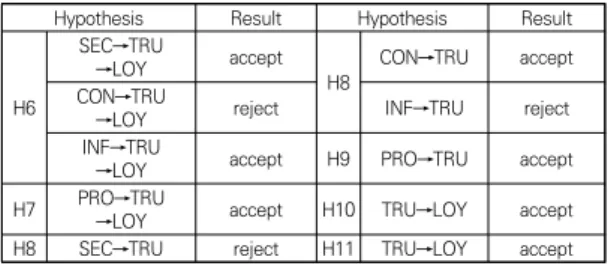
According to the above results, the hypothesis test for the mediating effect and the moderating effect is shown in Table 9.
Hypothesis Result Hypothesis Result H6
SEC→TRU
→LOY accept
H8 CON→TRU accept CON→TRU
→LOY reject INF→TRU reject
INF→TRU
→LOY accept H9 PRO→TRU accept
H7 PRO→TRU
→LOY accept H10 TRU→LOY accept
H8 SEC→TRU reject H11 TRU→LOY accept
Table 9. Hypothesis result of moderated effect
4.5 Discussing Research Results
The discussion points of the results of this study are as follows.
First, it was assumed that the characteristics of social economy internet shopping malls would have a positive effect on trust and loyalty to customers, and the hypothesis was significant. It is the same result as related previous studies.
Second, It was found that the residential area and purchase intention play a moderating effect on the variables. In the case of residential areas, the Jeonnam area showed higher trust in the characteristics of shopping malls than residents in other areas, and showed greater influence in loyalty to shopping malls. In purchase purpose, customers who ethically consume social economy products have a moderating effect between trust and loyalty. Previous studies have shown that purchase and repurchase intentions have a positive effect at a high level in ethical consumption propensity. However, in this study, the loyalty of customers who consume ethically was rather low. This may be related to regional limitations, promotion and marketing of shopping mall products. It is inferred that more than 50% of members are residents of the Jeonnam region, and they sell regional products separately from national awareness. Therefore, it is a part that needs follow-up research.
5. Conclusion
The summary of the results of this study is as
follows.
First, it was confirmed that the characteristics of social economy internet shopping malls had a significant effect on trust. However, information, security, and product characteristics were noted for the hypothesis, but not for convenience.
Second, it was found that trust had a significant effect on loyalty. Third, it was found that trust plays a partly an intermediary role between shopping mall characteristics and loyalty.
Security and information were shown as complete mediation effect, and product characteristics as partial mediation. Convenience did not play a mediating role. Fourth, the residential area served as a controlling variable in the path of shopping mall characteristics→
trust→loyalty. (Security and informationality excluded). It was confirmed that purchase intention plays a moderating action in the path of trust→loyalty.
The academic implications of this study are as follows.
We reconfirmed the results of existing research papers that the characteristics of internet shopping malls have a significant influence on trust and loyalty.
In the moderation effect analysis, the effect was confirmed by applying the residential area and purchase purpose variables. In previous studies, the purchase purpose variable played a role as an independent variable, but in this study, the moderating effect was analyzed by applying it as a single item.
The practical implications are as follows.
This study is a study on internet shopping malls dedicated to social economy. There are many Internet shopping malls such as social enterprises and village companies, but the Internet shopping malls that integrate social economy are all the'Jeonnam Social Economy Internet Shopping Mall' and the Seoul Social Economy Internet Shopping Mall. According to the results of this study, the Jeonnam social
economy shopping mall in the future should be actively promoted in other regions other than the Jeonnam region for customer management. In order to attract new customers, it is necessary to focus on security and information rather than convenience of shopping malls.
The limitations of the study are shown below.
First of all, there is a limitation in that the sample was targeted at Jeonnam social economy enterprise products and internet shopping malls.
In addition, since the study was conducted on members who purchased the product more than once at the shopping mall, additional research on customers who did not purchase the product is considered necessary.
As already mentioned in the implications, since the Jeonnam social economy shopping mall is the only social economy online shopping mall, it cannot be compared with the nationwide social economy enterprise product shopping mall. About this point
In the future, additional research such as comparative evaluation will be needed in relation to research on social economy enterprise products by region.
REFERENCES
[1] I. S. Kang. (2006). Social Economy and Promotion oriented Economics. The Korean Journal of Cooperative Studies 24(1), 203-224.
http://www.riss.kr.libproxy.hansung.ac.kr/link?id=A10 5866504
[2] J. H. Kim. (2014). A Social Enterprise and Legal Analysis on the Community Interest Company Act of UK. Kangwon Law review 43, 113-165.
[3] S. H. Kang & Y. O. Chon. (2018). A Study on the Law, Institution and Organization of Social Economy. Law Review 18(4), 385-406.
[4] S. Y. Kim. (2006). A study on the Recognition of Welfare Services for the Elderly. KJGSW 32. 99-117.
[5] J. K. Kim & K. H. Ko. (2019), Analysis of Consumer’s Intention for Social-economy Organizations, Social Economy & Policy studies 9(3), 59-88.
DOI: 10.22340/seps.2019.08.9.3.59
[6] S. H. Kang & Lee S. H. (2019), A Study on the Community Residents Perception of Social Economy and Attitudes of Value Consumption, Social Economy
& Policy studies9(4), 61-84.
DOI : 10.22340/seps.2019.11.9.4.61
[7] H. K. Park. (2019). The Effect of the Pro-social Behavior on the Repurchase Intentions of the Social Economy Organization : Focused on theMediating Effect of the Ethical Consumption. Social Enterprise Studies 12(3), 93-117.
[8] L. J. Lyu. (2020). A Study on the Relationship between Site Quality and WOM in Internet Shopping Mall Focusing on the differences between Korean and Chinese consumers. Masters dissertation. Konkuk University, Seoul, South Korea.
[9] S. S. Lee. (2010), A Study on the Customer Perceptions of Service Quality for Library E-Service:
Based on Zeithaml & Bitner's Model. JKOSIM 27(1), 119-136. DOI.org/10.3743/KOSIM.2010.27.1.119 [10] M. J. Bitner. (1995). Building Service Relationships:
It's All About Promises. Journal of the Academy of Marketing Science 23, 246-251.
[11] S. I. Yoon. (2019). The Relationships among Service Characteristics, Trust, and Behavioral Intention in Mobile Shopping Mall. (Doctoral dissertation) Sejong Unversity.
[12] Y. Zhu & J. W. Choi. (2018). An Empirical Study on Chinese Consumers’ Purchase Satisfaction of Korean Products using the SNS. The e-busineww studies 19(3). 21-42. DOI: 10.20462/TeBS.2018.6.19.3.21 [13] T. T. Dau. (2019). The effect of product, service, and
consumer characteristics of Vietnamese internet shopping malls on repurchase intention. Master’s Thesis. Pukyong National University, Busan.
[14] S. L. Jarvenpaa, N. Tractinsky & L. Saarinen. (1999).
Consumer trust in an Internet store: A cross-cultural validation. Journal of Computer-Mediated Communication, 5(2), JCMC526.
https://doi.org/10.1111/j.1083-6101.1999.tb00337.x [15] E. Y. Lee. (2016). The Study of Impact of Mobile App
Attributes for Fresh Food on Customers Trust, Satisfaction and Net Benefit. The e-Business Studies 17(4), 175-192.
DOI : 10.20462/TeBS.2016.08.17.4.175
[16] E. J. Ji, Y. J. Jeon & T. H. Kim. (2019). The Effect of Quality Properties of Platform-Based Online Food Shopping Mall on Trust, Satisfaction and Reuse Intention. Journal of Foodservice Management Society of Korea, 22(3), 215-240.
[17] J. H. Kwak. (2019). The Effect of Purchase Satisfaction of Silver Consumers on Repurchase. Journal of Social Welfare Management 6(1), 197-212.
[18] S. T. Jeun & H. J. Lee. (2012). The effect of service quality on the customer satisfaction and the customer loyalty in internet shopping mall: focused on
moderating effect of utilitarian value. Journal of KECRA 13(1), 59-85.
[19] S. Y. Lee. (2013). A Study of Ethical Consumerism Tendency of Consumerand Purchasing Intention. Doctoral dissertation. Sookmyung Women's University, Seoul.
[20] H. J. Shin. (2012). Developing a Scale for the Ethical Consumption Attitudes and the Effects of Consumers' Ethical Perception and Perceived Value on Purchase Intention. Doctoral dissertation.. Sunjgkonghoe University, Seoul.
[21] M. S. Kang &ㅤ Y. S. Kim. (2014). The Effect of People's Attitude on Social Enterprises: The Adjustment Effect of Ethical Consumption Intentions, JBE 28(6), 479-498.
김 은 정(Eun-Jeong Kim) [정회원]
․ 2000년 2월 : 전남대학교 일반대학원 (행정학 석사)
․ 2019년 9월 ~ 현재 : 한성대학교 일반 대학원 지식서비스&컨설팅학과 박사 과정
․ 2010년 7월 ~ 현재 : ㈜나남네트웍스 이사
․ 관심분야 : 농어촌지역개발, 일반농산어촌개발, 도시재생, 농 촌재생, 사회적경제, HR, CSR, CSV, 경영, 컨설팅
․ E-Mail : [email protected]
유 연 우(Yen-Yoo You) [정회원]
․ 1996년 2월 : 숭실대학교 정보과학대 학원(이학 석사)
․ 2007년 2월 : 한성대학교 일반대학원 행정학과(행정학 박사)
․ 1981년 7월 ~ 2002년 1월 : 해외건 설협회 (기획, 전산, 해외금융, 전략 /IT 컨설팅)
․ 2002년 2월 ~ 2009년 4월 : 중소기업기술정보진흥원 (컨설 팅, 경영혁신, CSR, IT, 서비스 R&D, 기술혁신)
․ 2008년 9월 ~ 2018년 2월 : 한성대학교 지식서비스&컨설 팅학과 교수
․ 2018년 3월 ~ 현재 : 한성대학교 스마트경영공학부 컨설팅 트랙 교수
․ 관심분야 : Consulting(Strategy, PM, 성과평가, MOT), CSR, Technology, Innovation, Management Innovation, Service R&D, Franchise, 지식재산, 사회적경제, 농촌컨 설팅
․ E-Mail : [email protected]