
*This study revised the paper presented at “The 10th International Conference on Convergence Technology in 2020” in Jeju, Korea.
*Corresponding Author : Jongnam Baek([email protected]) Received September 23, 2020
Accepted November 20, 2020 Revised October 26, 2020 Published November 28, 2020
The Technology-Pedagogy, and Content Knowledge differences between pre-service and in-service teachers and the related effects
of gender interaction in China
Wanzhi Ma
1, Jongnam Baek
2*1
Ph. D. Student, Dept. of Educational and Culture Contents Development, Woosuk University
2
Professor, Dept. of Special Education, Woosuk University
중국의 예비교사와 현직교사 간의 테크놀로지-교수내용지식 차이 분석 및 성별 상호작용 효과
마만지
1, 백종남
2*1
우석대학교 교육 및 문화 콘텐츠 개발학과 박사과정 학생,
2우석대학교 특수교육과 교수
Abstract The purpose of this study is to analyze the TPACK differences between pre-service and in-service teachers in China, and determine demographic influence variables on the differences between them. The participants of this study were 567 teachers, including 335 pre-service teachers and 232 in-service teachers from Ningxia, China. The results are as follows: First, The in-service teachers in the seven areas of TPACK scored higher than those of pre-service teachers; Second, The comparison of the average difference between teacher division and gender shows that the two factors have an interactive effect on TK. This study is meaningful because it compared the TPACK differences between pre-service and in-service teachers, and found out the effect of gender interaction on the differences in China; It provides practical suggestions for improving the TPACK ability of Chinese teachers. Finally, the discussion was conducted based on the results, and a follow-up study was suggested.
Key Words : China, Pre-service teachers, In-service teachers, Technology, Pedagogy and Contents Knowledge(TPACK), Gender differences, Digital convergence
요 약 이 연구는 중국 예비교사와 현직교사의 테크놀로지-교수내용지식(TPACK) 차이를 분석하고, 그 차이에 영향을 미치는 통계학적 변인이 무엇인지 알아보고자 계획되었다. 연구 참여자는 중국 닝샤의 예비교사 335명, 현직교사 232 명 등 총 567명이며, TPACK 수준에 대해 온라인 설문지에 응답하였다. 연구결과는 다음과 같다. 첫째, 현직교사는 예비교사에 비해 TPACK 모든 영역에서 높게 나타났다. 둘째, 현직교사와 예비교사의 TK 차이에 대해 성별 상호작용 효과가 나타났다. 이 연구는 중국의 예비교사와 현직교사 간의 TPACK 차이를 분석함으로써 중국 교사의 TPACK 역 량 향상을 위한 실천적 제언을 제시하였다는 데 그 의의가 있다. 마지막으로, 이 연구의 결과에 따라 논의하였으며, 후속연구를 제언하였다.
주제어 : 중국, 예비교사, 현직교사, 테크놀로지-교수내용지식(TPACK), 성별 차이, 디지털 융합
1. Introduction
With the advent of the Internet, computer technology and digital media, educational institutions have provided e-learning tools for learning and education. An online discussion forum can provide a rich learning experience, promote students' self-study, and be a useful learning tool for school students[1]. Today's students are represented by a generation that grows in a digitally rich environment and is attracted to a world full of different types of
information and communication
technologies(ICT). Currently, students are referred to by various labels such as "Internet generation[2]", "digital learner[3]", "digital age[4]",
"digital natives[4]" in the era of technological revolution. They freely use digital technologies.
The emergence of all new technologies from ancient times to the present has had varying degrees of influence on the field of education.
The rapid development of science and technology represented by ICT has changed society to some extent. It also affects the way people live, the way people think, their values, and the way they learn[5]. The highly developed Internet informatization has caused a series of major changes in education, such as teaching methods, learning, and students' lifestyles. Many studies have reported that, as students acquire and use skills, academic performance improves and real engagement is promoted, which has a positive impact on learning methods through which students can acquire knowledge[6].
With the advancement of "China's New Curriculum Reform", the application of ICT in education and teaching has clear requirements and intuitive manifestations in basic education curricular reform. From the "Basic Education Curriculum Reform Outline" from the Ministry of Education of China, it can be understood that the application of ICT should be placed in an important position in education and teaching to
increase its influence and radiation range. To achieve the full integration of ICT and curriculum teaching, there should be a positive expression about teaching content, learning methods and teaching methods, and an effective application platform and a good educational environment should be provided for students' learning and development[7].
In order for technology to be effectively used in learning, teachers must have the ability to integrate it into teaching based on their experience and professional knowledge[8,9].
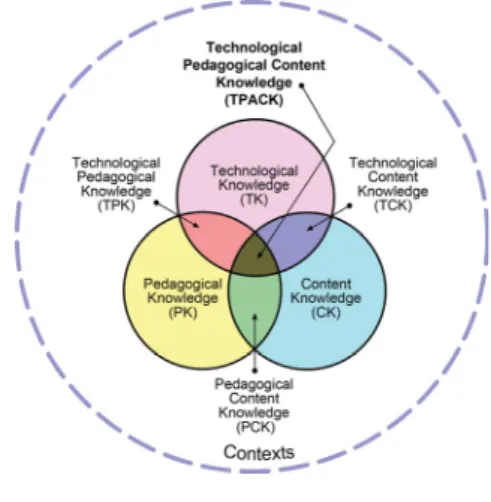
Technology, Pedagogy, And Content Knowledge(TPACK) incorporating Technology Knowledge(TK) into Pedagogical Content Knowledge(PCK) that was previously emphasized as a teachers' capacity, is required.
Fig. 1. TPACK framework
(http://tpack.org)The TPACK model is the basic knowledge required for teachers in the era of the digital technology revolution in the 21st century[10].
This can be explained by expanding it to elements such as Technological Pedagogy Knowledge (TPK), Technical Content Knowledge (TCK) and Pedagogical Content Knowledge (PCK) (see Fig. 1.).
Chinese researchers have begun to explore
teachers' TPACK. Since Li and Li[11] first
introduced the concept of TPACK to China in
2008, research on TPACK in Chinese domestic academic circles has gradually emerged[12]. The current overall research on TPACK mainly focuses on the following aspects: (1) The definition of the TPACK concept. TPACK theory was completed through research on its concept and structure[13,14]; (2) TPACK measurement model verification. The TPACK measurement model explored the structural relationship between the seven factors of TPACK and constructed a relationship model to determine the factors that have a significant predictive effect on it[15]; (3) Teacher TPACK level measurement and development strategy formulation. TPACK level measurement bridges theory and practice and provides a basis for the formulation of teachers’ TPACK training strategies[16-18].
Teachers' TPACK competency should be developed from pre-service training. The gap between pre-service and in-service teachers is analyzed herein; pre-service teachers' deficits must be addressed. There is a paucity of studies on the differences in TPACK between pre-service and in-service teachers in China[19].
Furthermore, the factors that influence the difference between pre-service and in-service teachers have not been identified. This study aims to compare pre-service and in-service teachers' perceptions of TPACK in China and analyze the factors that influence the TPACK differences between them.
The research questions are as follows: First, is there a difference in TPACK between pre-service and in-service teachers? Second, what are the demographic variables that influence the TPACK difference between pre-service and in-service teachers?
2. Method 2.1 Participants
This study adopted cluster sampling for a survey. The participants of the study were 567 teachers from Ningxia, China, including 335 pre-service teachers and 232 in-service teachers.
The general characteristics of the study participants are shown in Table 1.
Division Pre-service
n(%) In-service n(%)
gender Male 61 (18.2) 79 (34.1)
Female 274 (81.8) 153 (65.9) College
category Teacher raining 257 (76.7) 189 (81.5) Non-Teacher raining 78 (23.3) 43 (18.5) Education
Junior college 4 ( 1.2) 20 ( 8.6) Undergraduate 328 (97.9) 203 (87.5) Graduate school 3 ( 0.9) 9 ( 3.9)
Assigned classroom
High 93 ( 27.8) 55 ( 23.7) Middle 109 ( 32.5) 86( 37.1)
Primary 87 (26.0) 82 (35.3)
Others 46 (13.7) 9( 3.9)
Major
Language 99 (37.1) 89(39.9)
Mathematics 58 (21.7) 75 (33.6) Sociology 54 (20.2) 43 (19.3) Art, etc. 56 (21.0) 16 (7.2) Number of samples 335 (100) 232 (100)
Table 1. The general characteristics of participants
(N=567)
2.2 Tool
A 30-item survey questionnaire was used to measure participants' TPACK. The scale was originally developed by Schmidt et al.[20] and modified and verified by Zhan[21]. The tool consists of self-reported test questionnaires that measure a teacher's comprehensive knowledge of TPACK.
TPACK comprises seven factors and 30 items.
Each item was rated on a 5-point Likert scale(5=
strongly agree, 4=agree, 3=neutral, 2=disagree,
1=strongly disagree). Cronbach's Alpha(a)
coefficients for the subscales were as follows: TK
a=.802, PK a=.915, CK a=.914, TCK a=.935, TPK
a=.908, PCK a=.899, TPACK a=.974.
Fig. 2. The effect of gender Interaction affecting the differences between pre-service and in-service teachers on TK
2.3 Procedures
Researchers conducted TPACK measurement through an online survey system from December 2-23, 2019, in Ningxia, China. A total of 567 questionnaires were collected, and all of the collected questionnaires were used for analysis.
2.4 Data analysis
Analyses were conducted using SPSS ver.25 for Windows. To analyze TPACK differences between pre-service and in-service teachers, a 2-sample t-test was performed. To determine the factors that affect the TPACK differences between the groups, 2-way ANOVA(analysis of variance) was performed and the differences were compared through graphs.
3. Result
3.1 TPACK Differences Between Pre-service and In-service Teachers
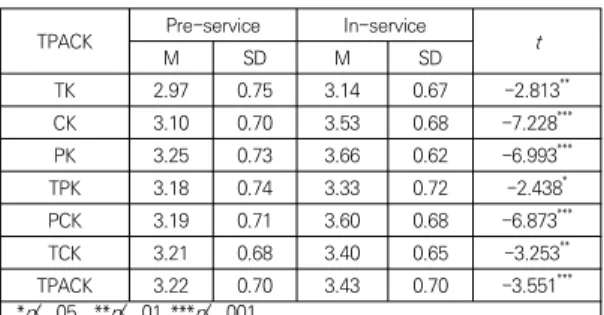
As shown in Table 2, the results of this study showed significant differences in all areas of TPACK: First, in-service teachers showed higher TK, CK, and PK than pre-service teachers;
second, in-service teachers showed higher TPK, PCK, and TCK than pre-service teachers; third, in-service teachers have higher TPACK than pre-service teachers.
TPACK Pre-service In-service t
M SD M SD
TK 2.97 0.75 3.14 0.67 -2.813**
CK 3.10 0.70 3.53 0.68 -7.228***
PK 3.25 0.73 3.66 0.62 -6.993***
TPK 3.18 0.74 3.33 0.72 -2.438*
PCK 3.19 0.71 3.60 0.68 -6.873***
TCK 3.21 0.68 3.40 0.65 -3.253**
TPACK 3.22 0.70 3.43 0.70 -3.551***
*p< .05 **p< .01 ***p< .001
Table 2. TPACK differences between pre-service and in-service teachers
(N=567)3.2 Demographic factors influencing TPACK differences between pre-service and in-service teachers
To find out which variables affect the discovered difference, variables such as gender, college category, education level, assigned classroom, and major were added to analyze the interaction. Results show that none of the interaction variables except gender influenced the difference between pre-service and in-service teachers. As shown in Table 3, the results of comparing the mean differences between teacher division and gender showed an interaction between the two factors on TK.
Sample D.V. Type Ⅲ SOS df Mean square F
Gender * Division
TK 2.872 1 2.872 5.786*
CK .823 1 .823 1.725
PK 1.095 1 1.095 2.336
PCK .061 1 .061 .125
TCK .737 1 .737 1.644
TPK .741 1 .741 1.399
TPACK .031 1 .031 .063
*p< .05 **p< .01 ***p< .001
Table 3. The interaction effect of the differences between teacher division and gender on TPACK
A graph was developed to determine the
specific differences, as shown in Fig. 2. The TK
differences between pre-service teachers
appeared large, but there were few differences between in-service teachers. There are few differences between male pre-service and in-service teachers, but female in-service teachers showed remarkable improvement compared to pre-service teachers.
4. Discussion
This study found differences between pre-service and in-service teachers in China. The results show that, first, there was a significant difference between pre-service and in-service teachers in their knowledge of different TPACK fields. The pre-service teachers in the seven areas of TPACK scored lower than those of in-service teachers. These results are consistent with a previous study conducted in China[22].
However, this is partially contradictory to the results of a study conducted in Kuwait that showed that pre-service teachers have a higher TPACK than in-service teachers due to gaps of the technology accessibility[23].
It is expected that the results of this study will help relevant Chinese education departments and teachers to gain a better understanding of the current state of teacher education information. It seems necessary for China’s education authorities to review relevant information technology courses and approve pre-service teachers. The curriculum for pre-service teachers should be designed to integrate ICT and strengthen the adaptation of pre-service teachers[24-26].
Second, the study found that demographic factors affect the difference in TPACK between pre-service and in-service teachers. The comparison of the average difference between teacher division and gender shows that the two factors have an interactive effect on TK. This result is in agreement with those from previous studies[27-30] showing that men have higher
technological abilities than women. In developing teacher training in China, there is a need for the curriculum to be planned according to the gender of teachers, and, in particular, to improve TK utilization and the integration ability of female pre-service teachers.
Looking at the trend of TK development among female teachers, the TK of pre-service teachers was low, but the TK of in-service teachers improved to almost the same level as that of male teachers. This means that female TK acquisition speed is faster than men's, and this supports results on the possibility of female technology development in previous studies[28].
Gender technology competencies differ in certain areas, but not in others[31]. A gender differences between teachers was not found regarding ICT in the information use divide, but there was a difference in its purpose and type[32]. For example, female teachers have a relatively stronger desire for communication than male teachers[30]. Therefore, in order to enhance the technology utilization ability of Chinese teachers, careful consideration is required of the purpose and type of technology utilization based on the gender of the teacher.
5. Conclusion
The following conclusions can be derived from
the discussions. The TPACK ability of pre-service
teachers should be evaluated and cultivated. This
study is meaningful because it compared the
TPACK differences between pre-service and
in-service teachers, and found out the effect of
gender interaction on the differences in China; it
provides practical suggestions for improving the
TPACK ability of Chinese teachers. Since Chinese
pre-service teachers scored lower than in-service
teachers in all areas of TPACK, it is necessary to
improve TPACK knowledge in the process of
pre-service teacher training in China. In
particular, it is necessary to improve the technology utilization and integration ability of female pre-service teachers.
The limitations of this study are as follows.
First, due to the constraints of conditions and time, when selecting the study targets, this study mainly collected the study objects from pre-service and in-service teachers in Ningxia.
Second, the study method is only a survey method and researchers did not participate in-depth in the actual classroom study of TPACK, so the study content is simple. In a follow-up study, it will be necessary to identify psychological variables affecting TPACK, such as technology self-efficacy, IT training experiences et al..
REFERENCES
[1] P. T. Ng. (2012). Singapore teacher leaders' perception of using online discussion forum as a learning tool.
International Journal of Innovation in Education, 1(4),
301-310.[2] D. Tapscott. (1998).
Growing up digital. Boston
: McGraw-Hill Education.[3] J. S. Brown. (2000). Growing up: Digital: How the web changes work, education, and the ways people learn.
Change: The Magazine of Higher Learning, 32(2),
11-20.[4] E. Rapetti & L. Cantoni. (2010). “Digital natives” and learning with the ICTs. The “Geny@ work” research in Ticino, Switzerland.
Journal of E-Learning and Knowledge Society, 6(1),
39-49.[5] D. K. Li. (2001). Digital learning-the core of information technology and curriculum integration.
E-education Research, 8
, 46-49.[6] T. Rashid, & H. M. Asghar. (2016). Technology use, self-directed learning, student engagement and academic performance: Examining the interrelations.
Computers in Human Behavior, 63
, 604-612.[7] Chinese Ministry of Education. (2001). Basic Education Curriculum Reform Outline (for Trial Implementation)
People’s Eduction, 9
, 6-8.[8] P. Mishra & M. J. Koehler. (2006). Technological pedagogical content knowledge: A framework for teacher knowledge,
Teachers College Record
,6
, 1017-1054.[9] J. Baek. (2018). Verification of Technology, Pedagogy, and Content Knowledge(TPACK) model for integrated educational teachers.
Korean Journal of Special Education
,53(1),
165-182.[10] T. Valtonen, E. T. Sointu, K. Mäkitalo-Siegl, & J.
Kukkonen. (2015, November). Developing a TPACK measurement instrument for 21st century pre-service teachers.
In Seminar. net
,11(2),
87-100.[11] M. F. Li, & Y. Li. (2008). TPCK: A New Framework for Teacher Professional Knowledge Integrating Technology.
Heilongjiang Researches on Higher Education, 4
, 74-77.[12] T. Valtonen, J. Kukkonen, S. Kontkanen, K. Sormunen, P. Dillon, & E. Sointu. (2015). The impact of authentic learning experiences with ICT on pre-service teachers' intentions to use ICT for teaching and learning.
Computers & Education, 81
, 49-58.[13] Y. Yu. (2014). Challenges Facing TPACK Theoretical Research.
China Educational Technology, 5
, 20-25.[14] J. X. Cai. (2015). Research on Technological Pedagogical Content Knowledge(TPACK): Progress and Trend.
Modern Distance Education Research. 3
, 9-18.[15] L. L. Zhao., Y. H. Li & J. Z. Xie. (2018). TPACK of Normal University Students of Information Technology in Local Colleges and Universities:
Influencing Factors and Construction Strategies.
Modern Distance Education, 3
, 29-36.[16] Y. X. Gu & X. Y. Qian. (2016). Research Status and Thinking of TPACK Measure Methods at Home and Abroad.
Journal of Distance Education, 34(5),
97-104.[17] Z. W. Wei & Q. Zhou. (2015). Investigation and Analysis on TPCK in the Core of Pre- service Teachers’ TPACK: In the Pre- service Chemistry Teachers as an Example.
Global Education, 44(8),
74-84.[18] X. Y. Nie & J. B. Wei. (2019). Analysis of the influencing factors of demographic variables in TPACK of mathematics teachers in primary and middle schools.
The Chinese Journal of ICT in Education, 4
, 11-15.[19] X. Y. Wu. (2017).
A Comparative Study on the Status Quo of TPACK between Mathematics Normal Students and In-service Teacher.
Master's dissertation, Shanxi Normal University.[20] D. A. Schmidt, E. Baran, A. D. Thompson, P. Mishra, M. J. Koehler & T. S. Shin. (2009). Technological pedagogical content knowledge (TPACK): The development and validation of an assessment instrument for preservice teachers.
Journal of Research on Technology in Education
,42(2),
123-149.[21] Y. Zhan. (2011).
An Empirical Study on Imporving
Preservice Teachers’ TPACK.
Master's dissertation, East China Normal University.[22] Y. Dong, C. S. Chai, G. Y. Sang, J. H. L. Koh & C. C.
Tsai. (2015). Exploring the profiles and interplays of pre-service and in-service teachers' technological pedagogical content knowledge (TPACK) in China.
Journal of Educational Technology & Society, 18(1),
158-169.[23] N. Alrwaished, A. Alkandari, & F. Alhashem. (2017).
Exploring In-and Pre-Service Science and Mathematics Teachers’ Technology, Pedagogy, and Content Knowledge (TPACK): What Next?
Eurasia Journal of Mathematics, Science and Technology Education, 13
(9), 6113-6131.[24] C. Angeli & N. Valanides. (2013). Technology mapping: An approach for developing technological pedagogical content knowledge.
Journal of Educational Computing Research, 48(2),
199-221.[25] C. S. Chai, J. H. L. Koh, C-C. Tsai, & L. L. W. Tan.
(2011). Modeling primary school pre-service teachers’
Technological Pedagogical Content Knowledge (TPACK) for meaningful learning with information and communication technology (ICT).
Computers &
Education, 57(1),
1184-1193.[26] Y. Zhan & Y. Q. Ren. (2011). Improving TPACK of Mathematics pre-service teachers: An experimental research.
China Educational Technology, 10
, 15-23.[27] A. Bhargava, A. Kirova-Petrova & S. McNair. (1999).
Computers, gender bias, and young children.
Information Technology in Childhood Education Annual
,1
, 263-274.[28] L. Shashaani. (1997). Gender differences in computer attitudes and use among college students.
Journal of Educational Computing Research
,16
(1), 37-51.[29] P. Schumacher & J. Morahan-Martin. (2001). Gender, internet and computer attitudes and experiences.
Computers in Human Behavior
,17(1),
95-110.[30] J. Baek. (2019). A study on teachers’ self-efficacy about digital technology in inclusive school.
The Journal of Educational Development
,39(1)
, 19-32.[31] K. S. Hong & C. K. Koh. (2002). Computer anxiety and attitudes toward computers among rural secondary school teachers: A Malaysian perspective.
Journal of Research on Technology in Education
,35(1),
27-48.[32] K. Lim, H. A. Sim & K. Y. Kim. (2010). A study on gender differences in the use of ICT among middle school teachers.
![OPEN BID INVITATION[the Provision of Security Service]](data:image/gif;base64,R0lGODlhAQABAIAAAP///wAAACH5BAEAAAAALAAAAAABAAEAAAICRAEAOw==)