ISSN 1225-7591(Print) / ISSN 2287-8173(Online)
Synthesis of Nanosized Nickel Particle from Spent Cathodic Material Containing Lithium
Jei-Pil Wang*
Department of Metallurgical Engineering, Pukyong National University, Busan 48513, Republic of Korea (Received July 31, 2019; Revised August 21, 2019; Accepted August 21, 2019)
···
Abstract Due to the rapid development of electricity, electronics, information communication, and biotechnology in recent years, studies are actively being conducted on nanopowders as it is required not only for high strengthening but also for high-function powder with electric, magnetic, and optical properties. Nonetheless, studies on nickel nanopowders are rare. In this study of the synthesis of nickel nanoparticles from LiNiO2 (LNO), which is a cathode active material, we have synthesized the nanosized nickel powder by the liquid reduction process of NiSO4 obtained through the leaching and purification of LNO. Moreover, we have studied the reduction reaction rate according to the temperature change of liquid phase reduction and the change of particle size as a function of NaOH addition amount using hydrazine monohydrate (N2H4·H2O) and NaOH.
Keywords: Recycling, Nickel sulfate, Nickel, Nanopoweder, Reduction
···
1. Introduction
The development of a metal powder material is mainly focused on ensuring high strength by changing alloy design and improving process. However, due to the rapid development of electricity, electronics, information com- munication, and biotechnology in recent years, there is a growing need for high-function powder with improved electrical, magnetic and optical properties as well as high strength [1]. These characteristics can be achieved only in nano-size particles rather than in conventional micron- sized powder. In particular, the metal nanoparticle has a new physical property that is not exhibited in the conven- tional metal powder due to the decrease in volume char- acteristics and surface characteristics and the increase in the surface area as the particles become finer in nano size. As a result, as a next-generation material, it is expected to contribute to generating new demands across industries such as high-strength mechanical parts, cata- lysts, medicine and biotechnology, etc. The nickel nanoparticles to be fabricated in this study has excellent
magnetic properties and reactivity, so it can be used as the material for high-performance electrode materials, functional fiber materials, conductive materials, and cata- lyst (general use, redox agent, photocatalyst, hydrogen, ammonia, ethanol synthesis) [2-4]. Many studies are being conducted on the production of metal nanopow- ders especially in Japan and the United States, but in Korea there are seldom studies on the production of metal nanoparticles in Korea due to relatively insuffi- cient basic studies, and most of the metal nanopowders are being imported [5].
As a result, many studies are being conducted on the metal nanopowder, but due to a limit in the manufactur- ing and storage, its commercial application is experienc- ing difficulty. In the case of chemically stable ceramic materials, it is easy to manufacture and store easily through various methods. However, in the case of the metal nanoparticle, it is difficult to maintain its nano structure due to the growth of particles during sintering and its electrical and magnetic properties are degraded due to the wide surface area which leads rapid reaction with oxy-
-Jei-Pil Wang: 교수
*Corresponding Author: Jei-Pil Wang, TEL: +82-51-629-6741, FAX: +82-51-629-6742, E-mail: [email protected]
gen [3]. As when the metal nanopoweder is oxidized, its electrical and magnetic properties are degraded, and sin- tering for bulk production is also difficult, there are many limitations in its application.
The manufacturing process of nanometer metal pow- der can be divided into physical synthesis and chemical synthesis. Physical synthesis includes gas evaporation condensation and mechanical synthesis. Chemical synthe- sis includes gas phase synthesis, liquid phase synthesis, and solid phase synthesis. First, the gas-evaporation con- densation is a method of obtaining the nanopoweder by evaporating and condensing the raw material by heating the raw material in an inert gas atmosphere. The purity of the particles is high and the size is uniform, but the yield is low and the production speed is slow, so there is a dis- advantage that the economical efficiency is low. Mechan- ical synthesis is a commonly known ball-milling process, and is a typical example of Top to Bottom method. It is a process of manufacturing metal nanopoweder by apply- ing a physical impact to a raw material using a crushing ball. The process is simple and has many advantages in mass production. However, when a physical impact is applied, there is the high possibility that the raw material is oxidized and impurities may be generated. In addition, it is difficult to uniformly control the particle size of the
powder, and the produced powder is isotropic and has a low residual magnetic flux density, so it is not suitable for the magnetic material [6]. On the other hand, the liq- uid phase reduction is a chemical synthesis method of producing a metal or an oxide powder in an aqueous solution by adding a precipitant or a reducing agent to the metal salt. It is a typical example of Bottom to Up method. Since the metal is synthesized from the ionic state, the particle size of the powder can be controlled to be uniform and small, and the purity and yield are higher than other processes. In addition, the production speed is fast and the particle size can be easily adjusted accord- ing to the concentration of the reducing agent. The previ- ous studies related to the production of nanopoweder by liquid reduction were focused on cobalt nanoparticles and silver nanopoweder depending on the kind of metal.
These studies have been focused on the size and shape of the particles, but filtration and dilution were required during process in most studies, which resulted in a decrease in economic efficiency [7-11].
Therefore, in this study, we used the liquid phase reduction method to manufacture nickel nanopoweder with high purity and uniform size. Experiments were conducted by setting the reaction rate change according to the liquid reduction temperature and the particle size change according to the amount of reducing agent added as variables. This study is meaningful in that it is intended to fabricate the nickel nanoparticle having excellent phys- ical properties without filtration and dilution process, which was not solved in the previous studies.
2. Materials
2.1 Raw Samples and Reducing Agent
NiSO4 (Ni6%) solution used for fabricating nickel nanopowder using the liquid reduction method was pre- pared as a raw material. The NiSO4 solution is a nickel precursor solution obtained by leaching sulfuric acid and refining the cathode active material (LiNiO2) obtained from the spent battery scrap. The components of the NiSO4 solution were analyzed by ICP-MS (Inductively Coupled Plasma with Mass Spectrometer) and results of analysis are listed in Table 2 below.
Hydrazine monohydrate (N2H4·H2O) was used as a reducing agent to be added in the liquid reduction pro- Table 1. Application of metal nanopowder
Type Application Fields Material
Power
Abrasive
Al2O3, SiO2, Fe2O3,
Cr2O3
Coagulant Fe2O3,
Al2O3 Precipitation inhibitor SiO2 Automotive Airbag Propellant Fe2O3
Coating
Paint General purpose, Automotive, Paste
Fe2O3, TiO2, ZnO
Catalyst
Oxidation reducing agent, Photocatalyst,
Hydrogen / Ammonia / Ethanol
synthesis
Ni, TiO2, Pd, Cu, Pt
Electro magnetic Application
Electromagnetic wave absorbent, UV
protection
Fe2O3, TiO2
Mechanical application
Wear-resistant coating, powder
coating
NiAl oxide
Chemical application
Corrosion-resistant
coating NbAl oxide
cess, and sodium hydroxide (NaOH) was added to pre- pare the hydroxide
2.2 Experimental apparatus
A magnetic stirrer is used to maintain the reaction con- dition of NiSO4 solution and reducing agent constantly.
Since it is equipped with hot wire, it is possible to stir while applying heat. A beaker in which a NiSO4 solution and a reducing agent is contained for reduction reaction, and a magnetic bar that stirs NiSO4 solution and reduc- ing agent and rotates at a constant speed by a magnetic field. A magnetic field generated in the motor of the apparatus rotates the magnetic bar to stir the sample in the beaker.
2.3 Experimental method
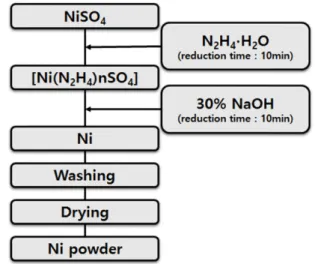
Fig. 1 is a procedure to fabricate nanosized nickel pow- der from the cathodic material of lithium ion battery.
NiSO4 solution and hydrazine monohydrate were mixed at a volume ratio of 10:3 and a reduction process was performed using a magnetic stirrer to synthesize a nickel hydrazine complex ([Ni(N2H4) nSO4]). Sodium hydrox- ide (NaOH) was added to generate nickel hydroxide, and nickel particles were generated by the reduction reaction of nickel hydroxide and hydrazine. In this experiment, it was confirmed that the reduction reaction did not take place if a heat source was not applied externally when adding sodium hydroxide. Therefore, the experiment was performed while applying heat in a magnetic stirrer. In order to confirm the temperature at which the most effec- tive reaction takes place, a reducing process was per- formed while measuring the temperature with a thermo- meter. After the reaction was completed, the recovered nickel powder was washed with distilled water and then dried. The overall nickel nanopoweder production reaction formula used in this experiment is as follows (1) - (3).
NiSO4 + nN2H4 → [Ni(N2H4)nSO4] (1) [Ni(N2H4)nSO4] + 2NaOH
→ Ni(OH)2 + nN2H4 + Na2SO4 (2)
Ni(OH)2 + N2H4 + H2O
→ Ni + NH3 + (NH4OH) + O2 (3)
Experiments were performed to determine the particle size change according to the amount of NaOH (30%) solution added after deriving the optimum temperature in the above experiment. At this time, the experiment was performed by setting the weight ratio of NiSO4 solution and sodium hydroxide solution to 10:1, 10:1.25 and 10:1.5, respectively. The nickel powder which had been reacted was washed with distilled water and dried.
The powder morphology and microstructure of the recovered nickel nanoparticle were analyzed using Field Emission Scanning Electron Microscope (FE-SEM), and the average particle size distribution of the nickel pow- der was analyzed using Laser Diffraction Particle Size Analyzer (PSA).
3. Results and Discussion
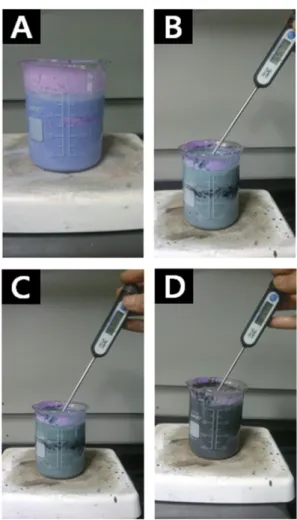
Fig. 2 is a photograph of the reduction process for 10 minutes by stirring the solution whose temperate was set differently after the addition of NaOH (30%) to NiSO4 with ratio of 1 to 10. The temperature of the solution was 18.7oC, 55.7oC, 65.1oC and 81.7oC respectively from the left to the right. It shows that almost no reduction reac- tion occurred when the experiment was performed at room temperature (18.7oC) after addition of NaOH to the nickel hydrazine complex which had been synthesized.
Unlike A, in D, stirring was performed while applying Table 2. Chemical composition of NiSO4
Element Ni Co Cr Ca Cu Fe
wt.% 6.44 0.0009 N.D N.D N.D N.D
Element Li Mg Mn Na Al Zn
wt.% N.D 0.0047 N.D 0.006 N.D N.D
Fig. 1. Experimental procedure.
heat after adding NaOH, and Fig. 2 shows that the reduc- tion reaction proceeded faster than other conditions. As a result, it was found that the reduction reaction of NiSO4 solution occurred faster when the temperature of NiSO4 solution was higher. However, when the temperature of the solution was over 88oC due to excessive heating, the solution was boiling over, indicating that it is unneces- sary to overheat.
Fig. 3 FE-SEM images of the nickel powder recovered after reducing NiSO4 and NaOH at the weight ratio to 10:1, 10:1.25, and 10:1.5, respectively and the reduction was conducted at 81.7oC for 15 minutes. As a result, when NaOH was added to nickel hydrazine complex ([Ni(N2H4)nSO4]) at the weight ratio of 10:1 to NiSO4, the nickel powder with the smallest particle size of 100~200 nm could be recovered, but when NaOH was added at the weight ratio was 10: 1.25 or 10:1.5, the nickel powder having a size of 200~300 nm was formed.
As the amount of NaOH added increased, smaller nickel powders of less than 100 nm were formed, but larger par- ticles were formed in the end due to agglomeration between particles.
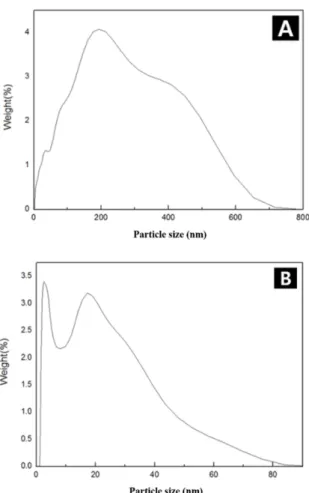
Fig. 4 shows the results of analyzing the particle size using a laser diffraction particle size analyzer at a weight ratio of 10:1 and 1:1.5. Similar to the results of the FE- SEM analysis, when more NaOH is added, more micron- sized Ni particles are present than nanoparticle-sized Ni powder. Furthermore, there can be some methods to con- trol agglomeration of nanoparticle with addition of poly- vinyl pyrrolidon (PVP) as a chemical dispersant and using ultrasonic dispersion as a physical process.
Fig. 2. Difference in reduction rate according to the temperature of solution (a) 18.7oC, (b) 55.7oC, (c) 65.1oC, (d) 81.7oC.
Fig. 3. Image of nickel nanopower taken by FE-SEM (a) NaOH (10:1), (b) NaOH (10:1.25), (c) NaOH (10:1.5).
4. Conclusion
We conducted this study to fabricate the nickel nano- powder from NaOH solution using liquid reduction method. To achieve this purpose, we performed experi- ments to analyze the reduction reaction rate according to the liquid reduction temperature and the particle size of nickel powder according to the addition of NaOH. We used the hydrazine monohydrate (N2H4·H2O) as a reduc- ing agent in the liquid reduction process, and added sodium hydroxide (NaOH) to prepare hydroxides. The results of the experiment are as follows.
Hydrazine monohydrate (N2H4·H2O) was added to the NiSO4 solution and reacted with a magnetic stirrer to form hydrazine complex ([Ni(N2H4)nSO4]).
The reaction did not occur at room temperature when NaOH was added to the hydrazine complex ([Ni(N2H4) nSO4]), and the temperature at which the reduction reac- tion most likely occurred was 81.7oC.
The particle size of nickel powder according to the amount of NaOH added was analyzed by FE-SEM and
PSA. As a result of analysis, it was found that the smaller the amount of NaOH added, the smaller size nickel powder was formed, but 200~300 nm nickel pow- der was synthesized due to the agglomeration between particles. The purity of nickel powder was examined by ICP and XRF and it was found to be 99.62 wt.% with minor purity of oxygen, nitrogen and sodium etc.
Acknowledgment
This research was also supported by the Brain Busan 21 plus (BB21+) Project in 2019 and by the National Research Foundation of Korea (NRF) grant funded by the Korea government (MSIT) (No. NRF-2019R1F1A 104940).
References
5[1] smt.sandvik.com, (http://www.kims.re.kr/webzine/200905/
sub/sub04_01.html).
5[2] J. M. Ryu: M. S. Thesis, A Study on Microstructure and Magnetic Property of Ni-20wt%Fe Nanoalloy Powder Produced by Hydrogen reduction, Hanyang University, Seoul (2009).
5[3] N. H. Lee: M. S. Thesis, The production of metal and ceramic nanopoeders by Pulsed Wire Evaporation(PWE) method, Chosun University, Gwangju (2002).
5[4] S. J. Lee: M. S. Thesis, Synthesis of ceramic nanopow- ders by thermal plasma for dye-sensitized solar cells, Inha University, Incheon (2013).
5[5] H. J. Kim: M. S. Thesis, The Study on the Alteration of Nanoparticles Characteristics based on the Nanopowder Manufacturing Process, Gyeongsang National University, Jinju (2014).
5[6] Y. J. Pyo: M. S. Thesis, Optimization of Cu nanoparticle coated by graphene using PVP for the application of oxi- dation prevention effect, Hanyang University, Seoul (2016).
5[7] M. S. Shin: M. S. Thesis, Stabilized Mn based Powders for Supercapacitor Electrodes Prepared by Chemical Reduction Method or Galvanic Displacement Reaction, Sungkyunkwan University, Seoul (2013).
5[8] J. H. Lee, S. H. Kim, J. W. Kim, M. H. Lee and Y. D.
Kim: J. Korean Powder Metall. Inst., 19 (2012) 60.
5[9] J. H. Lee: M. S Thesis, Synthesis and dispersion of cobalt nanopowder by liquid phase reduction, Hanyang Univer- sity, Seoul (2013).
[10] S. H. An, S. H. Kim, J. H. Lee, H. S. Hong and Y. D.
Kim: Korean J. Mater. Res., 21 (2011) 327.
[11] J. J. Lee: J. Korea Soc. Academia-Industrial Cooperation Soc., 17 (2016) 10.
Fig. 4. Results of PSA analysis (a) NaOH (10:1), (b) NaOH (10:1.5).