Yeungnam Univ J Med 2015;32(2):80-84
로타바이러스 백신 접종 유무 및 백신종류에 따른 창자겹침증 발병 연령의 비교: 단일기관 연구
이윤영, 이응빈, 최광해 영남대학교 의과대학 소아과학교실
Difference in the distribution of onset age of intussusception after rotavirus vaccination and according to the type of rotavirus vaccine: single medical center study
Yun Young Lee, Eung Bin Lee, Kwang Hae Choi
Department of Pediatrics, College of Medicine, Yeungnam University, Daegu, Korea
Background: Rotavirus is the most common cause of severe gastroenteritis in children <5 years of age.
The first vaccine, RotaShield was developed, but withdrawn because of its association with increased risk of intussusception. Then, RotaTeq and Rotarix were developed. Although in pre-licensure studies, they were not associated with an increased risk of intussusceptions, in recent studies, it has been controversial. Re- garding increased risk of intussusception, we studied the difference in the age of intussusception after rotavi- rus vaccination.
Methods: A retrospective analysis was conducted on 136 patients diagnosed with intussusception at Yeungnam University Medical Center for 4 years in the pre-vaccination period (group A) and in the post vaccination period (group B). Sex, mean age and age distribution of intussusceptions were compared according to the type of rotavirus vaccine (group B-1, RotaTeq; group B-2, Rotarix).
Results: The median ages of group A and group B were 18.8±19.6 months and 15.5±10.2 months, with no significant differences (p=0.23). The median ages of group B-1 and group B-2 were 15.3±9.3 months and 15.6±10.8 months, with no significant differences (p=0.91). And No significant difference in the distribution of onset age was observed between groups, and only 6 patients were diagnosed with intussusceptions within 1 month after vaccination.
Conclusion: No difference was observed in the distribution of onset age of intussusception after rotavirus vaccination and according to the type of rotavirus vaccine. Our study has a limitation in that it was con- ducted in part of the Daegu area. Additional study is needed.
Keywords: Rotavirus vaccine; RotaTeq; Rotarix; Intussusception
Received: September 21, 2015, Revised: October 20, 2015 Accepted: October 28, 2015
Corresponding Author: Kwang Hae Choi, Department of Pediatrics, College of Medicine, Yeungnam University, 170 Hyeonchung-ro, Nam-gu, Daegu 42415, Korea
Tel: +82-53-620-3537, Fax: +82-53-629-2252 E-mail: [email protected]
서 론
로타바이러스(rotavirus)는 5세 미만의 영유아에서 중증설사
질환을 일으키는 가장 흔한 원인바이러스이다. 전 세계적으 로 로타바이러스 백신이 시행되기 전에는 5세 미만의 영유아 중 매년 약 578,000명이 위장관염으로 사망하였고, 이중 약 1/3이 로타바이러스 감염으로 인한 것이었다[1]. 이에 따라 로타바이러스 백신이 1998년에 개발되었으나 창자겹침증 발생이 증가하여 접종이 중단되었다[2,3]. 이후, 사람과 소에 서 분리된 로타바이러스를 재배열하여 약독화시킨 5가 백신 (RV5; RotaTeq, Merck & Company, Inc, Whitehouse Station, NJ, USA)과 사람에게서 분리된 로타바이러스 G1P1를 약독화
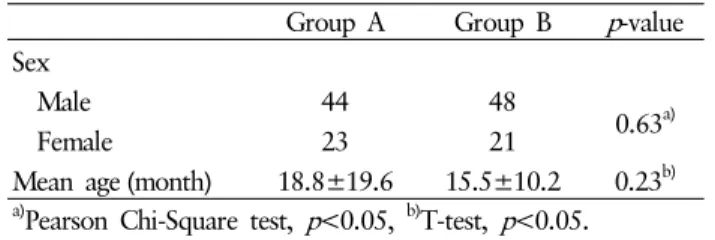
Table 1. Comparison of sex and mean age between group A and group B
Group A Group B p-value
Sex
Male 44 48
0.63a)
Female 23 21
Mean age (month) 18.8±19.6 15.5±10.2 0.23b)
a)Pearson Chi-Square test, p<0.05, b)T-test, p<0.05.
시켜 만든 1가 백신(RV1; Rotarix, GlaxoSmithKline Biologi- cals, Rixensart, Belgium)이 새로 개발되었고, 미국 식품의약국 과 우리나라 식품의약품안전처의 접종허가를 받아 현재 접종 되고 있다[4]. 하지만, 두 백신이 승인된 이후에 영유아들을 대상으로 한 최근의 연구들에서 두 백신의 접종은 창자겹침 증의 위험성이 있는 것으로 보고되고 있다[3,5-10]. 로타바이 러스 백신 접종 후 창자겹침증이 발병할 수 있는 위험성이 높은 시기에 대해서는 다양하게 보고되고 있다[3,5,11].
현재 우리나라에서 승인되어 접종되고 있는 로타바이러스 백신인 RotaTeq과 Rotarix는 각각 2007년 8월과 2008년 8월 부터 접종되기 시작하였으나, 우리나라 영유아를 대상으로 한 로타바이러스 백신 접종 후 창자겹침증 발생의 위험성에 대한 연구는 없는 실정이다. 이 연구에서는 후향적으로 창자 겹침증으로 진단받은 영유아들의 로타바이러스 예방 접종 유무와 백신 종류별로 창자겹침증의 평균 발병 연령 및 연령 분포를 비교하여, 로타바이러스 백신 접종이 창자겹침증 발 생에 영향을 미치는지를 알아보고자 하였다.
대상 및 방법
1. 대상
영남대학교 의료원에서 로타바이러스 백신 접종이 도입되 기 전 4년 동안(2003년 1월-2006년 12월) 창자겹침증으로 진단받은 환아와 로타바이러스 백신 접종이 도입된 후 4년 동안(2011년 1월-2014년 12월) 창자겹침증으로 진단받은 환아 중 로타바이러스 백신 접종을 받은 경우를 대상으로 하였다. 창자겹침증이 2번 이상 재발한 경우에는 처음 발생 한 연령만 포함하였으며, 창자겹침증의 선두가 될 수 있는 림프종, 멕켈 게실, 용종, 창자 중복과 같은 기저질환이 있는 경우는 제외하였다. 창자겹침증의 진단은 병력과 진찰소견이 창자겹침증이 의심되는 경우에 복부초음파로 확진하였다.
로타바이러스 예방 접종력은 병원정보전산시스템과 국가 예방접종도우미 사이트를 이용하여 각 환아들의 로타바이러 스 백신 접종 유무와 종류를 조사하였고, 로타바이러스 백신 접종 확인이 불확실한 경우는 제외하였다.
2. 방법
우리나라에 로타바이러스 백신이 출시되기 전 창자겹침증 을 진단받은 군(A군)과 로타바이러스 백신 출시된 후 진단받 은 군(B군)으로 나누었다. 또한 B군을 로타바이러스 백신 종 류에 따라 Rotarix 접종군(B-1군), RotaTeq 접종군(B-2군)으
로 나누어 창자겹침증의 평균 발병 연령과 분포를 비교 분석 하였다.
3. 통계
SPSS (version 22.0)를 이용하였으며, Pearson 카이제곱 검 정, Fisher의 정확한 검정, T 검정, Mann-Whitney 검정을 통 해 p-value가 0.05 미만인 경우를 유의 수준으로 정의하였다.
이 연구는 영남대학교병원 임상연구윤리위원회의 승인을 받 았다(YUMC-2015-09-010-002).
결 과
1. 로타바이러스 백신 접종 전과 후의 창자겹침증의 성별, 발병 연령 및 연령 분포
2003년부터 2006년까지 영남대학교 의료원에서 창자 겹침증으로 진단된 환아는 남자 44명(65.7%), 여자 23명 (34.3%)으로 총 67명(A군)이었다. 2011년부터 2014년까지 진단된 환아들 중 림프종으로 진단된 환아 1명을 제외하고, 총 69명(B군)이었으며, 이중 남자는 48명(69.6%), 여자는 21명 (30.4%)이었다. 두 군의 성별분포에는 차이가 없었고(p=0.63), A군의 평균 발병 연령은 18.8±19.6개월, B군의 평균 발병 연령은 15.5±10.2개월로 두 군 간의 평균 발병 연령은 통계 적으로 유의한 차이는 없었다(p=0.23, Table 1).
창자겹침증의 발병 연령분포는 A군에서는 7-12개월(37.3
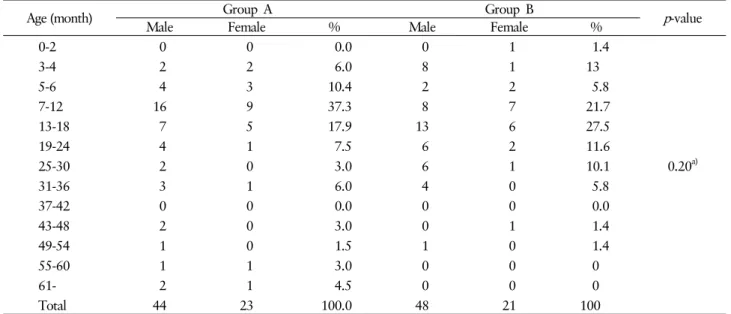
%), 13-18개월(17.9%), 5-6개월(10.4%) 순이었고, B군에서 는 13-18개월(27.5%), 7-12개월(21.7%), 3-4개월(13.0%) 순이 었으며, 통계적으로 유의한 차이를 보이지는 않았다(p=0.20, Table 2, Fig. 1).
2. 로타바이러스 백신 종류에 따른 창자겹침증의 성별, 발병 연령 및 연령 분포
Rotarix를 접종한 군(B-1군)과 RotaTeq을 접종한 군(B-2
Table 2. Comparison of distribution of age between group A and group B
Age (month) Group A Group B
p-value
Male Female % Male Female %
0-2 0 0 0.0 0 1 1.4
3-4 2 2 6.0 8 1 13
5-6 4 3 10.4 2 2 5.8
7-12 16 9 37.3 8 7 21.7
13-18 7 5 17.9 13 6 27.5
19-24 4 1 7.5 6 2 11.6
25-30 2 0 3.0 6 1 10.1 0.20a)
31-36 3 1 6.0 4 0 5.8
37-42 0 0 0.0 0 0 0.0
43-48 2 0 3.0 0 1 1.4
49-54 1 0 1.5 1 0 1.4
55-60 1 1 3.0 0 0 0
61- 2 1 4.5 0 0 0
Total 44 23 100.0 48 21 100
a)Pearson Chi-Square test, p<0.05.
Fig. 1. Comparison of distribution of age between group A and group B.
Table 3. Comparison of sex and mean age between group B-1 and group B-2
Group B-1 Group B-2 p-value
Sex
Male 17 31
0.91a)
Female 7 14
Mean age (month) 15.3±9.3 15.6±10.8 0.93b)
a)Pearson Chi-Square test, p<0.05, b)Mann-Whitney test, p<0.05.
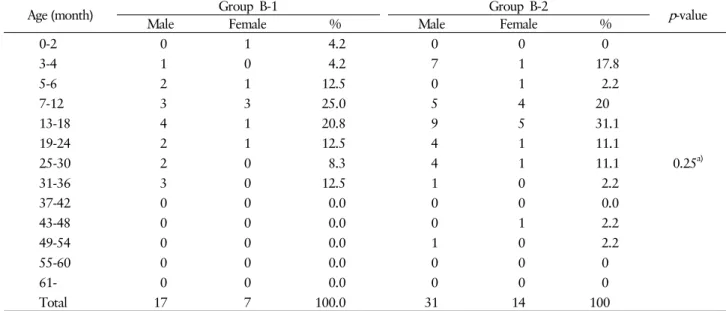
군), 이 두 군의 성별분포에는 차이는 없었으며(p=0.91), 평균 발병 연령은 B-1군 15.3±9.3개월, B-2군 15.6±10.8개월로 유의한 차이는 없었다(p=0.25, Table 3). 연령 분포는 B-1군 에서는 7-12개월(25%), 13-18개월(20.8%) 순이고, B-2군에 서는 13-18개월(31.1%), 7-12개월(20.0%) 순이었으며, 통계 적으로 유의한 차이를 보이지는 않았다(p=0.25, Table 4, Fig. 2).
3. 로타바이러스 백신 접종 후 30일 이내에 창자겹침증 이 발생한 경우
2011년부터 2014년까지 창자겹침증 진단을 받은 총 69명
의 환아 중 6명이 로타바이러스 백신 접종 후 30일 이내에 발생하였다. 이중 B-1군이 2명이었으며, 1차 접종 후 4일과 21일에 발생하였다. B-2군에서는 4명이 발생하였으며 2차 접종 후 2명, 3차 접종 후 2명이 발생하였다(Table 5).
고 찰
로타바이러스는 5세 미만의 영유아에서 발생하는 중증 설사질환의 주원인이지만, 그 유병률은 개인위생과 환경위생 의 개선으로도 감소되지는 않았다[2]. 따라서 백신을 통해 자연 감염과 같은 면역원성을 얻어 중등도 또는 중증의 로타바이 러스 감염을 예방하는 것이 최선의 방법이었다. 1998년 미국 Wyeth-Lederle사에서 4가 원숭이-사람 유전자 재배열 백신 (RRV-TV; RotaShield, Wyeth Laboratories, Inc., Marietta, PA, USA)을 개발하였고, 미국 식품의약국의 접종 허가를 받 아 2, 4, 6개월에 경구접종 하였다. 이후 로타바이러스 감염
Table 5. The onset period of intussusception after rotavirus vaccination
Patient No. Age (month) Vaccine type Onset day
1 2 Rotarix 4 days after 1st dose
2 3 Rotarix 21 days after 1st dose
3 4 RotaTeq 2 days after 2nd dose
4 4 RotaTeq 15 days after 2nd dose
5 6 RotaTeq 18 days after 3rd dose
6 8 RotaTeq 24 days after 3rd dose
Table 4. Comparison of distribution of age between group B-1 and group B-2
Age (month) Group B-1 Group B-2
p-value
Male Female % Male Female %
0-2 0 1 4.2 0 0 0
3-4 1 0 4.2 7 1 17.8
5-6 2 1 12.5 0 1 2.2
7-12 3 3 25.0 5 4 20
13-18 4 1 20.8 9 5 31.1
19-24 2 1 12.5 4 1 11.1
25-30 2 0 8.3 4 1 11.1 0.25a)
31-36 3 0 12.5 1 0 2.2
37-42 0 0 0.0 0 0 0.0
43-48 0 0 0.0 0 1 2.2
49-54 0 0 0.0 1 0 2.2
55-60 0 0 0.0 0 0 0
61- 0 0 0.0 0 0 0
Total 17 7 100.0 31 14 100
a)Fisher’s exact test, p<0.05.
Fig. 2. Comparison of distribution of age between group B-1 and group B-2.
으로 인한 중증 설사질환에 약 80% 이상의 매우 높은 예방효 과를 보였다[2,12]. 하지만 접종 후 창자겹침증 발생 증가로 인해 1999년 10월 생산이 중단되었다[2]. 이후, 사람과 소에 서 분리된 로타바이러스를 재배열하여 약독화시킨 5가 백신 과 사람에게서 분리된 로타바이러스 G1P1A를 약독화시켜 만든 1가 백신이 2세대 로타바이러스 백신으로 새로 개발되 었고, 미국 식품의약국과 우리나라 식품의약품안전처의 접종 허가를 받아 현재 접종되고 있다[4]. 2006년, 이 두 백신에 대한 대규모 임상 연구에서 백신의 효과와 접종 후 창자겹침 증 발병에 대한 안정성이 보고되었다[3,13-15]. 이후 2009년, WHO에서는 전세계적으로 국가 예방접종 프로그램에 두 로타 바이러스 백신으로 예방접종을 시행하도록 권장하였다[16].
하지만 이 두 백신에 대해서 접종 후 창자겹침증 발생 위험
성 증가에 대해서는 아직까지도 많은 연구들이 진행되고 있 고, RotaTeq 접종 후 이루어진 연구에서도 그 위험성 증가는 계속 보고되고 있다[3,5-8]. 2012년 멕시코에서 이루어진 Velazquez 등[9]의 연구에서는 Rotarix 접종 후 31일 이내 창자겹침증의 상대적 발생률이 1.75배, 1주일 내에는 6.49배 로 높았다. 2015년 Yung 등[10]이 2005년에서 2012년 사이 12개월 미만의 싱가포르 영아들을 대상으로 한 연구에서 Rotarix 백신 접종 후 7일 이내에 창자겹침증의 위험도는 접종하지 않은 환아에 비해 약 8배 높았다. 미국에서 Yih 등[5]이 2004년부터 2011년까지 U.S. health insurance plans 3곳에 등록된 영아들을 대상으로 한 연구에서는 RotaTeq 백신 첫 접종 후 7일 이내에는 창자겹침증 발생 위험도가 9.1배, 첫 접종 후 21일 이내에는 4.2배로 높았다.
다른 연구들처럼 로타바이러스 백신으로 인한 창자겹침증 의 발생 위험도는 모집단의 로타바이러스 접종률과 창자겹 침증의 발생률 등이 필요하다. 하지만, 본 연구는 단일 기관
의 연구라는 점에 한계가 있어, 본원에 내원한 창자겹침증 환아들을 대상으로 로타바이러스 백신 접종의 유무에 따라 연령 분포의 차이를 비교하여 간접적으로 로타바이러스 백 신이 창자겹침증에 영향을 미치는지 알아보고자 하였다. 로 타바이러스 백신 접종을 하지 않은 군과 접종을 한 군 간에 창자겹침증의 평균 발병 연령에는 유의한 차이가 없었다.
또한 연령별로 군을 나누어 접종 전과 후의 연령분포를 비교 해보아도 통계적으로는 유의한 차이를 보이지 않았다. 하지 만 1차 접종과 2차 접종 사이의 시기이면서 창자겹침증의 호발연령이 아닌 4개월 이하 군에서 비교해봤을 때 접종군은 전체의 14.4%, 비 접종군은 전체의 6%로 통계적으로 유의 하지는 않았지만 로타바이러스 백신 접종군이 더 많았다.
현재까지 이루어진 여러 연구들의 결과로 보면, 로타바이러 스 백신 접종이 호발연령이 아닌 시기의 창자겹침증의 발병 을 증가시키는 데 영향이 있을 것으로 추정해 볼 수 있지만, 본 연구의 규모가 작아 우리나라 영아 전체를 대상으로 한 연구가 필요할 것으로 생각된다.
여러 연구에서 2세대 로타바이러스 백신 접종 후에도 창 자겹침증의 유병률이 가장 높아지는 시기는 첫 접종 후 7일 이내 또는 30일 이내였다[3,5,17]. 본 연구에서는 로타바이 러스 백신 접종을 한 환아 총 69명 중 6명인 약 9%의 환아에 서 백신 접종 후 30일 이내에 발병하였다. 이 중 Rotarix를 접종한 환아 2명이 1차 접종 후 4일, 21일에 발생하였고, RotaTeq를 접종한 환아 4명이 2차 접종 후 각각 2일과 15일, 3차 접종 후 18일과 24일에 창자겹침증이 발생하였다.
결론적으로 로타바이러스 백신 접종 전과 후에 창자겹침 증의 평균 발병연령과 연령분포에 통계적으로는 유의한 차 이가 없었다. 하지만 본 연구는 단일기관연구이어서 연구대 상이 제한적이었고, 후향적 연구로 예방접종력이 정확하지 않아 제외된 대상이 많았다는데 제한점이 있다. 추후 우리나라 영아들 전체를 대상으로 한 조사가 더 필요할 것으로 생각된다.
REFERENCES
1. Parashar UD, Cortese MM, Payne DC, Lopman B, Yen C, Tate JE. Value of post-licensure data on benefits and risks of vaccination to inform vaccine policy: the example of rotavi- rus vaccines. Vaccine 2015;33(Suppl 4):D55-9.
2. Dennehy PH. Rotavirus vaccines--an update. Vaccine 2007;
25:3137-41.
3. Rha B, Tate JE, Weintraub E, Haber P, Yen C, Patel M, et al. Intussusception following rotavirus vaccination: an updated review of the available evidence. Expert Rev Vaccines 2014;
13:1339-48.
4. Kim CH. Up-to-date knowledge of rotavirus vaccine. J Soonchunhyang Med Sci;14:143-52. Korean.
5. Yih WK, Lieu TA, Kulldorff M, Martin D, McMahill-Walraven CN, Platt R, et al. Intussusception risk after rotavirus vacci- nation in U.S. infants. N Engl J Med 2014;370:503-12.
6. Escolano S, Farrington CP, Hill C, Tubert-Bitter P. Intussus- ception after rotavirus vaccination--spontaneous reports. N Engl J Med 2011;365:2139.
7. Escolano S, Hill C, Tubert-Bitter P. Intussusception risk after RotaTeq vaccination: evaluation from worldwide spontaneous reporting data using a self-controlled case series approach.
Vaccine 2015;33:1017-20.
8. Weintraub ES, Baggs J, Duffy J, Vellozzi C, Belongia EA, Irving S, et al. Risk of intussusception after monovalent rotavirus vaccination. N Engl J Med 2014;370:513-9.
9. Velázquez FR, Colindres RE, Grajales C, Hernández MT, Mercadillo MG, Torres FJ, et al. Postmarketing surveillance of intussusception following mass introduction of the attenu- ated human rotavirus vaccine in Mexico. Pediatr Infect Dis J 2012;31:736-44.
10. Yung CF, Chan SP, Soh S, Tan A, Thoon KC. Intussusception and monovalent rotavirus vaccination in Singapore: self-con- trolled case series and risk-benefit study. J Pediatr 2015;167:
163-8.e1.
11. Clark A, Jit M, Andrews N, Atchison C, Edmunds WJ, Sanderson C. Evaluating the potential risks and benefits of infant rotavirus vaccination in England. Vaccine 2014;32:
3604-10.
12. Murphy TV, Gargiullo PM, Massoudi MS, Nelson DB, Jumaan AO, Okoro CA, et al. Intussusception among infants given an oral rotavirus vaccine. N Engl J Med 2001;344:564-72.
13. Ruiz-Palacios GM, Pérez-Schael I, Velázquez FR, Abate H, Breuer T, Clemens SC, et al. Safety and efficacy of an attenu- ated vaccine against severe rotavirus gastroenteritis. N Engl J Med 2006;354:11-22.
14. Vesikari T, Karvonen A, Prymula R, Schuster V, Tejedor JC, Cohen R, et al. Efficacy of human rotavirus vaccine against rotavirus gastroenteritis during the first 2 years of life in European infants: randomised, double-blind controlled study.
Lancet 2007;370(9601):1757-63.
15. Vesikari T, Matson DO, Dennehy P, Van Damme P, Santosham M, Rodriguez Z, et al. Safety and efficacy of a pentavalent human-bovine (WC3) reassortant rotavirus vaccine. N Engl J Med 2006;354:23-33.
16. Rotavirus vaccines: an update. Wkly Epidemiol Rec 2009;84:
533-40.
17. Anderson EJ, Sederdahl BK. Intussusception risk increased after rotavirus vaccination but outweighed by benefits. Evid Based Med 2014;19:191-2.