• 검색 결과가 없습니다.

A Case Report of a Proprioceptive Neuromuscular Facilitation Intervention Strategy Applied with an ICF Tool in a Patient with Anterior Cruciate Ligament Reconstruction

N/A
N/A
Protected

Academic year: 2021

Share "A Case Report of a Proprioceptive Neuromuscular Facilitation Intervention Strategy Applied with an ICF Tool in a Patient with Anterior Cruciate Ligament Reconstruction"

Copied!
11
0
0

로드 중.... (전체 텍스트 보기)

전체 글

(1)

| Abstract |

Purpose: The purpose of this study was to use an ICF tool in an intervention for anterior cruciate ligament reconstruction (ACLR) patients to examine and evaluate the patients’ functional problems, measure the results of the intervention, and present the process of preparing proprioceptive neuromuscular facilitation (PNF) intervention strategies, thereby contributing to changes in and development of relevant future clinical practices.

Methods: A PNF rehabilitation exercise program using an ICF tool was applied to ACLR patients five times per week for four weeks. To measure the resulting changes, the ICF evaluation display, the visual analog scale (VAS), the manual muscle test (MMT), the range of motion (ROM) test, the Lysholm knee score (LKS), and the muscle endurance test (MET) were used.

Results: After the intervention was applied to the ACLR patients, improvements were achieved in all the tests: ICF evaluation display, VAS, MMT, ROM, LKS, and MET.

Conclusion: Utilizing the ICF tool, this study identified functional problems of ACLR patients. When the intervention was applied, physical functions improved, and structural damage was reduced, leading to enhanced levels of functional activities such as postural changes, posture maintenance, gait, movements, and movements between different places. The patients were able to complete the teacher training, which was their goal.

Key Words: ACL, ACLR, ICF, Knee joint, PNF

†Corresponding Author : Beom-Ryong Kim ([email protected])

Review Article Open Access

ICF 도구를 적용한 앞십자인대 재건술 환자의 고유수용성신경근촉진법 중재전략의 증례

송명수⋅김범룡

1†

⋅김창헌

1

⋅노현정

1

⋅강미경

11)

Dr. Song’s 재활과학연구소,

1

대자인병원 재활센터

A Case Report of a Proprioceptive Neuromuscular Facilitation Intervention Strategy Applied with an ICF Tool in a Patient with Anterior Cruciate Ligament Reconstruction

Myung-Soo Song⋅Beom-Ryong Kim

1†

⋅Chang-Heon Kim

1

Hyun-Jeong Noh

1

⋅Mi-Gyeong Kang

1

Dr. Song’s Rehabilitation Institute of Science and Academy

1
Department of Physical Therapy, Design Hospital Received: January 1, 2017 / Revised: February 16, 2017 / Accepted: February 16, 2017

ⓒ 2017 Journal of Korea Proprioceptive Neuromuscular Facilitation Association

This is an Open Access article distributed under the terms of the Creative Commons Attribution Non-Commercial License

(http://creativecommons.org/licenses/by-nc/3.0) which permits unrestricted non-commercial use, distribution, and reproduction

in any medium, provided the original work is properly cited.

(2)

Ⅰ. 서 론

무릎관절의 앞십자인대(anterior cruciate ligament, ACL) 손상은 넙다리뼈에 대한 정강뼈의 과신전과 안 쪽돌림에 의해 발생빈도가 높다 (Lee & Lim, 2009). 손 상 이후 치료시기 지연과 방치 등은 무릎관절 내부 구조물의 기능 저하와 뒤십자인대(posterior cruciate ligament, PCL), 반달연골(meniscus)의 동반손상을 유 발시킨다 (Brosky et al., 1999). ACL 손상은 2차적으로 무릎관절의 불안정성과 감각운동계의 저하(Trulsson et al., 2010), 근력과 관절가동범위의 제한, 관절의 섬유 화 (Wilk et al., 2003), 신체 기능과 구조의 손상 및 활동 제한의 문제를 발생시킨다(Papandreou et al., 2009).

위와 같은 원인과 손상의 정도에 따라 침습적인 방법으로 앞십자인대 재건술(anterior cruciate ligament reconstruction, ACLR)을 시행한다. ACLR은 자가건 (autogenous graft)과 타가건(allogenous graft) 이식을 통 한 수술 방법으로, 현재 ACLR은 ACL 손상 후의 무릎 관절의 기능 회복에 관한 최상의 모델로 여겨지고 있 다(Tanaka et al., 2010). ACLR로 인해 수술 후 빠른 회복과 관절가동범위 확보 및 체중부하가 가능해졌으 며, 수술 후 재활운동프로그램이 보편화됨에 따라 손 상 전으로의 복귀에 많은 도움을 주고 있다 (Lee & Lim, 2009). 또한 재활과정은 점차 가속재활 프로그램을 통 해 적극적인 근관절 기능과 운동수행능력의 회복을 요구하는 비중이 점차 높아지고 있다(Isberg et al., 2006).

이와 같이 환자를 재활하는데 있어서 환자의 활동 수준을 파악하고 기능적인 문제점을 파악하여 중재하 는 것이 중요하다. WHO (2001)는 국제기능, 장애, 건 강분류(international classification of functioning, disability and health, ICF)를 통해서 건강과 건강관련 상태를 정의하고 국제적으로 표준화된 공통된 용어를 제공하였다. ICF 평가 시트(assessment sheet)는 임상실 기에서 환자의 기능적인 문제점과 이를 발생시키는 원인 사이의 상호작용을 찾는데 용이하며 (Rauch et al., 2010), ICF 평가 디스플레이(evaluation display)는 목표

와 중재목표가 포함되어 중재 전과 후에 환자의 기능 적인 문제의 변화된 결과를 한눈에 파악할 수 있어 다 영역 전문가들 간에 협의가 가능하다(Rundell et al., 2009).

고 유 수 용 성 신 경 근 촉 진 법( p r o p r i o c e p t i v e neuromuscular facilitation, PNF)의 철학 중 기능적 접근 은 환자가 원하는 수준의 기능회복에 맞춰 ICF를 이용 한 치료와 평가를 포함하고 있다. 또한 PNF은 근육, 힘줄, 인대, 관절, 피부 내의 감각수용기를 자극하여 기능을 향상시키며 (Klein et al., 2002), 근력과 관절가 동범위의 신체 기능을 증가시키는 기법으로(Kim &

Kim, 2013; Lee & Kim, 2013), 근육, 뼈, 관절의 근골격 계 환자의 기능 향상에 널리 사용되고 있다(Kofotolis

& Kellis, 2006; McMullen & Uhl, 2000).

ICF는 임상에서 환자의 건강관련 정보를 파악하여 고객의 기능적인 문제점을 파악하고 평가할 수 있을 뿐만 아니라 중재를 구조화하도록 도와줄 수 있으며 , 문제점을 해결하는 접근법으로도 효과적으로 이용될 수 있다. 하지만 대부분의 국내의 치료사들은 임상에 서 표준화된 공통된 용어를 사용하여 환자의 문제점 을 파악하고 평가하지 않을 뿐만 아니라 문제 해결에 필요한 중재전략을 작성하지 않고 있는 실정이다 (Yun

& Kim, 2011). 국내에서 ICF 도구(tool)를 임상실기에 적용한 연구는 신경계 환자를 대상으로 연구가 진행 되고 있으나 근골격계 환자를 대상으로 한 연구는 거 의 없는 실정이다(Kong et al., 2011).

따라서 본 연구의 목적은 ACLR 환자를 중재하는

과정에서 ICF 도구를 사용하여 환자의 기능적인 문제

에 대한 검진과 평가 및 결과 측정을 실시하고 PNF

중재전략을 작성하는 과정을 제시함으로서 향후 임상

적 상황에서 치료적 목표에 의한 중재행위를 실시할

수 있는 기틀을 제공하고자 한다.

(3)

Ⅱ. 연구방법

1. 검진

1) 연구대상자의 병력 및 특성

(1) 개인정보

29세의 남성 환자로 키 182cm, 체중 76kg.

(2) 진단명과 과거력

2016년 6월 8일 ACL 파열 진단 받은 환자로 J병원으 로 응급 후송되어 6월 10일 우측 무릎 ACLR를 시행하 고 , 재활을 위해 2016년 6월 27일 D병원으로 전원 하였 다. 과거력은 2008년 12월 좌측 무릎 ACLR를 받았다.

(3) 환경과 사회적 정보

고등학교 선생님으로 일과 후에는 학생들과 농구 를 즐겨하였으며, 과거에도 농구시합을 하던 중 좌측 무릎 ACL 파열을 경험하였다. 2016년 8월에 교사연수 에 참석을 해야 한다.

(4) 고객의 요구와 태도

환자는 수술 후 재활에 관한 정보와 지식을 잘 이해 하고 있으며, 빠른 회복을 위해 재활운동의 필요성을 알고 있었다 . 회복 후 교사연수를 꼭 참석하기를 희망 하고 있다.

(5) 가족의 지원과 태도

환자의 경제적인 능력이 재활운동과정에 긍정적인 영향을 미칠 것으로 파악하였다.

2) 검사 및 측정

ICF 핵심지표(core set)을 이용하여 신체 기능과 신 체 구조의 변화를 파악하기 위하여 다음과 같은 검사 와 측정을 하였다.

(1) 감각 검사

일반적인 감각이나 우측 무릎의 고유수용성감각은 정상이었다.

(2) 통증 검사

우측 무릎의 통증을 알아보기 위하여 시각사상척 도(visual analog scale, VAS)를 사용하여 측정하였으 며, 검사 재검사 간 신뢰도 r=0.99이다(Wagner et al., 2007). 측정결과 평상시 VAS 3점, 보행 VAS 5점, 야간 VAS 5점을 나타났다.

(3) 근력 및 관절가동범위 검사

근력은 도수근력검사(manual muscle test, MMT)를 사용하여 측정하였으며, 측정자 간 신뢰도 r=0.99이다 (Fan et al., 2010). 관절가동범위(range of motion, ROM) 는 각도계 (EZ Read Jamar® Goniometer, Patterson Medical, USA)를 사용하여 측정하였으며, 측정자 간 신뢰도 r=0.89이다(Lenssen et al., 2007). 측정결과 다리 의 엉덩관절 굽힘근 fair, 폄근, 벌림근, 모음근 poor+, 무릎관절 굽힘근 poor, 폄근 poor+였다. 우측 무릎의 굽힘은 AROM 55°, PROM 70°으로 나타났으며 폄은 제한이 없었다.

(4) 불안정성 검사

우측 무릎의 불안정성을 알아보기 위하여 불안정 성 검사 (Lysholm knee score, LKS)을 사용하여 평가하 였으며, 검사 재검사 간 신뢰도 r=0.82이다(Celik et al., 2013). 평가결과 LKS은 25점 만점 5점(일상생활에도 자주 느낌 )으로 나타났다.

(5) 근지구력 측정

근지구력 측정 (muscle endurance test, MET)은 근육

군에 대해서 중력에 영향을 받는 자세에서 유지시간

을 측정하였다. 측정결과 엉덩관절의 굽힘근, 폄근,

벌림근, 모음근 유지시간은 15초 이상을 유지하지 못

하였다 . 무릎관절 폄근은 10초 이상, 굽힘근은 55°까지

굽혔지만 5초 이상을 유지하지 못하였다.

(4)

2. 평가

근골격계 손상 환자를 위한 ICF 핵심지표 (Bossmann et al., 2011; Kirschneck et al., 2011)을 사용하 여 신체 기능과 구조의 변화뿐만 아니라 , 환자의 기능 적인 문제점을 파악하기 위해 활동과 참여 영역에서 능력과 수행력을 파악하고, 이에 영향을 주는 환경적 요소와 개인적 요소를 ICF로 코드화 하였다.

1) 신체적 기능

신체기능에서 감각 기능과 통증은 무릎관절 통증 에서 중도의 손상(b28016.2)을 호소하였다. 신경근육 골격 및 운동과 연관된 기능은 무릎관절의 가동성에 서 고도의 손상(b7100.3)을 호소하였고, 한 관절의 안 정성에서 고도의 손상(b7150.3)을 호소하였다. 무릎 주위 분리된 근육과 근육군의 근력에서 고도의 손상 (b7300.3)을 호소하였고, 분리된 근육의 지구력에서 고도의 손상(b7400.3)을 호소하였다. 보행 형태 기능 에서도 고도의 손상(b770.3)을 호소하였다. 나머지 신 체 기능에는 손상이 없는 것으로 파악하였다.

2) 신체의 구조

신체구조에서는 우측 무릎 ACLR를 시행하여 하퇴 부 근육의 고도의 손상 (s75012.113)과 인대 및 근막의 고도의 손상(s75013.113)을 호소하였다. 나머지 신체 구조에는 손상이 없는 것으로 파악하였다.

3) 기능적인 문제 파악

환자의 기능적인 문제점을 알아보기 위해 ICF 핵심 지표를 활용하여 활동과 참여 영역에서 능력과 수행 력을 파악하고, 이에 영향을 주는 환경적 요소와 개인 적 요소들을 ICF로 코드화 하였다.

(1) 활동 제한과 참여 제약

이동(mobility) 영역의 기본적인 자세 변화 항목에 서 앉기(d4103.33)와 기립(d4104.33)에서 제한이 있었 다. 자세 유지 항목에서 앉기 자세 유지(d4153.33)와 기립 자세 유지(d4154.23)에서 제한이 있었다. 보행

항목에서 단거리 보행 (d4500.23)과 상이한 지면 보행 (d4502.23) 및 장애물 선회 보행(d4503.33)에서 제한이 있었다. 이동 항목에서 오르기(d4551.44)에서 제한이 있었다. 상이한 장소의 이동 항목에서 집을 제외한 건물 내 이동(d4601.23)과 집 그리고 여타 건물 외부에 서의 이동 (d4602.33)에서 제한이 있었다.

(2) 환경적 및 개인적 요소

환경적 요소로 개인 일상생활 용품 및 기술항목에 서 목발과 보조기 사용이 환자의 활동에 긍정적인 영 향(e115.+3)을 미치는 것으로 파악하였다. 가정의 경 제력은 병원에서 집중적 입원치료 하는데 있어서 긍 정적인 영향(e165.+3)을 미치는 것으로 파악하였다.

지원과 관계에서 직계가족들의 적극적인 지원이 긍정 적인 영향(e310.+3)을 미치는 것으로 파악하였다. 개 인적 요소로는 평생에 한 번뿐인 교사연수를 잘 마쳐 야한다는 목표가 재활의 의지에 높은 촉진요인으로 작용하고 있다고 파악하였다.

3. 진단

ICF 핵심지표를 활용하여 환자의 요구사항과 기능

적 문제 파악뿐만 아니라 무릎과 관련된 검사 및 측정

을 통해서 진단하였다 . 진단 결과, 신체 기능과 구조적

측면에서는 관절 통증 (b28016.2)과 한 관절의 가동성

저하(b7100.3), 한 관절의 안정성 저하(b7150.3), 분리

된 근육과 근육군의 근력 약화(b7300.3), 분리된 근육

의 지구력 저하(b7400.3) 그리고 보행 형태 기능 손상

(b770.3)과 같은 항목들의 문제점을 발견하였으며 이

러한 문제점으로 인하여 활동과 참여 항목에도 영향

을 미치게 되었는데 그 문제점들을 살펴보면 , 기본적

인 자세 변화의 앉기(d4103.33)와 기립(d4104.33), 자세

유지의 앉기 자세 유지(d4153.33), 기립 자세 유지

(d4154.23), 보행의 단거리 보행(d4500.23), 상이한 지

면 보행(d4502.23) 및 장애물 선회 보행(d4503.33), 이

동의 오르기(d4551.44), 상이한 장소이동에서 집을 제

외한 건물 내 이동(d4601.23) 그리고 집과 여타 건물

외부에서의 이동 (d4602.33)을 수행하는데 어려움이

(5)

있는 것으로 진단하였다.

4. 예후

1) 장기 목표

환자는 4주 후 8월에 교사연수를 참석하여 불편함 없이 독립적으로 생활 할 수 있다.

2) 단기 목표

(1) 기본적인 자세의 변화와 유지

무릎관절 통증의 정도를 VAS를 통해 측정한 평상 시 VAS 3점에서 1점 이하, 보행 VAS 5점에서 1점 이하, 야간 VAS 5점에서 1점 이하로 한다.

무릎관절의 ROM을 측정한 우측 무릎의 굽힘은 AROM 55°에서 125°이상, PROM 70°에서 135°이상으 로 한다.

(2) 보행

무릎관절의 LKS은 25점 만점 5점(일상생활에도 자 주 느낌)에서 20점(운동이나 무리한 일을 할 경우만

가끔 느낌 )으로 한다.

(3) 이동과 상이한 장소로의 이동

다리의 근력은 MMT를 사용하여 측정한 다리의 엉 덩관절 굽힘근 fair은 good이상, 폄근과 벌림근 및 모음 근 poor+은 fair+이상, 무릎관절 굽힘근 poor은 fair이 상, 폄근 poor+은 fair+이상으로 한다.

다리의 MET은 근육군에 대해서 중력에 영향을 받 는 자세에서 유지시간을 측정한 엉덩관절의 굽힘근, 폄근 , 벌림근, 모음근 유지시간은 15초대에서 60초 이 상 , 무릎관절 폄근은 10초대에서 45초 이상, 무릎관절 굽힘근은 55°를 유지하여 5초대에서 30초 이상으로 한다.

5. 중재

중재는 4주간, 주 5회, 1일 2시간정도 시행하였다.

환자의 요구사항을 근거로 기능적인 문제와 관련된 검사 및 측정을 통해 필요한 운동을 Shaw 등(2005)과 Fleming 등(2005)이 제시한 재활 프로그램을 바탕으로 PNF에 기초하여 2단계의 점진적 재활운동프로그램 을 작성하였다. 0∼2주에서는 관절가동범위 확보, 등

Type Exercise

Method Goals

Position Pattern Technique

Warm-up Supine, Side

lying, Prone Stretching HR 10minute Prevention of injury,

decreased of pain Joint

mobilization Supine Continuous passive motion RI 30minute Increased of ROM(passive)

PNF exercise

Long sitting Flexion-adduction-external and

extension-abduction-internal RS 10sec./5th/5set Increased of stability

Long sitting Knee extension, flexion HR 10sec./5th/5set

Increased of ROM(passive), decreased

of pain Supine Hip flexion, extension,

abduction, and adduction RS 10sec./5set Increased of stability and endurance Long sitting Bend push of knee extension RS 10sec./5th/5set Increased of stability Cool-down Supine, Side

lying, Prone Stretching HR 10minute Prevention of injury,

decreased of pain

HR : Hold-relax, RI : Rhythmic initiation, RS : Rhythmic stabilization, SR : Stabilizing reversal, ROM : Range of motion

Table 1. PNF rehabilitation exercise program(0∼2 weeks)

(6)

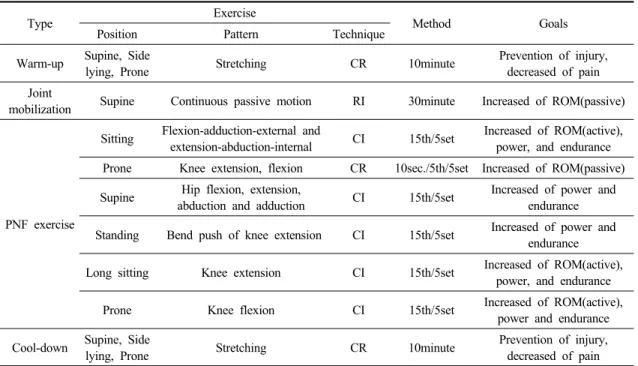
척성 운동을 통한 안정성과 근지구력 향상, 부종과 통증 감소를 목표로 하였다. 3∼4주에서는 완전한 관 절가동범위 확보, 등장성 혼합을 통한 근지구력 및 근력 향상, 고유수용감각회복을 목표로 실시하였다 (Table 1)(Table 2).

Ⅲ. 결과

앞십자인대 재건술 환자에 대한 중재 전과 후 무릎 관절 통증(VAS), 관절가동범위(ROM), 불안정성 (LKS), 근력(MMT), 근지구력(MET)의 변화를 평가한

Tests Pre-test Post-test

VAS (score) Rest/walk/night 3/5/5 0/1/1

ROM (°) AROM/PROM 55/70 130/140

LKS (score) 5 20

MMT Hip Flexor/extensor/

abductor/adductor

Fair/poor+/

poor+/poor+

Good/good/

good/good

Knee Flexor/extensor Poor/poor+ Fair+/good

MET (sec.) Hip Flexor/extensor/

abductor/adductor 15/15/15/15 60/60/60/60

Knee Flexor/extensor 5/10 60/60

VAS : Visual analog scale, ROM : Range of motion, AROM : Active range of motion, PROM : Passive range of motion, LKS : Lysholm knee score, MMT : Manual muscle test, MET : Muscle endurance test.

Table 3. Result of a change pre and post test goal achievement

Type Exercise

Method Goals

Position Pattern Technique

Warm-up Supine, Side

lying, Prone Stretching CR 10minute Prevention of injury,

decreased of pain Joint

mobilization Supine Continuous passive motion RI 30minute Increased of ROM(passive)

PNF exercise

Sitting Flexion-adduction-external and

extension-abduction-internal CI 15th/5set Increased of ROM(active), power, and endurance Prone Knee extension, flexion CR 10sec./5th/5set Increased of ROM(passive) Supine Hip flexion, extension,

abduction and adduction CI 15th/5set Increased of power and endurance Standing Bend push of knee extension CI 15th/5set Increased of power and

endurance Long sitting Knee extension CI 15th/5set Increased of ROM(active),

power, and endurance

Prone Knee flexion CI 15th/5set Increased of ROM(active),

power and endurance Cool-down Supine, Side

lying, Prone Stretching CR 10minute Prevention of injury,

decreased of pain HR : Hold-relax, RI : Rhythmic initiation, RS : Rhythmic stabilization, SR : Stabilizing reversal, CR : Contract-relax, CI : Combination of isotonics, ROM : Range of motion

Table 2. PNF rehabilitation exercise program (2∼4 weeks)

(7)

Assessment Evaluation(2016.06.28.) Evaluation(2016.07.26.) Global Goal : Teacher training

Service-Program-goal : Safely without crutches and braces for teacher training Cycle goal 1 : d410, d415; Changing basic body position and maintain Cycle goal 2 : d450; Walking Cycle goal 3 : d455, d460; Moving around and moving around in different location

ICF Categories - Intervention Targets ICF Qualifier

Goal relation

Goal value

ICF Qualifier Goal achleve

-ment

Problems Problem

0 1 2 3 4 0 1 2 3 4

b2806.2 Pain in joints Goal +

b7100.3 Mobility of a single joint Goal +

b7150.3 Stability of a single joint Goal +

b7300.3 Power of isolated muscles and

muscle groups Goal +

b7400.3 Endurance of isolated muscles Goal +

d4103.33 Sitting CG1 +

d4104.33 Standing CG1 +

d4153.33 Maintaining a sitting position CG1 +

d4154.23 Maintaining a standing position CG1 +

d4500.23 Walking short distances CG2 +

d4502.23 Walking on different surfaces CG2 +

d4503.33 Walking around obstacles CG2 +

d4551.33 Climbing CG3 +

d4601.23 Moving around within building

other than home CG3 +

d4602.33 Moving around outside the

home and other buildings CG3 +

facilitator barrier facilitator barrier 4+ 3+ 2+ 1+ 0 1 2 3 4 4+ 3+2+1+0 1 2 3 4 e115.+3 Products and technology for

personal use in daily living e165.+3 Asset

e310.+3 Immediate family

influence of personal factor

influence of personal factor positive neutral negative positive neutral negative Intention to rehabilitation +3

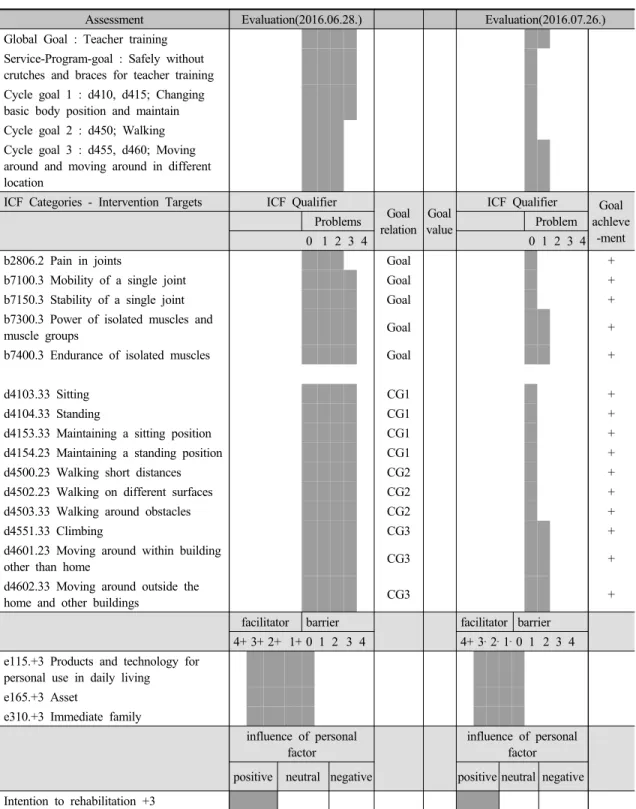
Table 4. ICF evaluation display

(8)

결과 (Table 3)와 같다. ICF의 평가치를 이용하여 중재 전과 후 신체 구조와 기능의 변화를 평가한 결과 (Table 4)와 같다.

Ⅳ. 고찰

본 연구는 ACLR 후 재활과정에서 ICF를 활용하여 임상추론과정을 통해 환자의 문제점 파악과 장⋅단기 목표 설정 및 중재전략 작성을 통해서 무릎재활을 위 한 임상실기과정의 유용한 자료를 제시하고자 시행하 였다.

ICF는 신체 기능과 구조, 활동과 참여, 배경요인 영역으로 약 1,400여개의 항목으로 구성되어 있으며, 체계적이고 표준화된 방법으로 환자의 기능수행과 장 애를 포괄적으로 표현하고 분류할 수 있다(WHO, 2001). WHO에 의해 개발된 ICF는 손상에서 장애에 이르는 과정을 한 방향으로 표현하던 이전의 Nagi 모 델과 WHO의 국제장애분류(international classification of impairments, disabilities, and handicaps, lCIDH) 모델 과 다르게 이들 영역의 요인들이 개인요인을 포함하 여 양방향으로 서로 영향을 줄 수 있다고 설명하고 있다 . 또한 환경요인은 개인의 기능수행 정도에 촉진 요소나 장애요소로 될 수 있다고 설명하여 환경요인 의 중요성을 제시하고 있다 (WHO, 2002). 임상에서 환 자의 기능수행 정도를 표현하는데 ICF의 활용을 촉진 하기 위해 뇌졸중 , 관절염, 요통 등 질환별 ICF 핵심지 표가 보고되고 있으며 이는 환자의 기능수행에 있어 해당 질병의 전형적인 문제를 표현할 수 있는 신체 기능과 구조, 활동과 참여, 배경요인의 ICF 항목들로 구성되어있다(Campos et al., 2012; Mullis et al., 2007;

Stucki & Cieza, 2004).

본 연구에서는 ACLR 환자의 기능적인 문제점을 파악하기 위해 ICF 핵심지표를 활용하여 신체 기능과 구조 손상 , 활동 제한과 참여 제약 요인들에 대한 환경 과 개인 요인들을 ICF 평가 시트를 활용하여 상호작용 을 파악하고 문제의 우선순위를 결정하였고 , ICF 평가

디스플레이를 활용하여 중재 전과 후 동안의 기능적 인 문제점들의 변화된 결과를 제시하였다.

ICF 평가 시트의 활용은 환자의 활동과 참여 관점에 서 나는 보행 보조도구 없이 무사히 평생에 한번뿐인 교사연수를 정상적인 모습으로 마치고 싶다. 하지만 앉고 일어서기 , 앉고 서있는 자세 유지, 실내⋅외에서 걷기, 계단 오르고 내리기와 실내외 상이한 지면과 다양한 환경에서 걷기에 어려움을 호소하였다. 이와 같은 정보를 바탕으로 건강을 관리하는 물리치료사 입장에서 ICF 핵심지표를 활용하여 활동과 참여 항목 의 기본적인 자세 변화 , 자세 유지, 보행, 이동, 상이한 장소의 이동의 항목에서 활동 제한과 참여 제약 요인 을 파악하였다. 또한, 환자의 활동과 참여에 있어서 신체 기능과 구조 관점에서는 무릎에 통증, 무릎 굽힘 의 어려움, 무릎의 불안정성, 다리 힘의 저하, 목발로 인한 걷기의 불편함을 호소하였다 . 이와 같은 정보를 바탕으로 ICF 핵심지표를 활용하여 신체 기능과 구조 항목의 통증 감각 , 관절의 가동기능, 관절의 안정기능, 근력 기능 , 근지구력 기능, 보행 형태 기능, 하지 구조 의 손상을 파악하였다 . 또한 신체 기능과 구조의 손상 이 감소가 된다면 자세 변화, 자세 유지, 보행, 이동, 상이한 장소 이동의 기능적 활동이 해결될 것으로 판 단되어 신체 기능과 구조의 양적인 평가를 위하여 무 릎관절의 통증, 근력 및 관절가동범위, 불안정성, 근지 구력 검사를 실시하여 환자분에 대한 정보를 더욱 정 확하게 파악하여 중재 전과 후를 비교하였다.

ICF 평가 시트와 신체 기능과 구조의 양적 평가를

바탕으로 PNF에 기초하여 2단계의 점진적인 재활운

동프로그램을 작성하였다. 0∼2주에서는 무릎관절 굽

힘에 대한 짧아진 근육과 협력근에 대해 직⋅간접적

으로 유지-이완 기법을 적용하여 수동적 관절가동범

위 확보와 통증 및 부종 감소를 목적으로 적용하였으

며 , 무릎관절에 대한 불안정을 감소시키기 위하여 무

릎관절 주위근육에 대하여 율동적 안정화 기법을 적

용하여 교대적인 등척성 수축을 통해 안정성 , 근지구

력 향상을 목적으로 적용하였다. 3∼4주에서는 무릎

관절 굽힘에 대한 구심성 , 원심성, 안정성 수축을 혼합

(9)

한 등장성 혼합 기법을 적용하여 능동적인 완전한 관 절가동범위 확보와 엉덩관절 굽힘, 폄, 벌림, 모음과 무릎관절 굽힘, 폄에 대한 등장성 혼합 기법을 통해 근지구력 및 근력 향상, 고유수용감각회복을 목적으 로 적용하였다. 본 연구의 PNF 재활운동 프로그램은 목적에 가장 적합한 자세 , 기능과 관련된 패턴, 문제해 결에 도움이 되는 기법을 활용하여 중재하였다.

PNF 재활운동에 따른 환자의 변화를 알아보기 위 하여 ICF 평가 디스플레이를 활용하였다. 그 결과 신 체 기능과 구조 손상에 맞는 중재가 진행되어 목표와 중재목표를 중재 전과 후에 환자의 기능적인 상태를 한눈에 파악할 수 있으며 , 이 후 지속적인 중재과정을 수행해나가기 위한 방향을 파악할 수 있었다.

본 연구는 환자의 활동과 참여라는 관점과 신체 기능과 구조적 측면을 파악하여 ICF 핵심지표를 활용 하였으며, 중재행위를 직접 시행하는 물리치료사 입 장에서 치료의 계획을 체계적이고 표준화하여 해결 가능한 과제를 정하였고, 이에 따른 중재의 목적과 목표를 선정하여 중재를 적용하였다. 그 결과 신체 기능과 구조 손상이 향상됨에 따라 활동과 참여가 가 능하게 되어 목표이었던 교사연수를 무사히 마칠 수 있었다. 이와 같은 방법으로 임상적 상황에서 추론의 과정을 이용하게 되면 환자가 요구하는 목표의 기능 적인 문제점을 정확하게 파악할 수 있을 뿐만 아니라 효율적으로 목표에 부합하는 점진적인 중재의 적용이 가능하다고 사료된다.

본 연구의 목적이 PNF를 활용한 치료의 방법과 효 율적인 결과를 제시하는 것도 중요 하지만, PNF를 치 료적 방법으로 선택하여 적용할 때 ICF 도구를 활용하 여 평가하고 중재를 통한 결과를 유도한다는 측면이 더 강조되고 있는 연구이다. 또한 PNF를 활용하여 ACLR 환자를 대상으로 임상실기 적용방법을 제시한 점에서 큰 의미가 있다고 생각된다.

Ⅴ. 결론

ACLR 환자를 대상으로 한 본 연구는 ICF 도구를 바탕으로 기능적인 문제점을 파악한 후 PNF의 기법을 이용한 중재를 점진적으로 적용하였다. 그 결과 신체 기능 향상과 구조의 손상이 감소됨에 따라 자세 변화 와 유지, 보행 그리고 상이한 장소로의 이동에 대한 기능적 활동이 해결되어 환자의 목표였던 교사연수에 참여 할 수 있었기에 본 연구의 최종적인 목표를 원만 히 달성 할 수 있었다.

References

Bossmann T, Kirchberger I, Glaessel A, et al. Validation of the comprehensive ICF core set for osteoarthritis:

the perspective of physical therapists. Physiotherapy.

2011;97(1):3-16.

Brosky JA Jr, Nitz AJ, Malone TR, et al. Intrarater reliability of selected clinical outcome measures following anterior cruciate ligament reconstruction. The Journal of orthopaedic and sports physical therapy. 1999;

29(1):39-48.

Campos TF, Rodrigues CA, Farias IMA, et al. Comparison of instruments for sleep, cognition and function evaluation in stroke patients according to the international classification of functioning, disability and health (ICF). Revista Brasileira de Fisioterapia.

2012;16(1):23-29.

Celik D, Coşkunsu D, Kiliçoğlu O. Translation and cultural adaptation of the Turkish Lysholm knee scale: ease of use, validity, and reliability. Clinical Orthopaedics and Related Research. 2013;471(8):2602-2610.

Fleming BC, Oksendahl H, Beynnon BD. Open- or

closed-kinetic chain exercises after anterior cruciate

ligament reconstruction? Exercise and Sport Sciences

Reviews. 2005;33(3):134-140.

(10)

Fan E, Ciesla ND, Truong AD, et al. Inter-rater reliability of manual muscle strength testing in ICU survivors and simulated patients. Intensive Care Medicine.

2010;36(6):1038-1043.

Isberg J, Faxén E, Brandsson S, et al. Early active extension after anterior cruciate ligament reconstruction does not result in increased laxity of the knee. Knee Surgery Sports Traumatology Arthroscopy. 2006;14(11):

1108-1115.

Kim SH, Kim DH. The effects of PNF exercise on body functions and fall efficacy of elderly women. The Korean Journal of Physical Education. 2013;52(2):495-512.

Kirschneck M, Kirchberger I, Amann E, Cieza A. Validation of the comprehensive ICF core set for low back pain:

the perspective of physical therapists. Manual Therapy. 2011;16(4):364-372.

Klein DA, Stone WJ, Phillips WT, et al. PNF training and physical function in assisted living older adults.

Journal of aging and physical activity. 2002;

10(4):476-488.

Kofotolis N, Kellis E. Effects of two 4-week proprioceptive neuromuscular facilitation programs on muscle endurance, flexibility, and functional performance in women with chronic low back pain. Physical Therapy.

2006;86(7):1001-1012.

Kong SW, Lim HC, Jung YW. ICF tool applied intervention strategy and charting on upper extremity functional recovery of the frozen shoulder patient-case study.

The Journal of Korean Academy of Orthopedic Manual Physical Therapy. 2011;17(1):35-44.

Lee DK, Kim YN. The effects of proprioceptive neuromuscular facilitation lower extremity pattern on muscular strength and flexibility in an aquatic environment.

The Journal of Korean Society of Physical Therapy.

2013;25(2)49-55.

Lee HS, Lim IS. The effect of rehabilitation training program during 8 weeks after ACL reconstruction on muscle

function & proprioception in the knee. The Korean Journal of Physical Education. 2009;48(5):523-533.

Lenssen AF, van Dam EM, Crijns YH, et al. Reproducibility of goniometric measurement of the knee in the in-hospital phase following total knee arthroplasty.

BMC Musculoskeletal Disorders. 2007;8(1):83-89.

McMullen J, Uhl TL. A kinetic chain approach for shoulder rehabilitation. Journal of Athletic Training. 2000;

35(3):329-337.

Mullis R, Barber J, Lewis M, et al. ICF core sets for low back pain: do they include what matters to patients?

Journal of Rehabilitation Medicine. 2007;39(5):

353-357.

Papandreou MG, Billis EV, Antonogiannakis EM, et al. Effect of cross exercise on quadriceps acceleration reaction time and subjective scores (Lysholm questionnaire) following anterior cruciate ligament reconstruction.

Journal of Orthopaedic Surgery and Research.

2009;4(1):2-11.

Rauch A, Escorpizo R, Riddle DL, et al. Using a case report of a patient with spinal cord injury to illustrate the application of the International Classification of Functioning, Disability and Health during multidisciplinary patient management. Physical Therapy Journal. 2010;90(7):1039-1052.

Rundell SD, Davenport TE, Wagner T. Physical therapist management of acute and chronic low back pain using the World Health Organization’s International Classification of Functioning, Disability and Health.

Physical Therapy Journal. 2009;89(1):82-90.

Shaw T, Williams MT, Chipchase LS. Do early quadriceps exercises affect the outcome of ACL reconstruction?

A randomised controlled trial. Australian Journal of Physiotherapy. 2005;51(1):9-17.

Stucki G, Cieza A. The international Classification of

Functioning, Disability and Health (ICF) Core Sets

for rheumatoid arthritis: a way to specify functioning.

(11)

Annals of the Rheumatic Diseases. 2004;63(2):40-45.

Tanaka Y, Yonetani Y, Shiozaki Y, et al. Retear of anterior cruciate ligament grafts in female basketball players:

a case series. Sports Medicine, Arthroscopy, Rehabilitation, Therapy & Technology. 2010;2(1):

7-12.

Trulsson A, Roos EM, Ageberg E, et al. Relationships between postural orientation and self reported function, hop performance and muscle power in subjects with anterior cruciate ligament injury. BMC Musculoskeletal Disorders. 2010;11(1):143-152.

Wagner DR, Tatsugawa K, Parker D, et al. Reliability and utility of a visual analog scale for the assessment of acute mountain sickness. High Altitude Medicine

and Biology. 2007;8(1):27-31.

WHO. International classification of functioning, disability and health. World Health Organization. 2001.

WHO. Toward a common language for functioning, disability and health. World Health Organization. 2002.

Wilk KE, Reinold MM, Hooks TR. Recent advances in the rehabilitation of isolated and combined anterior cruciate ligament injuries. Orthopedic Clinics of North America. 2003;34(1):107-137.

Yun TW, Kim TY. A case report of intervention strategy

applied ICF tool about floor to stand and stand to

floor for stroke patient. The Korean Academy of

Physical Therapy Science. 2011;18(1):33-49.

수치

Table 3. Result of a change pre and post test goal achievement
Table 4. ICF evaluation display

참조

관련 문서

Longitudinal study on torque transmitted from a denture base to abutment tooth of a distal extension removable partial denture with circumferential clasps..

First, the machine squat allowed higher load on the knee ligament due to the significant shorter distance between the patella and anterior tibia and induced

• Given similar degrees of hyperglycemia only a third of patients with diabetes develop clinically important renal disease  genetic determinantQ. • Relatively increased

3) A comparison of the stoichiometric equation with the experimental kinetic expression can suggest whether or not we are dealing with an elementary reaction. 4) If one

Figure 8.5b Movements allowed by synovial joints. (b) Angular movements: flexion, extension, and

It considers the energy use of the different components that are involved in the distribution and viewing of video content: data centres and content delivery networks

After first field tests, we expect electric passenger drones or eVTOL aircraft (short for electric vertical take-off and landing) to start providing commercial mobility

1 John Owen, Justification by Faith Alone, in The Works of John Owen, ed. John Bolt, trans. Scott Clark, "Do This and Live: Christ's Active Obedience as the