http://dx.doi.org/10.7236/JIWIT.2012.12.5.11
JIWIT 2012-5-2
레일레이 페이딩 채널에서 MRC/GSC 수신하는 DOT 릴레이 시스템의 성능
Performance of DOT Relay System with MRC/GSC receiver in Rayleigh Fading Channels
김남수 * Nam-Soo Kim
요 약 기회전송 시스템은 소형 단말기에 다수의 안테나를 장착하지 않고 무선 채널에서 발생되는 페이딩을 완화할 수 있기 때문에 많은 주목을 받고 있다
.
기회전송 시스템에서는 소스로부터 수신된 신호 대 잡음비가 임계값보다 큰 릴레이만 목적지로 송신한다.
그러나 현실적인 시스템에서 목적지의 수신 가지 수는 고정되어있기 때문에 송신 릴레 이 수가 수신 가지보다 많으면 시스템 성능을 개선하지 못할 뿐 만 아니라 전력소모도 증가한다.
따라서 이 논문에서 는 평균 송신 릴레이수를 조정할 수 있는DOT
협동 다이버시티 시스템을 이용한다.
비록DOT
시스템에서 두 개의 임계 치를 조정하여 평균 릴레이 수를 조정한다고 하여도 무선 채널의 페이딩 현상으로 순간 송신 릴레이의 수는 가 변된다.
그러므로 릴레이로부터 송신되는 신호의 수에 따라서 목적지에서 최대비 결합(MRC)
또는 일반 선택 결합(GSC)
방법을 제안한다.
제안한 시스템의 오수신율을 폐쇄형으로 유도하였다.
해석결과 시스템의 성능은 수신 가지수에 따라서 향상됨을 알 수 있었다
.
그리고 수신 가지 수가 고정되어있을 때,
소스-
릴레이 경로 및 릴레이-
목적지 경 로의 평균SNR
이 증가함에 따라서 오수신율이 감소하였다.
Abstract Opportunistic transmit cooperative relaying (OTR) system has been interested for its ability to mitigate the fading in wireless channel without multiple antennas in a small terminal. In OTR system, only the relays that the received Signal-to-noise ratio (SNR) from a source is greater than the threshold transmit to the destination. However, the receiving branches of a destination in a realistic system is fixed, the excess number of signals from the transmit relays does not improve the system performance and consequently increases power consumption. In this paper, we adopt Double Opportunistic Transmit (DOT) cooperative diversity system which controls the average number of transmit relays. Although the average number of the transmit relays can be controlled by adjusting the two thresholds in DOT system, the instantaneous number of transmit relays is varying in fading channel. Thus we propose Maximal Ratio Combining (MRC) or Generalized Selection Combining (GSC) according to the number of the signals from relays at the destination. The outage probability of the proposed system is derived in closed form. The analytical results show that the system performance is improved with the number of the branches. Also it is noticed that when the number of the branches is fixed, the outage probability decreases with the increase of the average SNR of S-R path and R-D path.
Key Words : Cooperative diversity, GSC, DOT, Relay, Opportunistic transmission.
*정회원 : 청주대학교 전자공학과
접수일자 2012년 8월 10일, 수정완료 2012년 9월 15일 게재확정일자 2012년 10월 12일
Received: 10 August, 2012 / Revised: 15 September, 2012 / Accepted: 12 October, 2012
*Corresponding Author: [email protected]
Dept. of Electronics Engineering, Cheongju University, Korea
Ⅰ. Introduction
Ad-hoc networks have focused on key technology for next generation wireless systems. However, the power consumption of wireless ad-hoc networks is critical to maintain network lifetime and communication reliability. Recently, cooperative diversity has been applied to wireless ad-hoc networks to reduce power consumption and improve system performance by mitigating the fading effects of wireless channels
[1].
Moreover in an opportunistic transmit cooperative relay system, only the relays that the received SNR is greater than the threshold transmit to the destination for more efficient use of the limited system power and the communication resources. In a realistic opportunistic transmit cooperative relay system, the receiving branches in a destination is usually fixed. S.
Ikki analyzed the performance of a cooperative diversity networks which have limited branches at a destination using Generalized Selection Combining (GSC)
[2]. However when the number of the received signals from the transmit relays exceeds the number of the branches at a destination, the excess number of signals does not improve the system performance and consequently increases power consumption.
In this paper, we adopt Double opportunistic transmit (DOT) cooperative system which can control the average number of transmit relays to prevent excess number of transmit relays by adjusting the thresholds
[3]. Though the average number of the transmit relays can be controlled in DOT system, the instantaneous number of transmit relays is continuously changing in fading channel. Thus we adaptively introduce Maximal Ratio Combining (MRC) or Generalized Selection Combining (GSC) at the destination according to the number of the received signals from the transmit relays. We assume independent and identically distributed (i.i.d) Rayleigh fading channels and decoded-and-forward (DF) relay.
This paper is organized as follows. The proposed cooperative relaying scheme and the transmit protocol
are described in section II. Its performance is analyzed theoretically in section III. Section IV presents the numerical results and discussions. The paper is concluded in section V.
Ⅱ. Proposed System
1. System model
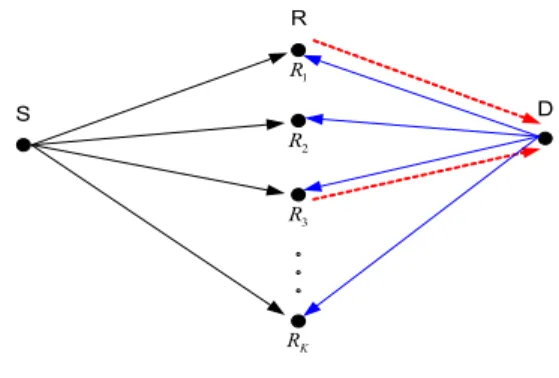
Fig. 1 shows the proposed system model in which S, R, and D denote source, relay and destination, respectively. denotes relay.
The solid lines show the source transmit step, and destination transmit step, and the dashed lines denote the relay transmit step
[3]. We assume a DF relay. The multipath channels are assumed independent identically distributed (i.i.d) Rayleigh fading channels. Each signal received from is independently faded and combined at D for the diversity gain. In this proposed system model, the opportunistic transmit conditions are identical to the DOT system in [3] and [4] but the combining method at the destination node is different.
According to the number of the receiving signals from the transmit relays, we adaptively apply to MRC or GSC for diversity combining.
S
R
D
R1R
2R
3R
KFig 1. Proposed system model 그림 1. 제안한 시스템 모델
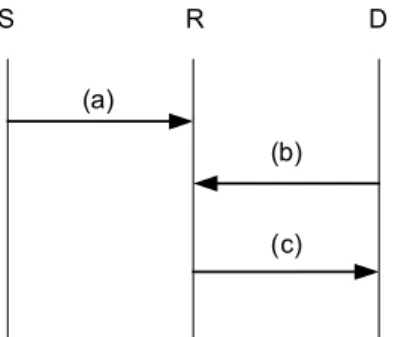
The transmit protocol of the proposed system consists of the following four steps (see Fig. 2):
(a) Source transmit step: The source transmits the
information to the relays. Each relay compares the
SNR received to the source-relay threshold ( ).
(b) Destination transmit step: The destination transmits a pilot tone to the relays. Each relay compares the SNR received to the destination – relay threshold ( ).
(c) Relay transmit step: When both received SNRs from the source and the destination exceed their respective thresholds, then the relays transmit.
(d) Diversity combining step: The multipath signals are received and MRC or GSC combined at D. If the number of transmit relays is less than the number of diversity branches at D, the received signals are MRC combined. On the other hand, the number of transmit relays is greater than the number of diversity branches, the received signals are GSC combined.
S R D
(a)
(c) (b)
Fig 2. Transmit protocol of the proposed system 그림 2. 제안한 시스템의 송신 프로토콜
2. Transmit condition of a relay
It is desirable that the number of transmit relays are identical to the number of branches in a destination for reducing the power consumption of the system and for efficient utilization of wireless communication resources.
If we define that the size of the active relay set is
, the probability of relays being transmitted among relays, , can be written as
( ) ( )
Pr( ) Pr
Sk SR,
Dk DR i1 Pr
Sk SR,
Dk DR K iC i K
i
γ γ γ γ
−= = ⎛ ⎞ ⎜ ⎟⎣ ⎡ > Γ > Γ ⎤ ⎡ − ⎦ ⎣ > Γ > Γ ⎤ ⎦
⎝ ⎠
(1)
where and denote the received SNR at
of the path and that of the path, respectively. Assume the channel is reciprocal, then can be replaced by . and
are the thresholds of the path and that of the path, respectively.
The transmit probability of DF relay in Rayleigh fading in equation (1) can be rewritten as
( ) ( )
( ) ( )
Pr , Pr ,
= Pr Pr = exp
Sk SR Dk DR Sk SR kD DR
Sk SR kD DR
SR DR
Sk kD
γ γ γ γ
γ γ
γ γ
> Γ > Γ = > Γ > Γ
> Γ > Γ
⎡ − ⎛ Γ + Γ ⎞ ⎤
⎢ ⎜ ⎟ ⎥
⎢ ⎝ ⎠ ⎥
⎣ ⎦
(2)
where and denote the average SNR of the
relay of the path and that of the path, respectively. Notice that the regular opportunistic transmit relaying system only considers the first term
in equation (2)
[5].
The average number of transmit relays that satisfy the transmit condition, the received SNR ( and ) of a relay is greater than the respective threshold (i.e.,
or ), can be written as [6],
( ) ( )
0
Pr , 1 Pr ,
exp
DOT
K k K k
Sk SR kD RD Sk SR kD RD
k
SR RD
Sk kD
M k K
k K
γ γ γ γ
γ γ
−
=
= ⎛ ⎞ ⎜ ⎟ ⎣ ⎝ ⎠ ⎡ > Γ > Γ ⎤ ⎡ − ⎦ ⎣ > Γ > Γ ⎤ ⎦
⎧ ⎛ Γ Γ ⎞ ⎫
⎪ ⎪
= ⎨ ⎜ − + ⎟⎬
⎪ ⎝ ⎠ ⎪
⎩ ⎭
∑
(3)
We noticed that the average number of transmit
relays is a function of the average SNR. When the
number of the diversity branches of a destination is
identical to the average number of transmit relays by
adjusting the average SNR and/or the thresholds, the
power consumption caused by the excess number of
transmit relays can be reduced and the efficiency of the
radio resources (i.e, time slots, radio frequencies, and
codes etc.) can be increased.
Ⅲ. Performance Analysis
Though the average number of the transmit relays can be controlled in equation (3), the instantaneous number of transmit relays is varying around the average number of the transmit relays in fading channel. Therefore the combined SNR can be written by [2]
1
1
,
,
,
, : k
k i
R D k
N R D i k
i N i N γ
γ γ
= Σ
=
⎧ ≤
= ⎨ ⎪⎪
⎪ ≥
⎪⎩
∑
∑ (4)
where
is the order statistics of
≥
≥ ≥
≥ . In equation (4), the first expression represents the combined SNR of MRC case that the number of the transmit relays is less than the number of the receiver branches . And the second expression represents the combined SNR of the GSC case that the number of the transmit relays is greater than the number of the receiver branches , therefore, the best signals among received signals are combined.
The probability density function (pdf) of combined SNR conditioned on the number of active relays
can be written by
( ) ( )
( )
1 2
, ,
RD RD
RD
f C i i N
f C i
f C i i N
γ
γ γ
γ
Σ
⎧ = ≤
= = ⎨ ⎪
= >
⎪⎩ (5)
where is the pdf of the output SNR of MRC. We will assume each branch has identical branch SNR, then and will be replaced to
and for all , respectively.
Assuming i.i.d. Rayleigh fading on each branch, the distribution is with degrees of freedom [7].
( )
11
, 0
1
/
( )!
RD RD i
RD
RD i RD
RD
f C i e
i
γ γ
γ γ γ
γ
−
= =
−≥
− (6)
And the pdf of the output SNR of GSC
can be given by [8]
( )
1 1 12
1
2
RD 0
1 1
1
1 , 0
/
/ /
( )! ( )
!
RD RD
RD RD RD RD
N i N N
RD N l
RD N
RD RDl
N m
l N RD
m RD
i e i N N
f C i
N N l l
e e l
m N
γ γ
γ γ γ γ
γ γ
γ γ
γ γ
γ
− −
− −
+ −
=
− − −
=
⎡ −
⎛ ⎞ ⎛ ⎞⎛ ⎞
= = ⎜ ⎟ ⎝ ⎠ ⎢ ⎢⎣ − + − ⎜ ⎝ ⎟⎜ ⎟ ⎠ ⎝ ⎠
⎧ ⎛ ⎞ ⎫ ⎤
⎪ ⎪⎥
× ⎨ ⎪ ⎩ − ⎜ ⎝ − ⎟ ⎠ ⎬ ⎪ ⎭⎦ ⎥ ≥
∑
∑
(7)
The unconditional pdf of combined SNR can be obtained using (6), (7), and (1),
( )
( ) ( )
( ) ( ) ( ) ( )
( )
0
1 2
0 1
1 1 1
1
0 1 1
1 1
1 1
/ /
Pr
Pr Pr
Pr ( )
( )! ( )!
RD RD RD RD
K
RD RD
i
N K
RD RD
i i N
i N N
N K i N
N l
RD RD
i N
i RD i N RD RDl
f f C i C i
f C i C i f C i C i
i i N
e C i e N
N l
i N l
γ γ
γ γ γ γ
γ γ
γ γ
γ γ
γ γ γ
Σ Σ
=
= = +
− − −
− − −
+ −
= = + =
= = =
= = = + = =
⎡ −
⎛ ⎞ ⎛ ⎞⎛ ⎞
= − = + ⎜ ⎟⎝ ⎠⎢⎢⎣ − + − ⎜⎝ ⎟⎜ ⎟⎠⎝ ⎠
×
∑
∑ ∑
∑ ∑ ∑
( )
2
0
/ / 1 Pr
!
RD RD RD RD
N m
l N RD
m RD
e e l C i
m N
γ γ γ γ γ
γ
− − −
=
⎧ ⎛ ⎞ ⎫⎤
⎪ − ⎜− ⎟ ⎪⎥ =
⎨ ⎝ ⎠ ⎬⎥
⎪ ⎪
⎩
∑
⎭⎦(8)
The outage probability is defined that the combined SNR is less than the threshold . The outage probability at the destination can be obtained by integrating the unconditional pdf, and written by
( )
( ) ( )
0
1
0 1
1
1 1
1
1
/
Pr
/
!
SR RD SR RD
SR RD SR RD RD
SR RD SR RD out
n K n k
N n
RD
n k
n K
n N
P f dr
K e e e
n k
K e n
γ
γ γ γ γ γ
γ γ
γ
γ
Σ Σ Γ
⎛Γ Γ ⎞ ⎛Γ Γ ⎞ − −
−⎜⎜⎝ + ⎟⎟⎠ −⎜⎜⎝ + ⎟⎟⎠ −Γ
= =
⎛Γ Γ ⎞
−⎜⎜⎝ + ⎟⎟⎠
= +
= ≤ Γ
=
⎧ ⎫ ⎧ ⎫ ⎧ Γ ⎫
⎛ ⎞⎪ ⎪ ⎪ ⎪ ⎪ ⎪
= ⎜ ⎟ ⎝ ⎠⎪ ⎨ ⎩ ⎬ ⎨ ⎪ ⎪ ⎭ ⎩ − ⎬ ⎪ ⎭ ⎨ ⎪ ⎩ − − ⎬ ⎪ ⎭
⎧ ⎫
⎛ ⎞⎪ ⎪
+ ⎜ ⎟ ⎨ ⎬
⎝ ⎠⎪ ⎩ ⎪ ⎭
∫
∑ ∑
∑
{ ( ) ( )
( )( )
( )
1 1 1
0 1
1 2
0 0
1 1
1 1
1
/
/ /
/
/
!
/
/ !
SR RD SR RD
RD
RD
RD K n
l N l N
N n N
RD
l l
m j
l N N m
RD
m j
e
n n N N
N e l l l
e l e
l N N j
γ γ
γ
γ
γ
γ
γ
⎛Γ Γ ⎞ −
−⎜⎜⎝ + ⎟⎟⎠
−
− − + −
−Γ
= =
− + Γ −
−Γ
= =
⎧ ⎫
⎪ − ⎪
⎨ ⎬
⎪ ⎪
⎩ ⎭
⎡ ⎛ ⎞ Γ ⎛ − ⎞⎛ ⎞
× ⎢⎜ ⎟ ⎣ ⎝ ⎠ − + − ⎜ ⎝ ⎟⎜ ⎟ ⎠ ⎝ ⎠
⎡ − ⎛ ⎞ ⎛ Γ ⎞ ⎤
⎢ ⎜ ⎟
× ⎢ ⎣ + − ⎜ ⎝ − ⎟ ⎜ ⎠ ⎝ − ⎟ ⎠
∑ ∑
∑ ∑ ⎥⎬ ⎥⎪ ⎦⎭⎦ ⎫⎪⎥ ⎤ ⎥
(9)
Ⅳ. Numerical results
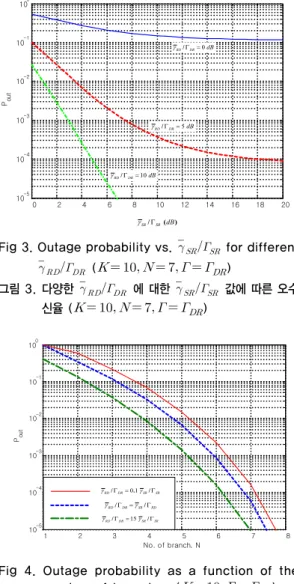
Fig. 3 shows the outage probability for ,
, . As we expected the outage probability decreases with the average SNR of S-R and R-D paths. In the case that equals 0 dB, the error floor that the error is not decreasing regardless of the SNR of S-R path is noticed. It is interpreted that the average SNR of R-D path is too week, it causes high outage probability although the SNR of S-R path is strong.
0 2 4 6 8 10 12 14 16 18 20
10-5 10-4 10-3 10-2 10-1 100
Pout
0
RD/DR dB
γ Γ =
5
RD/DR dB
γ Γ =
10
RD/DR dB
γ Γ =
/ ( )
SR SR dB γ Γ
Fig 3. Outage probability vs. for different
(
)그림 3. 다양한 에 대한 값에 따른 오수 신율 (
)1 2 3 4 5 6 7 8
10-5 10-4 10-3 10-2 10-1 100
No. of branch, N Pout
15
/ /
RD DR SR SR
γ Γ = γ Γ
0 1
/ . /
RD DR SR SR
γ Γ = γ Γ
/ /
RD DR SR RD
γ Γ =γ Γ
Fig 4. Outage probability as a function of the number of branches (
) 그림 4. 가지 수에 따른 오수신율 (
)The outage probability versus the number of branches for different average SNR of S-R path and R-D path is shown in Fig. 4. The outage probability is decreases with the number of branches. When the number of branches is fixed, the outage probability also decreases with the SNR of S-R path and R-D path.
Ⅴ. Conclusions
In this paper, we propose a DOT in a cooperative diversity system with MRC/GSC for diversity combining. The average number of transmit relays is limited to the number of the receiver branches at the destination to prevent the excess number signals from transmit relays in the DOT system. However, the instantaneous number of transmit relays is varying due to the channel fluctuation. When the instantaneous number of transmit relays is less/greater than the number of the branches of the destination, MRC/GSC is adopted for diversity combing.
The outage probability is analytically derived and the numerical results show that the system performance improves with the number of the branches. Also it is noticed that when the number of the branches is fixed, the outage probability decreases with the increase of the average SNR of S-R path and R-D path.
References
[1] N.C. Beaulieu, and J. Hu, “A closed form expression for the outage probability of Decode-and-forward relaying in dissimilar Rayleigh fading channels,”
IEEE Communications Letters, vol.10, no.12, pp.813-815, Dec. 2006.
[2] Salama Ikki, Mohamed Ahmed, “Performance
analysis of generalized selection combining for decode-
and–forward cooperative-diversity networks,” in
Proceedings of Vehicular Technology Conference,
※ 이 논문은 2012학년도 청주대학교가 지원하는 연구년으로 연구되었음