* Corresponding author
Phone: +82-53-650-4473 Fax: +82-53-621-4106 E-mail: [email protected]
This is an open-access journal distributed under the terms of the Creative Commons Attribution Non-Commercial License
(http://creativecommons.org/licenses/by-nc/4.0/)
http://dx.doi.org/10.15433/ksmb.2016.8.1.010 ISSN 2383-5400 (Online)
Potential Health Risks from Persistent Organic Pollutants (POPs) in Marine Ecosystem
Youn Ju Lee1, Jae-Seok Jang2, Jae-Ho Yang1*
1Department of Pharmacology, School of Medicine, Catholic University of Daegu, Daegu-si 42472, Republic of Korea
2Department of Thoracic and cardiovascular surgery, School of Medicine, Catholic University of Daegu, Daegu-si 42472, Republic of Korea
(Received 17 May 2016, Revised 10 June 2016, Accepted 10 June 2016)
Abstract A wide-spread contamination of persistent organic pollutants (POPs) such as dioxins, PCBs, PBDEs in the aquatic ecosystem has generated a great concern over the potential risk for these substances to impact marine biotas and food web. Since a major exposure route of these substances to the humans is through the consumption of food including fish and marine byproducts, the consumption of contaminated products has been a great public health concern.
Exposure to POPs has been associated with a wide spectrum of adverse effects including re- productive, developmental, immunologic, carcinogenic, and neurotoxic effects. This review covers the background information of key POPs substances and the recent development of toxicity studies including the mode of action. Because neurotoxic effects of some POPs have been observed in humans at low concentrations, polychlorinated biphenyl (PCB), a representative chemical of POPs, is focused to discuss the possible mode(s) of action for the neurotoxic effects. This review provides the updates of toxicity studies on POPs and paves ways to discuss a possible implication of contaminated marine biota over the human health among the marine biotechnology researchers.
Keywords : Persistent Organic Pollutants (POPs), PCBs, Neruotoxicity, Marine, Ecosystem
Introduction
Numerous chemicals are now produced in our in- dustrial society. Some of these chemicals are pro- duced unintentionally as unwanted byproducts in the course of their manufacturing processes. Many stud- ies demonstrated that these chemicals are harmful to humans if present in excessive amounts in our food web or ecosystems. Persistent organic pollutants (POPs) are long-lived toxic organic compounds such as polychlorinated biphenyls (PCBs), polybrominated diphenyl ethers (PBDEs), organochlorine pesticides,
and dioxins. POPs are major concern for human health and ecosystem due to their high degree of persistence and bioaccumulation in the environment. These POPs could be released with time, remain in the aquatic environment for long period of time due to their high persistence, and bioaccumulate in the food web [20,27].
The presence of POPs in marine environments is
a legacy of industrial chemical production and
management. Due to the long half-life of POPs in
the environment, marine life such fish can become
contaminated at concentrations many times higher than
those of the marine sediments. The bioaccumulation of
POPs, in particular PCBs, in fish has been particularly
well documented and numerous studies have reported elevated concentrations of PCBs in fish from various aquatic environments [3] The issue of PCB-contaminated fish and potential human exposure has elevated concern over human health.
Polychlorinated biphenyls (PCBs) are ubiquitous environmental contaminants resulting from intensive industrial use and inadequate disposal over past decades [25]. PCB mixtures as well as congeners possess a surprising array of biological activity leading to toxicity. It is known that some PCBs and other halogenated hydrocarbons such as 2,3,7,8-tetrachlorodibenzo-p-dioxin (TCDD) produce some of their biological effects through a receptor-mediated response by binding to the cytosolic aryl hydrocarbon (Ah) receptor followed by induction of a number of genes [22]. Since PCBs represent a significant group of POPs, the focus of this review will be on this group of chemicals discussing the neurotoxic effects and possible mode(s) of action.
Sources of Persistent Organic Pollutants (POPs)
PCBs
Polychlorinated biphenyls were used in electrical transformers, capacitors and heat transfer and hydraulic systems. PCBs were also used in paints, polymers and adhesives, as lubricants, plasticizers, fire retardants and immersion oils, vehicles for pesticide application [24].
Due to the widespread use, PCBs were detected in most of environmental media including aquatic ecosystem.
Although commercial use of PCBs is no longer allowed in the most of countries, they are still present in the global environment. About a million ton of PCBs is still in use in older electric equipment and other products [32].
PCDDs and PCDFs
Polychlorinated dibenzo-p-dioxins (PCDDs) and Polychlorinated dibenzo-p-furans (PCDFs) are by-products that are formed during the synthesis of certain industrial halogenated aromatic chemicals, and by-products of combustion [24]. PCDDs and PCDFs have been identified in effluents, wastes and pulp samples from the paper
industry. Emissions from municipal waste incinerators as well as backyard burning contain PCDDs and PCDFs [12,24].
PBDE
Polybrominated diphenyl ethers (PBDEs) were manu- factured for use as flame retardants in industrial and consumer products. These chemicals were used for carpet, clothes, holster, radios, televisions, thermostats, and various automotive parts [11].
Toxic equivalency factors (TEFs)
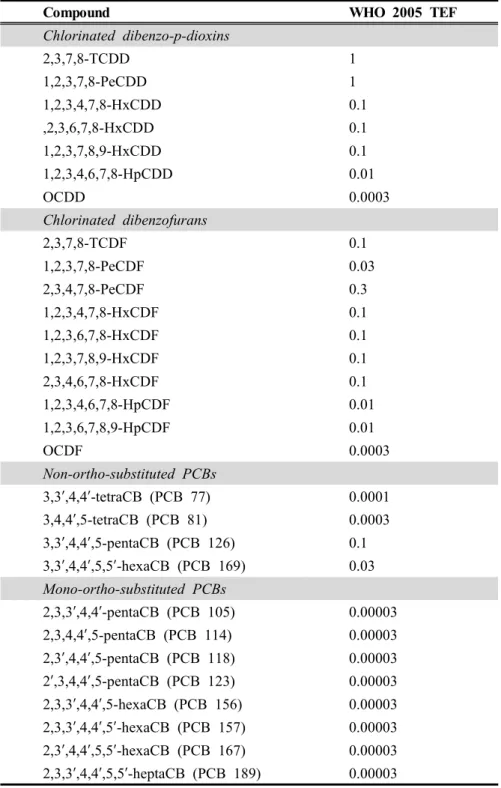
The structural relationship between PCDD, PCDF and PCB congeners and their toxicity is the computational fundamentals of toxicity equivalency factors (TEFs) and the toxic equivalency (TEQ) approach (Table 1). The TEQ approach is applied to estimate the toxic potency from mixtures of PCDDs, PCDFs and PCBs found in the environmental samples. Based on the assumption that these chemicals have a similar mechanism of action of binding to the AhR, the toxic potency of each chemical in a mixture is expressed as a fraction of 2,3,7,8-TCDD toxicity to cause the same effect. TEF value of 2,3,7,8-TCDD is assumed to be 1. In another word, the TEF is EC50 ratio of TCDD-like compounds/TCDD. The toxic potency of a mixture of PCDDs, PCDFs and/or PCBs is estimated by multiplying the concentrations of individual congeners by their respective TEFs and summing the products to yield a total TEQ. The total TEQ expresses the toxicity as if the mixture were pure 2,3,7,8-TCDD [24,26,27,33]. Although several assumptions are required to generate TEF values, the TEQ approach have been agreed in the international community of risk assessment as the most plausible way to estimate the potential toxic effects of mixtures of 2,3,7,8-TCDD-like chemicals [27].
Common mechanism of action for Dioxin-like compounds
The aryl hydrocarbon receptor (AhR) is involved in regulating
the metabolic enzymes of xenobiotics as well as genes involved
in cell growth regulation and differentiation [7,20,22]. The
AhR plays an important role in the species- and tissue-specific toxicity of PCBs and PCDD and PCDF isomers. It is generally agreed that most of the toxic effects of 2,3,7,8-TCDD (namely dioxin) and dioxin-like
compounds require activation of the AhR. The toxicity of individual isomers is closely associated with the affinity that these compounds bind to the AhR. The most toxic compounds tend to show the highest binding affinity
Table 1. Summary of World Health Organization (WHO) 2005 Toxic Equivalency Factor (TEF) values.
Compound WHO 2005 TEF
Chlorinated dibenzo-p-dioxins
2,3,7,8-TCDD 1
1,2,3,7,8-PeCDD 1
1,2,3,4,7,8-HxCDD 0.1
,2,3,6,7,8-HxCDD 0.1
1,2,3,7,8,9-HxCDD 0.1
1,2,3,4,6,7,8-HpCDD 0.01
OCDD 0.0003
Chlorinated dibenzofurans
2,3,7,8-TCDF 0.1
1,2,3,7,8-PeCDF 0.03
2,3,4,7,8-PeCDF 0.3
1,2,3,4,7,8-HxCDF 0.1
1,2,3,6,7,8-HxCDF 0.1
1,2,3,7,8,9-HxCDF 0.1
2,3,4,6,7,8-HxCDF 0.1
1,2,3,4,6,7,8-HpCDF 0.01
1,2,3,6,7,8,9-HpCDF 0.01
OCDF 0.0003
Non-ortho-substituted PCBs
3,3′,4,4′-tetraCB (PCB 77) 0.0001
3,4,4′,5-tetraCB (PCB 81) 0.0003
3,3′,4,4′,5-pentaCB (PCB 126) 0.1
3,3′,4,4′,5,5′-hexaCB (PCB 169) 0.03
Mono-ortho-substituted PCBs
2,3,3′,4,4′-pentaCB (PCB 105) 0.00003
2,3,4,4′,5-pentaCB (PCB 114) 0.00003
2,3′,4,4′,5-pentaCB (PCB 118) 0.00003
2′,3,4,4′,5-pentaCB (PCB 123) 0.00003
2,3,3′,4,4′,5-hexaCB (PCB 156) 0.00003
2,3,3′,4,4′,5′-hexaCB (PCB 157) 0.00003
2,3′,4,4′,5,5′-hexaCB (PCB 167) 0.00003
2,3,3′,4,4′,5,5′-heptaCB (PCB 189) 0.00003 Van den Berg et al. (2006)
of the AhR [22]. The receptor affinity may be respon- sible for species and strain differences in sensitivity to 2,3,7,8-TCDD and related chemicals may be responsible. Species differences in sensitivity to 2,3,7,8-TCDD and related chemicals in bird could be due to differences in amino acid composition of the ligand-binding domain [17]. Effects of dioxin-like compounds are also mediated through the AhR in fishes. Fishes possess AhRs that can be grouped within at least three distinct clades (AhR1, AhR2, AhR3). AhR2 has been shown to be the active form in most teleosts, with AhR1 not binding dioxin-like compounds [8]. However, there is still a controversy over explaining different responses in species susceptibility to dioxin and dioxin-like compounds.
The AhR is a basic helix-loop-helix (bHLH) and Per-Arnt-Sim (PAS)-containing transcription factor [7].
hsp90 (a heat shock protein of 90 kDa), the X-associated
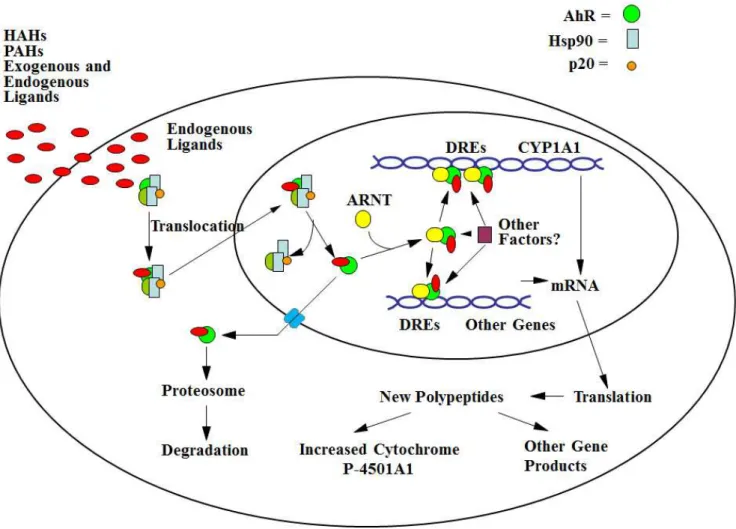
protein 2 (XAP2) and p23 are the chaperon proteins that are required for the activation of AhR. When dioxin ligand passes through the plasma membrane and binds to the AhR, the ligand AhR complex undergoes a conformational change for a nuclear localization (Figure 1). The complex translocates into the nucleus and the chaperone proteins dissociate from the complex. The AhR–ligand then binds to the bHLH-PAS nuclear protein, AhR nuclear translocator (Arnt). This heterodimer binds to DNA called the dioxin responsive element (DRE). Binding of the ligand–AhR–Arnt complex to the DRE initiates transcription of genes encoding ctyochrome P450 enzymes (notably CYP1A1 and other AhR-responsive genes [7].
Abrupt modulation of gene expression may be responsible for a series of biochemical, cellular and tissue changes following exposure to dioxin and related compounds [6,20].
Figure 1. Schematic drawing of AhR-mediated mechanism of action for dioxins and related compounds (Denison and Nagy, 2003)
Evidence of neurotoxicity following exposure to PCBs.
There is much evidence that PCBs can cause neurotoxicity in humans and that in utero exposure is more important than lactational exposure in causing the neurotoxic effects. It is reported that children born to mothers, who had ingested fish contaminated with PCBs, tend to have learning and memory deficits [15].
Prenatal PCB exposure was associated with poorer performance on the Psychomotor Index in children from general population in US [23]. It is also indicated that PCB exposure is associated with deficits in mental and motor scores in children up to 7-months of age [34]. These studies suggest that the nervous system, especially during development, is sensitive to exposure to PCBs and related chemicals.
Neurochemical effects
There is extensive evidence for an association between exposure to dioxin-like chemicals and adverse effects on behavior and cognition. Neurotransmitters are major targets of these compounds [10]. In addition, signal transduction enzymes such as protein kinase C (PKC) as well as alterations in Ca
2+homeostasis may play pivotal roles in expression of neurochemical effects following PCB exposure[30].
It has been shown that PCBs can reduce dopamine (DA) concentrations in the brain when an animal is exposed during developmental stage [28]. PCB-induced abnormality in cognitive function is related with the alteration of cholinergic neurotransmitter system [9].
PCB also altered N-methyl-D-aspartic acid (NMDA) receptor binding sites in the visual cortex area when exposed during the pregnancy [1]. PCB-induced alteration in the regulation of glutamate may lead to excess activation of excitatory neurons, which may result in neuronal death.
PCB congeners, in particular coplanar dioxin-like PCBs, are known to alter Ca
2+homeostasis in the brain.
Disruption of Ca
2+homeostasis by PCBs can result in various adverse effects such as the production of reactive oxygen species (ROS), long-term potentiation (LTP) and synaptic plasticity [21]. It is generally accepted that PCB exposure increase an influx of extracellular Ca
2+from a variety of routes. The routes of extracellular Ca
2+into cells include entry via L-type voltage-sensitive calcium channels, the endoplasmic r e t i c u l u m (ER), glutamate receptors channels [13].
Protein kinase C (PKC) has been shown to have an important role in PCB-induced toxicity [19].
Isoforms of PKC play pivotal roles in modulation of neurotransmitter release, neuronal apoptosis, long-term potentiation (LTP), and neurological diseases [4]. It is demonstrated that PCBs increase PKC translocation from membrane fraction to cytosolic fraction and affect the second messenger molecules such as inositol phosphate in cerebellar granule cells in vitro [19]. For classic PKC isoforms, extracellular calcium is required for their translocation. However, Yang and Kodavanti [35] reported that ortho-substituted PCBs (non-coplanar PCBs) induce translocation of the calcium-dependent isoform, PKC-α, as well as the calcium-independent isoform, PKC-ε. In a later study with rats exposed to 6 mg Aroclor 1254/kg body weight/day from GD 6 to PND 21, three different isoforms of PKC (-α, -ε, -γ) in subcellular fractions of brain preparations were altered [36]. Brain NOS activity is also inhibited by PCB exposure [16,37]. NOS is involved in both long-term potentiation and oxidative stress [31]. Thus, inhibition of NOS could influence the level of LTP which may result in learning and memory deficits.
Intracellular signal transduction is a key pathway by which extracellular signals are transferred to the cytosol and nucleus of the cell. Any interference with these processes would have the potential for profound effects on the function of neuron as well as their development.
Thus, any alteration of signaling pathway by PCB
exposure may lead to abruption of normal activity of
growth factors and neurotransmitters. For future studies,
cross talk between the receptor signals and second
messengers will be warranted to further elucidate PCB-induced neurotoxicities.
Discussion
Marine ecosystems are constantly threatened by contaminants produced by the rapid industrialization and other human activities on the grounds. The potential impact on marine organisms and human health is now a growing concern and becomes a global issue [14].
Persistent organic pollutants (POPs), such as polychlorinated dibenzo-p-dioxins (PCDDs), polychlorinated dibenzofurans (PCDFs), polychlorinated biphenyls (PCBs), brominated flame retardants (BFRs) can pose a great threat on marine fauna and human health, considering their high toxicity and persistence in the environment [29].
Recent increase in the incidence of developmental disabilities may be related with the environmental contamination in our surroundings. Although genetic factors have a key role in developmental disabilities, environmental chemicals may also be a factor responsible for various developmental disorders of the brain, such as Attention Deficient Hyperactive Disorder (ADHD) and autism [5]. Developmental neurotoxicity is associated with abnormality in behavior, neurophysiology, and neurochem istry of the nervous system occurring in the offspring, in particular when toxic chemicals are exposed in utero and during lactation. Compared to adult brain, the developing nervous system in early life is known to be more sensitive to toxicants, due to the presence of rapid growth period of the brain, known as “brain growth spurt” [9]. In humans, the “brain growth spurt” begins from the third trimester of pregnancy to the first one or two years of life. During this period, the brain goes through pivotal developmental stages such as neurogenesis, migration, and differentiation.
Toxicant exposure during any of these stages could have detrimental effects on the normal brain development in early life. Intracellular signaling is a crucial biochemical pathway for the normal function and development of the nervous system. The alterations of intracellular second messengers in this process by toxic chemicals may be
key steps for developmental neurotoxicity of a number of chemicals including PCBs. Understanding of neurotoxic mechanism of action for POPs may provide good scientific basis for more accurate human health risk assessment from environmental contaminants.
Conclusion
Human demands on marine resources are ever increasing. However, biodiversity on marine life is in jeopardy due to the off-shore contamination from the inlands [29]. Since consumption of contaminated products is a major route of the persistent toxic chemical exposure to the human bodies [38], it is critical to monitor the level of exposure regularly and implement the effective risk assessment over the suspected products. Recently, it is reported that the consumption of blue shark derived products can pose to human health, because the shark samples presented values above the regulatory limits of environmental contaminants [2]. When PCDDs/DFs and PCBs concentrations in fishes, crustaceans, cephalopods, and bivalves collected at markets in Korea were monitored for three years (2007–2009), slightly lowering trends of concentrations were found for fishes but no clear chronological trend was observed for other marine products [18]. Although the trend of contamination for certain marine species is generally in a decline, there is still unknown level of contamination in many other aquatic compartments threatening the health of marine ecosystem.
Fish consumption is one of major exposure routes
of PCB accumulation in our body. In particular, because
neurotoxic effects of PCBs are more significant when
exposed during early life thru lactation or in utero, the
critical window of exposure at the early life is a key
issue for regulating these chemicals. It is now a great
concern that even low background level of contamination
may influence developmental neurotoxicicty such as
ADHD and autism. Therefore, an extended monitoring
of POPs is required in the marine environment as well
as byproducts generated from marine biotechnology, to
minimize the risk of human health impact.
References
1. Altmann, L., Mundy, W.R., Ward, T.R., Fastabend, A., Lilienthal, H. 2001. Developmental exposure of rats to a reconstituted PCB mixture or Aroclor 1254: effects on long-term potentiation and [H-3]MK-801 binding in occipital cortex and hippocampus. Toxicol. Sci. 61, 321–330.
2. Alves, L.M., Nunes, M., Marchand. P., Le Bizec, B., Mendes, S., Correia, J.P., Lemos, M.F., Novais, S.C. 2016.
Blue sharks (Prionace glauca) as bioindicators of pollution and health in the Atlantic Ocean: Contamination levels and biochemical stress responses. Sci. Total. Environ.
29, 563-564.
3. Barghi, M., Choi, S.D., Kwon, H.O., Lee, Y.S., Chang, Y.S. 2016. Influence of non-detect data-handling on toxic equivalency quantities of PCDD/Fs and dioxin-like PCBs:
A case study of major fish species purchased in Korea.
Environ. Pollut. 214, 532-538.
4. Battaini F. 2001. Protein kinase C isoforms as therapeutic targets in nervous system disease states. Pharmacol. Res.
44, 353–361.
5. Branchi, I., Capone, F., Vitalone, A., Madia, F., Santucci, D., Alleva, E., Costa, L.G. 2005. Early developmental exposure to BDE 99 or Aroclor 1254 affects neurobehavioural profile:
interference from the administration route. Neurotoxicology.
26, 183–192.
6. Denison, M.S., Heath-Pagliuso, S. 1998. The Ah receptor:
a regulator of the biochemical and toxicological actions of structurally diverse chemicals. Bull. Environ. Contam.
Toxicol. 61, 557–568.
7. Denison, M.S., Nagy, S.R. 2003. Activation of the aryl hydrocarbon receptor by structurally diverse exogenous and endogenous chemicals. Annu. Rev. Pharmacol. Toxicol.
43, 309–334.
8. Doering, J.A., Giesy, J.P., Wiseman, S., Hecker, M. 2013.
Predicting the sensitivity of fishes to dioxin-like compounds:
possible role of the aryl hydrocarbon receptor (AhR) ligand binding domain. Environ. Sci. Pollut. Res. Int. 20, 1219- 1224.
9. Eriksson, P. 1997.Developmental neurotoxicity of environmental agents in the neonate. Neurotoxicology. 18, 719–726.
10. Fonnum, F., Mariussen, E. 2009. Mechanisms involved in the neurotoxic effects of environmental toxicants such
as polychlorinated biphenyls and brominated flame retardants. J. Neurochem. 111, 1327–1347.
11. Headrick, M.L., Hollinger, K., Lovell, R.A., Matheson, J.C. 1999. PBBs, PCBs, and dioxins in food animals, their public health implications. Vet. Clin. North. Am.
Food Anim. Pract. 15, 109–131.
12. Huwe, J.K. 2002. Dioxins in food: a modern agricultural perspective. J. Agric. Food. Chem. 50, 1739–1750.
13. Inglefield, J.R., Mundy. W.R., Shafer, T.J. 2001. Inositol 2,4,5-triphosphate receptor-sensitive C a2+ release, store-operated Ca2+ entry, and cAMP responsive element binding protein phosphorylation in developing cortical cells following exposure to polychlorinated biphenyls.
J. Pharmacol. Exp. Ther. 297, 762–773.
14. Ivar do Sul, J.A., Costa, M.F. 2014. The present and future of microplastic pollution in the marine environment.
Environ. Pollut. 185, 352-364.
15. Jacobson, J.L., Jacobson, S.W. 1996. Dose–response in perinatal exposure to polychlorinated biphenyls (PCBs):
the Michigan and North Carolina cohort studies. Toxicol.
Ind. Health. 12, 435–445.
16. Kang, J.H., Jeong, W., Park, Y., Lee, S.Y., Chung, M.W., Lim, H.K., Park, I.S., Choi, K.H., Chung, S.Y., Kim, D.S., Park, C.S., Hwang, O., Kim, J. 2002. Aroclor 1254 -induced cytotoxicity in catecholaminergic CATH.a cells related to the inhibition of NO production. Toxicology.
177, 157–166.
17. Karchner, S.I., Franks, D.G., Kennedy, S.W., Hahn, M.E.
2006. The molecular basis for differential dioxin sensitivity in birds: role of the aryl hydrocarbon receptor. Proc.
Natl. Acad. Sci. USA. 103, 6252–6257.
18. Kim, S.K., Yoon, J. 2014. Chronological trends of emission, environmental level and human exposure of POPs over the last 10 years (1999-2010) in Korea: implication to science and policy. Sci. Total. Environ. 1, 470-471.
19. Kodavanti, P.R.S., Shafer, T.J., Ward, T.R., Mundy, W.R., Freudenrich, T., Harry, G.J., Tilson, H.A. 1994. Differential effects of polychlorinated biphenyl congeners on phosphoinositide hydrolysis and protein kinase C translocation in rat cerebellar granule cells. Brain. Res. 662, 75–82.
20. Mandal, P.K. 2005. Dioxin: a review of its environmental effects and its aryl hydrocarbon receptor biology. J. Comp.
Physiol. B. 175, 221–230.
21. Mariussen, E., Fonnum, F. 2006. Neurochemical targets and behavioral effects of organohalogen compounds: an update. Crit. Rev. Toxicol. 36, 253-289.
22. Okey, A.B., Riddick, D.S., Harper, P.A. 1994. The Ah receptor:
mediator of the toxicity of 2,3,7,8-tetrachlorodibenzo- p-dioxin (TCDD) and related compounds. Toxicol. Lett.
70, 1–22.
23. Rogan, W.J., Gladen, B.C., Hung, K.L., Koong, S.L., Shih, L.Y., Taylor, J.S., Wu, Y.C., Yang, D., Ragan, N.B., Hsu, C.C. 1988. Congenital poisoning by polychlorinated biphenyls and their contaminants in Taiwan. Science. 24 1, 334–336.
24. Safe, S. 1990. Polychlorinated biphenyls (PCBs), dibenzo-p-dioxins (PCDDs), dibenzofurans (PCDFs), and related compounds: environmental and mechanistic considerations which support the development of toxic equivalency factors (TEFs). Crit. Rev. Toxicol. 21, 51–88.
25. Safe, S. 1994. Polychlorinated biphenyls (PCBs):
environmental impact, biochemical and toxic responses, and implications for risk assessment. Crit. Rev. Toxicol.
24, 87–149.
26. Safe, S. 1998. Development validation and problems with the toxic equivalency factor approach for risk assessment of dioxins and related compounds. J. Anim.
Sci. 76, 134–141.
27. Schecter, A., Birnbaum, L., Ryan, J.J., Constable, J.D.
2006. Dioxins: an overview. Environ. Res. 101, 419–428.
28. Seegal, R.F., Okoniewski, R.J., Brosch, K.O., Bemis, J.C.
2002. Polychlorinated biphenyls alter extraneuronal but not tissue dopamine concentrations in adult rat striatum:
an in vivo microdialysis study. Environ. Health. Perspect.
110, 1113–1117.
29. Shim, W.J., Thompson, R.C. 2015. Microplastics in the Ocean. Arch. Environ. Contam. Toxicol. 69, 265-268.
30. Smith, J.W., Evans, A.T., Costallm, B., Smythe, J.W.
2002. Thyroid hormones, brain function and cognition:
a brief review. Neurosci. Biobehav. Rev. 26, 45–60.
31. Sweatt, J.D. 1999. Toward a molecular explanation for long term potentiation. Learn. Mem. 6, 399–416.
32. Tanabe, S. 1988. PCB problems in the future: foresight from current knowledge. Environ. Pollut. 50, 5–28.
33. Van den Berg, M., Birnbaum, L.S., Denison, M., DeVito, M., Farland, W., Feeley, M., Fiedler, H., Hakansson, H., Hanberg, A., Haws, L., Rose, M., Safe, S., Schrenk, D., Tohyama, C., Tritscher, A., Tuomisto, J., Tysklind, M., Walker, N., Peterson, R.E. 2006. The 2005 World Health Organization re-evaluation of human and mammalian toxic equivalency factors for dioxins and dioxin-like co mpounds. Toxicol. Sci. 93, 223–241.
34. Winneke, G., Bucholski, A., Heinzow, B., Krämer, U., Schmidt, E., Walkowiak, J., Wiener, J.A., Steingrüber, H.J. 1998. Developmental neurotoxicity of polychlorinated biphenyls (PCBS): cognitive and psychomotor functions in 7-month old children. Toxicol. Lett. 28, 102-103.
35. Yang, J.H., Kodavanti, P.R.S. 2001. Possible molecular targets of halogenated aromatic hydrocarbons in neuronal cells. Biochem. Biophys. Res. Commun. 280, 1372–1377.
36. Yang, J.H., Derr-Yellin, E.C., Kodavanti, P.R.S. 2003.
Alterations in brain protein kinase C isoforms following developmental exposure to polychlorinated biphenyl mixture. Mol. Brain. Res. 111, 123–135.
37. Yun, J.S., Na, H.K., Park, K.S., Lee, Y.H., Kim, E.Y., Lee, S.Y., Kim, J.I., Kang, J.H., Kim, D.S., Choi, K.H.
2005. Protective effects of vitamin E on endocrine disruptors, PCB-induced dopaminergic neurotoxicity. Toxicology.
216, 140–146.
38. Christensen, K.Y., Raymond, M.R., Thompson, B.A., Anderson, H.A. 2016. Fish Consumption, Levels of Nutrients and Contaminants, and Endocrine-Related Health Outcomes Among Older Male Anglers in Wisconsin. J.
Occup. Environ. Med. [Epub ahead of print] PMID:272 53230