pISSN 1226-4407, eISSN 2234-7631
Brain-derived Neurotrophic Factor, Serotonin과 체력, 에너지소모량, 운동강도의 관계
The Relationship Between Brain-derived Neurotrophic Factor, Serotonin, Physical Fitness, Energy Expenditure and Exercise Intensity in Children
김 현 준*
경남대학교 체육교육과
Hyun-Jun Kim
*Department of Physical Education, Kyungnam University
요 약
연구배경: 본 연구는 아동의 뇌세포 활성 및 생성에 있어 아 동 신체활동 및 체력 증진 활동의 중요성을 강조하고자 뇌신 경세포 생성인자, 체력, 신체활동의 관계를 알아보았다.
방법: 73명의 아동을 선정하였고, 이들의 신체활동 측정은 SenseWear Armband (Bodymedia Co., USA)를 이용하였으 며, 분석 항목은 총에너지소모량, 평균 METs (Metabolic equivalents), 3 METs 미만 활동시간, 3-6 METs 활동시간, 6 METs 이상 활동시간이었다. 뇌신경세포 생성인자는 brain -derived neurotrophic factor (BDNF)와 serotonin이었다. 자 료처리는 PASW Statistics 18.0 프로그램을 이용하여 측정된 인자들 간의 상호 관련성을 분석하고, 뇌신경세포 생성인자에 영향을 미치는 독립인자을 찾고자 단계별회귀분석을 실시하 였다.
결과: 연구 결과 BDNF와 순발력, 6 METs 이상 활동시간 은 정상관관계가 있으며, BDNF와 근력, serotonin과 근력은 역상관관계가 있는 것으로 나타났다. 또한 BDNF를 예측하는 독립인자는 순발력, 근력, 6 METs 이상 활동시간, 3 METs 미 만 활동시간 이며, serotonin을 예측하는 독립인자는 근력임을 알 수 있었다.
결론: 본 연구 결과를 통해 뇌신경세포 생성인자인 BDNF 와 serotonin의 변화를 위해서는 순발력, 근력, 6 METs 이상
ABSTRACT
Background: The purpose of this study was to determine the effects of physical activity and fitness on brain nerve growth factor in children.
Method: Seventy-three subjects were selected from one elementary school. Variables related to physical fitness, physical activity and brain nerve growth were measured and assessed. The physical activities of daily life were measured using the SenseWear Armband (Bodymedia Co., USA). The collected data were analyzed in terms of Total energy expenditure, average METs, duration of activity less than 3.0 METs, duration of activity between 3.0 and 5.9 METs, and duration of activity exceeding 6 METs. The factors of brain nerve growth factor were BDNF (brain-derived neurotrophic factor) and serotonin. Data analysis was done using PASW Statistics 18.0 program and included Pearson correlation coefficients and stepwise regression analysis.
Results: Positive correlation was found between BDNF and duration of activity exceeding 6 METs. Negative correlation was noted between BDNF and muscular strength, also between serotonin and muscular strength. The independent variables predicting BDNF were agility, muscular strength, duration of activity exceeding 6 METs and duration of activity less than 3.0 METs. And predictor of serotonin was muscular strength.
Conclusion: The results indicate that in order to increase BDNF and serotonin in children, it is necessary to improve
ꠏꠏꠏꠏꠏꠏꠏꠏꠏꠏꠏꠏꠏꠏꠏꠏꠏꠏꠏꠏꠏꠏꠏꠏꠏꠏꠏꠏꠏꠏꠏꠏꠏꠏꠏꠏ
Received: Feb. 7, 2013; Reviewed: Feb. 22, 2013; Accepted: Apr. 23, 2013
Corresponding author: Hyun-Jun Kim, Department of Physical Education, Kyungnam University, Changwon, 631-701, Korea
Tel: +82-55-249-2358, Fax: +82-55-999-2151, E-mail: [email protected], Mobile: 82-10-9135-4543*본 연구는 2011학년도 경남대학교 신진교수연구비 지원을 받아 연구되었습니다.
* This is an Open-Access article distributed under the terms of the Creative Commons Attribution Non-Commercial License (http://creativecommons.org/licenses/
by-nc/3.0) which permits unrestricted non-commercial use, distribution, and reproduction in any medium, provided the original work is properly cited.
서 론
뇌신경세포 생성 및 활성에 관여하는 여러 요인 중에서 운동이 인지기능과 기억력을 증가시키고
1), 운동 시에 증가 되는 신경성장인자 및 신경전달물질인 serotonin, insulin, insulin-like growth factor 1 (IGF-1), Growth hormone (GH), cortisol 등이 뇌세포 생성 및 뇌기능 향상에 중요한 작용을 하는 brain-derived neurotrophic factor (BDNF)를 증가시키는 것으로 알려져 있다.
2)BDNF는 뇌신경세포의 활성과 생성을 촉진시키는 것으 로 알려져 있으며, 운동에 의해 발현이 증가하는 것으로 보 고되었다.
3)쥐를 대상으로 한 연구에서 뇌손상 후 자발적인 운동이 해마 BDNF를 증가시켜 뇌손상으로 인한 인지기능 장애를 완화시킬 수 있음을 제시한 바 있으며, 정상 쥐에서 도 달리기 후 BDNF 발현량이 증가하였다고 보고되었다.
4,5)그리고 사람을 대상으로 한 연구에서도 1회성의 사이클운동 에 의해 BDNF가 증가됨이 보고되었다.
6)BDNF의 생성을 유도하는 신경전달물질인 serotonin은 신경세포 생성을 유도하는 것으로 보고되었으며
7), 운동에 의해 serotonin의 수준이 변화된다고 보고되었다.
8,9)그러므 로 뇌세포 활성 및 생성에 관련된 BDNF와 serotonin 변화 에 영향을 미치는 요인을 찾는 것은 인간 뇌 연구를 위해 필요하다.
신체활동과 질환에 대한 연구들에 의하면 일상생활에서 의 증가된 신체활동량은 신체구성, 비만과 생활습관질환에 긍정적인 영향을 준다고 한다.
10)하지만 신체활동량과 뇌세 포 생성관련인자의 관계에 대한 연구는 부족한 실정이다.
특히 신체활동과 관련된 총에너지소모량, 평균 운동강도, 다 양한 운동강도의 지속시간, 체력, 비만 관련인자가 뇌세포 생성관련인자에 어떠한 영향을 미치는지에 대한 연구는 찾 아보기 어렵다. 그러므로 신체활동 분석 결과들과 뇌신경세 포 생성인자의 관계에 대한 분석이 필요하다.
11,12)또한 선행 연구를 통해 신체활동이 뇌신경세포 생성에 영향을 미치는 것으로 보고되고 있지만 대상자의 신체적 특성, 운동형태, 운동기간, 운동강도 등에 따라 다양한 결과가 있는 것으로 보고되고 있어 뇌신경세포 생성인자에 영향을 미치는 인자 를 찾는 연구가 필요하다.
3,4,13-16)이에 본 연구는 아동의 뇌신경세포 활성 및 생성에 있어
체력 및 신체활동 증진의 중요성을 강조하고자, 체력 및 신 체활동과 뇌신경세포 생성인자를 측정하여 인자들 간의 상 호 관련성을 분석하고, 뇌신경세포 생성인자에 영향을 미치 는 독립인자를 찾고자 연구를 진행하였다.
방 법 1. 연구대상
본 연구는 과거에 특별한 병력이 없고 현재 건강하며 신 체 및 정서발달장애가 없는 만 9~12세 아동을 대상으로 본 연구의 취지를 설명한 후 실험에 참가하기를 희망하는 참가 희망자 중에서 73명(나이: 10.48 ± 1)을 무선표집 하였다.
연구시작 전 아동과 학부모에게 본 연구의 취지와 프로그램 을 안내한 후 참가 동의서를 학부모로부터 받았다. 모든 연 구 대상자는 1회의 체력 측정, 2일 동안의 Armband (Bodymedia Co., USA)를 통한 신체활동량 측정, 1회의 10 시간 이상의 공복 채혈 후 혈액분석을 통해 뇌신경세포 생 성인자를 측정하였다. 모든 인자 간의 상관관계 분석과 체 력 및 신체활동이 뇌신경세포 생성인자에 미치는 영향력을 분석하였다.
2. 측정 항목
본 연구의 신체활동 측정항목은 총에너지소모량, 평균 METs (Metabolic equivalents), 3 METs 미만 활동시간, 3~6 METs 활동시간, 6 METs 이상 활동시간이었고, 체력 측정항목은 심폐지구력, 유연성, 근력, 순발력이며, 뇌신경 세포 생성인자는 BDNF, serotonin이었다.
3. 신체활동 측정
신체활동 측정은 SenseWear Armband (Bodymedia Co., USA)를 이용하여 연구대상의 상완 안쪽 중심에 착용시켰 다. 대상자들이 암밴드를 의식하지 않고 일상생활을 할 수 있도록 1시간의 적응시간과 사용방법에 대한 교육을 실시하 였으며, 평소와 같은 일상생활을 할 수 있도록 유도하여 측정하였다. Armband에 내장된 체온계(skin temperature sensor), 온도계(near-body temperature sensor), 가속도 센 서(accelerometer), 몸에서 발산되는 열량을 측정하여 에너 지소비량 산출에 적용되었다. 연령, 성별, 신장, 체중을 사전 활동시간과 3 METs 미만 활동시간 변화가 필요함을 알 수 있
었다.
중심단어: BDNF, Serotonin, 체력, 에너지소모량, 운동강도
agility and muscular strength, increase duration of activities less than 3.0 METs and exceeding 6 METs.
Key words: BDNF, Serotonin, Physical fitness, Energy
expenditure, Exercise intensity
에 입력하여 2일(48시간) 이상의 체온, 대기온도, 가속도 등 을 연속적으로 기록한 후 총에너지소모량과 운동강도에 따 른 시간을 측정하였다. 운동강도 분류 방법은 3 METs 이상 을 운동으로 분류하였으며, 3-6 METs를 중강도, 6 METs 이상을 중·고강도로 나누어 이에 따른 활동시간을 측정하였 다. 분석된 2일 이상의 신체활동을 2일(48시간)만의 기록으 로 절사 후 1일 평균 신체활동으로 계산하여 결과 분석에 사용하였다.
4. 체력 측정
심폐지구력(스텝테스트) 측정을 위해 실시자는 심박수 측 정기의 센서부분이 가슴 바로 아래 부위 피부에 밀착되도록 착용하고 손목에 수신기를 착용하고 손목에 찬 수신기에 심 박수가 표시되면 측정하였다. 실시자는 스텝박스(높이: 20.3 cm)를 한 발씩 오르고 내려오는 동작을 소리에 맞추어 3분 동안 계속해서 반복하며 이 때, 두 무릎과 어깨 등 몸 전체 를 바르게 펴는 것을 원칙으로 하고, 분당 24회의 박자로 스텝운동을 실시하였다. 3분간의 스텝운동을 마치면 의자에 앉아 안정을 취하며 측정자가 3회(1~1분30초, 2~2분30초, 3 분-3분30초)에 걸쳐 심박수 측정기의 수신기를 확인하고 결 과를 기록하였다. 측정된 심박수를 이용하여 신체효율지수 (PEI: physical efficiency index)를 공식[PEI = 스텝운동 지 속시간(초) / (2 × 심박수합) × 100]을 이용하여 구하였다.
근력(악력) 측정을 위해 피검자는 양발을 어깨 넓이로 벌 리고 서게 한 후, 옆으로 팔을 내린 상태에서 상완과 몸통의 간격을 두도록 하였으며, 그 후 악력계를 손가락의 2번째 마디에 맞추어 그립을 조정한 후, 한손으로 악력계를 잡고 최대한 힘껏 쥐도록 하였다. kg단위로 양손 모두를 각각 2 회씩 측정하여 가장 높은 값을 기록하였다.
유연성(앉아윗몸앞으로굽히기) 측정을 위해 피검자는 신 발을 벗고 양 발 사이의 거리는 5 cm가 넘지 않도록 하여 양 발바닥이 측정기구의 수직면에 완전히 닿도록 무릎을 펴 고 바르게 앉은 후 몸의 반동을 주지 않고 양손 끝을 측정 자 위에 대고 똑바로 밀게 하였다. 2회 측정을 실시한 후 높 은 측정값을 0.1 cm 단위로 기록하였다.
순발력(50 m 달리기)의 정확한 기록 측정과 부상을 막기 위해 준비운동을 실시하였으며, 실시자는 스탠딩 자세로 출 발 신호를 대기한 후 관리자의 신호에 따라 출발하고 50 m 결승선까지 전력으로 달리게 하였다. 1회 측정하여 0.1초 단위로 기록하였다.
5. 혈액 분석
혈액을 분석하기 위해 혈액 채취는 채취 전 10시간 이상 의 공복상태를 유지하도록 통제하여 익일 오전 8:00에 실시 하였다. 채혈은 앉은 자세에서 약 10 mL를 전주정맥 (antecubital veins)에서 채혈 하였으며, 이때 진공 채혈관을
사용하였고, 혈액분석은 K대학교 운동생화학실험실에서 실 시하였다.
채혈된 정맥혈은 상온에서 원심분리기로 혈청을 분리하 여 분석 시까지 영하 70℃ 환경에서 보관하였다. 혈청 BDNF (Abfrontier Human BDNF ELISA kit Catalog # LF-EK5005), serotonin (Enzo Human Serotonin ELISA kit Catalog # ADI-900-175) 농도 분석을 위해 Multiskan Go (Thermo. Co. USA)를 사용하여 Enzyme-Linked Immunosorbent Assay (ELISA) Kit (Promega, USA) 분석 방법에 따라 진행 하였다.
6. 자료 처리
모든 자료는 PASW Statistics 18 프로그램을 이용하여 측정항목의 평균값과 표준편차를 산출하여 다음과 같이 통 계 처리 하였다. 뇌신경세포 생성인자와 체력, 신체활동 인 자 간의 상관관계분석을 위해 Pearson Correlation을 이용 하였다. 독립변수 신장, 체중, BMI, 심폐지구력, 유연성, 근 력, 순발력, 총에너지소모량, 평균 METs (Metabolic equivalents), 3 METs 미만 활동시간, 3-6 METs 활동시간, 6 METs 이상 활동시간 중에서 뇌신경세포 생성인자에 영 향을 미치는 인자를 찾기 위해 단계별회귀분석(stepwise regression analysis)을 이용하였다. 통계적 모든 유의 수준 은 P = 0.05로 설정하였다.
결 과
연구 대상자의 체력, 신체활동, 뇌신경세포 생성인자 특 성은 Table 1과 같다.
남·여간의 체력, 신체활동, 뇌신경세포 생성인자의 차이 를 비교한 결과 심폐지구력(P < 0.001), 유연성(P < 0.001), 총에너지소모량(P < 0.01), 평균 METs (P < 0.01), 3 METs 미만 활동시간(P < 0.01), 3-6 METs 활동시간(P <
0.01), 6 METs 이상 활동시간(P < 0.05)에 차이가 있는 것 으로 나타났다.
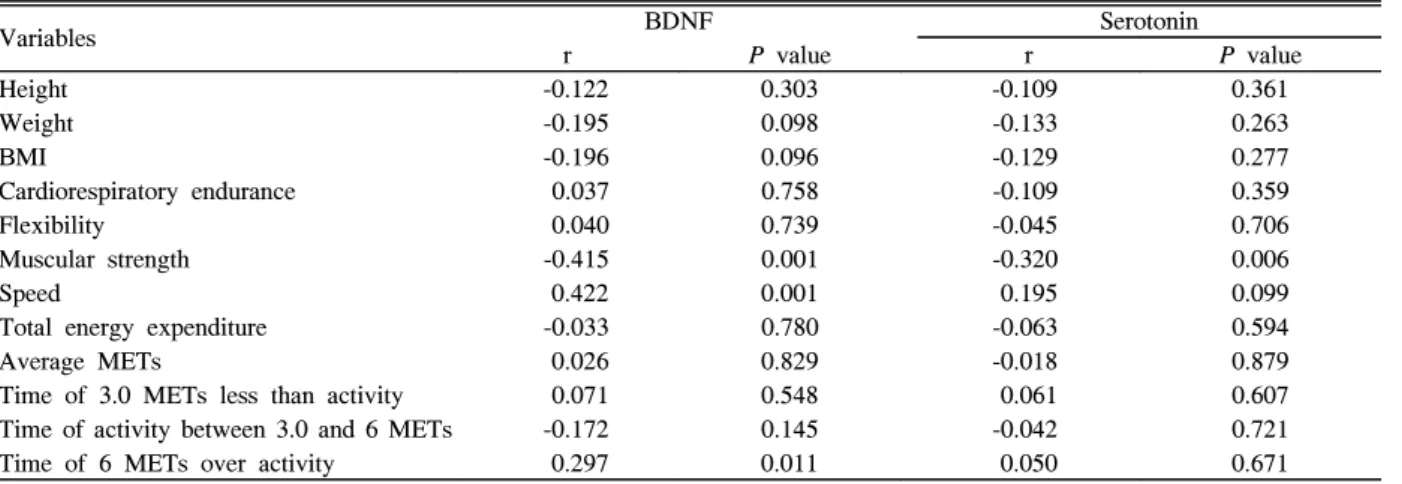
아동의 체력, 신체활동과 뇌신경세포 생성인자들의 상관 성을 분석한 결과는 Table 2와 같다.
뇌신경세포 생성인자 중 BDNF는 순발력(r = 0.442, P <
0.001), 6 METs 이상 활동시간(r = 0.297, P = 0.011)과 유 의한 정상관관계가 나타났으며, 근력(r = -0.415, P <
0.001)과는 유의한 역상관관계가 나타났다. serotonin은 근 력(r = -0.320, P = 0.006)과 유의한 역상관관계가 나타났다.
BDNF에 영향을 미치는 독립인자를 찾기 위하여 단계별
다중회귀분석을 시행한 결과는 Table 3과 같다. 다중공선성
확인 후 잔차 분석으로 Durbin-Watson 검정을 실시한 결과
1.695로 나타나 오차항 간에 체계적인 상관성이 없었으며,
오차항의 정규분포를 검증할 수 있어 설정한 모형의 적합성
을 확인하였다(F = 10.941, P < 0.001). 또한 순발력(t = 1.842, P = 0.07), 근력(t = -4.347, P < 0.001), 6 METs 이 상 활동시간(t = 3.841, P < 0.001), 3 METs 미만 활동시간 (t = 3.582, P = 0.001), 총에너지소모량(t = 2.010, P =
0.048)이 BDNF에 영향을 미치는 유의한 인자이며, 아동의 BDNF를 44.9% (R
2= 0.449, Adjusted R
2= 0.408) 설명해 주었다.
serotonin에 영향을 미치는 독립인자를 찾기 위하여 단계 Table 1. The characteristics of participants
Variables Male (n = 36) Female (n = 37) t
P value
Total (n = 73)Age (years) 10.36 ± 1.02 10.59 ± 0.99 -0.996 0.323 10.48 ± 1.00
Height (cm) 143.53 ± 8.28 144.31 ± 8.25 -0.399 0.691 143.93 ± 8.21
Weight (kg) 45.14 ± 12.34 42.4 ± 9.24 1.077 0.285 43.75 ± 10.89
BMI (kg/m2) 21.61 ± 4.2 20.19 ± 3.03 1.661 0.101 20.89 ± 3.70
Cardiorespiratory endurance 66.66 ± 17.82 53.83 ± 9.67 3.838 < 0.001 60.16 ± 15.58 Flexibility (cm) 5.54 ± 7.2 11.61 ± 4.69 -4.277 < 0.001 8.62 ± 6.75 Muscular strength (cm) 19.23 ± 7.23 18.27 ± 4.54 0.683 0.497 18.74 ± 6.00
Speed(sec) 9.9 ± 1.3 10.05 ± 0.71 -0.655 0.515 9.98 ± 1.04
Total energy expenditure (kcal) 2526.97 ± 889.24 1975.47 ± 596.03 3.120 0.003 2247.45 ± 799.44 Average METs (METs) 2.23 ± 0.35 1.94 ± 0.34 3.484 0.001 2.08 ± 0.38 Time of 3.0 METs less than
activity (min)
1065.88 ± 139.35 1163.87 ± 160.91 -2.778 0.007 1115.54 ± 157.54
Time of activity between 3.0 and 6 METs (min)
331.83 ± 113.41 252.37 ± 110.24 3.036 0.003 291.56 ± 118.02
Time of 6 METs over activity (min)
44.28 ± 49.59 19.01 ± 34.15 2.541 0.013 31.47 ± 44.05
BDNF (pg/mL) 2902.77 ± 1157.97 2900.01 ± 959.69 0.011 0.991 2901.37 ± 1054.67 Serotonin (ng/mL) 171.38 ± 79.8 167.45 ± 94.96 0.191 0.849 169.39 ± 87.22 BMI, body mass index; BDNF, brain derived neurotrophic factor.
Table 2. The correlation between variables (n = 73)
Variables BDNF Serotonin
r
P value
rP value
Height -0.122 0.303 -0.109 0.361
Weight -0.195 0.098 -0.133 0.263
BMI -0.196 0.096 -0.129 0.277
Cardiorespiratory endurance 0.037 0.758 -0.109 0.359
Flexibility 0.040 0.739 -0.045 0.706
Muscular strength -0.415 0.001 -0.320 0.006
Speed 0.422 0.001 0.195 0.099
Total energy expenditure -0.033 0.780 -0.063 0.594
Average METs 0.026 0.829 -0.018 0.879
Time of 3.0 METs less than activity 0.071 0.548 0.061 0.607
Time of activity between 3.0 and 6 METs -0.172 0.145 -0.042 0.721
Time of 6 METs over activity 0.297 0.011 0.050 0.671
BMI, body mass index; BDNF, brain derived neurotrophic factor.
Table 3. The effect of physical fitness and activity on BDNF (n = 73)
Dependent Independents beta t
P value
R2 Adjusted R2 FP value
BDNF Speed 0.188 1.842 0.070
0.449 0.408 10.941 < 0.001
Muscular strength -0.539 -4.347 < 0.001
Time of 6 METs over activity 0.426 3.841 < 0.001 Time of 3.0 METs less than activity 0.395 3.582 0.001
Total energy expenditure 0.247 2.010 0.048
BDNF, brain derived neurotrophic factor.
Excluded variables: height, weight, BMI, Cardiorespiratory endurance, Flexibility, Average METs, Time of activity between 3.0 and 6 METs.
별회귀분석을 시행한 결과는 Table 4과 같다. 다중공선성 확인 후 잔차 분석을 위해 Durbin-Watson 검정을 실시한 결과 1.85로 나타나 오차항 간에 체계적인 상관성이 없었으 며, 오차항의 정규분포를 검증할 수 있어 설정한 모형의 적 합성을 확인하였다(F = 8.116, P = 0.006). 또한 근력(t = -2.849, P = 0.006)이 serotonin에 영향을 미치는 유의한 인 자로 나타났으나, 아동의 serotonin의 설명력은 10.3%(R
2= 0.103, Adjusted R
2= 0.090)로 매우 낮은 것으로 나타났다.
고 찰
본 연구는 아동의 뇌신경세포 활성 및 생성에 있어 신체 활동 및 체력 증진 활동의 중요성을 강조하고자, 체력 및 신 체활동과 뇌신경세포 생성인자를 측정하여 인자들 간의 상 호 관련성을 분석하고, 뇌신경세포 생성인자에 영향을 미치 는 독립인자를 찾고자 하였다.
본 연구에서 체력 및 신체활동과 뇌신경세포 생성인자 간의 관련성을 분석한 결과 BDNF와 근력(r = -0.415, P <
0.001), serotonin과 근력(r = -0.320, P = 0.06)이 역상관관 계가 있는 것으로 나타났다. 많은 연구에서 신체활동과 심 폐체력이 뇌신경세포 생성인자의 수준을 높인다고 보고되 어 있어
4-6,17), 근육세포에서 지방산화에 대한 반응으로 BDNF가 증가된다는 연구
18)를 볼 때 근력과 뇌신경세포 생 성인자 간에는 정상관관계가 있을 것이라 예상되지만 본 연 구 결과는 이와는 반대로 근력과 BDNF 및 serotonin과 역 상관관계가 있는 것으로 나타났다. 이와 같은 결과는 본 연 구에서 체중 및 BMI와 BDNF간에 상관관계가 나타나지 않 았지만 체중 및 체지방률과 BDNF 간에는 역상관관계가 있 다는 선행연구 결과를 볼 때
19)체중 및 BMI가 높을수록 BDNF 수준이 낮다는 결과와 관련하여 해석할 수 있으며, 체중이 높고 비만할수록 지방과 근육량이 많아 근력은 높지 만 체지방률이 높아 BDNF 수준이 낮을 수 있다고 생각한 다. 또한 근육이 발달하여 근력이 높은 사람은 높은 수준의 BDNF가 필요 없어서 역상관관계를 보인다고 생각한다.
BDNF가 근육 내에서 당(glucose) 소비와 지방 산화를 촉진 하여 에너지소비를 증가시키고
20), 음식 섭취와 체중을 조절 하는 것으로 알려져 있다.
21,22)규칙적인 운동에 의해 이미 근육이 발달한 사람은 에너지소비가 높으며 TG가 낮아 에 너지소비를 촉진시키는 역할을 하는 BDNF 수준이 낮은 것
으로 보인다.
일부 선행연구에서도 BDNF 수준이 신체활동 수준, 심폐 체력과 역상관관계가 있다고 보고되었다.
13,23-25)이와 같은 결과는 BDNF의 혈액 순환 기능 및 분비·저장 조직과 관련 이 있는 것으로 생각된다.
26,27)일부 연구에 의하면 BDNF는 뇌 혈류 조절과 심혈관 질환과 관련이 있으며
27,28), BDNF 증가가 뇌 혈류 순환을 억제하여 체력과 부정적 관계가 나 타날 수 있다고 보고되었다.
29)BDNF의 증가를 위해서 운동 및 신체활동의 증가가 중 요하게 생각되어 본 연구에서 다양한 운동강도의 유지 시간 을 조사하여 뇌신경세포 생성인자와의 관련성을 분석한 결 과 BDNF는 6 METs 이상 활동시간(r = 0.297, P = 0.011) 과 유의한 정상관관계가 나타났다. 그 외 3 METs 미만 활 동시간과 3~6 METs 활동시간은 상관관계가 없는 것으로 나타났다. 이와 같은 결과를 볼 때 BDNF 증가를 통해 뇌기 능 활성과 뇌세포 생성을 촉진시키기 위해서는 6 METs 이 상 시간, 즉 중강도 이상의 신체활동이 필요한 것으로 생각 한다. Seifert 등
30)의 연구에서도 좌업생활 남성을 대상으로 12주 증강도의 유산소운동 후 BDNF가 증가한 것으로 보고 하였으며 Aguiar 등
31)의 연구에서도 중강도 트레드리밀 운 동 후 BDNF가 증가한 것으로 보고하였다. 또한 고강도의 일회성 운동에 의해서도 급격하게 증가되는 것으로 보고되 었다.
15)Schmidt-Kassow 등
32)의 연구에서는 고강도 운동에 서는 BDNF가 증가되었지만 저강도 운동에서는 증가하지 않은 것으로 나타났다. 이와 같은 결과를 볼 때 BDNF 증가 에 영향을 미치는 운동강도가 다르다는 것을 알 수 있으므 로 BDNF 증가에 영향을 미치는 운동 방법과 시간이 통제 된 보다 효과적인 운도강도를 찾는 연구가 필요하다고 생각 한다.
이처럼 체력과 운동강도의 여러 인자들이 뇌신경세포 생 성인자에 영향을 미치므로 인자들 중 영향력이 높은 독립인 자를 찾고자 단계별회귀분석을 실시하였다. 그 결과 BDNF 를 예측하는 독립인자는 순발력(t = 1.842, P = 0.07), 근력 (t = -4.347, P < 0.001), 6 METs 이상 활동시간(t = 3.841,
P < 0.001), 3 METs 미만 활동시간(t = 3.582, P = 0.001),총에너지소모량(t = 2.01, P = 0.048)으로 나타났다. 본 연 구의 3 METs 미만 활동시간과 총에너지소모량이 BDNF에 영향을 미치는 결과와 선행연구의 저강도 시간을 증가시키 는 것과 BDNF 증가와 관련 있다는 결과
5,13)를 볼 때 BDNF Table 4. The effect of physical fitness and activity on Serotonin (n = 73)
Dependent Independents beta t
P value
R2 Adjusted R2 FP value
Serotonin Muscular strength -0.320 -2.849 0.006 0.103 0.090 8.116 0.006
BDNF, brain derived neurotrophic factor.
Excluded variables: height, weight, BMI, Cardiorespiratory endurance, Flexibility, speed, Total energy expenditure, Average METs, Time of 3.0 METs less than activity, Time of activity between 3.0 and 6 METs, Time of 6 METs over activity.
변화를 위해서는 신체활동 시간을 증가시켜 에너지소비를 늘리는 것이 도움이 된다. 또한 BDNF의 증가 수준은 운동 강도와 관련이 있어 보인다. BDNF 증가를 위해 운동을 실 시한다면 체중 감소를 위한 운동과 6 METs 이상의 중·고 강도 운동이 필요하다고 볼 수 있다. Ferris 등
6)의 연구에서 도 운동강도가 높을 때 BDNF가 증가했다고 보고되었다.
본 연구에서 BDNF 및 serotonin을 예측하는 독립인자는 근력으로 나타났다. 선행연구에서 운동에 의해 serotonin의 분비 수준이 변화되고, serotonin의 변화가 BDNF 발현에 영향을 미치는 것으로 알려졌다.
2,8,9)그러나 선행연구에서 BDNF의 혈류 조절 기능에 의해 체력과 역상관관계가 나타 날 수 있음이 보고되었으며
29), 통계적으로 유의하지는 않지 만 체중 및 체지방률과 BDNF의 역상관관계를 고려할 때 BDNF 변화를 위해서는 장기간의 지속적인 운동을 통해 체 중 및 체지방률 감소가 우선 고려되어야 할 것이라 생각한다.
결론적으로 본 연구를 통해 BDNF와 근력, serotonin과 근력은 역상관관계, BDNF와 순발력 및 6 METs 이상 활동 시간은 정상관관계가 있으며, BDNF를 예측하는 독립인자 는 순발력, 근력, 6 METs 이상 활동시간, 3 METs 미만 활 동시간, 총에너지소모량, serotonin을 예측하는 독립인자는 근력임을 알 수 있었다.
그러나 본 연구는 뇌신경 생성 및 활성은 다양한 호르몬 의 영향으로 결정되지만 BDNF와 serotonin 만을 뇌신경 생 성 및 활성 인자로 본 제한점을 가지고 있다. 또한 성별에 따라 체력과 신체활동의 일부 항목에 차이가 있음에도 불구 하고 성별을 구분하여 분석하지 못하였다. 뇌신경 생성 및 활성에 관련된 더 많은 항목의 호르몬 분석과 연구 대상을 늘려 성별에 따른 차이에 대한 연구가 이어져야 할 것이다.
References