Case report : Anterior Open bite after injection of Botulinum Toxin on Masseter Muscles
Ji-won Ryu, D.D.S., M.S.D.
Department of Oral Medicine, School of Dentistry, Chosun University
Botulinum neurotoxin(BoNT) is a protease exotoxin produced from Clostridium botulinum. It works by blocking the release of acetylcholine from cholinergic nerve endings causing inactivity of muscles or glands. Recently, the therapeutic use of BoNT have expanded to include a wide range of medical and dental conditions. Botulinum neurotoxin type A(BoNT/A) is used off-label in the orofacial region to treat primary and secondary masticatory and facial muscle spasm, severe bruxism, facial tics, orofacial dyskinesias, dystonias, and hypertrophy of the masticatory muscles.
Local hematoma, infection, and persistent pain in the injection site are the site-of-injection side effects. Medication-related side effects are adjacent muscle weakness, slurred speech, an alteration in the character of the saliva, and severe headaches. In most cases, these complications are not persistent and bothersome. We reported a case report of a patient who had transient anterior open bite after BoNT/A injection on masseter muscles to treat the refractory myofascial pain.
Key Words : Anterior open bite, Botulinum toxin, Masseter
Ⅰ. Introduction
Botulinum neurotoxin(BoNT) is a protease exotoxin produced fromClostridium botulinum. It works by blocking the release of acetylcholine Corresponding Author: Ji-won Ryu
Associate Professor, Department of Oral Medicine, Chosun University, 421, School of Dentistry, Seosuk-dong, Dong-Gu, Gwang-Ju, 501-825 Tel : 062-220-3897
Fax : 062-234-2119 Fax: 062-234-2119
E-mail: [email protected] Received: 2013-10-08 Accepted: 2013-10-29
* This study was supported by research funds from Chosun University, 2012.
from cholinergic nerve endings causing inactivity of muscles or glands.1)Its first medical use was to treat strabismus in 1980.1) Recently, the therapeutic use of BoNT have expanded to include a wide range of medical and dental conditions.
The US Food and Drug Administration (FDA) approved botulinum neurotoxin type A(BoNT/A[BotoxⓇ, manufactured by Allergan, Irvine, CA]) in 1989 for focal muscle hyperactivity disorders.2)The FDA approved BoNT/A for the temporary treatment of blepharospasm and strabismus and then for cervical dystonia in 1990.
Additionally, BoNT/A has been approved for the treatment of primary axillary hyperhidrosis and for reduction of deep glabellar lines in the face.3) In addition to these on-label uses, BoNT/A is
primary and secondary masticatory and facial muscle spasm, severe bruxism, facial tics, orofacial dyskinesias, dystonias, and hypertrophy of the masticatory muscles.3)
Temporomandibular disorders(TMD) comprise a group of chronic pain conditions affecting the temporomandibular joint and masticatory muscles.4) The most common symptom is myofascial pain from masticatory muscles, which is often poorly localized and accompanied by headache and restricted jaw opening capacity.5)
The pathogenesis of myofascial TMD is unclear, and because of lack of knowledge about underlying mechanisms, a multimodal approach with conservative treatment is usually recommended, including behavioral instruction, physical therapy and occlusal splints. These conservative therapies are often efficious, but for some patients, pain does not resolve.6) BoNT/A causes muscle relaxation by temporarily blocking the release of acetylcholine from presynaptic cholinergic nerve terminals.5) The muscle remains paralyzed until new synaptic connections form as a result of sprouting.
With time, sprouting is reversed and the original nerve terminal is restored.8) BoNT is also reported to have an antinociceptive effect by blocking the release of inflammatory mediators, such as substance P and glutamate.8,9) Because of its muscle-relaxing and possible analgesic effects, BTX has also gained much interest as a possible treatment of myofascial pain and headache disorders.10)
Clark stated the side effects of the BoNT injections.3) Side effects can be divided into site-of-injection side effects and medication-related side effects. Local hematoma, infection, and persistent pain in the injection site are the site-of-injection side effects.
Medication-related side effects are adjacent muscle weakness, slurred speech, an alteration in
the character of the saliva, and severe headaches.
In most cases, these complications are not persistent and bothersome. We reported a case report of a patient who had transient anterior open bite after BoNT/A injection on masseter muscle to treat the refractory myofascial pain.
Ⅱ. Case
A 16-year-old female patient visited the Department of the Oral Medicine, Dental hospital, Chosun University, with a chief complaint of continuous dull pain in the jaw.
The symptom of the patient had started 1 year ago with intermittent pain, but 1 month before visiting, the frequency of the pain had been changed to be persistent. In measuring pain intensity by visual analogue scale (VAS), her pain was 5. For diagnosing her pain, we took the Temporomandibular Disorder (TMD) examination test. In the range of motion test, the comfortable mouth opening was 45 mm, and the active mouth opening was 50 mm with pain on both masseter muscles. In the muscle palpation test at the head and neck region, she had tenderness in both temporomandibular joint (TMJ), masseter muscle and trapezius muscle. But there were no specific pathologic findings on radiographic examination. With all above signs and symptoms were considered, the TMJ arthralgia and myalgia were diagnosed temporally. Behavioral modification and physical therapy were practiced, also nonsteroidal anti- inflammatory drug(NSAIDs: nabumetone [RelafenⓇ] 500mgb.i.d) and muscle relaxant(eperisone HCl[exoperinⓇ] 50mg b.i.d) were prescribed for 2 weeks. But she did not visit at 2 weeks follow-up.
6 months later, she re-visited our clinic, she stated that she had visited another dental hospital and the oral stabilization appliance had been given. The effect of the oral appliance was temporary, but she
stopped wearing appliance because of the tooth pain. After she stopped to wearing oral appliance, she felt the reduced mouth opening. In the range of motion test, the comfortable mouth opening was 20 mm, the active mouth opening was 30 mm, and the passive mouth opening was 40 mm with severe pain on both masseter muscles. In the muscle palpation test, she had tenderness in TMJs, masseter muscles, sternocleidomastoid muscles, and trapezius muscles on both side. In addition, the pain at the palpation on masseter muscles was radiated to TMJ. There were no sound and deviation/deflection signs during the mouth opening. Her jaw pain was diagnosed as myofascial pain because the symptom of the pain was diffuse and there were radiating patterns in the masseter muscle palpation. To reduce her pain, the tricyclic antidepressant (TCA:
amitriptyline [etravilⓇ]h.s.) was prescribed. The dosage was elevated by months from 10mg to 30mg to reduce the side effect of TCA. The oral appliance was adjusted and weared at night. Even though the medication and appliance treatment had been given for 3 months, there was no observable change in the patient’s condition. So we took trigger point injections on masseter muscle area, with 1% lidocaine, and after the trigger point injections, she stated that the pain in the jaw was temporarily reduced for 2 days.
After the patient had given informed consent, Botulinum toxin type A(BotoxⓇ, manufactured by Allergan, Irvine, CA) was injected into superficial masseter muscle on both sides, each 25 units. At this time of the injection, the pain was 7, measured by VAS.
After two weeks, her pain was relieved (measured 2 by VAS) but she complained the bite change. Intraoral examination revealed that the overbite(OB) was -2 mm and there were two molars(second molar area) contacts in centric occlusion.
According to the medical record at the first visit, the OB was 1mm and there were
occlusal contacts from the first premolar to the second molar on both sides in centric occlusion. We took clinical photographs in centric occlusion and instructed her to chew foods bilaterally.(Fig. 1.) Analysis of articulated casts revealed that dental migration had not occurred, since the casts occluded correctly. The conebeam computerized tomograph(CBCT) for TMJ was taken for finding degenerative changes in TMJ, and there was no pathologic change in TMJ. Her bite had been checked by month for 4 months.
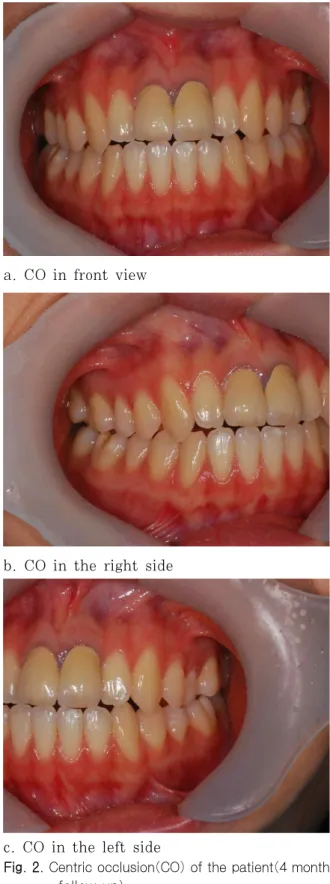
After 4 months, the centric occlusion returned to stable occlusion, and the treatment was finished.(Fig. 2.)
Ⅲ. Discussion
Myofascial pain(MFP) is defined as a regional pain syndrome characterized by muscle pain caused by myofascial trigger points.11, 12) Myofascial pain is a common cause of persistent regional pain such as neck pain, shoulder pain, headaches, and orofacial pain.13) The clinicians who deal with orofacial pain must understand the role of myofascial pain. It has been reported that approximately 50% of all temporomandibular disorders (TMDs) are masticatory myalgias or painful masticatory muscle disorders.14) Treatment of masticatory MFPS may include pharmacologic therapy (NSAIDs, muscle relaxants, TCAs, anxiolytics), stabilization splint therapy, trigger point therapy (spray and stretch, injections), and physical therapy (mandibular exercises).15)Most of the treatment methods for MFP are aimed to reduce the pain in trigger points and reduce muscle spasms. However, recurrence is frequent.
Multimodal, conservative treatments are often efficious, but for some patients, pain does not resolve.
In this case, conservative treatments (including behavioral modification, physical therapy, medication, and appliance therapy) were not
effective for the patient to reduce the pain, but the trigger point injection into masseter muscles was effective tentatively.
Myofascial trigger points(MTrPs) are thought to be the result of abnormal motor end-plate activity which produces an excessive continuous release of the neurotransmitter acetylcholine(ACh).16) In theory, using neurotransmitter blocking agents such as BoNT for myofascial trigger-point pain might eliminate the end-plate dysfunction by blocking the release of Ach and thereby reduce pain.3)
The possible antinociceptive effect after BoNT injections three mechanisms have been suggested to support this effect:
neuromuscular block at the level of SNARE proteins; inhibition of nociceptive pathways by modulating the release of calcitonin gene-related peptide (CGRP), substance P (SP) both peripherally and centrally etc.;
and an effect on the vascular circulation.15,17) The results of the few randomized and placebo-controlled trials (RCT) in myofascial TMDs are also conflicting. Two RCTs reported a better effect of BoNT in orofacial muscle pain.18,19)In contrast, 2 other double-blind RCTs reported no significant effect of BoNT.20,21) Ernberg stated that BoNT would probably not be the first choice, but in those patients where pain does not resolve after conservative treatment, the BoNT might be used as an adjunct.5) It was applied to the patient described above. After the explanation of BoNT treatment, the patient agreed and the injection of BoNT into masseter muscles on both sides were taken. It was effective and the symptom was relieved (from 7 to 2 by VAS), but she complained the bite change, anterior open bite. To our knowledge, anterior open bite after the BoNT injection had not been reported. The side effects related to BoNT are adjacent muscle weakness, slurred speech, an alteration in the character of the saliva, and severe headaches.3)In most cases, these complications are not persistent
and bothersome. Fortunately, the anterior open bite of the patient was disappeared, so this phenomenon was not persistent. To find the relating causes for anterior open bite of the patient, we took the conebeam computerized tomograph(CBCT) for finding degenerative changes in TMJ, there were no pathologic findings in TMJ of the patient. And analysis of articulated casts revealed that dental migration had not occurred, since the casts occluded correctly. We concluded that these alterations are more likely due to positional changes in the mandible. We tried to find articles about side effects of stabilization splints, because BoNT may have similar mechanisms to stabilization splints, and there was no published article about this alteration after BoNT injection. Magdaleno reported a similar case with stabilization splint, and he presumed that anterior open bite without occlusal modification may be a possible consequence of either changes in masticatory muscle activity, the different distribution of occlusal load, or modifications in the vertical dimension.22)In this case, the different distribution of occlusal load and modifications in the vertical dimension may not be possible causes of anterior open bite. So, changes in masticatory muscle activity could be a relevant cause of anterior open bite after BoNT injection. Further investigation should be needed to clarify the mechanism of this alteration.
a.a.a.Coa.COin
a. CO in front view
b. CO in the right side
c. CO in the left side
Fig. 1. Centric occlusion(CO) of the patient (2 weeks after the injection of botulinum toxin on masseter muscle on both side)
aashdkjhajsd
a. CO in front view
b. CO in the right side
c. CO in the left side
Fig. 2. Centric occlusion(CO) of the patient(4 month follow-up)
References
1. Persaud R, Garas G, Silva S et al. An evidence-based review of botulinum toxin (Botox) applications in non-cosmetic head and neck conditions. JRSM Short Rep 2013;4(2):10; Epub 1-9.
2. Charles PD. Botulinum neurotoxin serotype A:
a clinical update on non-cosmetic uses. Am J Health Syst Pharm 2004;61(22 Suppl 6):S11-23.
3. Glenn T. Clark, Raymond A. Dionne. Orofacial Pain: A guide to medications and management.
Oxford, 2012, Wiley-Blackwell, pp. 169-178.
4. The American Academy of Orofacial Pain. Differential diagnosis and management considerations of temporomandibular disorders. In Okenson JP(Ed).
Orofacial pain: guidelines for assessment, diagnosis and management. American Academy of Orofacial Pain.
Chicago, 1996, Quintessence Publishing Co.Inc, pp.
113-141.
5. Ernberg M, Hedenberg-Magnusson B, List T, Svensson P. Efficacy of botulinum toxin type A for treatment of persistent myofascial TMD pain: a randomized, controlled, double-blind multicenter study. Pain 2011;152(9):
1988-1996.
6. List T, Axelsson S. Management of TMD: evidence from systematic reviews and meta-analyses. J Oral Rehabil 2010;37(6): 430-451.
7. Meunier FA, Lisk G, Sesardic D, Dolly JO.
Dynamics of motor nerve terminal remodeling unveiled using SNARE-cleaving botulinum toxins: the extent and duration are dictated by the sites of SNAP-25 truncation. Mol Cell Neurosci 2003;22(4):454-466
8. Aoki KR. Review of a proposed mechanism for the antinociceptive action of botulinum toxin type A. Neurotoxicology 2005;26:785–793.
9. Purkiss J, Welch M, Doward S, Foster K.
Capsaicin-stimulated release of substance P from cultured dorsal root ganglion neurons:
involvement of two distinct mechanisms.
Biochem Pharmacol 2000;59:1403–1406.
10. Dodick DW, Turkel CC, DeGryse RE et al.
PREEMPT Chronic Migraine Study Group.
Onabotulinumtoxin A for treatment of chronic migraine: pooled results from the double-blind, randomized, placebo- controlled phases of the
PREEMPT clinical program. Headache 2010;50:921–936.
11. Simons DG, Travell JG, Simons LS. Travell &
Simons’s Myofascial Pain and Dysfunction: The Trigger Point Manual. 2nd ed., Baltimore, 1999, Williams & Wilkins, pp. 11-86.
12. Hong CZ, Simons DG. Pathophysiologic and electrophysiologic mechanism of myofascial trigger points. Arch Phys Med Rehabil 1998;79:863–872.
13. Svensson P, List T, Hector G. Analysis of stimulusevoked pain in patients with myofascial temporomandibular pain disorders.
Pain 2001;92:399-409.
14. Stohler CS. Oral and Maxillofacial Surgery.
Temporomandibular Disorders. Philadelphia, 2000, WB Saunders, pp.38–45.
15. Hong SJ, Yoon CL, Ahn JM, Ryu JW.
Treatment of Chronic Myofascial Pain with Botulinum Toxin : Case report. Korean J Oral Med 2010;35(3):221-227
16. Rivner MH. The neurophysiology of myofascial pain syndrome. Curr Pain Headache Rep 2001;5(5):432-440.
17. Brin MF, Fahn S Moskowitz Cet al.Localized injections of botulinum toxin for the treatment of focal dystonia and hemifacial spasm. Adv Neurol 1988;50:599–608.
18. von Lindern JJ. Type A botulinum toxin in the treatment of chronic facial pain associated with temporo-mandibular dysfunction. Acta Neurol Belg 2001;101:39–41.
19. Guarda-Nardini L, Manfredini D, Salamone M, Salmaso L, Tonello S, Ferronato G. Efficacy of botulinum toxin in treating myofascial pain in bruxers: a controlled placebo pilot study.
Cranio 2008;26:126–135.
20. Nixdorf DR, Heo G, Major PW. Randomized controlled trial of botulinum toxin A for chronic myogenous orofacial pain. Pain 2002;99:465–
473.
21. Kurtoglu C, Gur OH, Kurkcu M, Sertdemir Y, Guler-Uysal F, Uysal H. Effect of botulinum toxin-A in myofascial pain patients with or without functional disc displacement. J Oral Maxillofac Surg 2008;66:1644–1651.
22. Magdaleno F, Ginestal E. Side effects of stabilization occlusal splints: a report of three cases and literature review. Cranio 2010;28(2):128-135.
국문초록
보툴리눔 톡신 교근 주입 후 발생한 전방 개교합 증례보고
조선대학교 치의학전문대학원 구강내과학교실 유 지 원
보툴리눔 톡신은 신경독소로, 운동신경 말단부위에서 분비되는 아세틸콜린의 분비를 차단하여 근육의 위축을 유발하게 된다. 의학계 및 치의학계에서는 이를 이용하여 다양한 질환을 치료하는 것을 시도하고 있다. 치과영역에서는 저작근 수 축, 심한 이갈이, 안면 틱, 구강안면 운동장애, 교근비대의 치료 등 과활성 근육성 질환을 치료하는 데 사용하고 있다.
악안면 영역에 보툴리눔 톡신을 주입하고 난 뒤 발생되고 있는 합병증으로는, 자연스럽지 못한 안면표정, 통증의 증가, 두통 등이 유발될 수 있다고 보고되고 있다.
본 증례에서는 교근부에 보툴리눔 톡신 주입 후 발생된 전방 개교합 증상에 대하여 보고하고자 한다.
주제어: 교근, 보툴리눔 독소, 전방 개교합