Association between Exercise and Metabolic Syndrome in Koreans
Se Hun Lee1, Young Lee2, Je Hyun Seo2, Ye An Kim1,*
1Department of Internal Medicine and 2Research Institute, Veterans Health Service Medical Center, Seoul, Korea
Background: The favorable role of exercise on metabolic syndrome is well established; however, there is a lack of consistent epidemiological data. Thus, we analyzed the association between exercise intensity and metabolic syndrome using data from the Fourth Korea National Health and Nutrition Examination Survey (2007−2009).
Methods: A total of 10,533 Korean individuals were screened. Exercise amount and intensity were assessed from questionnaire responses. Subjects were divided into three groups according to exercise intensity: no activi- ty (n=607), walking only without intense exercise (n=2,336), and moderate to vigorous activity with or without walking (n=3,855). Logistic regression analyses were used to evaluate the associations between exercise inten- sity and metabolic syndrome.
Results: The overall prevalence of metabolic syndrome was 22.3% (total n=6,798). The prevalence of metabol- ic syndrome was 20.4% for the intense exercise group, 24.0% for the walking only group, and 29.9% for the no activity group (P<0.001). The intense exercise group had a significantly lower odds ratio for the prevalence of metabolic syndrome and its components, especially abdominal obesity and hypertriglyceridemia, but not for blood pressure. Interestingly, there were no negative associations identified within the walking only group, oth- er than prevalence of metabolic syndrome itself. The risk of hyperglycemia was slightly lower in the walking group compared to the no activity group but disappeared after multiple adjustments.
Conclusion: A strong inverse relationship between metabolic syndrome and moderate to vigorous intensity exercise was identified, which may reflect a protective effect of intense exercise, but not walking, on metabolic syndrome. Further prospective studies are needed to consolidate our findings.
Key words: Exercise, Intensity, Walking, Metabolic syndrome, Abdominal obesity
Received February 27, 2018 Reviewed April 16, 2018 Accepted June 15, 2018
* Corresponding author Ye An Kim
https://orcid.org/0000-0001-8986-2632 Department of Internal Medicine, Veterans Health Service Medical Center, 53 Jinhwangdo-ro 61-gil, Gangdong-gu, Seoul 05368, Korea
Tel: +82-2-2225-4691 Fax: +82-2-2225-1433 E-mail: [email protected]
The first two authors contributed equally to this study.
INTRODUCTION
Metabolic syndrome is characterized by increased insulin resis- tance and is associated with a high risk of cardiovascular disease and type 2 diabetes.
1Over the last several decades, metabolic syn- drome has grown to a serious problem world-wide, including Ko- rea, as a result of changes in dietary habits and increasing physical inactivity.
2,3Although the pathogenesis of metabolic syndrome is not fully understood, progression of metabolic syndrome is closely associated with physical inactivity and consumption of a diet high in fats and carbohydrates.
4These factors aggravate obesity and in-
sulin resistance, and seem to exacerbate metabolic syndrome in conjunction with other risk factors such as genetics, inflammation, and adipokines.
5Based on the pathophysiology of metabolic syndrome, exercise is considered one of the cornerstones of management.
5-9In 2010, the World Health Organization launched a global recommendation for reducing metabolic syndrome that comprised at least 60 min- utes of moderate to vigorous physical activity per day is for children and adolescents.
10In addition, regular exercise reduces body weight, waist circumference, and insulin insensitivity, while im- proving both dyslipidemia and hypertension.
11Copyright © 2018 Korean Society for the Study of Obesity
This is an Open Access article distributed under the terms of the Creative Commons Attribution Non-Commercial License (http://creativecommons.org/licenses/by-nc/4.0/) which per- mits unrestricted non-commercial use, distribution, and reproduction in any medium, provided the original work is properly cited.
2017-03-16 https://crossmark-cdn.crossref.org/widget/v2.0/logos/CROSSMARK_Color_square.svg
With respect to exercise intensity, many studies have shown that a high level of exercise reduces the risk of developing metabolic syndrome
7,12-14; however, several important issues surrounding the role of exercise remains. For example, most of the studies to date have been conducted in Europe and the United States
9,12,13,15,16, whereas there are relatively few studies of Asian populations.
14In addition, the benefits of low intensity exercise on metabolic syn- drome are controversial. Some studies have suggested that there is a linear relationship between exercise intensity and development of metabolic syndrome, while others have indicated that only high frequency exercise is effective for reducing the risk of metabolic syndrome. These results are important for prescribing exercise strategies, and many physicians are reluctant to recommend high intensity activities for certain groups such as the elderly who are easily tired and for whom moderate to severe activity may be harm- ful.
In the present study, we aimed to investigate the association be- tween exercise intensity and metabolic syndrome in Koreans using data from the Korea National Health and Nutrition Examination Survey (KNHANES 2007–2009).
METHODS Study population
This study used the dataset from the KNHANES IV, a nation- wide survey conducted between 2007 and 2009. KNHANES has periodically assessed the health and nutritional status of Koreans since 1998, and is a nationally representative cross-sectional survey that consists of a medical history, physical examination, health be- havior survey, and anthropometric and biochemical measurements.
We analyzed data for 5,690 women and 4,843 men from the sec- ond year (2007–2009) of KNHANES IV. The exclusion criteria were as follows: ≤ 18 years of age (n= 2,521), pregnancy (n= 43), malignancy (n= 145), liver cirrhosis (n= 10), chronic obstructive pulmonary disease or active tuberculosis (n= 60), and chronic re- nal disease (n= 19). Of the remaining 7,735 participants, we fur- ther excluded cases with insufficient data for metabolic syndrome or exercise (n= 729) or inadequate fasting time less than 8 hours (n= 208). Finally, 6,798 subjects were included in our analysis. All participants provided written informed consent and the study was
approved by the Institutional Review Board of Korea Centers for Disease Control and Prevention (No. 2010-02CON-21-C, 2011- 02CON-06-C, and 2012-01EXP-01-2C).
Assessment of exercise and metabolic syndrome
Physical activity was evaluated using the International Physical Activity Questionnaire. Subjects were asked if they had exercised for at least 10 minutes during the last week for different types of physical activity consisting of walking only, moderate physical ac- tivities (slow swimming, playing tennis doubles/volleyball/bad- minton/table tennis, transporting light objects, etc.), and vigorous physical activity (running, mountain climbing, soccer/basketball/
squash/single tennis, fast cycling, fast swimming, skipping rope, transporting heavy objects, etc.).
Subjects were further divided according to activity intensity: no activity group, walking only group, and moderate to vigorous activ- ity group. Because exercise frequency and exercise days were simi- lar between the moderate physical activity group and vigorous physical activity group, both groups were combined into the in- tense exercise group. On the other hand, the walking exercise group had a different pattern from the other two groups, and thus the walking exercise group was defined separately. Subjects who in- dicated that they did not participate in physical activity were as- signed to “group I,” while others who indicated that they only walked but did not participate in any moderate or vigorous activity were assigned to “group II.” All others who indicated participation in moderate to vigorous activity were assigned to “group III” re- gardless of walking.
Trained medical staff measured subjects’ height and weight to
the nearest 0.1 cm and 0.1 kg by portable stadiometer (Seriter, Bis-
marck, ND, USA) over a range of 850 to 2,069 mm and balance
beam scale (Giant-150N; HANA, Seoul, Korea). Waist circumfer-
ence was measured according to World Health Organization guide-
lines, namely, the midpoint between the inferior margin of the last
rib and iliac crest in a horizontal plane. Body mass index (BMI)
was calculated as weight (in kilograms) divided by height squared
(in meters). Blood pressure was assessed using an oscillometric
method with an automated sphygmomanometer. Serum glucose,
triglyceride, and high-density lipoprotein (HDL) cholesterol levels
were analyzed using an ADIVIA650 (Siemens, Madison, WI,
USA).
Metabolic syndrome was defined according to the modified Na- tional Cholesterol Education Program Adult Treatment Panel III criteria. Metabolic syndrome was diagnosed when patients fulfilled three of the five criteria listed as follows. Waist-circumference was
modified because of ethnic differences
17: (1) waist-circumference:
man ≥ 90 cm, woman ≥ 85 cm; (2) blood pressure: systolic blood pressure ≥ 130 mmHg or diastolic blood pressure ≥ 85 mmHg;
(3) fasting glucose: ≥ 100 mg/dL; (4) triglyceride: ≥ 150 mg/dL;
(5) HDL cholesterol: man < 40 mg/dL, woman < 50 mg/dL.
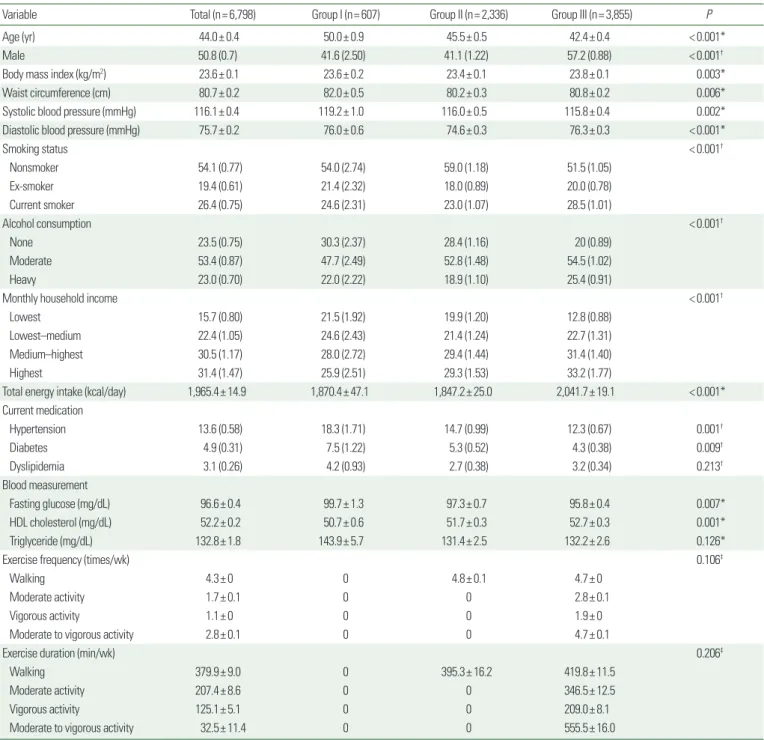
Table 1. Baseline characteristics of study subjects
Variable Total (n= 6,798) Group I (n= 607) Group II (n= 2,336) Group III (n= 3,855) P
Age (yr) 44.0± 0.4 50.0± 0.9 45.5± 0.5 42.4± 0.4 < 0.001*
Male 50.8 (0.7) 41.6 (2.50) 41.1 (1.22) 57.2 (0.88) < 0.001†
Body mass index (kg/m2) 23.6± 0.1 23.6± 0.2 23.4± 0.1 23.8± 0.1 0.003*
Waist circumference (cm) 80.7± 0.2 82.0± 0.5 80.2± 0.3 80.8± 0.2 0.006*
Systolic blood pressure (mmHg) 116.1± 0.4 119.2± 1.0 116.0± 0.5 115.8± 0.4 0.002*
Diastolic blood pressure (mmHg) 75.7± 0.2 76.0± 0.6 74.6± 0.3 76.3± 0.3 < 0.001*
Smoking status < 0.001†
Nonsmoker 54.1 (0.77) 54.0 (2.74) 59.0 (1.18) 51.5 (1.05)
Ex-smoker 19.4 (0.61) 21.4 (2.32) 18.0 (0.89) 20.0 (0.78)
Current smoker 26.4 (0.75) 24.6 (2.31) 23.0 (1.07) 28.5 (1.01)
Alcohol consumption < 0.001†
None 23.5 (0.75) 30.3 (2.37) 28.4 (1.16) 20 (0.89)
Moderate 53.4 (0.87) 47.7 (2.49) 52.8 (1.48) 54.5 (1.02)
Heavy 23.0 (0.70) 22.0 (2.22) 18.9 (1.10) 25.4 (0.91)
Monthly household income < 0.001†
Lowest 15.7 (0.80) 21.5 (1.92) 19.9 (1.20) 12.8 (0.88)
Lowest–medium 22.4 (1.05) 24.6 (2.43) 21.4 (1.24) 22.7 (1.31)
Medium–highest 30.5 (1.17) 28.0 (2.72) 29.4 (1.44) 31.4 (1.40)
Highest 31.4 (1.47) 25.9 (2.51) 29.3 (1.53) 33.2 (1.77)
Total energy intake (kcal/day) 1,965.4± 14.9 1,870.4± 47.1 1,847.2± 25.0 2,041.7± 19.1 < 0.001*
Current medication
Hypertension 13.6 (0.58) 18.3 (1.71) 14.7 (0.99) 12.3 (0.67) 0.001†
Diabetes 4.9 (0.31) 7.5 (1.22) 5.3 (0.52) 4.3 (0.38) 0.009†
Dyslipidemia 3.1 (0.26) 4.2 (0.93) 2.7 (0.38) 3.2 (0.34) 0.213†
Blood measurement
Fasting glucose (mg/dL) 96.6± 0.4 99.7± 1.3 97.3± 0.7 95.8± 0.4 0.007*
HDL cholesterol (mg/dL) 52.2± 0.2 50.7± 0.6 51.7± 0.3 52.7± 0.3 0.001*
Triglyceride (mg/dL) 132.8± 1.8 143.9± 5.7 131.4± 2.5 132.2± 2.6 0.126*
Exercise frequency (times/wk) 0.106‡
Walking 4.3± 0 0 4.8± 0.1 4.7± 0
Moderate activity 1.7± 0.1 0 0 2.8± 0.1
Vigorous activity 1.1± 0 0 0 1.9± 0
Moderate to vigorous activity 2.8± 0.1 0 0 4.7± 0.1
Exercise duration (min/wk) 0.206‡
Walking 379.9± 9.0 0 395.3± 16.2 419.8± 11.5
Moderate activity 207.4± 8.6 0 0 346.5± 12.5
Vigorous activity 125.1± 5.1 0 0 209.0± 8.1
Moderate to vigorous activity 32.5± 11.4 0 0 555.5± 16.0
Values are presented as mean± standard error or percentage (standard error). Group I, no activity group; Group II, walking only group; Group III, moderate to vigorous activity group.
P-values from *analysis of variance; †Rao-Scott chi-square test; ‡Independent t-test.
HDL, high-density lipoprotein.
Alcohol consumption and smoking status were estimated from subjects’ self-reported typical daily consumption. Drinking was di- vided into three groups by lifetime drinking experience in adults:
heavy drinker (> 1/wk), moderate drinker (≤ 1/wk), and non- drinker. Smoking status was likewise classified as current smoker, ex-smoker, or nonsmoker. Monthly household income was catego- rized into quartiles: lowest ( < $500), lowest–medium ($500–
1,000), medium–highest ($1,000–3,000), and highest (≥ $3,000).
Statistical analysis
Statistical analyses were performed using the R software version 3.4.1 (R Foundation, Vienna, Austria) to examine the association between exercise and metabolic syndrome in a complex sampling design. To reflect nationwide prevalence estimates, samples from KNHANES were weighted in all analyses. The study population was stratified into three groups based on exercise intensity. With re- spect to baseline characteristics, continuous variables were present- ed as mean with standard error (SE), while categorical variables were presented as percentage with SE.
Associations between exercise intensity and metabolic syndrome or its components were analyzed using multiple logistic regression.
Continuous variables such as age, BMI, and total energy intake were dichotomized using median cutoff values. Continuous vari- ables were analyzed by either independent t-test or analysis of vari- ance, while categorical variables were analyzed by Rao-Scott chi- square test. Regression models were sequentially adjusted for the following variables: age, sex, and BMI (model 1); total energy in- take and smoking (model 2); and alcohol intake and household in- come (model 3). All statistical tests were two-sided, and P-values
< 0.05 were considered statistically significant.
RESULTS Baseline characteristics
The baseline characteristics of the study population are shown in Table 1. The mean age was 44.0± 0.4 years and mean BMI was 23.6± 0.1 kg/m
2. Group III (moderate to vigorous activity) includ- ed 57.2% males, which was a higher proportion than group I (no activity group, 41.6%) and group II (walking only group, 41.1%).
The percentages of current smoking or drinking, a comparatively
high income, and total energy intake were also higher in group III than other groups. Factors associated with metabolic syndrome were generally more favorable in the exercise groups, with the ex- ception of diastolic blood pressure and triglyceride levels. Specifi- cally, diastolic blood pressure was highest (76.3± 0.3 mmHg) in group III and lowest (74.6± 0.3 mmHg) in group II. Triglyceride levels were lower in the exercise groups (~132 mg/dL) compared to group I (143.9± 5.7 mg/dL), but the difference was not signifi- cant (P=0.126). The proportion of subjects taking antidiabetic and antihypertensive medications was highest in group I. The number of days per week that subjects reported walking was 4.8± 0.1 in group II and 4.7± 0 in group III, and the time spent walking was comparable between groups (395.3± 16.2 min/wk for group II and 419.8± 11.5 min/wk for group III, respectively). Par- ticipants in group III spent 2.8± 0.1 day/wk participating in mod- erate activity and 1.9± 0 day/wk participating in vigorous activity.
More specifically, group III subjects spent 346.5± 12.5 min/wk participating in moderate activity and 209.0± 8.1 min/wk partici- pating in vigorous activity (total, 555.5± 16.0 min/wk).
Exercise and metabolic syndrome
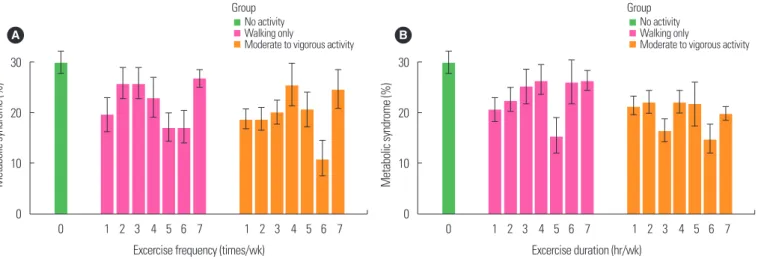
Fig. 1A shows the prevalence of metabolic syndrome according to exercise frequency. The overall percentage of metabolic syn- drome was highest in group I (29.9%) compared to group II (24.0%) and group III (20.4%). Frequency of exercise was not as- sociated with the prevalence of metabolic syndrome. Likewise, du- ration of exercise according to intensity was not associated with the prevalence of metabolic syndrome (Fig. 1B). However, the preva- lence of metabolic syndrome was associated with exercise intensity (Table 2). After multiple adjustments, the odds ratios for metabolic syndrome in group II and group III compared to group I were 0.750 (95% confidence interval [CI], 0.564−0.996; P=0.049) and 0.591 (95% CI, 0.446−0.782; P<0.001), respectively. With the ex- ception of blood pressure, the components of metabolic syndrome were negatively associated with moderate to vigorous activity com- pared to the no activity group. The odds ratios for group III com- pared to group I were calculated for low abdominal obesity (0.591;
95% CI, 0.396−0.883; P=0.011), low HDL cholesterol (0.768;
95% CI, 0.600−0.984; P =0.038), and high triglyceride levels
(0.610; 95% CI, 0.466−0.799; P<0.001) after multiple adjust-
Table 2. Prevalence of metabolic syndrome and its components according to exercise intensity
Exercise intensity Group I Group II Group III
OR (95% CI) P OR (95% CI) P
Metabolic syndrome
Model 1 1.0 0.720 (0.547−0.949) 0.021 0.540 (0.413−0.705) < 0.001
Model 2 1.0 0.738 (0.562−0.971) 0.031 0.562 (0.430−0.734) < 0.001
Model 3 1.0 0.750 (0.564−0.996) 0.049 0.591 (0.446−0.782) < 0.001
Abdominal obesity
Model 1 1.0 0.692 (0.470−1.020) 0.065 0.536 (0.362−0.795) 0.002
Model 2 1.0 0.713 (0.486−1.046) 0.085 0.553 (0.374−0.816) 0.003
Model 3 1.0 0.744 (0.504−1.097) 0.138 0.591 (0.396−0.883) 0.011
High systolic blood pressure
Model 1 1.0 0.815 (0.632−1.050) 0.115 0.822 (0.636−1.062) 0.136
Model 2 1.0 0.810 (0.628−1.044) 0.106 0.828 (0.642−1.069) 0.149
Model 3 1.0 0.841 (0.644−1.098) 0.204 0.902 (0.689−1.179) 0.450
High diastolic blood pressure
Model 1 1.0 0.780 (0.586−1.037) 0.089 0.912 (0.705−1.179) 0.481
Model 2 1.0 0.781 (0.588−1.038) 0.090 0.917 (0.710−1.185) 0.509
Model 3 1.0 0.805 (0.605−1.071) 0.139 0.934 (0.724−1.206) 0.603
Elevated fasting glucose
Model 1 1.0 0.758 (0.596−0.965) 0.026 0.767 (0.601−0.979) 0.034
Model 2 1.0 0.774 (0.608−0.985) 0.038 0.794 (0.623−1.012) 0.064
Model 3 1.0 0.791 (0.623−1.003) 0.054 0.799 (0.627−1.018) 0.071
Reduced HDL cholesterol
Model 1 1.0 0.921 (0.710−1.196) 0.540 0.737 (0.579−0.939) 0.015
Model 2 1.0 0.923 (0.709−1.201) 0.550 0.747 (0.586−0.953) 0.020
Model 3 1.0 0.915 (0.702−1.193) 0.513 0.768 (0.600−0.984) 0.038
Elevated triglyceride
Model 1 1.0 0.811 (0.626−1.051) 0.115 0.587 (0.452−0.763) < 0.001
Model 2 1.0 0.833 (0.640−1.085) 0.176 0.610 (0.468−0.795) < 0.001
Model 3 1.0 0.843 (0.644−1.103) 0.214 0.610 (0.466−0.799) < 0.001
Regression models were sequentially adjusted for the following variables: Model 1: age, sex, and body mass index; Model 2: total energy intake and smoking; Model 3: alcohol in- take and household income.
OR, odds ratio; CI, confidence interval; HDL, high-density lipoprotein.
Figure 1. The prevalence of metabolic syndrome according to exercise intensity with frequency (A) and duration (B). The prevalence of metabolic syndrome is shown ac- cording to the frequency of exercise (times per week, at least 10 minutes at once) (A) and the duration of exercise (hours per week) (B) within the three groups, which are categorized according to exercise intensity.
A 30
20
10
0
Metabolic syndrome (%)
1 2 3 4 5 6 7 1 2 3 4 5 6 7
Excercise frequency (times/wk) No activity Walking only
Moderate to vigorous activity
No activity Walking only
Moderate to vigorous activity B
30
20
10
0
Metabolic syndrome (%)
1 2 3 4 5 6 7 1 2 3 4 5 6 7
Excercise duration (hr/wk)
0 0