http://dx.doi.org/10.12925/jkocs.2017.34.3.587
12주간 줄넘기, 밴드운동이 비만 여중생의 GH, IGF-1 및 대사증후군 위험 인자에 미치는 영향
최공집
*․손원목
✝ 세한대학교 태권도학과(2017년 8월 15일 접수: 2017년 9월 2일 수정: 2017년 9월 8일 채택)
The Effect of 12 Weeks Rope Skipping and Band Exercise on GH, IGF-1 and Metabolic Syndrome Risk Factors in
Female Obese Middle School Students
Gong-Jip Choi*․Won-Mok Son✝
Department of Taekwondo
(Received August 15, 2017; Revised September 2, 2017; Accepted September 8, 2017)
Abstract : The purpose of this study was to investigate the effect of rope skipping and band exercise on GH, IGF-1 and metabolic syndrome risk factors in female obese middle school students. Twenty female obese middle school students(%BF > 30%) were randomly assigned to a exercise group(EX, n=10) or control group(CON, n=10). The exercise group has performed rope skipping and band exercise for 12 weeks, 3time per week. Exercise intensity was increased gradually, from 40% to 70%
of Heart Rate Reserve(HRR) and Rating of Perceived Exertion(RPE) 11-15. GH, IGF-1 and metabolic syndrome rist factors were GH, IGF-1 and metabolic syndrome risk factors were measured pre- and post-exercise program including rope skipping and band exercise. Levels of GH and IGF-1 were significantly increased (p<.01 and p<0.001, respectively) in exercise group after 12 weeks of exercise training. WC and TG were significantly decreased(p<.01) in exercise group after 12 weeks of training. HDL-C was significantly increased(p<.05) in exercise group after 12 weeks of training. In conclusion, rope skipping and band exercise were effective exercise program in improving GH, IGF-1 and metabolic syndrome risk factors in female obese middle school students.
Keywords : band exercise, IGF-1, GH, metabolic syndrome, rope skipping
✝
Corresponding author
(E-mail: [email protected])
1. 서 론
우리나라 19세 이상 성인의 비만율은 32.5%로 1998년 25.8%에 비하여 1.26배 증가하였으며(보 건복지부, 2013), 2013년 학생건강검사 표본조사 에서 초․중․고 학생들의 비만율은 15.3% 전년도 대비 0.6% 증가하였고, 고도비만 학생은 1.5%로 나타났다[1].
이는 잘못된 식습관, 운동부족 및 영양과잉으 로 인하여 청소년기 비만증이 급증하고 있으며, 이러한 청소년 비만은 만성 대사성질환을 유발시 킬 가능성이 높고, 성인기 비만으로 이어진다는 점에서 심각한 사회적 문제로 대두되고 있다[2].
비만으로 인해 혈액 내에 혈당이 높아지면 GH(Growth Hormone)의 분비가 억제되어 지방 조직에서는 지방산 동원을 감소시켜 지방이 분해 되지 못해 원활한 대사 작용을 방해하게 되며 [3,4], 지방대사와 내분비계 이상을 동반하여 성 장의 저해를 가져오며, 세포조직의 성장과정과 밀 접한 관련이 있는 IGF-1(Insulin-like Growth Factor-1) 수준을 감소시킨다[5, 6].
또한 비만은 고지혈증, 고혈압, 심혈관질환 및 제2형 당뇨병 등과 같은 대사성질환의 발병률을 증가시키며[7, 8, 9], 최근 10년 사이에 중학생 대사증후군(metabolic syndrome : MetS)이 두 배로 증가한 것으로 나타났다[10]. 대사증후군이 란 대표적인 생활습관병으로 허리둘레(WC), 높 은 혈압(BP), 높은 혈당(FBG), 높은 TG 및 낮은 HDL-C를 한 사람이 3개 항목 이상에 해당되는 경우를 말하며, 대사증후군 위험인자의 진단기준 은 WC ≥ 90㎝(남), ≥ 85㎝(여); BP ≥ 130/85㎜Hg; FBG ≥ 100㎎/㎗; TG ≥ 150㎎/
㎗; HDL-C < 40㎎/㎗(남), < 50㎎/㎗(여)이다 [11].
그러나 규칙적인 신체활동은 인체의 혈액 및 심장 등의 생리적, 화학적 변화를 초래하여 신체 활동 능력 향상뿐만 아니라[12, 13] 대사증후군 의 개선 또는 그와 관계된 심혈관계질환의 위험 요인들을 감소시키는 효과가 있는 것으로 알려져 있다[14, 15].
줄넘기는 많은 신체활동 중에서 별다른 장비 없이 누구든지, 언제 나, 어디서나, 손쉽게 할 수 있는 운동으로 짧은 시간 내에 체력을 향상시킬 수 있는 좋은 운동이다[16]. 밴드 운동은 관절이 나 근육에 부담을 주지 않으면서도 유연성 및 근 력 증가 등에 효과적인 운동임이 보고되고 있다
[17].
이와 같이 줄넘기 운동과 밴드운동을 함께 실 시하게 되면 두 가지 운동의 효과를 모두 가질 수 있으므로 병행할 때 운동의 효과가 더욱 커지 는 것으로 나타났다[18, 19, 20, 21].
선행연구에서 두 가지 운동을 병행한 후 GH[22], IGF-1[23], 및 대사증후군인자[24]의 개선을 보고하였다. 따라서 본 연구는 만성적인 운동부족과 고칼로리 섭취에 따른 영양과잉의 비 만 여중생을 대상으로 줄넘기와 밴드운동이 GH, IGF-1 및 대사증후군인자에 미치는 영향을 규명 하기 위하여 실시하였다.
2. 실 험
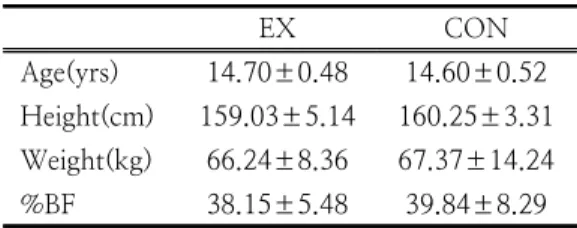
2.1. 연구대상본 연구는 B광역시 소재 J중학교에 재학 중인 체지방률이 30%이상으로(ACSM, 2013), 최근 6 개월간 규칙적인 운동에 참여 하지 않았으며, 특 정한 질환이 없고, 학부모님과 학생이 참여에 동 의한 비만 여자 중학생을 대상으로 하였다. 운동 군(10명), 대조군(10명)으로 총 20명으로 실시하 였다.
연구 대상자의 신체적 특성은 Table 1과 같다.
Table 1. Characteristics of subject
EX CON
Age(yrs) 14.70±0.48 14.60±0.52 Height(cm) 159.03±5.14 160.25±3.31 Weight(kg) 66.24±8.36 67.37±14.24
%BF 38.15±5.48 39.84±8.29
2.2. 측정항목
모든 검사항목은 동일한 방법과 조건으로 GH, IGF-1 및 대사증후군 관련인자를 사전, 사후 총 2회, 12시간 동안 공복 상태를 유지하여 오전 8 시∼10시 사이에 측정하였다.
2.2.1 신체조성
신장, 체중 및 체지방율은 최대한 간편한 복장 으로 착용한 후 X-SCAN PLUS (JAWON Medical, Korea)으로 측정하였다
Table 2. Rope Skipping, Band Exercise program
week order exercise intensity frequency
1-12 week
Warm-up(5min) Static stretching
3times /week Main
exercise (50min)
rope-skipping (30 min)
left and right side stroke 1 line 1 jump
foot changing run jump cross jump,
right & left jump before & behind jump turns around jump
40-70%HRR RPE 11-16
band exercise (30 min)
chest press, seated row, biceps curl, triceps curl, leg extension, leg curl, hip extension,
(10×3sets) RPE 11-16 Cool-down(5min) Static stretching
2.2.2 채혈 및 분석
혈액채취를 위해 채혈 전날 오후 8시 이후에는 공복을 유지하였다. 오전 8~10시에 진공 채혈관 과 바늘을 이용하여 전완정맥에서 10 ml 혈액을 채취, 원심분리기로 10분간 3,000 rpm에서 원심 분리 후 분석 시까지 혈청을 –70℃ 이하에서 냉 동보관 후 분석하였다.
2.2.3 GH
Immulite 2000GH kit(SIEMENS, USA)를 이 용하였으며, (Chemilum-inescent Immuno Assay)법을 사용할 것이고, CLIA분석 장비 Immulite 2000(SIEMENS, USA)를 사용 하였다.
2.2.4 IGF-1
검사시약은 IGF-I-D-RIA-CT를 이용하였으 며, RIA(Radiommuno Assay)법으로 분석하였고, 1470-Wizard γ-Counter(Wizard Co., Finland) 를 사용하였다.
2.2.4. 대사증후군 위험인자
허리둘레는 장골 능선과 12번 갈비뼈 사이 중 간 지점 경계선 사이의 가장 얇은 둘레를 팔을 편안히 내리고 정상호기에 측정하였고, 혈압은 안 정을 취한 상태에서 전자혈압측정기 ES-H55 (Terumo, Japan)를 이용하여 좌측 상완에서 수축 기혈압과 이완기혈압을 측정하였다.
공복혈당은 농도는 글루코스 측정용 Kit
(Glu-hk, 아산제약, Korea)를 사용하여 효소법에 기초한 Hexokinase(HK)법으로 측정하였으며, HDL-C는 SIEMENS(Georgia, USA) 사의 시약 으로 ADVIA-1650(Georgia, USA) 자동 생화학 분석기를 이용하여 분석하였고, TG는 SIEMENS (Georgia, USA)사의 시약으로 ADVIA-1650 (Georgia, USA) 자동 생화학 분석기를 이용하여 분석 하였다.
2.3. 운동방법
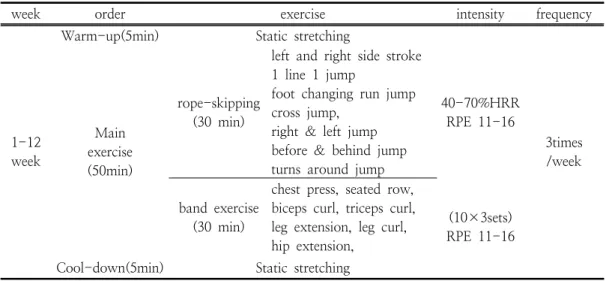
줄넘기와 밴드운동을 실시하였으며, 피험자가 비만 여자 중학생임을 고려하여 1-2주간 적응기 를 거쳐 12주간 주 5회 실시하였다. 운동 시간은 준비운동 5분, 본 운동 60분, 정리운동 5분으로 구성하여 총 70분을 실시하였고, 운동 중 심박수 계측기기인 손목 시계형 Polar(Polar RS400sd, USA)를 착용한 후 40-70%HRR(Heart Rate Reserve)의 강도로 운동할 수 있도록 심박수 변 화를 측정하였다. 밴드운동은 Best-Martini &
Botenhagen(2003)의 밴드운동을 수정․보완하여 상지, 몸통, 하지 운동으로 1회에 7항목으로 구성 하여 실시하였다. 운동강도는 Borg(1993)의 주관 적 운동 강도(RPE)를 이용하여 11-16 수준으로 실시하였다. 복합운동프로그램의 내용은 Table 2 와 같다.
2.4. 자료처리
SPSS 23.0을 이용하여 각 측정변인에 대해 평
Table 3. The changed of GH and IGF-1
Variable Group Pre Post F-value
GH (mg/dL)
EX 5.00±3.21 5.82±3.22* Time 0.021
Group 0.527
CON 4.97±2.20 4.09±2.25 Time×Group 14.565**
IGF-1 (mg/dL)
EX 407.97±41.43 429.72±43.48** Time 0.084
Group 1.200
CON 405.97±46.94 386.43±55.00 Time×Group 29.365***
Values are M±SD, *
p
<.05, **p
<.01, ***p
<.01 EX : exercise group, CON : control group균값과 표준편차(M±SD)를 산출한 후 사전 운동 군과 대조군의 신체적 특성과 각 측정변인에 대 한 동질성 검정을 위하여 독립 t-test를, 집단 내 의 사전·사후 평균치 변화에 대한 차이 검증은 종속 t-test를, 집단간 차이에 대한 주효과 검정 및 집단간 시기간 상호작용 효과는 반복측정 이 원변량분석(2-way ANOVA repeated measure) 을 이용하였다.
3. 결과 및 고찰
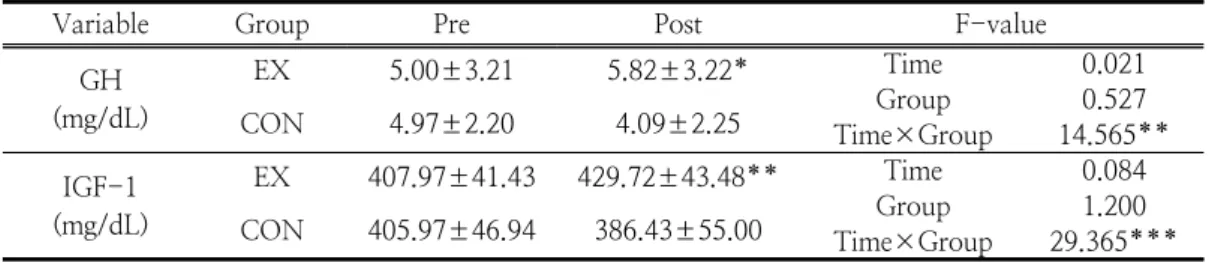
3.1. GH, IGF-1GH는 주로 간에 존재하는 성장호르몬 수용체 와 결합하여 IGF-1의 생성을 촉진하며, 혈중 IGF-1 농도를 상승시킨다[25]. 비만은 안정 시 GH 수준을 감소시키며 성장발달 요인 중 하나인 IGF-1 농도를 감소시킨다[5, 6, 25]. 하지만 운 동은 성장호르몬 관련인자의 분비를 직접 자극함 으로써 호르몬를 증가시킬 뿐만 아니라 소마토스 타틴(somatostatin)의 생산을 억제시킴으로써 성 장호르몬의 방출을 촉진시키는 호르몬 생산을 자 극하게 되며, 성장호르몬 분비가 증가는 IGF-1의 합성을 촉진하게 된다[26].
선행연구에서 비만 여중생을 대상으로 12주간 주 3회 70%HRmax, 1RM 70% 강도로 복합운 동을 실시한 결과 GH 및 IGF-1이 유의하게 증 가하였으며[27], 비만 남중생을 대상으로 12주간 주 4-5회 45-70%HRmax, 1RM 60-70% 강도 로 복합운동을 실시한 결과 GH 및 IGF-1이 유 의하게 증가하였다[22]. 이는 줄넘기와 밴드운동 을 통한 혈당 감소와 somatostatin의 억제에 따 른 GH의 분비량 증가 및 GH 증가에 따른 간에 서 자극[28]으로 IGF-1이 증가 한 것으로 생각
된다. 따라서 줄넘기와 밴드운동이 비만 억제와 청소년기 성장 촉진에 중요한 GH 및 IGF-1의 분비 증가에 도움이 될 것으로 사료된다.
3.2. 대사증후군 위험인자
청소년기에 높은 혈압, 혈당 및 복부비만 등이 주 증상인 대사증후군에 걸리면 30대 전후 젊은 나이에도 불구하고 당뇨병과 고지혈증 및 심혈관 질환의 위험이 증가되고 이에 따른 치명적 합병 증까지 동반된다[10]. 하지만 규칙적인 신체활동 은 대사증후군과 관련된 허리둘레, 혈압 감소 및 지단백 효소의 활성화로 인한 TC의 감소와 같이 대사증후군 위험인자에 긍정적인 효과가 보고되 고 있다[29].
허리둘레 측정은 내장지방의 간접적인 측정방 법으로 체중증가에 따른 지방의 축척은 허리둘레 를 증가 시키며 둔부비만보다 복부비만에서 대사 증후군의 위험이 높게 나타났다[19, 30]. 선행연 구에서 정상 및 비만 남중생을 대상으로 12주간 주3회, 55-75%HRR, 1RM 40-80% 강도로 실 시한 결과 허리둘레가 유의하게 감소하였다[31].
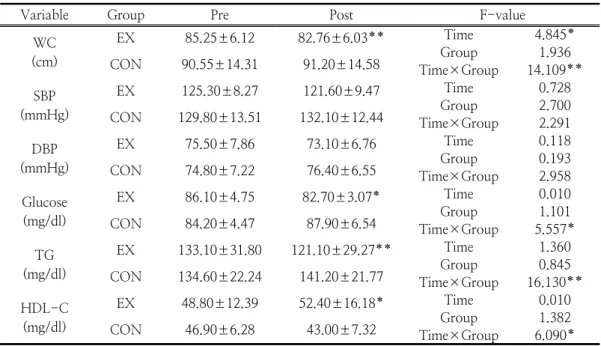
본 연구결과 허리둘레는 시기 간에 유의한 차이 가 났으며(p<.05) 시기와 집단 간 상호작용이 나 타났고(p<.05), 운동군이 유의하게 감소하였다 (p<.01). 이는 줄넘기와 밴드운동에 따른 내장지 방 감소로 인해 허리둘레가 줄어 든 것으로 생각 된다.
혈압은 심박출량, 말초저항 및 순환 혈액량에 의해 결정되며, 안정 시 혈압이 높은 이유는 동 맥경화 등의 혈관 탄력성 감소로 나타나는 현상 으로 높은 혈압은 심장에 부담을 주게 되고, 말 초저항을 높여 혈액의 부적절한 공급 유발로 인 해 심혈관질환계 질환을 유발한다[32]. 선행연구 에서 폐경기 여성을 대상으로 12주간 주3회,
Table 4. The changed of Metabolic Syndrome Risk Factors
Variable Group Pre Post F-value
WC (cm)
EX 85.25±6.12 82.76±6.03** Time 4.845*
Group 1.936
CON 90.55±14.31 91.20±14.58 Time×Group 14.109**
SBP (mmHg)
EX 125.30±8.27 121.60±9.47 Time 0.728
Group 2.700
CON 129.80±13.51 132.10±12.44 Time×Group 2.291 DBP
(mmHg)
EX 75.50±7.86 73.10±6.76 Time 0.118
Group 0.193
CON 74.80±7.22 76.40±6.55 Time×Group 2.958
Glucose (mg/dl)
EX 86.10±4.75 82.70±3.07* Time 0.010
Group 1.101
CON 84.20±4.47 87.90±6.54 Time×Group 5.557*
TG (mg/dl)
EX 133.10±31.80 121.10±29.27** Time 1.360
Group 0.845
CON 134.60±22.24 141.20±21.77 Time×Group 16.130**
HDL-C (mg/dl)
EX 48.80±12.39 52.40±16.18* Time 0.010
Group 1.382
CON 46.90±6.28 43.00±7.32 Time×Group 6.090*
Values are M±SD, *
p
<.05, **p
<.01 EX : exercise group, CON : control group 60%VO2R, 1RM 60-70% 강도로 실시한 결과 허리둘레가 유의한 차이가 나지 않았다[33]. 본 연구 결과 혈압은 그룹 간 유의한 차이가 나지 않았지만, 다소 감소하는 경향을 보였으며, 이는 꾸준한 운동을 통해 혈압을 감소시킬 수 있을 것 으로 생각된다.공복 시 혈당이 높은 경우 대사증후군 발생율 이 높은 것으로 보고되고 있다[34]. 선행연구에서 50-60대 비만여성을 대상으로 8주간 주3회, 60-70%HRmax, 1RM 50-60% 강도로 실시한 결과 혈당이 유의하게 감소하였다[35]. 본 연구결 과 혈당은 시기와 집단 간 상호작용이 나타났으 며(p<.05), 운동군이 유의하게 감소하였다(p<.05).
이는 줄넘기와 밴드운동을 통한 근육에서의 포도 당 이용이 증가[36]에 의해 혈당이 감소한 것으 로 생각된다.
TG는 영양과잉 섭취와 운동부족이 지속되면 중요기관에 침착되며 비만, 고혈압 및 당뇨병 등 생활습관병의 원인이 된다[37]. 선행연구에서 비
만여성을 대상으로 12주간 주3회
40-75%HRamx, RPE 11-15 강도로 실시한 결 과 TG가 유의하게 감소하였다[38]. 본 연구 결과 TG는 시기와 집단 간 상호작용이 나타났으며
(p<.01), 운동군이 유의하게 감소하였다(p<.01).
이는 줄넘기와 밴드운동에 따른 중성지방 합성 유발 HTGL(hepatic triglyceride lipase)의 활성 억제 및 말초 근육 부위에서 중성지방의 흡수 증 가[39]에 의해 TG가 감소 한 것으로 생각된다.
HDL-C는 간과 소장에서 합성되어 혈액으로 유출되며, 지질 중 가장 큰 비중을 차지하고 있 고, 일반적으로 HDL-C의 감소는 콜레스테롤의 운반능력의 감소로 죽상경화 병변의 발생이 쉬우 며 심근경색 등의 허혈성 질환의 발병률이 높다 [40]. 선행연구에서 비만 중년여성을 대상으로 10 주간 주3회, 40-80%HRmax 1RM 50-60% 강 도로 실시한 결과 HDL-C가 유의하게 증가하였 다[41].
본 연구 결과 HDL-C는 시기와 집단 간 상호 작용이 나타났으며(p<.05), 운동군이 유의하게 증 가하였다(p<.05). 이는 줄넘기와 밴드운동에 따른 간의 HTGL(hepatic triglyceride lipase) 억제로 HDL2-C의 catabolism이 낮아짐[42]에 의해 HDL-C가 증가 한 것으로 생각된다. 따라서 이 상의 결과를 종합하여 볼 때 줄넘기와 밴드운동 이 대사증군 위험인자의 개선 및 비만 예방에 도 움이 될 것으로 사료된다.
4. 결 론
본 연구는 12주간 줄넘기, 밴드운동이 비만 여 중생의 성장호르몬, IGF-1 및 대사증후군 관련 인자에 미치는 영향을 알아보기 위하여 체지방률 30% 이상의 비만여중생을 20명을 대상으로 운동 군 10명, 대조군 10명 분류하여 실시한 결과 다 음과 같은 결과가 나타났다.
성장호르몬은 시기와 집단 간 상호작용이 나타 났으며(p<.05), 운동군이 유의하게 증가하였다 (p<.01). IGF-1는 시기와 집단 간 상호작용이 나 타났으며(p<.01), 운동군이 유의하게 증가하였다 (p<.001). 허리둘레는 시기 간에 유의한 차이가 났으며(p<.05), 시기와 집단 간 상호작용이 나타 났으며(p<.05), 운동군이 유의하게 감소하였으며 (p<.01), 혈압은 유의한 차이가 나타나지 않았다.
혈당은 시기와 집단 간 상호작용이 나타났으며 (p<.05), 운동군이 유의하게 감소하였다(p<.05).
HDL-C는 시기와 집단 간 상호작용이 나타났으 며(p<.05), 운동군이 유의하게 증가하였다(p<.01).
TG는 시기와 집단 간 상호작용이 나타났으며 (p<.01), 운동군이 유의하게 감소하였다(p<.01).
따라서 12주간 줄넘기, 밴드운동를 실시한 결 과 성장호르몬, IGF-1 및 대사증후군 관련 인자 개선이 도움이 되는 것으로 나타났으며, 청소년 성장촉진과 비만억제에 위한 다양한 연구가 필요 할 것으로 사료된다.
References
1. Ministry of Education School, "
Health Examination Sample Survey Results
". Seoul :Ministry of Education (2014).2. C. H. Kang, K. S. Koo, Y. J. Hong, J. H.
Lee, "The Effect of Participation in One Year Exercise Program on Body Composition and Physical Fitness of Obese Children".
The Korean Journal of Growth and Development,
20(2), 59-65 (2012).3. L. DeMarinis, A. Bianchi, A. Mancini, R.
Gentilella, M. Perrelli, A. Giampietro, T.
Porcelli, L. Tilaro, A. Fusco, D. Valle, R.
M. Tacchino, "Growth hormone secretion and leptin in morbid obesity before and after biliopancreatic diver-sion:
relationships with insulin and body composition",
The Journal of Clinical Endocrinology and Metabolism,
89(1), 174-180 (2004).4. R. M. Luque, R. D. Kineman, "Impact of obesity on the growth hormone axis:
evidence for a direct inhibitory effect of hyperinsulinemia on pituitary function",
Endocrinology,
147(6), 2754-2763 (2006).5. R. Cimaz, R. Rusconi, B. Cesana, A.
Buoncompagni, F. Corona, M. Gattinara, V. Gerloni, P. Picco, M. Bardare, "A multicenter study on insulin-like growth factor-I serum levels in children with chronic inflammatory diseases",
Clinical and Experimental Rheumatology,
15(6), 691-696 (1997).6. U. M. Davies, J. Jones, J. Reeve, C.
Camacho-Hubner, A. Charlett, l. M.
Ansel, M. A. Preece, P. M. Woo, "Juvenile rheumatoid arthritis. Effects of disease activity and recom- binant human growth hormone on insulin-like growth factor 1, insulin-like growth factor binding proteins 1 and 3, and osteocalcin",
Arthritis and Rheumatism,
40(2), 332-340 (1997).7. M. I. Coran, G. D. Ball, M. L. Cruz,
"Obesity and risk of type 2 diabetes and cardiovascular disease in children and adolescents",
The Journal of Clinical Endocrinology and Metabolism,
88(4), 1417-1427 (2003).8. G. Csabi, K. Torok, S. Jeges, D. Molnar,
"Presence of metabolic cardiovascular syndrome in obese children",
European Journal of Pediatrics,
159(1-2), 91-94 (2000).9. R., Sinha, G. Fisch, B. Teague, W. V.
Tamborlane, B. Banyas, K. Allen, M.
Savoye, V. Rieger, S. G. Barbetta, R. S.
Sherwin, S. Caprio, "Prevalence of impaired glucose tolerance among children and adolescents with marked obesity",
The New England Journal of Medicine,
346(11), 802-810 (2002).10. Hankookilbo. “
Youth metabolic syndrome
10-year double”
. http://www.hankooki.com (19. Fed. 2013)11. National Health Insurance Service.
“
Metabolic syndrome guidelines
”. Seoul:Hankookilbo (2015).
12. M. K. Kim, K. Tanaka, M. J. Kim, T.
Matsuo, R. Ajisaka, "Exercise training- induced changes in heart rate recovery in obese men with metabolic syndrome",
Metabolic Syndrome and Related Disorders,
7(5), 469-476 (2009).13. M. T. Hamilton, D. G. Hamilton, T. W.
Zderic, "Role of low energy expenditure and sitting in obesity, metabolic syndrome, type 2 diabetes, and cardiovascular disease",
Diabetes.
56(11), 2655-2667 (2007).14. T. A. Lakka, D. E. Laaksonen, "Physical activity in prevention and treatment of the metabolic syndrome",
Applied Physiology Nutrition and Metabolism,
32(1), 76–88 (2007).15. B. C. Guinhouya, "Physical activity in preventing metabolic syndrome in children",
Medicine Science,
25(10), 827-33 (2009).16. K, A. Park, S. S. Kim, "The analysis of elementary school student's physical fitness and body composition according to music rope-jumping",
Korean Journal of Teacher Education
, 25(4), 54-71 200917. R. M. Petterson, C. W. Stegink Jansen, H.
A. Hogan, M. D. Nassif, "Material properties of thera-band tubing",
Physical Therapy,
81(8), 1437-1445 (2001).18. S. K. Park, Y. C. Kwon, E, H. Kim,
"Effects of 12 weeks complex training on body composition and risk factors of metabolic syndrome in the obese middle school girls",
The Korean Journal of Physical Education,
46(1), 813-822 (2007).19. ACSM, "
ACSM's Resource for Guidelines for Exercise Testing and Prescription
. Baltimore", MD: Lippincott Williams &Wilkins (2013).
20. N. Wang, R. S. Hikida, R. S. Staron, J.
A. Simoneau, "Muscle fiber types of
women after resistance training- quantitative ultrastructure and enzyme activity",
European Jounal of Physiology,
424(5-6), 494-502 (1993).21. L. Patel, A. C. Buckels, I. J. Kinghorn, P.
R. Murdock, J. D. Holbrook, C, Macphee, C. H. Plumpton, S. A. Smith, "Resistin is expressed in human macrophages and directly regulated by PPAR gamma activatiors",
Biochemical and Biophysical Research Communications,
300(2), 472-476 (2003).22. E. A. Hwang, J. H. Jeong, J. S. Kim, S.
H. Yang, "The Effects of the Complex Exercise on Body Composition, Blood Lipid, Growth Hormone, Insulin-like Growth Factor-1 and Physeal Plate of Calcaneus in Obese Adolescents",
Journal of Sport and Leisure Studies
64, 931-942 (2016).23. R. G. Vale, R. D. de Oliveira, C. S.
Pernambuco, Y. P. de Meneses, S. F. de Andrade Ade, "Effects of muscle strength and aerobic training on basal serum levels of IGF-1 and cortisol in elderly women",
Archives of Gerontology and Geriatrics,
49(3), 343-347 (2009).24. S. C. Lee, M. Y. Ho, S. D. Roh, "The Effect on Body Composition and Metabolic Syndrome Factors of the 12-week combination exercise program by age Groups in Obese Women",
Korean Journal of Sports Science,
26(1), 1111-1122 (2017).25. F. De Benedetii, T. Alonzim, A. Moretta, D. Lazzaro, P. Costa, V. Poli, A. Martini, G. Ciliberto, I. E. Fattor, "Interleukin 6 causes growth impairment in transgenic mice through a decrease in insulin-like growth in children with chronic inflammation",
The Journal of Clinical Investigation,
99(4), 643-650 (1997).26. D. K. Synder, L. E. Underwood, D. R.
Clemmons, "Anabolic effects of growth hormone in obese diet-restricted subjects are dose dependent",
The American Journal
of Clinical Nutrition,
52(3), 431-437 (1990).27. I, R. Park, "The Effects of Complex exercise program on Body composition, Growth hormone and IGF-1 of obese girls in middle school",
The Korean Journal of Physical Education,
43(6), 419-442 (2004).28. S. Yakar, C. J. Rosen, W. G. Beamer, C.
L. Ackert-Bicknell, Y. Wu, J. L. Liu, G.
T. Ooi, J. Setser, J. Frystyk, Y. R.
Boisclair, D. LeRoith, "Circulating levels of IGF-1 directly regulate bone growth and density",
Journal of Clinical Investigation,
110(6), 771-781 (2002).29. P. D. Savage, M. Brochu, E. T. Poehlman, P. A. Ades, "Reduction in obesity and coronary risk factors after high caloric exercise training in overweight coronary patients",
American Heart Journal,
146(2), 317-323 (2003).30. R. Gupta, P. Rastogi, M. Sarna, V. P.
Gupta, S. K. Sharma, K. Kothari,
"Body-mass index, waist-size, waist-hip ratio and cardiovascular risk factors in urban subjects",
The Journal of the Association of Physicians of India,
55, 621-627 (2007).31. N. Y. Ahn, K. J. Kim, "Differences of body composition, physical fitness, and metabolic syndrome`s risk factors after 12 week combined exercise program between obese and non-obese middle school students",
The Korean Journal of Physical Education,
48(3), 553-566 (2009).32. Y. H. Lin, K. Y. Pao, W. S. Yang, V. C.
Wu, Y. J. Chen, Y. L. Lin, W. S. Tsai, I.
J. Tsai, C. S. Gau, J. J. Hwang, "Waist- to-hip ratio correlates with homocysteine levels in male patients with coronary artery disease",
Clinical Chemistry Laboratory Medicine,
46(1), 125-130 (2008).33. J. W. Kim, J. A. Lee, D. Y. Kim, "Effects of Combined Exercise on Metabolic Syndrome Risk Factors, Body Composition and CBC in Menopause Women",
Journal of Sport and Leisure Studies
, 58(2), 971-982 (2014).34. K. Osei, T. Gaillard, D. P. Schuster,
"Pathogenetic mechanisms of impaired glucose tolerance and type Ⅱ diabetes in Africa-American. The significance of insulin secretion, insulin sensitivity and glucose effectiveness",
Diabetes Care,
20(3), 396-404 (1997).35. S, I. Oh, Y, S. Hwang, J. H. Cho, "The Effects of Combined Exercise Program on 50~60 Obesity Women’s Health-Related Physical Fitness and Metabolic Syndrome",
Korean Journal of Sports Science
, 21(4), 1007-1017 (2012).36. J. C. Pickup, G. Williams, "
Textbook of diabetes, 2nd ed
", Blackwell Science Ltd Editerial Offices (1997).37. R. M. Malina, C. Bouchard, "
Growth maturation and physical activity
",Champaign, Ⅲ
: Human Kinetics (2004).38. C. H. Ha, S. Ha, W. Y. So, "Effects of a 12-week Combined Exercise Training Program on the Body Composition, Physical Fitness Levels, and Metabolic Syndrome Profiles of Obese Women",
Journal of Korean Public Health Nursing,
26(3), 417-427 (2012).39. W. L. Haskell, "The influence of exercise on the concentrations of triglyceride and cholesterol in human plasma",
Exercise and Sports Science Review,
12(1), 204-244 (1984).40. H. S. Kang, K. J. Kim, T. W. Kim, H.
M. Kim, K. T. Jang, J. G. Jun, "
Physioloy of sports and exercise
", Seoul:Daehanmedia (2006).
41. S, I. Oh, Y, S. Hwang, M, J. Rhyu,
"Effects of 10 Weeks Combined Exercise on Metabolic Syndrome Related Factors and Inflammatory Factors of Obese Women",
The official journal of the Korean academy of kinesiology
, 16(3), 87-96 (2014).42. S. P. Brown, W. C. Miller, J. M. Eason,
"