Arthroscopic Repair versus Non-operative Treatment of First-time Traumatic Anterior Shoulder Dislocations: A Numbers-needed-to- treat Analysis for Prevention of Recurrent Dislocations
Jihong Park , Nicole L. Cosby1
Athletic Training Laboratory, Department of Sports Medicine, Kyung Hee University, Yongin, Korea, 1Point Loma Nazarene University, San Diego, CA, USA
Background: Arthroscopic surgical repair is a better intervention than non-operative (conservative) treatment for patients with shoulder dislocations. This systematic review determined the numbers-needed-to-treat (NNT) and relative risk reduction (RRR) associated with arthroscopic surgical repair versus non-operative treatment in reducing recurrence rates among patients with first-time traumatic anterior shoulder dislocations.
Methods: We searched Google Scholar, MEDLINE, SPORTDiscus, and CINAHL from inception in 2015. All articles had to compare ar- throscopic surgical repair and non-operative treatment and be written in English. We used the total number of subjects and the number of recurrent dislocations within each treatment to calculate the NNT and RRR for each study and the pooled data.
Results: Six articles were selected and all clearly demonstrated that the arthroscopic surgical repair was more effective than non-opera- tive treatment in reducing the recurrence episodes. The pooled NNT was 1.76 (95% confidence interval [CI]=NNT to benefit 1.50–2.13) and the pooled RRR was 86.0% (95% CI=77.0%–92.0%) among individuals who underwent arthroscopic repair. The average follow-up time was 56 months.
Conclusions: A Strength of Recommendation Taxonomy level of evidence of 1 with a grade A recommendation supports the use of arthroscopic surgical repair over non-operative treatment in prevention of first-time traumatic anterior shoulder dislocations. We suggest that sports medicine practitioners consider the patients’ age, occupation, and physical activity level when making a clinical decision.
(Clin Shoulder Elbow 2016;19(2):110-116)
Key Words: Glenohumeral; Conservative; Instability; Redislocation Clinics in Shoulder and Elbow Vol. 19, No. 2, June, 2016
http://dx.doi.org/10.5397/cise.2016.19.2.110
Received May 28, 2015. Revised January 4, 2016. Accepted March 20, 2016.
Correspondence to: Jihong Park
Athletic Training Laboratory, Department of Sports Medicine, Kyung Hee University, 1732 Deogyeong-daero, Giheung-gu, Yongin 17104, Korea Tel: +82-31-201-2721, Fax: +82-31-204-8117, E-mail: [email protected]
Financial support: None. Conflict of interests: None.
Introduction
Traumatic anterior shoulder dislocations are common due to the vast three-dimensional mobility of the shoulder joint. Recur- rent episodes, after the first-time dislocation, are more problem- atic because of functional deficiency, emotional disturbance, and medical expenses. A recent study reported that the recurrence rate one year after the initial dislocation was 39%.1) Treatment options include primary arthroscopic surgical capsulolabral re- pair or non-operative (conservative) treatment. Many systematic
reviews2-4) reported that arthroscopic surgical repair is superior to non-operative treatment in terms of recurrent episodes of shoulder dislocations, especially in young patients participating in intense physical activity (e.g., contact sports).3) Since the effec- tiveness of arthroscopic repair has been well documented, the next logical step would be to determine the degrees of effective- ness when compared with non-operative treatment.
Summarizing treatment effects from randomized clinical trials (RCTs), in terms of the numbers-needed-to-treat (NNT) and rela- tive risk reduction (RRR), is helpful to physicians and clinicians in
making a decision.5) Simply, the NNT is an inverse of the abso- lute risk reduction (ARR),6) indicating the number of interventions in order to receive clinical benefit or risk.7) The ideal NNT would be 1. This means that for every patient who received a specific intervention, one recurrent event would be prevented.8) For ex- ample, from a recent NNT analysis, 89 individuals would need to participate in neuromuscular training to prevent one anterior cruciate ligament (ACL) injury.9) RRR estimates the percentage of risk that an intervention reduces risk compared to the control (no intervention),10) which is simply calculated by subtracting relative risk (RR) from one. RR is a ratio between the probability of an event in the intervention and the probability of an event in the control.5) Therefore, a RR close to one indicates no difference in treatment efficacy between the intervention and the control.
In the same systematic review mentioned above,9) the RRR was 70%. This indicates that neuromuscular training would reduce the risk of ACL injury by70% relative to the control (no training).
Several practical advantages of the NNT and RRR include the following:11) (1) sports medicine practitioners understand the po- tential risk of injury involved with a specific intervention, (2) the information can be used in making a clinical decision in terms of medical cost and time effectiveness, (3) clinical interventions are reinforced by scientific evidence, resulting in improving value for patients. The number of patients required to undergo arthroscopic surgical repair in order to prevent recurrent events and the magnitude of efficacy is unclear. Hence, we were in- terested in systematically reviewing the literature to report the efficacy of arthroscopic surgical repair in preventing recurrent episodes in patients with first-time traumatic anterior shoulder dislocations. We evaluated the methods of previous RCTs and calculated NNT and RRR. The pooled results of this study would increase the strength of current evidence and be helpful in de- velopment of guidelines for clinical decision making.
Methods
Literature Search and Included Studies
We searched Google Scholar, PubMed, SPORTDiscus, and CINAHL from inception of March 2015 using combinations of the terms ‘shoulder, glenohumeral, rotator cuff, scapular stabiliz- ers, external rotators, rehabilitation, strengthening, surgery repair, reconstruction, instability, dislocation, subluxation, arthroscopy, trauma, and acute’. Citations were also cross-referenced for identification of studies not found using the original search terms. We further limited the search by applying additional se- lection criteria: (1) full manuscripts written in English, (2) acute first-time traumatic anterior dislocations only, (3) an arthroscopic capsulolabral repair had to be compared with a non-operative treatment, and (4) an outcome measure of dislocation recur- rence rates within the arthroscopic surgical repair and non- operative treatments had to be included.
After applying selection criteria, a total of 1,554 articles were initially identified but 1,543 studies were excluded based on the exclusion criteria. More specifically, these articles included a comparison between different surgical techniques (e.g., open vs.
arthroscopic), patients with shoulder dislocations rather than an- terior direction (e.g., posterior instability), patients with multiple dislocations (e.g., not first-time), different outcome measures (e.g., cost effectiveness), only recorded outcome measures from the surgical treatment (e.g., absence of the control). Among the remaining 11 relevant studies,12-22) five articles18-22) were further excluded. One study,18) which was a longer-term follow-up to the same patients used in another study,16) and was included in the pooled data, was excluded. We chose to pool the results of the shorter follow-up study16) because several patients could not be included at the longer-term follow-up.18) We further excluded four studies19-22) because patients in those studies underwent arthroscopic lavage21,22) and debridement.20) One article was ex- cluded because only an abstract was published.19) Therefore, six studies12-17) were finally pooled. The average follow-up time was 56 months.
Quality Assessment
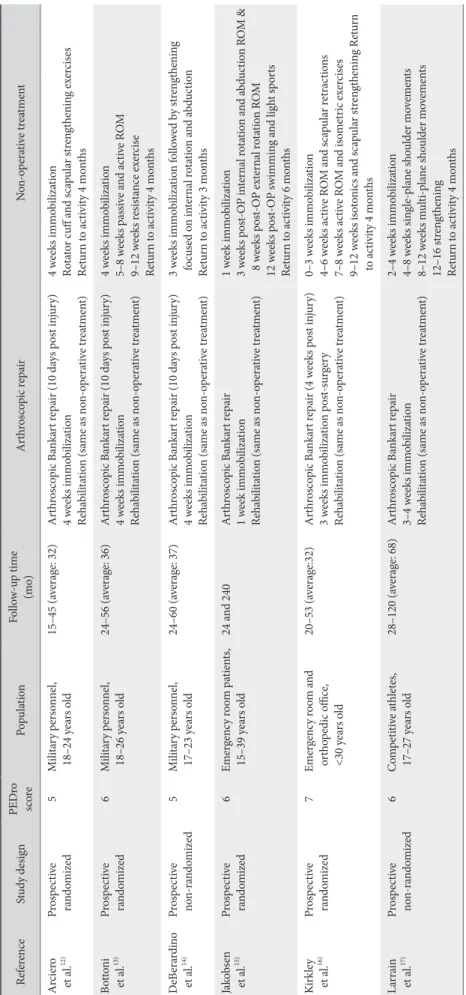
Selected studies were evaluated by two co-authors using the Physiotherapy Evidence Database (PEDro) scale,23) a 10-item scale designed for rating methodological quality of randomized controlled trials, with a fair to good reliability (intraclass correla- tion coefficient, 0.68; 95% confidence interval [CI], 0.57–0.76).24) The articles within this systematic review were independently rated, and a consensus score was determined for each article, after collaboration. Scores ranged between 5 and 7, with an av- erage of 5.8 out of 10 (Table 1).
Data Extraction
Calculation of the NNT, RRR, and the 95% CIs required ex- traction of the following data from the 11 studies: (1) number of patients with recurrent glenohumeral dislocations following arthroscopic surgical or non-operative treatment, (2) number of patients without recurrent glenohumeral dislocations following arthroscopic surgical or non-operative treatment, and (3) the total number of patients within each treatment (arthroscopic sur- gical and non-operative). The number of patients in each study and the number of recurrences per treatment were added to obtain a pooled estimate of effectiveness.
Statistical Analyses
To quantify homogeneity level, heterogeneity test (I2) was per- formed (24 cells: recurrence rates for each treatment across six studies).
I2=[(Q-df)/Q]×100%, where Q is chi-squared value and df is degrees of freedom.25)
NNT was calculated as the inverse of the ARR, which was
Table 1. Summary of PEDro Scores and Interventions ReferenceStudy designPEDro scorePopulationFollow-up time (mo)Arthroscopic repairNon-operative treatment Arciero et al.12)Prospective randomized 5Military personnel, 18–24 years old15–45 (average: 32)Arthroscopic Bankart repair (10 days post injury) 4 weeks immobilization Rehabilitation (same as non-operative treatment)
4 weeks immobilization Rotator cuff and scapular strengthening exercises Return to activity 4 months Bottoni et al.13)Prospective randomized 6Military personnel, 18–26 years old24–56 (average: 36)Arthroscopic Bankart repair (10 days post injury) 4 weeks immobilization Rehabilitation (same as non-operative treatment)
4 weeks immobilization 5–8 weeks passive and active ROM 9–12 weeks resistance exercise Return to activity 4 months DeBerardino et al.14)Prospective non-randomized5Military personnel, 17–23 years old24–60 (average: 37)Arthroscopic Bankart repair (10 days post injury) 4 weeks immobilization Rehabilitation (same as non-operative treatment)
3 weeks immobilization followed by strengthening focused on internal rotation and abduction Return to activity 3 months Jakobsen et al.15)Prospective randomized 6Emergency room patients, 15–39 years old24 and 240 Arthroscopic Bankart repair 1 week immobilization Rehabilitation (same as non-operative treatment)
1 week immobilization 3 weeks post-OP internal rotation and abduction ROM & 8 weeks post-OP external rotation ROM 12 weeks post-OP swimming and light sports Return to activity 6 months Kirkley et al.16) Prospective randomized 7Emergency room and orthopedic office, <30 years old
20–53 (average:32)Arthroscopic Bankart repair (4 weeks post injury) 3 weeks immobilization post-surgery Rehabilitation (same as non-operative treatment)
0–3 weeks immobilization 4–6 weeks active ROM and scapular retractions 7–8 weeks active ROM and isometric exercises 9–12 weeks isotonics and scapular strengthening Return to activity 4 months Larrain et al.17)Prospective non-randomized 6Competitive athletes, 17–27 years old28–120 (average: 68)Arthroscopic Bankart repair 3–4 weeks immobilization Rehabilitation (same as non-operative treatment)
2–4 weeks immobilization 4–8 weeks single-plane shoulder movements 8–12 weeks multi-plane shoulder movements 12–16 strengthening Return to activity 4 months PEDro: Physiotherapy Evidence Database, ROM: range of motion, OP: operation.
calculated by taking the non-operative recurrence risk minus the arthroscopic surgical recurrence risk. The surgical recur- rence risk was calculated by taking the total number of recurrent dislocations in the arthroscopic surgical treatment and dividing those by total number of patients in the arthroscopic surgical treatment.9,26) The non-operative recurrence risk was calculated by taking the total number of recurrent dislocations in the non- operative treatment and dividing them by the total number of patients in the non-operative treatment.9,26) The NNT was then calculated by taking the inverse of the ARR. NNT to benefit was indicative of a preventative effect in the arthroscopic surgical treatment compared to the non-operative treatment. NNT CIs were calculated on a 95% interval, those that crossed infinity were considered to be NNT to harm and were representative of the surgical treatment increasing the risk of recurrent dislocation compared to the non-operative treatment.10)
ARR=Non-operative recurrence risk-Arthroscopic surgical recurrence risk
Recurrence risk=Total # of recurrent dislocations/Total # of patients (within the same treatment) NNT=1/ARR
RRR estimates the percentage of risk that an intervention reduces risk compared to the control (no intervention).10) To calculate the RRR, the RR had to be calculated first, by divid- ing the surgical recurrence risk by the non-operative recurrence risk. The RRR was then calculated by subtracting the RR from one and multiplying by 100 so that the RRR could be expressed as a percentage. The RRR is indicative of the ability of the ar- throscopic treatment to reduce the risk of recurrent dislocation when compared to the non-operative treatment. Positive RRRs indicated reduced risk with arthroscopic treatment and negative values indicated increased risk associated with the arthroscopic treatment in comparison with the non-operative treatment; 95%
CI and the point estimates for the NNT, ARR, and RRR were calculated using a statistical software program (Confidence Inter- val Analysis ver. 2.1; University of Southampton, Southampton,
UK).
RR=Non-operative recurrence risk/Arthroscopic surgical recurrence risk
RRR=(1-RR)×100
Results
The result of the heterogeneity test was 66%, indicating that the level of patient heterogeneity in the pooled data was moder- ate.
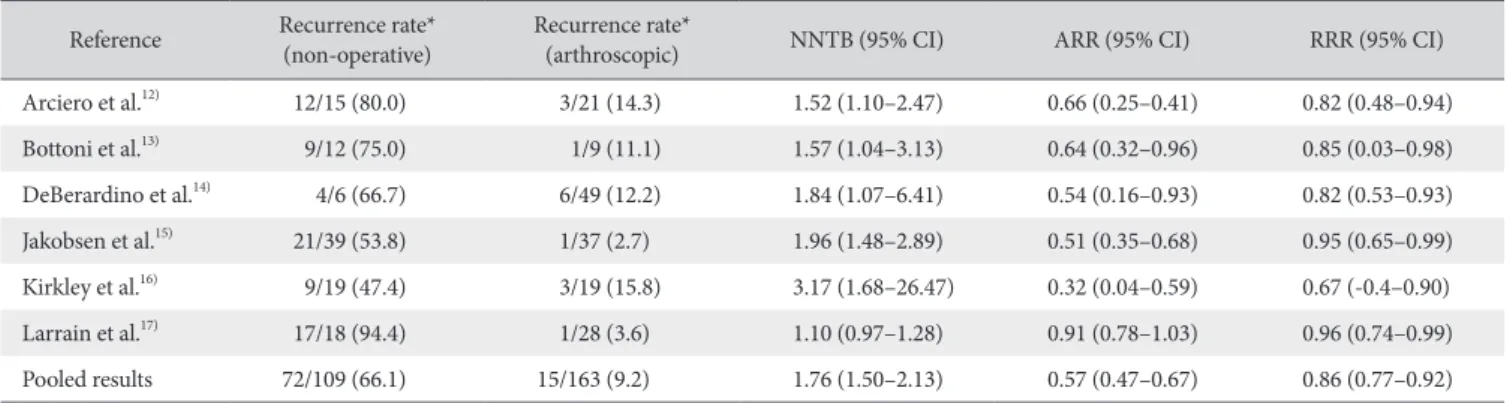
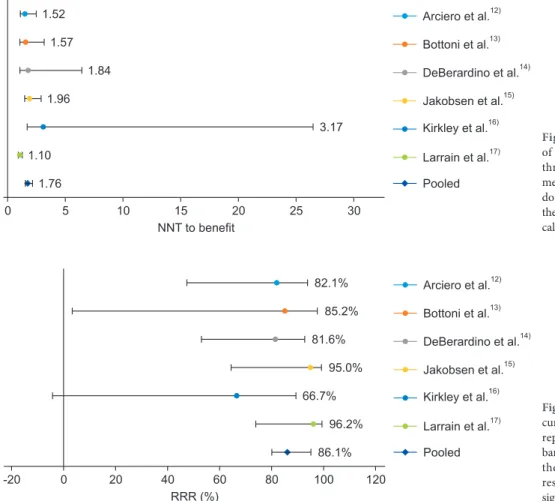
The results for the NNT, ARR, and RRR calculations are sum- marized in Table 2. Forest plots for NNT and RRR are shown in Fig. 1 and 2, respectively. Across all six studies,12-17) the ar- throscopic surgical treatment showed a decreased rate of recur- rent shoulder dislocations or subluxations when compared to the non-operative treatment.
Calculated pooled result of NNT was a positive number of 1.76 (95% CI=1.50 to 2.13), indicating that two arthroscopic surgical repairs would need to be performed in order to pre- vent one recurrent episode. The pooled RRR was 86.0% (95%
CI=77.0% to 92.0%) indicating that the risk of a recurrent shoul- der dislocation in a patient treated with arthroscopic surgical repair would be 87% lower compared to a patient treated non- operatively.
Discussion
The purpose of this review was to evaluate the effectiveness of arthroscopic surgical treatment (Bankart repair) when com- pared to non-operative treatment at reducing recurrent anterior shoulder dislocation in patients with first-time traumatic ante- rior shoulder dislocations. Our search and calculations clearly demonstrated that reduction of recurrence rates in all studies was much higher in the arthroscopic surgical treatment than the non-operative treatment. The results of this systematic review re- inforce the previous studies reporting2-4,27) that arthroscopic Ban-
Table 2. Injury rates, Numbers-needed-to-treat Analysis, ARR, and RRR Reference Recurrence rate*
(non-operative) Recurrence rate*
(arthroscopic) NNTB (95% CI) ARR (95% CI) RRR (95% CI)
Arciero et al.12) 12/15 (80.0) 3/21 (14.3) 1.52 (1.10–2.47) 0.66 (0.25–0.41) 0.82 (0.48–0.94)
Bottoni et al.13) 9/12 (75.0) 1/9 (11.1) 1.57 (1.04–3.13) 0.64 (0.32–0.96) 0.85 (0.03–0.98)
DeBerardino et al.14) 4/6 (66.7) 6/49 (12.2) 1.84 (1.07–6.41) 0.54 (0.16–0.93) 0.82 (0.53–0.93)
Jakobsen et al.15) 21/39 (53.8) 1/37 (2.7) 1.96 (1.48–2.89) 0.51 (0.35–0.68) 0.95 (0.65–0.99)
Kirkley et al.16) 9/19 (47.4) 3/19 (15.8) 3.17 (1.68–26.47) 0.32 (0.04–0.59) 0.67 (-0.4–0.90)
Larrain et al.17) 17/18 (94.4) 1/28 (3.6) 1.10 (0.97–1.28) 0.91 (0.78–1.03) 0.96 (0.74–0.99)
Pooled results 72/109 (66.1) 15/163 (9.2) 1.76 (1.50–2.13) 0.57 (0.47–0.67) 0.86 (0.77–0.92)
ARR: absolute risk reduction, RRR: relative risk reduction, NNTB: numbers-needed-to-treat to benefit, CI: confidence interval.
*Total # of recurrent dislocations/total # of patients (%).
kart repair is a more effective treatment for reducing the number of recurrent dislocations in patients with first-time traumatic anterior shoulder dislocations, when compared to non-operative treatment. One16) of the studies in this systematic review had RRRs that crossed zero, meaning that there is uncertainty as to the true effectiveness of the intervention. In this study,16) number of positive (recurrent episodes; n=9) and negative outcomes (n=10) in the arthroscopic repair were similar in the non- operative treatment (n=19). These numbers were produced in much smaller ARR (0.32) and RRR (0.67), compared to other studies (Table 2) which yielded wider 95% confidence bands, which resulted in 95% confidence bands touching the zero line.
Despite this study, the pooled results provide strong evidence (level 1 with grade A based on the Strength of Recommendation Taxonomy grading scale).28) The results of individual studies in this systematic review were consistent (level 1) and the outcome measurement was recurrent dislocation (good quality patient- oriented evidence: grade A).28)
The studies selected in this systematic review used Bankart repair for the arthroscopic surgery. Open surgical techniques are also currently being used in treatment of first-time traumatic anterior shoulder dislocations. Many studies29-32) have compared open surgical procedures with arthroscopic procedures for treat-
ment of the same population as this review. However, these studies yielded different results. A recent systematic review29) pooled 19 studies, and concluded that arthroscopic surgery was associated with significantly higher risk of recurrent instability compared to the open surgical procedure. Two studies30,32) were prospective RCTs. One of them30) demonstrated that both tech- niques yielded similar postoperative results, but recommended arthroscopic procedure because it can be performed safely.
Another study32) reported that no significance was found, but the authors mentioned that open is a more reliable method for col- lision athletes. One study31) retrospectively reviewed outcomes of both procedures and found no significant difference between the two types of surgical procedures. In our systematic review, we reviewed studies that included the arthroscopic procedure compared to non-operative treatment. This systematic review did not include any study with open surgical technique. There- fore, the results and analysis in this study can only be applicable to the arthroscopic Bankart repair, not the general surgical inter- vention.
According to traumatic or atraumatic classifications,33) we reviewed and analyzed studies that evaluated patients with first- time traumatic anterior shoulder dislocations. Therefore, we do not know the effects of the two different interventions on mul-
Fig. 1. Numbers-needed-to-treat (NNT) of recurrence rate in a comparison of ar- throscopic repair and non-operative treat- ment. Error bars (95% confidence intervals) do not cross the midline (zero) indicate that the corresponding average number is statisti- cally significant (p<0.05).
0 5 10 15 20 25 30
NNT to benefit 1.52
1.57 1.84 1.96
3.17 1.10
1.76
Arciero et al.12) Bottoni et al.13)
Jakobsen et al.15)
Larrain et al.17) Pooled Kirkley et al.16) DeBerardino et al.14)
Fig. 2. Relative risk reduction (RRR) of re- current rate in a comparison of arthroscopic repair and non-operative treatment. Error bars (95% confidence intervals) do not cross the midline (zero) indicate that the cor- responding average number is statistically significant (p<0.05).
-20 0 20 40 60 80 100
RRR (%)
Arciero et al.12) Bottoni et al.13)
Jakobsen et al.15)
Larrain et al.17) Pooled Kirkley et al.16) DeBerardino et al.14) 82.1%
85.2%
81.6%
95.0%
66.7%
96.2%
86.1%
120
tidirectional (e.g., inferior and/or posterior) or chronic shoulder instability. In addition, the pooled results cannot be generalized for other acute shoulder pathologies such as rotator-cuff or SLAP (superior labrum anterior to posterior) tear. There were also differences in the subject population across the pooled results from six studies. Three studies12-14) included military cadets, two studies15,16) sampled from emergency rooms, and one study17) in- cluded competitive athletes. Level of homogeneity of the patient population in the pooled studies (66%) may weaken our results.
Because clinical and methodological variation always exists, any systematic review has some degree of heterogeneity. For ex- ample, 25% of meta-analyses have I2 values higher than 50%.25) Therefore, the interpretation of heterogeneity test is arguable.34) In addition, since we focused more on a select specific popula- tion (patients with first-time traumatic anterior shoulder disloca- tions) rather than activity levels or age ranges, the effect of pa- tient heterogeneity on the pooled results is minimal. Therefore, we believe that the selected population in this review adds to and strengthens current evidence as expected.
Throughout the six studies, averaged follow-up times to evaluate the functional outcomes varied (Table 1). All six studies followed more than 24 months: Arciero et al.12) and Kirkley et al.16) followed 32 months, Bottoni et al.13) followed 36 months, DeBerardino et al.14) followed 37 months, and Larrain et al.17) followed 68 months. One study15) reported different follow up times, one at 2 years and one at 10 years. Even though most of the patients were evaluated after 24 months, the long-term effects of arthroscopic surgical treatment have not been thor- oughly investigated, and remain a limitation. Although the same rehabilitation programs were applied to both treatments in each article, immobilization periods and rehabilitation program with progression timeframes during rehabilitation were slightly differ- ent among the six studies (Table 1). One study15) only reported a week of immobilization while other studies reported three to four weeks. Regarding rehabilitation protocols and progression timeframes, most studies13,15-17) followed a 4-week progression of initial range of motion (ROM) exercises after immobilization fol- lowed by shoulder and scapular strengthening exercises (Table 1).
Two studies12,14) did not specify ROM exercises and progression timelines in their rehabilitation programs. Time for returning to activity also varied among the six studies. In four studies12,13,16,17)
patients returned after 4 months, and after 3 months14) and 6 months15) in the other studies.
Note that variations of the aforementioned factors in rehabili- tation programs may affect the clinical and functional outcomes.
Documented rehabilitation programs may allow sports medicine practitioners to construct rehabilitation protocols when working with the same pathology. In order to prevent recurrent episodes of shoulder dislocation, we suggest application of rehabilitation protocols that include immobilization, neuromuscular and ROM exercises, strengthening exercises, and functional exercises with
a 4-week progression.35) We also suggest paying more attention to neuromuscular and strengthening exercises at the glenohu- meral and scapulothoracic joints since dynamic stability of the shoulder joint is from the capsuloligamentous and musculoten- dinous stabilizers.
Conclusions
The pooled NNT (1.76; 95% CI=1.50 to 2.13) and RRR (86.0%; 95% CI=77.0% to 92.0%) reinforce the current scien- tific and empirical evidence that arthroscopic surgical treatment has substantially lower recurrence rates than non-operative treat- ment in patients suffering a first-time traumatic anterior shoulder dislocation. Sports medicine practitioners should consider pa- tients’ age, occupation, and physical activity level when making a clinical decision for patients following first-time traumatic ante- rior shoulder dislocations.
Acknowledgements
We thank Dr. Jay Hertel for his assistance in the NNT and RRR calculations.
References
1. Olds M, Ellis R, Donaldson K, Parmar P, Kersten P. Risk factors which predispose first-time traumatic anterior shoulder dislo- cations to recurrent instability in adults: a systematic review and meta-analysis. Br J Sports Med. 2015;49(14):913-22.
2. Arliani GG, Astur Dda C, Cohen C, et al. Surgical versus non- surgical treatment in first traumatic anterior dislocation of the shoulder in athletes. Open Access J Sports Med. 2011;2:19- 24.
3. Bishop JA, Crall TS, Kocher MS. Operative versus nonopera- tive treatment after primary traumatic anterior glenohumeral dislocation: expected-value decision analysis. J Shoulder El- bow Surg. 2011;20(7):1087-94.
4. Cox CL, Kuhn JE. Operative versus nonoperative treatment of acute shoulder dislocation in the athlete. Curr Sports Med Rep.
2008;7(5):263-8.
5. Cook RJ, Sackett DL. The number needed to treat: a clinically useful measure of treatment effect. BMJ. 1995;310(6977):452-4.
6. Laupacis A, Sackett DL, Roberts RS. An assessment of clinically useful measures of the consequences of treatment. N Engl J Med. 1988;318(26):1728-33.
7. Altman DG. Confidence intervals for the number needed to treat. BMJ. 1998;317(7168):1309-12.
8. Olmsted LC, Vela LI, Denegar CR, Hertel J. Prophylactic ankle taping and bracing: a numbers-needed-to-treat and cost- benefit analysis. J Athl Train. 2004;39(1):95-100.
9. Grindstaff TL, Hammill RR, Tuzson AE, Hertel J. Neuromuscu-
lar control training programs and noncontact anterior cruciate ligament injury rates in female athletes: a numbers-needed-to- treat analysis. J Athl Train. 2006;41(4):450-6.
10. Barratt A, Wyer PC, Hatala R, et al; Evidence-Based Medicine Teaching Tips Working Group. Tips for learners of evidence- based medicine: 1. Relative risk reduction, absolute risk reduc- tion and number needed to treat. CMAJ. 2004;171(4):353-8.
11. King M, Nazareth I, Lampe F, et al. Conceptual framework and systematic review of the effects of participants’ and profession- als’ preferences in randomised controlled trials. Health Tech- nol Assess. 2005;9(35):1-186.
12. Arciero RA, Wheeler JH, Ryan JB, McBride JT. Arthroscopic Bankart repair versus nonoperative treatment for acute, initial anterior shoulder dislocations. Am J Sports Med. 1994;22(5):
589-94.
13. Bottoni CR, Wilckens JH, DeBerardino TM, et al. A prospec- tive, randomized evaluation of arthroscopic stabilization versus nonoperative treatment in patients with acute, traumatic, first- time shoulder dislocations. Am J Sports Med. 2002;30(4):576- 80.
14. DeBerardino TM, Arciero RA, Taylor DC, Uhorchak JM. Pro- spective evaluation of arthroscopic stabilization of acute, initial anterior shoulder dislocations in young athletes. Two- to five- year follow-up. Am J Sports Med. 2001;29(5):586-92.
15. Jakobsen BW, Johannsen HV, Suder P, Søjbjerg JO. Primary repair versus conservative treatment of first-time traumatic an- terior dislocation of the shoulder: a randomized study with 10- year follow-up. Arthroscopy. 2007;23(2):118-23.
16. Kirkley A, Griffin S, Richards C, Miniaci A, Mohtadi N. Pro- spective randomized clinical trial comparing the effectiveness of immediate arthroscopic stabilization versus immobilization and rehabilitation in first traumatic anterior dislocations of the shoulder. Arthroscopy. 1999;15(5):507-14.
17. Larrain MV, Botto GJ, Montenegro HJ, Mauas DM. Arthroscop- ic repair of acute traumatic anterior shoulder dislocation in young athletes. Arthroscopy. 2001;17(4):373-7.
18. Kirkley A, Werstine R, Ratjek A, Griffin S. Prospective random- ized clinical trial comparing the effectiveness of immediate arthroscopic stabilization versus immobilization and rehabili- tation in first traumatic anterior dislocations of the shoulder:
long-term evaluation. Arthroscopy. 2005;21(1):55-63.
19. Sandow MJ, Liu SH. Acute arthroscopic bankart repair for ini- tial anterior shoulder dislocation: a prospective clinical trail. J Shoulder Elbow Surg. 1996;5(2):S81.
20. Wheeler JH, Ryan JB, Arciero RA, Molinari RN. Arthroscopic versus nonoperative treatment of acute shoulder dislocations in young athletes. Arthroscopy. 1989;5(3):213-7.
21. Wintzell G, Haglund-Akerlind Y, Nowak J, Larsson S. Ar- throscopic lavage compared with nonoperative treatment for traumatic primary anterior shoulder dislocation: a 2-year fol-
low-up of a prospective randomized study. J Shoulder Elbow Surg. 1999;8(5):399-402.
22. Wintzell G, Haglund-Akerlind Y, Ekelund A, Sandström B, Hovelius L, Larsson S. Arthroscopic lavage reduced the recur- rence rate following primary anterior shoulder dislocation. A randomised multicentre study with 1-year follow-up. Knee Surg Sports Traumatol Arthrosc. 1999;7(3):192-6.
23. Sherrington C, Herbert RD, Maher CG, Moseley AM. PEDro.
A database of randomized trials and systematic reviews in physiotherapy. Man Ther. 2000;5(4):223-6.
24. Maher CG, Sherrington C, Herbert RD, Moseley AM, Elkins M.
Reliability of the PEDro scale for rating quality of randomized controlled trials. Phys Ther. 2003;83(8):713-21.
25. Higgins JP, Thompson SG, Deeks JJ, Altman DG. Measuring inconsistency in meta-analyses. BMJ. 2003;327(7414):557-60.
26. Pietrosimone BG, Grindstaff TL, Linens SW, Uczekaj E, Hertel J. A systematic review of prophylactic braces in the prevention of knee ligament injuries in collegiate football players. J Athl Train. 2008;43(4):409-15.
27. Brophy RH, Marx RG. The treatment of traumatic anterior in- stability of the shoulder: nonoperative and surgical treatment.
Arthroscopy. 2009;25(3):298-304.
28. Ebell MH, Siwek J, Weiss BD, et al. Strength of recommenda- tion taxonomy (SORT): a patient-centered approach to grad- ing evidence in the medical literature. Am Fam Physician.
2004;69(3):548-56.
29. Lenters TR, Franta AK, Wolf FM, Leopold SS, Matsen FA 3rd.
Arthroscopic compared with open repairs for recurrent ante- rior shoulder instability. A systematic review and meta-analysis of the literature. J Bone Joint Surg Am. 2007;89(2):244-54.
30. Bottoni CR, Smith EL, Berkowitz MJ, Towle RB, Moore JH.
Arthroscopic versus open shoulder stabilization for recurrent anterior instability: a prospective randomized clinical trial. Am J Sports Med. 2006;34(11):1730-7.
31. Tjoumakaris FP, Abboud JA, Hasan SA, Ramsey ML, Williams GR. Arthroscopic and open Bankart repairs provide similar outcomes. Clin Orthop Relat Res. 2006;446:227-32.
32. Rhee YG, Ha JH, Cho NS. Anterior shoulder stabilization in collision athletes: arthroscopic versus open Bankart repair. Am J Sports Med. 2006;34(6):979-85.
33. Thomas SC, Matsen FA 3rd. An approach to the repair of avulsion of the glenohumeral ligaments in the management of traumatic anterior glenohumeral instability. J Bone Joint Surg Am. 1989;71(4):506-13.
34. Higgins JPT, Green S. Cochrane handbook for systematic re- views of interventions. Oxford: The Cochrane Collaboration;
2011.
35. Prentice WE. Rehabilitation techniques for sports medicine and athletic training. 5th ed. New York: McGraw Hill; 2011.
7-16.