서 론
심장질환과 뇌혈관질환은 각각 한국인의 사망 원인 2위와 3위에 해당하며1), 보건복지부에서는 그 중요성을 인식하여 2008년부터 전
국 11개 권역심뇌혈관질환센터를 지정해 지원해왔다.2) 심뇌혈관질 환 위험인자로는 가족력과 체중, 혈압, 고지혈증, 흡연 등이 있다.3-6) Framingham Study에서 부모 중 1명이 심혈관질환을 가질 경우 남자 는 8년간 심혈관질환 위험도가 2배, 여자는 70% 증가하였으며 이를
Received May 22, 2017 Revised July 22, 2017 Accepted August 7, 2017
Corresponding author Jinyoung Shin Tel: +82-2-3410-2449, Fax: +82-2-3410-0388 E-mail: [email protected] ORCID: http://orcid.org/0000-0001-9558-1853
Copyright © 2018 The Korean Academy of Family Medicine
This is an open-access article distributed under the terms of the Creative Commons At- tribution Non-Commercial License (http://creativecommons.org/licenses/by-nc/4.0) which permits unrestricted noncommercial use, distribution, and reproduction in any medium, provided the original work is properly cited.
Original Article
https://doi.org/10.21215/kjfp.2018.8.3.429 eISSN 2233-9116
Korean J Fam Pract. 2018;8(3):429-434
Korean Journal of Family Practice
KJFP
심뇌혈관질환 환자와 가족의 교육 및 소득수준에 따른 건강행태:
국민건강영양조사 2013-2014
김진혁
1, 신진영
2,*, 송윤미
1, 고현영
1, 이승연
1, 노연진
11성균관대학교 의과대학 삼성서울병원 가정의학교실, 2건국대학교병원 가정의학과
Health-Related Behavior of Patients and Family Members with Cardiovascular Disease Focus on Education and House Income: The Korea National Health and Nutrition Examination Survey, 2013-2014
Jin Hyuck Kim1, Jinyoung Shin2,*, Yun-Mi Song1, Hyeon Young Ko1, Seung Yeon Lee1, Youn Jin Roh1
1Department of Family Medicine, Samsung Medical Center, Sungkyunkwan University School of Medicine; 2Department of Family Medicine, Konkuk University Medical Center, Seoul, Korea
Background: Cardiovascular disease (CVD) is the second most common cause of death in Korea. It shows a strong tendency for familial aggregation.
However, the relationship between family history of CVD and health-related behaviors has not been clarified. Moreover, health-related behaviors would be greatly influenced by educational or house income level. This study aimed to investigate health-related behaviors according to history of CVD by focusing on educational and house income levels among Koreans.
Methods: For this study, 6,549 Korean adults aged ≥40 years who participated in the Korea National Health and Nutrition Examination Survey between 2013 and 2014 were included. Information regarding health-related behaviors such as smoking, alcohol intake, and family history of CVD were obtained using a self-administered questionnaire. The risk of poor health-related behaviors was assessed using multiple logistic regression analysis.
Results: Of the participants, 407 (6.21%) had CVD and 1,494 (22.81%) had family members with CVD. Overall no significant differences in health-related behaviors were found between the patients and family members with CVD after adjusting for factors such as age and sex. However, lower educational level was related with elevated risks of current smoking and obesity in family members. In addition, lower income level increased the risks of heavy drinking, current smoking, obesity, and skipping health screening.
Conclusion: Poor health-related behaviors in patients and family members with CVD seem to be mediated or modified by educational and income levels. These findings suggest that in the modification of health-related behaviors, the patient’s family history and educational and income levels must be considered.
Keywords: Health Behavior; Cardiovascular Disease; Smoking; Obesity; Primary Prevention
Jin Hyuck Kim, et al. Health-Related Behavior of Patients and Family Members with Cardiovascular Disease
Korean Journal of Family Practice
KJFP
통해 심혈관질환에서 가족력의 중요성이 확인되었고7) 뇌졸중의 경 우에도 가족력이 있는 경우 2배 증가하는 것으로 보고되었다.8-10) 따 라서 심뇌혈관질환의 가족력이 있는 개인이 교정 가능한 건강행태 위험 요인을 살피고 이를 개선하고 있는지 확인할 필요성이 있으나, 기존 연구는 심혈관질환, 뇌졸중으로 나누어 조사하였으며 알려진 건강행동 중 일부만을 제한적으로 평가하였다는 한계가 있었다.11,12) 가족에게 생긴 심뇌혈관질환이 개인의 건강행태를 개선 시킬 것12,13) 이라는 전제하에 시행된 이전 연구에서는 음주, 흡연, 운동, 과체중, 건강검진 등 연구마다 측정하는 건강행태 지표의 차이가 있었으며, 가족력이 건강행태에 미치는 일관된 결과를 확인하지 못하였다.12,14-20) 지금까지 국내에서 심뇌혈관질환 가족력이 건강행태에 미치는 영향을 평가한 연구는 없었다. 또한, 최근 운동, 식사형태, 금연, 금주 등의 건강에 영향을 줄 것으로 생각되는 요인에 대한 사회적 관심이 높아져 가족의 질환력과 개인의 건강행태의 연관성에 대해 확인해 볼 필요가 있다. 이에 본 연구는 국민건강영양조사를 이용하여 심뇌 혈관질환을 진단받은 환자 혹은 가족력이 있는 군에서 건강행태에 유의한 차이가 있는지, 개인의 건강행동에 영향을 미치는 것으로 알 려진 소득 및 교육 수준에 초점을 두고 살펴보고자 한다.21-23) 방 법
1. 연구 대상
2013년과 2014년의 국민건강영양조사(Korea National Health and Nutrition Examination Survey, KNHANES) 제6기 1, 2년차 년도 원시 자료를 사용하였다. 국민건강영양조사 제6기는 매년 192개의 표본 조사구를 추출하여 3,840가구의 만1세 이상 가구원 전체를 대상으 로 1–12월까지 시행하여 총 19,814명을 대상으로 실시하였다. 분석은 40세 이상을 대상으로 하였으며, 40세 미만인 대상자와 연령을 알 수 없는 대상자, 심뇌혈관 질환력 및 가족력을 알 수 없는 대상자, 기 타 본 연구에서 사용된 설문 항목에 대해 응답하지 않거나 잘 모르 겠다고 대답한 대상자를 제외한 6,549명을 분석 대상으로 하였다.
본 연구는 삼성서울병원의 기관 윤리심의위원회 심의(IRB no. 2016- 09-096)를 통과하였다.
2. 자료 수집
국민건강영양조사 자료 중 신체 계측을 통해 수집한 체질량지수 (body mass index, BMI [kg/m2])와, 자기 기입식 설문을 통해 수집한 본인, 부, 모, 형제, 자매의 뇌졸중과 허혈심장질환(본인의 심근경색, 협심증 포함)의 의사 진단 여부, 연령, 성별, 교육, 가구 소득수준, 결 혼 여부, 음주, 흡연 상태 및 지난 2년 이내의 건강검진 여부와 하루
나트륨 섭취량을 분석에 이용하였다.
3. 변수의 정의
심뇌혈관질환 가족력 여부는 가족의 뇌졸중과 허혈성심장질환 의 의사 진단 여부에 대한 설문을 바탕으로 둘 중 하나라도 진단받 았다고 응답한 군을 가족력이 있는 군으로 분류하였으며. 뇌졸중, 협심증, 심근경색 중 하나 이상 의사에게 진단받았다고 설문조사에 대답한 군은 심뇌혈관질환 환자군, 해당사항이 없으면 대조군으로 정의하였다. 환자군과 가족력 있는 군에 동시에 속할 경우 환자군으 로 포함하였다. 연령은 심뇌혈관 질환의 유병률을 고려하여 40세 이 상만을 연구에 포함시켰으며 40–59세, 60세 이상의 두 군으로 분류 하였다. 교육수준은 초등학교 졸업 이하인 6년 이하와 6년 이상으로 나누었고 결혼 여부에 대해 미혼, 기혼으로 구분하였으며 가구 소 득은 사분위로 구분한 것을 이용하였다. 건강행태의 항목은 2003년 보건복지부에서 발표하였으며 2010년 개정된 한국인을 위한 식생활 지침서24)를 기반으로 다음과 같이 구분하였다. 체질량지수를 기준 으로 25 kg/m2 미만인 군과, 25 kg/m2 이상인 비만 군으로 분류하였 으며, 음주에 대해서는 폭음(종류에 관계없이 7잔 이상)을 주 1회 이 상 하는지를 기준으로 분류하였다. 질환 혹은 가족력이 있는 상태임 에도 현재 흡연을 하고 있는지, 2년 이내 건강검진을 받았는지 여부 도 건강행태에 포함되었다.
4. 자료 분석 방법
2013년부터 2014년까지 수행한 제6기 국민건강영양조사 원시자료 는 국민건강영양조사 원시자료 분석지침에 따라 통합하였고, 복합 표본 설계에 의하여 표본이 설계된 자료임을 감안하여 가중치를 적 용하였다. 대상자를 심뇌혈관질환자군, 심뇌혈관질환의 가족력이 있는군, 대조군으로 나누고 교차분석을 통하여 세 군 간에 기본적 특성에 유의한 차이가 있는지 확인하였으며, 심뇌혈관질환 가족력 군과 환자군에서 대조군에 비해 바람직하지 못한 건강행태를 가질 위험도를 검정하기 위해 다중 로지스틱 회귀 분석을 시행하였다. 이 때, 가구 소득수준, 성별, 연령, 교육수준을 보정하였다. 심뇌혈관질 환 가족력군과 환자군, 대조군의 인구사회학적 변수에 따른 건강행 태를 비교하기 위해 가구의 소득수준과 교육수준을 하위 그룹으로 나누어 다중 로지스틱 회귀 분석을 실시하였으며, 각각의 인구사회 학적 변수와 건강행태 사이의 교호작용을 확인하였다. 0.05 미만의 P값을 유의한 것으로 간주하였으며 모든 분석은 PASW Statistics 18.0 (IBM Co., Armonk, NY, USA) 프로그램을 이용하여 시행하였다.
김진혁 외. 교육 및 소득에 따른 심뇌혈관질환자와 가족의 건강행태 Korean Journal of Family Practice
KJFP
결 과
1. 연구 대상자들의 일반적 특성
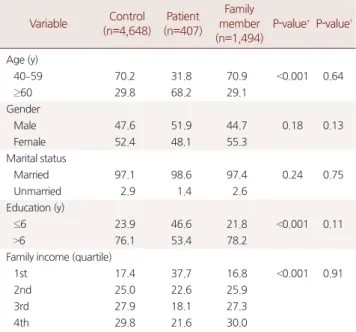
본 연구 대상자들의 인구사회학적 특성은 Table 1과 같다. 대상자 6,549명 중 407명(6.21%)이 심뇌혈관질환자로 분류되었으며 1,494명 (22.81%)은 가족력군으로 분류되었다. 심뇌혈관질환자의 평균 연령 은 64.8세였고 이 중 4,466명(68.2%)이 60세 이상으로, 가족력군이 평 균 연령 54.8세, 대조군이 55.0세인 것에 비해 연령대가 높았다. 결혼 여부는 세 군에서 유의한 차이가 나타나지 않았다. 환자군에서 교 육수준이 낮은 것으로 확인되었으며(P<0.001) 낮은 소득수준을 보 였다. 가족력과 대조군은 인구사회학적으로 차이를 보이지 않았다.
2. 심뇌혈관질환 병력 및 가족력과 건강행태와의 관계
대상자들의 심뇌혈관질환 병력 및 가족력과 건강행태와의 연관 성에 대한 다중 로지스틱 회귀분석 결과는 Table 2에 제시하였다. 연 령, 성별, 가구 소득, 교육수준 등의 인구사회학적 변수를 보정하여, 비만(BMI ≥25 kg/m2)의 위험은 심뇌혈관질환 환자군에서 1.53배 (95% confidence interval [CI], 1.18–1.97) 증가하였으나, 가족력군에서 는 1.14배(95% CI, 0.99–1.32)로 통계적으로 유의한 차이는 없었다. 이 외 현재 흡연 여부, 폭음의 위험이 가족력군에서 증가하는 것을 보이 나 통계적으로 유의하지는 않았으며, 최근 2년간 건강검진을 하지 않았는지 여부, 하루 나트륨 섭취량 10 g 이상의 위험도는 대조군에 비해 환자군, 가족력군 모두에서 높았으나 통계적으로 유의하지 않 았다.
3. 교육수준에 따른 심뇌혈관질환 병력 및 가족력과 건강행태와의 관계
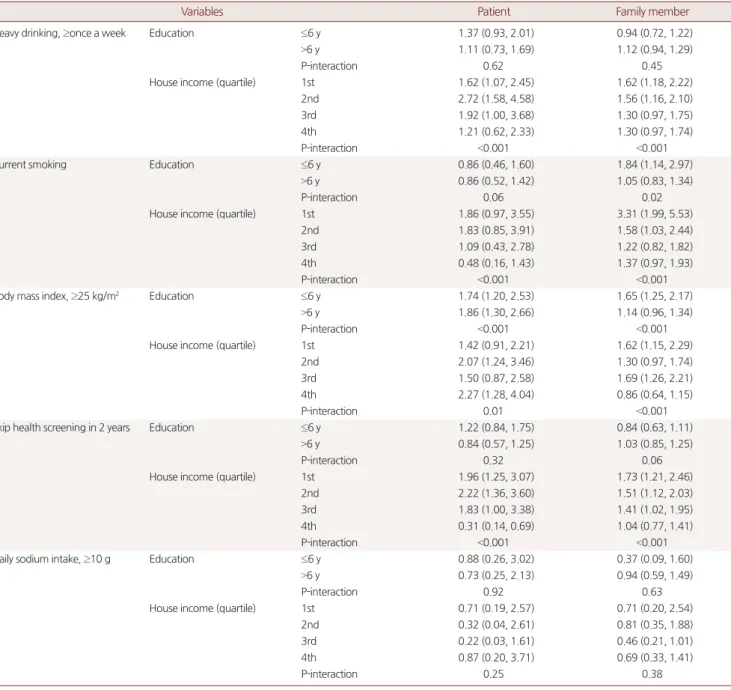
6년 이하의 교육을 받은 심뇌혈관질환 가족력군에서 현재 흡연을 하고 있는 위험도가 1.84배(95% CI, 1.14–2.97), 비만의 위험도가 1.65 배(95% CI, 1.25–2.17) 증가하였다. 그러나 가족력군에서 폭음 빈도, 건강검진 누락, 나트륨 과다섭취의 위험은 6년 이상 교육받은 대조 군과 차이가 없었다. 환자군에서는 교육수준에 상관없이 비만의 위 험도가 증가하였다. 이외, 폭음 빈도, 현재 흡연, 건강검진 누락, 나트 륨 과다섭취의 위험은 유의한 차이가 없었다(Table 3).
4. 가구 소득수준에 따른 심뇌혈관질환 병력 및 가족력과 건강행태와의 관계
폭음의 위험은 낮은 소득수준(1, 2사분위)의 심뇌혈관질환 환자 군과 가족력군 모두에서 증가하였다. 현재 흡연의 위험은 환자군에 서는 유의한 차이를 보이지 않았으나 가족력군의 낮은 가구 소득수 준인 1, 2사분위에서 각각 교차비 3.31 (95% CI, 1.99–5.53), 1.58 (95%
CI, 1.03–2.44)로 증가하였다. 비만의 위험은 소득수준별로 관련성을 보였으며, 2년 이내 건강검진 누락 위험은 가족력군의 경우 소득수 Table 1. Demographic characteristics of participants by family history
of atherosclerotic cardiovascular disease and its patients
Variable Control (n=4,648)
Patient (n=407)
Family member (n=1,494)
P-value* P-value†
Age (y)
40–59 70.2 31.8 70.9 <0.001 0.64
≥60 29.8 68.2 29.1
Gender
Male 47.6 51.9 44.7 0.18 0.13
Female 52.4 48.1 55.3
Marital status
Married 97.1 98.6 97.4 0.24 0.75
Unmarried 2.9 1.4 2.6
Education (y)
≤6 23.9 46.6 21.8 <0.001 0.11
>6 76.1 53.4 78.2
Family income (quartile)
1st 17.4 37.7 16.8 <0.001 0.91
2nd 25.0 22.6 25.9
3rd 27.9 18.1 27.3
4th 29.8 21.6 30.0
Values are presented as percentage.
*P-value for the difference between patient group and control. †P-value for the difference between family members and control.
P-values are estimated by chi-square test.
Table 2. Risk* of poor health behaviors compared with control group Participants Body mass index,
≥25 kg/m2 Current smoking Heavy drinking†,
≥once a week
Skip health screening in 2 years
Daily sodium intake,
≥10 g
Control (n=4,648) 1 1 1 1 1
Patients (n=407) 1.53 (1.18, 1.97) 0.77 (0.52, 1.14) 1.20 (0.89, 1.60) 0.94 (0.73, 1.21) 0.83 (0.37, 1.90) Family members (n=1,494) 1.14 (0.99, 1.32) 1.09 (0.88, 1.34) 1.05 (0.91, 1.23) 0.94 (0.80, 1.12) 0.88 (0.56, 1.36)
P for trend 0.01 0.24 0.43 0.70 0.80
Values are presented as odds ratio (95% confidence interval).
*Odds ratios (95% confidence intervals) were estimated by multiple logistic regression analysis after adjusting for age, sex, education, family income. †Defined as 7 or more drinks on the same occasion for men, 5 or more drinks for women.
Jin Hyuck Kim, et al. Health-Related Behavior of Patients and Family Members with Cardiovascular Disease
Korean Journal of Family Practice
KJFP
준이 낮을수록 높았으며 환자군에서는 소득하위 1, 2사분위에서는 대조군에 비해 검진 누락 위험이 높았으나, 4사분위에서는 유의하게 낮았다(P-interaction <0.001) (Table 3).
고 찰
본 연구 결과로부터 심뇌혈관질환의 가족력은 개인이 바람직한
건강행태를 갖도록 개선하는 데에 영향을 주지 못하는 것이 확인되 었다. 그러나, 가족력군에서 교육수준이 낮을 경우 현재 흡연율 및 비만 위험이 증가하였으며, 가구 소득이 낮을 경우 비만, 폭음, 현재 흡연, 건강검진 누락의 위험이 증가하는 것으로 확인되었다.
심혈관질환, 뇌졸중 이외에 암환자의 가족력군을 대상으로 한 이 전 조사에서도 가족력군은 대조군의 건강행태와 유의한 차이가 없
었다.12,14-20,25) 이에 대해 최근 연구들에서는 단순히 가족 중에 심뇌혈
Table 3. Risk* of poor health behaviors compared with control group by education status, family income
Variables Patient Family member
Heavy drinking, ≥once a week Education ≤6 y 1.37 (0.93, 2.01) 0.94 (0.72, 1.22)
>6 y 1.11 (0.73, 1.69) 1.12 (0.94, 1.29)
P-interaction 0.62 0.45
House income (quartile) 1st 1.62 (1.07, 2.45) 1.62 (1.18, 2.22)
2nd 2.72 (1.58, 4.58) 1.56 (1.16, 2.10)
3rd 1.92 (1.00, 3.68) 1.30 (0.97, 1.75)
4th 1.21 (0.62, 2.33) 1.30 (0.97, 1.74)
P-interaction <0.001 <0.001
Current smoking Education ≤6 y 0.86 (0.46, 1.60) 1.84 (1.14, 2.97)
>6 y 0.86 (0.52, 1.42) 1.05 (0.83, 1.34)
P-interaction 0.06 0.02
House income (quartile) 1st 1.86 (0.97, 3.55) 3.31 (1.99, 5.53)
2nd 1.83 (0.85, 3.91) 1.58 (1.03, 2.44)
3rd 1.09 (0.43, 2.78) 1.22 (0.82, 1.82)
4th 0.48 (0.16, 1.43) 1.37 (0.97, 1.93)
P-interaction <0.001 <0.001
Body mass index, ≥25 kg/m2 Education ≤6 y 1.74 (1.20, 2.53) 1.65 (1.25, 2.17)
>6 y 1.86 (1.30, 2.66) 1.14 (0.96, 1.34)
P-interaction <0.001 <0.001
House income (quartile) 1st 1.42 (0.91, 2.21) 1.62 (1.15, 2.29)
2nd 2.07 (1.24, 3.46) 1.30 (0.97, 1.74)
3rd 1.50 (0.87, 2.58) 1.69 (1.26, 2.21)
4th 2.27 (1.28, 4.04) 0.86 (0.64, 1.15)
P-interaction 0.01 <0.001
Skip health screening in 2 years Education ≤6 y 1.22 (0.84, 1.75) 0.84 (0.63, 1.11)
>6 y 0.84 (0.57, 1.25) 1.03 (0.85, 1.25)
P-interaction 0.32 0.06
House income (quartile) 1st 1.96 (1.25, 3.07) 1.73 (1.21, 2.46)
2nd 2.22 (1.36, 3.60) 1.51 (1.12, 2.03)
3rd 1.83 (1.00, 3.38) 1.41 (1.02, 1.95)
4th 0.31 (0.14, 0.69) 1.04 (0.77, 1.41)
P-interaction <0.001 <0.001
Daily sodium intake, ≥10 g Education ≤6 y 0.88 (0.26, 3.02) 0.37 (0.09, 1.60)
>6 y 0.73 (0.25, 2.13) 0.94 (0.59, 1.49)
P-interaction 0.92 0.63
House income (quartile) 1st 0.71 (0.19, 2.57) 0.71 (0.20, 2.54)
2nd 0.32 (0.04, 2.61) 0.81 (0.35, 1.88)
3rd 0.22 (0.03, 1.61) 0.46 (0.21, 1.01)
4th 0.87 (0.20, 3.71) 0.69 (0.33, 1.41)
P-interaction 0.25 0.38
Values are presented as odds ratio (95% confidence interval).
*Odds ratios (95% confidence intervals) were estimated by multiple logistic regression analysis after adjusting for age, sex, education, family income, except for the se- lected stratification variable. Each statistics were calculated from subjects who had no previous cardiovascular disease (CVD) or family history of CVD, and longer educa- tion or the highest house income group, respectively.
김진혁 외. 교육 및 소득에 따른 심뇌혈관질환자와 가족의 건강행태 Korean Journal of Family Practice
KJFP
관질환자가 있다고 설문에 응답하는 것과 자신의 심뇌혈관질환 위 험도가 증가된 상태라고 인지하는 것에 차이가 있음을 주목하기 시 작했다.11) 가족력이 있는 개인이 건강행태 개선을 하기 위해서 본인 의 심뇌혈관질환 위험도가 증가되어 있음을 인지하는 과정이 필요 하다는 것이다. 실제로 국외에서 가족력으로 인해 심뇌혈관질환 위 험도가 증가되어 있음을 인지하고 있는 군의 건강행태를 조사하였 으며 대조군에 비해 운동량이 많고 식습관의 개선이 있음이 보고되
었다.26-29) 또한, 건강검진 및 건강한 생활습관에 대해 일반적인 메시
지를 받은 군에 비해 심뇌혈관질환 가족력의 위험도를 알 수 있도록 맞춤형 메시지를 받은 군에서 유의하게 채소류 섭취가 늘고 신체활 동이 증가하였다는 보고도 있다.30) 따라서 심뇌혈관질환의 위험도 를 인식하고 있는 것과 단순히 가족력을 아는 것의 차이가 개인의 건강행태 개선에 중요한 영향을 미치며, 구분할 필요가 있을 것이라 생각된다.
주목할 만한 결과로 현재 흡연, 비만에는 교육 및 소득수준이, 건 강검진 누락과 음주에서는 소득수준이 효과 변경 인자(effect modi- fier)임이 확인되었다. 즉, 교육 및 소득수준이 대상자의 건강행태에 영향을 주었을 것으로 생각된다. 이는 소득 및 교육 수준 등의 사회 경제학적 요소가 개인의 건강행태에 중요한 영향을 미친다고 알려 진 이전 연구들을 바탕으로 설명할 수 있다.21-23) 그러나 단면 연구의 한계로 인과관계를 알 수 없으므로, 건강행태가 원래 좋지 않았던 가족력군이 가족의 질환으로 경제적 소득이 나빠져 저소득층이 되 었을 가능성도 있다.
본 연구는 앞서 언급한대로 면접 및 자가 기입식 방식으로 실행한 설문을 대상으로 단면 연구를 시행하였으므로, 현시점에서의 심뇌 혈관질환 가족력 및 질환력과 건강행태와의 인과관계를 증명하기 어렵다. 또한, 흡연, 음주 등의 다양한 척도로 건강행태를 평가하였 으나 중등도 운동 실천 여부의 항목이 제6기 국민건강영양조사에 제외되어있어 분석에 포함하지 못하였다. 아울러, 암병력, 콩팥이나 간질환 등의 만성질환자 및 가족력이 있는 개인들이 모두 연구에서 제외되지 않고 포함되었다. 마지막으로, 가족력으로 인해 본인의 심 뇌혈관질환의 위험도가 증가하였음을 인지하고 있는지에 대해서는 조사되지 않아 분석에 포함하지 못했다.
본 연구의 강점으로는 첫째, 대한민국 대표성을 갖춘 자료를 이용 하여 심뇌혈관질환의 가족력과 건강행태의 연관성에 대해 처음으 로 조사하였다는 것과 둘째, 심뇌혈관질환력을 통합하여 고려하였 다는 점이다. 이 연구를 통해, 대한민국 성인의 심뇌혈관질환 일차 예방에 있어 위험인자를 선별하여 합리적인 접근이 이루어지길 기 대할 수 있겠다.
향후에는 가족력이 있는 집단이 본인의 심뇌혈관질환 위험도를
인지하고 소득 및 교육수준을 고려하여 건강행태를 개선할 수 있도 록 보건의료 정책적인 접근이 필요할 것이다.
감사의 글
We would like to thank the Korea Centers for Disease Control and Prevention for the data obtained from the sixth Korea National Health and Nutrition Examination Survey (KNHANES VI) 2013–2014.
요 약
연구배경:
가족력은 심뇌혈관질환의 독립적인 위험인자이다. 국외 연구에서는 심뇌혈관질환 가족력이 건강행태에 미치는 영향은 일 치된 결과를 보이지 못하였으며 소득수준과 교육수준이 건강행태 에 밀접한 영향을 미치는 것으로 알려졌다. 우리는 이러한 결과가 한 국인들에게서는 어떻게 관찰되는지 소득과 교육 수준에 초점을 맞 추어 심뇌혈관 질환의 가족력 집단과 환자군 대조군을 비교하여 확 인하고자 한다.방법:
우리는 제6기 국민건강영양조사에 참여하였던 6,549명의 40 세 이상 성인을 대상으로 분석을 시행하였다. 분석을 위해 심뇌혈관 가족력이 있는 1,494명과 407명의 심뇌혈관질환자, 4,648명의 대조군 에서 현재 흡연 여부, 폭음 빈도 등의 건강행태를 비교하였다.결과:
대상자 6,549명 중 407명(6.21%)이 심뇌혈관질환자로 분류되었 으며 1,494명(22.81%)은 가족력군으로 분류되었다. 가족력군과 환자 군에서 대조군에 비해 건강행태에 유의한 차이가 없었으나 교육수 준이 낮을 경우 현재 흡연과 비만의 위험이 상승하였고, 저소득 계층 의 경우 폭음, 현재 흡연, 비만, 건강검진 누락의 위험이 증가하였다.결론:
본 연구에서 심뇌혈관질환 환자군과 가족력이 있는 군의 건 강행태는 교육 및 소득수준에 의해 영향을 받는 것을 확인하였다.향후 심뇌혈관질환 일차 예방을 위한 건강행태를 개선을 위해서는 가족력, 교육, 소득수준이 고려 된 보건의료 정책적인 접근이 필요할 것이다.
중심단어:
건강 행동; 심혈관질환; 흡연; 비만; 일차 예방 REFERENCES1. Statistics Korea. Annual report on the cause of death statistics [Internet].
Daejeon: Statistics Korea; 2016 [cited 2016 Sep 19]. Available from: http://
kostat.go.kr/portal/korea/kor_nw/2/1/index.board?bmode=read&bSeq=&
Jin Hyuck Kim, et al. Health-Related Behavior of Patients and Family Members with Cardiovascular Disease
Korean Journal of Family Practice
KJFP
aSeq=356345&pageNo=42&rowNum=10&navCount=10&currPg=&sTar get=title&sTxt=.
2. Jeong JO. Regional cardiocerebrovascular center project in the treatment of acute myocardial infarction. Korean J Med 2013; 85: 272-4.
3. Toborek M, Lee YW, Garrido R, Kaiser S, Hennig B. Unsaturated fatty acids selectively induce an inflammatory environment in human endothelial cells. Am J Clin Nutr 2002; 75: 119-25.
4. Schaefer EJ. Lipoproteins, nutrition, and heart disease. Am J Clin Nutr 2002;
75: 191-212.
5. Roger VL, Go AS, Lloyd-Jones DM, Benjamin EJ, Berry JD, Borden WB, et al. Heart disease and stroke statistics--2012 update: a report from the Amer- ican Heart Association. Circulation 2012; 125: e2-220.
6. Delaney JA, Daskalopoulou SS, Brophy JM, Steele RJ, Opatrny L, Suissa S.
Lifestyle variables and the risk of myocardial infarction in the general prac- tice research database. BMC Cardiovasc Disord 2007; 7: 38.
7. Lloyd-Jones DM, Nam BH, D’Agostino RB Sr, Levy D, Murabito JM, Wang TJ, et al. Parental cardiovascular disease as a risk factor for cardiovascular disease in middle-aged adults: a prospective study of parents and offspring.
JAMA 2004; 291: 2204-11.
8. Lisabeth LD, Peyser PA, Long JC, Majerisk JJ, Smith MA, Morgenstern LB.
Stroke among siblings in a biethnic community. Neuroepidemiology 2008;
31: 33-8.
9. Kim H, Friedlander Y, Longstreth WT Jr, Edwards KL, Schwartz SM, Sisco- vick DS. Family history as a risk factor for stroke in young women. Am J Prev Med 2004; 27: 391-6.
10. Choi JC, Lee JS, Kang SY, Kang JH, Bae JM. Family history and risk for isch- emic stroke: sibling history is more strongly correlated with the disease than parental history. J Neurol Sci 2009; 284: 29-32.
11. Imes CC, Lewis FM. Family history of cardiovascular disease, perceived cardiovascular disease risk, and health-related behavior: a review of the lit- erature. J Cardiovasc Nurs 2014; 29: 108-29.
12. Aycock DM, Kirkendoll KD, Coleman KC, Clark PC, Albright KC, Alexan- drov AW. Family history of stroke among African Americans and its associ- ation with risk factors, knowledge, perceptions, and exercise. J Cardiovasc Nurs 2015; 30: E1-6.
13. Berg AO, Baird MA, Botkin JR, Driscoll DA, Fishman PA, Guarino PD, et al.
National Institutes of Health State-of-the-Science Conference statement:
family history and improving health. Ann Intern Med 2009; 151: 872-7.
14. Thanavaro JL, Moore SM, Anthony MK, Narsavage G, Delicath T. Predic- tors of poor coronary heart disease knowledge level in women without pri- or coronary heart disease. J Am Acad Nurse Pract 2006; 18: 574-81.
15. Tamragouri RN, Martin RW, Cleavenger RL, Sieber WK Jr. Cardiovascular risk factors and health knowledge among freshman college students with a family history of cardiovascular disease. J Am Coll Health 1986; 34: 267-70.
16. Slattery ML, Murtaugh MA, Lanier AP, Ma KN, Ferucci ED, Etzel RA, et al.
Family health history and health behaviors in Alaska native and American Indian people. J Health Care Poor Underserved 2009; 20: 678-94.
17. McCusker ME, Yoon PW, Gwinn M, Malarcher AM, Neff L, Khoury MJ.
Family history of heart disease and cardiovascular disease risk-reducing be- haviors. Genet Med 2004; 6: 153-8.
18. Kip KE, McCreath HE, Roseman JM, Hulley SB, Schreiner PJ. Absence of risk factor change in young adults after family heart attack or stroke: the CARDIA Study. Am J Prev Med 2002; 22: 258-66.
19. Kelley C, Krummel D, Gonzales EN, Neal WA, Fitch CW. Dietary intake of children at high risk for cardiovascular disease. J Am Diet Assoc 2004; 104:
222-5.
20. Andersson P, Sjöberg RL, Ohrvik J, Leppert J. The effects of family history and personal experiences of illness on the inclination to change health-re- lated behaviour. Cent Eur J Public Health 2009; 17: 3-7.
21. Glanz K, Rimer BK, Viswanath K. Health-behavior-and-health-education.
4th ed. San Francisco: Jossey-Bass; 2008.
22. Nandi A, Glymour MM, Subramanian SV. Association among socioeco- nomic status, health behaviors, and all-cause mortality in the United States.
Epidemiology 2014; 25: 170-7.
23. Lantz PM, House JS, Lepkowski JM, Williams DR, Mero RP, Chen J. Socio- economic factors, health behaviors, and mortality: results from a nationally representative prospective study of US adults. JAMA 1998; 279: 1703-8.
24. National Health Insurance Service. Dietary recommendation for Korean adults National Health Insurance Service: the Ministry of Health and Wel- fare 2010 Dietary recommendations [Internet]. Wonju: National Health In- surance Service [cited 2016 Dec 10]. Available from: https://hi.nhis.or.kr/
main.do.
25. Ham Y, Oh HY, Seo SS, Kim MK. Association between Health Behaviors and a Family History of Cancer among Korean Women. Cancer Res Treat 2016; 48: 806-14.
26. Patel MJ, de Lemos JA, Philips B, Murphy SA, Vaeth PC, McGuire DK, et al.
Implications of family history of myocardial infarction in young women.
Am Heart J 2007; 154: 454-60.
27. Kavanagh T, Shephard RJ, Hamm LF, Mertens DJ, Thacker L. Risk profile and health awareness in male offspring of parents with premature coronary heart disease. J Cardiopulm Rehabil 2000; 20: 172-9.
28. Hunt K, Davison C, Emslie C, Ford G. Are perceptions of a family history of heart disease related to health-related attitudes and behaviour? Health Educ Res 2000; 15: 131-43.
29. Allen JK, Blumenthal RS. Risk factors in the offspring of women with pre- mature coronary heart disease. Am Heart J 1998; 135: 428-34.
30. Ruffin MT 4th, Nease DE Jr, Sen A, Pace WD, Wang C, Acheson LS, et al. Ef- fect of preventive messages tailored to family history on health behaviors:
the Family Healthware Impact Trial. Ann Fam Med 2011; 9: 3-11.