Printed in the Republic of Korea
http://dx.doi.org/10.5012/jkcs.2011.55.5.765
Design, Synthesis and Biological Evaluation of Novel Analogs of Bortezomib
R. Janaki Rama Rao, A. K. S. Bhujanga Rao*, K. Swapna, B. Baby Rani, S. Prasanna Kumar S. Awantika, and Y. L. N. Murthy†
Natco Research Centre, Natco Pharma Ltd., Hyderabad, Andhra Pradesh, PIN. 500018, India.
*E-mail: [email protected]
†Department of Organic Chemistry, Andhra University, Visakhapatnam, Andhra, Pradesh, PIN. 530003, India (Received March 25, 2011; Accepted July 8, 2011)
ABSTRACT. Novel analogs of bortezomib were designed, synthesized and in vitro biological evaluation was carried out using human tumor cell lines A549 and PC3. Docking studies of these analogs of bortezomib was discussed.
According to biological investigations, the inhibitors 4, 6, and 8 were found to be more potent than reference drug can- didate bortezomib. A549 cell line showed significant sensitivity towards 4, 6, and 8 with IC50 values 14.03, 18.5, and 12.4 nM, respectively, and PC3 cell line showed IC50 values 26.1, 37.0, and 21.2 nM, respectively. The IC50 values of bortezomib in these cell lines are 27.3 nM and 42.0 nM.
Key words: Bortezomib, human tumor cell lines, A549, PC3, IC50 values
INTRODUCTION
The ubiquitin-proteasome pathway (UPP) plays an essential role in the maintenance of homeostasis in cells and organisms and it is responsible for the degradation of more than 80% normal and abnormal intracellular pro- teins.1 The proteasome 26S complex is a large multipro- tein complex with a molecular weight of 700 kDa present in both the cytoplasm and the nucleolus of all eukaryotic cells.2 It is composed of two functional components, a 20S core catalytic complex and the 19S regulatory subunit.
The 26S proteasome plays an essential role in the UPP by acting as the final proteolytic effect or of cellular proteins targeted by polyubiquitination for destruction. The real- ization that the proteasome is so critically related to the development of a number of major human diseases pro- moted research into the design and the synthesis of var- ious proteasome inhibitors and the evaluation of their therapeutic potentials. In recent years, there has been a great deal of interest in proteasome inhibitors as novel class of anticancer candidates and some of them entered clinical trials such as bortezomib.3
Bortezomib is a dipeptide boronic acid proteasome inhibitor. It effects the degradation of polyubiquitinated proteins destined for catalysis by the proteasome. The boronic acid moiety of bortezomib is thought to form a stable tetrahedral complex with the active site N-termi- nal threonine residue of the 20S β5 subunit. Bortezomib is very efficacious and more potent among the drugs
used for treatment of multiple myeloma, invented by Millennium pharmaceuticals USA. Bortezomib was approved by the FDA for the treatment of patients with relapsed and refractory multiple myeloma (MM) approved in 2003 with at least one prior line therapy and for the treatment of mantle cell lymphoma (MCL, approved in 2006).4,5
Multiple myeloma is a bone marrow cancer generally thought to be incurable, but remission may be induced with chemotherapy and stem cell transplants. It occurs more commonly in men. There are approximately 20,000 new cases of myeloma in the U.S. each year. At any time there are over 100,000 myeloma patients undergoing treatment for their disease in the U.S. Bortezomib shows significant antitumor activity in human tumor xenograft models.
Experiments have demonstrated that bortezomib is cyto- toxic to a variety of cancer cell types in vitro. Bortezomib causes a delay in tumor growth in vivo in non-clinical tumor models, including multiple myeloma.
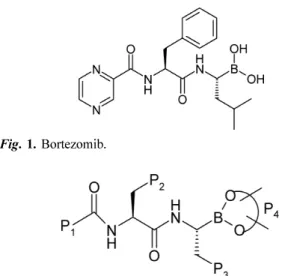
The chemical name of bortezomib is [(1R)-3-methyl-1- [[(2S)-1-oxo-3-phenyl-2-[(Pyrazinylcarbonyl)amino]pro- pyl]-amino]butyl] boronic acid and its chemical structure is given below(Fig. 1). Bortezomib is marked under the brand name Velcade® (intravenous injection).
Some interesting analogs of bortezomib were reported in recent literature. Yongqiang and coworkers,6 synthe- sized and evaluated biological study of the some novel analogs of bortezomib. The general structure is depicted in Fig. 2.
Among the above compounds, the analogues where the 2-pyrazinyl moiety of bortezomib is replaced with 1,2,3,4- tetrahydronaphthyl and 5,6,7,8-tetrahydronaphthyl showed higher inhibitory activity against solid tumors.
The same authors also synthesized, and studied in vitro and in vivo biological activity of dipeptidyl boronic acid proteasome inhibitors composed of β- amino acids7. The general structure of these compounds is depicted in Fig. 3.
The synthesis and biological evaluation of tripeptide boronic acids as proteasome inhibitors has been reported8. 2-Pyrazinyl and L-leucinyl moieties of bortezomib are kept intact in this series of tripeptide boronic acids. In between 2-pyrazinyl and L-leucinyl moieties of borte- zomib two different kinds of α-amino acids were intro-
duced by peptide bond formation.General structure of tripeptideboronic acids shown in Fig. 4.
A review of literature indicated that attempts were made to replace 2-pyrazinyl moiety with phenyl, tetrahy- dronaphthyl, methyl and tert-butoxy components.6-8 No heterocyclic moiety was introduced for the replacement of 2-pyrazinyl fragment of bortezomib.
As the heterocyclic fragments play a vital role in bio- logical activities of many pharmaceutical ingredients, we aimed to synthesize novel analogs of bortezomib by replacing the 2-pyrazinyl moiety with other heterocyclic ring systems and to study the biological activity of these analogs in vitro on human cell lines.
In this manuscript, we described the design, docking studies, synthesis, and in vitro cytotoxicity evaluation with human tumor cell lines A549 (lung cancer) and PC3 (prostate cancer) of novel analogs of bortezomib as poten- tial anticancer agents.
RESULTS AND DISCUSSION
Molecular docking studies
We performed docking studies to screen the designed analogs of bortezomib. To date, several ligand-protea- some crystal complexes have been reported.9-12 We selected Cocrystal structure of 20S proteasome in com- plex with bortezomib for our studies. Cocrystal structures (PDB ID-2F16) demonstrate that protein consist of 28 chain. The docking process was carried out by Discovery Studio C-Docker program. The docking results offered useful information for understanding the interaction mode and potency of molecules. The protein and ligands for docking were prepared using software Discovery Studio2.5.
The initial structure was derived from the crystal complex coordinates (PDB code-2F16). A set of ligand confor- mations were generated using high temperature molecu- lar dynamics with random seed. For each final pose, Fig. 1. Bortezomib.
P1=1,2,3,4-tetrahydronaphthyl, 5,6,7,8-tetrahydronaphthyl, methyl, tert- butoxy, and benzyloxy etc;
P2=methyl, naphthyl, 4-hydroxyphenyl, and indole, etc;
P3=tolyl, 4-fluorophenyl, and phenyl etc;
P4=pinanediol and H
Fig. 2. Novel analogs of Bortezomib.
R1=Pyz, Ph, nicotin-3-yl, THNA R2=H, CH3, OCH3, Cl R3= Pr, Ph, (4-CH3)-Ph
Fig. 3. General structure of dipeptidylboronic acids containing β-amino acids.
P2=L-tyrosine, L-leucine, L-phenylalanine, L-(2-naphthyl)alanine, and L-tryptophan
P3=L-phenylalanine, L-(2-naphthyl)alanine, L-tryptophan P4=pinanediol, H
Fig. 4. General structure of tripeptideboronic acids.
CHARMm energy and interaction energy were calcu- lated. First to test credibility of the developed docking procedure, the structure of bortezomib was docked into the binding pocket. As shown in the docking result, designed 10 analogs were docked in same binding site, by using above mentioned docking procedure.
Docking results
The structural formulas and docking results of novel analogs of bortezomib of present work are mentioned in Table 1.
The above results revealed that out of ten docked ana- logs six compounds 3, 4, 5, 6, 8, and 9 are good and in turn 8 is more potent among them. Molecules 7 and 10 have been predicted to have moderate activity and molecule 1 and 2 are expected to be least active. In the above ten ana-
logs we aimed to synthesize three more active (4, 6, 8) and two least active compounds (1, 2) to study biological activity using A549 and PC3 cell lines.
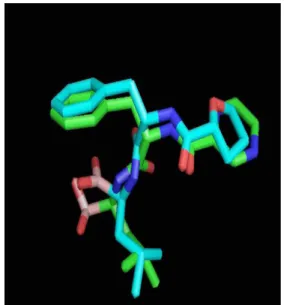
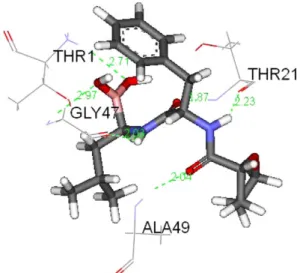
The alignment of novel analogues 3, 4, 5, 6, 8, and 9 with bortezomib (green) in binding site of protein is showed in Fig. 5. Superimposition of analog 8 with ref- erence molecule bortezomib (green color) is depicted in Fig. 6. Hydrogen bonding and binding affinity of more potent analog 8 are depicted in Fig. 7 and Fig. 8 respec- tively.
Chemistry
The analogs of bortezomib studied involve introduc- tion of 5- and 6-membered ring heterocyclic moieties in Table 1. Docking studies of bortezomib and its analogs
Molecule Structural formula C-Docker C-Docker interac- tion energy Bortezomib
(Reference) -42.61 -43.46
1 -51.68 -38.47
2 -26.11 -39.81
3 -61.29 -50.35
4 -48.58 -47.99
5 -47.35 -46.59
6 -47.52 -40.54
7 -47.19 -46.86
8 -43.39 -43.468
9 -49.77 -46.069
10 -36.52 -44.95
Fig. 5. Binding Sites of analogs 3, 4, 5, 6, 8, and 9 with reference bortezomib (green) in binding site of protein.
Fig. 6. Superimposition of analog 8 with reference molecule (green color).
place of 2-pyrazinyl moiety. Ten novel analogues of bort- ezomib were designed by replacing 2-pyazinyl moiety of bortezomib with 2-thiophene, 3-thiophene, 2-tetrahydro- furan, proline, histidine, 4-nicotinyl, isonipecotyl, indole, tryptophan and isoquinoline residues. As indicated by docking studies compounds with 4-nicotinyl, 2-thienyl, 2- tetrahydrofuryl fragments (4, 6 and 8) are more potent and compounds with tryptophan, proline (1, 2) are least active, the remaining analogs being moderately active.
Synthesis of analogs 4, 6, 8 of bortezomib involves cou- pling of (1R)-(1S,2S,3R,5S)-pinanediol leucine boronate tri- fluoroacetate salt (11)13 with N-BOC-β-(1-phenyl)-L-alanine (12) in the presence of TBTU to yield (1S,2S,3R,5S)- pinanediol-N-BOC-β-(1-phenyl)-L-alanine-L-leucine bor- onate (13). The resulting compound was treated with
EtOAc-HCl to yield BOC deprotected compound (1S,2S, 3R,5S)-pinanediol-β-(1-phenyl)-L-alanine-L-leucine bor- onate HCl (14) and was coupled with the corresponding carboxylic acid in the presence of TBTU to get dipeptidyl compound (15). Finally pinanediol moiety of above dipeptidyl compound (15) was deprotected with isobutyl boronic acid to afford corresponding dipeptidyl boronic acids 4, 6, and 8 (Scheme 1). The products were obtained in moderate yields with > 98% purity (HPLC).
In case of preparation of analogs 1 and 2 the corre- sponding Boc protected amino acids (16) have been employed to react with (1S,2S,3R,5S)-pinanediol-β-(1- phenyl)-L-alanine-L-leucine boronate HCl (14) to get compound 17. The BOC moiety of amino acid was depro- tected with 1,4-dioxane-HCl to yield BOC- deprotected dipeptidyl boronate (18) and the resulting compound was treated with isobutyl boronic acid to get required borte- zomib analogs 1 and 2 (Scheme 2).
The starting material (1R)-(1S,2S,3R,5S)-pinanediol leucine boronate trifluoroacetate salt (11) was prepared by homologation of (1S,2S,3R,5S)-pinanediol isobutyl bor- onate (19) using dichloromethane as reagent in the pres- ence of a strong base like LDA (lithium diisopropylamide, prepared insitu by reacting n-BuLi and diisopropylamine) followed by Lewis acid catalysis. The Lewis acid used was zinc chloride that catalyses the rearrangement of intermediate dichloromethylboronate complex to get (1S)- (S)-pinanediol-1-chloro-3-methylbutane-1-boronate (20).
The reaction requires subzero temperatures (-60 to -70oC).
The resulting homologated product (20) was reacted with lithium bis(trimethylsilyl)amide at -20oC to yield (1R)- (S)-pinanediol-1-bis(trimethylsilyl)amino-3-methylbutane- 1-boronate (21). The disilazane compound obtained was treated with trifluoroacetic acid at 0oC to afford the required starting material (1R)-(1S,2S,3R,5S)-pinanediolleucinebor- onatetrifluoroacetate salt (11) (Scheme 3).
Biological activity
Bortezomib and its analogs 1, 2, 4, 6, and 8 were dis- solved in DMSO as a 10mM stock solution and diluted to required concentration with PBS (1X) (Phosphate Buffer Saline). Cytotoxicity analysis was carried out by using 3- (4,5-dimethylthiazol-2-yl)2,5-diphenyl- tetrazolium bro- mide (MTT) dye reduction assay. The MTT kit received from promega and procedure followed by therein instructed.
Exponential growing cells were exposed to bortezomib and 1, 2, 4, 6, and 8 for the indicated time. The drug - induced cytotoxicity was assessed by the MTT assay.
Lung cancer cell line and prostate cancer cell line (A549 Fig. 8. Analog 8 with protein.
Fig. 7. H-bonds of analog 8.
and PC3 respectively) were treated with bortezomib and 1, 2, 4, 6, and 8 cell viability was measured.
Bortezomib and its analogs 1, 2, 4, 6, and 8 were added to cells and 72h later, cell viability was assessed by the
thiazolylblue (MTT) assay. All experiments were per- formed in triplicates. After 72h of treatment bortezomib and its analogs potently induced cytotoxicity in cell lines was tested (Fig. 9 and Fig. 10). Analogs 1,2,4,6 and 8 are Scheme 1. Synthesis of novel analogs 4, 6, and 8 of bortezomib.
Scheme 2. Synthesis of novel analogs 1 and 2 of bortezomib.
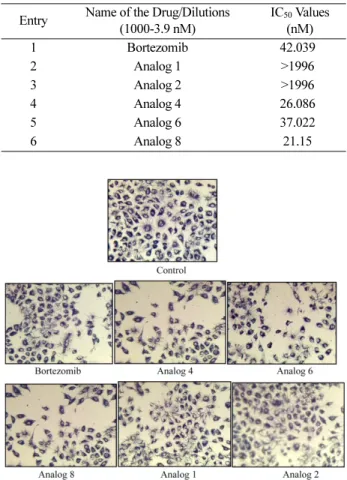
designated VLD-VI-TRP, VLD-VI-PRO, VLD-VI-ISN, VLD-VI-2TH and VLD-VI-2THF respectively in Fig. 9 and Fig. 10. The IC50 values of analogs 4, 6, 8 were lower than the bortezomib in A549 Cell line (Table 2) and in PC3 cell line (Table 3), whereas IC50 values of analogs 1 and 2 were higher than the bortezomib.
The effect of bortezomib analogs on A549 and PC3 cell lines are depicted in Fig. 11 and Fig. 12 respectively.
Scheme 3. Synthesis of key intermediate (1R)-(1S,2S,3R,5S)-Pinanediol leucineboronate trifluoroacetate salt (11).
Fig. 9. Cytotoxicity of Bortezomib and its analogs 1, 2, 4, 6, and 8 on A549 Cancer cell line.
Fig. 10. Cytotoxicity of Bortezomib and its analogs 1, 2, 4, 6, and 8 on PC3 Cancer cell line.
Table 3. IC50 values of Bortezomib and its analogs on PC3 cell line (72 Hrs)
Entry Name of the Drug/Dilutions (1000-3.9 nM)
IC50 Values (nM)
1 Bortezomib 42.039
2 Analog 1 >1996
3 Analog 2 >1996
4 Analog 4 26.086
5 Analog 6 37.022
6 Analog 8 21.15
Fig. 11. Pictures showing the Effect of Bortezomib and its ana- logs on A549 cell line.
Table 2. IC50 values of Bortezomib and its analogs on A549 cell line (72 Hrs)
Entry Name of the Drug/Dilutions (1000-3.9 nM)
IC50 Values (nM)
1 Bortezomib 27.311
2 Analog 1 845.345
3 Analog 2 >1996
4 Analog 4 14.030
5 Analog 6 18.498
6 Analog 8 12.389
CONCLUSION
A total of ten novel analogs of bortezomib were designed by substituting the 2-pyrazinyl moiety with various 5- and 6-membered ring heterocycles. These were subjected to molecular modeling study to estimate the binding affinity with PDB ID 2F16 imported from protein data bank (PDB). The more potent analogs 4, 6, 8 and the least potent analogs 1and 2 were selected from docking studies to syn- thesize and evaluate biological activities. A549 (lung can- cer) and PC3 (prostate cancer), were employed for cytotoxity studies, and IC50 values were calculated. The results obtained from the activity study revealed that cyto- toxicity of borterzomib analogs 4, 6, 8 are more than bort- ezomib, analogs 1 and 2 didn’t show any cytotoxic effect.
The results obtained from docking studies are concordant with biological testing results.
EXPERIMENTAL PROCEDURES
Docking studies
The protein and ligands for docking were prepared using software Discovery Studio 2.5 C-Docker program.
The initial structure of bortezomib was derived from the crystal complex coordinates (PDB ID–2F16). The dock- ing process was carried out by using Discovery Studio C- Docker program. A set of ligand conformations were gen-
erated using high temperature molecular dynamics with random seed. For each final pose, CHARMm energy and interaction energy were calculated. To evaluate the devel- oped docking procedure, the structure of bortezomib was docked into the binding pocket. As shown in the docking result, the ten analogs designed were docked in same binding site, by the above mentioned docking procedure.
The results revealed that out of ten analogs six com- pounds 3, 4, 5, 6, 8, and 9 are good and in turn 8 is more potent among them. Molecules 7, and 10 are expected moderate activity and molecule 1 and 2 are expected to be least active.
Synthesis
All reactions were monitored by thin layer chromatog- raphy and carried out on 0.2 mm E. Merck silica gel plates (60F-254) using UV light as a visualizing agent. All sol- vents were obtained from commercial source and freshly distilled before use. Analytical HPLC was performed on a Waters system equipped with a UV detector set at 215 nm.
Compounds were dissolved in mobile phase and injected through a 100 µL loop. The following gradient system was used as eluent mobile phase A: acetonitrile, water and for- mic acid in the ratio of 30: 70: 0.1 (V/V/V) and mobile phase B: acetonitrile, water and formic acid in the ratio of 80:20:0.1 (V/V/V). HPLC retention times (tR) were obtained, at flow rates of 1.0 ml/min, using the following condi- tions. Develosil C8 -UG-5 (150×4.6 mm) column a gradi- ent run up to 55 min. Purity of liquid products was checked by GC on Agilent Technologies Model No: 6890N. Opti- cal rotation of chiral molecules was recorded on Rudolph Research Analyticalpolarimeter, Model: AUTOPOLV.
The IR spectral data of all the compounds were recorded on Perkin-Elmer FT-IR spectrometer (MODEL NO:
PARAGON-1000) using liquid state as KBr cell and solid state as KBr dispersion. The 1H NMR and 13C NMR spec- tra were recorded on Buker 400-MHz spectrometer. The chemical shifts are reported in δ parts per million (ppm) relative to TMS. The Mass spectra were recorded onWa- ters Quattro Micro LC/MS/MS.
Preparation of (1R)-(1S,2S,3R,5S)-pinanediol leucine boronate trifluoroacetate salt (11)
(+) Pinanediol-2-methylpropane-1-boronate (19, 60 g, 0.25 moles), tert-butyl methyl ether (300 mL), and meth- ylene dichloride (112.5 g (84.9 mL), 1.32 moles) were charged into 2 L four necked round bottomed flask. The reaction mass was cooled to -65 to -60oC using liquid nitrogen-acetone bath. LDA (lithium diisopropylamide) Fig. 12. Pictures showing the Effect of Bortezomib and its ana-
logs on PC3 cell line.
solution prepared from diisopropyl- amine (33.3 g, 0.33 moles), n-BuLi 1.6 M solution in hexane (196.8 mL, 0.32 moles) in tetrahydrofuran was added drop wise to the above reaction mass during 50 min under nitrogen atmosphere.
The resulting pale yellow coloured cloudy solution was stirred for 20 min at -60 to -55oC. Then ZnCl2 solution (64 g, 0.47 moles) in tetrahydrofuran was added drop wise during 50 min. under nitrogen atmosphere. The reaction mass was allowed to stir for 35 min at -50 to -45oC.
The reaction mass was warmed to -10oC and 10% sul- phuric acid (prepared from 36 g of conc. Sulphuric acid and 324 mL of water) was added below 0oC during 40 min. Layers were separated and the aq. layer was extracted with tert-butyl methyl ether (120 mL), and combined organic layer was washed with water followed by brine solution. The organic layer was separated, dried over sodium sulphate and solvent was evaporated under reduced pres- sure at 45oC, to yield (+) pinanediol(1S)-1-chloro-3- methylbutane -1-boronate (20) as yellow coloured oil. [70 g, 96.7%, purity: 87% (GC).]
The above compound was taken to next step without further purification.
Lithium bis(trimethylsilyl)amide (20% in tetrahydrofu- ran), 226 mL (46 g, 0.27 moles) was charged into 1L four necked round bottomed flask and cooled to -25 to -20oC using liquid nitrogen-acetone bath. A solution of (+) pinanediol(1S)-1-chloro-3-methylbutane-1-boronate (20, 70 g, 0.25 moles) in cyclohexane (150 mL) was added to the above reaction mass drop wise under nitrogen atmo- sphere during 60 min. The resulting yellow coloured solu- tion was stirred for 65 min at -25 to -20oC.
Solvent was distilled off at 45oC under reduced pres- sure to attain a cream to yellow coloured suspension. The resulting suspension was triturated with cyclohexane (120 mL) and filtered, and the residue was washed with diiso- propyl ether (150 mL). The filtrate obtained contains (1R)- (S)-pinanediol-1-bis(trimethylsilyl)amino-3-methylbutane- 1-boronate (21), which was taken to next step without product isolation.
Trifluoroacetic acid (77 g, 0.67 moles) and diisopropyl ether (500 mL) were charged into 2 L three necked round bottomed flask reaction mass was cooled to -10oC (ice- salt bath). The solution of (1R)-(S)-pinanediol-1-bis(tri- methylsilyl)amino-3-methylbutane-1-boronate (21) obtained above was added drop wise to the reaction mixture. After completion of addition the reaction mass was stirred for 6- 8 h at below 0oC. The product was filtered from the reac- tion massand washed with diisopropyl ether to afford the required product (1R)-(1S,2S,3R,5S)-pinanediol leucine
boronate trifluoroacetate salt(11) as off white coloured solid. (50 g, % yield: 57.6).
(α)D25+9.8o (c=1 in methanol);mp: 125-140oC; GC:
98.8%; 1H NMR (CDCl3): δ 7.79 (s, 1H), 4.33 (dd, 1H, J=
8Hz, 4.2Hz), 2.91 (t, 1H, J=8Hz), 2.25 (m, 2H), 2.03 (t, 1H, J=5.2Hz), 1.86-1.9 (m, 3H), 1.77 (m, 2H), 1.6 (m, 2H), 1.38 (s, 3H), 1.27 (s, 3H), 1.05 (m, 1H), 0.92 (dd, 6H, J=6.4Hz, 1.6Hz), 0.8 (s, 3H); 13C NMR (CDCl3): δ 162.4;
120.93, 118.02, 115.11, 112.20, 87.61, 78.70, 50.99, 39.31, 38.28, 35.46, 34.78, 28.04, 26.93, 24.65, 23.86, 22.06;
MS (ESI), m/z=266.28 (M+1–CF3COOH), 210.20; IR (KBr): cm-1 3046.5 (-NH), 2962.7-2872.0 (Aliphatic C-H streching), 1678.5 (C=O, CF3COOH), 1420.5-1391.9 (Ali- phatic C-H bending), 1202.8 (C-N bending).
Preparation of (1S,2S,3R,5S)-pinanediol-β-(1-phe- nyl)-L-alanine-L-leucine boronate HCl(14)
(1R)-(1S,2S,3R,5S)-Pinanediol leucine boronate triflu- oroacetate salt (11, 50 g, 0.13 moles), BOC-L-phenylala- nine (12, 35 g, 0.13 moles), TBTU (48.16 g, 0.150 moles) and methylene chloride (760 mL) were charged into in 3 L 4 necked round bottomed flask at room temperature under nitrogen atmosphere and stirred for 5 min. Resulting off white coloured suspension was cooled to -2oC using ice- salt bath. N,N-diisopropylethylamine (52.45 g, 0.41 moles) was added drop wise to the above reaction mass, during 20-30 min. The reaction mass was then stirred for 35 min at -2 to 0oC for 35 min. TLC was Checked for reaction completion, using mobile phase: Toluene: ethyl acetate (1:1), detection: UV at 254 nm; and 0.75% aq. potassium permanganate solution.
The solvent was distilled off at 40-45oC under reduced pressure to obtain an oily product. The resulting crude product was dissolved in ethyl acetate washed with water (2×300 mL), 1% aq. H3PO4 solution (390 mL), 2% aq. K2CO3
solution (390 mL) followed by 10% aq. NaCl solution (350 mL). Organic layer was separated, dried over sodium sulphate and the solvent was evaporated under reduced pressure at 45oC to afford (1S,2S,3R,5S)-pinanediol-N- BOC-β-(1-phenyl)-L-alanine-L-leucineboronate (13) as white coloured foamy solid (67.0 g (Yield: 98.5%). The compound was taken to next step without further puri- fication.
(1S,2S,3R,5S)-Pinanediol-N-BOC-β-(1-phenyl)-L-ala- nine-L-leucineboronate (13, 67 g, 0.13 moles) was dis- solved in ethyl acetate (200 mL) and cooled to 10 to 15oC.
Then EtOAc-HCl solution (830 mL, assay: 11.5% w/v;
2.61 moles) was added to the reaction mass and stirred for 4 h. TLC was checked for completionof reaction. The reaction mass was concentrated under reduced pressure at
40-45oC to yield white coloured suspension. To the result- ing suspension was added 450 mL of fresh ethyl acetate, stirred for 2 h at room temperature and filtered to afford (1S,2S,3R,5S)-pinanediol-β-(1-phenyl)-L-alanine-L-leu- cineboronate HCl (14) as white crystalline solid (70g; % yield: 79.84); (α)D25+8.3 (c=1 in methanol); mp: 200-205
oC; purity 95.6% (HPLC); 1H NMR (CDCl3): δ 8.23 (br s, 2H), 7.71 (brs, 1H), 7.24- 7.35 (m, 5H), 4.67 (m, 1H), 4.22 (dd, 1H, J=7.6Hz, 4.2Hz), 3.29-3.42 (m, 2H), 2.90 (t, 1H, J=5.3Hz), 2.27 (m, 2H), 2.11 (m, 2H), 2.02 (t, 1H, J=5.2Hz), 1.77-1.82 (m, 2H), 1.46 (m, 2H), 1.33 (s, 3H), 1.26 (s, 3H), 0.84 (m, 6H), 0.8 (s, 3H); 13C NMR (CDCl3): δ 168.21, 134.05, 129.83, 128.64, 127.26, 85.92, 77.47, 53.46, 51.19, 39.28, 38.03, 36.98, 35.35, 28.41, 26.99, 26.23, 24.77, 23.94, 23.06, 21.56; MS (ESI), m/z=447.11 (M-1), 411.13, 341.06; IR (KBr): cm-1 3393.9 (-NH), 2961.9-2868.4 (Ali- phatic C-H stretching), 1665.6 (C=O), 1605.2 (Amide-II), 1566.0 (Aromatic C=C), 1233.0 (C-N bending).
Synthesis of novel bortezomib analogs 4, 6, and 8 For the synthesis of bortezomib analogs 4, 6, 8 the cor- responding carboxylic acids 4-pyridinecarboxlic acid, thiophene-2-carboxylic acid, and tetrahydrofuran-2-car- boxylic acid, were employed as substrates to couple with compound 14.
General procedure for the synthesis of compounds 4, 6, and 8
(1S,2S,3R,5S)-Pinanediol-β-(1-phenyl)-L-alanine-L- leucineboronate HCl (14, 1 mole equivalent), the corre- sponding carboxylic acid (1.1 mole equivalents), TBTU (1.1 mole equivalents) were charged into 3necked round bottomed flask along with methylene chloride. Reaction mass was cooled to 0-3oC, then N,N-diisopropylethylamine (3.5 mole equivalents) was added drop wise to the above reaction mass under nitrogen atmosphere. The reaction mass stirred for 1h at 15-20oC for completion of reaction. The reaction completion was essentially monitored by TLC.
Solvent from the reaction mass was distilled off at 40- 45oC under reduced pressure to obtain an oily liquid. The resulting product was dissolved in ethyl acetate washed with water, 1% aq. H3PO4 solution, 2%aq. K2CO3 solution, followed by 10% aq. NaCl solution. The organic layer was separated, dried over sodium sulphate and the solvent was evaporated under reduced pressure at 45oC to afford required dipeptidyl pinanediol boronate compound (15) aspale yellow coloured residue.
The compound obtained above is dissolved in metha- nol, then was added isobutyl boronic acid (1.84 mole
equivalents) in heptane. 1N aq. hydrochloric acid was added drop wise to the reaction mass and stirred for 16h at room temperature. Layers were separated, aq. layer was concentrated to attain white coloured suspension. The resulting suspension was dissolved in 2N aq. sodium hydroxide solution, and washed with methylene chloride.
Aq. layer was separated, pH was adjusted to 6±0.5 with 1N aq. hydrochloric acid and the resulting precipitate was extracted into methylene chloride. Solvent was evapo- rated under vacuum to afford required product as white coloured foam. The foam was crystallized from suitable solvent to get pure product.
N-(4-Nicotincarbonyl-L-phenylalanine-L-leucinebo- ronic acid (4): Crystallized from EtOAc; Yield: 56%; mp:
124.7oC; purity (HPLC): 99.07%; 1H NMR (DMSO-d6):
δ 9.06 (d, 1H, J=8.4 Hz), 8.9 (d, 2H, J=8.4 Hz), 8.7-8.66 (dd, 2H, J=10.4 Hz, J=4.8Hz), 7.3-7.55 (m, 5H), 4.83 (m, 1H), 3.3-3.5 (m, 2H), 2.6 (brs, 1H), 1.54 (m, 2H), 1.35(m, 2H), 1.15 (m, 1H), 0.75-0.8 (m, 6H); 13C NMR (DMSO-d6): δ 173.3; 170.4, 164.6, 150.0, 141.0, 140.7, 138.4, 137.4, 129.2, 128.0, 126.2, 121.3, 54.8, 52.5, 36.9, 24.8, 23.2, 22.5, 22.1; MS (ESI), m/z = 383.23 (M+
ion), 382.22 (M-1peak), 364.22 (M-1-H2O); IR (KBr):
cm-1 3430.3, 3307.5, 3066.2, 2950.3, 1633.1, 1532.8, 1398.8, 1284.4, 1209.8.
N-(2-Thiophene)carbonyl-L-phenylalanine-L-leucine boronic acid (6): Crystallized from EtOAc: heptane (1:9);
Yield: 35%; mp: 130.4oC; purity (HPLC): 98.64%; 1H NMR (DMSO-d6): δ 8.82 (brs, 1H), 8.72 (d, 1H, J=8.4Hz), 7.82 (d, 1H, J=2.8Hz), 7.7 (d, 1H, J=4.8Hz), 7.54 (m, IH), 7.1-7.31 (m, 6H), 4.8 (m, 1H), 2.9-3.1 (m, 2H), 2.6 (brs, 1H), 1.55 (t, 1H, J=6.4Hz), 1.25(m, 2H), 0.75-0.83 (m, 7H); 13C NMR (DMSO-d6): δ 173.5, 170.6, 161, 150.0, 139.1, 137.5, 131.0, 129.2, 128.7, 127.8, 126.4, 54.6, 43.0, 37.1, 25.0, 23.0, 22.5; MS (ESI), m/z=388.21 (M+ ion), 387.21 (M-1peak), 369.20 (M-1-H2O); IR (KBr): cm-1 3295.4, 3089.3, 2952.4, 1628.2, 1537.7, 1384.1, 1281.5, 1200.6.
N-(2-Tetrahydrofuran)carbonyl-L-phenylalanine- L-leucineboronic acid (8): Crystallized from EtOAc:
heptane (1:9); Yield: 43%; mp: 69.9oC; purity (HPLC):
98.89%; 1H NMR (DMSO-d6): δ 7.19-7.28 (m, 5H), 6.9 (m, 1H), 4.83 (m, 1H), 4.7 (m, 1H), 4.2 (brs, 1H), 3.6-3.8 (m, 2H), 3.0-3.23 (m, 2H), 2.2 (m, 1H), 1.80 (m, 4H), 1.5 (m, 2H), 1.25 (m, 2H), 0.86 (m, 7H); 13C NMR (DMSO- d6): δ 174.7 173.5, 136.0, 129.2, 128.5, 127.0, 78.1, 69.3, 52.2, 39.9, 37.6, 31.8, 30.0, 28.9,25.8, 22.6, 14.0; MS (ESI), m/z=376.23 (M+ ion), 375.22 (M-1 peak), 357.22 (M-1- H2O); IR (KBr): cm-1 3404.1, 3065.2, 2953.4, 1654.3, 1521.0, 1394.4, 1238.6, 1201.1, 1072.4.
Synthesis of analogues 1and 2
Boc-L-tryptophan and Boc-L-proline were employed as substrates to prepare bortezomib analogs 1 and 2 respec- tively.
General procedure for the synthesis of analogues 1 and 2
(1S,2S,3R,5S)-Pinanediol-β-(1-phenyl)-L-alanine-L- leucineboronate HCl (14, 1 mole equivalent), the corre- sponding Boc-N-protected amino acid (16, 1.1 mole equiva- lents), TBTU (1.1 mole equivalents) were charged into three necked round bottomed flask along with methylene chloride. The reaction mass was cooled to 0-5oC, then N,N-diisopropylethylamine (3.5 mole equivalents) was added drop wise to the reaction mass under nitrogen atmo- sphere. The reaction mass was stirred for 1h at 15-20oC for completion of reaction (TLC).
Solvent was distilled off at 40-45oC under reduced pressure to obtain pale brown coloured oily liquid. The resulting crude was dissolved in ethyl acetate washed with successively water, 1% aq. H3PO4 solution, 2% aq. K2CO3 solution, followed by 10% aq. NaCl solution. The organic layer was separated dried over sodium sulphate and the solvent was evaporated under reduced pressure at 45oC to afford required dipeptidyl pinanediol boronate compound (17) aspale yellow coloured residue. The compound obtained was dissolved in ethyl acetate, then 1,4-dioxane- HCl (5 mole equivalents) was added, reaction mass was stirred overnight at room temperature. Product was fil- tered from the reaction mass, and washed with ethyl ace- tate to yield a cream coloured solid (18). The compound was suspended in ethylacetate and neutralized with tri- ethylamine and filtered. The filtrate was evaporated under reduced pressure at 45oC to get white coloured foamy mass.
The compound (18) obtained above was dissolved in methanol, then was added isobutyl- boronic acid (1.84 mole equivalents) in heptane. 1N aq. hydrochloric acid was added drop wise to the reaction mass and stirred for 16h at room temperature. Layers were separated, aq. layer was concentrated to obtain white coloured suspension.
The resulting suspension was dissolved in 2N aq. sodium hydroxide solution, and washed with methylene chloride.
Aq. layer was separated, pH was adjusted to 6±0.5 with 1N aq. hydrochloric acid and the resulting precipitate was extracted into methylene chloride. Solvent was evapo- rated under vacuum to afford the required product as white coloured foam. The foam was crystallized from suitable solvent to get pure product.
N-(Tryptophan)carbonyl-L-phenylalanine-L-leu- cineboronic acid (1): Crystallized from heptane; Yield:
52%; mp: 139.4oC; purity (HPLC): 94.82%; 1H NMR (DMSO-d6): δ 7.3-7.5 (m, 4H), 7.1-7.3 (m, 5H), 6.9 (s, 1H), 6.6 (brs, 1H), 6.3 (s, 1H), 5.3 (d, 2H, J=7.6 Hz), 4.8 (m, 1H), 4.6 (m, 1H), 3.3-3.5 (m, 2H), 2.2 (m, 2H), 1.70 (m, 1H), 1.35(m, 2H), 0.75-0.80 (m, 7H); 13C NMR (DMSO-d6): δ 176.5, 172.8.6, 166.7, 155.6, 150.0, 148.8, 141.5, 139.1, 137.5, 133.0, 129.2, 128.7, 127.8, 126.4, 54.6, 43.0, 37.1, 25.0, 23.0, 22.5; MS m/z: 446.33 (M- H2O), 445.32 (M-H2O-1); IR (KBr): cm-1 3404.3, 3350.6, 3076.4, 2952.0, 1636.4, 1515.8, 1363.8, 1231.2.
N-(2-Prolin)carbonyl-L-phenylalanine-L-leucinebo- ronic acid (2): Crystallized from EtOAc; Yield: 39%; mp:
95.7oC; purity (HPLC): 99.35%;1H NMR (DMSO-d6): δ 7.60 (brs, 1H), 7.16-7.20 (m, 5H), 4.65 (m, 1H), 4.5 (m, 1H) 3.05 (m, 2H), 2.75-2.9 (m, 2H), 2.7 (brs, 1H), 2.55 (brs, 1H), 1.80 (m, 1H), 1.27-1.44 (m, 6H), 0.80 (m, 7H);
13C NMR (DMSO-d6): δ 174.7,173.5, 138.0, 129.8, 128.5, 126.6, 77.1, 70.3, 57.2, 40.2, 37.6, 34.8, 30.8, 27.9,24.8, 22.8, 13.8; MS m/z: 375.26 (M+ ion), 374.25 (M-1peak), 356.23 (M-1-H2O); IR (KBr): cm-1 3426.0, 3300.3, 3114.4, 2948.6, 1627.1, 1537.7, 1384.3, 1271.2, 1247.8.
Biological activity
The MTT kit received from promega was used. A 549 (lung cell line) and PC3 (prostate cancer cell line) were obtained from American type culture collection and main- tained in F12K medium (Hi-media) supplemented with 10% fetal bovine serum (SFC bioscience), 200 mM L- glutamine and 1000 units/mL penicillin/streptomycin (10 mg/mL) [Hi-media] in a humidified atmosphere of 5%
CO2 and 95% air.
Bortezomib and its analogs 1, 2, 4, 6, and 8 were dis- solved in DMSO as a 10mM stock solution and diluted to required concentration with PBS (1X) (Phosphate Buffer Saline).
Cytotoxicity of Bortezomib and its analogs 1, 2, 4, 6, and 8: Cytotoxicity analysis was carried out by using 3- (4,5-dimethylthiazol-2-yl)2,5-diphenyl- tetrazolium bro- mide (MTT) dye reduction assay. Exponential growing cells were exposed to bortezomib and its analogs 1, 2, 4, 6, and 8 for the indicated time. The drug–induced cytotox- icity was assessed by the MTT assay. Lung cancer cell line and prostate cancer cell line (A549 and PC3 respectively) were treated with bortezomib and its analogs 1, 2, 4, 6, 8 and cell viability was measured.
PC3 and A549 cells were seeded in 96 well plate the day before chemical treatment of concentration of 4×10³ cells/
well and 1.25×10⁴ cells/well respectively. The test sam- ples were added to cells and 72h later the cell viability was assessed by the thiazolyl blue (MTT) assay. All experi- ments were performed in triplicates. After 72h of treat- ment the test compounds induced cytotoxicity of cell lines tested. The IC50 values of analogs 4, 6, 8 were lower than the bortezomib in A549 Cell line and in PC3 cell line, whereas the IC50 values of analogs 1 and 2 were higher than the bortezomib.
Acknowledgement. The authors thank the manage- ment of Natco Pharma Ltd. for supporting this work. The technical service from the analytical division and cell biology division of Natco Research Centre is gratefully acknowledged.
REFERENCES 1. Goldberg, A. L. Nature. 2003, 426, 895.
2. Voges, D.; Zwickl, P.; Baumeister, W. Annu. Rev. Bio- chem. 1999, 68, 1015.
3. Julian Adams.; Yu-Ting Ma.; Ross Stein.; Matthew Bae- vsky.; Louis Grenier.; Louis Plamondon. U.S. Patent 5780454, 1998.
4. Orlowski, L. Z.; Zeger, E. L. Expert Opin. Invest. Drugs
2006, 15, 117.
5. Dorsey, B. D.; Iqubal, M.; Chatterjee, S.; Menta, E.; Ber- nardini, R.; Bernareggi, A.; Cassar, P.G.; D’Ansmo, G.;
Ferretti, E.; DeMunari, S.; Oliva, A.; Pezzoni, G.; Allievi, C.; Strepponi, I.; Ruggeri, B.; Atori, M.A.; Williams, M.;
Mallamo, J.P. J. Med. Chem. 2008, 51, 1068.
6. Yongqiang Zhu.; Xin Zhao.; Xinrong Zhu.; Gangwu, Yuejie Li.; Yuheng Ma.; Yunxia Yuan.; Jie Yang.; Yang Hu.; Li Ai.; Qingzhi Gao. J. Med. Chem. 2009, 52, 4192.
7. Yongqiang Zhu.; Xinrong Zhu.; Gang Wu.; Yuheng Ma.;
Yuejie Li.; Xin Zhao.; Yunxia Yuan.; Jie Yang.; Sen Yu.;
Feng Shao.; Rutalo Li.; Yanrong Ke.; Aijun Lu.; Zhen- ming Liu.; Liangren Zhang. J. Med. Chem. 2010, 53, 1990.
8. Yongqiang Zhu.; Shuyang Yao.; Bo Xu, Zemei Ge.; Jin- grong Cui.; Tieming Cheng. Bioorg. Med. Chem. Lett.
2009, 6851.
9. Lowe, J.; Stock, D.; Jap, B.; Baumeister, W.; Huber, R.
Science 1995, 268, 533.
10. Groll, M.; Ditzal, L.; Lowe, J.; Stock, D.; Bochtler, M.
B.; Huber, R. Nature 1997, 386, 463.
11. Groll, M.; Huber, R.; Potts, B. C. J. Am. Chem. Soc.
2006, 128, 5136.
12. Groll, M.; Brekers, C. R.; Ploegh, H. L.; Ovaa, H. Struc- ture 2006, 14, 451.
13. Fraser Pickersgill, John E. Bishop etal. U.S. Patent 0240047A1, 2005.