ISSN 2234-3806 • eISSN 2234-3814
304 www.annlabmed.org http://dx.doi.org/10.3343/alm.2013.33.4.304 Ann Lab Med 2013;33:304-307
http://dx.doi.org/10.3343/alm.2013.33.4.304
Letter to the Editor
Diagnostic Hematology
The Utility of the Multiplex Reverse Transcriptase- Polymerase Chain Reaction Assay in the Detection of Hematologic Malignancies
Min Jin Kim, M.D.1, Sun Young Cho, M.D.2, Woo-In Lee, M.D.2, Tae Sung Park, M.D.2, and Hee Joo Lee, M.D.2
Department of Medicine1, Graduate School; Department of Laboratory Medicine2, School of Medicine, Kyung Hee University, Seoul, Korea
Dear Editor
The new 2008 WHO classification of hemato-oncological dis- eases includes a new category for recurrent chromosomal ab- normalities [1]. Recurrent gene rearrangements such as RUNX1/ RUNX1T1 (formerly AML1/ETO), CBFB/MYH11, or PML/RARA, provide additional information for the diagnosis of AML, regard- less of the blast count. Chromosomal abnormalities and gene mutations are the most influential and/or prominent factors used for determining prognosis. Detection of recurrent genetic abnormalities has become important for the diagnosis, determi- nation of prognosis, and detection of minimal residual disease.
Many translocations can be detected through conventional cy- togenetics, FISH, and reverse transcriptase-PCR (RT-PCR).
Among these, RT-PCR is the most sensitive method and can also detect cryptic gene rearrangements that remain undetected by conventional cytogenetics [2]. Single RT-PCR has been the most commonly used method to detect gene rearrangements in Korea. However, this method is limited to the detection of only certain types of translocations. In the 2000s, multiplex RT-PCR became widely adopted in Korea, enabling rapid detection of a broader range of gene rearrangements.
In this study, we compared the diagnostic utility of multiplex RT-PCR to single RT-PCR, and then compared both of them with conventional cytogenetics. Although a direct comparison was not available because of different sampling periods, we in- vestigated the difference between single RT-PCR and conven- tional cytogenetics to provide a more robust assessment of the diagnostic utility of multiplex RT-PCR.
Among patients who visited our institution from January 2005 to June 2012, we identified individuals who were diagnosed with hematologic malignancies. Single RT-PCR was used for the di- agnosis of patients from January 2005 to May 2008, and multi- plex RT-PCR from June 2008 to June 2012. Patients were con- sidered to have a hematologic malignancy when the results in- dicated AML, ALL, mixed phenotype acute leukemia (MPAL), and CML. Cytogenetic analysis and FISH analysis were per- formed according to the manufacturer’s instructions. Single RT- PCR was performed using 3 primers for PML/RARA, BCR/ABL1, and RUNX1/RUNX1T1. Multiplex RT-PCR was conducted by the HemaVision kit (DNA Technology, Aarhus, Denmark).
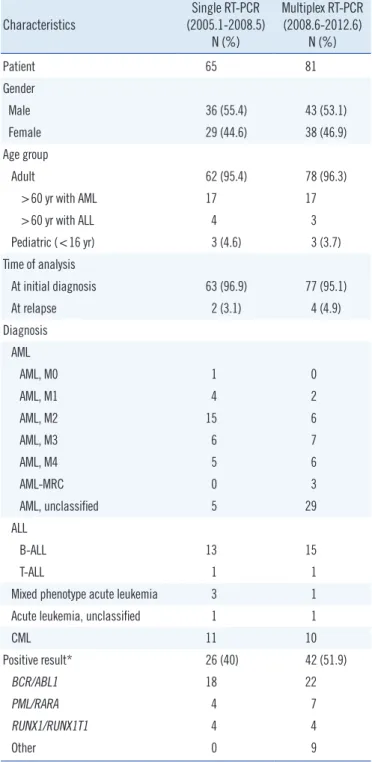
Characteristics of patients diagnosed with hematologic malig- nancies by single RT-PCR and multiplex RT-PCR are shown in
Received: October 9, 2012 Revision received: April 24, 2013 Accepted: May 16, 2013
Corresponding author: Tae Sung Park
Department of Laboratory Medicine, School of Medicine, Kyung Hee University, 23 Kyungheedae-ro, Dongdaemun-gu, Seoul 130-702, Korea Tel: +82-2-958- 8673, Fax: +82-2-958-8609, E-mail: [email protected] Co-Corresponding author: Hee Joo Lee
Department of Laboratory Medicine, School of Medicine, Kyung Hee University, 23 Kyungheedae-ro, Dongdaemun-gu, Seoul 130-702, Korea Tel: +82-2-958-8672, Fax: +82-2-958-8609, E-mail: [email protected]
© The Korean Society for Laboratory Medicine.
This is an Open Access article distributed under the terms of the Creative Commons Attribution Non-Commercial License (http://creativecommons.org/licenses/by-nc/3.0) which permits unrestricted non-commercial use, distribution, and reproduction in any medium, provided the original work is properly cited.
Kim MJ, et al.
Multiplex RT-PCR in hematologic malignancies
305
http://dx.doi.org/10.3343/alm.2013.33.4.304 www.annlabmed.org
Table 1. There were 65 patients who were diagnosed using sin- gle RT-PCR. Two of these patients who were initially diagnosed with AML and ALL, respectively, experienced relapse and were
subsequently given the same diagnosis. In terms of diagnostic outcomes, AML was the most frequently diagnosed hematologic malignancy (36 cases). Further, there were 14 cases of ALL (13 B-cell [B-ALL] and 1 T-cell [T-ALL]), 3 cases of MPAL, 1 case of unclassified acute leukemia due to unavailability of a bone mar- row biopsy specimen (peripheral blood test was subsequently conducted), and 11 cases of CML. Using multiplex RT-PCR, we detected hematologic malignancies in 81 patients. Among them, 77 were found to be ill on initial diagnosis and 4 experienced re- lapses. Among the patients who experienced relapse, 2 with AML and ALL, respectively, received the same diagnosis before and after relapse. The remaining 2 patients were diagnosed with AML at their second relapse. Similarly, AML was found to be the most frequently diagnosed hematologic malignancy (53 cases) using multiplex RT-PCR. Further, there were 16 cases of ALL (15 B-ALL and 1 T-ALL), 1 case of MPAL, 1 case of unclassified acute leukemia due to unavailability of a bone marrow biopsy specimen (peripheral blood test was subsequently conducted), and 10 cases of CML. Translocations were detected in 40% (26/65) of the patients by single RT-PCR and 51.9% (42/81) of the patients by multiplex RT-PCR. For statistical analysis, chi- square test was conducted using SPSS version 19.0 (SPSS Inc., Chicago, IL, USA). However, no statistically significant difference was observed in the positivity rate between the 2 groups of pa- tients (P =0.154).
Single RT-PCR detected 18 cases of BCR/ABL1 gene rear- rangement, 4 cases of RUNX1/RUNX1T1 gene rearrangement, and 4 cases of PML/RARA gene rearrangement. In contrast, 22 cases of BCR/ABL1 gene rearrangement, 7 cases of PML/RARA gene rearrangement, 4 cases of RUNX1/RUNX1T1 gene rear- rangement, 3 cases of CBFB/MYH11 gene rearrangement, 2 cases of ETV6/RUNX1 gene rearrangement, 1 case of MLL/ELL gene rearrangement, 1 case of MLL/MLLT3 gene rearrange- ment, 1 case of RUNX1/MDS1/EVI1 gene rearrangement, and 1 case of NPM1/MLF1 gene rearrangement were detected by multiplex RT-PCR analysis. While single RT-PCR was only able to detect 3 frequently reported gene rearrangements (RUNX1/ RUNX1T1, PML/RARA, and BCR/ABL1), multiplex RT-PCR identified several other types of gene rearrangement, including a rare NPM1/MLF1 rearrangement. To the best of our knowl- edge, this is the first time this type of rearrangement has been detected and reported in Korea [3]. Apart from the 28 different translocations it can identify, the HemaVision kit (DNA Technol- ogy) can also effectively detect more than 80 breakpoints. Be- cause the HemaVision kit can easily detect atypical breakpoints in BCR/ABL1, we were able to identify a unique e8a2 fusion Table 1. Characteristics of patients diagnosed with hematologic
malignancies by single and multiplex RT-PCR analysis
Characteristics Single RT-PCR (2005.1-2008.5)
N (%)
Multiplex RT-PCR (2008.6-2012.6)
N (%)
Patient 65 81
Gender
Male 36 (55.4) 43 (53.1)
Female 29 (44.6) 38 (46.9)
Age group
Adult 62 (95.4) 78 (96.3)
>60 yr with AML 17 17
>60 yr with ALL 4 3
Pediatric (<16 yr) 3 (4.6) 3 (3.7)
Time of analysis
At initial diagnosis 63 (96.9) 77 (95.1)
At relapse 2 (3.1) 4 (4.9)
Diagnosis AML
AML, M0 1 0
AML, M1 4 2
AML, M2 15 6
AML, M3 6 7
AML, M4 5 6
AML-MRC 0 3
AML, unclassified 5 29
ALL
B-ALL 13 15
T-ALL 1 1
Mixed phenotype acute leukemia 3 1
Acute leukemia, unclassified 1 1
CML 11 10
Positive result* 26 (40) 42 (51.9)
BCR/ABL1 18 22
PML/RARA 4 7
RUNX1/RUNX1T1 4 4
Other 0 9
*Chi-square statistical analysis revealed no significant difference between patients assessed by single RT-PCR or multiplex RT-PCR (χ2=2.036, P = 0.154).
Abbreviations: RT, reverse transcriptase; MRC, myelodysplasia-related chang- es.
Kim MJ, et al.
Multiplex RT-PCR in hematologic malignancies
306 www.annlabmed.org http://dx.doi.org/10.3343/alm.2013.33.4.304 transcript that has not yet been reported in B-ALL cases [4].
Single RT-PCR produced negative results for 3 cases that were subsequently tested positive after cytogenetic analysis (Ta- ble 2); 2 of these cases showed translocations at inv(16) and t(4;11). If these patients had undergone testing using multiplex RT-PCR, CBFB/MYH11 or MLL/AFF1 gene rearrangements may have been detected. Considering how many clinically important hematologic malignancy-related fusion genes and translocations are being reported [5], and because chromosome abnormalities affect the prognosis of diseases other than leukemogenesis, prompt detection of genetic changes is imperative.
In this study, ETV6/RUNX1 gene rearrangements were de- tected in 2 cases of B-ALL with normal karyotypes using multi- plex RT-PCR (Table 3). FISH results showed ETV6/RUNX1 gene rearrangements in 55.8% and 80.7% of specimens analyzed.
ETV6/RUNX1 is known to be the most common molecular ge- netic abnormality and is found in about 20-25% of pediatric cases of B-ALL [6]. However, as a cryptic translocation, ETV6/ RUNX1 is difficult to detect with conventional cytogenetics and therefore requires RT-PCR or FISH as a parallel test [7]. The study also found a case of MLL/ELL gene rearrangements with a normal karyotype (Table 3). Although R-banding can identify where chromosome 11 is enlarged, a MLL/ELL abnormality can be mistaken for a normal karyotype under G-banding [8].
Therefore, RT-PCR or FISH would be necessary to confirm cyto- genetic analysis results. Multiplex RT-PCR by HemaVision (DNA Technology) is limited by the fact that it can only detect about
10 out of 70 known MLL partner gene types [9-11]. In order to enhance the sensitivity of gene abnormality detection in patients with hematologic malignancies but normal karyotypes, multiplex RT-PCR kits should be further developed to detect additional types of MLL gene rearrangements.
This study is limited in that a small number of hematologic malignancy cases were included; moreover, only a few of the patients analyzed had positive PCR results. Further, this was a retrospective analysis; here, a comparison was made between different individuals who visited our institution during different periods, and the methods of single RT-PCR or multiplex RT-PCR were used separately.
In conclusion, a combination of multiplex RT-PCR and con- ventional cytogenetics should be considered the routine proce- dure for the diagnosis of hematologic malignancies. Multiplex RT-PCR panels should be developed to increase diagnostic ca- pability and treatment effectiveness for hematologic malignan- cies.
REFERENCES
1. Swerdlow SH, Campo E, et al. eds. WHO classification of tumours of haematopoietic and lymphoid tissues. 4th ed. Lyon: IARC Press, 2008. 2. King RL, Naghashpour M, Watt CD, Morrissette JJ, Bagg A. A compara-
tive analysis of molecular genetic and conventional cytogenetic detec- tion of diagnostically important translocations in more than 400 cases of acute leukemia, highlighting the frequency of false-negative conven- tional cytogenetics. Am J Clin Pathol 2011;135:921-8.
3. Lim G, Choi JR, Kim MJ, Kim SY, Lee HJ, Suh JT, et al. Detection of Table 2. Translocation cases with negative single RT-PCR results
No. Case Sex Age (yr) Single RT-PCR* Chromosome FISH Diagnosis
1 M 38 ND 46,XY,add(9)(p24),t(10;11)(p13;q21)
[19]/46,XY[10] NT AML
2 M 76 ND 46,XY,inv(16)(p13.1q22)[15]/46,XY[5] nuc ish (CBFB*2)(5'CBFB sep 3'CBFB*1)
[171/231] AML
3 F 1 ND 46,XX,t(4;11)(q21;q23)[10]/46,XX[6] NT Acute leukemia†
*Single RT-Nested PCR only used RUNX1/RUNX1T1, PML/RARA, and BCR/ABL1 related primers; †Peripheral blood was used for this patient since a bone marrow biopsy specimen was not available.
Abbreviations: RT, reverse transcriptase; F, female; M, male; ND, not detected; NT, not tested.
Table 3. Discrepancy between cytogenic analysis and multiplex RT-PCR results
No. Case Sex Age (yr) Multiplex RT-PCR Chromosome FISH Diagnosis
1 M 3 ETV6/RUNX1* 46,XX[15] nuc ish(TELx2),(AML1x3)(TEL con AML1x1)[119/213] ALL
2 M 3 ETV6/RUNX1* 46,XY[20] nuc ish 12p13(TELx3),21q22(AML1x4)(TEL con AML1x2)[133/207]
nuc ish 12p13(TELx2),21q22(AML1x3)(TEL con AML1x1)[34/207] ALL
3 F 64 MLL/ELL 46,XX[20] nuc ish(MLLx2)(5'MLL sep 3'MLLx1)[167/220] AML
*ETV6/RUNX1 is the new abbreviation for TEL/AML1, as provided by the HUGO Gene Nomenclature Committee [12].
Abbreviations: RT, reverse transcriptase; F, female; M, male.
Kim MJ, et al.
Multiplex RT-PCR in hematologic malignancies
307
http://dx.doi.org/10.3343/alm.2013.33.4.304 www.annlabmed.org
t(3;5) and NPM1/MLF1 rearrangement in an elderly patient with acute myeloid leukemia: clinical and laboratory study with review of the litera- ture. Cancer Genet Cytogenet 2010;199:101-9.
4. Kim MJ, Yoon HJ, Park TS. The e8a2 fusion transcript in B lymphoblas- tic leukemia with BCR-ABL1 rearrangement. Korean J Hematol 2012; 47:161.
5. Mitelman F, Mertens F, Johansson B. Prevalence estimates of recurrent balanced cytogenetic aberrations and gene fusions in unselected pa- tients with neoplastic disorders. Genes Chromosomes Cancer 2005; 43:350-66.
6. Jamil A, Theil KS, Kahwash S, Ruymann FB, Klopfenstein KJ. TEL/AML- 1 fusion gene. its frequency and prognostic significance in childhood acute lymphoblastic leukemia. Cancer Genet Cytogenet 2000;122:73-8. 7. Kim SR, Kim HJ, Kim SH. Clinical utility of fluorescence in-situ hybrid-
ization profile test in detecting genetic aberrations in acute leukemia.
Korean J Lab Med 2009;29:371-8.
8. Huret JL. t(11;19)(q23;p13.1). Atlas Genet Cytogenet Oncol Haematol 1997;1:102-3. http://AtlasGeneticsOncology.org/Anomalies/t1119ELL.
html
9. Park TS, Lee SG, Song J, Lee KA, Kim J, Choi JR, et al. CASP8AP2 is a novel partner gene of MLL rearrangement with t(6;11) (q15;q23) in acute myeloid leukemia. Cancer Genet Cytogenet 2009;195:94-5.
10. Kim MJ, Choi JR, Suh JT, Lee HJ, Lee WI, Park TS. Diagnostic stan- dardization of leukemia fusion gene detection system using multiplex reverse transcriptase-polymerase chain reaction in Korea. J Korean Med Sci 2011;26:1399-400.
11. Yang JJ, Marschalek R, Meyer C, Park TS. Diagnostic usefulness of ge- nomic breakpoint analysis of various gene rearrangements in acute leu- kemias: a perspective of long distance- or long distance inverse-PCR- based approaches. Ann Lab Med 2012;32:316-8.
12. Shaffer LG, Slovak ML, et al. eds. ISCN (2009): an international system for human cytogenetic nomenclature. Basel: S. Karger, 2009.