ISSN 2234-3806 • eISSN 2234-3814
454 www.annlabmed.org https://doi.org/10.3343/alm.2017.37.5.454 Ann Lab Med 2017;37:454-456
https://doi.org/10.3343/alm.2017.37.5.454
Letter to the Editor
Clinical Microbiology
Persistence of Group B Streptococcus in the Urogenital Area
Won-Hee Choi, Ph.D.1, Hyun-Woong Park, M.D.2, and Sunjoo Kim, M.D.2,3
Department of Nursing Science1, Kyungsung University, Busan; Department of Laboratory Medicine2, Changwon Gyeongsang National University Hospital, Changwon; Department of Laboratory Medicine3, Gyeongsang Institute of Health Sciences, Gyeongsang National University School of Medicine, Jinju, Korea
Dear Editor,
Early onset neonatal infections might be due to transmission from the maternal vaginal carriage of group B streptococcus (GBS) [1]. Urinary GBS suggests a heavy load of GBS [2]. Persistence of GBS in the urogenital area is not clearly understood and may cause recurrent infections. The aim of this study was to investi- gate how long GBS remains in the urogenital tract.
The study involved 14 patients whose urine (n=9) and vagi- nal swab (n=5) repeatedly tested positive for GBS throughout 2011–2015. The interval between the first and second isolation ranged from two to 40 months for urine and from two to six months for vaginal swabs. Intervals of less than two months were exclud ed.
The vaginal swabs were taken from pregnant women for preterm screening of GBS. Bacterial identification and antimicrobial sus- ceptibility test were performed by using the Vitek-2 system (bio- Merieux Inc., Marcy l’Etoile, France).
Multilocus sequence typing (MLST) was performed according to previous reports for the collected isolates [3]. Briefly, bacterial DNA was extracted by using the GENEDIA Mycobacteria DNA Prep Kit (Green Cross Medical Science, Eumseng, Korea), and PCR was conducted for seven housekeeping genes with the Ac- cuPower Taq PCR PreMix (Bioneer, Daejeon, Korea). DNA se- quencing was performed at Macrogen Inc. (Seoul, Korea) using a dye-terminator method. Allocation of each allele and sequence
type (ST) was assigned by using https://pubmlst.org/ [4]. This study was exempted from the approval by the institutional re- view board of Changwon Gyeongsang National University Hos- pital, Korea.
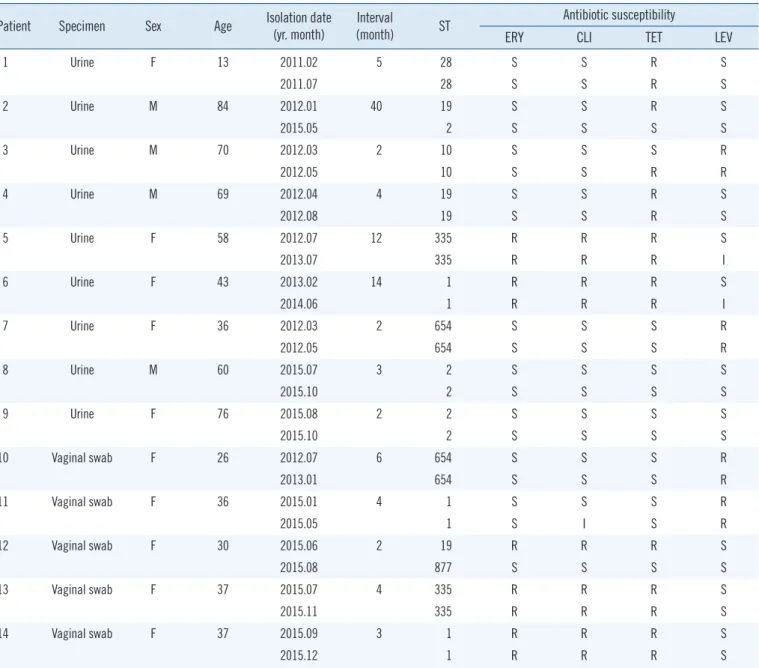
None of the isolates were resistant to ampicillin, penicillin-G, ceftriaxone, co-trimoxazole, linezolid, or vancomycin. Therefore, susceptibility to erythromycin, clindamycin, tetracycline, and le- vofloxacin was compared between the first and second isolations (Table 1). Of the isolates from the 14 patients, those of patients 2 and 3 showed a change in susceptibility to tetracycline, while those of patient 12 showed a change in susceptibility to erythro- mycin, clindamycin, and tetracycline.
Seven different STs were identified among the first isolates of the 14 patients. ST1 and ST19 were the most common (n=3), followed by ST2, ST335, ST654 (n =2), and ST10 and ST28 (n=1) (Table 1). Interestingly, only patients with ST19 exhibited different STs in their second specimen (patient 2, ST2 in the urine; patient 12, ST877 in the vaginal swab), whereas the other patients demonstrated the same ST. The allele combination of the seven housekeeping genes (adhP, pheS, atr, glnA, sdhA, glcK, and tkt) was 1-1-3-2-2-2-2 for ST19, 1-1-3-1-1-2-2 for ST2, and 166-1-2-1-1-2-2 for ST877. The interval of patient 2 was 40 months, and that of patient 12 was two months. The longest interval with the same ST was 14 months (patient 6) in
Received: March 16, 2017 Revision received: April 19, 2017 Accepted: June 8, 2017
Corresponding author: Sunjoo Kim
Department of Laboratory Medicine, Changwon Gyeongsang National University Hospital, 11 Samjungja-ro, Seongsan-gu, Changwon 51472, Korea
Tel: +82-55-214-3072, Fax: +82-55-214-3087 E-mail: [email protected]
© Korean Society for Laboratory Medicine.
This is an Open Access article distributed under the terms of the Creative Commons Attribution Non-Commercial License (http://creativecommons.org/licenses/by-nc/4.0) which permits unrestricted non-commercial use, distribution, and reproduction in any medium, provided the original work is properly cited.
1 / 1 CROSSMARK_logo_3_Test
2017-03-16 https://crossmark-cdn.crossref.org/widget/v2.0/logos/CROSSMARK_Color_square.svg
Choi W-H, et al.
Urogenital persistence of GBS
https://doi.org/10.3343/alm.2017.37.5.454 www.annlabmed.org 455
Table 1. Isolation interval, sequence type (ST), and antibiogram of repeatedly isolated group B streptococci in urine and vaginal swabs Patient Specimen Sex Age Isolation date
(yr. month) Interval
(month) ST Antibiotic susceptibility
ERY CLI TET LEV
1 Urine F 13 2011.02 5 28 S S R S
2011.07 28 S S R S
2 Urine M 84 2012.01 40 19 S S R S
2015.05 2 S S S S
3 Urine M 70 2012.03 2 10 S S S R
2012.05 10 S S R R
4 Urine M 69 2012.04 4 19 S S R S
2012.08 19 S S R S
5 Urine F 58 2012.07 12 335 R R R S
2013.07 335 R R R I
6 Urine F 43 2013.02 14 1 R R R S
2014.06 1 R R R I
7 Urine F 36 2012.03 2 654 S S S R
2012.05 654 S S S R
8 Urine M 60 2015.07 3 2 S S S S
2015.10 2 S S S S
9 Urine F 76 2015.08 2 2 S S S S
2015.10 2 S S S S
10 Vaginal swab F 26 2012.07 6 654 S S S R
2013.01 654 S S S R
11 Vaginal swab F 36 2015.01 4 1 S S S R
2015.05 1 S I S R
12 Vaginal swab F 30 2015.06 2 19 R R R S
2015.08 877 S S S S
13 Vaginal swab F 37 2015.07 4 335 R R R S
2015.11 335 R R R S
14 Vaginal swab F 37 2015.09 3 1 R R R S
2015.12 1 R R R S
Abbreviations: ERY, erythromycin; CLI, clindamycin; TET, tetracycline; LEV, levofloxacin; S, susceptible; I, intermediate; R, resistant.
All isolates were susceptible to ampicillin, penicillin-G, ceftriaxone, co-trimoxazole, linezolid, and vancomycin.
urine and six months (patient 10) in the vaginal swab.
Recurrence of GBS colonization has been reported to be sig- nificantly higher during the subsequent pregnancies of women with prior GBS positivity (53%) than in controls (15%) [5], sug- gesting that GBS persists in the urogenital area for a few years.
A previous study examining the dynamics of recto-vaginal GBS colonization during pregnancy by pulsed-field gel electrophore- sis (PFGE) showed that genomic DNA was stable for repeated isolations from the same person throughout a 1.6-yr period; dif- ferent genomic DNA was found between patients [6]. Twelve
(85.7%) out of 14 patients showed the same STs in this study.
This might be due to differences in study methodology: PFGE vs MLST. Another study monitoring ST genotypic diversity and se- rotype distribution pre- and post-delivery reported that a change of ST or serotype occurred in 18.3% (23/126) during a six-week period [6]. Although very few subjects participated in the cur- rent study, the frequency of ST change was 7.7% (1/13) within 14 months. Change of ST commonly occurred in ST1 (6/13) or ST23 (4/13) in a previous study [3], whereas in our study, it was observed in ST19. Therefore, certain STs may not be predisposed
Choi W-H, et al.
Urogenital persistence of GBS
456 www.annlabmed.org https://doi.org/10.3343/alm.2017.37.5.454 to change. As expected, different STs were identified after 40
months in urine (patient 2). In another study, 3/8 (37%) patients showed a different serotype between the urinary isolates in the first trimester and vaginal isolates in the third trimester [7].
In contrast to ST, the antibiogram did not provide complete discrimination. Although there was a change in susceptibility to tetracycline (S -> R, patient 3), the ST remained the same. Con- sidering the difference in allocated alleles, different STs in the first and second specimens appear to be due to the acquisition of a new strain rather than the evolution of the previous type.
In conclusion, we observed that GBS may persist for at least 14 months in the urogenital tract. The frequency of change of the strain was 7.7% (1/13) during that period.
Authors’ Disclosures of Potential Conflicts of Interest
No potential conflicts of interest relevant to this article were re- ported.
REFERENCES
1. Melin P. Neonatal group B streptococcal disease: from pathogenesis to preventive strategies. Clin Microbiol Infect 2011;17:1294-303.
2. Ulett KB, Benjamin WH Jr, Zhuo F, Xiao M, Kong F, Gilbert GL, et al. Di- versity of group B streptococcus serotypes causing urinary tract infec- tion in adults. J Clin Microbiol 2009;47:2055-60.
3. Public database for molecular typing and microbial genome diversity (PubMLST), Streptococcus agalactiae (group B streptococcus, GBS) MLST databases. http://www.pubmlst.org/sagalactiae/ (Updated in May 2017).
4. Turrentine MA and Ramirez MM. Recurrence of group B streptococci colonization in subsequent pregnancy. Obstet Gynecol 2008;112:259- 64.
5. Hansen SM, Uldbjerg N, Kilian M, Sørensen UB. Dynamics of Strepto- coccus agalactiae colonization in women during and after pregnancy and in their infants. J Clin Microbiol 2004;42:83–9.
6. Manning SD, Lewis MA, Springman AC, Lehotzky E, Whittam TS, Davies HD. Genotypic diversity and serotype distribution of group B streptococ- cus isolated from women before and after delivery. Clin Infect Dis 2008;
46:1829-37.
7. McKenna DS, Matson S, Northern I. Maternal group B streptococcal (GBS) genital tract colonization at term in women who have asymptom- atic GBS bacteriuria. Infect Dis Obstet Gynecol 2003;11:203-7.