Abstract
In this study, a MEMS microphone that uses Si
3N
4as the vibration membrane was produced for application as an auditory device using a sound visualization technique (sound visualization) for the hearing impaired. Two sheets of 6-inch silicon wafer were each fabricated into a vibration membrane and back plate, after which, wafer bonding was performed. A certain amount of charge was created between the bonded vibration membrane and the back plate electrodes, and a MEMS microphone that functioned through the capacitive method that uses change in such charge was fabricated. In order to evaluate the characteristics of the prepared MEMS microphone, the frequency flatness, frequency response, properties of phase between samples, and directivity according to the direction of sound source were analyzed. The MEMS microphone showed excellent flatness per fre- quency in the audio frequency (100 Hz–10 kHz) and a high response of at least −42 dB (sound pressure level). Further, a stable differential phase between the samples of within −3 dB was observed between 100 Hz–6 kHz. In particular, excellent omni- directional properties were demonstrated in the frequency range of 125 Hz–4 kHz.
Keywords: MEMS, Microphone, Phase, Directionality
1. INTRODUCTION
Recently, the demand for multifunctionality, high-functionality, size reduction, and thickness reduction of mobile devices has become an important factor in determining the value of a product.
Among the technologies available for realizing such demands, the microelectromechanical systems (MEMS) technique, which reduces the sizes of the components, is receiving attention [1].
MEMS technology is based on the fine machining techniques of semiconductors and has high reliability because it makes it possible to machine actuators, sensors, and other components with high accuracy, integrate them with the integrated circuits, and use materials such as crystal silicon [2-4].
For small-sized microphones, the current technology is mainly electret condenser microphones (ECMs) [5,6]. The ECM structure consists of a vibration membrane and fixed electrode forming a
capacitor. Because the ECM uses the electret device, there is no need for an external voltage supply. However, the electret device has poor heat resistance and low response to acoustic pressure.
The temperature in which stable response and frequency properties are realized is between -20
oC and 80
oC.
The recently developed MEMS microphone uses MEMS technology; thus, there is no need for electrets, and the smallest sensor chip in the world is used [7-10]. This MEMS microphone has excellent heat resistance, and when mounted, stability can be improved and cost can be reduced. In this study, the microphone prepared through the MEMS design and production process was integrated on a circuit board together with a complementary metal oxide semiconductor (CMOS) signal amplifier, after which the device was completed through the packaging process. Then, the mechanical properties and electrical response characteristics were measured and directive properties evaluated for the completed device.
2. EXPERIMENT AND RESULTS
2.1 Design of the MEMS Microphone
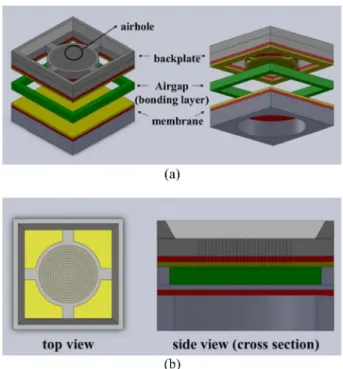
The capacitive-type MEMS microphone is composed of a vibration membrane electrode and a back plate electrode that maintain a certain distance in between [11-13]. As shown in Fig. 1, if the
1
Korea Institute of Machinery & Materials, 156 Gajeongbuk-Ro, Yuseong-gu, Daejeon, 305-343, Korea.
2
School of Electronics Engineering, Kyungpook National University, Daehakro, Bukgu, Daegu, 702-701, Korea.
+