Corresponding author: Jae-Ki Ryu
Department of Biomedical Laboratory Science, Gimcheon University, 214 Daehak-ro, Gimcheon 39528, Korea
E-mail: [email protected]
ORCID: https://orcid.org/0000-0001-5055-4018
ORIGINAL ARTICLE
Effects of Dietary Yogurt: Changes in Blood Components on Healthy Men Smokers
Hyun-Kyung Kim, Chang-Oh Kweon, Byung-Won Kim, Soo-Hwan Kim, Jae-Ki Ryu
Department of Biomedical Laboratory Science, College of Nursing and Health Science, Gimcheon University, Gimcheon, Korea
식이 요거트의 효과: 흡연남성에게서 요거트에 의한 혈액성분의 변화
김현경, 권창오, 김병원, 김수환, 류재기
김천대학교 임상병리학과
ARTICLE INFO ABSTRACT
Received March 27, 2020 Revised 1
stMay 22, 2020 Revised 2
ndJune 3, 2020 Accepted June 5, 2020
Smoking is associated with increased inflammation and is a risk factor for a range of diseases.
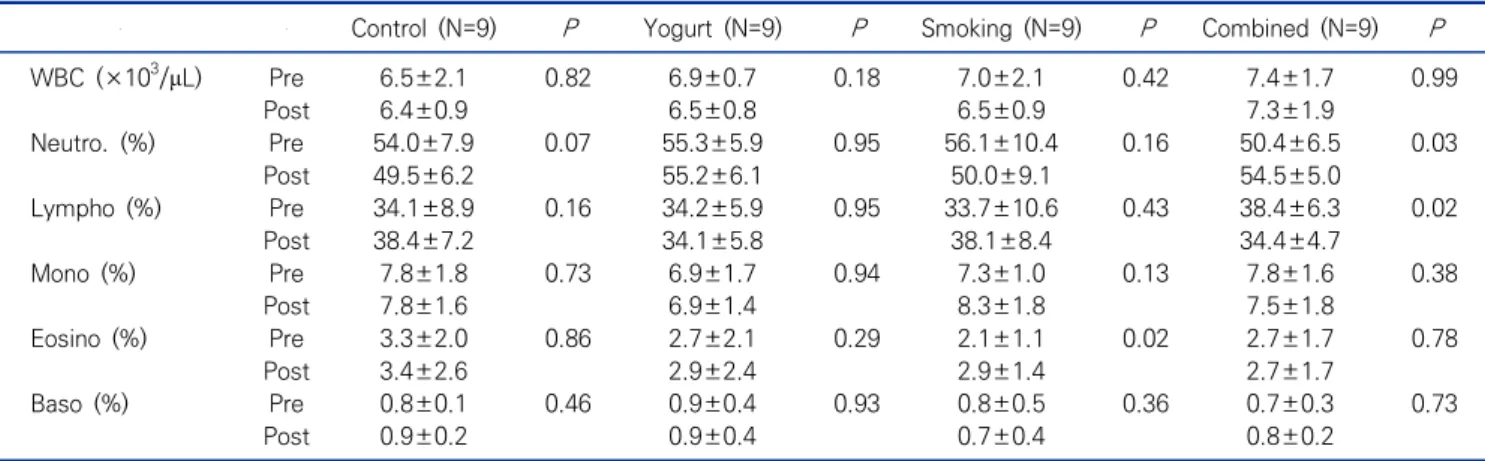
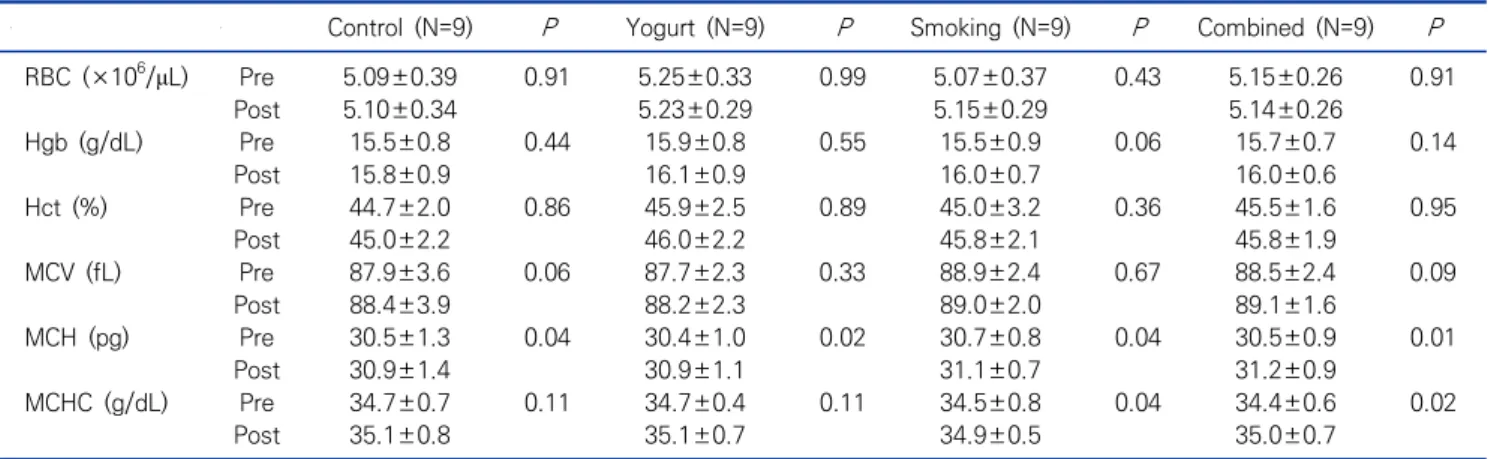
Conversely, yogurt has beneficial effects on health. This study examined the effects of yogurt consumption on the hematological parameters and fibrinogen levels in smokers. The participants were categorized into four groups. Non-smokers were assigned to the control and yogurt groups while smokers were assigned to the smoking and combined (yogurt plus smoking) groups. The participants consumed yogurt, and either smoked or did not smoke for three weeks. The changes in hematological parameters and fibrinogen levels were examined. In the combined group, the proportion of neutrophils and fibrinogen levels increased significantly, whereas the lymphocyte proportion decreased. The eosinophil proportion increased significantly in the Smoking group, but no change was observed in the combined group. In addition, the mean corpuscular hemoglobin concentration increased in the smoking and combined groups, indicating that smoking may affect the lifespan of red blood cells. In conclusion, this study showed that yogurt consumption might influence the immune function by modulating the levels of neutrophils, lymphocytes, and fibrinogen in smokers. Furthermore, the absence of any increase in the eosinophil proportion in the combined group, unlike in the smoking group, suggests that yogurt consumption may have an inhibitory effect on allergic reactions.
Copyright Ⓒ 2020 The Korean Society for Clinical Laboratory Science. All rights reserved.
Key words Fibrinogen Immune Smoker White blood cells Yogurt
INTRODUCTION
Blood is a sensitive marker for various changes that occur in response to physiological and pathological conditions [1], therefore, investigations into hematological changes are critical in the diagnosis of diseases.
Cigarette smoke contains more than 7,000 chemicals, including various oxidizing agents [2]. Smoking is associated with the occurrence of hypertension and inflammation, and is a risk factor for diseases including cancer and cardiovascular diseases [3-5]. Fibrinogen is a plasma glycoprotein that plays a role in the coagulation system. Fibrinogen levels in the blood increases during inflammatory responses, it is a known proinflammatory mediator already used as a marker of arterial thrombosis [1]. Several studies have investigated
Korean Society for Clinical Laboratory Science