Korean Journal of Pediatric Urology Vol 1, No. 2: 105-108, 2009
105
ORIGINAL ARTICLE
Urodynamic Evaluation in Patients with Anorectal Malformation: According to Spinal Cord Abnormalities
Kyung Hwa Choi, Kwang Hyun Kim, Young Jae Im, Chang Hee Hong, Sang Won Han
From the Department of Urology, Urological Science Institute, Yonsei University College of Medicine, Seoul, Korea
최경화ㆍ김광현ㆍ임영재 홍창희ㆍ한상원
연세대학교 의과대학 비뇨기과학교실 비뇨의과학연구소
Purpose: Anorectal malformation (ARM) is often accompanied by spinal cord abnormality or neurovesical dysfunction. However, only a few stud- ies have comparatively assessed spinal cord abnormality and urodynamic data. We evaluated the effect of spinal cord abnormalities on perioper- ative neurovesical dysfunction and investigated the necessity of urody- namic study in patients with ARM.
Materials and Methods: From 1993 to 2007, 219 patients with ARM were newly diagnosed at our institution; A retrospective study was con- ducted on 20 patients who underwent preoperative and postoperative ur- odynamic examinations.
Results: Of 20 patients, 10 had abnormal spinal cords. Fourteen (70%) presented abnormal urodynamic findings (detrusor overactivity, dysfunc- tional voiding, detrusor sphincter dyssynergia, combined overactivity and dyssynergia, or detrusor acontractility). Preoperative urodynamic abnor- malities were reported in 6 of 10 patients with abnormal spinal cords and 8 of 10 patients with normal spinal cords. New postoperative urodynamic abnormalities were reported in 2 patients in the abnormal spinal cord group, while 2 preoperative cases were resolved. In the normal spinal cord group, 2 preoperative cases were converted to other forms of urody- namic abnormality.
Conclusions: We advocate routine preoperative and follow-up urody- namic assessment of all patients with anorectal malformation, regardless of spinal cord abnormality.
Key Words: Urodynamics, Anorectal malformation, Spinal cord abnormality, Neurovesical dysfunction
교신저자 한상원
연세대학교 의과대학 비뇨기과학교실
서울시 서대문구 성산로 250, 120-752
Tel: 02-2228-2316 Fax: 02-312-2538 E-mail: [email protected]
INTRODUCTION
Lower urinary tract function is often disturbed in patients with anorectal abnormalities. Anorectal malformation (ARM) has been associated with spinal cord abnormality and neu- rovesical dysfunction (NVD).1,2 A significant proportion of ARM patients also have associated urologic abnormalities, which include vesicoureteral reflux (VUR), hydronephrosis,
and renal agenesis.3 Typically, patients require third-stage operations including pelvic surgery to correct ARM. Pelvic and perineal surgery may damage the nerve supply of the genitourinary tract and pelvic floor muscles, resulting in functional problems of the lower urinary tract.4 It has been suggested that lower urinary tract dysfunction occurs pri- marily in patients with spinal cord abnormalities.5-7 Some patients, however, may have abnormal urodynamic results before or after the operation, despite having a normal spine.
106 Korean Journal of Pediatric Urology Vol. 1, 105-108, 2009
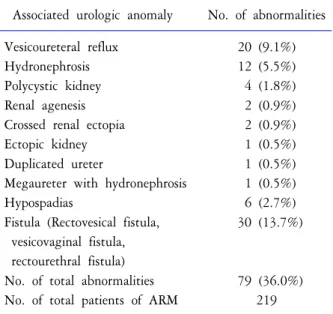
Table 1. Associated urologic abnormalities
Associated urologic anomaly No. of abnormalities
Vesicoureteral reflux 20 (9.1%)
Hydronephrosis 12 (5.5%)
Polycystic kidney 4 (1.8%)
Renal agenesis 2 (0.9%)
Crossed renal ectopia 2 (0.9%)
Ectopic kidney 1 (0.5%)
Duplicated ureter 1 (0.5%)
Megaureter with hydronephrosis 1 (0.5%)
Hypospadias 6 (2.7%)
Fistula (Rectovesical fistula, 30 (13.7%) vesicovaginal fistula,
rectourethral fistula)
No. of total abnormalities 79 (36.0%) No. of total patients of ARM 219
Few studies have focused on the incidence of perioperative neurovesical dysfunction. Therefore, we have evaluated the effect of spinal cord abnormalities on perioperative NVD in patients with ARM.
MATERIALS AND METHODS
The study included 219 patients of anorectal anomalies who were treated between June 1993 and February 2007.
Among them, 79 patients (36.0%) were evaluated with as- sociated preoperative urological anomalies and postoperative voiding symptoms. After further investigation, 20 cases (9.1%) of vesicoureteral reflux and 12 cases (5.5%) of hyd- ronephrosis were noted. Further, 30 cases (13.7%) of fistula, including rectovesical fistula, vesicovaginal fistula, and re- ctourethral fistula, were also noted. Several cases of poly- cystic kidney (N=4), renal agenesis (N=2), crossed renal ectopia (N=2), ectopic kidney (N=1), duplicated ureter (N=1), megaureter with hydronephrosis (N=1), and hy- pospadias (N=6) were reported (Table 1).
Patients who did not show both preoperative and post- operative urodynamic results were excluded from the study.
We selected 4 females and 16 males (2 female cloacal mal- formation patients and other 18 imperforate anus patients) who were previously treated for anorectal anomalies at our institution. Among 18 imperforate anus patients, only 1
patient had intermediate type disease. Functional and urodynamic evaluation was performed on patients aged 1 month to 11 years (median age: 6 months). All patients underwent magnetic resonance imaging (MRI) of the spinal cord. MRI images were evaluated by a neuroradiologist blinded to patient functional status. The bony spine was also evaluated using conventional X-rays. Urodynamic investiga- tion was performed in all patients without sedation. Pre- catheterization uroflowmetry and postvoid residual urine were recorded. Abdominal and bladder pressure were measured with 6-or 8-Fr urethral catheter and rectal tube.
Subtracted detrusor pressure was measured simultaneously with pelvic floor electromyography using surface electrodes and computerized equipment. Bladder filling was performed with a separate 6- or 8-Fr urethral tube at a rate of 5-10 ml/min, which corresponds to 10% of estimated bladder ca- pacity. Pressure flow measurement was also conducted when the patient was able to cooperate.
To treat the underlying ARM, operations were performed according to the fundamentals described by Pena and Dev- ries.8 In this study, we present preoperative and postopera- tive urodynamic outcomes to find the effect of sacroperineal dissections and spinal cord lesions on the voiding function.
Based on such examinations, the data were classified as normal detrusor function, detrusor acontractility, detrusor overactivity, dysfunctional voiding for normal spinal cord patients and dyssynergia for neurovesical dysfunction patients, according to the definition of ICCS 2006.9
RESULTS
Spinal MRI showed pathological findings in 10 patients, including tethered cord, syringomyelia, and caudal regres- sion. The remaining 10 patients had normal spinal cords.
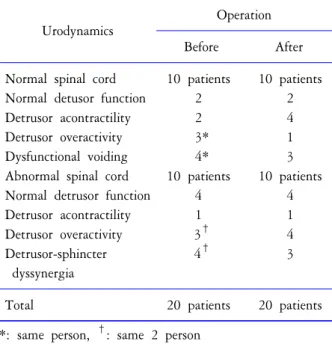
Table 2 lists the relationships between spinal cord status and urodynamic abnormalities preoperatively and post- operatively. The incidence of preoperative NVD in various forms was found to be 70% (14/20 patients); the remaining 30% (6/20 patients) had normal neurovesical function. In normal spinal cord group, 2 patients including a intermedi- ate type imperforate anus patient were diagnosed with normal detrusor function, 2 with detrusor overactivity, 1 with both detrusor overactivity and dysfunctional voiding,
Kyung Hwa Choi, et al: Urodynamic Evaluation in Patients with Anorectal Malformation 107
Table 2. Association of spinal cord abnormality and uro- dynamic finding before and after operation
Urodynamics
Operation
Before After
Normal spinal cord 10 patients 10 patients
Normal detusor function 2 2
Detrusor acontractility 2 4
Detrusor overactivity 3* 1
Dysfunctional voiding 4* 3
Abnormal spinal cord 10 patients 10 patients
Normal detrusor function 4 4
Detrusor acontractility 1 1
Detrusor overactivity 3† 4
Detrusor-sphincter 4† 3
dyssynergia
Total 20 patients 20 patients
*: same person, †: same 2 person
3 with dysfunctional voiding only and 2 with detrusor acontractility. In the abnormal spinal cord group, 4 cases of normal detrusor function, 1 of detrusor overactivity, 2 of combined detrusor overactivity and detrusor sphincter dyssynergia, 2 of detrusor sphincter dyssynergia and 1 of detrusor acontractility were reported. No significant dif- ference in the incidence of NVD was observed in patients who had undergone Pena operations. In the normal spinal cord group, preoperative 1 case of pure detrusor overactivity and 1 case of combined dysfunctional voiding and detrusor overactivity were each changed into postoperative detrusor acontractility. Intermediate type imperforate anus patient maintained normal detrusor function, postoperatively. In the abnormal spinal cord group, detrusor sphincter dyssynergia and detrusor overactivity were each newly found in 2 pa- tients, postoperatively who had normal preoperative uro- dynamics. On the other hand, another 2 patients with pre- operative detrusor sphincter dyssynergia recovered normal neurovesical function postoperatively.
DISCUSSION
Among patients with ARM, particularly in those with high-level variants, late diagnosis as well as late treatment
of lower urinary tract dysfunction caused by NVD often leads to the development of permanent upper urinary tract damage.5 Previously, it has been suggested that in most patients, lower urinary tract dysfunction in cases of anorectal anomalies is associated with sacral or spinal abnormalities.1 It has been also suggested that abnormal urodynamic find- ings are significantly related to sacral anomalies.5 However, our results show that the incidence of urodynamic abnor- malities in ARM patients with spinal cord abnormalities (6/10 patients) was not higher than that of patients with normal spinal cords (8/10 patients), and that abnormal urodynamic findings were not clearly associated with the state of the spine. But the small number of patients in the current study may have skewed the analysis. None the less, regardless of spinal cord problems, NVD should be dia- gnosed as early as possible, because our study shows that even in patients who did not have spinal cord abnormalities, the urodynamic result was abnormal to treat. In cases of pathological results following urodynamic examination, the further investigation and management for NVD should be done immediately.10
NVD after rectal surgery has been considerably described in the literature.11 Bladder denervation has been reported in patients with ARM after undergoing abdominoperineal pull- through operations, particularly in patients with high le- sions.12 During surgery for high cloacal malformations, re- ctoprostatic and rectovesical fistulas and bladder innervation are in close proximity to the surgical field, which may result in postoperative micturition disturbances.13 In patients with ARM, damage to the external vesical sphincter during lig- ation of rectourethral fistulas, iatrogenic injury to the sacral nerves during operation in the pelvis minor and associated malformations of the urogenital tract and vertebral column also play an important role in postoperative urinary incon- tinence and decreased urinary tract dysfunction.2,14,15 In the postoperative period, 70% (14 of 20) of patients had fea- tures of NVD. On comparing the preoperative and post- operative urodynamic findings, we found that 2 of 6 normal patients developed postoperative NVD, which might be attributed to iatrogenic nerve damage. However, delayed manifestation of NVD due to spinal cord abnormality can- not be excluded. Urodynamic values obtained preoperatively and postoperatively did not show significant difference, re-
108 Korean Journal of Pediatric Urology Vol. 1, 105-108, 2009
gardless of whether the surgery was combined with a major transabdominal procedure. But preoperative urodynamic re- sults is still important to predict a possibility of postopera- tive fecal incontinence.2 In view of the above findings, func- tional as well as structural evaluation of the lower urinary tract should be performed before and after surgery as well as throughout follow-up, regardless of the spinal cord ab- normality. Nevertheless, a larger study size is warranted in order to stratify ARM patients into subgroups according to the presence or absence of spinal defects.
CONCLUSIONS
The incidence of preoperative lower urinary tract dy- sfunction based on urodynamic evaluation is high in patients with ARM, even when no clinical or radiological evidence of spinal cord anomalies. This suggests that a normal spinal cord does not exclude dysfunction of the lower urinary tract in ARM patients. In view of the above findings, we advocate routine urodynamic assessment of patients with ARM during the preoperative as well as follow-up periods.
REFERENCES
1. Boemers TML, Beek FJA, van Gool JD, de Jong T, Bax KMA. Urologic problems in anorectal malformations. Part 1: Urodynamic findings and significance of sacral anomali- es. J Pediatr Surg 1996;31:407-10
2. Chung YH, Han SW, Lee T. Urologic aspect in the man- agement of VATER anomalies. Korean J Urol 1997;38:
1202-9
3. Taskinen S, Valanne L, Rintala R. Effect of spinal cord abnormalities on the function of the lower urinary tract in patients with anorectal abnormalities. J Urol 2002;168:
1147-9
4. Leveckis J, Boucher NR, Parys BT, Reed MW, Shorthouse AJ, Anderson JB. Bladder and erectile dysfunction before
and after rectal surgery for cancer. Br J Urol 1995;76:752 5. Boemers TML, Beek FJA, Bax NMA. Guidelines for the urological screening and initial management of lower uri- nary tract dysfunction in children with anorectal malforma- tions the ARGUS protocol. BJU Int 1999;83:662-71 6. Moon KH, Lee SK, Ra YS, Kim JB, Kim KS. The change
of bladder function after neurosurgery in patients with lip- omyelomeningocele. Korean J Urol 2007;48:452-7 7. Jung JH, Kim HW, Kim JW, Kim MJ, Kim CS, Jeon
HJ, et al. When should videourodynamic study be per- formed after correcting the defect in patients with my- elodysplasia? Korean J Urol 2006;47:522-6
8. Pena A, Devries PA. Posterior sagittal anorectoplasty:
Important technical considerations and new applications. J Pediatr Surg 1982;17:796
9. Neveus T, von Gontard A, Hoebeke P, Hjalmas K, Bauer S, Bower W, et al. The standardization of terminology of lower urinary tract function in children and adolescents:
report from the Standardisation Committee of the Inter- national Children's Continence Society. J Urol 2006;176:
314-24
10. Holmdahl G, Hanson E, Hanson M, Hellstrom AL, Hjalmas K, Sillen U. Four-hour voiding observation in healthy infants. J Urol 1996;156:1809-12
11. Chang PL, Fan HA. Urodynamic studies before and/or after abdominoperineal resection of the rectum for carci- noma. J Urol 1983;130:948
12. Holschneider AM, Kraeft H, Scholtissek C. Urodynamic investigations of bladder disturbances in imperforate anus and Hirschsprung's disease) (author's transl). Z Kinderchir 1982;35:64-8
13. Emir H, Soylet Y. Neurovesical dysfunction in patients with anorectal malformations. Eur J Pediatr Surg 1998;
8:95-7
14. Kumar A, Agarwala S, Mitra DK. Occult neurovesical dysfunction with anorectal malformations. Indian J Pediatr 2006;73:999-1003
15. Kiliç N, Emir H, Sander S, Eliçevik M, Celayir S, Söylet Y. Comparison of urodynamic investigations before and after posterior sagittal anorectoplasty for anorectal malfor- mations. J Pediatr Surg 1997;32:1724-7