• 검색 결과가 없습니다.

Successful Pre-Operative Local Control of Skin Invasion of Breast Cancer Using a Combination of Systemic Chemotherapy and Mohs Paste

N/A
N/A
Protected

Academic year: 2021

Share "Successful Pre-Operative Local Control of Skin Invasion of Breast Cancer Using a Combination of Systemic Chemotherapy and Mohs Paste"

Copied!
10
0
0

로드 중.... (전체 텍스트 보기)

전체 글

(1)

ABSTRACT

Locally advanced breast cancer (tumor > 5 cm, widespread infiltration of the skin and muscle, or metastases to lymph nodes) is difficult to resect by surgery, and even when it is resectable, there is a high probability of local recurrence and distant metastasis. Therefore, systemic therapy should be administered first. However, as cutaneous infiltration progresses, the patient's quality of life is impaired by pain, bleeding, presence of exudates, and a foul- smelling odor. Treatment with Mohs paste with systemic therapy can control symptoms associated with skin infiltration and can also be expected to decrease tumor volume.

Herein, we report a case in which a tumor was resected following Mohs paste and systemic chemotherapy administration, and the skin defect was reconstructed with a latissimus dorsi myocutaneous flap. We also review the literature for previously reported cases of breast cancer involving Mohs paste.

Keywords: Breast neoplasms; Drug therapy; General surgery; Myocutaneous flap; Zinc

INTRODUCTION

Locally advanced breast cancer with cutaneous infiltration can significantly impair a patient's quality of life (QOL) due to pain, bleeding, presence of exudates and a foul-smelling odor.

Patients with breast cancer have the highest prevalence of malignant wounds (47.1%) [1].

Such cases are often difficult to manage, and this condition can cause not only a decrease in the QOL due to a reduced motivation to engage in activities but also a decrease in motivation to continue treatment. Resection is performed as a symptomatic treatment if the general condition is good, but unfortunately, the risk of surgery is not associated with the survival rate. Radiation and chemotherapy may be effective, but it can take time for the effects to appear, and the symptoms may worsen due to disintegration. There have been reports of anti-cancer drug-containing ointments and antibacterial drug ointments, but their effects have not been established [2].

Case Report

Received: Jun 8, 2021 Revised: Sep 28, 2021 Accepted: Oct 15, 2021 Correspondence to Masahiro Takeuchi

Department of Surgery, Yamaguchi Rosai Hospital, 1315-4, Onoda, Sanyo-onoda, Yamaguchi 756-0095, Japan.

E-mail: [email protected]

© 2021 Korean Breast Cancer Society This is an Open Access article distributed under the terms of the Creative Commons Attribution Non-Commercial License (https://

creativecommons.org/licenses/by-nc/4.0/) which permits unrestricted non-commercial use, distribution, and reproduction in any medium, provided the original work is properly cited.

ORCID iDs Masahiro Takeuchi

https://orcid.org/0000-0002-3520-7402 Takefumi Katsuki

https://orcid.org/0000-0003-4775-5278 Kumiko Yoshida

https://orcid.org/0000-0002-1878-0055 Masahiko Onoda

https://orcid.org/0000-0003-2859-6216 Michinori Iwamura

https://orcid.org/0000-0001-8373-3020 Toshihiro Inokuchi

https://orcid.org/0000-0002-3983-3232 Akira Furutani

https://orcid.org/0000-0002-7631-0836

Masahiro Takeuchi

1,3

, Takefumi Katsuki

2,3

, Kumiko Yoshida

1

, Masahiko Onoda

1

, Michinori Iwamura

1,3

, Toshihiro Inokuchi

1

, Akira Furutani

1

, Tomoe Katoh

1

, Kazuaki Kawano

1

, Keiji Hirata

3

1

Department of Surgery, Yamaguchi Rosai Hospital, Yamaguchi, Japan

2

Department of Breast Surgery, Kitakyusyu General Hospital, Fukuoka, Japan

3
Department of Surgery 1, School of Medicine, University of Occupational and Environmental Health, Fukuoka, Japan

Successful Pre-Operative Local Control of Skin Invasion of Breast Cancer

Using a Combination of Systemic

Chemotherapy and Mohs Paste

(2)

Tomoe Katoh

https://orcid.org/0000-0003-0638-9005 Kazuaki Kawano

https://orcid.org/0000-0001-9523-5731 Keiji Hirata

https://orcid.org/0000-0001-6461-5109 Conflict of Interest

The authors declare that they have no competing interests.

Author Contributions

Conceptualization: Takeuchi M, Katsuki T, Iwamura M; Investigation: Takeuchi M, Katsuki T, Yoshida K, Onoda M, Iwamura M, Inokuchi T, Furutani A, Katoh T, Kawano K, Hirata K;

Supervision: Katoh T, Hirata K; Validation:

Takeuchi M; Visualization: Takeuchi M;

Writing - original draft: Takeuchi M, Katsuki T;

Writing - review & editing: Katsuki T, Iwamura M, Hirata K.

Mohs paste is a tissue fixative containing zinc chloride as the main component and is used in chemosurgery for malignant tumors of the skin [3]. It has been reported to be useful for improving symptoms and the QOL in patients with unresectable skin tumors, including metastasis [4-6]. Mohs paste has an immediate effect and is inexpensive. In addition, pain associated with chemical fixation can be controlled by the oral administration of non- steroidal anti-inflammatory drugs.

Recently, the use of Mohs chemosurgery has become widespread for the primary purpose of improving QOL. Mohs chemosurgery chemically fixes and removes lesions, such as skin cancer, and when performing a histopathological diagnosis of tissue samples, this procedure consists of a radical resection that repeats fixation, followed by the removal of the tumor until all traces of the tumor disappear on microscopic examinations. Compared to surgical resection, the procedure is simpler, less invasive, does not require special equipment, and can be performed even in cases where surgical resection is difficult [3,7].

Herein, we report a case of a locally advanced breast cancer in which the patient underwent radical surgery with reconstruction by a latissimus dorsi musculocutaneous flap after a combination of systemic therapy and Mohs paste and review currently published cases of Mohs paste being used to treat breast cancer patients along with a discussion of the clinical characteristics, treatment, and surgical indications to improve the QOL of breast cancer presenting with malignant wounds.

CASE REPORT

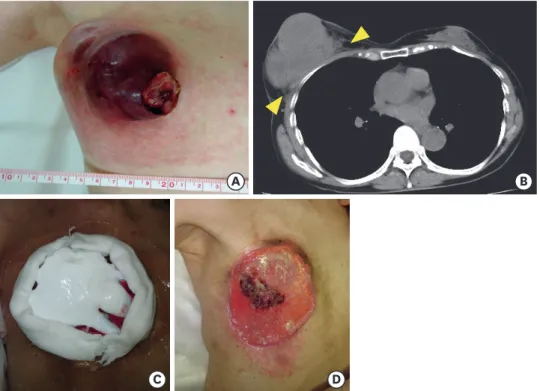
A 64-year-old woman visited our hospital complaining of a right breast mass with pain, bleeding and exudates and was foul-smelling. She had been aware of bleeding from the nipple for the past nine months. On admission, the mass was 13 cm in diameter, measured laterally from the nipple, and included the central portion of the breast. Skin infiltration and fixation of the chest wall were observed (Figure 1A). The hard axillary lymph nodes were palpable. Some tumor markers showed abnormal values, including carbohydrate antigen 15-3 (CA15-3; 1082 U/mL), NCC-ST-439 (33.0 U/mL) and BCA225 (1,442 U/mL).

Computed tomography (CT) revealed a tumor with a maximum diameter of 88 mm with an unclear border between the pectoralis major muscle and swollen lymph nodes in the right axilla (Figure 1B). However, no distant metastases were observed. A core needle biopsy was performed, and histopathologic examination revealed invasive ductal carcinoma- papillotubular carcinoma that was estrogen receptor-negative, progesterone receptor- negative, and human epidermal growth factor receptor 2-negative, with a Ki-67 index of 80%, suggesting triple-negative cancer. The patient was hospitalized, and fluorouracil (500 mg/m

2

) + epirubicin hydrochloride (100 mg/m

2

) + cyclophosphamide (500 mg/m

2

) (FEC) was selected as the first systemic therapy. After four cycles of FEC, it was changed to weekly paclitaxel (100 mg/m

2

), and she underwent systemic chemotherapy for a total of 10 months.

In parallel with the systemic therapy, written informed consent was obtained from the

patient, and Mohs paste was applied to control local bleeding and exudates. Zinc chloride

was pulverized into a powder and dissolved in purified water, and zinc oxide starch powder

was gradually mixed. Finally, glycerin was added to achieve a viscosity that was individualized

to the patient's needs (Table 1). After petroleum jelly was applied to the surrounding normal

(3)

skin, Mohs paste was applied to the tumor and then removed after 24 hours (Figure 1C). The tumor was observed daily, and the fixed tissue was gradually resected. After 10 months, the tumor nearly resembled a skin ulcer, and only a small amount of tumorous lesion remained in the center (Figure 1D). CT showed that the tumor volume had remarkably decreased, and the swollen lymph nodes in the right axilla had disappeared. Furthermore, all tumor marker values were within the normal limits.

The patient then underwent radical surgery with partial resection of the pectoralis major for the remaining tumor (Figure 2A), and the resulting large defect was reconstructed using a latissimus dorsi musculocutaneous flap (Figure 2B). In brief, the incision of the flap was extended laterally from the defect, and the latissimus dorsi was mobilized and passed under the axilla. The defect and flap were then sutured (Figure 2C). The engraftment of

A B

C D

Figure 1. Macroscopic and CT image of the right breast at the initial visit and Mohs chemosurgery. (A) The tumor was approximately 13 cm with cutaneous infiltration mainly in area C of the right breast. Mobility was poor, and axillary lymph nodes were swollen. (B) CT revealed a mass with infiltration of the pectoralis major muscle (yellow arrowhead). (C) First, petroleum jelly was applied to the surrounding normal skin, and then Mohs paste was applied to the tumor and removed again after 24 h for observation of the tumor, with the cycle repeated as necessary. (D) Macroscopic image of the right breast before surgical treatment. The tumor was fixed by the effect of the Mohs paste, and necrotic tissue was removed bluntly. The process of applying paste, performing observation, and sacrificing necrotic tissue was repeated for 10 months. As a result, most of tumor was shaved off, until only a small amount remained in the center.

CT, computed tomography.

Table 1. Formulation of Mohs' paste

Material Original method [3,7] Our hospital

Saturated zinc chloride 34.5 mL

Zinc chloride 25 g

Purified water 15 mL

Powdered Sanguinaria canadensis 10 g

Zinc oxide starch powder 30 g

Paste containing stibnite 40 g

Glycerin 15 mL

(4)

the musculocutaneous flap was good, and no obvious recurrence or distant metastasis was observed 10 years after the operation (Figure 2D).

Consent for publication

Written informed consent was obtained from the patient for publication of this case report and any accompanying images.

DISCUSSION

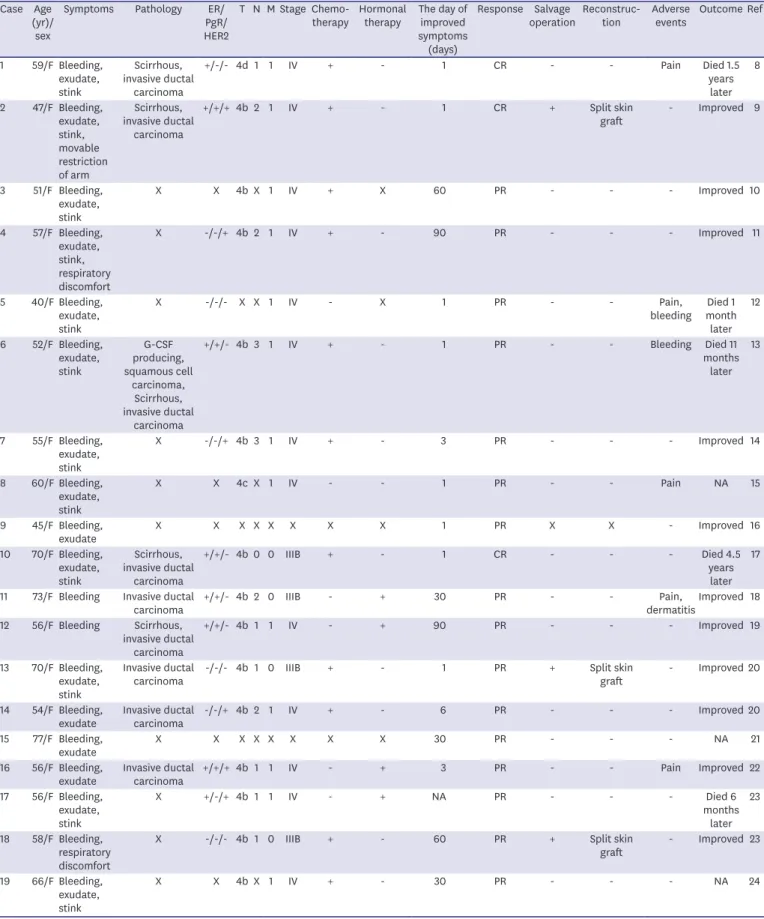
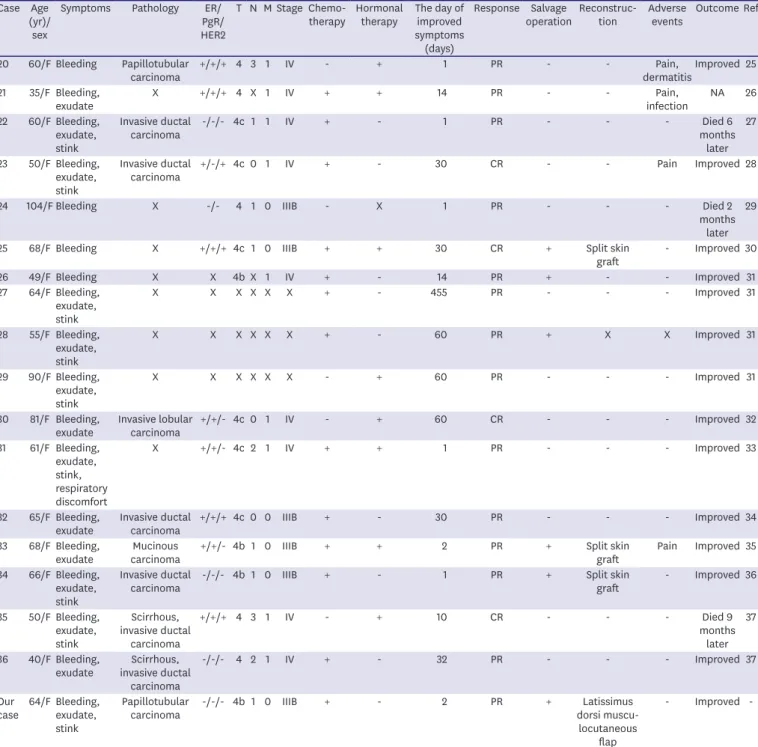
Recently, in addition to reports in the field of palliative care on ways to improve the QOL by controlling bleeding and malodor, there have been many reports from Japan on the utility of Mohs paste for the initial treatment of locally advanced breast cancer. A search of PubMed and Ichushi-web was performed to identify the relevant case reports and case series using the following terms: “breast cancer” and “Mohs paste.” We identified 39 articles published between 2008 and 2020 in Japan, of which 59 included complete information. Of all the included cases, 36 involved the use of Mohs paste for a primary lesion. A summary of this systematic review is presented in Table 2 [8-37].

Flap 10 × 7 cm

Defect Muscle

Step 1.

Step 2.

Step 3.

Step 4.

A

B

C

D

Figure 2. Radical surgery and reconstruction by latissimus dorsi musculocutaneous flap. (A) Resected specimens. The remaining tumor was resected along with

a part of the pectoralis major. (B) The flap was designed in a spindle form (10 × 7 cm) that could cover a defect of the right chest (Step 1). To mobilize the flap, an

incision was made between the flap and defect and was connected (Step 2). The latissimus dorsi musculocutaneous flap passed under the axilla and filled in the

defect (Step 3). Finally, the flap was sutured (Step 4). (C) State at the end of surgery. (D) No engraftment failure was observed, and no recurrence or metastasis

of the breast cancer has been observed for 10 years.

(5)

Table 2. Summary of data in 37 cases of breast cancer and Mohs paste reported in the literature Case Age

(yr)/

sex

Symptoms Pathology ER/

HER2 PgR/

T N M Stage Chemo-

therapy Hormonal

therapy The day of improved symptoms (days)

Response Salvage

operation Reconstruc-

tion Adverse

events Outcome Ref

1 59/F Bleeding, exudate, stink

Scirrhous, invasive ductal

carcinoma

+/-/- 4d 1 1 IV + - 1 CR - - Pain Died 1.5

years later

8

2 47/F Bleeding, exudate, stink, movable restriction of arm

Scirrhous, invasive ductal

carcinoma

+/+/+ 4b 2 1 IV + - 1 CR + Split skin

graft - Improved 9

3 51/F Bleeding, exudate, stink

X X 4b X 1 IV + X 60 PR - - - Improved 10

4 57/F Bleeding, exudate, stink, respiratory discomfort

X -/-/+ 4b 2 1 IV + - 90 PR - - - Improved 11

5 40/F Bleeding, exudate, stink

X -/-/- X X 1 IV - X 1 PR - - Pain,

bleeding Died 1 month later

12

6 52/F Bleeding, exudate, stink

G-CSF producing, squamous cell

carcinoma, Scirrhous, invasive ductal

carcinoma

+/+/- 4b 3 1 IV + - 1 PR - - Bleeding Died 11

months later

13

7 55/F Bleeding, exudate, stink

X -/-/+ 4b 3 1 IV + - 3 PR - - - Improved 14

8 60/F Bleeding, exudate, stink

X X 4c X 1 IV - - 1 PR - - Pain NA 15

9 45/F Bleeding,

exudate X X X X X X X X 1 PR X X - Improved 16

10 70/F Bleeding, exudate, stink

Scirrhous, invasive ductal

carcinoma

+/+/- 4b 0 0 IIIB + - 1 CR - - - Died 4.5

years later

17

11 73/F Bleeding Invasive ductal

carcinoma +/+/- 4b 2 0 IIIB - + 30 PR - - Pain,

dermatitis Improved 18 12 56/F Bleeding Scirrhous,

invasive ductal carcinoma

+/+/- 4b 1 1 IV - + 90 PR - - - Improved 19

13 70/F Bleeding, exudate, stink

Invasive ductal

carcinoma -/-/- 4b 1 0 IIIB + - 1 PR + Split skin

graft - Improved 20

14 54/F Bleeding,

exudate Invasive ductal

carcinoma -/-/+ 4b 2 1 IV + - 6 PR - - - Improved 20

15 77/F Bleeding,

exudate X X X X X X X X 30 PR - - - NA 21

16 56/F Bleeding,

exudate Invasive ductal

carcinoma +/+/+ 4b 1 1 IV - + 3 PR - - Pain Improved 22

17 56/F Bleeding, exudate, stink

X +/-/+ 4b 1 1 IV - + NA PR - - - Died 6

months later

23

18 58/F Bleeding, respiratory discomfort

X -/-/- 4b 1 0 IIIB + - 60 PR + Split skin

graft - Improved 23

19 66/F Bleeding, exudate, stink

X X 4b X 1 IV + - 30 PR - - - NA 24

(continued to the next page)

(6)

The average patient age at onset was 60.3 (range: 35–104) years, and stage IV disease was seen in 68.7% (22/32) of all cases. Interestingly, symptoms were controlled within 24 hours in 36.1% (13/36) of the patients. Furthermore, all cases showed a reduction in tumor volume (measured using RECIST version 1.1) [38]. Complete tumor removal was achieved in 25% (9/36) of patients. However, 96.9% of cases with complete information (31/32) were concurrently administered chemotherapy and/or hormonal therapy. Adverse events due to Mohs paste occurred in 27.8% (10/36), with complaints of “pain” in most cases. After Case Age

(yr)/

sex

Symptoms Pathology ER/

HER2 PgR/

T N M Stage Chemo-

therapy Hormonal

therapy The day of improved symptoms (days)

Response Salvage

operation Reconstruc-

tion Adverse

events Outcome Ref

20 60/F Bleeding Papillotubular

carcinoma +/+/+ 4 3 1 IV - + 1 PR - - Pain,

dermatitis Improved 25 21 35/F Bleeding,

exudate X +/+/+ 4 X 1 IV + + 14 PR - - Pain,

infection NA 26 22 60/F Bleeding,

exudate, stink

Invasive ductal

carcinoma -/-/- 4c 1 1 IV + - 1 PR - - - Died 6

months later

27

23 50/F Bleeding, exudate, stink

Invasive ductal

carcinoma +/-/+ 4c 0 1 IV + - 30 CR - - Pain Improved 28

24 104/F Bleeding X -/- 4 1 0 IIIB - X 1 PR - - - Died 2

months later

29

25 68/F Bleeding X +/+/+ 4c 1 0 IIIB + + 30 CR + Split skin

graft - Improved 30

26 49/F Bleeding X X 4b X 1 IV + - 14 PR + - - Improved 31

27 64/F Bleeding, exudate, stink

X X X X X X + - 455 PR - - - Improved 31

28 55/F Bleeding, exudate, stink

X X X X X X + - 60 PR + X X Improved 31

29 90/F Bleeding, exudate, stink

X X X X X X - + 60 PR - - - Improved 31

30 81/F Bleeding,

exudate Invasive lobular

carcinoma +/+/- 4c 0 1 IV - + 60 CR - - - Improved 32

31 61/F Bleeding, exudate, stink, respiratory discomfort

X +/+/- 4c 2 1 IV + + 1 PR - - - Improved 33

32 65/F Bleeding,

exudate Invasive ductal

carcinoma +/+/+ 4c 0 0 IIIB + - 30 PR - - - Improved 34

33 68/F Bleeding,

exudate Mucinous

carcinoma +/+/- 4b 1 0 IIIB + + 2 PR + Split skin

graft Pain Improved 35 34 66/F Bleeding,

exudate, stink

Invasive ductal

carcinoma -/-/- 4b 1 0 IIIB + - 1 PR + Split skin

graft - Improved 36

35 50/F Bleeding, exudate, stink

Scirrhous, invasive ductal

carcinoma

+/+/+ 4 3 1 IV - + 10 CR - - - Died 9

months later

37

36 40/F Bleeding,

exudate Scirrhous, invasive ductal

carcinoma

-/-/- 4 2 1 IV + - 32 PR - - - Improved 37

Our case 64/F Bleeding, exudate, stink

Papillotubular

carcinoma -/-/- 4b 1 0 IIIB + - 2 PR + Latissimus

dorsi muscu- locutaneous

flap

- Improved -

ER, estrogen receptor; PgR, progesterone receptor; HER2, epidermal growth factor receptor 2; T, tumor; N, node; M, metastasis; Ref, reference; CR, complete response; X, not appeared; PR, partial response; NA, not analyzed.

Table 2. (Continued) Summary of data in 37 cases of breast cancer and Mohs paste reported in the literature

(7)

performing systemic chemotherapy and applying Mohs paste, 25% of cases underwent salvage surgery (9/36). Most patients underwent reconstruction with a split skin graft, and a pedicle graft, such as a latissimus dorsi musculocutaneous flap, was only used in our case.

Mohs paste, also known as Mohs chemosurgery, was developed by Frederic E. Mohs in the 1930s [3]. This method was originally applied for fixing and collecting histopathological tissue using the fixing and corrosive ability of zinc chloride, which is the main component.

The underlying mechanism involves zinc ion precipitating proteins in an aqueous solution, which causes a tissue-astringent action and corrosion.

Mohs chemosurgery has primarily been used to treat patients with skin cancer, head and neck cancer, genital cancer and breast cancer [6,39-41].

Inoperable advanced breast cancer and locally recurrent lesions produce large amounts of exudate and necrotic tissue from the lesion. Such tissue can easily become infected by anaerobic bacteria, and thus give off a foul odor. In addition, these lesions easily bleed and become very difficult to manage, with episodes of bleeding in every dressing change. Such issues markedly impair a patient's QOL.

Mohs chemosurgery is less invasive than other approaches and does not require any special techniques or equipment. Most importantly, it can improve a patient's QOL and is expected to reduce tumor volume through gradual resection. Furthermore, management is easy and wound pain can be controlled by the administration of nonsteroidal anti-inflammatory drug.

Such improvements can bolster the patients' motivation to continue therapy.

Mohs chemosurgery is not a first-line choice, but good results have been reported in cases of skin tumors [5,42]. Multidisciplinary treatment should be applied in locally advanced breast cancer [43]. In Japan, Mohs chemosurgery has frequently been reported for local control of advanced breast cancer or local recurrence, showing that Mohs chemosurgery can rapidly improve symptoms and facilitate tumor reduction when combined with multidisciplinary treatment.

The combination of systemic therapy and Mohs paste can be expected to markedly improve a patient's QOL and contribute to a good prognosis, and it may be the first choice for the treatment of advanced breast cancer.

From the perspective of curability, appearance and infection, resection of the primary lesion

is often performed in cases that have shown some reduction by systemic therapy and Mohs

paste. Many cases have undergone reconstruction with a split skin graft, although such cases

presumably involve a small defect area due to tumor reduction and good granulation. A split

skin graft has the benefit of being able to be collected flexibly, depending on the purpose

and site of use, and is minimally invasive; however, it has the drawback of inducing skin

contraction and notable pigmentation [44]. The present case had a large defect and poor

granulation and needed a thick, wide area. While a latissimus dorsi musculocutaneous flap is

more invasive than a split skin graft, it strongly connects muscle and skin and does not cause

cosmetic issues [45]. Therefore, when planning reconstructive surgery, the strengths and

weaknesses of the graft and flap should be carefully considered and the indications should be

determined according to the size of the defect and the degree of the observed granulation.

(8)

We encountered a case of a locally advanced breast cancer with good results after systemic therapy, Mohs chemosurgery and radical surgery with reconstruction using a latissimus dorsi musculocutaneous flap.

REFERENCES

1. Maida V, Ennis M, Kuziemsky C, Trozzolo L. Symptoms associated with malignant wounds: a prospective case series. J Pain Symptom Manage 2009;37:206-11.

PUBMED | CROSSREF

2. Kuge S, Tokuda Y, Ohta M, Okumura A, Kubota M, Ninomiya S, et al. Use of metronidazole gel to control malodor in advanced and recurrent breast cancer. Jpn J Clin Oncol 1996;26:207-10.

PUBMED | CROSSREF

3. Mohs FE. Chemosurgery: a microscopically controlled method of cancer excision. Arch Surg 1941;42:279-95.

CROSSREF

4. Mosterd K, Krekels GA, Nieman FH, Ostertag JU, Essers BA, Dirksen CD, et al. Surgical excision versus Mohs' micrographic surgery for primary and recurrent basal-cell carcinoma of the face: a prospective randomised controlled trial with 5-years' follow-up. Lancet Oncol 2008;9:1149-56.

PUBMED | CROSSREF

5. Skelton LA. The effective treatment of basal cell carcinoma. Br J Nurs 2009;18:346-50.

PUBMED | CROSSREF

6. Kakimoto M, Tokita H, Okamura T, Yoshino K. A chemical hemostatic technique for bleeding from malignant wounds. J Palliat Med 2010;13:11-3.

PUBMED | CROSSREF

7. Mohs FE. Chemosurgery for the microscopically controlled excision of cutaneous cancer. Head Neck Surg 1978;1:150-66.

PUBMED | CROSSREF

8. Kato Y, Oyama K, Yoshida S, Hara T, Hiraki T, Haseda Y. Six cases of advanced breast cancer treated with Mohs' paste. Jpn J Breast Cancer 2013;28:453-8.

9. Shinohara T, Shiroshita A, Nagaoka M, Yamanaka Y, Yamada H, Fujimori Y, et al. A case of locally advanced breast cancer associated with multiple distant metastases successfully treated with combined modality therapy using Mohs' paste, split-thickness skin graft, and chemotherapy. Jpn J Breast Cancer 2014;29:647-53.

10. Arima M, Kobayashi N, Utsumi T, Matsunaga K. Modified Mohs and topical application of zinc oxide starch powder for treating skin infiltration of malignant tumor that is difficult to remove surgically. Skin Cancer 2014;29:68-74.

CROSSREF

11. Ueno S, Miyauchi K, Nakakuma T, Kurita A, Mineta S, Mizutani T, et al. A case of locally advanced breast cancer successfully treated with Mohs paste. Gan To Kagaku Ryoho 2013;40:2399-401.

PUBMED

12. Fujiwara E, Tamura K, Sugita T, Ootuka T, Kunihisa T. Mohs therapy aim to improve QOL of an advanced breast cancer patient with skin infiltration. Stoma 2014;21:33-7.

13. Tanabe T, Ishihara N, Musha N, Kuwabara A, Tsubono T, Sakai Y. A case of mixed-type squamous cell carcinoma of the breast, suspected of being a G-CSF-producing tumor. Jpn J Breast Cancer 2013;28:605-11.

14. Ogawa H, Masuda N, Masuda H, Yamamura J, Nakamori S, Tsujinaka T, et al. Mohs paste for unresectable local lesion of breast cancer. Gan To Kagaku Ryoho 2008;35:1531-4.

PUBMED

15. Itoh M, Hori N, Igarashi A. Mohs' chemosurgery in palliative care. Jpn J Dermatol 2008;62:668-71.

16. Morita K, Yoshitatsu S, Osaki Y, Ogawa H, Masuda N, Higasino M, et al. Experience in the use of mohs paste for cutaneous lesions in advanced malingnat tumor patients. Jpn J Plast Surg 2013;56:1197-204.

17. Takatsuka S, Shinkawa H, Kaizaki R, Fujiwara Y. Case report of successful treatment of locally advanced breast cancer with Mohs paste. J Jpn Coll Surg 2012;37:1096-101.

18. Miyazawa K, Oeda Y, Yoshioka S, Shiobara M, Wakatsuki K, Kataoka M, et al. A case of advanced breast cancer in which quality of life was improved by Mohs' paste and hormone therapy. Gan To Kagaku Ryoho 2012;39:2051-3.

PUBMED

(9)

19. Yamaguchi T, Honma T, Masuda Y, Shiotsuki S, Hayasi M, Komatsu N, et al. Increase of serum zinc concentration on Mohs past treatment. Jpn J Breast Cancer 2012;27:367-71.

20. Inoue T, Nishi T, Yoshida T, Yayoi E, Sawai Y, Yamazaki M. Local control of advanced breast cancer with Mohs' paste. Gan To Kagaku Ryoho 2011;38:2008-10.

PUBMED

21. Takahashi M, Ogata M, Urushibata M, Hino H. Experience in the use of Mohs paste. Hifuka No Rinsho 2012;54:297-91.

22. Masuda R, Hama Y, Ito M. A case of favoral initial treatment of advanced breast cancer using Mohs' paste, radiotherapy, and hormone therapy. Jpn J Breast Cancer 2011;26:623-7.

23. Sunagawa M, Katoh T, Hiramatsu K, Shibata Y, Yoshihara M. Three cases of skin invasion from breast cancer performed Mohs chemosurgery improving the quality of life. Surgery 2011;73:883-6.

24. Nawata M, Onishi K, Kanda K, Okamoto Y. Improvement of quality of life in advanced cancer patients applied Mohs chemosurgery. Surgery 2011;73:879-82.

25. Takeuchi Y. The use of Mohs' paste to control of hemorrhage and exudate in patients with advanced cancer who have invasion or metastasis to the skin. J Jpn Surg Assoc 2010;71:1909-15.

26. Abe I, Saito M, Kasumi F, Nakai K, Horimoto Y, Karasawa K. Mohs' paste for local lesion of breast cancer.

Jpn J Breast Cancer 2009;24:747-52.

27. Tanigawa T, Miyamoto Y, Abe M, Hasuo T, Doiguchi M, Sakamoto F. Treatment for the advanced breast cancer with necrotic change-improvement of QOL by using Mohs' paste. Jpn J Breast Cancer 2009;24:417-9.

28. Tanaka S, Okamoto J, Unai S, Ota D, Fukuuchi A, Nishi T, et al. A case of locally advanced breast cancer successfully treated with Mohs paste. Jpn J Breast Cancer 2009;24:411-5.

29. Ono N, Inamoto N, Morinaga S, Kawakami H, Ito T, Chen K. Two cases of in which terminal cancer medical care was improved by Mohs' paste. Hifuka No Rinsho 2008;50:1263-6.

30. Hirai C, Tada M, Yanai H, Hasuo H, Sakuma H, Matsumori E, et al. Locally advanced breast cancer treated with Mohs' paste and neoadjuvant chemotherapy: a case report. Gan To Kagaku Ryoho 2019.46:2131-3.

PUBMED

31. Horio T, Tsubuku T, Sueyoshi S, Nagamatsu Y, Akagi Y. Management of cancerous skin ulcers due to breast cancer with Mohs paste and metronidazole gel. J Jpn Surg Assoc 2016;77:2646-52.

32. Okumura K, Yabe S, Shimokuni T, Nishikawa M, Miyazaki M, Suzuki T, et al. A case of advanced breast cancer in an elderly patient that was well controlled by Mohs' paste, endocrine therapy, and denosumab.

Gan To Kagaku Ryoho 2019;46:336-8.

PUBMED

33. Kamei R, Yamamoto T, Tokuhisa A, Sakamoto K, Kitamura Y, Ando S, et al. A case of advanced breast cancer with improvement in the quality of life by local treatment using Mohs paste and systemic pharmacotherapy. Gan To Kagaku Ryoho 2018;45:2099-101.

PUBMED

34. Satoh E, Osanai T, Tomi Y, Nakamura M, Yonekura K, Murakata A, et al. A case report of recurrent bleeding and massive malodorous effusion due to skin invasion of advanced breast cancer successfully treated with Mohs' paste. Jpn J Cancer Chemother 2018;45:1997-99.

PUBMED

35. Tsubota Y, Yamamoto D, Ishizuka M, Yoshikawa K, Sueoka N, Kon M. A successful treatment of locally advanced breast cancer with using Mohs' paste and chemotherapy: a case report. Gan To Kagaku Ryoho 2018;45:725-7.

PUBMED

36. Hara K, Yoshitomi S, Tsuji H. A case of the locally advanced breast cancer with serious comorbidities obtained a good local control. Gan To Kagaku Ryoho 2018;45:365-7.

PUBMED

37. Nishiya S, Doi M, Oikawa A, Kawaura A, Mihara K, Ono S, et al. Local control of advanced breast cancer with Mohs paste and systemic therapy. Gan To Kagaku Ryoho 2016;43:443-5.

PUBMED

38. Eisenhauer EA, Therasse P, Bogaerts J, Schwartz LH, Sargent D, Ford R, et al. New response evaluation criteria in solid tumours: revised RECIST guideline (version 1.1). Eur J Cancer 2009;45:228-47.

PUBMED | CROSSREF

39. Swanson NA. Mohs surgery. Technique, indications, applications, and the future. Arch Dermatol 1983;119:761-73.

PUBMED | CROSSREF

(10)

40. Tomisawa Y, Ogasawara S, Kashiwaba M, Inaba T, Takeda Y, Sugimura Y, et al. Mohs chemosurgery for local control of giant recurrent papillary thyroid cancer. Thyroid 2009;19:657-9.

PUBMED | CROSSREF

41. Yanazume S, Douzono H, Yanazume Y, Iio K, Douchi T. New hemostatic method using Mohs' paste for fatal genital bleeding in advanced cervical cancer. Gynecol Oncol Case Rep 2013;4:47-9.

PUBMED | CROSSREF

42. Feldman S, Pearce DJ, Williford PM. Surgical decision making for basal-cell carcinoma of the face. Lancet Oncol 2008;9:1119-20.

PUBMED | CROSSREF

43. Gradishar WJ, Anderson BO, Balassanian R, Blair SL, Burstein HJ, Cyr A, et al. Breast cancer, version 4.2017, NCCN clinical practice guidelines in oncology. J Natl Compr Canc Netw 2018;16:310-20.

PUBMED | CROSSREF

44. Braza ME, Fahrenkopf MP. Split-thickness skin grafts. In: Statpearls. Treasure Island (FL): StatPearls Publishing LLC; 2021.

45. Vincent A, Hohman MH. Latissimus dorsi myocutaneous flap. In: Statpearls. Treasure Island (FL):

StatPearls Publishing LLC; 2021.

수치

Figure 1. Macroscopic and CT image of the right breast at the initial visit and Mohs chemosurgery
Figure 2. Radical surgery and reconstruction by latissimus dorsi musculocutaneous flap
Table 2. Summary of data in 37 cases of breast cancer and Mohs paste reported in the literature Case Age
Table 2. (Continued) Summary of data in 37 cases of breast cancer and Mohs paste reported in the literature

참조

관련 문서

3) A comparison of the stoichiometric equation with the experimental kinetic expression can suggest whether or not we are dealing with an elementary reaction. 4) If one

Post-surgical use of radioiodine (131I) in patients with papillary and follicular thyroid cancer and the issue of remnant ablation: a consensus

After first field tests, we expect electric passenger drones or eVTOL aircraft (short for electric vertical take-off and landing) to start providing commercial mobility

1 John Owen, Justification by Faith Alone, in The Works of John Owen, ed. John Bolt, trans. Scott Clark, "Do This and Live: Christ's Active Obedience as the

• Hormone Therapy With or Without Combination Chemotherapy in Treating Women Who Have Undergone Surgery for Node-Negative Breast Cancer (The TAILORx Trial)..

- distributes indexes across multiple computers and/or multiple sites - essential for fast query processing with large numbers of documents - many variations:

근래에 연구되는 격자형 모델은 각 경계범위에서 각기 다른 변수의 영향을 정확 하게 산출하지 못하고 있으나 , 수용모델링을 병행하는 경우 높은 정확도를 추정할

[r]