일차 항결핵제 모두에 과민반응을 보인 환자의 성공적 탈감작 결핵 치료 1예
이애라1, 김수정1, 김정현1, 박주희1, 이정규1, 김주영1,2, 이서영1,2,3, 강혜련1,2,3
1서울대학교 의과대학 내과학교실, 2서울대학교 의학연구원 알레르기 및 임상면역학연구소, 3서울대학교병원 지역의약품안전센터
Successful desensitization for antitubercular drugs
Ae-Ra Lee1, Soo Jung Kim1, Junghyun Kim1, Ju-Hee Park1, Jung-Kyu Lee1, Ju-Young Kim1,2, Suh-Young Lee1,2,3, Hye-Ryun Kang1,2,3
1Department of Internal Medicine, Seoul National University College of Medicine, Seoul; 2Institute of Allergy and Clinical Immunology, Seoul National University Medical Research Center, Seoul National University College of Medicine, Seoul; 3Regional Pharmacovigilance Center, Seoul National University Hospital, Seoul, Korea
Tuberculosis is an infectious disease that can be treated using a combination of antitubercular drugs. First-line antitubercular agents such as isoniazid and rifampin are considered pivotal to successful treatment. However, they are also known to have relatively high rates of adverse events including hypersensitivity reactions. Discontinuing the first-line agents in the event of hypersensitivity may significantly compromise the cure rate of tuberculosis. Drug desensitization can be an effective method allowing continued use of the first-line agents and achieving successful cure of tuberculosis. A 70-year-old man was diagnosed with culture proven pulmonary tuberculosis and treated with first-line antitubercular agents (isoniazid, 300 mg; rifampin, 600 mg; pyrazinamide, 1,500 mg; and eth- ambutol, 800 mg). After 2 weeks of treatment, generalized erythematous papular rash and fever developed, for which all drugs were discontinued. Since he had hypersensitivity to all 4 first-line antitubercular agents, we tried desensitization for all 4 drugs one by one to resume antituberculosis treatment. After successful desensitization of all 4 first-line antituberculosis drugs, 6 months-anti- tubercular therapy was completed without any complications. We report here a case of multiple desensitization in a pulmonary tu- berculosis patient having hypersensitivity to all of the 4 first-line antitubercular drugs, successfully completing 6-month antituber- cular therapy without any complications. (Allergy Asthma Respir Dis 2013;1:395-399)
Keywords: Drug hypersensitivity, Antitubercular agents, Desensitization, Tuberculosis
서 론
우리나라 활동성 폐결핵 환자의 유병률은 경제 성장과 꾸준한 결핵관리사업의 노력으로 1965년 결핵실태조사에서는 5.1%를 차 지하였으나 1995년에는 1.0%로 감소하였다.1) 그러나, Organisation for Economic Co-operation and Development 국가 중에서는 여전 히 발병률과 유병률이 가장 높다. 세계보건기구에서 추정하는 우 리나라의 결핵 발병률은 2000년 이래로 큰 변동은 없으나 2000년 에 100,000인 년당 72건에서 2011년에는 100,000인 년당 100건으 로 꾸준한 증가 추세를 보이고 있어2) 아직도 지속적인 결핵관리사 업이 필요하다.
1970년대에 rifampicin (RFP)과 pyrazinamide (PZA)가 치료에 포함되면서 치료 기간을 6개월까지 단축시킬 수 있었으나, 아직도 6 개월이라는 긴 기간은 환자의 불순응(nonadherence)을 유발한다.
또한 항결핵제에 대한 약제부작용은 약제의 변경 또는 중단의 주 요한 원인이 되고 있다. 통상적으로 항결핵제로 인한 약제부작용 은 20%–57%로 알려져 있으며3,4) 항결핵제에 대한 과민반응으로 약제를 변경하거나 중단하는 경우는 일반인구의 4%–5% 정도에서 관찰된다.5) 특히 isoniazid (INH), RFP 등의 주요 항결핵제에 대한 과민반응은 약제 중단 및 약제 종류와 치료 기간의 변경 등을 초래 하는데 이는 결핵 치료에 있어 중대한 제한으로 작용한다. 따라서 결핵 유병률이 높은 우리 나라에서는 탈감작 요법을 통해 일차 항 Allergy Asthma Respir Dis 1(4):395-399, December 2013 http://dx.doi.org/10.4168/aard.2013.1.4.395 CASE REPORT
Correspondence to: Hye-Ryun Kang
Department of Internal Medicine, Seoul National University Hospital, Seoul National University College of Medicine, 101 Daehak-ro, Jongno-gu, Seoul 110-744, Korea
Tel: +82-2-2072-0820, Fax: +82-2-742-3291, E-mail: [email protected]
• This research was supported by a grant from Ministry of Food and Drug Safety to operation of the regional pharmacovigilance center in 2013.
Received: July 10, 2013 Revised: July 16, 2013 Accepted: July 23, 2013
© 2013 The Korean Academy of Pediatric Allergy and Respiratory Disease The Korean Academy of Asthma, Allergy and Clinical Immunology This is an Open Access article distributed under the terms of the Creative Commons Attribution Non-Commercial License
결핵제를 유지하는 것이 성공적인 결핵의 치료와 감염관리를 위해 중요하다.
저자들은 일차 항결핵제인 INH, RFP, ethambutol (EMB), PZA 모두에 의해 발열과 발진이 발생하였던 폐결핵 환자에서 네 가지 약제 모두에 대하여 연속적으로 탈감작요법을 시행하여 6개월간 의 결핵 치료를 성공적으로 마친 1예를 경험하였기에 문헌고찰과 함께 보고하는 바이다.
증 례
환자: 남자 70세, 심OO.
주소: 호흡곤란 및 전신성 홍반성 발진
현병력: 70세 남자 환자가 활동성 폐결핵으로 진단되어 항결핵 제 복용을 시작하였다(INH, 300 mg; RFP, 600 mg; EMB, 800 mg;
PZA 1,500 mg). 약 복용 2주째부터 고열과 피부발진이 발생하여 모 든 약을 중단하였고 증상은 호전되었다. 약 중단 2주 후 1차 약제로 복용하였던 결핵약을 1가지씩 추가하며 관찰하였다. INH을 300 mg 단독 투여 후 1일 만에 호흡곤란과 심한 가려움이 발생하여 중 단하였다. 1주일 후 RFP 600 mg을 단독 투약하였고 2일 후 얼굴에
가려움증을 동반한 발진이 발생하여 RFP도 투약을 중단하였다.
과거력: 특이사항 없었다.
가족력: 특이사항 없었다.
알레르기 병력: 없었다.
검사 소견: 말초혈액검사에서 혈색소는 14.1g/dL, 백혈구는 5,940/μL (호산구 11.1%), 혈소판은 267,000/μL이었으며 간 및 신장 기능은 정상이었다.
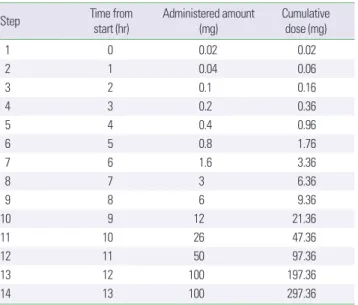
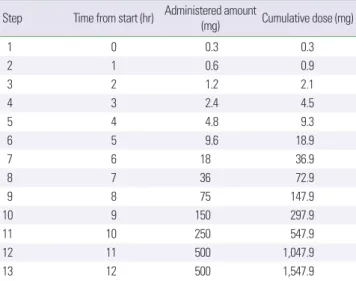
경과 및 치료: 환자는 INH와 RFP에 대한 과민반응으로 진단되 어 탈감작을 시행하기 위해 입원하였다. INH, RFP의 목표 투여량 은 Table 1에 정리하였다. INH와 RFP에 대하여 순차적으로 탈감작 을 시행하였으며(Tables 2, 3), INH를 탈감작하고 이틀간 상용량의 INH를 투여하면서 지연성 과민반응이 없음을 확인한 후 RFP 탈 감작을 시도하였다. 환자는 두 약제 모두 탈감작에 성공하여 퇴원 하였으며, 이후 상용량의 EMB, PZA를 하나씩 추가하였다. EMB 투약 1일 후 전신에 두드러기양 발진이 발생하였으며, EMB 투여 중 단한 후 호전되었다. 이후 투약을 개시한 PZA 역시 1일 후 고열을 동반한 두드러기가 발생하였으며 약제 중단 후 호전되었다. 이에 환 자는 EMB와 PZA에 대한 탈감작을 위해 재입원하였다. 입원 전 환 자가 임의로 INH, RFP을 중단하여 재입원 후 4가지 약제에 대해 다시 이틀 간격으로 INH → RFP → EMB → PZA 순서로 탈감작을 시행하였다. EMB와 PZA의 목표용량은 Table 1에, 탈감작에 사용 한 프로토콜은 Table 4와 Table 5에 표시하였다. PZA 투여 후 경한 소양감이 있었으나 두드러기나 피부병변은 관찰되지 않아 경구 항 히스타민제를 복용하면서 항결핵제를 유지할 수 있었다. 환자는 이 후 별다른 부작용 없이 총 6개월간 결핵 치료를 성공적으로 마쳤다.
Table 1. Drugs related with hypersensitivity reactions
Drug Total dose administered Symptoms of hypersensitivity Isoniazid 90 mg Dyspnea, pruritis, eosinophilia Rifampin 50 mg Fever, pruritis erythema, wheals
Ethambutol 1,200 mg Urticaria
Pyrazinamide 125 mg Fever, urticaria, pruritis, rash
Table 2. Oral desensitization protocol for isoniazid (target dose: 300 mg)
Step Time from
start (hr) Administered amount
(mg) Cumulative
dose (mg)
1 0 0.02 0.02
2 1 0.04 0.06
3 2 0.1 0.16
4 3 0.2 0.36
5 4 0.4 0.96
6 5 0.8 1.76
7 6 1.6 3.36
8 7 3 6.36
9 8 6 9.36
10 9 12 21.36
11 10 26 47.36
12 11 50 97.36
13 12 100 197.36
14 13 100 297.36
Solution for step 1–6: isoniazid 10 mg+dextrose 5% in water 50 mL (0.2 mg/mL);
solution for step 7–11: isoniazid 100 mg+dextrose 5% in water 50 mL (2 mg/mL).
Table 3. Oral desensitization protocol for rifampin (target dose: 600 mg)
Step Time from start (hr) Administered amount (mg) Cumulative dose (mg)
1 0 0.03 0.03
2 1 0.06 0.09
3 2 0.15 0.24
4 3 0.3 0.54
5 4 0.6 1.14
6 5 1.2 1.34
7 6 2.4 3.74
8 7 4.5 8.24
9 8 9 17.24
10 9 18.6 35.84
11 10 37.5 73.34
12 11 75 148.34
13 12 150 298.34
14 13 300 598.34
Solution for step 1–6: rifampin 150 mg+dextrose 5% in water 500 mL (0.3 mg/mL);
solution for step 7–12: rifampin 150 mg+dextrose 5% in water 50 mL (3 mg/mL).
고 찰
결핵약은 항결핵 효과와 작용기전에 따라 5가지 군으로 분류한 다. 이 중 항결핵 효과가 좋을 뿐 아니라 부작용이 적어서 결핵 초치 료에 사용되는 약제들을 일차 항결핵제(1군)라고 하고, 초치료에 실패했을 때 사용하는 약제들을 이차 항결핵제라 부르며6) 2군, 3 군, 4군에 해당하는 약제들이 이에 속한다. 특히 강력한 살균작용 (bactericidal effect)을 갖는 INH와 RFP은 결핵 치료의 핵심적인 약제이다.
약물과민반응이란 약물에 감작된 환자에서 약물 본래의 약리작 용과는 무관한 면역기전으로 매개되는 반응으로 본 증례에서는 두 드러기양 발진 및 발열 등의 증상이 항결핵제 투약 24시간 이후 (EMB, PZA) 및 72시간 이후에(INH, RFP) 발생한 지연성 과민반 응 사례였다. 문헌마다 차이는 있으나 일차 항결핵제로 치료한 경 우 9%까지도 과민반응을 보고하고 있다. PZA로 인한 과민반응이 5%–6%로 가장 높았으며, INH가 3%–4%, RFP이 1.5%–3%로 그 뒤를 이었고 EMB로 인한 경우는 1% 미만으로 보고하였다.3,5,7) INH는 간에서 대사되는 약물이며 과민반응을 일으키는 물질이 INH 자체인지 INH의 대사산물인지는 아직 명확히 밝혀지지 않았 다. RFP도 간에서 탈아세틸화를 통해 대사되는 물질이다. RFP은 일반 결핵 환자에서는 4% 미만에서 발진과 발열 등을 포함한 과민 성을 보이는 데 반해 AIDS 환자에서는 19명의 결핵 환자 중 9명 (47.3%)이 열, 호산구증, 간효소치 증가, 소양감, 근육통, 피부발진, 신장기능 약화, 복통, 설사, 오심, 구토 등의 과민반응을 보였다고 보고하였다.8) 국내의 한 보고에 따르면 결핵성 임파선염으로 진단 되었던 정상면역(immunocompetant)의 한 여자 환자가 RFP 복용
이후 아나필락시스와 횡문근융해증 등의 과민반응이 발생하여 복 용 60시간 만에 사망한 경우도 있었다.9) 본 증례에서는 다른 원인이 될 만한 약물의 투여가 없었던 환자에서 항결핵제의 투여 후 과민 반응이 발생하였으며 약제 중단한 후 증상이 소실되었고 결핵약제 들의 개별 재투여에 의해 증상이 재발함을 확인하여 4가지 일차 항 결핵제 모두에 대해 과민반응이 있음을 확인하였다.
탈감작요법은 과민반응을 일으킨 약제가 치료에 필수적이고 효 과적인 대체 약물이 없으며 과민반응의 정도가 중증이 아닐 경우 고려해 볼 수 있다. 결핵약제의 경우 2차 약제로 전환할 경우 1차 약 제에 비해 항결핵 치료 효과 및 투여기간에 있어 불리하기 때문에, 본 증례에서는 탈감작을 시행하기로 결정하였다.
탈감작요법은 원인 항원의 소량 주입을 통해 숙주의 면역반응을 변화시키고 점점 항원의 양을 늘려 결국 원래 용량의 약물을 사용 할 수 있게 하는 방법이다.10) IgE 매개형 반응을 일으키는 약물에서 탈감작화는 조절된, 즉 임상 증상이 나타나지 않는 아나필락시스 를 유발하는 것을 원칙으로 한다. IgE 매개형 반응은 아니지만 급 성 반응을 야기시키는 약물에 있어서는 약물의 종류와 약물이 일 으키는 부작용의 종류에 따라서 탈감작의 성공 가능성 여부가 달 라진다. 지연형 반응을 일으키는 약물에 있어서는 느린 탈감작이 필요하다.11) 탈감작의 단기, 장기 프로토콜 중에서 순응 측면에서는 단기가, 성공과 안전측면에서는 장기 프로토콜이 좋은 것으로 알려 져 있다.12) 이처럼 탈감작요법은 두드러기나 혈관부종과 같은 즉시 형 반응과 반점구진성 발진과 같은 지연성 반응에 모두 적용되고 있으나, 아나필락시스나 스티븐스-존슨증후군, 독성 표피 괴사 용 해 또는 drug rash with eosinophilia and systemic symptoms (DR- ESS) syndrome 등과 같은 중증 혹은 생명을 위협한 사건에서는 재 Table 4. Oral desensitization protocol for ethambutol (target dose: 800 mg)
Step Time from start (hr) Administered amount (mg) Cumulative dose (mg)
1 0 0.1 0.1
2 1 0.2 0.3
3 2 0.5 0.8
4 3 1 1.8
5 4 2 3.8
6 5 4 7.8
7 6 8 15.8
8 7 15 30.8
9 8 30 60.8
10 9 60 120.8
11 10 100 220.8
12 11 200 420.8
13 12 400 820.8
Solution for step 1-6: ethambutol 40 mg+dextrose 5% in water 40 mL (1 mg/mL);
solution for step 7-10: ethambutol 400 mg+dextrose 5% in water 40 mL (10 mg/mL).
Table 5. Oral desensitization protocol for pyrazinamide (target dose: 1,500 mg)
Step Time from start (hr) Administered amount (mg) Cumulative dose (mg)
1 0 0.3 0.3
2 1 0.6 0.9
3 2 1.2 2.1
4 3 2.4 4.5
5 4 4.8 9.3
6 5 9.6 18.9
7 6 18 36.9
8 7 36 72.9
9 8 75 147.9
10 9 150 297.9
11 10 250 547.9
12 11 500 1,047.9
13 12 500 1,547.9
Solution for step 1–6: pyrazinamide 60 mg+dextrose 5% in water 20 mL (3 mg/mL);
solution for step 7–10: pyrazinamide 1500 mg+dextrose 5% in water 50 mL (30 mg/
mL).
투여 자체가 금기사항이므로 시행하지 않는 것이 원칙이다.13) 결핵약제에 대하여 탈감작을 유도하는 정확한 기전과 탈감작 요 법 후의 병태생리학적 변화에 대해서는 잘 알려져 있지 않다. 페니 실린에 대한 탈감작에 대한 연구에서 미루어 생각해 보면, 면역복 합체에 의한 IgE의 소진 등에서 면역복합체에 의한 제 III형 과민반 응의 가능성과 항원 특이 비만 세포의 탈감작, 혈청 IgE와 호산구 의 증가 등으로 미루어 IgE 매개 과민반응의 가능성을 생각해 볼 수 있겠다.14) INH의 경우 INH에 대한 피부시험 결과가 음성이므 로 IgE 매개반응이 관련이 없을 가능성을 주장한 문헌이 있는가 하 면5) INH-단백 결합체(INH-protein conjugates)에 대한 피부반응 검사에서 양성을 보인다는 보고도 있어15) 이러한 점은 과민반응이 IgE 매개반응과 관련이 있을 가능성을 시사한다. 항결핵제에 대한 약물알레르기의 기전에서는 지연성 반응(non-immediate reac- tion)이 즉시형 반응(immediate reaction)보다 더 흔한 것으로 되어 있다.16) 또한 RFP은 세포 내로 투과성이 좋고 지용성-합텐 결합을 하여 외인성 경로(exogeneous pathway)뿐만 아니라 세포질 내로 들어가는 내인성 경로(endogeneous pathway)를 거쳐 T 세포에 관 여하는 과민반응의 가능성이 보고되었다.8)
일차약제들에 대한 과민반응으로 투여를 지속하기 어려운 경우 선택할 수 있는 효과적인 대체약제가 마땅치 않아 탈감작을 통해 이들 약제들을 투여하려는 시도가 보고되고 있다. 1990년 Holland 등5)이 탈감작을 시행한 이래, 경구 및 정맥을 통한 항결핵제 탈감작 성공 사례가 다종의 항결핵약제에 대하여 보고되었다.8,17) 표준 일 차 항결핵제 치료를 하였을 때 투여된 약제들에 과민반응을 보였 던 환자들의 60–80%는 탈감작치료를 통하여 해당 항결핵제를 중 단하지 않고 표준치료를 지속할 수 있었다.9) 한 후향적 연구에 따르 면 탈감작을 시행하였을 때 RFP에서는 79%, INH에서는 83%의 성 공률을 보였다.18) 국내의 경우에도 항결핵제에 대한 탈감작 성공사 례가 보고되었다.8,17) 항결핵제에 과민반응을 보이는 경우 한 가지 혹은 두 가지 약제에 의해 반응이 나타나는 것이 일반적이다. 본 증 례는 4가지 일차 항결핵제 모두에 대해 과민반응을 보여 투여를 지 속할 수 없어 이들 4종 모두에 대해 순차적으로 탈감작을 시행한 사례로 아직까지 문헌상 보고된 바가 없다.
일반적으로 즉시형 반응에 대한 급속 탈감작 프로토콜은 어느 정도 보편화되어 있으나, 지연성 과민반응에 대한 탈감작은 많이 시도되고 있지 않아 보편화된 프로토콜이 없으며, 보통 수시간에 서 1일 정도의 간격을 두고 증량한 증례보고들이 있었다. RFP과 INH으로 인한 지연성 과민반응으로 경구 탈감작을 하였던 한 증 례에서는5) 처음에는 15분씩 네 번 투약하였고 이후 30분 간격으로 4번 투약, 그 이후로는 2시간 간격으로 2회 투약하여 상용량 투여 에 성공하였다. RFP 및 EMB에 의한 지연성 과민반응 사례에서는 45분 간격으로 12회 투약한 후 3시간 반 간격으로 2회 투약하였고 이후로는 7시간 반 이후 투약한 다음 상용량 투여에 성공하였음을
보고하였다.19) RFP을 29일에 걸쳐, INH를 25일의 탈감작기간을 가 졌던 예도 있었다.18) 항결핵제의 경우 결핵균의 특성 때문에 저농도 항결핵제에 오랜 기간 노출되면 내성 발생의 우려가 있음을 고려하 여 본 증례에서는 경구로 두 가지 농도의 용액을 만들어 한 시간 간 격으로 증량하여 1일 만에 목표량에 도달하는 일정으로 진행하여 네 가지 약제 모두 성공적으로 탈감작을 완료하였다.
저자들은 일차 항결핵제 4종 모두에 대해 피부과민증을 보인 환 자에게 경구 탈감작을 성공적으로 시행하였다. 본 증례처럼 모든 일차 항결핵제에 대해 과민반응을 보이는 경우, 2차 항결핵제로 변 경하는 대신 탈감작 요법을 고려해 볼 수 있겠다.
REFERENCES
1. Kim HJ. Current status of tuberculosis in Korea. Korean J Med 2012;82:
257-62.
2. Global tuberculosis report 2012 [Internet]. Geneva: World Health Orga- nization; c2012 [cited 2013 Jul 19]. Available from: http://apps.who.int/
iris/bitstream/10665/75938/1/9789241564502_eng.pdf.
3. Kobashi Y, Abe T, Shigeto E, Yano S, Kuraoka T, Oka M. Desensitization therapy for allergic reactions to antituberculous drugs. Intern Med 2010;
49:2297-301.
4. Schaberg T, Rebhan K, Lode H. Risk factors for side-effects of isoniazid, rifampin and pyrazinamide in patients hospitalized for pulmonary tu- berculosis. Eur Respir J 1996;9:2026-30.
5. Holland CL, Malasky C, Ogunkoya A, Bielory L. Rapid oral desensitiza- tion to isoniazid and rifampin. Chest 1990;98:1518-9.
6. Park JS. Korean guidelines for the treatment of tuberculosis. Korean J Med 2012;82:269-73.
7. Yee D, Valiquette C, Pelletier M, Parisien I, Rocher I, Menzies D. Incidence of serious side effects from first-line antituberculosis drugs among patients treated for active tuberculosis. Am J Respir Crit Care Med 2003;167:
1472-7.
8. Seo HS, Min PK, Kim CW, Park JW, Jeong JH, Jang KH, et al. Two cases of rifampin desensitization in AIDS patients with rifampin hypersensitiv- ity. J Asthma Allergy Clin Immunol 2002;22:119-23.
9. Kuwabara K. Anti-tuberculosis chemotherapy and management of ad- verse reactions. Nihon Rinsho 2011;69:1389-93.
10. Kim MS, Cho YJ. Cyclosporine desensitization in patient with multiple hypersensitivity reactions immediately after peripheral blood stem cell transplantation. Korean J Asthma Allergy Clin Immunol 2008;28:59-63.
11. Millikan LE, Mroczkowski TF. Immunology of adverse drug eruptions.
Clin Dermatol 1986;4:30-9.
12. Moreno-Ancillo A, Lopez-Serrano MC. Hypersensitivity reactions to drugs in HIV-infected patients. Allergic evaluation and desensitization.
Clin Exp Allergy 1998;28 Suppl 4:57-60.
13. Scherer K, Brockow K, Aberer W, Gooi JH, Demoly P, Romano A, et al.
Desensitization in delayed drug hypersensitivity reactions: an EAACI po- sition paper of the Drug Allergy Interest Group. Allergy 2013;68:844-52.
14. Gruchalla R. Understanding drug allergies. J Allergy Clin Immunol 2000;105(6 Pt 2):S637-44.
15. Asai S, Shimoda T, Hara K, Fujiwara K. Occupational asthma caused by isonicotinic acid hydrazide (INH) inhalation. J Allergy Clin Immunol 1987;80:578-82.
16. Thong BY. Update on the management of antibiotic allergy. Allergy
Asthma Immunol Res 2010;2:77-86.
17. Kim JH, Kim HB, Kim BS, Hong SJ. Rapid oral desensitization to isonia- zid, rifampin, and ethambutol. Allergy 2003;58:540-1.
18. Kobashi Y, Okimoto N, Matsushima T, Abe T, Nishimura K, Shishido S, et al. Desensitization therapy for antituberculous drugs. Kekkaku 2000;
75:521-6.
19. Matz J, Borish LC, Routes JM, Rosenwasser LJ. Oral desensitization to ri- fampin and ethambutol in mycobacterial disease. Am J Respir Crit Care Med 1994;149(3 Pt 1):815-7.