컴퓨터 인지훈련프로그램 사용 후 인지기능의 효과성 분석
김희진
*,#·양영순
†,#·최경회
*김태유
‡한양대학교 의과대학 신경과학교실*
보훈공단 중앙보훈병원 신경과†
윌리스기념병원 신경과‡
The Effect of Computer-Based Cognitive Training Program On Cognition
Hee-Jin Kim, M.D.*,#, Young Sun Yang, M.D.†,#, Kyoung-Hee Choi, RN*, Tae-You Kim, M.D.‡ Department of Neurology*, Hanyang University College of Medicine, Seoul; Department of Neurology†, Veterans Hospital, Seoul Medical Center, Seoul; Department of Neurology‡, Willis Memorial Hospital, Busan, Korea Background: Effective non-pharmacological cognitive program to prevent Alzheimer’s dementia or slow its progression are an urgent international priority. The effect of computer-based cognitive training pro- gram has not been demonstrated yet in dementia. The purpose of this study is to know whe ther the com- puter-based cognitive training improved cognitive abilities in patients with mild cognitive disorder and ear- ly stage of dementia. Methods: Totally 20 participants (14 with MCI and 6 with mild Alzhie mer dementia) participated in this study. To test the effectiveness of computer-based cognitive training programs to cog- nition, all patient were randomly allocated to an intervention group (n=10) or a control group (n=10) An intervention group received regularly computer-based cognitive training totally 20 times for 10 weeks.
Neuropsychological examinations were conducted before and after this period. Results: After 10 weeks, intervention group showed a significant change in language of K-MMSE compared with baseline cogni- tive examinations. Also, there was improvement in attention (backward digit span), calculation, memory, and frontal function for the intervention group as compared with controls. Patients with mild cognitive dis- order showed marked improvements in language and visuospatial capacity, while patients with dementia showed no or slight improvement in these fields. Conclusions: Computer-based cognitive training pro- gram might have beneficial effect on general cognitive function in both mild cognitive disorder and de- mentia. Especially, conspicuous effectiveness showed in patients with mild cognitive disorder.
Received: November 14, 2013 Revision received: December 11, 2013 Accepted: December 11, 2013
Address for correspondence Hee-Jin Kim, M.D.
Department of Neurology, Hanyang University College of Medicine, 22-2 Majo-ro, Seongdong-gu, Seoul 133-792, Korea Tel: +82-2-2290-8374
Fax: +82-2-2296-8370 E-mail: [email protected]
#These authors equally contributed to this study. Key Words: Computer-based cognitive training, Cognition, Mild cognitive disorder, Alzheimer’s disease
서 론
치매는 노인층에서 발생하는 중요 질환이며 개인의료비용 및 국 가 의료재정에 큰 부담을 초래하며 조기발견 및 치료가 늦어질수 록 국가 의료재정이 부담해야 할 비중이 점차 증가하는 대표적인 질환이다[1]. 아세틸콜린분해효소 억제제(acetylcholinesterase inhibi- tors, AChEIs)가 알츠하이머병의 주요 치료제로 사용되고 있지만 증 상 완화가 주요 효과이고 질환의 진행을 막을 수는 없다[2]. 인지기 능 장애는 행동장애 및 정신적 문제와 함께 환자의 일상생활능력 을 독립적으로 하는 데 장애를 일으키기 때문에[3], 환자의 독립생 활 보장을 위해 인지프로그램이 소개되고 있다[4]. 비약물적 치료 로서 인지치료(cognitive therapy)는 정상인을 대상으로 하는 예방적
차원의 인지자극(cognitive stimulation)과 집중력, 언어능력, 집행기 능, 기억력의 각 영역을 통합적으로 훈련시키는 인지훈련(cognitive training), 하나의 인지 영역을 집중적으로 훈련시켜 일상생활 개선 에 목표를 두는 인지재활(cognitive rehabilitation)의 세 가지 영역으 로 나누고 있다[5]. 인지훈련 프로그램은 손상된 인지기능의 회복 을 주 목적으로 하나, 근래는 뇌기능의 능력의 최대한의 활용을 통 한 뇌 조직의 재구성(reorganization)이 가능하다는 뇌의 가소성 (plasticity)의 개념이 도입되면서[6], 초기 치매 환자들을 대상으로 하여 활발히 연구되고 있다[7]. 인지훈련 중에서 비교적 접근이 쉬 운 컴퓨터를 이용한 인지훈련 프로그램에 대한 연구들이 전 세계 적으로 다양하게 이루어지고 있다[8]. 컴퓨터를 이용한 인지치료는 1988년 Glisky와 Schacter [9]가 기억력 저하 환자를 대상으로 처음
© 2013 Korean Dementia Association
This is an Open Access article distributed under the terms of the Creative Commons Attribution Non-Commercial License (http://creativecommons.org/licenses/by-nc/3.0) which permits unrestricted non-commercial use, distribution, and reproduction in any medium, provided the original work is properly cited.
컴퓨터를 이용한 기억력 훈련을 시작으로 사용하게 되었으며, 2000 년 Palmese와 Ras kin [10]은 Attention Process Training-II (APT-II) 프 로그램을 3명의 경한 외상성 뇌손상 환자에게 10주간 적용하여 집 중력과 성취력의 속도가 호전되고 치료 후 6주까지 인지기능의 안 정성이 남아 있음을 보고하였다. 최근에는 6개월 동안 치매환자를 대상으로 컴퓨터 인지프로그램을 진행하면 뇌 위축이 경한 환자의 경우 비교군에 비해 시공간 능력의 향상을 보인 것으로 보고하였다 [8]. 따라서 본 연구에서는 첫째, 약물치료용량에 변화가 없는 경도 인지장애와 경증의 알츠하이머 치매 환자를 대상으로 하여 단기간 의 집중적인 컴퓨터 인지프로그램이 인지영역별로 어떠한 효과를 미치는지, 둘째로 프로그램 사용이 경도인지장애와 치매환자에게 미치는 효과에 대해 확인하기로 하였다.
대상과 방법
대상2012년 1월부터 12월까지 서울 소재 두 개의 종합병원을 방문한 기억력 저하 환자를 대상으로 하여 Petersen 진단기준에 근거한 기 억형 경도인지장애[11]와 Criteria of the National Institute of Neu rologic and Communicative Disorders and Stroke-Alzheimer Disease and Re- lated Disorders Association (NINCDS-ADRDA) [12] 진단기준에 의해 알츠하이머 치매로 진단받은 환자 중 경증(Clinical Dementia Rating Scale: CDR=1)의 경우에서 약물의 용량이 3개월간 변화가 없는 환자 만을 대상으로 선정하였다. 1) 뇌종양이나 뇌염, 2) 연구 시작시점 2년 이내에 Diagnostic and Statistical Manual of Mental Disorders (DSM- IV) 진단기준에 의거한 정신질환, 3) 심한 우울감이 있거나 (Hamil- ton Depression Rating Scale [HAMD] score>18), 4) 파킨슨병, 헌팅톤 병, 정상압 뇌수두증 등 다른 신경학적 질환, 5) 다른 인지기능저하 를 일으킬 수 있는 내과적 질병이 있는 경우(간질환, 신장질환, 갑상 선질환), 6) 2년 내에 알코올이나 약물중독이 있는 환자, 7) 컴퓨터 프로그램을 완료할 수 없는 신체장애가 있는 경우를 배제기준으로 정하였다. 모든 환자들은 기본적 인구학적인 특성을 조사하였고, Kang 등에 의해 개발된 한국판 간이 정신 상태 검사(Korean version of Mini-Mental State Examination, K-MMSE)를 사용하여 선별검사 를 하였고[13], 환자의 알츠하이머병의 중증도 평가는 임상적 치매 척도(Clinical Dementia Rating, CDR) 에 따라서 구분하였다[14].
연구설계
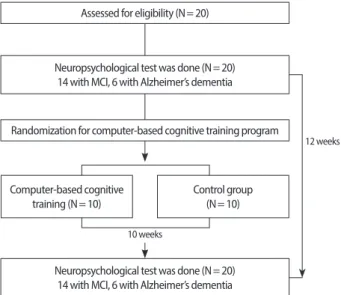
컴퓨터 인지프로그램을 이용한 인지기능 향상 프로그램의 설계 도는 Fig. 1에 기술되어 있다. 모든 대상자들은 신경과 의사에 의해
신체검진 및 신경학적 검사를 받았다. 동일한 신경심리사가 모든 대 상자에게 프로그램 전에 기초 신경심리검사를 하였고, 모든 환자는 MRI를 시행하였다. 서울 소재 두 개의 종합병원에서 기억형 경도인 지장애(CDR= 0.5) 14명, 알츠하이머 치매(CDR=1) 6명 등 총 20명의 환자가 등록되었다. 무작위로 번호표를 배부하여 등록된 순서대로 짝수에 해당이 되는 군이 실험군으로, 홀수는 대조군으로 정하였 다. 총 10주간 20회기의 인지프로그램을 진행하였고, 진행 2주 후 신 경심리학적 검사를 재실시하였다. 모든 참여자는 동의서를 작성하 였고, 이 연구는 한양대학교 의과대학의 의학연구 윤리위원회에 승 인을 받아 진행되었다(승인번호: HYUH 2013-05-003-004).
컴퓨터인지프로그램
브레인 닥터는 윌리스 인지과학연구소에서 개발하고, (주)가바 플러스에서 제공한 하드웨어를 기반으로 한 인지단계별 맞춤형 컴 퓨터 인지프로그램이다. 브레인닥터는 1) 주의집중력, 2) 시공간능 력, 3) 기억력, 4) 집행능력(구성능력), 5) 언어능력, 6) 계산능력, 7) 소 리인지력 등으로 7가지 영역을 동시에 자극하는 뇌 기능을 향상시 키는 인지향상프로그램 소프트웨어이다. 프로그램의 목적은 7가지 인지영역에 속하는 기능을 중심으로 각 인지영역 중 현저히 낮아지 는 능력을 구별하여 그 영역의 뇌 인지능력을 향상시키고자 개발되 었다. 인지능력이 떨어져 있는 치매환자의 경우 뇌의 고차원적인 기 능을 유지하고 증진시키면 궁극적으로 독립적인 일상생활능력을 유지할 것으로 판단되어, 7가지 인지영역을 모두 이용한 다각도 인 지훈련 프로그램을 대상자에게 적용하였다. 과정은 주 2회 60분씩 브레인닥터를 실행하여 총 10주 동안 지속적으로 사용하게 하였다.
Assessed for eligibility (N= 20)
Randomization for computer-based cognitive training program Neuropsychological test was done (N= 20)
14 with MCI, 6 with Alzheimer’s dementia
Neuropsychological test was done (N= 20) 14 with MCI, 6 with Alzheimer’s dementia
10 weeks
12 weeks
Computer-based cognitive
training (N= 10) Control group (N= 10)
Fig. 1. Study design for computer-based cognitive training program.
MCI, Mild Cognitive Impairment.
각 문제는 음성과 자막의 안내에 따라 제공되며 정해진 시간 내에 대상자는 손가락으로 화면을 터치하거나, 터치한 상태에서 손가락 을 이동하면 해답을 제공하는 방식이다. 또한 각 과정이 끝난 후 대 상자가 수행한 결과는 자동적으로 저장되어 그 결과를 볼 수 있게 하여, 대상자가 수행 정도 확인을 통해 성취감을 느끼게 설계하였 다. 모든 과정은 숙련된 치매 전문가가 동석하여 프로그램 진행을 관리하도록 하였다.
신경심리검사
환자의 각 인지기능의 영역을 평가하기 위한 신경심리검사는 서 울신경심리검사(Seoul Neuropsychological Screening Battery, SNSB)를 사용하였다[15]. 하부 인지영역별로 살펴보면, 집중력은 forward와 backward digit span, 언어능력은 한국판 보스턴 이름대기 검사(Ko- rean-Boston Naming Test, K-BNT) [16], 시공간능력은 Rey Complex Figure test (RCFT) [17]의 따라그리기 점수를 이용하여 알아보았다.
언어적 기억력과 시각적 기억력은 Seoul Verbal Learning Test (SVLT) 와 RCFT의 즉각회상(3회 시도의 합산점수), 지연회상, 재인검사 점 수를 이용하여 알아보았다. 전두엽 관련 기능을 알아보기 위해서는 통제 단어 연상 검사(Controlled Oral Word Association Test, COW- AT) [18]의 2가지(동물, 시장) 의미적 단어 유창성(semantic word flu- ency) 각각의 점수와 3가지(ㄱ, ㅇ, ㅅ) 음소적 단어 유창성(phonemic word fluency)의 합산 점수와 Korean-Color Word Stroop Test (K-CWST) [19]의 색깔읽기(color reading) 점수를 이용하였다. 검사는 총 두 번 에 걸쳐서 이루어졌는데, 기초검사 후 10주간 컴퓨터 인지프로그램 을 실시한 후 즉각적인 효과를 확인하기 위해 기초검사로부터 12주 지난 시점에서 신경심리 재검사를 진행하였다. 이런 과정은 컴퓨터 프로그램을 사용하지 않은 대조군도 동시에 진행하였다.
통계분석방법
실험군과 대조군 사이의 인구학적 비교는 two sample t-test로 비 교하였다. 컴퓨터 인지훈련 프로그램 전후의 신경심리학검사의 아 군의 비교는 Wilcoxon’s rank sum test를 통하여 확인하였다. 통계분 석은 SPSS 21.0을 이용하였고, p값이 0.05 이하인 경우를 통계학적 으로 의미가 있는 것으로 간주하였다.
결 과
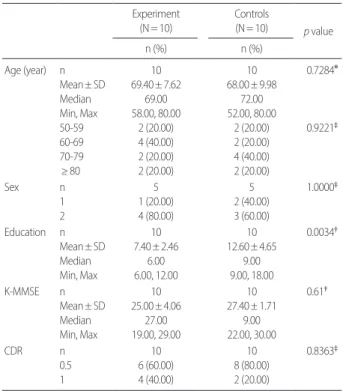
인구학적 분석실험군과 대조군에서 나이나 성별, 임상치매 단계 등은 양 군 간
의 차이가 없었다. 교육연수는 실험군에 비해 대조군이 각각 7.40±
2.46 대 12.60±4.65로 대조군이 높았다. K-MMSE, CDR, GDS 등의 군 간의 차이는 없었다(Table 1).
전반적 인지기능에 미치는 영향
K-MMSE 점수에서는 컴퓨터 인지 프로그램을 사용한 군이 언어 능력이 기초검사의 7.40± 0.52에 비해 8.00± 0.00로 유의하게 향상을 보였으나, 다른 영역에서의 변화는 크지 않았다. 신경심리검사에서 는 다영역에 걸쳐 유의한 향상된 변화를 보였는데, digit backward span은 시행 전에 비해 시행 후가 2.40± 0.52, 3.20±1.03으로 대조군 에 비해 뚜렷한 향상을 보였으며, Go-no go 검사에서는 실험군에서 12.40±4.84에서 17.80±4.16으로 좋은 결과가 있었다(Table 2). 이러 한 변화는 계산 영역에서도 관찰되었는데, 특히 나눗셈에서 뚜렷한 향상을 보이면서(2.40± 0.92 vs 2.90± 0.32) 전반적인 점수가 향상되 었다. 기억력은 언어와 시각의 즉각 회상이나 지연회상에서 전반적 인 점수의 향상 경향을 보였지만, 변화 정도는 대조군과 차이를 보 이진 않았다. 그러나 언어와 시각 기억력 모두 재인검사에서 통계적 으로 유의한 변화를 보였고, 특히 시각 기억력의 뚜렷한 효과가 있 었다.
Table 1. Participants demographics Experiment
(N= 10) Controls
(N= 10) p value
n (%) n (%)
Age (year) n Mean± SD Median Min, Max 50-59 60-69 70-79
≥ 80
10 69.40± 7.62
69.00 58.00, 80.00
2 (20.00) 4 (40.00) 2 (20.00) 2 (20.00)
10 68.00± 9.98
72.00 52.00, 80.00
2 (20.00) 2 (20.00) 4 (40.00) 2 (20.00)
0.7284*
0.9221‡
Sex n
1 2
5 1 (20.00) 4 (80.00)
5 2 (40.00) 3 (60.00)
1.0000‡ Education n
Mean± SD Median Min, Max
10 7.40± 2.46
6.00 6.00, 12.00
10 12.60± 4.65
9.00 9.00, 18.00
0.0034†
K-MMSE n Mean± SD Median Min, Max
10 25.00± 4.06
27.00 19.00, 29.00
10 27.40± 1.71
9.00 22.00, 30.00
0.61†
CDR n
0.5 1
10 6 (60.00) 4 (40.00)
10 8 (80.00) 2 (20.00)
0.8363‡
*Two-sample t-test; †Wilcoxon’s rank sum test; ‡Fisher’s exact test.
K-MMSE, the Korean-Mini Mental State Examination; CDR, clinical dementia rating.
Table 2. Results of Neuropsychological test
Experiment (N= 10) Control (N= 10)
p value
Mean± SD Median Mean± SD Median
Digitspan
backward Baseline
After Change p value
2.40± 0.52 3.20± 1.03 0.80± 1.03
2.00 4.00 1.00
3.80± 0.79 3.40± 0.52 -0.40± 0.52
4.00 3.00
0.00 0.0092*
0.0368‡ 0.1250†
Digitspan backward (‰)
Baseline After Change p value
14.49± 14.92 32.38± 27.69 17.89± 28.73
3.92 34.09 5.54
42.49± 32.15 26.28± 15.23 -16.21± 21.71
39.74 34.09
0.00 0.0062*
0.0804‡ 0.1250†
Calculation
division Baseline
After Change p value
2.40± 0.52 2.90± 0.32 0.50± 0.53
2.00 3.00 0.50
2.60± 0.84 2.20± 1.03 -0.40± 0.84
3.00 3.00
0.00 0.0082*
0.0625† 0.5000†
Calculation
total score Baseline After Change p value
11.20± 0.79 11.60± 0.70 0.40± 0.70
11.00 12.00 0.50
11.60± 0.84 11.20± 1.03 -0.40± 0.84
12.00 12.00
0.00 0.0280*
0.2188† 0.5000†
SVLT recognition score
Baseline After Change p value
17.60± 3.31 19.00± 3.33 1.40± 2.80
18.00 20.00 1.00
18.20± 3.36 18.60± 2.07 0.40± 2.17
17.00 19.00
0.00 0.7265*
0.0938† 0.5744‡
SVLT recognition
score (‰) Baseline After Change p value
22.25± 17.41 38.87± 24.42 16.62± 18.30
22.96 46.32 16.82
28.01± 35.32 32.21± 20.93 4.20± 27.03
11.12 27.43
0.00 0.2445§
0.0184‡ 0.6349‡
RCFT recognition
score Baseline
After Change p value
17.20± 2.94 19.30± 2.54 2.10± 2.60
18.00 20.00 1.00
18.20± 2.86 18.40± 2.55 0.20± 1.69
20.00 18.00
0.00 0.1345*
0.0310‡ 0.6875†
RCFT recognition score (‰)
Baseline After Change p value
28.13± 30.03 58.87± 31.70 30.74± 33.45
20.61 64.90 25.81
44.71± 37.71 44.30± 38.54 -0.41± 24.71
66.64 37.83
0.00 0.0292§
0.0174‡ 0.9591‡
RCFT recognition discriminability index (‰)
Baseline After Change p value
28.21± 29.99 58.87± 31.70 30.65± 33.40
20.90 64.90 25.81
44.72± 37.70 44.30± 38.54 -0.42± 24.70
66.64 37.83
0.00 0.0294§
0.0175‡ 0.9581‡
RCFT immediate
recall Baseline
After Change p value
10.50± 7.28 11.55± 8.98 1.05± 6.71
12.00 11.75 -1.50
13.60± 7.53 15.90± 8.60 2.30± 3.44
15.00 20.50
0.00 0.0868*
0.9375† 0.2813†
*Wilcoxon’s rank sum test; †Wilcoxon signed rank test; ‡Fisher’s exact test; §Two-sample t-test.
SVLT, Seoul Verbal Learning Test; RCFT, Rey Complex Figure test.
경도인지장애군과 치매군에서의 효과성 분석
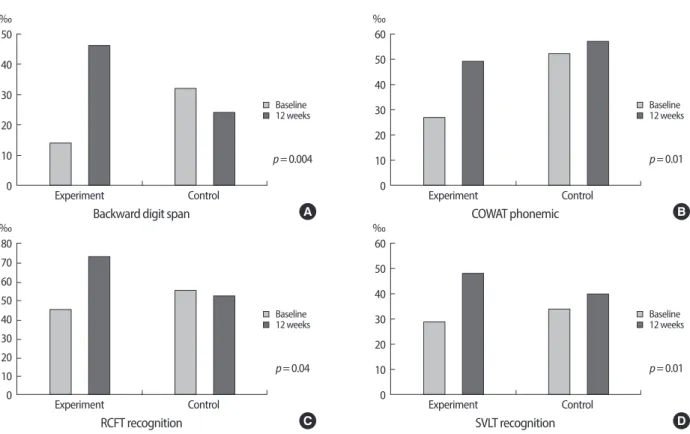
이번 연구에 등록된 기억형 경도인지장애는 실험군 6명, 대조군 8명이었다. 양 군의 나이는 실험군과 대조군이 각각 64.67±5.24와 65.00±8.75로 군별 차이는 없었고, 교육년수는 대조군이 13.5년으 로 실험군의 8년보다 오히려 높았다. 경도인지장애군만을 분석한 결과는 실험군이 인지영역 여러 분야에서 대조군에 비해 뚜렷한 향 상 효과를 보였는데, K-BNT, 언어기억력, 시각기억력, 시공간능력, stroop 검사에서 대조군에 비해 유의한 향상 효과를 보였다(Fig. 2).
언어 기억력검사(SVLT)도 시행을 거듭할수록 기억력이 점점 좋아 지는 반복자극에 대한 향상 효과를 보였다(Table 3). 알츠하이머 치 매환자는 이러한 변화가 통계적으로 유의하게 관찰되지는 않았다.
고 찰
본 연구를 통해서 규칙적인 컴퓨터를 이용한 인지 훈련 프로그 램을 시행하면 다영역에 걸친 인지기능의 향상을 보임을 알 수 있었
다. 집단으로 진행되는 전통적인 인지훈련에 비하여, 컴퓨터를 이용 한 인지치료의 장점은 환자가 스스로 실시하고 배워 나감으로써 치 료자의 개입시간이 단축되고 수행결과에 대하여 환자에게 즉시 feedback을 줄 수 있어 치료에 대한 동기를 부여할 뿐 아니라 객관적 이고 정확한 결과를 얻을 수 있고 지속적으로 데이터를 보관할 수
있다. 컴퓨터 인지프로그램을 치매에 도입한 것은 1996년이지만, 그 결과에 대한 보고는 매우 다양하다[8, 20, 21]. 이번 연구를 통해서 컴퓨터 인지 프로그램이 전반적 인지향상에 도움이 되는 것을 알 수 있었는데, 특히 계산능력, 언어기억력, 시각적 기억력, 시공간 능 력의 향상을 보였다. 이런 변화는 경도인지장애군만 별도로 분석했 을 때 향상 정도가 더욱 두드러졌는데, 실험군에서 기억력 검사는 일차시행보다 삼차시행에서 대조군에 비해 학습효과와 함께 향상 을 기록하는 것으로 보아 컴퓨터 인지프로그램을 시행하는 것은 능동적 시각 인지자극을 통한 전반적 뇌기능에 좋은 효과를 주는 것으로 생각할 수 있었다. 특히 기억력과 계산능력은 평상시 우리가 간편하게 사용할 수 있는 디지털 기계 등의 발달로 인해 가장 사용 이 적어진 부분으로 알려져 왔는데, 이번연구를 통해 본 반복적인 훈련용 컴퓨터 프로그램이 가지고 오는 이런 결과들이 앞으로 환 자에게 어떤 영향을 줄지 기대해 볼 만하다. 지금까지 치매와 뇌 손 상 환자들을 대상으로 하여 인지장애의 악화를 지연시킬 수 있는 재활치료 방법들로 기억력 훈련 프로그램이 주로 연구되었고, 경도 인지장애군에서 기억을 위한 인지 전략들을 잘 이용할 경우 기억력 을 호전시킬 수 있는 것으로 밝혀져 왔다[22]. 노인에서의 기억력 저 하는 주의력 장애로 인한 작업기억력의 저하가 주원인이 될 수 있 Table 3. SVLT result of patient with mild cognitive disorder
Experiment (N= 6) Control (N= 8) p value Mean± SD Median Mean± SD Median SVLT recall
trial 1
Baseline After Change p value
4.00± 0.89 4.83± 0.75 0.83± 0.98
4.00 5.00 1.00
5.00± 1.07 5.50± 0.53 0.50± 1.20
5.00 5.50
0.50 0.6345*
0.1875† 0.2753‡
SVLT recall trial 2 Baseline
After Change p value
5.67± 0.52 7.17± 1.47 1.50± 1.22
6.00 6.50 1.00
6.50± 1.20 7.25± 1.16 0.75± 1.39
6.50 7.00
1.00 0.3908*
0.0301‡ 0.1250† SVLT recall
trial 3 Baseline After Change
6.33± 0.52 8.33± 1.03 2.00± 0.89
6.00 9.00 2.00
7.25± 1.16 8.25± 0.89 1.00± 0.76
7.00 8.50
1.00 0.0426§
p value 0.0028‡ 0.0072‡
*Wilcoxon’s rank sum test; †Wilcoxon signed rank test; ‡Fisher’s exact test; §Two-sam- ple t-test.
SVLT, Seoul Verbal Learning Test.
Fig. 2. Neuropsychological results after using computer-based cognitive training program in mild cognitive disorder group. There were marked im- provement in attention, visuo-spatial and verbal memory function after computer-based cognitive program.
COWAT, Controlled Oral Word Association Test; RCFT, Rey Complex Figure test; SVLT, Seoul Verbal Learning Test.
50 40 30 20 10 0
‰
Experiment Control
Backward digit span
p= 0.004 Baseline 12 weeks
A
60 50 40 30 20 10 0
‰
Experiment Control
COWAT phonemic
p= 0.01 Baseline 12 weeks
B 80
70 60 50 40 30 20 10 0
‰
Experiment Control
RCFT recognition
p= 0.04 Baseline 12 weeks
C
60 50 40 30 20 10 0
‰
Experiment Control
SVLT recognition
p= 0.01 Baseline 12 weeks
D
다고 알려져 있어[23], 이번 연구에서 기획된 종합적인 인지 프로그 램을 손과 디지털 도구를 이용하였을 때는 환자의 인지기능 향상 에 효과적일 것으로 예상된다.
이번 연구의 제한점으로 기존 연구들과 마찬가지로, 소규모로 진 행하여 표본 수에서 가지는 통계학적으로 유효한 결과를 예측하는 것이 미진하였다. 프로그램 운용에 있어 초기 개발의 목적과 달리, 노령자인 참여대상자들이 스스로 하지 못하고 컴퓨터 프로그램 조 작을 도와줄 보조자가 필요했다. 컴퓨터를 기반으로 한 인지기능 향상 프로그램의 개발방향은 기기에 대한 좀 더 손쉬운 접근 방법 의 개발이 필요하다고 생각되었다. 이러한 도구의 제한적 사용 때문 에 결과적으로 이 연구를 대규모로 진행하지 못했다. 이미 경도인 지장애군의 인지프로그램에 대한 단기간 효과는 많이 알려져 있는 데 인지자극은 비록 제한적인 영역이지만 강력한 효과를 낸다고 알 려져 있다[22]. 그러나 아직까지 치매단계로 진입해 있는 환자를 대 상으로 어떤 효과를 나타내는지는 이견이 많다[24]. 우리 연구에서 도 치매환자를 대상으로 시행하였을 때 한 시간 정도의 프로그램 진행이 집중력 저하로 어려웠다. 따라서 이번 연구에서 치매군보다 는 경도인지장애 환자가 많이 등록되어 양 군의 비교 결과를 보기 가 어려웠다. 컴퓨터 인지프로그램의 장기적 효과성 검증을 위한 프로그램 시행 직후와 6개월 이상의 재검사가 필요한데, 단기간 효 과를 확인하는 것으로 그쳐 이에 대한 후속연구를 진행하는 것이 필요할 것으로 생각한다.
이번 연구는 컴퓨터 인지 훈련 프로그램을 이용하고 체계적으로 그 효과를 본 국내에서 시행된 첫 번째 연구이다.
이번 연구 결과는 추후에 다양한 방법을 이용한 치매군별, 임상 치매 단계별 인지훈련 프로그램의 효과성에 대한 좋은 결과를 예 상할 수 있는 가능성을 제시하였다.
주의할 점을 환자의 인지장애의 상태를 정확히 파악하지 못하였 을 때, 환자에 대한 개별적인 치료가 실시되지 못하고 주어진 프로 그램에만 의존할 위험이 있으며, 컴퓨터가 인간의 사회적 관계 속에 서 일어나는 모든 것들을 재현할 수 없다는 점이다. 본 연구 결과 치 료 전 기초검사에서는 각 검사 항목에서 대조군과 실험군 사이에 통계학적으로 유의한 인지기능의 차이가 없었으나 치료 후 단기 언 어성 기억력, 단기 시지각기억력, 청각적 및 시각적 주의 집중력에서 향상되어 컴퓨터를 이용한 인지훈련 프로그램은 인지기능 저하 환 자에게 증진에 효과가 있음을 확인할 수 있었다. 이에 저자들은 여 러 제한점에도 불구하고, 경도인지장애를 가진 환자에게 인지 프로 그램의 적용과 함께 장기적 효과성 분석이 필요할 것으로 생각한 다. 또한 임상치매 단계별 맞춤형 프로그램의 도입이 반드시 필요함 을 주장하는 바이다.
참고문헌
1. Wimo A, Jonsson L, Bond J, Prince M, Winblad B. The worldwide eco- nomic impact of dementia 2010. Alzheimers Dement 2013; 9: 1-11 e13.
2. Muayqil T, Camicioli R. Systematic review and meta-analysis of combi- nation therapy with cholinesterase inhibitors and memantine in Alzheim- er’s disease and other dementias. Dement Geriatr Cogn Dis Extra 2012;
2: 546-72.
3. Royall DR, Lauterbach EC, Kaufer D, Malloy P, Coburn KL, Black KJ.
The cognitive correlates of functional status: a review from the Commit- tee on Research of the American Neuropsychiatric Association. J Neuro- psychiatry Clin Neurosci 2007; 19: 249-65.
4. Yamaguchi H, Maki Y, Yamagami T. Overview of non-pharmacological intervention for dementia and principles of brain-activating rehabilita- tion. Psychogeriatrics 2010; 10: 206-13.
5. Clare L, Wilson BA, Carter G, Roth I, Hodges JR. Awareness in early- stage Alzheimer’s disease: relationship to outcome of cognitive rehabilita- tion. J Clin Exp Neuropsychol 2004; 26: 215-26.
6. Woolf CJ, Salter MW. Neuronal plasticity: increasing the gain in pain.
Science 2000; 288: 1765-9.
7. Yu F, Rose KM, Burgener SC, et al. Cognitive training for early-stage Al- zheimer’s disease and dementia. J Gerontol Nurs 2009; 35: 23-9.
8. Zhuang JP, Fang R, Feng X, Xu XH, Liu LH, Bai QK, et al. The impact of human-computer interaction-based comprehensive training on the cog- nitive functions of cognitive impairment elderly individuals in a nursing home. J Alzheimers Dis 2013; 36: 245-51.
9. Glisky EL, Schacter DL. Long-term retention of computer learning by patients with memory disorders. Neuropsychologia 1988; 26: 173-8.
10. Palmese CA, Raskin SA. The rehabilitation of attention in individuals with mild traumatic brain injury, using the APT-II programme. Brain Inj 2000; 14: 535-48.
11. Petersen RC, Doody R, Kurz A, Mohs RC, Morris JC, Rabins PV, et al.
Current concepts in mild cognitive disorder. Arch Neurol 2001; 58: 1985- 92.
12. McKhann G DD, Folstein M, Katzman R, Price D, Stadian, EM. Clinical diagnosis of Alzheimer’s disease: report of the NINCDS-ADRDA work group under the auspices of department of health and human services task force on Alzheimer’s disease. Neurology 1984; 34: 6.
13. Y. K. A normative study of the Korean-Mini Mental State Examination (K-MMSE) in the elderly. Korean J Psychol 2006; 25: 12.
14. JC M. Clinical dementia rating: a reliable and valid diagnostic and stag- ing measure for dementia of the Alzheimer type. Int Psychogeriatr 1997;
9: 4.
15. Kang YW, Na DL. Seoul neuropsychological screening battery. Incheon:
Human Brain Research & Consulting Co., 2003.
16. Kim H, Na DL. Normative data on the Korean version of the Boston Nam- ing Test. J Clin Exp Neuropsychol 1999; 21: 127-33.
17. Meyers KR. Rey Complex Figure Test and recognition trial: professional manual. Lutz FL: Psychological Assessment Resources, 1995.
18. Kang YW, Chin J, Na DL, Lee J, Park JS. A normative study of the Kore- an version of Controlled Oral Word Association Test (COWAT) in the el- derly. Kor J Clin Psychol 2000; 19: 8.
19. Lee JH, Kang YW, Na DL. Efficiencies of Stroop Interference Indexes in Healthy Older Adults and Dementia Patients. Kor J Clin Psychol 2000;
19: 12.
20. Hofmann M, Hock C, Muller-Spahn F. Computer-based cognitive train-
ing in Alzheimer’s disease patients. Ann N Y Acad Sci 1996; 777: 249-54.
21. Lee GY, Yip CC, Yu EC, Man DW. Evaluation of a computer-assisted er- rorless learning-based memory training program for patients with early Alzheimer’s disease in Hong Kong: a pilot study. Clin Interv Aging 2013;
8: 623-33.
22. Li H, Li J, Li N, Li B, Wang P, Zhou T. Cognitive intervention for persons with mild cognitive disorder: a meta-analysis. Ageing Res Rev 2011; 10:
285-96.
23. Jansen DA, Keller ML. Identifying the attentional demands perceived by elderly people. Rehabil Nurs 1998; 23: 12-20.
24. Aguirre E, Woods RT, Spector A, Orrell M. Cognitive stimulation for dementia: a systematic review of the evidence of effectiveness from ran- domised controlled trials. Ageing Res Rev 2013; 12: 253-62.