Retrieval of Distally Migrated Coils with Detachable Intracranial Stent during Coil Embolization of Cerebral Aneurysm
Devendra Pal Singh1, Soon Chan Kwon2, Lijin Huang3, Won Joo Lee2
1Department of Neurosurgery, SPS Apollo Hospital, Ludhiana, India
2Department of Neurosurgery, Ulsan University Hospital, University of Ulsan College of Medicine, Ulsan, Korea
3Department of Neurosurgery, The 3rd affiliated Hospital of Sothern Medical University, Guangzhou, China
Migration of coils during endovascular procedures is a rare, but well-known complication. We are reporting two cases of successfully retrieving mi- grated coil using detachable intracranial stent.
In both of our cases there was distal migration of coil during the intra- cranial aneurysm coiling procedure. The Solitaire® AB stent (Covidien, Irvine, CA, USA) was used to retrieve those coils. The stent was passed distal to the migrated coil using standard technique. It was then partially deployed and gradually withdrawn along with the entangled coil.
Coil retrieval using the fully retrievable intracranial stent is a very simple, safe and easily available alternative for retrieval of distally migrated coil.
J Cerebrovasc Endovasc Neurosurg.
2016 March;18(1):48-54 Received : 19 January 2015 Revised : 12 August 2015 Accepted : 14 September 2015 Correspondence to Soon Chan Kwon Department of Neurosurgery, Ulsan University Hospital, University of Ulsan College of Medicine, 877 Bangeojinsunhwan-doro, Dong-gu, Ulsan 44033, Korea
Tel : 82-52-250-7139 Fax : 82-52-250-7138 E-mail : [email protected],
ORCID : http://orcid.org/0000-0003-4885-4156
This is an Open Access article distributed under the terms of the Creative Commons Attribution Non- Commercial License (http://creativecommons.org/li- censes/by-nc/3.0) which permits unrestricted non- commercial use, distribution, and reproduction in any medium, provided the original work is properly cited.
Keywords Endovascular procedure, Complication, Intracranial aneurysm, Stent
INTRODUCTION
With the coming up of endovascular coiling as a standard therapy for treatment of cerebral aneurysms, complications that are related to it are also coming up. Distal migration of the coil is one of the serious complications. If not managed quickly, it can lead to thrombus formation and vessel occlusion resulting in- to cerebral infarction.
Various techniques have been described to address this complication, using variety of devices.1-12)14)16)17)19-21)
We describe here a technique that was used in two patients for retrieval of distally migrated coil using the Solitaire® AB stent.
CASE REPORT 1
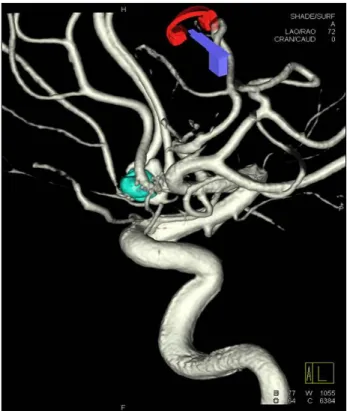
A 57-year-old woman underwent balloon assisted coil embolization, for ruptured anterior communicat- ing (A-com.) aneurysm. Her angiogram one year later showed residual aneurysmal sac (Fig. 1).
Stent-assisted coiling of the remnant sac was plan- ned (Fig. 2). 75 mg of clopidogrel and 100 mg of as- pirin was given for 5 days before the procedure.
During the procedure a coil (MicroPlex HyperSoft Helical 1.5 × 1 mm, Microvention, Tustin, CA, USA) migrated into the contralateral anterior cerebral artery (ACA) (Fig. 3). Initially it got lodged into the right A2 segment but it migrated further and finally it got lodged into the distal callosomarginal artery (Fig. 4),
Fig. 1. One year, follow-up 3-dimensional cerebral angiography (showed trifurcation of A2 and residual aneurysmal sac of A-com aneurysm).
Fig. 2. Intra-operative angiography. A stent was placed around aneurysmal neck and further coil was placed in aneurysmal sac.
Fig. 3. Angiography showing the migrated filling coils to the proximal anterior cerebral artery.
causing its occlusion. We removed undetached stent, and a microcatheter (Prowler Plus Select, Codman Neurovascular, Raynham, MA, USA), which was ini- tially used for stent-assistance, was negotiated beyond the occluded ACA (Fig. 5), and Solitaire® AB 4 × 15 mm stent was passed through it distal to the occluded artery and was deployed (Fig. 6). It was then gradu- ally withdrawn, entangling the migrated coil and was captured into the microcatheter. Microcatater along with the stent was then withdrawn, retrieving the dis- placed coil along with it (Fig. 7).
CASE REPORT 2
A 44-year-old female presented with SAH, Hunt and Hess grade 2. Her cerebral angiogram showed the right posterior communicating (P-com.) artery aneur- ysm, sized 2.2 × 2.2 × 6.1 mm (Fig. 8). After place- ment of 3 coils, there was still some space remning near the neck. A DeltaPlush (Codman Neurovascular,
Raynham, MA, USA) 1.5 × 2 mm coil was used to pack the sac. After the coil was detached it got dislodged from the aneurysm and migrated into the right MCA branch (Fig. 9). A microcatheter (Rebar18, Covidien, Irvine, CA, USA) was passed beyond the embolic coil
A B C
Fig. 4. Cerebral angiography (A) and micro-angiography (B, C) showing further migration of coil into distal anterior cerebral artery.
A B
Fig. 5. Micro-angiography (A, B) showing distally navigated microcatheter beyond migrated coil.
and a 4 × 15 mm sized Solitaire® Stent was passed through it distal to the migrated coil. The stent was
then, successfully withdrawn along with the micro- catheter retrieving the entangled coil along with it
Fig. 7. Photograph showing the removed Solitaire stent with
the coil. Fig. 8. Initial cerebral angiography showing a right P-com.
aneurysm.
A B
Fig. 6. Roadmap images (A, B) showing deployed stent with entangled coil.
(Fig. 10, 11).
DISCUSSION
Coil migration is a well-known complication asso- ciated with endovascular coiling. It can cause brain is- chemia due to distal vessel occlusion. Factor that pre- dispose to this complication are wide neck aneur-
ysms, small fundus to neck ratio, tortuous vessel, un- stable microcatheter position, use of undersized coil, premature detachment and high flow conditions. Despite continual improvements in materials and techniques, the risk of coil misplacement or migration, even in the hands of experienced and skilled operators, remains.
Various strategies to remove displaced coils have
Fig. 9. Angiography showing the migrated filling coils to the middle cerebral artery (arrow).
A B
Fig. 10. Roadmap images (A, B) showing distally navigated microcatheter beyond migrated coil and deployed stent with coil.
been reported,1-12)14)16)17)19-21) including surgery,15)18) but none of them appears easy and reliable.
Already 2 cases of coil retrieval using a Solitaire® stent have been reported in the English literature.5)9) In this case report, we have presented two cases in which there was an accidental coil migration during aneurysmal coiling. In both the cases Solitaire® AB stent was successfully used to retrieve the distally mi-
grated coil. The Stent was carried distal to the mi- grated coil and was expanded. The expanded stent was then gradually withdrawn, leading to the en- tangling of the migrated coil into the struts of the stent. The Stent was then withdrawn along with the migrated coil.
Initially the Solitaire® stent, which is a self-expand- ing and fully retrievable even after full deployment, was developed and designed as neurovascular re- construction device for endovascular treatment of wide-necked and complex intracranial aneurysms.
But, nowadays due to its peculiar structural design, it is also used for mechanical thrombectomy.13)
We found that the Solitaire® AB stent can be used to retrieve distally migrated coil in vessels of small di- ameter where the use of other devices can be dangerous or technically demanding. Owing to its ParametricTM design (an overlapping stent-based technology), its struts can overlap, at least partially, when the stent is compressed. These overlapping struts allow the stent to be crimped to a smaller initial delivery diameter than may be achieved with non-overlapping designs for given metal density. This reduces the delivery di- ameter which allows the stent to be placed in the dis- tal small tortuous vessels and thus it can be safely
Fig. 11. The final angiogram showing totally occluded aneur- ysm and with well-preserved distal middle cerebral artery flows.
used to retrieve coils that have migrated to distal ves- sels, which may not be possible with other alternatives.
Problems that have been associated with coil retriev- ing devices are lack of universal availability, compli- cations associated with them, and most importantly, because they are very infrequently used, they could be difficult to handle.
Micro-snare and Merci Retriever (Stryker; Kalamazoo, MI, USA), especially when used in small diameter vessels can cause vessel wall injury,3)4)16) Although we have used Solitaire® stent for coil retrieval in only two cases we did not face any problem using it. But we think that the complications that could be asso- ciated with it would not be different from those that are encountered, when it is used for mechanical thrombolysis and there, it has been found to be hav- ing low complication rate.
Because of its frequent uses, such as vascular re- construction for aneurysm coiling and mechanical thrombectomy, Solitaire® stent is readily available is easy to handle as compared to other devices.
Although using a Solitaire® stent for retrieval of dis- tally migrated coils is off-label use, the technique with
a Solitaire® stent provides us a simple and safe meth- od to retrieve the distally migrated coil, especially for the coils that get lodged in distal small vessels. It has one more advantage of universal availability. Therefore, it could be considered as an option for removing mi- grated coils.
CONCLUSION
Retrieval of migrated coil using Solitaire® AB stent is a safe, simple and effective technique in selected cases. And can be considered as an option for coils that have migrated distally.
Disclosure
The authors report no conflict of interest concerning the materials or methods used in this study or the findings specified in this paper.
REFERENCES
1. Cekirge S, Saatci I, Firat MM, Balkanci F. Retrieval of an embolization coil from the internal carotid artery us- ing the Amplatz microsnare retrieval system. Cardiovasc Intervent Radiol. 1995 Jul-Aug;18(4):262-4.
2. Fiorella D, Albuquerque FC, Deshmukh VR, McDougall CG. Monorail snare technique for the recovery of stretch- ed platinum coils: technical case report. Neurosurgery.
2005;57(1 Suppl):E210; discussion E210.
3. Graves VB, Rappe AH, Smith TP, Sepetka I, Ahuja A, Strother CM. An endovascular retrieving device for use in small vessels. AJNR Am J Neuroradiol. 1993 Jul-Aug;14(4):804-8.
4. Henkes H, Lowens S, Preiss H, Reinartz J, Miloslavski E, Kuhne D. A new device for endovascular coil retrieval from intracranial vessels: alligator retrieval device. AJNR Am J Neuroradiol. 2006 Feb;27(2):327-9.
5. Hopf-Jensen S, Hensler HM, Preiß M, Müller-Hülsbeck S. Solitaire® stent for endovascular coil retrieval. J Clin Neurosci. 2013 Jun;20(6):884-6.
6. Koseoglu K, Parildar M, Oran I, Memis A. Retrieval of intravascular foreign bodies with goose neck snare. Eur J Radiol. 2004 Mar;49(3):281-5.
7. Lee CY. Use of wire as a snare for endovascular re- trieval of displaced or stretched coils: rescue from a technical complication. Neuroradiology. 2011 Jan;53(1):31-5.
8. Liu KC, Ding D, Starke RM, Geraghty SR, Jensen ME.
Intraprocedural retrieval of migrated coils during endo- vascular aneurysm treatment with the Trevo Stentriever device. J Clin Neurosci. 2014 Mar;21(3):503-6.
9. O'Hare AM, Rogopoulos AM, Stracke PC, Chapot RG.
Retrieval of displaced coil using a Solitaire(®) stent.
Clin Neuroradiol. 2010 Dec;20(4):251-4.
10. Oh J, Kim J, Hong S, Hu C, Pyen J, Whang K, et al.
Retrieval of unintended migrated detached coil: case report.
J Cerebrovasc Endovasc Neurosurg. 2014 Sep;16(3):268-74.
11. Prestigiacomo CJ, Fidlow K, Pile-Spellman J. Retrieval of a fractured Guglielmi detachable coil with use of the Goose Neck snare "twist" technique. J Vasc Interv Radiol.
1999 Oct;10(9):1243-7.
12. Raftopoulos C, Goffette P, Billa RF, Mathurin P.
Transvascular coil hooking procedure to retrieve an un- raveled Guglielmi detachable coil: technical note.
Neurosurgery. 2002 Apr;50(4):912-4; discussion 914-5.
13. Saver JL, Jahan R, Levy EI, Jovin TG, Baxter B, Nogueira R, et al. SOLITAIRETM with the intention for thrombectomy (SWIFT) trial: design of a randomized, controlled, multicenter study comparing the SOLITAIRETM Flow Restoration device and the MERCI Retriever in acute ischaemic stroke. Int J Stroke. 2014 Jul;9(5):658-68.
14. Schütz A, Solymosi L, Vince GH, Bendszus M. Proximal stent fixation of fractured coils: technical note. Neuroradiology.
2005 Nov;47(11):874-8.
15. Shin YS, Lee KC, Kim DI, Lee KS, Huh SK. Emergency sur- gical recanalisation of A1 segment occluded by a Guglielmi detachable coil. J Clin Neurosci. 2000 May;7(3):259-62.
16. Smith TP, Graves VB, Halbach VV, Higashida RT, Fraser KW, Dowd CF, et al. Microcatheter retrieval de- vice for intravascular foreign body removal. AJNR Am J Neuroradiol. 1993 Jul-Aug;14(4):809-11.
17. Standard SC, Chavis TD, Wakhloo AK, Ahuja A, Guterman LR, Hopkins LN. Retrieval of a Guglielmi de- tachable coil after unraveling and fracture: case report and experimental results. Neurosurgery. 1994 Nov;35(5):994-8;
discussion 999.
18. Thornton J, Dovey Z, Alazzaz A, Misra M, Aletich VA, Debrun GM, et al. Surgery following endovascular coiling of intracranial aneurysms. Surg Neurol. 2000 Nov;54(5):352-60.
19. Vora N, Thomas A, Germanwala A, Jovin T, Horowitz M. Retrieval of a displaced detachable coil and intra- cranial stent with an L5 Merci Retriever during endo- vascular embolization of an intracranial aneurysm. J Neuroimaging. 2008 Jan;18(1):81-4.
20. Watanabe A, Hirano K, Mizukawa K, Kamada M, Okamura H, Suzuki Y, et al. Retrieval of a migrated detachable coil--case report. Neurol Med Chir (Tokyo).
1995 Apr;35(4):247-50.
21. Zoarski GH, Bear HM, Clouston JC, Ragheb J. Endovascular extraction of malpositioned fibered platinum microcoils from the aneurysm sac during endovascular therapy.
AJNR Am J Neuroradiol. 1997 Apr;18(4):691-5.