On March 11, 2020, the World Health Organization (WHO) de- clared the coronavirus disease 2019 (COVID-19) a pandemic.
Until May 20, 2020, there were more than 4.9 million reported COVID-19 cases and 324869 deaths across more than 200 coun- tries. Currently, there are no specific therapeutic agents for treat- ing severe acute respiratory syndrome coronavirus 2 (SARS- CoV-2) infection. Potential drugs for treating COVID-19 include
human immunodeficiency virus (HIV) type 1 aspartate protease inhibitors, such as lopinavir and darunavir, which have been shown to inhibit SARS-CoV in vitro, the cause of SARS in hu- mans.
1-4Cobicistat-boosted darunavir is a boosted protease in- hibitor in a fixed-dose combination that is approved for use in treating HIV type 1 infection.
5,6Drug efficacy evaluation in cell models in vitro have revealed that darunavir is active against SARS-CoV-2.
2At present, however, there are no clinical data on the use of these drugs for COVID-19.
Cobicistat-boosted darunavir is stable as a suspension,
7so it was considered to be suitable for administration as a nasogas- tric tube to critical ill patients. Here, we evaluated the effects of darunavir-cobicistat on the clinical outcomes of critically ill patients with COVID-19 using a risk stratification model that adjusted for potential differences between the darunavir-cobi- cistat treated and non-darunavir-cobicistat treated individuals.
We retrospectively reviewed the medical records of all adults with laboratory-confirmed SARS-CoV-2 infection who were sub- sequently admitted to an intensive care unit (ICU) at one of the
Use of Darunavir-Cobicistat as a Treatment Option for Critically Ill Patients with SARS-CoV-2 Infection
Eun Jin Kim
1*, Sun Ha Choi
2*, Jae Seok Park
3, Yong Shik Kwon
3, Jaehee Lee
4, Yeonjae Kim
5, Shin Yup Lee
2, and Eun Young Choi
61Division of Pulmonary and Critical Care Medicine, Daegu Catholic University Medical Center, Daegu;
2Division of Pulmonary and Critical Care Medicine, Kyungpook National University Chilgok Hospital, Daegu;
3Division of Pulmonology, Department of Internal Medicine, Keimyung University Dongsan Hospital, Keimyung University School of Medicine, Daegu;
4Department of Internal Medicine, School of Medicine, Kyungpook National University, Daegu;
5Division of Pulmonary and Critical Care Medicine, Daegu Fatima Hospital, Daegu;
6Division of Pulmonary and Critical Care Medicine, Yeungnam University Medical Center, Daegu, Korea.
We retrospectively reviewed patients with severe acute respiratory syndrome coronavirus 2 (SARS-CoV-2) infections who were admitted to an intensive care unit in Daegu, South Korea. The outcomes of patients who did (cases) or did not (controls) receive darunavir-cobicistat (800–150 mg) therapy were compared. Fourteen patients received darunavir-cobicistat treatment, and 96 re- ceived other antiviral therapy (controls). Overall, the darunavir-cobicistat group comprised patients with milder illness, and the crude mortality rate of all patients in the darunavir-cobicistat group was lower than that in the controls [odds ratio (OR) 0.20, 95%
confidence interval (CI) 0.04–0.89, p=0.035]. After 1:2 propensity-score matching, there were 14 patients in the darunavir-cobici- stat group, and 28 patients in the controls. In propensity score-matched analysis, the darunavir-cobicistat group had lower mor- tality than the controls (OR 0.07, 95% CI 0.01–0.52, p=0.009). In conclusion, darunavir-cobicistat therapy was found to be associ- ated with a significant survival benefit in critically ill patients with SARS-CoV-2 infection.
Key Words: Coronavirus disease 2019, severe acute respiratory syndrome coronavirus 2, darunavir-cobicistat
pISSN: 0513-5796 · eISSN: 1976-2437
Received: May 21, 2020 Revised: July 11, 2020 Accepted: July 28, 2020
Corresponding author: Eun Young Choi, MD, PhD, Division of Pulmonary and Critical Care Medicine, Yeungnam University Medical Center, 170 Hyeonchung-ro, Nam-gu, Daegu 42415, Korea.
Tel: 82-53-640-6540, Fax: 82-53-620-3849, E-mail: [email protected]
*Eun Jin Kim and Sun Ha Choi contributed equally to this work.
•The authors have no potential conflicts of interest to disclose.
© Copyright: Yonsei University College of Medicine 2020
This is an Open Access article distributed under the terms of the Creative Com- mons Attribution Non-Commercial License (https://creativecommons.org/licenses/
by-nc/4.0) which permits unrestricted non-commercial use, distribution, and repro- duction in any medium, provided the original work is properly cited.
Yonsei Med J 2020 Sep;61(9):826-830 https://doi.org/10.3349/ymj.2020.61.9.826
seven tertiary or referral hospitals in Daegu, South Korea be- tween February 18 and April 5, 2020. A WHO guidance docu- ment defines laboratory confirmation of SARS-CoV-2 infection as a positive result of a real-time reverse transcriptase-poly- merase chain reaction assay of samples obtained from nasal and pharyngeal swabs. The first part of this study was a retro- spective cohort study that included all patients who were criti- cally ill with laboratory-confirmed SARS-CoV-2 infection. Co- bicistat-boosted darunavir was assigned to patients who failed other antiviral treatments or at the physician’s discretion. The outcomes of patients who did (cases) or did not (controls) receive darunavir-cobicistat (800–150 mg) therapy were compared.
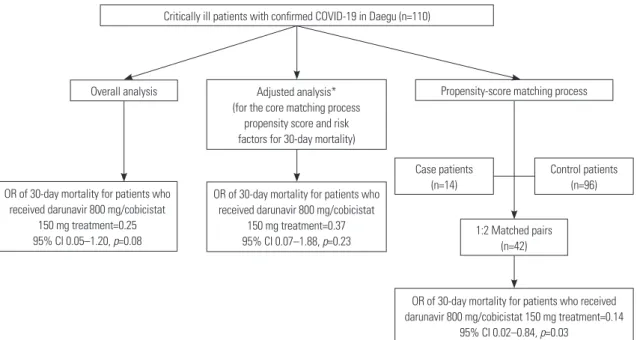
The second part of the investigation comprised a matched (1:2) case-control study, with the patients who did or did not receive darunavir-cobicistat therapy designated as “cases” and “con- trols” (Fig. 1), respectively. This study was conducted in accor- dance with the tenets of the Declaration of Helsinki and was re- viewed and approved by the Institutional Review Board at each hospital. The requirement for informed consent was waived be- cause of the retrospective study design (IRB Number: YUH IRB 2020-03-057, IRB Institution: Yeungnam University Medical Center).
The present study included 110 critically ill patients who re- ceived intensive care for COVID-19, of whom 14 received da- runavir-cobicistat treatment and 96 received other antiviral therapy.
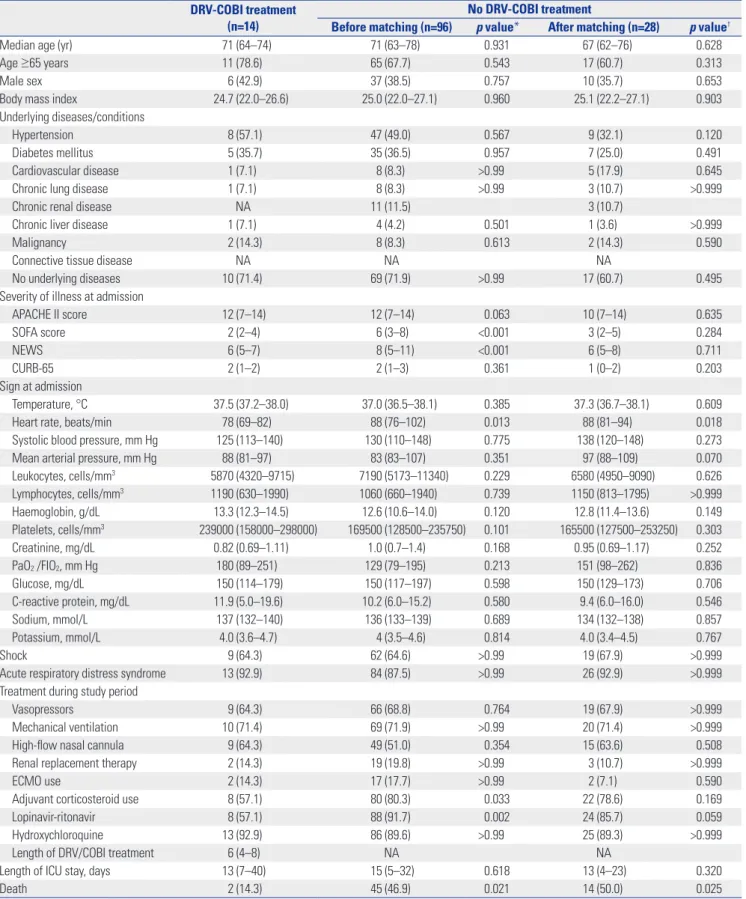
There were no significant intergroup differences with regard to age, sex ratio, body mass index, and underlying disease/con- ditions between the groups who did and did not receive daruna- vir-cobicistat treatment (Table 1). Sequential Organ Failure As- sessment (SOFA) scores {median score 2 [interquartile range (IQR) 2–4] vs. 6 [IQR 3–8], p<0.001} and National Early Warning
Scores [median score 6 (IQR 5–7) vs. 8 (IQR 5–11), p<0.001] were significantly lower in the darunavir-cobicistat group than in the controls, indicating that the darunavir-cobicistat group had pa- tients with milder illness. The incidence of shock and acute re- spiratory distress syndrome (ARDS) during hospitalization did not differ between the two groups. There were no between-group differences in the length of ICU stay or survival, although the number of deaths was significantly lower in the darunavir-co- bicistat treatment group (14.3% vs. 46.9%, p=0.021). There were also significant differences in the numbers of patients who sur- vived and were discharged from the ICU: 10 (83.3%) in the da- runavir-cobicistat group and 29 (39.2%) in the controls (p=0.004).
The crude mortality rates of all patients and ARDS patients in the darunavir-cobicistat group were lower than those in the con- trols [odds ratio (OR) 0.20, 95% confidence interval (CI) 0.04–
0.89, p=0.035 and OR 0.17, 95% CI 0.04–0.79, p=0.024, respec- tively) (Table 2). Mortality rates after adjusting for variables, such as age ≥65 years and SOFA score, were the same in both groups.
Two variables, age ≥65 years and SOFA score, were selected for propensity-score matching based on outcomes of the univari- ate and multivariate analyses. After 1:2 propensity-score match- ing, there were 14 patients in the darunavir-cobicistat group and 28 in the controls. Table 1 shows the patient characteristics for both groups after matching the propensity scores; the two groups were balanced. The number of deaths was significant- ly lower in the darunavir-cobicistat group (14.3% vs. 50.0%, p=
0.025). In the propensity score-matched analysis, the darunavir- cobicistat group had lower mortality than the controls (OR 0.09, 95% CI 0.01–0.52, p=0.009) (Table 2). Furthermore, the daruna- vir-cobicistat group, which comprised ARDS patients, had lower mortality than the controls (OR 0.08, 95% CI 0.01–0.50, p=0.008).
To determine the effect of darunavir-cobicistat on COVID-19,
Fig. 1. Schematic representation of the data analysis plan for the cohort study and the matched case-control study. *Adjusted aged ≥65 years, Sequen- tial Organ Failure Assessment. OR, odds ratio; CI, confidence interval.
Critically ill patients with confirmed COVID-19 in Daegu (n=110)
Propensity-score matching process
Case patients (n=14)
1:2 Matched pairs (n=42)
Control patients (n=96) Adjusted analysis*
(for the core matching process propensity score and risk factors for 30-day mortality)
OR of 30-day mortality for patients who received darunavir 800 mg/cobicistat
150 mg treatment=0.37 95% CI 0.07–1.88, p=0.23
OR of 30-day mortality for patients who received darunavir 800 mg/cobicistat 150 mg treatment=0.14
95% CI 0.02–0.84, p=0.03 OR of 30-day mortality for patients who
received darunavir 800 mg/cobicistat 150 mg treatment=0.25 95% CI 0.05–1.20, p=0.08
Overall analysis
Table 1. Baseline Demographics and Clinical Characteristics (n=110) of the Study Population DRV-COBI treatment
(n=14)
No DRV-COBI treatment
Before matching (n=96) p value* After matching (n=28) p value†
Median age (yr) 71 (64–74) 71 (63–78) 0.931 67 (62–76) 0.628
Age ≥65 years 11 (78.6) 65 (67.7) 0.543 17 (60.7) 0.313
Male sex 6 (42.9) 37 (38.5) 0.757 10 (35.7) 0.653
Body mass index 24.7 (22.0–26.6) 25.0 (22.0–27.1) 0.960 25.1 (22.2–27.1) 0.903
Underlying diseases/conditions
Hypertension 8 (57.1) 47 (49.0) 0.567 9 (32.1) 0.120
Diabetes mellitus 5 (35.7) 35 (36.5) 0.957 7 (25.0) 0.491
Cardiovascular disease 1 (7.1) 8 (8.3) >0.99 5 (17.9) 0.645
Chronic lung disease 1 (7.1) 8 (8.3) >0.99 3 (10.7) >0.999
Chronic renal disease NA 11 (11.5) 3 (10.7)
Chronic liver disease 1 (7.1) 4 (4.2) 0.501 1 (3.6) >0.999
Malignancy 2 (14.3) 8 (8.3) 0.613 2 (14.3) 0.590
Connective tissue disease NA NA NA
No underlying diseases 10 (71.4) 69 (71.9) >0.99 17 (60.7) 0.495
Severity of illness at admission
APACHE II score 12 (7–14) 12 (7–14) 0.063 10 (7–14) 0.635
SOFA score 2 (2–4) 6 (3–8) <0.001 3 (2–5) 0.284
NEWS 6 (5–7) 8 (5–11) <0.001 6 (5–8) 0.711
CURB-65 2 (1–2) 2 (1–3) 0.361 1 (0–2) 0.203
Sign at admission
Temperature, °C 37.5 (37.2–38.0) 37.0 (36.5–38.1) 0.385 37.3 (36.7–38.1) 0.609
Heart rate, beats/min 78 (69–82) 88 (76–102) 0.013 88 (81–94) 0.018
Systolic blood pressure, mm Hg 125 (113–140) 130 (110–148) 0.775 138 (120–148) 0.273
Mean arterial pressure, mm Hg 88 (81–97) 83 (83–107) 0.351 97 (88–109) 0.070
Leukocytes, cells/mm3 5870 (4320–9715) 7190 (5173–11340) 0.229 6580 (4950–9090) 0.626
Lymphocytes, cells/mm3 1190 (630–1990) 1060 (660–1940) 0.739 1150 (813–1795) >0.999
Haemoglobin, g/dL 13.3 (12.3–14.5) 12.6 (10.6–14.0) 0.120 12.8 (11.4–13.6) 0.149
Platelets, cells/mm3 239000 (158000–298000) 169500 (128500–235750) 0.101 165500 (127500–253250) 0.303
Creatinine, mg/dL 0.82 (0.69–1.11) 1.0 (0.7–1.4) 0.168 0.95 (0.69–1.17) 0.252
PaO2 /FIO2, mm Hg 180 (89–251) 129 (79–195) 0.213 151 (98–262) 0.836
Glucose, mg/dL 150 (114–179) 150 (117–197) 0.598 150 (129–173) 0.706
C-reactive protein, mg/dL 11.9 (5.0–19.6) 10.2 (6.0–15.2) 0.580 9.4 (6.0–16.0) 0.546
Sodium, mmol/L 137 (132–140) 136 (133–139) 0.689 134 (132–138) 0.857
Potassium, mmol/L 4.0 (3.6–4.7) 4 (3.5–4.6) 0.814 4.0 (3.4–4.5) 0.767
Shock 9 (64.3) 62 (64.6) >0.99 19 (67.9) >0.999
Acute respiratory distress syndrome 13 (92.9) 84 (87.5) >0.99 26 (92.9) >0.999
Treatment during study period
Vasopressors 9 (64.3) 66 (68.8) 0.764 19 (67.9) >0.999
Mechanical ventilation 10 (71.4) 69 (71.9) >0.99 20 (71.4) >0.999
High-flow nasal cannula 9 (64.3) 49 (51.0) 0.354 15 (63.6) 0.508
Renal replacement therapy 2 (14.3) 19 (19.8) >0.99 3 (10.7) >0.999
ECMO use 2 (14.3) 17 (17.7) >0.99 2 (7.1) 0.590
Adjuvant corticosteroid use 8 (57.1) 80 (80.3) 0.033 22 (78.6) 0.169
Lopinavir-ritonavir 8 (57.1) 88 (91.7) 0.002 24 (85.7) 0.059
Hydroxychloroquine 13 (92.9) 86 (89.6) >0.99 25 (89.3) >0.999
Length of DRV/COBI treatment 6 (4–8) NA NA
Length of ICU stay, days 13 (7–40) 15 (5–32) 0.618 13 (4–23) 0.320
Death 2 (14.3) 45 (46.9) 0.021 14 (50.0) 0.025
DRV-COBI, darunavir-cobicistat; APACHE, Acute Physiology and Chronic Health Evaluation; SOFA, Sequential Organ Failure Assessment; NEWS, National Early Warning Scores; PaO2, Partial pressure of oxygen in the arterial blood; FiO2, percentage of inspired oxygen; ECMO, extracorporeal membrane oxygenation; ICU, intensive care unit; NA, not applicable.
Data are presented as a median (interquartile range) or n%.
*p value of DRV-COBI treatment vs. no DRV-COBI treatment, before matching, †p value of DRV-COBI treatment vs. no DRV-COBI treatment, after matching.
we subjected the matched cohorts to Kaplan-Meier analysis and noted a significant between-group difference in in-hospital sur- vival rate (p=0.048, respectively) (Fig. 2).
To our knowledge, this is the first report to evaluate the treat- ment effect of darunavir-cobicistat in critically ill COVID-19 pa- tients in whom darunavir-cobicistat therapy was associated with a significant survival benefit over standard treatment.
The mechanism of action underlying the effect of darunavir- cobicistat on SARS-CoV-2 remains to be elucidated. Several stud- ies have evaluated the therapeutic effects of antiretroviral drugs in COVID-19, although the results are controversial. A recent randomised clinical trial by Cao, et al.
8investigated the efficacy of lopinavir-ritonavir (400–100 mg, twice daily for 14 days) treat- ment in COVID-19 and showed no beneficial effect thereof over standard care in hospitalised adults with severe COVID-19. Re- garding antiviral therapy with darunavir-cobicistat, there are no human clinical data on the use of this drug combination in COVID-19 patients, although a randomised clinical trial of da- runavir-cobicistat is ongoing in China (NCT04252274).
This study has several limitations. First, because the study was retrospective, the possibility of selection bias cannot be exclud- ed. Second, the propensity score matching method is limited because it adjusted only for observed covariates. Finally, there was a selection bias of using cobicistat-boosted darunavir only in 14 patients with physician preference and interference with other antiviral agents. Owing to this limitation, the conclusions of nonrandomised studies that use propensity scores must be
assessed for consistency with other results, as well as for biolog- ical plausibility. Therefore, we suggest that preclinical studies and prospective clinical studies are needed to confirm these preliminary results.
In conclusion, darunavir-cobicistat therapy was associated with a significant survival benefit in critically ill patients with SARS-CoV-2 infection in this study. Further study of darunavir- cobicistat in relation to this highly virulent disease is needed.
ACKNOWLEDGEMENTS
This work was supported by the Research Program of Medici- ty Daegu Council funded by Daegu Metropolitan City (fund code COVID19-DM18).
AUTHOR CONTRIBUTIONS
Conceptualization: Eun Young Choi. Data curation: all authors. For- mal analysis: Eun Jin Kim and Sun Ha Choi. Funding acquisition:
Eun Young Choi. Investigation: all authors. Methodology: Eun Jin Kim, Sun Ha Choi, and Eun Young Choi. Software: Eun Jin Kim, Sun Ha Choi, and Eun Young Choi. Validation: Eun Jin Kim, Sun Ha Choi, and Eun Young Choi. Writing—original draft: Eun Jin Kim, Sun Ha Choi, and Eun Young Choi. Writing—review & editing: Sun Ha Choi and Eun Young Choi. Approval of final manuscript: all authors.
ORCID iDs
Eun Jin Kim https://orcid.org/0000-0001-9791-8077 Sun Ha Choi https://orcid.org/0000-0002-9665-7466 Jae Seok Park https://orcid.org/0000-0002-5751-7209 Yong Shik Kwon https://orcid.org/0000-0002-8003-7668 Jaehee Lee https://orcid.org/0000-0001-8111-7320 Yeonjae Kim https://orcid.org/0000-0001-9936-7379 Shin Yup Lee https://orcid.org/0000-0002-2121-7335 Eun Young Choi https://orcid.org/0000-0003-2974-5447
REFERENCES
1. Chu CM, Cheng VC, Hung IF, Wong MM, Chan KH, Chan KS, et al. Role of lopinavir/ritonavir in the treatment of SARS: initial vi- rological and clinical findings. Thorax 2004;59:252-6.
2. China News Network. Abidol and darunavir can effectively inhibit coronavirus [accessed on 2020 February 5]. Available at: http://
www.sd.chinanews.com/2/2020/0205/70145.html.
3. Dong L, Hu S, Gao J. Discovering drugs to treat coronavirus dis- ease 2019 (COVID-19). Drug Discov Ther 2020;14:58-60.
4. Sanders JM, Monogue ML, Jodlowski TZ, Cutrell JB. Pharmaco- logic treatments for coronavirus disease 2019 (COVID-19): a review.
Table 2. Adjusted Effects of Mortality
Crude Adjusted mortality Propensity-matched
OR (95% CI) p value Adjusted OR* p value Adjusted OR* p value
All patients 0.20 (0.04–0.89) 0.035 0.32 (0.06–1.62) 0.169 0.07 (0.01–0.52) 0.009
Subgroup, ARDS 0.17 (0.04–0.79) 0.024 0.22 (0.04–1.10) 0.065 0.08 (0.01–0.50) 0.008
ARDS, acute respiratory distress syndrome; CI, confidence interval; OR, odds ratio.
*Adjusted aged ≥65 years, Sequential Organ Failure Assessment score.
Fig. 2. Kaplan-Meier analysis for survival outcomes with darunavir-cobi- cistat (DRV-COVI) therapy plotted against time after admission with p val- ues by log-rank test.
1.0
0.5
0.0 0 10 20
Time after admission (days)
30 40 50 60
28 14
24 13
20 11
14 11
11 7
7 3
2 0 No. at risk
No DRV/COVI DRV/COVI
Probability of survival
Log-rank test p=0.048
Treatment of DRV/COVI No treatment of DRV/COVI
JAMA 2020 Apr 13 [Epub]. Available at: https://doi.org/10.1001/
jama.2020.6019.
5. Curran A, Pérez-Valero I, Moltó J. Rezolsta® (darunavir/cobicistat):
first boosted protease inhibitor co-formulated with cobicistat. AIDS Rev 2015;17:114-20.
6. Putcharoen O, Do T, Avihingsanon A, Ruxrungtham K. Rationale and clinical utility of the darunavir-cobicistat combination in the
treatment of HIV/AIDS. Drug Des Devel Ther 2015;9:5763-9.
7. Zanon D, Manca A, De Nicolò A, D'Avolio A, Musazzi UM, Cilurzo F, et al. Data on the stability of darunavir/cobicistat suspension after tablet manipulation. Data Brief 2020;30:105552.
8. Cao B, Wang Y, Wen D, Liu W, Wang J, Fan G, et al. A trial of lopi- navir-ritonavir in adults hospitalized with severe Covid-19. N Engl J Med 2020;382:1787-99.