Introduction
Beginning in February 2020, Daegu faced a serious situa- tion due to the rapid outbreak of coronavirus disease 2019 (COVID-19), which is caused by severe acute respiratory syn- drome coronavirus-2 (SARS-CoV-2). The healthcare system in Daegu Metropolitan City was ill-prepared for this sudden disaster situation. The COVID-19 pandemic is still ongoing in South Korea. Daegu has limited medical resources compared to the Seoul Metropolitan Area, and a review of the outbreak therein could provide information valuable for dealing with
future outbreaks. The likelihood of death due to COVID-19 de- pends on the capacity of an area to treat critically ill patients.
This report reviews the overall treatment process followed for critically ill patients in Daegu.
Clinical Characteristics of COVID-19 Patients in Daegu
Most people infected with COVID-19 have mild or no symptoms. However, COVID-19 spread very quickly in Daegu, resulting in many cases in a short period; a large proportion of these were moderate-to-severe and required inpatient treat- ment with oxygen. In addition, many mild-to-moderate cases progressed to severe disease; these patients tended to deterio- rate rapidly, according to the records of a tertiary medical in- stitution in Daegu
1. Most patients included in this report were over 50 years of age and had severe symptoms and comor- bidities. On chest computed tomography, 85% of patients had multiple lesions or involvement of both lungs. Most critically ill patients progressed to acute respiratory distress syndrome (ARDS) or septic shock, and required mechanical ventilation or extracorporeal membrane oxygenation (ECMO). Among 110 critically ill patients with COVID-19 admitted to the in- tensive care unit (ICU) in Daegu, septic shock was diagnosed in 22.7% (25/110), and 68.2% (75/110) needed vasopressors.
Patients requiring mechanical ventilation had severe hemo- dynamic instability, and medical staff experienced exhaustion
Experience of Treating Critically Ill
COVID-19 Patients in Daegu, South Korea
Kyeong-Cheol Shin, M.D., Ph.D.
Division of Pulmonology and Allergy, Regional Center for Respiratory Disease, Yeungnam University Medical Center, Yeungnam University College of Medicine, Daegu, Republic of Korea
At the beginning of February 2020, Daegu faced a serious situation due to the rapid outbreak of coronavirus disease 2019 (COVID-19), which is caused by severe acute respiratory syndrome coronavirus-2. The healthcare system in Daegu Metropolitan City was ill-prepared for this sudden disaster situation. The COVID-19 pandemic is still ongoing in South Korea. Daegu has limited medical resources compared to the Seoul Metropolitan Area, and it is hypothesized that a review of the outbreak therein could provide information that will be valuable for dealing with future outbreaks. The likelihood of death due to COVID-19 depends on the capacity of the area for the treatment of critically ill patients. This report reviews the overall treatment process followed for critically ill patients in Daegu.
Keywords: COVID-19; Critical Care; National Intensive Care System; Pandemic
Address for correspondence: Kyeong-Cheol Shin, M.D., Ph.D.
Division of Pulmonology and Allergy, Regional Center for Respiratory Disease, Yeungnam University Medical Center, Yeungnam University College of Medicine, 170 Hyeonchung-ro, Nam-gu, Daegu 42415, Republic of Korea
Phone: 82-53-640-6680, Fax: 82-53-654-8386 E-mail: [email protected]
Received: Oct. 12, 2020 Revised: Feb. 2, 2021 Accepted: Mar. 17, 2021 Published online: Mar. 17, 2021
cc
It is identical to the Creative Commons Attribution Non-Commercial License (http://creativecommons.org/licenses/by-nc/4.0/).
Copyright © 2021
The Korean Academy of Tuberculosis and Respiratory Diseases.
because the patients required continuous monitoring. Once intensive care was initiated, it took a long time for the patients to recover, leading to a shortage of beds for other critically ill patients.
Treatment Status of Critically Ill Patients in Early March 2020
The number of critically ill COVID-19 patients in Daegu rose between the end of February and middle of March 2020.
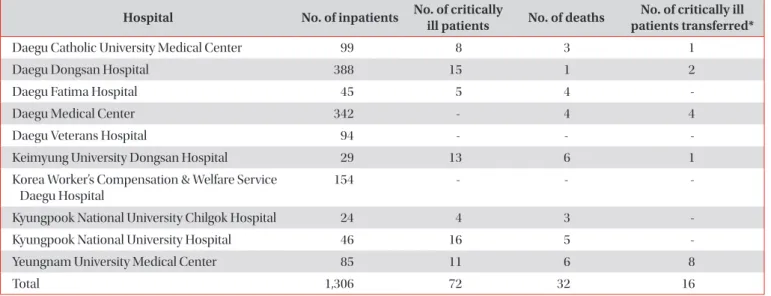
Table 1 provides data on COVID-19 patients treated in the var- ious medical institutions in Daegu up to March 8, 2020. In to- tal, 1,306 patients were admitted to hospitals in Daegu, among whom 72 received intensive care, 16 were considered critical and transferred to another region, and 32 died. Together, these patients accounted for approximately 9.2% of all cases. Some of the deceased died in a general ward or emergency room, while others received inadequate treatment. This was because the capacity to treat critically ill patients at medical institutions in Daegu had already been exceeded.
Capacity to Treat Critically Ill Patients
1. Intensive care physicians
The treatment capacity for critically ill patients depends on the availability of medical facilities and staff. Between 2018 and 2020, five of the 42 tertiary general hospitals in South Korea were in the Daegu-Gyeongbuk region (Kyungpook National University Hospital, Keimyung University Dongsan
Hospital, Daegu Catholic University Medical Center, Yeung- nam University Medical Center, and Kyungpook National Uni- versity Chilgok Hospital). Although Daegu Fatima Hospital is not a tertiary general hospital, it has always provided intensive care. Overall, the medical facilities in Daegu are relatively good compared to other regions of South Korea, but are inferior to those in the Seoul Metropolitan Area.
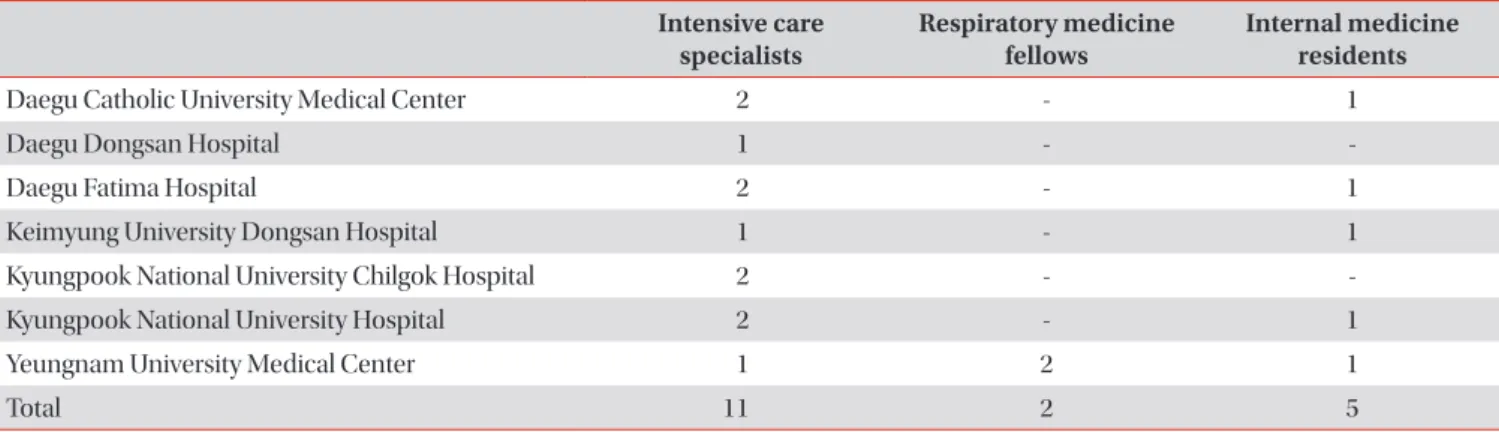
Intensive care was provided by intensive care and pulmo- nary specialists (1–2 per hospital). However, some cases re- ceived both general and outpatient treatment, and there was a general shortage of intensive care physicians. Table 2 shows the distribution of the physicians responsible for treating criti- cally ill COVID-19 patients among institutions in Daegu. Most of the patients presented with ARDS or septic shock, and there were insufficient numbers of intensive care physicians rela- tive to the volume of cases, as stated above. Although Daegu Dongsan Hospital was initially designated for the treatment of COVID-19 patients with mild disease, an ICU was opened to deal with the dramatic increase in the number of critically ill patients. From March 10, 2020, the operations of the hospital were expanded, facilitated by medical staff from the Korean Society of Critical Care Medicine. Despite this measure, it was evident that more staff were needed on the frontline.
2. Intensive care facilities
Negative pressure isolation rooms are needed to treat criti- cally ill COVID-19 patients. All medical institutions in Daegu have 3–4 negative pressure isolation rooms in their ICU; 14 of these satisfy national standards (i.e., are airborne infection isolation rooms) and eight do not. No rooms were available for many of the patients who were already in the ICU, and
Table 1. Data on COVID-19 patients seen at medical institutions in Daegu up to March 8, 2020 Hospital No. of inpatients No. of critically
ill patients No. of deaths No. of critically ill patients transferred*
Daegu Catholic University Medical Center 99 8 3 1
Daegu Dongsan Hospital 388 15 1 2
Daegu Fatima Hospital 45 5 4 -
Daegu Medical Center 342 - 4 4
Daegu Veterans Hospital 94 - - -
Keimyung University Dongsan Hospital 29 13 6 1
Korea Worker’s Compensation & Welfare Service Daegu Hospital
154 - - -
Kyungpook National University Chilgok Hospital 24 4 3 -
Kyungpook National University Hospital 46 16 5 -
Yeungnam University Medical Center 85 11 6 8
Total 1,306 72 32 16
*Critically ill patients transferred to regions outside Daegu.
COVID-19: coronavirus disease 2019.
the number of beds was insufficient to cope with the large number of critically ill patients who presented at the end of February. Special measures were therefore required to secure additional beds.
Emergency Measures for Treating Critically Ill Patients in Daegu
1. Augmentation of temporary negative pressure isolation rooms in ICUs
Temporary negative pressure isolation rooms were aug- mented and, to ensure a sufficient number of beds, patients in the ICU (other than those already in negative pressure isola- tion rooms) were transferred to another ICU. Three or four portable negative pressure devices were installed to create a
large negative pressure region. Although patients with mild disease were supposed to be treated in Daegu Dongsan Hos- pital, 10 ICU beds were made available to treat the increasing numbers of critically ill patients. Another 10 ICU beds were secured for monitoring patients at risk of rapid deterioration.
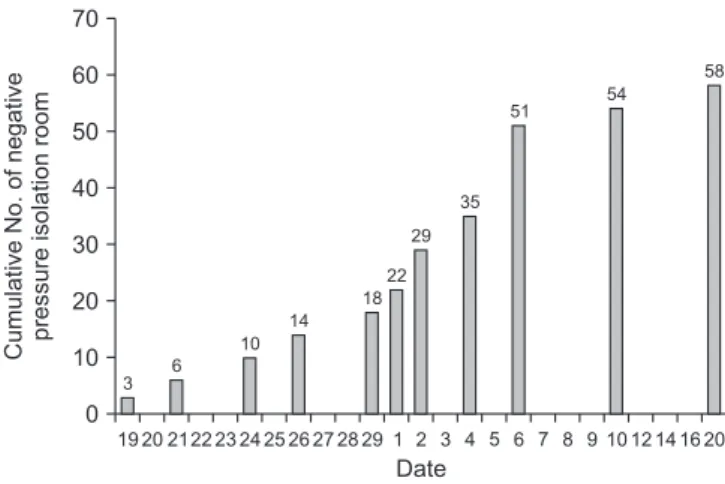
As shown in Table 3, a total of 58 beds were secured; 40 beds had been added by March 20 (Figure 1). However, by March 8, while 120 patients needed intensive care, only 51 beds avail- able; thus, the capacity to treat critically ill patients was clearly insufficient.
The reasons for the difficulty in securing negative pressure units for the treatment of critically ill patients were as follows:
(1) The exponential increase in the number of patients, (2) Shortage of negative pressure isolation rooms in ICU, (3) Si- multaneous treatment of general intensive care patients other than COVID-19, (4) Lack of alternative ICUs to transfer critical patients who were already under intensive care, and (5) De- Table 2. Distribution of intensive care physicians among medical institutions in Daegu
Intensive care
specialists Respiratory medicine
fellows Internal medicine residents
Daegu Catholic University Medical Center 2 - 1
Daegu Dongsan Hospital 1 - -
Daegu Fatima Hospital 2 - 1
Keimyung University Dongsan Hospital 1 - 1
Kyungpook National University Chilgok Hospital 2 - -
Kyungpook National University Hospital 2 - 1
Yeungnam University Medical Center 1 2 1
Total 11 2 5
Table 3. Number of beds and negative pressure isolation rooms in ICUs Negative pressure isolation
rooms in ICUs Temporary negative pressure
isolation rooms Total beds Kyungpook National University Hospital 3 (Feb 19, 2020) 4 (Mar 1, 2020)
5 (Mar 6, 2020)
12
Daegu Dongsan Hospital 3 (Mar 1, 2020) 4 (Feb 29, 2020)
3 (Mar 10, 2020) 10
†(Mar 18, 2020)
10+10
Keimyung University Dongsan Hospital 4 (Feb 23, 2020) 4
Daegu Catholic University Medical Center 4* 3 (Mar 2, 2020)
6 (Mar 4, 2020)
9
Daegu Fatima Hospital 4 (Mar 2, 2020) 4 (Mar 20, 2020) 8
Yeungnam University Medical Center 4 (Feb 26, 2020) 6 (Mar 6, 2020) 10
Kyungpook National University Chilgok Hospital 2* 5 (Mar 6, 2020) 5
Total 18/6* 40+10
†58+10
Parentheses contain the dates on which the intensive care units (ICUs) opened.
*Not operational due to the inability to secure space to transfer existing critically ill patients.
†Ten rooms were operated as “sub-ICUs” (Mar 18,
2020).
layed decision-making on the floor.
With the increase in number of temporary negative pres- sure isolation rooms, intensive care in Daegu entered a new era. The transfer of critically ill patients to other regions was drastically reduced and very few patients died without first receiving intensive treatment.
The biggest barrier to increasing the number of temporary negative pressure isolation rooms was the potential for cross- infection among patients, who were not isolated on an indi- vidual basis. However, this was not discussed with frontline medical staff. The Korea Centers for Disease Control and Pre- vention guidelines at that time stipulated isolating COVID-19 patients on a one-per-room basis, but this was infeasible given the rapid increase in cases. Ultimately, the responsibility for reducing the risk of cross-infection in the temporary negative pressure isolation rooms fell on the frontline medical staff. To obtain the best treatment outcomes with limited resources, quarantine guidelines must be modified according to the ac- tual situation.
2. Patient transfer process
The saturation of intensive care facilities in Daegu neces- sitated that patients be transferred to other areas. The trans- portation of severely ill patients was highly complicated. Typi- cally, when transferring a patient at high risk of deterioration, medical staff use the fastest route. However, to transfer a CO- VID-19 patient, a request first had to be made to the govern- ment of Daegu Metropolitan City, and the National Medical Center of Korea then nominated a hospital to treat the patient.
The patient could only be transferred with approval from the municipality in which the nominated hospital was located. In some instances, the municipality refused the transfer, while in other cases they did not respond within 24 hours of the trans- fer request. After several such experiences, it was determined that the requirement for local municipality approval was the
most problematic step in the patient transfer process, and we asked the quarantine authorities to resolve this. Eventu- ally, this step was omitted, reducing the difficulty of patient transfer. A systematic and safe transfer system for critically ill COVID-19 patients is urgently required.
3. Dispatch of intensive care medical staff to Daegu Due to the shortage of medical staff to care for critically ill COVID-19 patients in Daegu, the Korean Society of Critical Care Medicine dispatched 32 medical professionals, includ- ing 21 intensive care medical specialists, to Daegu Dongsan Hospital between March 10 and April 19, 2020. At that time, severe COVID-19 cases continued to occur in Daegu, but criti- cally ill patients could not be treated because the intensive care facilities had already reached capacity. In addition, even if the number of hospital beds for intensive care had been ex- panded, there was a lack of medical staff able to provide care for critically ill patients.
Therefore, an intensive care facility was established in Daegu Dongsan Hospital, where patients with mild disease were being treated. Daegu Dongsan Hospital operated as a secondary hospital after Keimyung University Dongsan Hospital had been moved to the Seongseo area of Daegu. It had previously been a tertiary general hospital, and its ICU was still available; this provided 20 beds (10 for intensive care, and 10 for monitoring patients at risk of deterioration). The dispatch of intensive care specialists to Daegu represented the first attempt to address the pandemic in South Korea. Special- ized medical staff to treat critically ill patients were urgently needed in Daegu, where treatment capacity had already been exceeded and could not be expanded any further to treat new critically ill patients. The staff expressed a desire for enhanced care facilities, rather than transferal of patients to other areas.
The number of critically ill patients in Daegu peaked during this period. The intensive care specialists played an important role in this context. The experience of Daegu clearly shows that a detailed initial intensive care plan would have led to bet- ter outcomes for patients with severe disease.
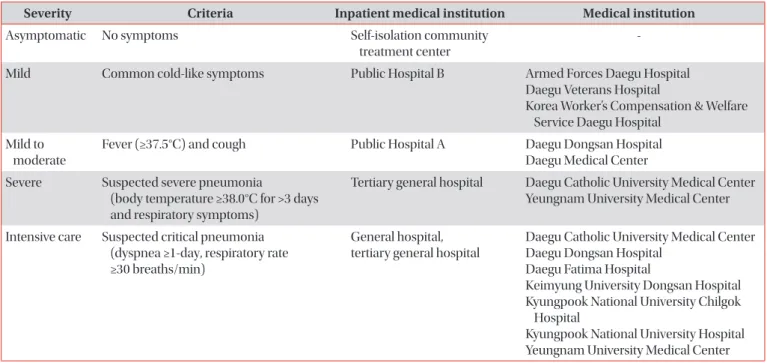
4. Triage
The severity of each patient’s condition prior to hospitaliza- tion was determined based on an internally developed triage questionnaire, health insurance data, and the severity of the patient’s self-described symptoms at home
2.
The initial symptoms and underlying health conditions were identified through the triage questionnaire and health insurance data, respectively, as well as via teleconferences attended by a professor from the Daegu Center for Infectious Diseases Control and Prevention and experts from the Daegu Medical Association. The classification process took approxi- mately 2 days. Although a patient classification system was
0 70 60 50 40 30 20 10
19 20 2122 23 24 25 26 27 28 29 1 2 3 4 5 6 7 8 9 10 12 14 16 CumulativeNo.ofnegative pressureisolationroom
20 3
6 10
14 18
22 29
35 51
54 58
Date