Introduction
Body mass index (BMI), calculated from the height and weight of a patient, is a simple and useful index for obesity
1. BMI has been reported to be an important prognostic factor for many medical conditions. For example, in chronic obstruc- tive pulmonary disease, chronic renal failure, and cancer, mor- tality is increased in underweight patients
2,3, whereas in many metabolic diseases, including hypertension, diabetes mellitus, and dyslipidemia, mortality is commonly increased in over- weight patients
4. Moreover, the relationship between BMI and all-cause mortality in the general population is known to be ‘J’- or ‘U’-shaped
5.
Many studies have examined the usefulness of BMI as a prognostic factor in critically ill patients with differing results.
Body Mass Index as a Predictor of Acute Kidney Injury in Critically Ill Patients:
A Retrospective Single-Center Study
Sunmi Ju, M.D.
1, Tae Won Lee, M.D.
2, Jung-Wan Yoo, M.D.
1, Seung Jun Lee, M.D., Ph.D.
1, Yu Ji Cho, M.D., Ph.D.
1, Yi Yeong Jeong, M.D., Ph.D.
1, Jong Deog Lee, M.D., Ph.D.
1, Ju-young Kim, M.D.
2, Gi Dong Lee, M.D.
2and Ho Cheol Kim, M.D.
21
Department of Internal Medicine, Gyeongsang National University Hospital, Gyeongsang National University School of Medicine, Jinju,
2Department of Internal Medicine, Gyeongsang National University Changwon Hospital, Gyeongsang National University School of Medicine, Changwon, Korea
Background: The aim of this study was to examine the influence of body mass index (BMI) on the development of acute kidney injury (AKI) in critically ill patients in intensive care unit (ICU).
Methods: Data of patients admitted to medical ICU from December 2011 to May 2014 were retrospectively analyzed.
Patients were classified into three groups according to their BMI: underweight (<18.5 kg/m
2), normal (18.5–24.9 kg/m
2), and overweight (≥25 kg/m
2). The incidence of AKI was compared among these groups and factors associated with the development of AKI were analyzed. AKI was defined according to the Risk, Injury, Failure, Loss of kidney function, and End-stage (RIFLE) kidney disease criteria.
Results: A total of 468 patients were analyzed. Their mean BMI was 21.5±3.9 kg/m
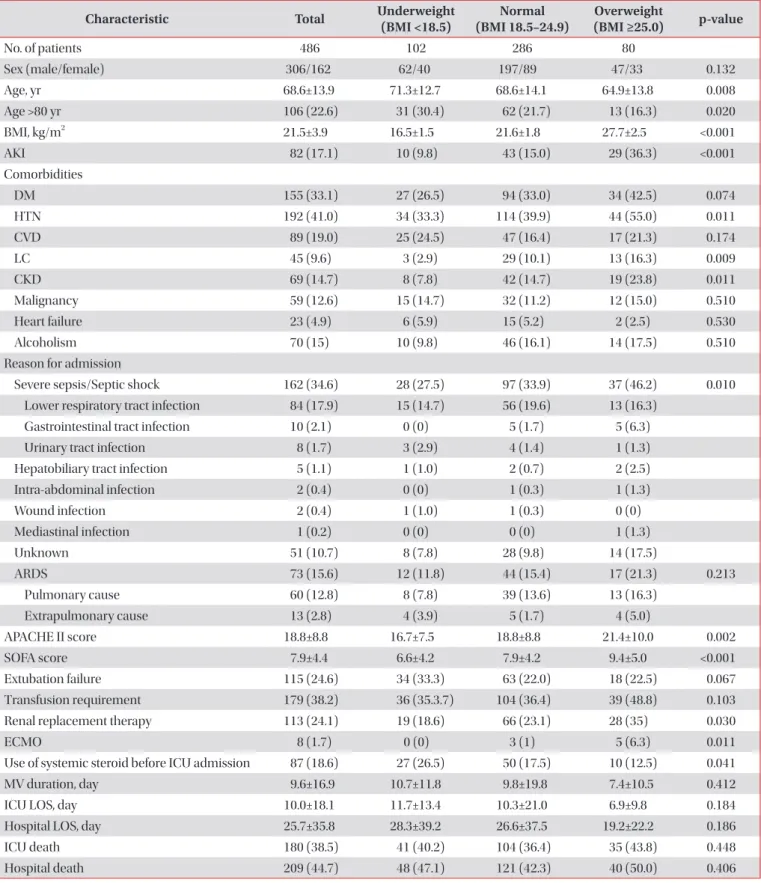
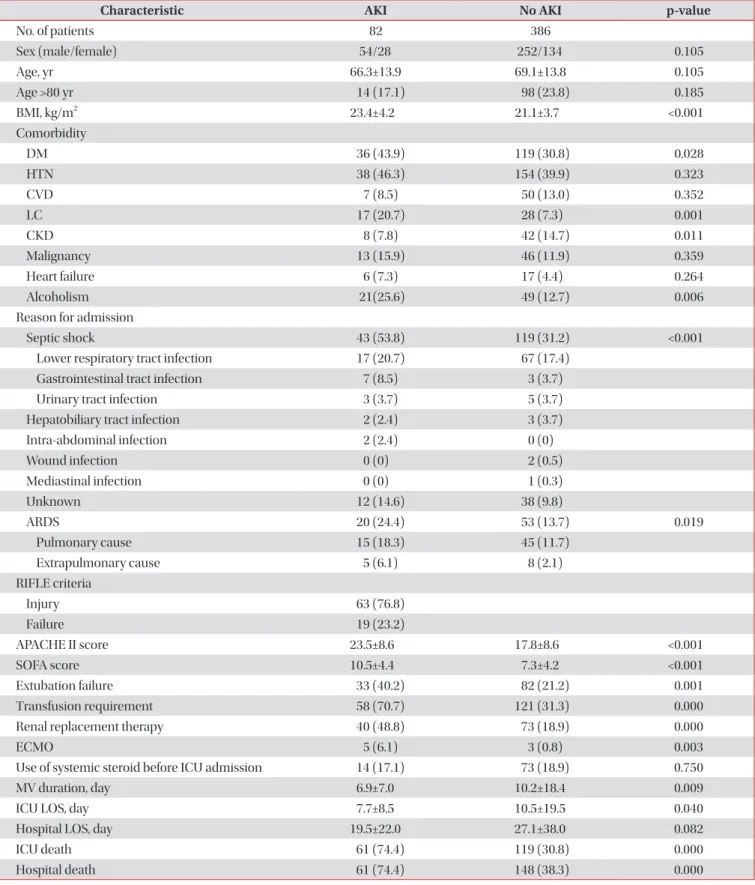
2, including 102 (21.8%) underweight, 286 (61.1%) normal-weight, and 80 (17.1%) overweight patients. Overall, AKI occurred in 82 (17.5%) patients. The overweight group had significantly (p<0.001) higher incidence of AKI (36.3%) than the underweight (9.8%) or normal group (15.0%). In addition, BMI was significantly higher in patients with AKI than that in those without AKI (23.4±4.2 vs.
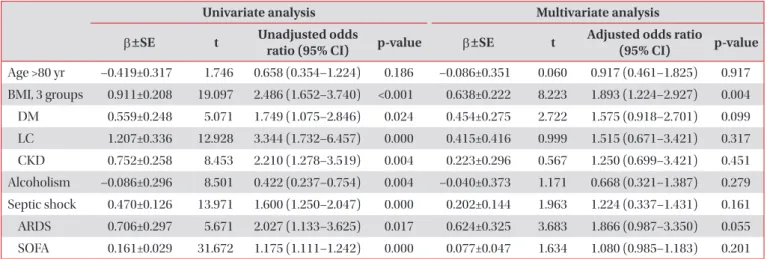
21.1±3.7, p<0.001). Multivariate analysis showed that BMI was significantly associated with the development of AKI (odds ratio, 1.893; 95% confidence interval, 1.224–2.927).
Conclusion: BMI may be associated with the development of AKI in critically ill patients.
Keywords: Body Mass Index; Acute Kidney Injury; Intensive Care Unit
Address for correspondence: Ho Cheol Kim, M.D.
Department of Internal Medicine, Gyeongsang National University Changwon Hospital, 91 Samjeongja-ro, Seongsan-gu, Changwon 51472, Korea
Phone: 82-55-214-3730, Fax: 82-55-214-8618 E-mail: [email protected]
Received: Jul. 10, 2017 Revised: Dec. 21, 2017 Accepted: Apr. 22, 2018 Published online: Jun. 19, 2018
cc It is identical to the Creative Commons Attribution Non-Commercial License (http://creativecommons.org/licenses/by-nc/4.0/).