Introduction
The worldwide population is rapidly aging. Consequently, the number of elderly patients admitted to intensive care units (ICUs) is increasing as is the number of elderly patients age >80 years
1,2. According to data reported by Lim et al.
3, the number of ICU patients age ≥80 years increased from 12.8%
in 2005 to 20.7% in 2014 in Korea. A recent multicenter study in Korea has also reported that 22.1% of patients admitted to ICUs are elderly patients age over 80 years
4.
In a recent study of elderly patients admitted to ICUs, the authors reported that ICU and in-hospital mortality rates do not differ significantly between patients aged more than 80 years and those younger than 80 years. The mortality rates of the ICU patients were 34.9% for patients age >80 years vs.
Retrospective Analysis of Long-Term Survival in Very Elderly (Age ≥80) Critically Ill
Patients of a Medical Intensive Care Unit at a Tertiary Care Hospital in Korea
Seung Hun Lee, M.D., Ph.D.
1, Ju-Young Kim, M.D.
2, Tae Hoon Kim, M.D., Ph.D.
2, Sun Mi Ju, M.D.
3, Jung-Wan Yoo, M.D.
3, Seung Jun Lee, M.D., Ph.D.
3, Yu Ji Cho, M.D., Ph.D.
3, Yi Yeong Jeong, M.D., Ph.D.
3, Jong Deog Lee, M.D., Ph.D.
3and Ho Cheol Kim, M.D., Ph.D.
21
Department of Internal Medicine, On Hospital, Busan,
2Department of Internal Medicine, Gyeongsang National University Changwon Hospital, Gyeongsang National University School of Medicine, Changwon,
3Department of Internal Medicine, Gyeongsang National University Hospital, Gyeongsang National University School of Medicine, Jinju, Korea
Background: The purpose of this study was to evaluate the long-term survival rates of very elderly (age ≥80) critically ill patients admitted to a medical intensive care unit (MICU) at a regional tertiary-care hospital in Korea.
Methods: We retrospectively analyzed data from patients who survived after discharged from the MICU of our hospital.
Survival rates at 90 days, 1 year, 2 years, and 3 years were assessed between patients age ≥80 and those age <80. Survival status was evaluated using the National Health Insurance Service data.
Results: A total of 468 patients were admitted, 286 (179 males, 97 females; mean age, 70.18±13.2) of whom survived and were discharged soon after their treatment. Among these patients, 69 (24.1%) were age ≥80 and 217 (75.9%) were age
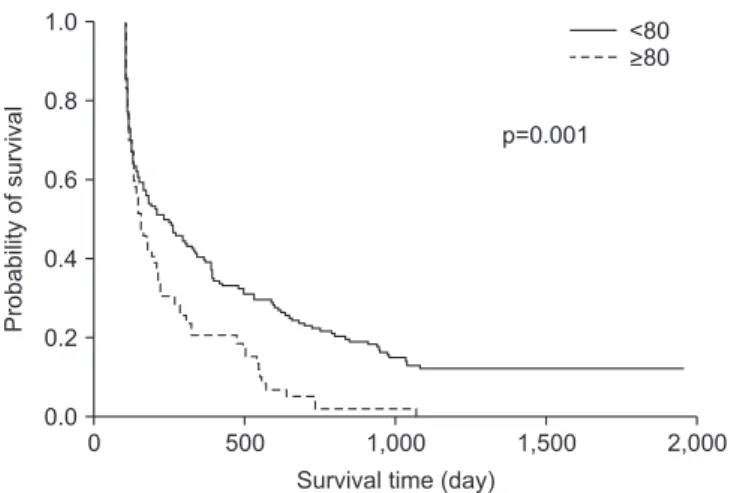
<80. The 90-day, 1-year, 2-year, and 3-year survival rates of patients age ≥80 were significantly lower than those in patients age <80 (50.7%, 31.9%, 15.9% and 14.5% vs. 68.3%, 54.4%, 45.6%, and 40.1%, respectively) (p<0.01). The Kaplan-Meier survival curves showed significantly lower survival rates in patients age ≥80 than in those age <80 (p=0.001).
Conclusion: The poor rates of long-term survival in very elderly (age ≥80) and critically ill patients admitted to an ICU should be considered while managing and treating them.
Keywords: Very Elderly; Intensive Care Unit; Long-Term Survival
Address for correspondence: Ho Cheol Kim, M.D., Ph.D.
Department of Internal Medicine, Gyeongsang National University Changwon Hospital, Gyeongsang National University School of Medicine, 11 Samjeongja-ro, Seongsan-gu, Changwon 51472, Korea
Phone: 82-55-214-3730, Fax: 82-55-214-8618E-mail: [email protected] Received: Apr. 25, 2019 Revised: Aug. 12, 2019 Accepted: Dec. 20, 2019 Published online: Mar. 10, 2020
cc
It is identical to the Creative Commons Attribution Non-Commercial License (http://creativecommons.org/licenses/by-nc/4.0/).
Copyright © 2020
The Korean Academy of Tuberculosis and Respiratory Diseases.
39.5% for those age ≤80 years
5. However, there have been few studies conducted on the long-term survival of patients ad- mitted to ICUs in Korea. Recent study by Heo et al.
6reported long-term mortality according to age in patients admitted ICU using National Health Insurance data. In contrast, there is a relatively large amount of research data available outside of Korea. In one study in France, 2-year and 3-year survival rates of patients admitted to medical ICU for patients age >80 were 33% and 29%, respectively
7.
Because few studies have been conducted on the long-term survival of critically ill patients age >80 admitted to ICUs in Ko- rea, the purpose of this study was to investigate the long-term survival and factors associated with mortality of such patients in the ICU of a single regional tertiary hospital in Korea.
Materials and Methods
All critically ill patients admitted to the medical ICU (MICU) at a single regional tertiary hospital (total hospital beds, 890;
MICU beds, 13–15) between December 2011 and May 2014 were retrospectively studied. Admissions were determined by attending physicians according to general ICU admission criteria. Patient demographic and clinical characteristic data were prospectively collected and analyzed retrospectively.
The following data were analyzed: sociodemographic data, in- cluding age, sex, body mass index (BMI), and chronic underly- ing disease; the reasons for admission; severity of illnesses, as measured by the Acute Physiology and Chronic Health Evalu- ation II (APACHE II)
8and Sequential Organ Failure Assess- ment (SOFA)
9systems at admission; duration of mechanical ventilation (MV); length of ICU and in-hospital stays, and out- come data, including survival status in ICU and at in-hospital.
Patients were excluded if they were admitted due to acute coronary syndrome, drug overdoses, or acute cerebrovascular disease and age less than 18 years.
Weaning failure is defined as the failure to pass a sponta- neous breathing trial or the need for reintubation within 48 hours following extubation and when blood transfusion is restricted to packed red cell transfusion.
Survival at 90th day, 1 year, 2 years, and 3 years were evalu- ated in patients who were admitted to the ICU and discharged from the hospital. The survival status of a patient was assessed based on National Health Insurance Corporation’s medical in- surance standards. A patient’s death was evaluated by the ces- sation of medical insurance, and date of death was determined as the date of cessation. This study was approved by the insti- tutional review board of the hospital (GNUCH-2018-10-011).
The patients’ informed consent for the study was waived due to the retrospective nature of the study.
The data are presented as mean±standard deviation and median with an interquartile range. Categorical data are presented as frequencies and percentages. Independent
t test (continuous variables) and chi-square test (categorical variables) results were compared between patients age ≥80 patients and those age <80. Survival curves were estimated by the Kaplan-Meier method, and with a log-rank test. Mul- tivariate Cox proportional hazard regression models were used to evaluate factors associated with mortality in patients at 1 year after discharge. We choose the factor when univari- ate analysis showed p-value less than 0.05 or factor assumed with cause of death. A p-value of <0.05 was considered to be statistically significant for all tests. All statistical analyses were performed using SPSS version 25.0 (IBM Corp., Armonk, NY, USA) for Windows (Microsoft Corporation, Redmond, WA, USA).
Results
1. Baseline clinical characteristics of the patients who survived
A total of 468 patients (306 male, 162 female; mean age, 68.6±13.9 years) were enrolled. Among these, 286 patients (179 male, 97 female; mean age, 70.18±13.2 years) survived and were discharged. The baseline characteristics were listed in Table 1.
2. Comparison of clinical characteristics between patients age ≥80 and those age <80
Among all patients survived, 69 (24.1%) were age ≥80 and 217 (75.9%) were age <80. There were more males among patients age <80 than among those age ≥80 (66.4% vs. 50.7%, p=0.019). BMI and SOFA scores at admission were higher in patients age <80 than in those age ≥80 (BMI: 21.6±3.76 vs.
20.6±3.4, p=0.041; SOFA score: 6.9±3.93 vs. 5.55±3.23, p=0.005).
Among underlying diseases, diabetes was more common in patients age <80 than in those age ≥80 (34.6% vs. 21.7%, p=0.046). Moreover, heart disease was less common in pa- tients age <80 than in those age ≥80 (17.5% vs. 29%, p=0.039).
Transfusion requirements were more common in patients age <80 than in those age ≥80 (41.4% vs. 27.4%, p=0.02).
3. Comparison of the clinical outcomes and the
differences in survival rates between patients age ≥80 and those age <80
Regarding clinical outcomes, the durations of hospital
stay were longer for patients age <80 than for those age ≥80
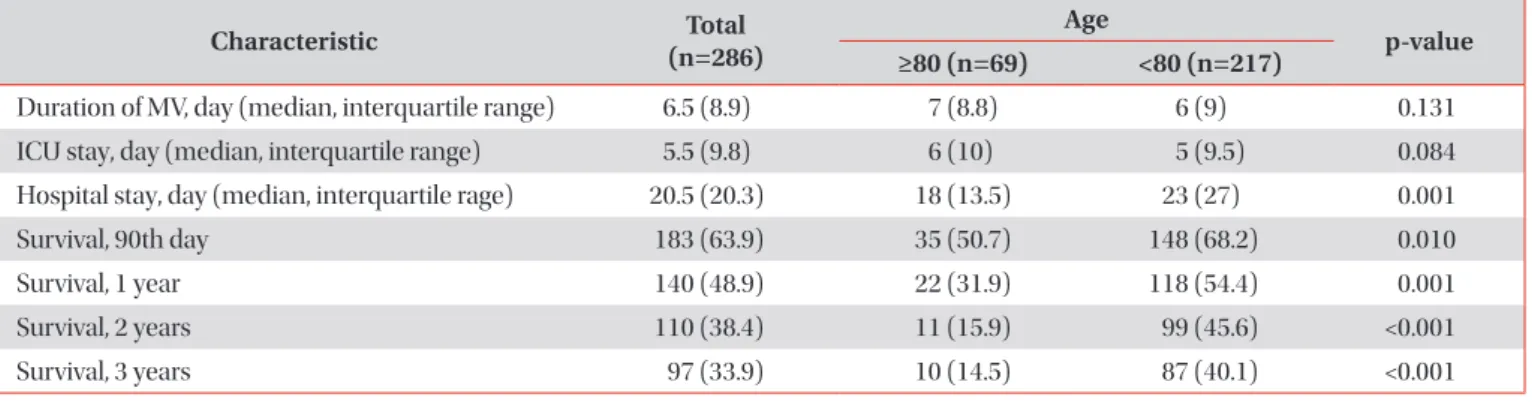
(27.95±39.63 days vs. 18.17±15.45 days, p=0.001). The 90-day,
1-year, 2-year, and 3-year survival rates of patients age ≥80
were 50.7%, 31.9%, 15.9%, and 14.5%, respectively, and the
corresponding survival rates in patients age <80 were 68.3%,
54.4%, 45.6%, and 40.1%, respectively (p<0.05) (Table 2). The
Table 1. Baseline characteristics of enrolled 286 survived patients
Characteristic Total
(n=286)
Age (yr)
p-value
≥80 (n=69) <80 (n=217)
Age, yr 70.18±13.2 84.1±3.6 65.7±12.0 0.000
Male sex 179 (62.6) 35 (50.7) 144 (66.4) 0.019
BMI, kg/m
221.4±3.7 20.6±3.42 21.6±3.76 0.041
APACHE II score 16.6±7.78 15.7±7.39 16.9±7.89 0.214
SOFA score 6.6±3.8 5.55±3.23 6.90±3.93 0.005
Diabetes mellitus 90 (31.4) 15 (21.7) 75 (34.6) 0.046
Heart disease 58 (20.3) 20 (29) 38 (17.5) 0.039
Liver disease 24 (8.3) 3 (4.3) 21 (9.7) 0.164
Renal disease 56 (19.6) 8 (11.6) 48 (22.1) 0.055
Malignant disease 29 (10.1) 3 (4.3) 26 (12.0) 0.067
Cerebrovascular disease 36 (12.6) 7 (10.1) 29 (13.4) 0.483
Severe sepsis/septic shock 74 (25.8) 12 (17.6) 62 (28.7) 0.262
ARDS 33 (11.5) 7 (10.1) 26 (12.0) 0.677
MV (invasive) 273 (95.4) 68 (98.6) 205 (94.5) 0.156
Weaning failure 37 (12.9) 11 (15.9) 26 (12.0) 0.393
Unplanned extubation 25 (8.7) 7 (10.1) 18 (8.3) 0.636
Tracheostomy 33 (11.5) 4 (6.3) 29 (9.7) 0.511
Reintubation 30 (10.4) 8 (11.6) 22 (10.1) 0.506
Renal replacement therapy 45 (15.7) 8 (11.6) 37 (17.1) 0.278
Transfusion 86 (30.1) 13 (18.8) 73 (33.6) 0.020
ECMO 3 (1.0) 0 (0) 3 (1.4) 0.618
Values are presented as mean±SD or number (%).
BMI: body mass index; APACHE II: Acute Physiology and Chronic Health Evaluation II; SOFA: Sequential Organ Failure Assessment; ARDS:
acute respiratory distress syndrome; MV: mechanical ventilation; ECMO: extracorporeal membrane oxygenation.
Table 2. Comparison of outcome and survival rate between age ≥80 and age <80 among 286 survived patients
Characteristic Total
(n=286)
Age p-value
≥80 (n=69) <80 (n=217)
Duration of MV, day (median, interquartile range) 6.5 (8.9) 7 (8.8) 6 (9) 0.131
ICU stay, day (median, interquartile range) 5.5 (9.8) 6 (10) 5 (9.5) 0.084
Hospital stay, day (median, interquartile rage) 20.5 (20.3) 18 (13.5) 23 (27) 0.001
Survival, 90th day 183 (63.9) 35 (50.7) 148 (68.2) 0.010
Survival, 1 year 140 (48.9) 22 (31.9) 118 (54.4) 0.001
Survival, 2 years 110 (38.4) 11 (15.9) 99 (45.6) <0.001
Survival, 3 years 97 (33.9) 10 (14.5) 87 (40.1) <0.001
Values are presented as median (interquartile range) or number (%).
MV: mechanical ventilation; ICU: intensive care unit.
Kaplan-Meier curves and log-rank tests for 1-year survival of patients age ≥80 showed significantly lower survival rates than those age <80 (p=0.001) (Figure 1).
4. Comparison of clinical characteristics between survivors and non-survivors 1 year after discharge among the 69 patients age ≥80
Characteristics of survivors and non-survivors 1 year after discharge among the 69 patients age ≥80 are summarized in Table 3. The proportions of males and BMI scores were not significantly different between survivors and non-survivors.
However, the proportion of BMIs ≤18 was significantly dif- ferent between survivors and non-survivors (4.5% vs. 27.7%, p=0.026). No difference was found between APACHE II and SOFA scores at admission between survivors and non-survi- vors. Regarding underlying disease and the cause of admis- sion, the proportion of patients presenting with severe sepsis and septic shock was not significantly different between survi- vors and non-survivors. Although ICU and hospital stays were not significantly different between survivors and non-survi- vors, the durations of MV were significantly longer in non- survivors than in survivors (5.67±4.53 vs. 9.66±8.52, p=0.015).
The MV weaning failure and unplanned extubation were not significantly different between survivors and non-survivors.
Requirements for renal replacement therapy, extracorporeal membrane oxygenation, and transfusions were not signifi- cantly different between survivors and non-survivors.
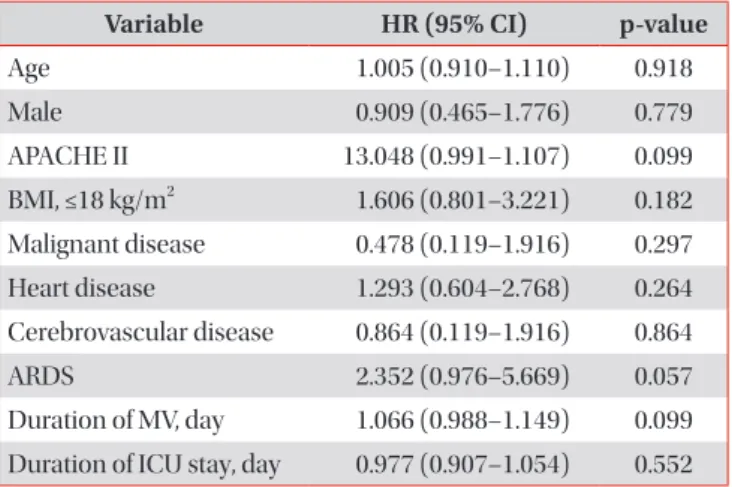
5. Factors associated with mortality in patients 1 year after discharge
The sociodemographic data, including age, sex, BMI, un- derlying disease, severity of illnesses and durations of MV, and length of ICU stay were not associated with a risk of mortality
at 1 year after discharge among 69 patients age ≥80, according to the multivariate Cox regression analysis of hazard ratios (Table 4).
Discussion
This study evaluated long-term survival in critically ill pa-
0 500 1,000 1,500
1.0
0.8
0.6
0.4
0.2
2,000
Probabilityofsurvival
Survival time (day) 0.0
<
>
80 80
p=0.001