• 검색 결과가 없습니다.

Review of Radio Frequency Identification and Wireless Technology for Structural Health Monitoring

N/A
N/A
Protected

Academic year: 2021

Share "Review of Radio Frequency Identification and Wireless Technology for Structural Health Monitoring"

Copied!
13
0
0

로드 중.... (전체 텍스트 보기)

전체 글

(1)

Review of Radio Frequency Identification and Wireless Technology for Structural Health Monitoring

Dipesh Dhital*, Chen Ciang Chia*, Jung-Ryul Lee*

and Chan-Yik Park**

Abstract Radio frequency identification(RFID) combined with wireless technology has good potential for structural health monitoring(SHM). We describe several advantages of RFID and wireless technologies for SHM, and review SHM examples with working principles, design and technical details for damage detection, heat exposure monitoring, force/strain sensing, and corrosion detection in concrete, steel, carbon fiber reinforced polymer(CFRP), and other materials. Various sensors combined with wireless communication are also discussed.

These methodologies can be readily developed, implemented, and customized. There are some technical difficulties, but solutions are being addressed. Lastly, a surface acoustic wave-based RFID system is presented, and possible future trends of SHM based on RFID and wireless technology are presented.

Keywords: Structural Health Monitoring, Radio Frequency Identification, Wireless System, Sensors, Wireless Sensor Network

Received: March 29, 2010, Revised: June 3, 2010, Accepted: June 10, 2010. * Department of Aerospace Engineering, Chonbuk National University, 664-14, Duckjin-dong, Jeonju, Korea, ** Aeronautical Technology Directorate, Agency for Defense Development, Yuseong-gu, Daejon, Korea, ✝ Corresponding Author: [email protected]

Journal of the Korean Society for Nondestructive Testing Vol. 30, No. 3 (2010. 6)

1. Introduction

Sensor integration into a wireless sensor network(WSN) and radio frequency identification (RFID) system is suitable for structural health monitoring(SHM). A WSN contains a group of autonomous sensor nodes, each equipped with a transducer, microcomputer, transceiver, and power source or energy harvesting technique. A WSN normally constitutes a wireless ad hoc network, meaning that each sensor supports a multi-hop routing algorithm; i.e., each node participates in routing by forwarding data to other nodes and to the base station (Lynch and Loh, 2006). Similarly, RFID is a system in which an electronic device uses radio frequency (RF) or magnetic field variations for communication. An RFID tag is attached to an item and transmits wirelessly the identity of the

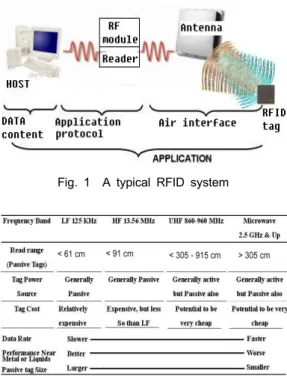
object using a unique serial number (Potgantwar and Wadhai, 2009). RFID technology does not require contact or line-of-sight for communica- tion (Zhang et al., 2010). Sensors can be made with different types of RFID tags and can be integrated into a chip, or be connected separately via a bus (Ruhanen et al., 2008). The cost of passive RFID tags has dropped from $0.5-0.7 in 2003 to $ 0.04-0.4 in 2005 to $0.02-0.05 in 2006, and is still decreasing (Potyrailo and Morris, 2007). A typical RFID system consists of a tag, antenna, reader (transceiver), and host as shown in Fig. 1.

A tag is an electronic circuit for storing and

processing information, and where sensors are

integrated. A tag can be active, passive, or

semi-passive. Passive tags are the most widely

used and popular because they need no power

and are activated by the electromagnetic field

(2)

Fig. 1 A typical RFID system

Fig. 2 Characteristics at various frequencies

Fig. 3 Crack detection system from the reader’s signal. RFID tags can be

categorized as low frequency(LF), 125~134 kHz;

high frequency(HF), 13.56 MHz; ultra-high frequency(UHF), 860~960 MHz; and microwave, 2.4 GHz and above, as shown in Fig. 2.

2. Advantages of RFID/Wireless Systems

WSNs can have distributed and mobile sensor nodes. These nodes can provide automated damage detection with good computational power and a good data rate because each sensor node is like a small computer in itself. Node capacity is scalable, limited only by the bandwidth of the gateway node (Lynch and Loh, 2006). Similarly, the most basic advantage of RFID is its automatic and unique identification capability (Ruhanen et al., 2008). RFID eliminates the need for excessive lengths of coaxial wires, and saves installation and maintenance time and costs. An RFID system is also inexpensive. They help in remote locations, and are good for mass-critical structures

(e.g., aerospace structures). Micro-tags can be installed on aerodynamic surfaces, used for on-board real time SHM, and the data can travel along with the component throughout its life cycle. Since they are wireless, tiny, and cheap, dense sensor nodes can be configured across the entire structure for more accurate local and global damage detection (Lynch, 2004). RFID for SHM can minimize the need for periodic inspections, or at least focus these inspections on critical areas (Prosser, 2003). In addition, a passive RFID requires neither maintenance nor power (Arms et al., 2004).

3. RFID/Wireless Utilization 3.1 Damage Detection

3.1.1 RFID and Electrically Conductive Material

This type of system consists of an RFID tag and electrically conductive material such as paint (directly applied), or a printed sheet (glued) to the structure, as shown in Fig. 3 (Morita and Noguchi, 2006). Copper wire connects the electrically conductive material to the structure and to an RFID tag to form a circuit. When a crack occurs, the paint or printed sheet is cracked, and the resistance increase is detected by the receiver. A similar system shown in Fig.

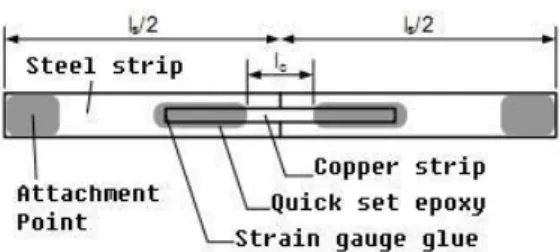
4 consists of two thin steel strips connected by a

narrow and thin copper strip to form a gauge. It

is merged into an RFID tag. When a crack

exceeds a threshold value, a copper strip with

(3)

Fig. 6 Wireless MEMS Lamb wave sensors

Fig. 7 Inductively-coupled transducers Fig. 4 The gauge design

gauge length l

c

is broken, which is detected via an RFID signal. The total length of the gauge l

s

determines the sensor detection range and is extendable (Chin et al., 2008). The crack width can be correlated to l

c

experimentally from reference data. There are other similar methods using the wire or foil breakage principle (Novak et al., 2003 and Ihler et al., 2000).

3.1.2 RFID and Carbon Fiber-Reinforced Plastics

Embeddable RFID wireless sensors have been studied (Jung et al., 1999), but embedding sensors inside carbon fiber-reinforced plastic (CFRP) may cause reductions in static and fatigue strengths (Matsuzaki and Todoroki, 2005). The CFRP itself has been used as a sensor where only thin surface-mounted electrodes were used, as shown in Fig. 5.

Delamination causes electrical resistance and oscillating frequency changes. The frequency information transferred wirelessly is used to detect the delamination.

Fig. 5 Electrodes and current flow

3.1.3 Wireless MEMS Ultrasonic Transducer

This method uses a wireless micro- electromechanical system(MEMS) ultrasonic sensor as shown in Fig. 6. The sensor platform consists of a rectenna circuit, Lamb wave generators (silicon nitride membranes), interdigital transducers(IDTs) as ultrasonic receivers, and a wireless circuit for wireless data transmission (Aatre et al., 2003). The rectenna converts microwave energy to DC that excites a MEMS membrane that generates Lamb waves. The reflected waves from the crack or corrosion crack are received by IDT sensors and transmitted back to the receiver. Lamb waves are sensitive to other structural damage modes in composites (Kessler et al., 2001).

3.1.4 Wireless Inductively-Coupled Transducer

Wireless inductively-coupled piezoelectric

transducers can be excited to generate ultrasonic

waves (Zheng et al., 2008). A shadow is

detected when the path is intercepted by a crack

as shown in Fig. 7. This is a nondestructive

evaluation technique in which transducers need

to be displaced for crack inspection. However, if

(4)

Fig. 8 High temperature sensor tag

Fig. 9 Thin film microfuse layout

Fig. 10 Ceramic sensor with LC circuit several transducers are placed for sufficient

coverage using a phased array technique to steer the ultrasonic wave electrically to a preferred direction, increase the reading range, and remove the need to manually displace the transducers, then this method could be effective for SHM.

3.1.5 Wireless Acoustic Emission Monitoring

A wireless acoustic emission(AE) monitoring system uses a custom-built radio telemetry system that transmits AE data from a wind turbine rotating frame to the ground (Blanch and Dutton, 2003). The main components are sensors (PZT crystals at blade surfaces), transmitters (at blade roots), power supply boards (the hub), and an aerial connection and receivers (at the ground station). Pattern recognition software analyzes and classifies AE data. Delaminations and cracks can be detected, while load, displacement, AE signal level, and absolute energy can be recorded continuously on the AE monitoring system (Dutton et al., 2003).

3.2 Temperature Monitoring 3.2.1 Heat Monitoring Microfuse

A passive sensor tag consists of a coil antenna, RFID microchip, and microfuse, as shown in Fig. 8 (Watters et al., 2002). The tag is placed at the inter-tile gap of the thermal protection system of the space shuttle. A microfuse (Fig. 9) has a solder bridge with a mixture of 90% Pb, 5% Ag, and 5% Sn that melts at about 292 ºC (threshold temperature).

Thus, the circuit opens and indicates an excessive increase in temperature.

3.2.2 Temperature Sensitive Ceramic Sensor

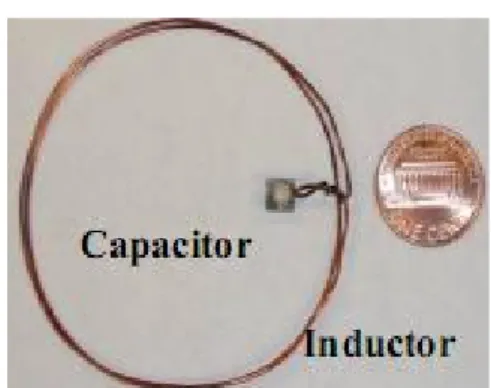
This sensor consists of a temperature sensitive ceramic multi-layer planar capacitor integrated with a planar spiral inductor, as shown

in Fig. 10. The capacitance changes due to temperature and thus the resonant frequency also changes, and an external reader with a loop antenna detects the change remotely (Wang et al., 2008). This approach has been proposed for use in high temperature rotating component monitoring; e.g., rotating bearings in aircraft engines and high speed shaft components.

3.2.3 High Temperature Thermocouple

A thermocouple is an assembly of two wires

of different metals joined at the hot end for

(5)

Fig. 11 Electrochemical sensor concept

Fig. 12 Inverted bit stream

Fig. 13 RFID tag with coated sensing films temperature measurement, and at the cold end as

a reference at 0 °C. It can be connected to wireless input/output (I/O) devices to create a WSN. They can measure temperatures up to 2300 °C (Bentley, 1998). However, the signal output from a thermocouple is weak and can easily be affected by noise. In hostile environments, they have a limited life of only a few days because they are easily affected by corrosive chemicals.

3.2.4 High Temperature Surface Acoustic Wave Sensor

The high temperature surface acoustic wave (SAW) sensor is based on detecting a change in phase velocity of the SAW caused by temperature. The velocity change can be monitored wirelessly by measuring the frequency or phase characteristics of the sensor. These characteristics can then be correlated to the corresponding temperature. It is useful for some harsh environments, but its disadvantage is that the speed of sound is dependent not only on temperature, but also on environmental, geometric, and material properties (Seifert and Weigel, 1997). The operating principles of SAW devices are presented in detail in Section 5.

3.3 Corrosion Detection

3.3.1 Monitoring Chloride Ingress

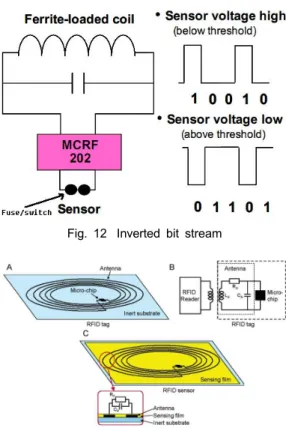
Corrosion in steel rebar due to chloride ions leads to volumetric expansion of the rebar and causes cracking of the concrete. This concept is used by passive RFID tag/electrochemical hybrid sensors as shown in Fig. 11 (Watters et al., 2002). When the chloride ions diffuse inside through permeable cementitious material and the Cl¯ concentration reaches a specified threshold, the voltage drops and is sensed by the sensor.

The RFID device then transponds an inverted bit stream as shown in Fig. 12. The sensor tag can

be embedded during the concrete pour, or later using back-filled core. To maintain constant potential of the reference electrode is a major design challenge. This system can also monitor pH by changing the electrodes, which is discussed in Section 3.3.3 (Watters et al., 2003).

3.3.2 Chemically Sensitive Coated Film

A conventional RFID tag is coated with

(6)

Fig. 14 Corrosion detection using steel wires Fig. 15 The system module chemically sensitive films whose resistance and

capacitance changes depending on the concentration of gases, causing an impedance change and frequency shift. These changes can be measured wirelessly to detect several corrosive gases and chemicals at once using a single sensor tag (Potyrailo and Morris, 2007). A similar sensitized coating method was also proposed by Saafi and Romine in 2004.

3.3.3 pH Monitoring Using Electrochemical Sensor

pH levels can indicate acid rain and carbonation effects in concrete. Ag/AgCl can be used as the reference electrode in a saturated KCl solution, and Ni/NiO or Cu/CuO can be used as a pH-sensitive electrode as shown in Fig. 11 (Watters et al., 2003). pH can also be monitored using nano-composite pH sensitive films (Loh et al., 2007), which is described in Section 3.4.2.

3.3.4 Corrosion Detection Using Surrogates

Thin black steel wires of various diameters can be coupled with passive RFID tags as shown in Fig. 14 and embedded in concrete.

When corrosion occurs, the wires break at different intervals. The thinner wire breaks earlier whereas the thicker wire will break if the corrosion continues to increase, thereby indicating the rate of corrosion (Watters et al.,

2003). The breakage of the wire causes a circuit to be broken which is detected via RFID signal.

A similar method uses steel wires for frequency-based corrosion detection. When fully corroded, the steel wires break and induce a measurable decrease in sensor frequency characteristics (Novak et al., 2003) as discussed in Section 3.1.1.

3.4 Load/Stress/Strain/Pressure Monitoring 3.4.1 Force Sensor and RFID

This system consists of strain gauge sensors, RFID tags and a reader, and a PC as shown in Fig. 15 (Ikemoto et al., 2009). A strain gauge voltage signal is received by the RFID reader. If the system needs more power, multiple RFID tags and readers can be used, one for communication and another for the power supply to strain gauge circuit. The concept of using two separate modes for power supply and RF communication was reported by Carkhuff and Cain in 2003.

3.4.2 Passive Wireless Strain Sensing

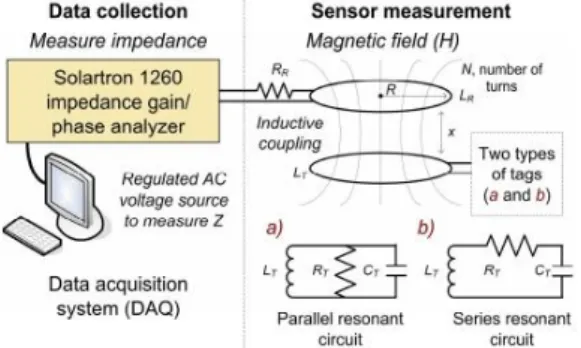
In this approach, strain-sensitive nano- omposite thin films are fabricated on an RFID tag to form an inductively-coupled strain sensor (Loh et al., 2007). The system consists of an RFID reader with a loop antenna coupled with an AC source that also acts as an impedance gain and phase analyzer, and RFID sensor tags.

The tags are composed of an inductor coil

(7)

Fig. 16 Parallel or series resonant tag circuit

Fig. 17 Ceramic pressure sensor antenna (L

T

), a resistor (R

T

), and a capacitor

(C

T

) as an RLC series or parallel resonant circuit as shown in Fig. 16. A resistance or capacitance change due to strain causes the bandwidth and resonant frequency to change.

Another wireless strain sensor, called a remotely-queried embedded micro-sensor (RQEM), was designed to perform in naval electromagnetic interference(EMI) conditions. The RFID RQEM sensor devices can withstand a high level of radar activity and EMI for monitoring of naval structures (Gause et al., 1999).

3.4.3 Wireless Micro-Machined Ceramic Pressure Sensor

Excess pressure levels may damage structures such as nuclear reactor pressure vessels, rocket pressure tanks, engine cylinders, turbine engines, and compressors. This method uses wireless micro-machined ceramic pressure sensors for high-temperature applications (Fonseca et al., 2002). Layers of ceramic tapes, inductor coils, and capacitor electrodes are fabricated together to form a pressure sensor as shown in Fig. 17.

As the pressure increases, the ceramic membrane deflects, thereby causing an increase in sensor capacitance and a decrease in resonant frequency.

Thus, the phase shifts downward (Hoe et al., 2009). This approach uses wireless telemetry wherein data are received using an external loop antenna and sent to an impedance gain and phase analyzer.

Another method uses polyvinylidene fluoride (PVDF) piezoelectric polymer films to monitor pressure. The PVDF polymer films are integrated with a wireless data acquisition system. Each device is connected to an integrated interface circuit that includes a capacitance-to-frequency converter(C/F). Two capacitances are formed using PVDF for the sensing layer. When the films are deformed under pressure, the resulting change in capacitance is transmitted wirelessly to an external receiver that converts the signal to a corresponding voltage (Arshak et al., 2006).

3.5 Miscellaneous

Polymer Aging Concepts, Inc. (Dahlonega, GA, USA) manufactures a passive sensor device called AgeAlert™ that uses a custom-designed conductive polymer composite or electrically- conductive nano-carbon particles integrated into passive RFID tags as the sensors for polymer degradation monitoring. The sensors degrade along with the material, and the degradation causes a change in the electrical resistance of the sensor circuit that is detected via RFID signal.

An RFID-based wireless sensor and actuator

(8)

integrated as a single device was proposed in 1998 (Das et al., 1998). The device had a single microstrip antenna patterned upon a piezoelectric substrate along with digital and analog circuitry.

Another RFID-based sensor was designed to memorize peak strain or displacement. It used a thin wire held by two blocks (one fixed and another gliding). During structural displacement, the force acting on the gliding block is greater than the static friction between the wire and the block, resulting in the wire pulling out from the fixed block by a small amount. The structural displacement then causes elastic buckling in the displaced wire, thus memorizing the peak displacement (Mita and Takahira, 2002). Another method used wireless sensors with strain gauges to measure tensile strength, and thermometers to measure the temperature of highway pavement (Bennett et al., 1999). MEMS accelerometers have been used on bridges as wireless sensors to measure the acceleration response resulting from vibration. The vibration is caused by traffic on the bridge (Lynch and Loh, 2006). Wireless local area network(LAN) technology has also been applied to SHM for a ship. Sensor nodes installed throughout the ship’s structure were connected wirelessly through the ship’s LAN (Schwartz, 2002). Bluetooth wireless radio has also been used (Ploeger et al., 2003). The health of offshore oil platform structures has been monitored using a WSN consisting of multiple sensor nodes wirelessly connected to a server base station through a LAN or the Internet (Li et al., 2003). Another method uses a passive RFID system with an RLC circuit and a polymer thick film(PTF) ink to screen print an inductive coil antenna. Stress changes the resistance of the circuit, and hence the frequency. These changes can be detected via an RFID signal (Walsh et al., 2001). A wireless modular monitoring system (WiMMS) combined with vibration sensors was proposed. This device measured a structure’s kinetic energy and detected the energy dissipated by damage formation. Wireless transmission was established between the wireless sensors and a

remote base station with no data loss (Straser and Kiremidjian, 1998). Agent-based SHM systems were proposed in 2004 (Sandoval, 2004). An agent is a computer system capable of autonomous operation, suitable for large-scale WSNs with hundreds of sensor nodes.

Impedance-based damage detection has been used in bolted mechanical joints (Grisso et al., 2005) in which a wireless active sensing unit has piezoelectric elements for sensing, actuation, and energy-harvesting, and the wireless active sensor generates impedance curves. Wireless active sensors have been used to emit electrical signals into concrete and fiber-reinforced cementitious composites(FRCCs) (Hou and Lynch, 2005). The result showed that electrical resistance was linear with respect to strain and also it was correlated to damage.

4. Technical Difficulties and Solutions

For the tag collision issue, an anti-collision algorithm technique to prevent interference has been developed with a single reader that can read multiple RFID tags (Watters et al., 2003).

Metal is an electromagnetic reflector and radio signals cannot penetrate it. Thus, specially designed tags were developed to overcome the multipath influence resulting from high RF reflectivity of steel. Frequency-hopping spread spectrum(FHSS) wireless radios were used (Schwartz, 2002). Microwave bands could also be used to address the interference issues.

Microwave bands are less affected by interference than LF bands. Also, design patches have been made in the signal modules and antenna construction to reduce radio signal interference (Hunt et al., 2007). Some antennas read from just one direction. Thus, omni-directional antennas could be used to address this issue.

They have many different angles designed to suit

any RF orientations. Lastly, an energy harvesting

technique can be used to extract energy from the

surrounding environment and convert it to usable

electrical energy (Park et al., 2008).

(9)

Fig. 18 Passive RF-based SAW device Fig. 19 OFC SAW RFID tag

5. Comparatively Advanced System

5.1 Surface Acoustic Wave(SAW) RFID Sensor Tags with Enhanced Range

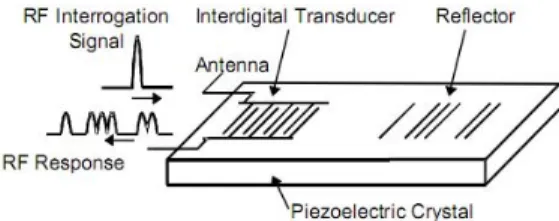
A passive RF SAW device is shown in Fig.

18. The signal wave is converted into a SAW by a rectenna and IDTs, and is transmitted throughout the structure. Reflected SAW waves then generate electric charges on IDTs, causing an electric output signal that is transmitted by the antenna to the reader. These output signals contain unique tag identification(ID) and sensor state information. Precisely positioned reflectors act as a unique code, thereby providing a unique tag ID. These reflectors also help to cancel regeneration waves (Springer et al., 1999).

SAW-based RFID devices can be considered to be a better system because they have ten times the read range of conventional RFID tags, are immune to RF backscatter signals, and the high signal-to-noise(S/N) ratios of these devices make them ideal for use in metal environments. Also, they do not contain electronic components (capacitors, microchips, etc.). Hence, they are more passive than an integrated circuit (IC)-based passive RFID tag, and the power drawn from the radio waves is sufficient to operate the passive device. Lack of electronic components lets them operate in extreme temperature and radiation environments, whereas IC-based general RFID devices cannot tolerate such conditions. Also, general RFID technology cannot provide data sampling at a rate of mega-samples per second as required for integrated structural/vehicle health monitoring.

SAW RFID tags have better signal penetration in

and around liquids and metals, and have more robust anti-collision capabilities (Wilson et al., 2008).

5.2 Orthogonal Frequency Coded(OFC) SAW Device

This SAW devices have been introduced in recent years. Each reflector or transducer can be uniquely coded with multiple carrier frequencies as shown in Fig. 19. OFC provides a wide bandwidth spread spectrum signal. A multi-layer coding approach is possible, which reduces code collision in a multi-sensor tag system. The use of OFC SAW devices as temperature, hydrogen, torsion, acceleration, and stress sensors has been successful.

Research on pressure and vibration-sensitive OFC sensors is ongoing: NASA is testing them for ground applications of space structures and aircraft applications (hypersonic and long duration aircraft) (Wilson et al., 2009).

6. Future Trends

Polymer electronics can be an effective

technology. Devices are easy to shape and

process, and their properties can be tuned. Also,

the cost of polymer tags is much less than

silicon-based RFID tags (Mutigwe and Aghdasi,

2007). Energy harvesting techniques will solve

the power issue, which is one of the major

drawbacks of active RFID and wireless-based

SHM technique (Park et al., 2008). This

improvement might encourage widespread

acceptance of wireless/RFID SHM systems. SAW

RFID devices, because of their advantages, might

be widely used in SHM (Springer et al., 1999).

(10)

Micro-fabricated sensors, on the other hand, are tiny, multipurpose and rugged. Thus, they also may gain wide acceptance for embedded RFID and wireless-based SHM systems.

7. Conclusion

Passive RFID and wireless technologies have several advantages over traditional methods for SHM. Transition to an RFID/wireless-based system for SHM is extremely economical, and time- and mass-friendly. Tiny passive RFID tags with micro-fabricated sensors can also be applied to aerodynamic surfaces, high temperature and radiation environments to which it is difficult for wired systems to apply. They need no real maintenance, and the passive devices can last a lifetime without any direct power supply. They can be custom designed, and a single system can have multipurpose sensing capabilities. More innovative and improved techniques should be developed to solve current issues, and to increase implementation range, capabilities and performances that are still weak points relative to wired systems.

References

Aatre, K. R., Joshi, A., Dasam, S., Abraham, J.

K., Varadan, V. K., Mahapatra D. R. and Gopalakrishnan, S. (2003) Wireless MEMS Devices for Crack and Corrosion Detection, Tri-Service Corrosion Conference, Las Vegas, USA

Arms, S. W., Newhard, A. T., Galbreath, J. H.

and Townsend, C. P. (2004) Remotely Reprogrammable Wireless Sensor Networks for Structural Health Monitoring Applications, Proc.

of International Conference on Computational and Experimental Engineering and Sciences, Medeira, Portugal

Arshak, K., Morris, D., Arshak, A., Korostynska,

O., Jafer, E., Waldron, D. and Harris, J. (2006) Development of Polymer-Based Sensors for Integration into a Wireless Data Acquisition System Suitable for Monitoring Environmental and Physiological Processes, Biomolecular Engineering Journal 23, pp. 253-257

Bennett, R., Gill, B. H., Crowe, J. A., Armitage, R., Rodgers D. and Hendroff, A. (1999) Wireless Monitoring of Highways, Smart Systems for Bridges, Structures, and Highways, SPIE 3671, pp. 173-182

Bentley, R. E. (1998) Handbook of Temperature Measurement: Temperature and Humidity Measurement, Springer Publications, Vol. 1

Blanch, M. J. and Dutton, A. G. (2003) Acoustic Emission Monitoring of Field Tests of an Operating Wind Turbine, Key Engineering Materials Journal 245-246, pp. 475-482

Carkhuff, B. and Cain, R. (2003) Corrosion Sensors for Concrete Bridges, IEEE Instrumentation and Measurement Magazine 6, pp. 19-24

Chin, J. C., Rautenberg, J. M., Ma, C. Y. T., Pujol S. and Yau, D. K. Y. (2008) A Low-Cost, Low-Data-Rate Rapid Structural Assessment Network: Design, Implementation, and Experimentation, Proc. of IEEE MASS, Atlanta, USA, pp. 173-182

Das, N. K., Khorrami F. and Nourbakhsh, S.

(1998) A New Integrated Piezoelectric–Dielectric Microstrip Antenna for Dual Wireless Actuation and Sensing Functions, SPIE 3328, pp. 133-146

Dutton, A. G., Blanch, M. J., Vionis, P., Lekou,

D., van Delft, D. R. V., Joosse, P. A.,

Anastassopoulos, A., Kouroussis, D., Kossivas,

T., Philippidis, T. P., Assimakopoulou, T. T.,

Fernando, G., Doyle, C. and Proust, A. (2003)

Acoustic Emission Condition Monitoring of

(11)

Wind Turbine Rotor Blades: Laboratory Certification Testing to Large Scale In-Service Deployment, Proc. of EWEC, Madrid, Spain

Fonseca, M. A., English, J. M., Arx M. V. and Allen, M. G. (2002) Wireless Micro-Machined Ceramic Pressure Sensor for High-Temperature Applications, Journal of Micro Electro Mechanical Systems 11, pp. 337-343

Gause, L. W., Krantz, D. G., Biermann P. J. and Belk, J. H. (1999) Early Demonstration of Remotely Queried Microsensors, SPIE 3673, pp.

190-194

Grisso, B. L., Martin L. A. and Inman, D. J.

(2005) A Wireless Active Sensing System for Impedance Based Structural Health Monitoring, Proc. of the 23rd International Modal Analysis Conference, Orlando, USA

Hoe, K. D, Nieuwenhuyse, A.V., Ottoy, G., Strycker, L. D., Backer, L. D., Goemaere J. P.

and Nauwelaers, B. (2009) Influence of Different Types of Metal Plates on a High Frequency RFID Loop Antenna: Study and Design, Advances in Electrical and Computer Engineering 9, pp. 3-8

Hou, T.C. and Lynch, J. P. (2005) Monitoring Strain in Engineered Cementitious Composites Using Wireless Sensors, Proc. of the International Conference on Fracture(ICF XI), Turin, Italy, pp. 20-25

Hunt, V. D., Puglia A. and Puglia, M. (2007) RFID-A Guide to Radio Frequency Identification, WILEY Interscience Publications

Ihler, E., Zaglauer, H. W., Schmidt, U. H., Dittrich K. W. and Wiesbeck, W. (2000) Integrated Wireless Piezoelectric Sensors, SPIE 3991, pp. 44-51

Ikemoto, Y., Suzuki, S., Okamoto, H.,

Murakami, H., Lin, X., Itoh, H. and Asama, H.

(2009) Force Sensor System for Structural Health Monitoring Using Passive RFID Tags for Structural Health Monitoring, Sensor Review Journal 29, pp. 127-136

Jung, K. H., Bredow, J. W. and Joshi, S. P.

(1999) Electromagnetically Coupled Embedded Sensors, SPIE 3674, pp. 148-156

Kessler, S. S., Spearing, S. M. and Soutis, C.

(2002) Structural Health Monitoring in Composite Materials Using Lamb Wave Methods, Smart Materials and Structures 11, pp.

1-13

Li, H. W., Zhou, Z. and Ou, J. P. (2003) Offshore Platform Health Monitoring Applications of Wireless Sensor, Proc. of the 21st International Modal Analysis Conference, Florida, USA

Loh, K. J., Lynch, J. P. and Kotov, N. A.

(2007) Passive Wireless Strain and pH Sensing Using Carbon Nanotube-Gold Nanocomposite Thin Films, Sensors and Smart Structures Technologies for Civil, Mechanical and Aerospace Systems, SPIE 6529, 652919.1- 652919.12

Lynch, J. P. (2004) Overview of Wireless Sensors for Real-Time Health Monitoring of Civil Structures, Proc. of the 4th International Workshop on Structural Control and Monitoring, NY, USA

Lynch, J. P. and Loh, K. J. (2006) A Summary Review of Wireless Sensors and Sensor Networks for Structural Health Monitoring, The Shock and Vibration Digest 38, pp. 91-128

Matsuzaki, R. and Todoroki, A. (2006) Wireless

Detection of Internal Delamination Cracks in

CFRP Laminates Using Oscillating Frequency

(12)

Changes, Composites Science and Technology 66, pp. 407-416

Mita A. and Takahira, S. (2002) Health Monitoring of Smart Structures Using Damage Index Sensors, Smart Structures and Materials, SPIE 4696, pp. 92-99

Morita, K. and Noguchi, K. (2006) Crack Detection Methods Using Radio Frequency Identification and Electrically Conductive Materials, AIJ Journal of Technology and Design 24, pp. 73-76 (in Japanese)

Mutigwe, C. and Aghdasi, F. (2007) Research Trends in RFID Technology, Interim:

Interdisciplinary Journal 6:11, pp. 68-82

Novak, L. J., Grizzle, K. M., Wood S. L. and Neikirk, D. P. (2003) Development of State Sensors for Civil Engineering Structures, SPIE 5057, pp. 358–363

Park, G., Rosing, T., Todd, M. D., Farrar C. R.

and Hodgkiss, W. (2008) Energy Harvesting for Structural Health Monitoring Sensor Networks, Journal of Infrastructure Systems 14, pp. 64-79

Ploeger, R., Newton, W. W., Rabiner A. and Lally, R. (2003) Wireless e-Diagnostics Reduces Workload and Improves Shipboard Quality of Life, Oceana Sensor Technologies, White Paper

Potgantwar, A. D. and Wadhai, V. M. (2009) Internal Location Based System for Mobile Devices Using Passive RFID and Wireless Technology, International Journal of Computer Science and Information 6, pp. 153-159

Potyrailo, R. A. and Morris, W. G. (2007) Multianalyte Chemical Identification and Quantitation Using a Single Radio Frequency Identification Sensor, Analytical Chemistry 79, pp. 45-51

Price, A. (2007) An Opportunity Analysis for

Efficient Parts Management in Airlines, IATA, www.iata.org/stbsupportportal

Prosser, W. H. (2003) Development of Structural Health Management Technology for Aerospace Vehicles, NASA LaRC, JANNAF 39th CS/27thAPS/21st PSHS/3rd MSS Joint Subcom.

Meeting

Ruhanen, A., Hanhikorpi, M., Bertuccelli, F., Colonna, A., Malik, W., Ranasinghe, D., López, T.S., Yan, N. and Tavilampi, M. (2008) Sensor-Enabled RFID Tag Handbook, BRIDGE, www.bridge-project.eu

Saafi, M. and Romine, P. (2004) Embedded MEMS for Health Monitoring and Nanagement of Civil Infrastructure, SPIE 5391, pp. 331-343

Sandoval, M. R. (2004) Smart Sensors for Civil Infrastructure Systems, Ph. D Thesis, University of Notre Dame

Schwartz, G. (2002) Reliability and Surviv- ability in the Reduced Ship’s Crew by Virtual Presence System, Proc. of the IEEE International Conference on Dependable Systems and Networks, Bethesda, MD, USA, pp. 199-204

Seifert, F. and Weigel, R. (1997) SAW-Based Radio Sensor and Communication Techniques, Proc. of the 27th European Microwave Conference, Jerusalem, Israel, pp. 1323-1346

Shanks, W (2004) Two RF Inputs Make a Better RFID Tag, Matrics Inc., White Paper

Springer, A., Weigel, R., Pohl, A. and Seifert, F.

(1999) Wireless Identification and Sensing Using Surface Acoustic Wave Devices, Mechatronics 9, pp. 745-756

Straser, E. G. and Kiremidjian, A. S. (1998) A

Modular, Wireless Damage Monitoring System

(13)

for Structures, John A. Blume Earthquake Engineering Center, Stanford, CA, USA, Technical Report No. 128

Walsh, S. M., Butler, J. C., Belk, J. H. and Lawler, R. A. (2001) Development of a Structurally Compatible Sensor Element, SPIE 4335, pp. 63-73

Wang, Y., Jia, Y., Chen Q. and Wang, Y.

(2008) A Passive Wireless Temperature Sensor for Harsh Environment Applications, Sensors Journal 8, pp. 7982-7995

Watters, D. G., Jayaweera, P., Bahr A. J. and Huestis, D. L. (2002) Design and Performance of Wireless Sensors for Structural Health Monitoring, Quantitative Nondestructive Evaluation, Proc. of AIP Conference 615, Melville, USA, pp. 969-976

Watters, D. G., Bahr, A. J., Jayaweera, P. and Huestis, D. L. (2003) Smart Pebbles™: Passive Embeddable Wireless Sensors for Chloride Ingress Monitoring in Bridge Decks, California

Dept. of Transportation, Report No.

FHWA/CA/TL-2003/07

Wilson, W. C., Perey, D. F., Atkinson, G. M.

and Barclay, R. O. (2008) Passive Wireless SAW Sensors for IVHM, Proc. of IEEE International Frequency Control Symposium 1, Honolulu, USA, pp. 273-277

Wilson, W. C., Malocha, D. C., Kozlovski, N., Gallagher, D.R., Fisher, B., Pavlina, J., Saldanha, N., Puccio, D. and Atkinson, G. M. (2009) Orthogonal Frequency Coded SAW Sensors for Aerospace SHM Applications, IEEE Sensors Journal 9, pp. 1546-1556

Zhang, Y., Yang L. T. and Chen, J. (2009) RFID and Sensor Networks: Architectures, Protocols, Security, and Integrations, CRC Press, 1st Edition

Zheng, P., Greve D. W. and Oppenheim, I. J.

(2008) Crack Detection with Wireless

Inductively-Coupled Transducers, SPIE 6932,

69321H-69321H-10

수치

Fig. 1 A typical RFID system
Fig. 6 Wireless MEMS Lamb wave sensors
Fig. 9 Thin film microfuse layout
Fig. 12 Inverted bit stream
+4

참조

관련 문서

It considers the energy use of the different components that are involved in the distribution and viewing of video content: data centres and content delivery networks

For safety, when constructing a connection system between a Sensor and panel with a connector, make sure that the connector plug is on the Sensor side and the connector socket

In an all-solid-state lithium-sulfur battery manufactured using a composite solid electrolyte, the ratio of carbon, a conductive material added to improve the

Sometimes called a direct neural interface or a brain-machine interface, is a direct communication pathway between a brain (or brain cell culture) and an external device..

2) polymer reactions using a polymer as a carrier or support for some component of a reaction system (polymeric brominating and Wittig reagents, the Merrifield

Wang, “Medium access control with a dynamic duty cycle for sensor networks,” IEEE Wireless Communications and Networking Conference, vol.. Dubendorfer,

In wireless sensor networks (WSNs), a transport protocol plays an important role of reliable transmission and congestion control.. The efficient design of

synthesis and application of silicon nano particles for improved efficiency in perovksite solar cells.. synthesis and application of silicon nano particles for improved