Journal of Internet Computing and Services(JICS) 2014. Oct.: 15(5): 01-07 1
무선 센서망에서 생체시스템 기반의 전송노드 선택 및 다중 채널 전송 알고리즘☆
Bio ‐ inspired Node Selection and Multi ‐ channel Transmission Algorithm in Wireless Sensor Networks
손 재 현1 양 윤 기11 변 희 정2*
Jae‐Hyun Son Yoon-Gi Yang Hee-Jung Byun
요 약
무선센서 네트워크(WSNs)는 일반적으로 수많은 센서노드들이 배치되어 데이터를 전송하며, 불필요한 데이터 전송으로 인해 에너 지 낭비를 초래한다. 기존의 연구들은 주로 에너지 소모문제를 해결하는데 집중되었다. 하지만 실시간으로 정보전송이 필요한 어플 리케이션에 대해서는 지연 보장 역시 고려되어야 한다. 본 논문은 생체시스템을 모방하여 무선센서망에서 에너지의 소모와 연시간을 줄이기 위한 BISA(Bio-inspired Scheduling Algorithm)를 제안한다. BISA는 에너지 효율성이 높은 라우팅경로를 탐색하고 다중채널을 이 용해 데이터 전송경로를 다중화함으로써 데이터 전송을 위한 에너지소모와 지연시간을 최소화한다. 실험결과를 통해 제안한 알고리 즘의 기존방식 보다 적은 에너지를 사용하며 동시에 요구지연 시간을 보장함을 확인한다.
☞ 주제어 : 무선센서네트워크, 에너지효율성, 생체모방알고리즘 ABSTRACT
WireWireless sensor networks(WSNs) are generally comprised of densely deployed sensor nodes, which causes highly redundant sensor data transmission and energy waste. Many studies have focused on energy saving in WSNs. However, delay problem also should be taken into consideration for mission-critical applications. In this paper, we propose a BISA (Bio-Inspired Scheduling Algorithm) to reduce the energy consumption and delay for WSNs inspired by biological systems. BISA investigates energy-efficient routing path and minimizes the energy consumption and delay using multi-channel for data transmission. Through simulations, we observe that the BISA archives energy efficiency and delay guarantees.
☞ keyword : Wireless sensor networks, node state, energy efficiency, bio-inspired algorithm
1. Introduction
Wireless sensor networks (WSNs)are composed of a large number of sensor nodes, where data is transmitted through multi-hop routing along with short-range communication.
Owing to advantage that can establish networking system with low cost and relatively easy way through sensor nodes,
1,2Dept. of Information and TelecommunicationsEngineering , (Suwon University)., Hwaseong-si,Gyeonggi-do, 445-745, Korea.
* Corresponding author([email protected])
[Received 30March 2014, Reviewed 11 April 2014, Accepted 29May 2014]
☆ This research was supported by the GRRC SUWON 2014-B4 program of Gyeonggi province.
☆ A preliminary version of this paper was presented at ICONI 2013 and was selected as an outstanding paper.
WSN systems have been used for multiple purposes such as collecting information and real-time surveillance in many areas. However, sensor nodes have limited capacity of power by using compact battery and it is hard to replace battery of node once it has been deployed. Since the sensor node uses a method of collecting data by being spread to specific areas randomly and sending to other node, effective energy co nsumption problem has been pointed out as one of critical problems of sensor network.
Many researches have focused to solve this energy consumption problem. However, delay problem also should be taken into consideration for mission-critical applications.
Specifically, when source node transmits data to sink node through multi-hop, receiving node should be awaken to receive data. When the receiving node maintains the awaken ISSN 2287-1136 (Online)
http://www.jksii.or.kr
state for a long time, it can reduce transmission delay, but resulting in large energy consumption. On contrary, if node maintains sleeping state, there is no energy consumption but it cannot receive data from sending node for a long time, resulting in additional delay.
To solve delay problem, sensor network systems have used multi-channel. Multi-channel can solve the delay problem incurred when sending data simultaneously through a channel by expending the number of channels. However, the problem of selecting high efficient channel in data transmission remains for multi-channel based approach. In this paper, wepropose a new node scheduling algorithm for archiving energy savings while reducing delay using multi-channel in WSNs.
2. Related work
Researches to minimize energy consumption of sensor network can be divided into two methods in large. First, method of controlling energy by adjusting duty cycle has been proposed. S-MAC [1] protocol was suggested to minimize energy consumption by maintaining active time and sleeping time in a fixed period. However, active state is maintained even at the state of data transmission termination, which results in energy consumption. The work of [2]
reduced energy consumption by not increasing active state through adjusting duty cycle of receiving node.Second, method of minimizing energy consumption through routing was proposed by minimizing transmission path between nodes. Also, method of sending data through shortest routing path based on cost was proposed [3,4,5,6]. However, if many nodes with identical hop exist, they select remote node as next node, resulting in energy consumption. Existing works for WSN have been mainly designed to maximize node life by conserving energy. However, lowering the energy consumption induces the additional delay.
Recently, many researches have been proposed to achieve a good tradeoff between energy consumption and delay. In order to reduce end-to-end delay, methods of sending control packets informing data transmission to receiving node before receiving node sends data were proposed [7,8,9]. However, many control packets induces additional
energy wastes. To solve the problem, the work of [10] sends data to upper node in order from lower node by applying different duty cycle time depending on route depth.
However, packet collision occurs upon packet transmission if there are several nodes at a layer because all of them have identical back-off time. Another approach for reducing delay has been proposed using multi-channel and distributing data transmission. LQ-MCMAC [11] suggested method that sends data with RSSI threshold value and selects channel with high transmission efficiency. Reservation based multi-channel CSMA MAC protocol [12] reserves transmission request when transmission is requested from other node during data transmission, which leads to minimize competition for transmission.
These existing works could conserve energy and reduce delay significantly. However, due to their large scale, they impose limitations when coordinating sensor nodes [13].
Even for the distributed networking protocols into the scalability issue, the performance of a large scale WSN deteriorates as the number of nodes increases. Moreover, they possess some problems of maintaining a certain level of functionality and performance.
To address these concersn, we propose a bio-inspired node scheduling algorithm (BISA) in the multi-channel environment. Self-organized control inspired by biological systems has been receiving considerable attention as a new alternatives for the realization of robustness, scalability and adaptability. Biological systems are versatile and adapt themselves to environmental changes. Each entity of abiological system makes decisions based on local interactionswith their neighbors. For this reason, a number of methods have been proposed where the attributes of biological systemswere adopted to computer network systems. In this paper, we apply biologicalsystem to WSNs in order to save energy and reduce delay as well.
3. Bio-inspired Scheduling Algorithm
3.1 Ant Colony Optimization(ACO)
Ant Colony Optimization(ACO) algorithm introduced by Dorigo(1992) is a method to find a shortest path among many paths from starting point to final destination[14,15].
Fig.1 shows the process for ants to find a shortest path by selecting paths. After ants reach destination passing through many paths to arrive at the destination where foods are from the starting point, they discharge their pheromone on the path coming back to the starting point. Afterwards ants heading toward destination from starting point head for the destination following pheromone ants which have started before themand come back have discharged. Even though many ants travel through many paths, pheromone of remote path vaporizes due to ants' long travel distance and shorter distance has much accumulated pheromone owing to short travel distance. While ants travel through path with much pheromone, pheromone remains a travel path toward destination, determining the shortest path to the final destination.
A
B
C
D
(Figure 1) How real ants find a shortest path [16].
3.2 ACO Based Algorithm Structure Sink node broadcasts packets and all neighboring nodes which have received packet renew path metric values with data included in packet and their data. Afterwards each node determines path metric value of its own, transmitting to neighboring nodes. The neighboring nodes save received path metric values and in case that they have data to send, they select node with the biggest path metric value among neighboring nodes and transmit. In order to apply ACO algorithm to our proposed scheme (BISA), we show the relevant entities of the ant colony system and our proposed BISA system in Table 1.
(Table 1) Mapping from ACO to BISA
ACO BISA
Ant point of departure Source node Destination Sink Node
Ant Packet
Pheromone release Path metric Shortest path Path metric values with the
highest sequence of nodes
In BISA, by applying ACO method which is a kind of bio-inspired methods, packet is transmitted to the final destination, sink node through neighboring nodes in the sending node and calculation on the value of energy amount remaining and the number of hops which each node has is sent to neighboring node and node with the maximum value among received values is selected by forward node.
3.3 Initialization
By setting the number of hops of itself as 0 at sink node, packet broadcasting is conducted. As packet is transmitted to node, the number of hops increases by one and node receiving packet determines its number of hops by the number of hops written on packet and conducts broadcasting of packet written its number of hops to neighboring nodes.
By repeating the process, all nodes on network set the number of hops.
3.4 Node Selection
Path metric is defined as F below
F = (E0–Ec) / H (1)
E0is overall energy, Ec energy consumed up to now, and H the number of hops from the relevant node to sink node. Fis a value dividing energy amount remaining at node by hop count value up to sink node. Each node informs itsFvalue to neighboring nodes periodically and node having data to send selects node with the biggest F value as next node.
3.5 Channel Selection
Channel with RTT value smaller than threshold value of channel among channels which node has in the selected node is selected in priority and in case that all channels exceed threshold value, channel with the smallest RTT value is selected and data was transmitted. By overhearing pack sending and receiving of sending and receiving nodes with application of CSMA MAC protocol, RTT of channel is calculated and renewed.
Each node measures RTT(Round trip time) by channel and saves filtered RTT(RTTa) value using following formula:
) 1 0 ( ) 1 (
,
, ,
<
<
=
+
−
=
α α α
α inew
past i new
i
RTT RTT
RTT RTT
RTT
(2)
Where RTTis the measured RTT value for channel i.
past
RTTi, is RTT value saved for channeli. RTTi,newis a newly calculated RTT value using RTTi,pastand RTT.We introduce RTT threshold value, γ, which is a random value following uniform distribution within [0,(2Dreq)/H].
) / ) 2 ( , 0 (
~U Dreq H
γ (3)
whereDreqis delay requirement. By comparing RTTa value of selected channel with γ, in case that RTTa value
has smaller value than γ, packet is transmitted through RTTa channel selected first. In case that RTTa value of channel is bigger thanγ,however, packet is selected with comparison of RTTa value of other channel and γ, at that time RTTa value of other channel compares RTTa value of channel obtained through previous data packet transmission savedat the table of each node with γ. If RTTa of a channel is smaller than γ, packet is transmitted through the channel and in case of being bigger than γ, packet is transmitted by selecting other channel with the small RTTa value with comparing RTTavalue between channels.
(Table 2) Simulation Parameter Variable Name Values Number of nodes 20 Nodes Number of packets 10 Packets Number of channels 10 Channels Packet size 127 bytes Data rate 20 kbps Minimum channel quality 0.075 Maximum channel quality 0.75
4. Simulation Results
4.1 Simulation Configuration
To identify functions of proposed BISA, we compared with MCRT(Multi-channel real-time communication protocol) [17] and EER (Energy Efficient Routing) [18]. MCRT determines the shortest routing path between nodes by selecting path based on distance between nodes. EER selects next path from shortest path between source node and receiving node, while minimizing energy of the node by keeping sleep state.
We simulate three methods using MATLAB. The simulation parameters are listed in Table 2. 20 sensor nodes are deployed randomly in a region that measure 100m × 100m. By setting the number of channels as 10, residual energy amount at node and delay are compared.
4.2 Simulation Results
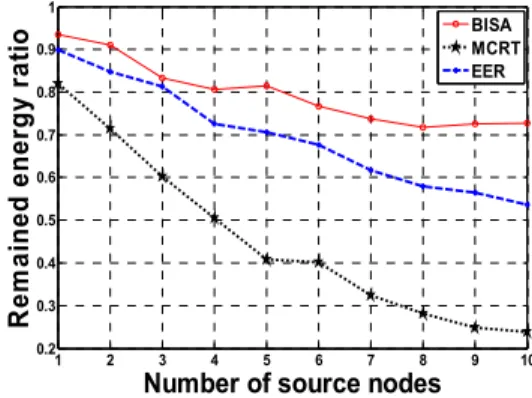
Fig 2 shows ratio of residual energy amount at 20 nodes in overall on the whole energy by varying the number of nodes. MCRT and EER algorithm show rapid reduction of remaining energy amount according to the increase of the number of receiving nodes. In BISA algorithm, even though the number of receiving nodes increases, a bit amount of energy decreases. This is because there is small re-transmission of data packet sent at each node in BISA.
However MCRT algorithm wastes much energy as re-transmission of packet becomes much. EER also shows a larger number of data retransmission, but it shows higher energy efficiency than MCRT because of a fewerrouting path. Increasedre-transmission of node packet continues to energy depletion of node, causing loss of interim transmission path.
Fig 3 shows end-to-end delay by varying the number of nodes. We set the delay requirement to three seconds. BISA shows that the end-to-end delay is maintained under the delay requirement in spite of increasing the number of receiving nodes. However, MCRT and EER show that the end-to-end delay exceeds the required delay.
Fig 4 shows end-to-end transmission time by varying packet rates.We increase the number of sending packets from 1 to 10 per a second. BISA shows that the end-to-end transmission time lies under three seconds, but MCRT and EER do not guarantee delay requirement at all.
1 2 3 4 5 6 7 8 9 10
0.2 0.3 0.4 0.5 0.6 0.7 0.8 0.9 1
Number of source nodes
Remained energy ratio BISAMCRT
EER
(Figure2) Average residual energy ratio varing the number of source nodes.
(Figure3)Average delay time varing the number of source nodes.
1 2 3 4 5 6 7 8 9 10
2 3 4 5 6 7 8 9
Packet Rates(packet/s)
End-to-end Transmission time(s)
BISA MCRT EER
(Figure4) End to end transmission time varing the number of transmission packets.
5. Conclusions
We propose a new bio-inspired node scheduling algorithm (BISA) to improve energy efficiency while guaranteeing delay requirement. The proposed algorithm minimizes energy consumption through setting the shortest routing path with node hop and energy value. In addition, the proposed algorithm selects the channel based on the calculated RTT of channel. From the simulation results, we observe that BISA is more effective than the existing protocols in terms of energy consumption and transmission delay. In future, we plan to extend our research to realize our algorithm in WSNs.
참 고 문 헌 (Reference)
[1] W. Ye, J. Heidemann, and D. Estrin, “An energy-efficient MAC protocol for wireless sensor networks,” IEEE INFOCOM 2002, Vol .3, pp. 1567-1576
[2] Seonghun, Sungkeun Lee, Changryul Jung, and JingwangKoh, “Adaptive MAC protocol for Low Latency in WMSN,” Journal of Korean Society for Internet Information,Vol. 10, No.2, pp. 161-169, 2009.
[3] Sora Jin, Wooyoung Lee, Taeyoung Kim, Wonhee Lee, Jeongsik In, and DooseopEom, “A cost-based Optimal Path routing algorithm in Wireless Sensor Netowrks,”
IEEK, Vol29, No. 2 , pp. 314-317, 2006.
[4] Rahul C. Shah and Jan M. Rabaey, “Energy Aware Routing for Low Energy Ad Hoc Sensor Networks,”WCNC2002, Vol. 1, pp. 350-355, 2002.
[5] Sourabh Jain, Praveen Kaushik, and JyotiSinghai, “Energy efficient maximum lifetime routing for wireless sensor network,”International Journal Of Advanced Smart Sensor Network Systems(IJASSN), Vol. 2, No. 1, pp. 1-11, 2012.
[6] JaewanSeo, Moonseong Kim, Sanghun Cho, HyunseungChoo, “On Data Dissemination Protocol Considering Between Energy and Distance in wireless Sensor Networks.” Journal of Korean Society for Internet Information, Vol. 9, No. 5, pp. 131-140, 2008.
[7] Manseok Kim, Sangsoo Kim, KwangshinKoh, Gihwan Cho, and Moonho Lee, “An MAC Protocol Design in Minimizeing of Data Transmission Delay for Wireless Sensor Networks,” Journal of Korean Society for Internet Information,Vol. 8, No. 2 , pp. 43-54, 2007.
[8] Dongho Lee and Kwangsu Chung. “An Energy efficient and low latency mac protocol using RTS aggregation for wireless sensor networks,” Journal of KIISE,Vol. 35, No.
4, pp. 326-336, 2008.
[9] Sanghoon Lee, joonho Park, and Lynn Chon,
“AMAC:Traffic-adaptive sensor network MAC protocol through variable duty-cycle operations,”IEEE international Conference on Communications, pp. 3259-3264, 2007
[10] Kyunghyun Kang, Byunghun Song, and Kwangsue Chung,
“An adaptive back-off scheme to gurantee bounded delay in wireless sensor networks,” KCC 2009. Vol36, No. 1, pp. 263-266, 2009.
[11] Kwanghyun Chung and Kwangsue Chung,
“Amulti-channel mac protocol based on link quality to improve transmission reliability in wireless sensor networks,” Journal of KIISE,Vol. 38, No. 4, pp. 282-292, 2011.
[12] Jungahn Han, Yunhyung Kim, Moonho Lee, and Byunggi Kim, “Reservation based multichannel CSMA protocol for improvement of energy consumption and Qos in wireless sensor networks,” J-KICS,Vol .32, No. 2, pp.
143-151, 2007.
[13] F. Dressler and O. B. Akan, “A survey on bio-inspired networking,”Computer networks, Vol. 54, No. 6, pp.
881-900, 2010.
[14] Marco Dorigo, Mauro Birattari, and Thomas Stutzle,. “Ant Colony Optimization,” IEEE Computational Intelligence Magazine, pp.28-39, 2006.
[15] A. Kumar and A. Thomas, “Energy efficiency and network lifetime maximization in wireless sensor networks using improved ant colony optimization,” ICCCNT, pp. 1-5, 2012.
[16] Surendra Kumar and C.S.P. Rao, “Application of ant colony, genetic algorithm and data mining-based techniques for scheduling,”18th international conference on flexible automation and intelligent manufacturing,Vol.
25, No. 9, pp. 901-908, 2009.
[17] Xiaodong Wang, Xiaorui Wang, Xing Fu, Guoliang Xing, and NitishJha, “Flow-based Real-Time Communication in Multi-Channel Wireless Sensor Networks,” Proceedings of the6th European Conference on Wireless Sensor Networks,pp. 33-52, 2009.
[18] N. Batra, A. Jain, and S. Dhiman, “An Optimized Energy Routing Algorithm For Wireless Sensor network,”International Journal of Innovative Technology
& Creative Engineering, Vol. 1, No. 5, pp. 41-45, 2011.
◐ 저 자 소 개 ◑
손 재 현 (Jae-Hyun Son) 2012년 수원대학교정보통신공학과학사 2014년 수원대학교정보통신공학과석사.
관심분야 무선네트워크, 생체모방알고리즘
양 윤 기 (Yoon-Gi Yang) 1989년 서울대학교어계측공학과학사.
1991년 서울대학교대학원제어계측공학과석사.
1996년 서울대학교대학원제어계측공학과박사.
현재 수원대학교정보통신공학과부교수.
관심분야 디지털통신, 영상처리, 신호처리
변 희 정 (Hee-Jung Byun) 1999년 숭실대학교보통신공학과학사.
2001년 한국과학기술원전자전산학과석사.
2005년 한국과학기술원전자전산학과박사.
2010년 삼성종합기술원,삼성전자
2010~현재 수원대학교IT대학정보통공학과 조교수.
관심분야 네트워크제어