http://dx.doi.org/10.7236/JIIBC.2013.13.4.17
JIIBC 2013-4-3
모바일 애드혹 무선 네트워크에서 멀티 홉 협력 전송 프로토콜
A Multi-hop Cooperative Transmission Protocol in Mobile Ad-hoc Wireless Networks
공형윤* Hyung-Yun Kong
요 약 본 논문에서는 레일리 페이딩 채널의 멀티 홉 협력 전송 프로토콜을 제안한다. 제안된 프로토콜에서, 멀티 홉 협력 전송은 시스템 성능의 향상을 위해 사용되었다. 중계라는 특성으로 인해, 전송받는 노드와 다음의 노드뿐만 아니라, 목적지와 그 사이의 전송 받는 모든 노드들이 제한되어 있지 않다. 제안된 프로토콜은 선택된 릴레이나 몇몇 의 중간 노드로부터 건너 뛰어 전송되는 멀티 홉 직접 전송 프로토콜에 비해 평균 전송 전력을 절약할 수 있다. 제안 하는 기법은 모바일 ad-hoc 무선 네트워크에서 시행 및 평가되어진다.
Abstract In this paper, we propose a multi-hop cooperative transmission protocol over Rayleigh fading channels.
In the proposed protocol, the multi-hop cooperative transmission is used to improve the system performance.
Due to broadcast nature, we do not limit the receiving node to be only the next node, but the destination and all the nodes between the transmitting node and the destination. The proposed protocol can hence save the average transmit power, compared with multi-hop direct transmission protocol due to the skipped transmissions from some intermediate nodes or chosen relays. The proposed scheme is implemented and evaluated in mobile ad-hoc wireless networks.
Key Words : Cooperative Transmission, Outage Probability, Mobility, Mobile Ad-hoc Wireless Networks.
*정회원, 울산대학교 전기전자정보시스템공학부 접수일자 : 2013년 5월 1일, 수정완료 : 2013년 7월 7일 게재확정일자 : 2013년 8월 16일
Received: 1 May, 2013 / Revised: 7 July, 2013 / Accepted: 16 August, 2013
*Corresponding Author: [email protected]
School of Electrical Engineering, University of Ulsan, Korea
Ⅰ. Introduction
Recently, multi-hop cooperative transmission has gained a great interest in research community.
Currently various cooperative transmission protocols have been studied in several literatures [1-2]. In these protocols, each node on the route can receive the signals from the previous transmitting nodes, processes
the received signals and forwards the processed signal without using combining techniques. In [3-4], the relay terminals are equipped with maximal combining technique (MRC) to enhance the outage performance.
However, the authors in [1-4] only considered the static networks in which nodes are assumed to be stationary.
In [5], a multi-hop cooperative transmission scheme proposed and implemented in mobile ad-hoc networks.
However, in this protocol, the cooperative transmission is realized at each hop, which can reduce the channel utilization efficiency.
In this paper, we propose a multi-hop cooperative transmission protocol in mobile ad-hoc network. In proposed scheme, named MCT, a route is established by network layer and the relays are selected at each hop along this route. At physical layer, due to broadcast nature, we let the destination have the permission to receive the packet from the source or the nodes being on the established route (hereafter called intermediate nodes) or the selected relays at each hop.
If the destination receives successfully, the transmission of the new packet will start. Otherwise, the successfully intermediate node that is nearest to the destination will be considered as a source again and will repeat the procedure as the previous source does.
In the proposed protocol, we use mobility prediction technique to construct a stable route and select stable relays at each hop. We then evaluate the performances of the MCT protocol in terms of packet delivery ratio (PDR) and end-to-end delay.
The rest of the paper is organized as follows. The system model is described in Section II. The simulation results are presented in Section III. Finally, the paper is concluded in Section IV.
Ⅱ. System Model
2.1 The construction of a stable route using the mobility prediction technique In this paper, the most stable route among all available routes is selected by using the mobility prediction technique [6]. With this method, two nodes, inside the transmission range (Z) of each other, can know the mobility information and the position information of each other. Therefore, we can determine the duration of time these two nodes will remain connected. Assume that at time t, node i is a neighbor of node j and vice versa. Let denote as the
Source
Destination
Mobile Ad-hoc Wireless Networks
Mobile node over the chosen route
Mobile node in the given network at t Mobile node in the given network at t+Δt Velocity vector (speed,direction )
RREQ Transmission
RREP Transmission
Mobile node over different routes N1
N2
N3
N4
N5
N0
N6
그림 1. 이동성 감지 기술을 사용한 경로의 설정 Fig. 1. Establishment of a route using the mobility prediction technique.
coordinate of node i and as that of node j. If
and are the velocities, and and are the directions of nodes i and j, respectively, then the amount of time that they would stay connected is predicted by [6]:
(1) where , ,
and .
The operation of the route establishment can be performed as follows:
Step 1: As reactive routing protocols such as Ad hoc on-demand Distance Vector (AODV)[7], the source generates RREQ packet and this packet is forwarded to destination or nodes which know the route for destination. In this paper, RREQ packet contains the mobility information and the position information of node which sends it.
Step 2: After receiving the RREQ packet from neighbor i, mobile node j calculates the amount of the connection time: , according to (1). In our proposal, each node just broadcasts the RREQ packet when it receives the first RREQ packet from its neighbor. If it
receives the RREQ packet again, it just updates the information from this packet. Next, assume that node k receives RREQ packet from node j at the first time;
similarly, node k calculates the connected time , and compares this value with the received value . Then, the minimum value between and will be attached in the RREQ packet broadcasted by this node. Sequentially, the RREQ packet is forwarded to the destination by the different routes and the destination can calculate the lifetime of these routes.
For example, consider a route that consists of nodes
, , , , , and , where is source node and is destination node, as shown in Fig. 1. The lifetime of this route is given by
(2)
where i=0,1,2,3,4,5.
Step 3: When the destination receives RREQ, it only chooses the route with the maximum lifetime and replies to the source by sending a Route Reply packet (RREP) along this path. The RREP packet also includes the mobility information and the position information of node which sends it. When the source receives RREP from the destination, a route is established and the source can send the data packets to the destination.
2.2 The relay selection strategy using the mobility prediction technique
Ni
1
Ni+
M3
M1
M2
Mobile node over the route at t+Δt Mobile node over the route at t
Mobile node in the given network at t
Mobile node in the given network at t+Δt
Velocity vector (speed, direction)
2, i1
TM N+
2, i
TM NM N1, i1
T +
1, i
TM N
3, i1
TM N+
3, i
TM N
그림 2. 이동성 감지 개념을 사용한 중계기 선택 Fig. 2. Relay selection using the mobility prediction concept.
Applying the mobility prediction scheme as mentioned above, we propose a relay selection method as follows. First, we assume that the route including intermediate nodes , , , , and is chosen (see Fig. 1). Now, we consider hop i+1 between nodes and as presented in Fig. 2. Denote A (i.e., as the set of nodes that are in radio range of both nodes and . By the operation of route construction, each node belonging to the set D can receive RREQ packet from node and RREP packet from node . Therefore, each node
can calculate the connection time
and
and sends these values to node
. Node will then choose the stable relays by following strategy:
≥ (3)
Equation (3) implies that relay staying in the radio range of nodes and with the amount of time that is larger than a certain threshold T will be chosen as relays for cooperation. In this paper, we set T to equal the lifetime of the established route.
Furthermore, to reduce the control overhead and complexity, the chosen relays should be used during the lifetime of the route. When the route is broken, the source finds a new route to the destination and relays at each hop of this route are re-selected as the strategy above.
When a route is established and the relays are chosen at each hop, the source can send the packet to the destination by using the following transmission strategy.
2.3 Cooperative Transmission at Physical Layer
At first time slot, the source cooperates with the chosen relays at the first hop to transmit the source packet to the destination and intermediate nodes.
Generally, whenever the destination decodes incorrectly, a NACK message is sent to request a re-transmission. Then, the intermediate node that successfully decodes the packet and is nearest to the destination is considered as the source again and it cooperates with the chosen relays at that hop to transmit the source packet. The transmission is terminated when the destination receives successfully or, there is no more intermediate node that can decode successfully. In addition, in the MCT protocol, it should be noted that the size of NACK message is negligible relative to the size of the packet and hence the total time delay of finding an intermediate node for the re-transmission is also negligible, in comparison with the average delay of a packet transmitted from a transmitter to a receiver.
We assume that the channels between two nodes are subjected to flat Rayleigh fading plus AWGN. It is assumed that K transmitters, , cooperate to transmit the same packet to a receiver R.
The mutual information between the transmitters and the receiver R is give as
(4)where P is the average transmit power, is variance of Gaussian noise,
is Rayleigh fading coefficient between nodes and R. In (4), the factor 1/K implies that the cooperative transmission is realized by K time slots. In this paper, we assume that the receiver R can decode the packet from K transmitters successfully if ≥ where
is target rate of the system. If , it is assumed that the receiver R cannot receive the packet correctly.
Ⅳ. Simulation Results
In mobile ad-hoc wireless networks, the proposed
protocol is implemented by the Optimized Network Engineering Tool (OPNET). We model a network consisting of 50 nodes that are placed randomly within a square area of 1 km x 1 km. Each node is assumed to be aware of its position exactly. The mobile nodes are also assumed to have constant radio range of Z=
250m. Furthermore, we use the random mobility scenario, in which speed and direction of each mobile node are uniformly distributed with speed range
km/h and direction range , respectively. During the simulation, each node moves around the network area, and when a mobile reaches to the boundary of the given network, the node reenters into network.
In the following simulations, we set the target rate of the system to 1.5 packet/sec/Hz, the path loss exponent to 3, the simulation time to 100 seconds, the rate of sending packets to 5 packets/sec. In addition, we assume that in interval of 5 seconds, the speech and velocity of each mobile node is constant, 5 seconds for reconstructing a new route from a source to a destination and the maximum number of chosen relays at each hop (V) is 2.
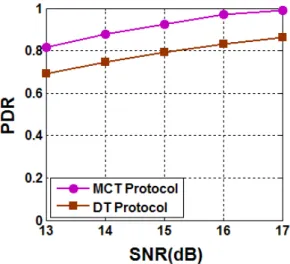
그림 3. km/h 일 때, 패킷 전송율.
Fig. 3. Packet delivery ratio when km/h.
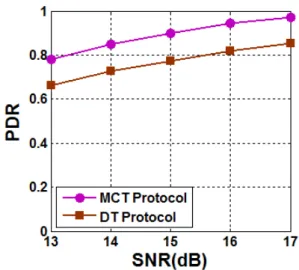
그림 4. km/h 일 때, 패킷 전송율.
Fig. 4. Packet delivery ratio when km/h.
Figures 3-4 show the packet delivery ratio (PDR) as a function of transmit signal-to-noise ratio ( ) in dB when the value of is fixed. PDR is the ratio of the number of packets received at the destination to the number of packets transmitted at the source. In these figures, for all presented values of velocities, the PDR of the proposed protocol is larger than that of the DT protocol. It is due to the fact that the proposed scheme uses cooperative diversity transmission which enhances the reliability of the data transmission.
그림 5. 제안된 기법과 DT 프로토콜의 단-대-단 중계 Fig. 5. End-to-end delay of the proposed scheme and the DT protocol.
In Fig. 5, we present the average end-to-end delay time as a function of the transmit SNR in dB. It is noted that in this simulation, the end-to-end delay does not depend on the velocity of mobile node. It can be observed that the end-to-end delay of the proposed protocol decreases with increasing SNR, while the multi-hop direct transmission protocol (MDT) protocol keeps the constant one.
Ⅴ. Conclusion
In this paper, we proposed the multi-hop cooperative transmission protocol (MCT) over Rayleigh fading channels. The proposed scheme can increase the PDR when compared to the MDT protocol. Furthermore, relying on broadcast nature, the MCT protocol can decrease the average number of transmissions so reducing power consumption and end-to-end delay which are important criteria in multi-hop transmission.
Furthermore, we considered a realistic approach that based on mobile nodes in mobile ad-hoc wireless network.
Reference
[1] T.T. Duy and C.-K. An, "Cooperative Multi-Hop Transmission Protocol with Incremental Relaying Strategy over Rayleigh Fading Channel", Journal of Electromagnetic Engineering and Science (JEES), vol. 12, no. 2, pp. 142-147, June 2012.
[2] T.T. Duy and H.Y. Kong, "PER Analysis for Cooperative Multi-hop Transmission Protocol over Nakagami-m Fading Channels", Journal of Electromagnetic Engineering and Science (JEES), vol. 12, no. 3, pp. 189-195, Sept. 2012.
[3] T.T. Duy and J.-S. Kim, "Multihop Transmission Protocol Using Cooperative Diversity over Rayleigh Fading Channel", Journal of Electromagnetic Engineering and Science (JEES), vol. 12, no. 2, pp.
135-141, June 2012.
[4] T.T. Duy, B. An and H.Y. Kong, "A Novel Cooperative-Aided Transmission in Multi-Hop Wireless Networks", IEICE Transactions on Communications, vol. E93-B, no. 3, pp. 716-720, March 2010.
[5] B. An, T. T. Duy and H.Y. Kong, "A Cooperative Transmission Strategy using Entropy-based Relay Selection in Mobile Ad-hoc Wireless Sensor Networks with Rayleigh Fading Environments", KSII Transactions on Internet and Information Systems (TIIS), vol. 3, no. 2, pp.147-162, Feb. 2009.
[6] S.J. Lee, W. Su, M. Gerla, "Ad hoc wireless multicast with mobility prediction," in proc of IEEE ICCCN '9, Oct. 1999.
[7] C. E. Perkins, E. M. Royer, "Ad-hoc on-demand distance vector routing," in proc. of WMCSA '99, pp.90-100, 25-26, February 1999.
저자 소개
공 형 윤(정회원)
∙1989년 2월 : New York Institute of Technology(미국) 전자공학과 학사
∙1991년 2월 : Polytechnic University (미국) 전자 공학과 석사
∙1996년 2월 : Polytechnic University (미국) 전자 공학과 박사
∙1996년~1996년 : LG전자 PCS팀장
∙1996년~1998년 : LG 전자 회장실 전략 사업단
∙1998년~현재 : 울산대학교 전기전자정보시스템공학부 교수
<주관심분야> 모듈레이션, 채널 부호화, 검파 및 추정 기술, 협력통신, 센서네트워크