1. INTRODUCTION
Wireless sensor networks have various applica- tion services. Generally, wireless sensor network has short wireless links and make network using multi-hop transmission. In a multi-hop trans- mission, some links can be broken, some links can erroneous channel, and batteries of nodes can be out. The wireless sensor network has property of ad-hoc network and it is established easily and the nodes can freely join or drop out of the network [1,2]. A wireless channel suffers from time-vary- ing fading caused by multi-path propagation and destructive superposition of signals arriving via different path. In those time-varying situations, if the nodes have battery out or drop out of the net- work, routing path cannot work and transmission is not possible. Traffic congestion also make seri- ous problem and it can stop the data transmission.
Especially in the multimedia transmission, in-
creased amount of data can induce large trans- mission delay.
To solve these problems, various multipath routing techniques were proposed [3,4]. Multipath routing distributes traffic into different paths and can prevent overflow of traffic. Multipath routing also can provide space diversity gain. Diversity techniques are a widely applied to reduce detri- mental effects of time-varying fading When one routing path is broken, data can be transferred via the other different path. When we design the mul- tipath protocol, the important issues are which paths to be selected and how to distribute the traffic.
When we determine the multipath, we should consider the effect of interference among the paths.
In a single path transmission, there is no perform- ance degradation caused by path interference, but path interference can cause severe performance degradation in the multipath routing. To avoid path
Interference Aware Multipath Routing in Multi-rate Wireless Sensor Networks
Kang Gun Lee
†, Hyung Kun Park
††ABSTRACT
In wireless sensor networks, sensor nodes have a short transmission range and data is transferred from source to destination node using the multi-hop transmission. Sensor nodes are powered by battery and the link qualities are different, and the routing protocol in the wireless sensor network is one of the important technical issues. Multipath routing was proposed to reduce the data congestion and increase data throughput. In the multipath routing, however, each path can be interfered by the other path, and it can aggravate network performance. In this paper, we propose the multipath routing scheme for multi-rate wireless sensor networks. The multipath routing selects transmission paths to minimize transmission delay and path interference.
Key words: Wireless Sensor Network, Multipath Routing, Multi-hop Transmission, Routing Protocol
※ Corresponding Author : Hyung Kun Park, Address:
(330-708) 1600, Chungjeol-ro Byeongcheon-myeon, Dongnam-gu Cheonan-City, Chungnam-Do, Korea, TEL : +82-41-560-1176, FAX : +82-41-564-3261, E-mail
: [email protected]
Receipt date : Jun. 30, 2015, Revision date : Jun. 30, 2015
Approval date : Jul. 17, 2015
††
School of Electric Electronic and Communication Engineering, KOREATECH
(E-mail : [email protected])
††
School of Electric Electronic and Communication
Engineering, KOREATECH
interference, location based multipath routing pro- tocol were proposed [5]. In that protocol, additional equipment such as GPS (Global Positioning Sys- tem) receiver or localization techniques [6, 7] are required to get the positional information, which increases the complexity, size and cost of nodes.
To cope with unreliable transmission, several standards support multi-rate transmissions. Trans- mission rate is deeply related with the transmission time and overall path delay. Earlier routing proto- cols considered only the minimum number of hops [8]. Some studies, however, considered the mul- ti-rate in routing protocol[9]. In the multi-rate wireless sensor networks, minimum hop route might not mean the minimum route delay. In the multi-rate based multipath routing, it is required to set up the paths to increase the throughput con- sidering the transmission rate and end-to-end de- lay due to the channel condition, and also minimize the path interference. In this paper, we consider wireless sensor networks with multi-rate capa- bility and propose multipath routing scheme to minimize interference among the paths without any positioning system.
The rest of this paper is organized as follows.
In Section II, we present the routing method con- sidering multi-rate transmission in wireless sensor network. In Section III, we propose a multipath routing scheme to avoid path interference. Section IV shows the simulation environment and the results. Finally, we conclude our work in Section V.
2. ROUTING FOR MULTI-RATE WIRELESS SENSOR NETWORK
In this paper, we consider the IEEE 802.11b based transmission scheme. The IEEE 802.11b standard supports 4 different transmission rate such as 1Mbps, 2Mbps, 5.5Mbps, 11Mbps. The conventional AODV(Ad-hoc On-demand Distance Vector) [8] routing protocol set up paths consider- ing minimum hop count and it is proper routing
protocol to minimize the end-to-end delay when the transmission rate is fixed. In multi-rate trans- mission, however, end-to-end delay depends on both of hop count and transmission rate. Even though the number of hops is high, if the links can support highest transmission rate, the end-to-end delay becomes short. In this paper, we adopt basic concept of AODV protocol but do not select the paths according to the number of hops but the end-to-end delay.
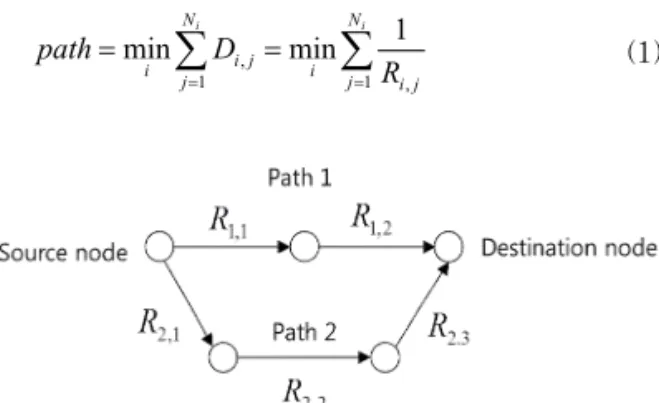
As shown in Fig. 1, there are two paths from source node to destination node. Path 1 requires two hops to the destination node and it is less than that of path2. The links between the nodes has dif- ferent rate,
is the data rate of i-th path and j-th link. If the and are same data rate 1 Mbps and the links in the path 2 has 11Mbps data rate, path 2 has the less delay than the path 1 even if path 1 has smaller number of hops.
Data rate between the nodes is determined by the channel condition. After data rate between no- des i and j,
, is determined, the transmission de- lay
can be obtained. Receiving RREQ (Route Request) packet, the node add link delay
to the accumulated delay
and send the total delay
by RREQ packet. If RREQ is received again through the different path, the node com- pares the total delay and if it is smaller than the prior path, the node update its routing in- formation[10]. The following equation shows the path selection method using link delay.
å å
=
=
=
=
i
i N
j ij
i N
j j
i
D
iR
path
1 ,
1 ,
min 1
min (1)
Fig. 1. Routing path in multi-rate wireless sensor net-
works.
where
is the number of hops in the i-th path.
3. INTERFERENCE AWARE MULTIPATH ROUTING
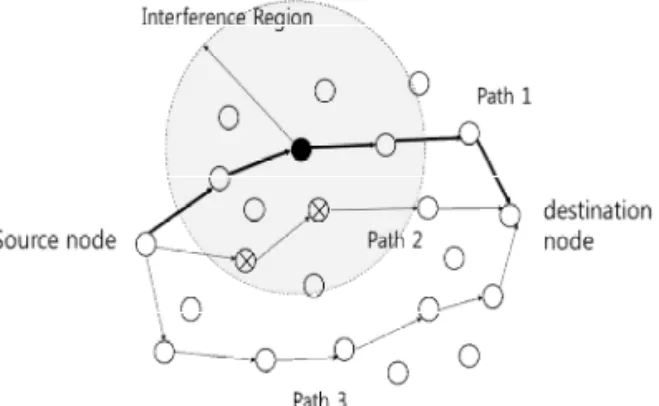
3.1 Transmission range and interference range In the wireless sensor networks, the distance between transmitter and receiver node should be less than specific distance to communicate each other. Transmission range is the range that node can transmit data without error. Even though one node is outside of the transmission range of trans- mitter node and cannot receive the transmitted da- ta, the node can be interfered by transmitted data.
The interference range is the range that trans- mitting node can interfere with the other nodes. As shown in Fig. 2, interference range is larger than transmission range and it depends on the channel condition. Generally interference range is consid- ered to be 1.8 times larger than transmission range[11].
Transmission and interference range is de- termined by the received signal power and it can be calculated by the following simple path loss model.
r t
r
d
KP d
P ÷
ø ç ö è
= æ
0(2)
where is the reference distance for the antennal
far field, K is constant path-loss factor and r is path-loss exponent.
and
are transmitted pow- er and received power respectively. Path-loss ex- ponent is determined by channel environment and it is about 1.6~1.8 in the LOS (line of sight) chan- nel environment[12].
3.2 Multipath routing for multi-rate wireless sensor networks
After first path was built, if we establish the second path using the same manner with first path and the path 2 in Fig. 3 has shorter delay than path 3, the path 2 will be selected as second path for multipath transmission. However, some nodes in path 2 are in interference range of path 1, and sever interference between the paths will happens and it will degrade the routing performance. Even though path3 has a longer route and larger delay than path 2, it is interference free route and path 3 should be the second path for multipath routing instead of path 2. As a result, to build second path for mul- tipath routing, we need routing schemes different from routing method used to establish the first path To build second path, node in interference region should not participate in second path. However each node doesn’t know if it is in interference re- gion or not. In this paper, we propose the scheme that the nodes in interference region notice their region using the RREP (Route Response). When the RREQ packet arrives at destination node, des-
Fig. 2. illustration of Transmission range and interfer- ence range.
Fig. 3. Illustration of path selection to avoid interfer-
ence.
tination node transmits RREP to establish first routing path. To build the second path, source node transmits RREQ packet again. The nodes heard RREP for first routing should ignore the RREQ and should not participate in second routing. The nodes which heard RREP are in transmission range of first path. The nodes in the interference range also should not participate in second routing. However the nodes don’t know whether they are in the inter- ference range of first path or not. To solve this problem, we propose RREP transmission with in- creased power. If the transmitted power of RREP is increased and the packet can arrive at the inter- ference range, the nodes in interference region can know that they are in the interference region.
To receive RREP packet at the boundary of in- terference range, the transmitted power should be increased. If we assume that the interference range is α times longer than interference range, the transmitted power
′ should satisfy the following relationship [11].
r t r t
r
d
KP d d KP d
P ÷÷
ø ö çç è
= æ
÷ ø ç ö è
= æ
a
0
0
' (3)
To transmit packet up to interference range, the transmit power should be
t r
t
P
P ÷
ø ç ö è
= æ a
' 1 (4)
If we assume that the interference range is 1.8 times longer than transmission range and node transmits data in LOS (Line of Sight) environment, about 2.56 times stronger power is required to transmit packet to the interference region. In this case, more power is consumed to transmit RREQ, but RREQ is a very short packet compared with data packet and nodes don’t have to transmit RREQ after establishing the route, and power con- sumption due to the increased power of RREQ is not serious. Using the RREP with increased trans- mit power, nodes adjacent to the first routing path can recognize whether they are in the interference range or not. If they are in interference range, they
don’t participate in building the second path and the paths can avoid interference.
4. SIMULATION AND RESULTS
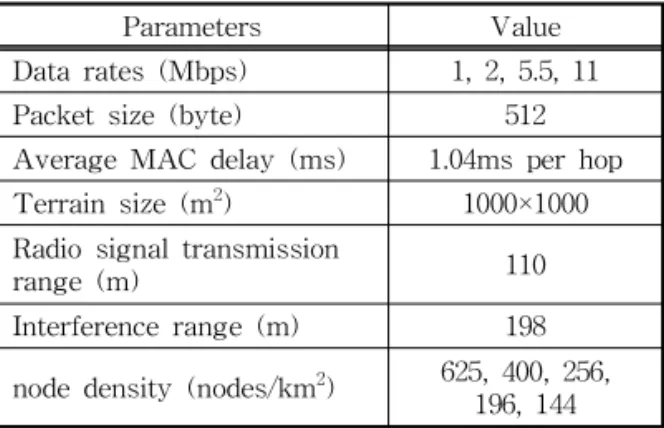
Simulations are performed to evaluate the pro- posed multipath routing scheme. Nodes are uni- formly distributed in 1x1 km
2rectangular areas.
Simulations are performs with different number of nodes and the number of nodes is from 144 to 625.
The average distance of adjacent nodes is 40~80m.
IEEE802.11 standard at MAC layer is used, and the MAC delay at each link is calculated as 1.04msec [13].
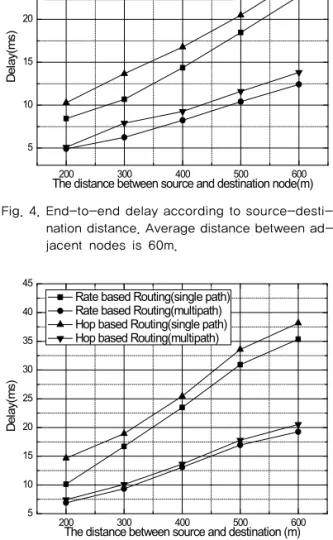
Hop based routings are based on the conven- tional AODV routing protocols which select paths with minimum hop count. In the delay-based single path routing, routing scheme considers the mul- ti-rates and selects the path with minimum end-to-end delay is selected. Fig. 4 and 5 shows the end-to-end delay according to the distance be- tween source and destination node. As shown in Fig. 4 and Fig. 5, multipath routing shows much less end-to-end delay than single path routing, and the delay-based multipath routing has the less end-to-end delay than hop-based multipath routing.
As the distance between source and destination in- creases, delay difference between single path and multipath gets larger. It shows that the multipath routing is more effective when the distance be- tween source and destination node gets longer.
Table 1. Simulation Parameters
Parameters Value
Data rates (Mbps) 1, 2, 5.5, 11
Packet size (byte) 512
Average MAC delay (ms) 1.04ms per hop Terrain size (m
2) 1000×1000 Radio signal transmission
range (m) 110
Interference range (m) 198 node density (nodes/km
2) 625, 400, 256,
196, 144
Fig. 6 shows the end-to-end delay according to the average distance between adjacent nodes. It is the case that the distance between source and des- tination node is 400m. As the average distance of adjacent nodes increases, the delay difference be- tween hop-based routing and delay-based routing gets smaller. If the distance between adjacent no- des increases, the data rate gets smaller and it in- creases the transmission delay. As the distance be- tween adjacent nodes becomes near the trans- mission range, the data rate decreases abruptly and hop-based routing induces high end-to-end delay.
5. CONCLUSION
Nowadays, lots of services are developed in the wireless sensor networks. To enlarge serve areas of wireless sensor networks, multipath routing protocol is one of the important technical issues.
In this paper, we proposed the interference aware delay-based multipath routing in the multi-rate wireless sensor networks. The proposed multipath routing considers channel conditions and link data rates are used to determine the routing paths, and the second path is established to avoid path inter- ference by using the raised powered RREP packets.
Simulation results shows that the proposed routing protocol has less end-to-end delay and multipath routing also shows the more enhanced delay per- formances than the conventional hop-based rout- ing protocols.
REFERENCE
[ 1 ] S. Basagni, M. Conti, S. Giordano, and I.
Stojamenovic, Mobile Ad Hoc Networking : The cutting Edge directions, John Willey &
Sons, Hoboken, New Jersev, 2013.
[ 2 ] Y. Joo, and J. Kim, "A Study on Environment Management System in Tunnel using Wireless Senor networks,“ Journal of Korea
200 300 400 500 600
5 10 15 20 25 30
Rate based Routing (single path) Rate based Routing (multipath) Hop based Routing (single path) Hop based Routing (multipath)
D e la y( m s)
The distance between source and destination node(m) Fig. 4. End-to-end delay according to source-desti-
nation distance. Average distance between ad- jacent nodes is 60m.
200 300 400 500 600
5 10 15 20 25 30 35 40 45
D e la y( m s)
The distance between source and destination (m) Rate based Routing(single path)
Rate based Routing(multipath) Hop based Routing(single path) Hop based Routing(multipath)
Fig. 5. End-to-end delay according to source-desti- nation distance. Average distance between ad- jacent nodes is 80m.
40 50 60 70 80
10 15 20 25