이동성 있는 무선 센서 네트워크에서 노드의 상태를 고려한 에너지 효율적인 토폴로지 제어 방법
윤 명 준 , 전 한 얼*, 김 석 규** 이 재 용°
An Energy Efficient Topology Control Algorithm using Additional Transmission Range Considering the Node Status
in a Mobile Wireless Sensor Network
Myungjune Youn , Hahn Earl Jeon*, Seog-Gyu Kim**, Jaiyong Lee°
ABSTRACT
Topology control increases channel efficiency by controlling transmission power of a node, and as a result, network lifetime and throughput are increased. However, reducing transmission range causes a network connectivity problem, especially in mobile networks. When a network loses connectivity, the network topology should be re-configured. However, topology re-configuration consumes lots of energy because every node need to collect neighbor information. As a result, network lifetime may decrease, even though topology control is being used to prolong the network lifetime. Therefore, network connectivity time needs to be increased to expend network lifetime in mobile networks. In this paper, we propose an Adaptive-Redundant Transmission Range (A-RTR) algorithm to address this need. A-RTR uses a redundant transmission range considering a node status and flexibly changes a node's transmission range after a topology control is performed.
Key Words : Topology Control, Wireless Sensor Network, Mobility, Connectivity, Energy Efficiency
※ This research was supported by the MKE(The Ministry of Knowledge Economy), Korea, under the ITRC(Information Technology Research Center) support program supervised by the NIPA(National IT Industry Promotion Agency)" (NIPA-2012-H0301-12-1001)
※ A preliminary version of this paper appeared in FGCN 2010, December 13-15, Jeju, Korea. This version includes a concrete analysis result and simulation result on various envionment.
주저자:연세대학교 전기전자공학과 유비넷 연구실, [email protected], 정회원
° 교신저자:연세대학교 전기전자공학과 유비넷 연구실, [email protected], 종신회원
* 한국방송통신전파진흥원, [email protected], 종신회원
** 안동대학교 정보통신공학과, [email protected], 종신회원
논문번호:KICS2012-05-237, 접수일자:2012년 5월 3일, 최종논문접수일자:2012년 8월 22일
Ⅰ. Introduction
In wireless networks such as ad-hoc or sensor networks, topology control is one of the key issues, which is used to increase channel efficiency. A topology control reduces a node's transmission range and not only decreases a node's energy consumption, but also lowers radio interference. As a result, channel efficiency and
network lifetime are increased. When no topology control is used, a node transmits a packet with the maximum power level and experiences many communication collisions. Therefore, topology control is an unavoidable requirement in high density networks, such as wireless sensor networks, to increase a network throughput and lifetime. However, reducing a node's transmission range causes a network connectivity problem.
Subsequently, most of the existing topology control algorithms[1-6] consider network connectivity when designing a protocol. Such algorithms perform well in static networks.
However, in mobile networks, because of the mobility of a node, network connectivity is broken frequently. Consequently, whenever the connectivity is broken, all nodes must find another topology to communicate with each other.
Each node has to collect neighbor node information using maximum transmission power to construct a new topology. As a result, frequent topology change causes energy dissipation and decreases a network lifetime. Therefore, it is important to maintain the existing topology as long as possible while maintaining network connectivity. Some algorithms have been proposed[7-10] that maintain network topology in mobile networks. We will introduce these algorithms in Section II.
The rest of this paper is organized as follows.
Section Ⅱ presents current researches related to topology control in mobile networks. In Section
Ⅲ, we propose an A-RTR (Adaptive - Redundant Transmission Range) algorithm. In Section Ⅳ we present simulation results, and conclude the paper in Section Ⅴ.
Ⅱ. Related Works
Much research has been dedicated to solve topology control issues in mobile networks. The research has focused on finding solutions to two problems: the neighbor consistency problem and the network connectivity problem. Furthermore, the network connectivity solution is subdivided into two categories. The first category is a k-connectivity algorithm, which constructs a stable topology that does not lose network connectivity even if some of the nodes fail or move out of transmission range. The second category is a Redundant Transmission Range (RTR) algorithm that uses additional transmission range to increase a network connectivity time.
i. Topology Control
Most of the topology control algorithms use neighbor node information to find a minimum transmission range that satisfies network connectivity. Usually, neighbor information contains node's id and location information. Then all nodes in the network have to know their position. One of the methods to get location information is using the Global Positioning System (GPS). However, in sensor networks, because of the limited processing power and battery it is not easy to utilize GPS. So there have been lots of researches such as[12-14] that calculate location by using radio signal strength.
Each node collects neighbor information by exchanging hello messages with the maximum transmission power. So hello messages exchange consumes lots of energy. In static networks, hello message exchange is not a significant overhead because the procedure is performed only once.
However, in mobile networks, network connectivity is broken by node mobility. So periodic topology re-configuration is necessary to avoid connectivity breakage and when the network topology is re-configured, and all nodes need to exchange hello message with the maximum transmission power. This causes energy dissipation and network lifetime is decreased. Moreover, periodic topology re-configuration cannot support stable data transmission. So increasing a network connectivity time is an important problem to decrease energy consumption. In section Ⅱ.ⅲ and
Ⅱ.ⅳ explain how to prevent frequent topology re-configuration in mobile networks.
ii. Neighbor Consistency
In order to find a connected topology, each node has to know link information for its neighbor nodes. Based on the data, each node finds a connected topology and decides how much transmission power is needed. Typically, neighbor information is gathered by using periodic hello messages. In static networks, after the neighbor information is collected, there is no need to update the information. Therefore, the overhead
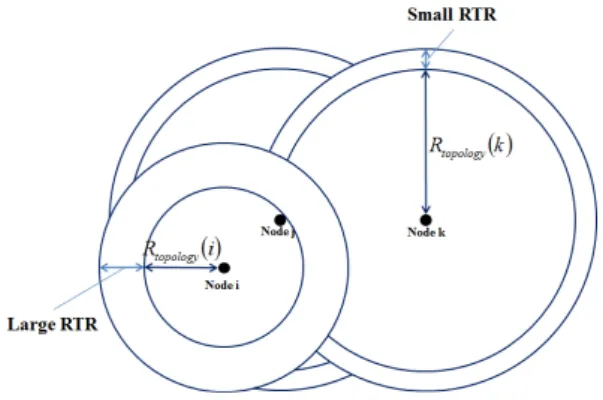
Fig. 1. The RTR (Redundant Transmission Range) concept
caused by collecting neighbor node information is very small compared to the energy saving caused by using a topology control algorithm. However, in mobile networks, each node should exchange hello messages periodically to update neighbor information. The periodicity must remain inversely proportional to the velocity of a node to yield accurate information. Therefore, in high mobility networks, each node exchanges hello messages frequently, and as a result, energy consumption is increased. Furthermore, collecting neighbor information in the high mobility network is a difficult problem. When some of the neighbor node move out of transmission range, the node cannot obtain correct neighbor information, and using incorrect neighbor information may result in an unconnected topology. This problem is solved in [8], using view consistency. In this paper, the neighbor consistency problem is not our interest.
We focus on how to prolong network connectivity while maintaining the topology found by various topology control algorithms.
iii. k-connectivity
A topology control algorithm tries to reduce the node transmission range to decrease the number of neighbor nodes until network connectivity is achieved. As a result, each node has limited connectivity, which is easily broken even if a node has low mobility or experiences a small change in the channel condition. In order to prevent the problem, a k-connectivity algorithm is proposed in [9], where the failure of at most k-1 nodes will not break the network connectivity.
Therefore, even if some of the nodes less than k-1 move out of a node's transmission range, the node does not lose network connectivity.
Accordingly, the network maintains connectivity longer than other topology control algorithms.
However, the k-connectivity solution depends on the specific topology control algorithm, and cannot be used in general topology control algorithms. Consequently, it is difficult to adapt k-connectivity to mobile networks that use other topology control algorithms. The k-connectivity
algorithm is designed for the fault-tolerant network, possibly increasing the network connectivity time in the low mobility environment.
However, the algorithm is not suitable for the high mobility environment because the k-connectivity algorithm has no parameters that control node mobility.
iv. Redundant Transmission Range
The RTR scheme is used in [8] to prolong network connectivity caused by node mobility.
Unlike the k-connectivity algorithm, RTR can be easily adapted to the other topology control algorithms. The RTR concept is shown in Fig. 1.
As shown in the figure, each node in the network sets transmission range determined by the topology control algorithm, and then adds some additional transmission range. Each node after that transmits with increased power to cover the extended transmission range. In other words, the node's transmission range is determined by the follows :
min
max
(1)In eq. (1), is a transmission range found by the topology control algorithm. is an additional transmission range used to prolong network connectivity. A node's transmission range,
is a sum of and , but transmission range has to be limited in m ax, the maximum transmission range of a node.
is a fixed value determined by a network administrator for all nodes. For example, when a node's transmission range determined by the topology control algorithm is 15m, m ax is 30m, and is 5m, then node's transmission range is 20m. If the transmission range determined by the topology control algorithm is 26m, then 26m+5m=31m, but 31m is larger than the maximum transmission range of 30m. The network administrator may set a value that is proportional to the maximum node speed,
m ax. For a high mobility network,
should be set to a large value, and for a low mobility network, can be set to a small value. When the maximum node speed is m ax, network connectivity is guaranteed for the time interval if the RTR value is set to
m ax.
Ⅲ. Proposed Algorithm i. RTR Value Considerations
RTR is an effective scheme for prolonging network connectivity in mobile environments.
However, the effect is different for each node.
The problem is that none of the nodes in the network have the same mobility level or speed. A large RTR value is more efficient for a high mobility node, but for a low mobility node, a large RTR wastes energy. Therefore, it is important to set an individual RTR value corresponding to the node's status. Some considerations for determining the RTR value are given below.
1. node's speed
2. neighbor node's speed 3. neighbor node density
4. transmission range determined by the topology control algorithm
A node's speed is the most important factor when determining the RTR value. For a high
speed node, the RTR value should be larger than that for a low speed node. In addition to the speed of a given node, the speed of the neighbor nodes is also important. When a neighbor node has mobility, connectivity is broken even if the given node has no mobility. Therefore, the relative speed is important when deciding the RTR value. Another consideration is the number of neighbor nodes in the transmission range, known as the neighbor node density. There is a high probability of maintaining network connectivity when there are many neighbor nodes.
A small RTR is then sufficient to maintain network connectivity. The last consideration is the transmission range decided by the topology control algorithm, known as . When
is large enough to maintain connectivity, a small RTR is enough to maintain connectivity. Moreover, when is large, using the large RTR value consumes lots of energy, because transmission power is exponentially increased as transmission range increases.
ii. Adaptive-RTR algorithm
Considering the above conditions, we propose an A-RTR (Adaptive-Redundant Transmission Range) algorithm. Unlike RTR which uses the same RTR value for all nodes, A-RTR changes each node's RTR value according to the node's condition, relative node speed, neighbor node density, and transmission range determined by the topology control algorithm. Because A-RTR changes the RTR value adaptively according to the node status, A-RTR controls the transmission range more effectively and uses less energy than RTR. Therefore, A-RTR prolongs network connectivity compared to the RTR algorithm. Fig.
2 shows an example of the A-RTR algorithm.
Assume that node i is a high mobility node, and nodes j and k are low mobility nodes. Because node i has high mobility, the RTR value of node i is larger than the RTR value of nodes j and k, which have small mobility. Although node j has
Fig. 2. The A-RTR (Adaptive - Redundant Transmission Range) concept
Fig. 3. The flowcharts of general topology control, RTR, A-RTR algorithm low mobility, relative speed to node i is high
because node i has high mobility. However, the RTR value of node j does not need to be large, because the transmission range determined by the topology control algorithm is large enough to maintain network connectivity. When the RTR algorithm is used, if all nodes i, j, k have the same RTR value, then there is a high probability that node i will lose connectivity with node j because node i has high mobility. However, A-RTR adaptively changes RTR value and tries to make a probability that a node loses connectivity equally. Therefore, A-RTR uses the node's power
more efficiently.
The A-RTR algorithm determines the RTR value as follows :
min
max
(2)
de f ×
m ax max
×
× m ax
m ax
(3)
In eq. (2), is a transmission range determined by the topology control algorithm.
is a RTR value of node i, which is determined by eq. (3). In eq. (3), is the relative speed of a neighbor node j. m ax is the maximum speed of a node. is the neighbor node density of node i. de f is a default RTR value that is a constant decided by the network administrator. The A-RTR algorithm changes the default RTR value, de f, considering the node's relative speed, neighbor
node density, and transmission range determined by the topology control which are taken into consideration when deciding the RTR value. The second term in eq. (3), max
m axconsiders the relative speed of neighbor nodes.
Because the maximum relative speed is twice
m ax, the second term is bounded from 0 to 2.
The third term considers the neighbor node density. When the neighbor node density is lower than the average network node density, A-RTR increases the RTR value. Conversely, A-RTR decreases the RTR value when the neighbor node's density is higher than the average. The fourth term considers the transmission range determined by the topology control algorithm.
When is large, the fourth term decreases, thus decreasing the RTR value.
In eq. (3), there may seem to be a contradiction between third and fourth term. In a static network, when nodes are distributed uniformly, is affected by network node density. In generally, when density is high,
value is low. On the other hand, when density is low, value is high.
Then there is a contradiction between third and fourth term. However, in a mobile network, the relationship is not true. Because of node's movement, some nodes may gather some part of the network.. Then node's neighbor node density is high. Nevertheless, may have low or high value to satisfy network connectivity. In order to satisfies whole network connectivity, some of the nodes in high density area should have long transmission range to communicate with other nodes, which is located in low density area.
Also topology control algorithms in a mobile network, maintains multiple connection to stabilize network connectivity. So in mobile networks,
and is loosely coupled. As a result, there is no contradiction between third and fourth term.
There is a case that A-RTR value is below 0 if each term of eq. (3) is not a multiplication.
However, negative A-RTR value means reducing the original transmission range determined by a topology control algorithm. This causes network connectivity breakage, because a topology control algorithm finds a minimum transmission range that maintains network connectivity. So we used multiplications so that A-RTR value is always a positive number.
In Fig. 3 shows flowcharts of general topology control algorithm, RTR and A-RTR. In general, a topology control algorithm is operated as following. When the network is initialized, each node collects neighbor information, which contains neighbor node id and location information. Based on the data, a topology control algorithm finds minimum transmission range that satisfies network connectivity and adjusts each node's transmission range. When the network connectivity is broken or topology re-configuration timer is expired, all nodes gather neighbor information again, and find another topology. RTR and A-RTR operation is almost same to a general topology control algorithm except that each node adds additional transmission range after finding the minimum transmission range that satisfies network connectivity. The difference between RTR and A-RTR is two things. One is that A-RTR needs to get velocity information when collecting neighbor information. However, collecting velocity information is negligible because velocity information can be obtained from the location information and the information can be transferred by piggybacking onto the hello message packet.
Another difference is that A-RTR needs to calculate Eq. (3) which requires some additional processing power. Even though, the processing is a simple calculation, and it is negligible compared to the energy saving gain by using the A-RTR algorithm.
iii. Analysis
We can calculate the expected value of A-RTR as in eq. (4) under the assumption that all nodes are uniformly distributed in the network, and the node speed is also uniformly distributed. Because
Parameters Environments Network Size 200(m) X 200(m)
Node Number 300
Mobility Model RWP Model Node Speed 0.5 ~ 2.5 (m/s) Maximum Transmission Power -40 (dBm)
RTR Default 10 ~ 50 (m) A-RTR Default 10 ~ 50 (m) Receiver Sensitivity -80 (dBm) Pass-loss Exponent, n 2 Table 1. Simulation parameters
each term in eq. (3) is independent and excludes constant terms,
max
,
,
remain. We assumed that the maximum node speed is m ax and uniformly distributed, such that the relative speed is a uniform distribution from 0 to m ax. Thus
max
m ax,
because we assumed that the nodes are distributed uniformly in the network, and that the average neighbor density of a node is the same as that of the network.
then remains. The
value changes as the density of the network changes. When the network density is high, each node requires a small transmission range to maintain network connectivity, and when the density is low, each node requires a large transmission range to maintain connectivity.Therefore if we assume that the network density is sufficiently high to satisfy
≥ m ax, the expected value of A-RTR is smaller than de f. This means that high density networks such as wireless sensor networks, the A-RTR algorithm with de freduces the transmission range compared to the RTR algorithm with a RTR value of de f . Consequently, the network energy efficiency and lifetime are increased.
In [11], six is a magic number for maintaining connectivity with high probability. Using this result, when the number of neighbor node in
m ax is larger than six, or when the network
density is larger than
m ax m ax. We can say that A-RTR with consumes less energy than RTR that has RTR value of de f , with high probability.
de f × × maxm ax× m ax
m ax
de f ×
m ax max
×
×
m ax
m ax
de f ×
m ax
m ax
×
× m ax
m ax
de f ×
m ax
m ax
(4)
Ⅳ. Simulation i. Simulation environments
We simulated the A-RTR and RTR algorithm using MATLAB. In the simulation, we assumed that there was no neighbor consistency problem, i.e., all nodes know their neighbor nodes exactly without error, even in the high mobility environment. The neighbor consistency problem occurs, and network connectivity is easily broken in the real network. However, we used this assumption to focus on the performance of the A-RTR algorithm, and the assumption does not influence the verification of the A-RTR algorithm performance. The simulation environments are shown in Table. 1.
In the simulation, we used the pass-loss model shown in Eq. (5). In the equation, is a reference distance, is the pass-loss exponent, and is a gaussian random variable with a
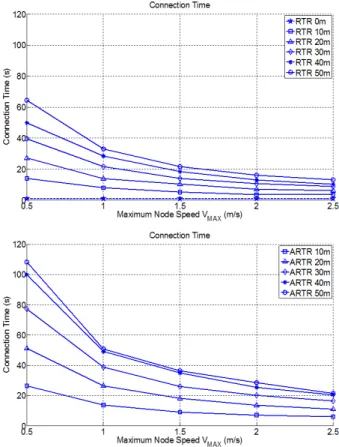
Fig. 4. Network connection time as a function of mobility mean of zero. A node's maximum transmission
power is -40 dBm, which is approximately a 100m transmission range when the receiver sensitivity is -80 dBm and the pass-loss exponent is 2.
(5)
We used the Random WayPoint (RWP) mobility model, which is a commonly used analytic model for mobility. The RWP model is operated as follows. A node selects a destination in the network boundary, randomly selecting the node's speed within the maximum node speed
m ax. After the node reaches its destination, the node awaits a predetermined pause time. After the pause time expires, the node chooses another destination. In the simulation, we used m ax
from 0.5 m/s to 2.5 m/s, and a pause time of 0.
ii. Simulation results
Fig. 4 shows the network connection time as the node's mobility increases. In the figure, the x-axis is the maximum mobility of a node in the RWP mobility model. The y-axis is the connection time of the network, which is the time from when the topology is configured to when the network loses connectivity. As shown in the figure, when RTR is not used (RTR of 0m) the network connectivity is easily broken, and the frequent loss of connectivity causes packet loss and long delays. When the RTR algorithm is used, the network connection time is greatly increased, even when the RTR value is 10m, and there is a performance improvement of more than 200%. This means that the RTR algorithm is an effective means for maintaining network connectivity. As shown in the figure, when A-RTR with default RTR, i.e. de f, is 10m, A-RTR performs better compared to RTR at 10m. This means that A-RTR adaptively changes the RTR range with respect to the node's status while efficiently maintaining network connectivity.
The connection time gap between RTR values is
almost equal. And the connection time gap between A-RTR algorithm, except for the A-RTR with 40m de f and 50m de f. Generally, increasing the RTR value expands the network connectivity time. However a limit to the increase connectivity time exists because of the mobility. In order words, A-RTR with a 40m
de f nearly reaches the limit point, so increasing the de f to greater than 40m does not further reduce energy consumption caused by the topology re-configuration when using the A-RTR algorithm in the given simulation environment.
Fig. 5 shows an example of one simulation result. In the figure, the x-axis is a node id, and the y-axis is a RTR value of the RTR and A-RTR algorithms. In the RTR algorithm, all nodes have the same RTR value regardless of the node's mobility. However, A-RTR adapts the RTR value according to the node's status. In the figure, the average RTR value assigned by the
0 5 10 15 20 25 30 0
5 10 15 20 25
Node ID
Transmission Range
A Compare of the Transmission Range Between RTR and A-RTR A-RTR RTR
Fig. 5. Additional transmission range of the RTR and A-RTR algorithms
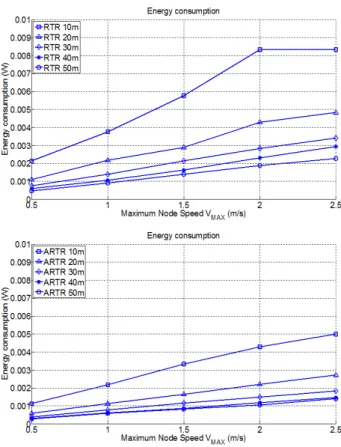
Fig. 6. Network energy consumption as mobility increases A-RTR is 10.3m, which is almost the same value
as de f. This finding is the same as that from the analysis of the expected A-RTR transmission range discussed in the previous section.
Fig. 6 shows the energy consumption of the network. The graph shows the total energy consumption over 1000 seconds. The simulation environment is a high density network, so the energy consumption of A-RTR is less than RTR with the same default RTR value. The x-axis is the maximum node speed of the RWP model, and the y-axis is the total energy consumption of the network. When the topology loses network connectivity, all nodes find neighbor information using maximum transmission power, and construct a new topology based on the information.
However, this process consumes a great deal of energy. Consequently, as shown in the figure, the energy consumption increases as the maximum node speed increases. Furthermore, a large RTR and the default A-RTR value results in less energy consumption compared to the small RTR and default A-RTR value because the large RTR and default A-RTR values prevent network connectivity breakage. A-RTR results in greatly reduced energy consumption compared to RTR because A-RTR adaptively changes its transmission range considering the node's status and increased network connectivity time. As a result, the amount of topology re-configuration is reduced. Therefore, A-RTR consumes less energy.
In the figure, the slope of each graph is an increase ratio of energy consumption. The slope of A-RTR is lower than that of RTR, indicating that mobility affects RTR more than A-RTR. This means that A-RTR adapts to the mobile environment more efficiently using less energy compared to the RTR algorithm.
Ⅴ. Conclusion
In this paper, we proposed an A-RTR (Adaptive-Redundant Transmission Range) algorithm that can prolong the network connectivity time while maintaining the network topology. The traditional RTR algorithm uses a fixed value without any consideration of a node's environment. However, A-RTR considers the relative speed of neighbor nodes, the neighbor node density, and the transmission range determined by the topology control algorithm, and adaptively changes the RTR value of a node based on these factors. Therefore, A-RTR uses the node's transmission power more efficiently than
the RTR algorithm. Moreover, the overhead cost by using A-RTR is negligible compared to the advantages that reduce network energy consumption and stabilize network connectivity.
We analyzed the expected transmission range of A-RTR, and the results showed that A-RTR consumes less energy in a high density network, such as a wireless sensor network. The simulation results showed that A-RTR uses less energy to maintain the network connectivity time compared to RTR. Furthermore, because of the simple algorithm, A-RTR can be applied to any existing topology control algorithm, and can be easily implemented into any network.
References
[1] L. Li, J.Y. Halpern, P. Bahl, Y.M. Wang and R. Wattenhofer, "A Cone-Based Distributed Topology-Control Algorithm for Wireless Multi-Hop Networks," IEEE/ACM Trans.
Networking, vol. 13, pp.147-159, Feb. 2005.
[2] N. Li, J.C. Hou and L. Sha, "Design and Analysis of an MST-Based Topology Control Algorithm," IEEE Trans. Wireless Comm., vol.
4, no. 3, pp. 1195-1206, 2005.
[3] Ning Li; Hou, J.C.; , "Localized topology control algorithms for heterogeneous wireless networks," Networking, IEEE/ACM Trans. on, vol.13, no.6, pp. 1313- 1324, Dec. 2005.
[4] Dai, F., Wu, J., "An extended localized algorithm for connected dominating set formation in ad hoc wireless networks", IEEE Trans. on Parallel and Distributed Systems, vol.15, no.10, pp. 908-920, Oct. 2004.
[5] Jian Ma, Min Gao, Qian Zhang, Ni, L.M.,
"Energy-Efficient Localized Topology Control Algorithms in IEEE 802.15.4-Based Sensor Networks," IEEE Trans. on Parallel and Distributed Sys., vol.18, no.5, pp.711-720, May 2007.
[6] Peng-Jun Wan, Alzoubi, K.M., Frieder, O.,
"Distributed construction of connected dominating set in wireless ad hoc networks,"
INFOCOM 2002. Twenty-First Annual Joint
Conf. of the IEEE Computer and Comm.
Societies. Pro.. IEEE , vol.3, no., pp. 1597-1604 vol.3, 2002.
[7] Siripongwutikorn, P. and Thipakorn, B.
"Mobility-aware topology control in mobile ad hoc networks," Computer Comm. Vol. 31, no.
14, pp. 3521-3532, Sep. 2008.
[8] Wu, J.; Dai, F.; , "Mobility-sensitive topology control in mobile ad hoc networks," Parallel and Distributed Processing Symposium. Pro.
18th International , vol., no., pp. 28, 26-30 Apr.
2004.
[9] Li, N.; Hou, J.C.; , "Localized fault-tolerant topology control in wireless ad hoc networks,"
Parallel and Distributed Systems, IEEE Trans.
on, vol.17, no.4, pp. 307- 320, Apr. 2006.
[10] Ning Li; Hou, J.C.; Sha, L.; , "Design and analysis of an MST-based topology control algorithm," Wireless Comm., IEEE Trans. on, vol.4, no.3, pp. 1195- 1206, May 2005.
[11] L. Kleinrock and J. Silvester, "Optimum transmission radii for packet radio networks or why six is a magic number", Proc. Conf. Nat.
Telecomm. Conf., pp.4.3.1 - 4.3.5 , 1978.
[12] J. A. Costa, N. Patwari, and A. O. Hero III,
"Distributed Weighted - Multidimensional Scaling for Node Localization in Sensor Networks,", ACM Trans. Sensor Networks, vol.
2, no.1, pp. 39-64, 2006.
[13] Y. Shang, W. Ruml, Y. Zhang, and M.
Fromherz, "Localization from Connectivity in Sensor Networks," IEEE Trans. on Parallel and Distributed Sys., vol. 15, no. 11, pp. 961-974, Nov. 2004.
[14] Hojae Lee; Sanghoon Lee; Yeonsoo Kim;
Hakjin Chong; , "Grouping multi-duolateration localization using partial space information for indoor wireless sensor networks," Consumer Electronics, IEEE Trans. on, vol.55, no.4, pp.1950-1958, Nov. 2009.
윤 명 준 (Myungjune Youn)
2005년 2월 연세대학교 전기전 자공학과 졸업
2007년 2월 연세대학교 전기전 자공학과 석사
2007년 3월~현재 연세대학교 전기전자공학과 박사과정
<관심분야> Ubiquitous Sensor Network, M2M
전 한 얼 (Hahn Earl Jeon)
1995년 2월 연세대학교 전기전 자공학과 졸업
1997년 8월 연세대학교 전기전 자공학과 석사
2003년 3월 연세대학교 전기전 자공학과 박사
2003년 3월~2004년 2월 연세 대학교 차세대방송기술 연구센터 연구 교수 2004년 7월~2008년 2월 방송위원회 연구위원 2009년 3월~2010년 2월 연세대학교 차세대
RFID/USN 연구센터 연구교수
2010년 3월~현재 한국방송통신전파진흥원 책임연 구원
<관심분야> QoS Routing, Wireless Sensor Network, Wireless Multihop Network, 융합기술, n-스크린
김 석 규 (Seog-Gyu Kim)
1990년 2월 연세대학교 전자 공학과 졸업
1992년 8월 연세대학교 전자 공학과 석사
1997년 8월 연세대학교 전자 공학과 박사
1997년 9월~2004년 3월 SK 텔레콤 선임연구원
2004년 3월~2006년 3월 연세대학교 전기전자공학 과 IT 연구단 연구교수
2006년 4월~현재 안동대학교 정보통신공학과 부교 수
<관심분야> Ubiquitous Sensor Network, Mobile Network, 차세대 네트워크
이 재 용 (Jaiyong Lee)
1977년 2월 연세대학교 전자 공학과 졸업
1984년 5월 IOWA State University 공학석사
1987년 5월 IOWA State University 공학박사
1987년 6월~1994년 8월 포항 공과대학 교수
1994년 5월~현재 연세대학교 전자공학과 교수
<관심분야> Internet of Things, Ubiquitous Sensor Network, Future Internet, Content Centric Network, Wireless TCP, Relay enhanced Cellular Multihop Networks