Characterization of a Korean Domestic Cyanobacterium Limnothrix sp.
KNUA012 for Biofuel Feedstock
Ji Won Hong
1, Seung-Woo Jo
2, Oh Hong Kim
1, Mi Rang Jeong
3, Hyeon Kim
1, Kyung Mok Park
4, Kyoung In Lee
5and Ho-Sung Yoon
1,2,3*
1Advanced Bio-resource Research Center, Kyungpook National University, Daegu 41566, Korea
2Department of Energy Science, Kyungpook National University, Daegu 41566, Korea
3School of Life Sciences, BK21 Plus KNU Creative BioResearch Group, Kyungpook National University, Daegu 41566, Korea
4Department of Pharmaceutical Engineering, Dongshin University, Naju 58245, Korea
5Biotechnology Industrialization Center, Dongshin University, Naju 58245, Korea
Received December 24, 2015 /Revised February 3, 2016 /Accepted February 4, 2016
A filamentous cyanobacterium, Limnothrix sp. KNUA012, was axenically isolated from a freshwater bloom sample in Lake Hapcheon, Hapcheon-gun, Gyeongsangnam-do, Korea. Its morphological and molecular characteristics led to identification of the isolate as a member of the genus Limnothrix.
Maximal growth was attained when the culture was incubated at 25°C. Analysis of its lipid composi- tion revealed that strain KNUA012 could autotrophically synthesize alkanes, such as pentadecane (C
15H
32) and heptadecane (C
17H
36), which can be directly used as fuel without requiring a trans- esterification step. Two genes involved in alkane biosynthesis-an acyl-acyl carrier protein reductase and an aldehyde decarbonylase-were present in this cyanobacterium. Some common algal biodiesel constituents-myristoleic acid (C
14:1), palmitic acid (C
16:0), and palmitoleic acid (C
16:1)-were produced by strain KNUA012 as its major fatty acids. A proximate analysis showed that the volatile matter con- tent was 86.0% and an ultimate analysis indicated that the higher heating value was 19.8 MJ kg
-1. The isolate also autotrophically produced 21.4 mg g
-1phycocyanin-a high-value antioxidant compound.
Therefore, Limnothrix sp. KNUA012 appears to show promise for application in cost-effective pro- duction of microalga-based biofuels and biomass feedstock over crop plants.
Key words : Alkane-producing genes, biofuel, cyanobacteria, phycocyanin, potential feedstock
*Corresponding author
*Tel : +82-53-950-5348, Fax : +82-53-953-3066
*E-mail : [email protected]
This is an Open-Access article distributed under the terms of the Creative Commons Attribution Non-Commercial License (http://creativecommons.org/licenses/by-nc/3.0) which permits unrestricted non-commercial use, distribution, and reproduction in any medium, provided the original work is properly cited.
Journal of Life Science 2016 Vol. 26. No. 4. 460~467 DOI : http://dx.doi.org/10.5352/JLS.2016.26.4.460
Introduction
Renewable and sustainable energy resources have re- ceived much renewed interest as a solution to the heavy reliance on fossil fuels since global petroleum supplies have diminished and serious environmental problems have aris- en from greenhouse gas emissions. Recently, photosynthetic microorganisms have gained particular interest as a new source for biofuel feedstock because they are able to convert carbon dioxide (CO
2) to a variety of potent biofuels [3, 7, 11]. In particular, microalgae have become an attractive can- didate for liquid transport fuel production due to their high- er photosynthetic efficiency and oil yield compared to ter- restrial energy crops [12, 16].
However, there are still a number of technical barriers
that must be overcome and one of the major challenges
in algae-based biodiesel production is to reduce the cost
of lipid extraction that accounts for up to 90% of the total
energy consumption [15]. Algal biodiesel is mainly obtained
by transesterifying algal oil triglycerides with an alcohol
in the presence of catalysts [13, 17]. Methanol is the most
commonly used alcohol in this process due to its low cost
[6], yet it is also responsible for 26% of the total energy
consumption in biodiesel production [5]. It has been re-
ported that some freshwater and marine cyanobacteria
could naturally produce alkanes such as pentadecane
(C
15H
32) and heptadecane (C
17H
36) [25, 26]. The biological
function of alkane in cyanobacteria is still unclear, but it
was hypothesized that the hydrocarbons blended into the
lipid bilayers may enhance permeability, flexibility, and flu-
idity against curvature and oxidative stresses [32]. As petro-
leum-based diesel is made up of a mix of alkanes with 8-20
carbon atoms, these cyanobacteria-derived alkanes can be
directly used as biodiesel without converting triglycerides
to liquid hydrocarbons and thus may serve as a possible
Table 1. Results from BLAST searches using the sequences of the 16S rRNA, PC-IGS, 16S-23S ITS, and rbcLX genes of strain KNUA012
Marker gene Accession No.
Length (bp)
Closest match (GenBank accession No.)
Query cover (%)
Sequence similarity (%) 16S rRNA
PC-IGS 16S-23S ITS
rbcLX
JQ653272 KU297785 KU662322 KU662323
662 680 632 1,082
Limnothrix sp. B15 (GQ848190)
Uncultured cyanobacterium clone DC07PC-38 (HM020449)a Geitlerinema unigranulatum BCCUSP 94 (KJ735459) Limnothrix planktonica KLL-C001 clone (KP698043)
99 94 82 23
100 100 96 94
aClosest cultured match: Geitlerinema unigranulatum BCCUSP94 (FJ545642)
candidate to replace fossil fuels.
In this study, a filamentous cyanobacterium, Limnothrix sp. KNUA012 was axenically isolated from a summer bloom sample in Lake Hapcheon, Korea and its potential as biofuel feedstock was investigated.
Materials and Methods
Sample collection and isolation
Bloom samples were collected in September 2010 from Lake Hapcheon, Bongsan-ri, Bongsan-myeon, Hapcheon- gun, Gyeongsangnam-do (35° 37’N, 128° 02’E). Samples were then taken to the laboratory and 1 ml aliquots of these samples were inoculated into 100 ml BG-11 medium [21]
with cycloheximide (Sigma, St. Louis, MO, USA) at a con- centration of 250 μg ml
-1. The flasks were incubated at 25°C with shaking at 160 rpm on an orbital shaker (VS-202D, Vision Scientific, Bucheon, Korea) until cyanobacterial growth was apparent. Well-grown cyanobacterial cultures (1.5 ml) were centrifuged at 3,000 g for 15 min (Centrifuge 5424, Eppendorf, Hamburg, Germany). Resulting pellets were streaked onto BG-11 agar and filamentous growth was monitored daily. When emerging cyanobacterial filaments were macroscopically visible, they were aseptically trans- ferred to fresh BG-11 plates to separate cyanobacteria from contaminating bacteria. Cyanobacterial filaments were then streaked onto R2A and LB agar plates (Becton, Dickinson and Company, Sparks, MD, USA) and incubated in the dark to check the axenic status of the culture for 14 days. The stain obtained in this study was deposited in the Korean Collection for Type Cultures (KCTC) under the accession number KCTC 12064BP.
Morphological and molecular identification
The isolate was grown in BG-11 medium for 20 days.
Live cells were harvested by centrifugation at 3,000× g for 5 min, washed twice with sterile distilled water, and exam-
ined at 1,000× magnification under a Nikon Eclipse E100 Biological Microscope (Tokyo, Japan). For molecular analy- sis, genomic DNA was extracted using a DNeasy Plant Mini kit (Qiagen, Hilden, Germany). For the amplification of 16S rRNA gene fragments, the primer set, CYA106F and CYA781R(a) and CYA781R(b) described by Nübel et al. [20]
was used. Due to the highly conserved nature of the 16S rRNA gene, three other genetic markers, the phycocyanin encoding operon intergenic spacer (PC-IGS), ribosomal 16S- 23S intergenic spacer (ITS), and RuBisCO (ribulose-1,5-bi- sphosphate carboxylase/oxygenase) rbcLX, were employed.
The PC-IGS was amplified using the primer pair, PCβF and PCαR specific for cyanobacteria [19]. The ribosomal 16S-23S ITS region was evaluated using primers, 16S1407F and 23S30R [30] and region RuBisCO rbcLX was also amplified with primers, CW and CX, described by Rudi et al. [23], respectively. DNA sequences obtained in this study were deposited in the database of the National Center for Biotech- nology Information (NCBI) under accession numbers JQ653272, KU297785, KU662322, and KU662323 (Table 1).
Phylogenetic analysis using 16S rRNA gene The sequence obtained from this study was compared to 16S rRNA gene sequences in the NCBI GenBank database using the BLASTN algorithm [1]. Its closely related
Limnothrix sequences were downloaded and aligned in theMolecular Evolutionary Genetics Analysis (MEGA) soft- ware, ver. 6.0 [29], with the ClustalW tool. The best-fit nu- cleotide substitution model (K2) was selected by means of MEGA ver. 6.0 on the basis of the Bayesian information criterion. This model was used to build a maximum like- lihood (ML) phylogenetic tree with 1,000 bootstrap repli- cates [8]. Synechococcus elongatus PCC 6301 (NR_074309) was used as an outgroup.
Temperature testing
Late-exponential phase cultures of Limnothrix sp. KNUA
012 (1 ml each) were inoculated into BG-11 medium in trip- licate and incubated for 20 days. Survival and growth of KNUA012 cells maintained at temperatures ranging from 5°C to 25°C (at intervals of 5°C) were examined to de- termine the optimum culture temperature. The cell biomass was separated from the bottom of the flask and thoroughly mixed by pipetting and samples taken from each time point were homogenized by sonification for 15 sec on an ultra- sonic cell disruptor (Model 550, Fisher Scientific, Pittsburgh, PA, USA). Cyanobacterial cell density was determined by measuring the optical density (OD) of the cultures at 750 nm with an Optimizer 2120UV spectrophotometer (Mecasys, Daejeon, Korea).
Gas chromatography/mass spectrometry (GC/MS) analysis
The isolate was autotrophically grown in BG-11 medium for 20 days under its optimal conditions and cells were har- vested for lipid analysis. The samples were freeze-dried to enhance the extraction efficiency. Then, 100 mg of each dried sample was blended with a mixture of chloro- form:50% methanol (1:1) and extracted for 16 hr at 25°C.
After extraction, the chloroform extract was isolated and dried in a rotary evaporator. The dried extract was treated with a pre-made solution of methanol and potassium hy- droxide to facilitate transesterification. Next, 2 ml of hexane was added to the mixture to isolate the fatty acid methyl esters (FAMEs). The whole mixture was heated to 30°C and stirred for 10 hrs. The mixture was then cooled and the methanol and hexane layers were separated. The yellow hexane layer was isolated for further analysis. GLC-90 (Supelco, Bellefonte, PA, USA) was used as external stand- ard to calculate the FAME concentrations. The FAME com- position was analyzed using a 6890N gas chromatograph (Agilent, Santa Clara, CA, USA) equipped with a 5973N mass selective detector and a HP-5MS capillary column (30 m ×0.25 mm ID ×0.25 μm film thickness). The initial oven temperature of the gas chromatograph was 120°C. It was maintained for 2 min, increased to 300°C at a rate of 5°C min
-1, and held for 22 min. The injection volume was 1 μl with a split ratio of 20:1. Helium was used as carrier gas at a constant flow rate of 1 ml min
-1. The mass spec- trometer parameters were as follows: injector and source temperatures were 250°C and 230°C, respectively, and the electron impact mode at an acceleration voltage of 70 eV was used for sample ionization, with an acquisition range
from 50-550 m z
-1. Wiley/NBS libraries were used as refer- ence databases.
Biomass characterization
The remaining freeze-dried biomass samples were pulv- erized with a mortar and pestle and sieved through ASTM No. 230 mesh (opening = 63 μm). Ultimate analysis was conducted in order to determine the carbon (C), hydrogen (H), nitrogen (N), and sulfur (S) contents using a Flash 2000 elemental analyzer (Thermo Fisher Scientific, Milan, Italy).
Higher heating value (HHV) was estimated by the following equation developed by Friedl et al. [9]: [HHV = 3.55C
2− 232C–2,230H + 51.2C × H + 131N + 20,600 (MJ kg
-1)].
Proximate analysis was carried out on a DTG-60A ther- mal analyzer (Shimadzu, Kyoto, Japan). Platinum pans were used to contain 30 mg of α-alumina (α-Al
2O
3) powder (Shimadzu, Kyoto, Japan) as a reference material and ap- proximately 10 mg of each sample, respectively. Nitrogen (>99.999%, N
2) was supplied as the carrier gas at a rate of 25 ml min
-1to protect the microalgae powder from oxidation. Samples were heated from 50°C to 900°C at a rate of 10°C min
-1. Thermogravimetric analysis (TGA) data were analyzed by ta60 Ver. 2.21 software (Shimadzu, Kyoto, Japan).
Phycocyanin (PC) concentration in the cyanobacterium was quantified by a slightly modified method of Silveira
et al. [28]. Briefly, 0.16 g of dried biomass in 2 ml of distilledwater (at a biomass-solvent ratio of 0.08 g ml
-1) was mixed with shaking at 100 rpm on an orbital shaker at 25°C for 4 hr. Then, the tubes were centrifuged at 10,000 g for 15 min and the OD of the supernatant was measured at 615 and 652 nm. The PC concentration was calculated by the following equations: [PC (mg ml
-1) = (OD
615−0.474 × (OD
652)) / 5.34]. The extraction yield was estimated by the following formula: [Yield (mg g
-1) = PCC × V / DB], where
V is the volume of solvent (ml) and DB is dried biomass(g).
Detection and identification of genes involved in alkane biosynthesis
Two primer sets were designed according to the fully
sequenced Nostoc sp. PCC 7120 genome to amplify an ac-
yl-acyl carrier protein (ACP) reductase and an aldehyde de-
carbonylase in Limnothrix sp. KNUA012. Partial fragments
of both genes in Limnothrix sp. KNUA012 were successfully
amplified by the primer sets, alr5284F and Lim_red_4R, and
Table 2. List of the primers designed and used in this study
Name Sequence (5’ – 3’) Length
(bp) Gene
alr5284F
(forward) ATG TTT GGT CTA ATT GGA CA 20 Partial acyl-ACP
reductase
Lim_red_4R (reverse) ATG CTC AAC AAT GCC ACC 18 Partial acyl-ACP
reductase
ADDP1F (forward) GTN ATH GAR GGN GA 14 Partial aldehyde
decarbonylase
ADDP6R (reverse) AAY TTY GGH GA 11 Partial aldehyde
decarbonylase KNUA012_RED_F (forward) CCG TCT AGA CTG TCT CGG TT 20 Full acyl-ACP reductase KNUA012_RED_R (reverse) GGC TGA GTC CAT AGC CCT AG 20 Full acyl-ACP reductase KNUA012_aldehyde_decarbonylase_
F (forward) GTT TTC CGA CCG TTA CCC AC 20 Full aldehyde
decarbonylase KNUA012_aldehyde_decarbonylase_
R (reverse) ATG TTG GCT GCA AAT GGG TT 20 Full aldehyde
decarbonylase Fig. 1. Light microscopy of Limnothrix sp. KNUA012 (scale bar
represents 20 μm).
ADDP1F and ADDP6R, respectively. The downstream and upstream regions of the known sequences were further ob- tained using genome walking-PCR based on the manu- facturer’s protocol (Clontech, Mountain View, CA, USA).
Finally, the full length acyl-ACP reductase and aldehyde decarbonylase including open reading frames (ORFs) in
Limnothrix sp. KNUA012 were amplified by the primer sets,KNUA012_RED_F and KNUA012_RED_R, and KNUA012_
aldehyde_decarbonylase_F and KNUA012_aldehyde_de- carbonylase_R, respectively. All the primers used in this study were designed by using Primer3Plus software [31]
and listed in Table 2.
Results and Discussion
Identification of the strain KNUA012
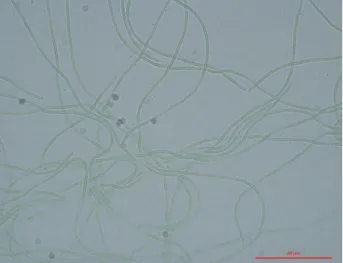
As shown in Fig. 1, the cyanobacterium was filamentous with straight trichomes composed of cylindrical cells. Cells were 1-2 μm wide and 20-50 μm long and not attenuated towards ends. End cells were slightly rounded and gas va- cuoles were observed near the cross walls and sometimes distributed within the cells. Overall, strain KNUA012’s mor- phological characteristics suggested that this isolate be- longed to members of the genus Limnothrix.
Molecular characterization inferred from sequence analy- sis of the genes for 16S rRNA also indicated that the isolate belonged to the Limnothrix group (Fig. 2). Therefore, the isolate was tentatively identified as Limnothrix sp. KNUA
012. However, the PC-IGS region sequence comparison re- vealed that uncultured cyanobacterium clone DC07PC-38 (HM020449) was the closest match for strain KNUA012 (Table 1). The 16S-23S ITS sequence analysis showed that the closest sequence match was Geitlerinema unigranulatum BCCUSP 94 (KJ735459) with a query coverage of only 82%.
The rbcLX region sequence comparison also showed that
uncultured Limnothrix planktonica KLL-C001 clone (KP
698043) was the closest match, but again the coverage was
only 23%. This may be due to the lack of sequence data
in GenBank for Limnothrix PC-IGS, 16S-23 ITS, and rbcLX
genes, so no identification could be made with these data.
Fig. 2. The phylogenetic relationship of strain KNUA012 and its closely related species inferred from the 16S rRNA sequence data. The tree was generated by the maximum likelihood method with 1,000 bootstrap replicates. The scale bar represents a 1% difference in nucleotides sequences.
Table 3. Growth of strain KNUA012 at various temperatures
Temperature (°C) 5 10 15 20 25
OD750 0.0 0.0 0.2 1.4 1.4
Optimal growth temperature
As shown in Table 3, strain KNUA012’s maximal growth was obtained at ambient temperatures (20 and 25°C).
However, no growth was observed at lower temperatures (5 and 10°C).
GC/MS analysis of strain KNUA012
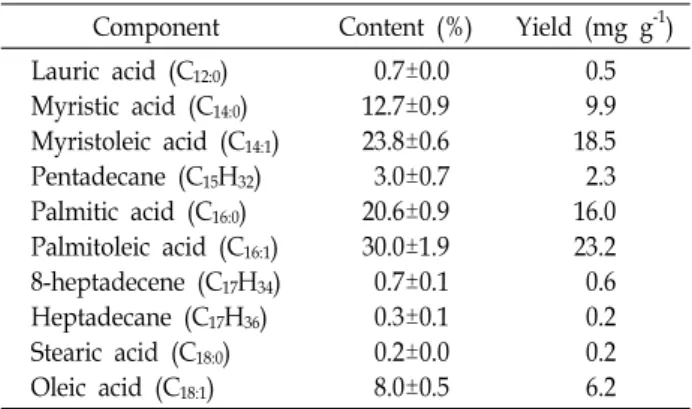
It was found that strain KNUA012 was able to autotroph- ically synthesize alkanes (C
nH
2n+2) such as pentadecane and heptadecane. Since C
15H
32and C
17H
36are 15- and 17-carbon alkane hydrocarbons known as the major components of petrodiesel [14], this cyanobacterium-derived alkanes can be directly used as a biodiesel component without having to convert triglycerides into liquid hydrocarbons. In addition, other algal biodiesel constituents, C
14:1, C
16:0, C
16:1were also
produced by strain KNUA012. The GC/MS results are sum- marized in Table 4.
Table 4. Lipid profile of strain KNUA012
Component Content (%) Yield (mg g-1) Lauric acid (C12:0)
Myristic acid (C14:0) Myristoleic acid (C14:1) Pentadecane (C15H32) Palmitic acid (C16:0) Palmitoleic acid (C16:1) 8-heptadecene (C17H34) Heptadecane (C17H36) Stearic acid (C18:0) Oleic acid (C18:1)
0.7±0.0 12.7±0.9 23.8±0.6 3.0±0.7 20.6±0.9 30.0±1.9 0.7±0.1 0.3±0.1 0.2±0.0 8.0±0.5
0.5 9.9 18.5 2.3 16.0 23.2 0.6 0.2 0.2 6.2
Biomass properties
In proximate analysis by TGA, the moisture content (MC)
is determined by the mass loss before 110°C under N
2at-
mosphere, the volatile matter (VM) refers to the mass loss
between 110–900°C under N
2as a result of thermal decom-
Fig. 3. TGA profiles of Limnothrix sp. KNUA012. The mass change in percentage is on the y-axis and temperature (°C) is on the x-axis.
Table 5. Proximate and ultimate analysis results of Limnothrix sp. KNUA012
Material component
Proximate analysis (wt%)
Elemental composition
Ultimate analysis (wt%) MC
VM FC + ash
6.6 86.0 7.4
C H N S HHV (MJ kg-1)
47.4 6.7 7.3 0.6 19.8
Table 6. Acyl-ACP reductase and aldehyde decarbonylase genes in Limnothrix sp. KNUA012
Gene The translated amino acid
(Accession No. / length)
Closest match (Accession No. / % ID) Acyl-ACP reductase hypothetical acyl-ACP reductase
(KU341740 / 369 amino acids)
Long-chain fatty acyl-ACP reductase [Leptolyngbya sp. JSC-1] (WP_035997292 / 73%) Aldehyde decarbonylase hypothetical aldehyde decarbonylase
(KU341741 / 234 amino acids)
Long-chain fatty aldehyde decarbonylase [Geitlerinema sp. PCC 7105] (WP_017659189 / 73%)
position, and the remaining mass represents fixed carbon
(FC) and ash [2]. The moisture, VM, and FC and ash con- tents of strain KNUA012 were 6.6%, 86.0%, and 7.4%, respectively. The VM is defined as the part of solid fuel that is driven-off as a gas by heating and typical biomass generally has a VM content of up to 80%(crop residue:
63-80%; wood: 72-78%). The VM content of the cyanobac- teria used in this study was higher than those of wood- based biomass feedstocks.
The HHV was also calculated to understand the potential of cyanobacterial biomass as a biofuel feedstock (Table 5).
The result showed that the HHV was within the range of the terrestrial energy crops (17.0-20.0 MJ kg
-1) [22]. Given the higher photosynthetic efficiency and biomass pro- ductivity of microalgae [24], strain KNUA012 holds promise
as a potential source for biomass feedstocks over crop plants. As high carbon content is a desirable property for fuel, if the higher concentration of CO
2in the medium is available, the higher HHV are possible.
Strain KNUA012 was also able to autotrophically pro- duce 21.4 mg g
-1PC. Because PC occurs as the major phyco- biliprotein in cyanobacteria, it has been extracted from cya- nobacteria such as Spirulina platensis and widely used in cosmetic and food industries. Recent studies have demon- strated the hepatoprotective, anti-inflammatory, and anti- oxidant properties of PC [18, 27]. This makes the isolate also desirable for commercial applications in the pharma- ceutical industry.
Alkane biosynthesis genes
Partial sequences of an acyl-ACP reductase and an alde- hyde decarbonylase in Limnothrix sp. KNUA012 were suc- cessfully obtained by the primer sets, alr5284F and Lim_
red_4R, and ADDP1F and ADDP6R, respectively (Table 2).
The downstream and upstream regions of the known se- quences were further obtained using genome walking-PCR.
The translated amino acid sequence of the hypothetical ac- yl-ACP reductase in Limnothrix sp. KNUA012 was most closely related to the long-chain fatty acyl-ACP reductase (WP_035997292) [Leptolyngbya sp. JSC-1] with 73% identity.
In case of the hypothetical aldehyde decarbonylase, the clos- est match turned out to be the long-chain fatty aldehyde decarbonylase (WP_017659189) [Geitlerinema sp. PCC 7105]
with an identity of 73%. The results are presented in Table 6.
The alkane biosynthesis pathway in cyanobacteria was
first described by Schirmer et al. [25]. They demonstrated
that fatty acyl-ACP was reduced to fatty aldehyde by a fatty
acyl-ACP reductase and then converted into alkane by a
fatty aldehyde decarbonylase, and it was found that both
genes were required for alkane biosynthesis in cyanobac-
teria. Therefore, it seemed that these two hypothetical pro-
teins in Limnothrix sp. KNUA012 may have resulted in the
production of odd-chain alkanes (C
15H
32and C
17H
36). How- ever, it should be stated that the alkane yields from wild type cyanobacteria are still insufficient to compete with pe- troleum derived fuels [4, 10] and the over expression of alkane synthesis pathways is necessary [33, 34]. Future work could be required to see whether the gene set from strain KNUA012 would confer alkane production to heterologous hosts such as E. coli or yeast.
In conclusion, this Korean indigenous cyanobacterium could serve as potential biological resource to produce vari- ous compounds of biochemical interest. The real potential of the isolate described in this paper should be evaluated through further cultivation studies at molecular, laboratory, and field scales.
Acknowledgements
This work was supported by the Advanced Biomass R&D Center (ABC) of Global Frontier Project funded by the Ministry of Science, ICT and Future Planning (2015M3A 6A2065698), Korea. This project was also supported by the Freshwater Microalgae–based Bioenergy Research and Development Project from Chilgok-gun, Gyeongsangbuk- do, Korea.
References
1. Altschul, S. F., Gish, W., Miller, W., Myers, E. W. and Lipman, D. J. 1990. Basic local alignment search tool. J. Mol.
Biol. 215, 403-410.
2. Bi, Z. and He, B. B. 2013. Characterization of microalgae for the purpose of biofuel production. Biol. Eng. Trans. 56, 1529-1539.
3. Chisti, Y. 2007. Biodiesel from microalgae. Biotechnol. Adv.
25, 294-306.
4. Coates, R. C., Podell, S., Korobeynikov, A., Lapidus, A., Pevzner, P., Sherman, D. H., Allen, E. E., Gerwick, L. and Gerwick, W. H. 2014. Characterization of cyanobacterial hy- drocarbon composition and distribution of biosynthetic pathways. PLoS ONE 9, e85140.
5. Dassey, A. J., Hall, S. G. and Theegala, C. S. 2014. An analy- sis of energy consumption for algal biodiesel production:
Comparing the literature with current estimates. Algal Res.
4, 89-95.
6. Demirbas, A. 2005. Biodiesel production from vegetable oils via catalytic and non-catalytic supercritical methanol trans- esterification method. Prog. Energy Combust. Sci. 31, 466-487.
7. Dismukes, G. C., Carrieri, D., Bennette, N., Ananyev, G.
M. and Posewitz, M. C. 2008. Aquatic phototrophs: efficient alternatives to land-based crops for biofuels. Curr. Opin.
Biotechnol. 19, 235-240.
8. Felsenstein, J. 1985. Confidence limits on phylogenies: an approach using the bootstrap. Evolution 39, 783-791.
9. Friedl, A., Padouvas, E., Rotter, H. and Varmuza, K. 2005.
Prediction of heating values of biomass fuel from elemental composition. Anal. Chim. Acta 544, 191-198.
10. Fu, W. J., Chi, Z., Ma, Z. C., Zhou, H. X., Liu, G. L., Lee, C. F. and Chi, Z. M. 2015. Hydrocarbons, the advanced biofuels produced by different organisms, the evidence that alkanes in petroleum can be renewable. App. Microbiol.
Biotechnol. 99, 7481-7494.
11. Hu, Q., Sommerfeld, M., Jarvis, E., Ghirardi, M., Posewitz, M., Seibert, M. and Darzins, A. 2008. Microalgal triacylgly- cerols as feedstocks for biofuel production: perspectives and advances. Plant J. 54, 621-639.
12. Huntley, M. E. and Redalje, D. G. 2007. CO2 mitigation and renewable oil from photosynthetic microbes: a new appraisal. Mitigation Adapt. Strateg. Glob. Chang. 12, 573-608.
13. Johnson, M. B. and Wen, Z. 2009. Production of biodiesel fuel from the microalga Schizochytrium limacinum by direct transesterification of algal biomass. Energ. Fuel 23, 5179- 5183.
14. Knothe, G. 2010. Biodiesel and renewable diesel: a compar- ison. Prog. Energy Combust. Sci. 36, 364-373.
15. Lardon, L., Helias, A., Sialve, B, Steyer, J. P. and Bernard, O. 2009. Life-cycle assessment of biodiesel production from microalgae. Environ. Sci. Technol. 43, 6475-6481.
16. Li, Y., Horsman, M., Wu, N., Lan, C. Q. and Dubois-Calero, N. 2008. Biofuels from microalgae. Biotechnol. Prog. 24, 815- 820.
17. Meher, L. C., Vidya Sagar, D. and Naik, S. N. 2006. Technical aspects of biodiesel production by transesterification-a review. Renew. Sust. Energ. Rev. 10, 248-268.
18. Nagaraj, S., Arulmurugan, P., Rajaram, M. G., Karuppasamy, K., Jayappriyan, K. R., Sundararaj, R., Vijayanand, N. and Rengasamy, R., 2012. Hepatoprotective and antioxidative effects of C-phycocyanin from Arthrospira maxima SAG 25780 in CCl 4-induced hepatic damage rats. Biomed. Prev.
Nutr. 2, 81-85.
19. Neilan, B. A., Jacobs, D. and Goodman, A. E. 1995. Genetic diversity and phylogeny of toxic cyanobacteria determined by DNA polymorphisms within the phycocyanin locus.
Appl. Environ. Microbiol. 61, 3875-3883.
20. Nübel, U., Garcia-Pichel, F. and Muyzer, G. 1997. PCR pri- mers to amplify 16S rRNA genes from cyanobacteria. Appl.
Environ. Microbiol. 63, 3327-3332.
21. Rippka, R., Deruelles, J., Waterbury, J. B., Herdman, M.
and Stanier, R. 1979. Genetic assignments, strain histories and properties of pure cultures of cyanobacteria. J. Gen.
Microbiol. 111, 1-61.
22. Ross, A. B., Jones, J. M., Kubacki, M. L. and Bridgeman, T. 2008. Classification of macroalgae as fuel and its thermo- chemical behaviour. Bioresour. Technol. 99, 6494-6504.
23. Rudi, K., Skulberg, O. M. and Jakobsen, K. S. 1998. Evolution of cyanobacteria by exchange of genetic material among phyletically related strains. J. Bacteriol. 180, 3453-3461.
초록:토착 남세균 림노트릭스 속 KNUA012 균주의 바이오연료 원료로서의 특성 연구
홍지원
1․조승우
2․김오홍
1․정미랑
3․김 현
1․박경목
4․이경인
5․윤호성
1,2,3*
(1경북대학교 신바이오소재연구소, 2경북대학교 에너지과학과, 3경북대학교 첨단복합 생명과학인력 양성사업단,
4동신대학교 제약공학과, 5동신대학교 생물자원산업화지원센터)
사상체 토착 남세균을 경상남도 합천군 합천호의 수화시료로부터 무균적으로 분리하였으며, 형태적․분자적 동정 결과 림노트릭스 속에 속하는 것으로 밝혀졌다. 따라서, 본 남세균 균주는 림노트릭스 속 KNUA012 균주로 명명하였으며, 분리균주의 최적생장 온도는 섭씨 25도였다. 지질성분 분석 결과, 에스테르 교환반응을 거치지 않 고 직접 연료로 사용할 수 있는 펜타데칸(C
15H
32)과 헵타데칸(C
17H
36)과 같은 알칸들이 본 균주에 의해 광독립 영 양적으로 생합성 된다는 것이 밝혀졌다. 또한 알칸 생합성에 관여하는 유전자들이 본 남세균 내에 존재하는 것을
발견하였다. 일반적인 미세조류 바이오디젤 구성성분으로 알려진 미리스트올레산(C
14:1), 팔미트산(C
16:0) 및 팔미톨
레산(C
16:1) 역시 KNUA012 균주에 의해 주요 지방산 성분으로서 생산되는 것으로 확인되었다. 근사분석 결과
KNUA012 균주의 휘발성물질 함량은 86.0%였으며, 원소분석 결과 고위발열량은 19.8 MJ kg
-1으로 나타났다. 또
한, 본 분리균주는 고부가가치 항산화물질로 알려져 있는 피코시아닌을 광독립영양적으로 21.4 mg g
-1의 농도로
생산할 수 있는 것을 확인하였다. 따라서, 본 연구결과는 KNUA012 균주가 미세조류 기반 바이오연료와 바이오매 스 원료의 경제적인 생산에 있어 이상적인 자원이 될 수 있음을 제시하였다.
24. Schenk, P. M., Thomas-Hall, S. R., Stephens, E., Marx, U.
C., Mussgnug, J. H., Posten, C., Kruse, O. and Hankamer, B. 2008. Second generation biofuels: high-efficiency micro- algae for biodiesel production. Bioenergy Res. 1, 20-43.
25. Schirmer, A., Rude, M. A., Li, X., Popova, E. and del Cardayre, S. B. 2010. Microbial biosynthesis of alkanes.
Science 329, 559-562.
26. Shakeel, T., Fatma, Z., Fatma, T. and Yazdani, S. S. 2015.
Heterogeneity of alkane chain length in freshwater and ma- rine cyanobacteria. Front. Bioeng. Biotechnol. 3, 34.
27. Shih, C. M., Cheng, S. N., Wong, C. S., Kuo, Y. L. and Chou, T. C. 2009. Antiinflammatory and antihyperalgesic activity of C-phycocyanin. Anesth. Analg. 108, 1303-1310.
28. Silveira, S. T., Burkert, J. F. M., Costa, J. A. V., Burkert, C. A. V. and Kalil, S. J. 2007. Optimization of phycocyanin extraction from Spirulina platensis using factorial design.
Bioresour. Technol. 98, 1629-1634.
29. Tamura, K., Stecher, G., Peterson, D., Filipski, A. and Kumar, S. 2013. MEGA6: molecular evolutionary genetics analysis
version 6.0. Mol. Biol. Evol. 30, 2725-2729.
30. Taton, A., Grubisic, S., Brambilla, E., De Wit, R. and Wilmotte, A. 2003. Cyanobacterial diversity in natural and artificial microbial mats of Lake Fryxell (McMurdo Dry Valleys, Antarctica): a morphological and molecular ap- proach. Appl. Environ. Microbiol. 69, 5157-5169.
31. Untergasser, A., Nijveen, H., Rao, X., Bisseling, T., Geurts, R. and Leunissen, J. A. M. 2007. Primer3Plus, an enhanced web interface to Primer3. Nucleic Acids Res. 35, 71-74.
32. Valentine, D. L. and Reddy, C. M. 2015. Latent hydro- carbons from cyanobacteria. Proc. Natl. Acad. Sci. USA 112, 13434-13435.
33. Wang, W., Liu, X. and Lu, X. 2013. Engineering cyanobac- teria to improve photo-synthetic production of alka(e)nes.
Biotechnol. Biofuels 6, 69.
34. Yoshida, S., Takahashi, M., Ikeda, A., Fukuda, H., Kitazaki, C. and Asayama, M. 2015. Overproduction and easy recov- ery of biofuels from engineered cyanobacteria, autolyzing multicellular cells. J. Biochem. 157, 519-527.