Res. Plant Dis. 18(4) : 298−303 (2012) © The Korean Society of Plant Pathology http://dx.doi.org/10.5423/RPD.2012.18.4.298
초고속 Real-time PCR을 이용한 Tomato yellow leaf curl virus의 신속진단
김택수·최승국1·고민정·이민호2·최형석·이세원· 박경석·박진우*
국립농업과학원 농업미생물과, 1국립원예특작과학원 원예특작환경과, 2국립농업과학원 유기농업과
Ultra-rapid Real-time PCR for the Detection of Tomato yellow leaf curl virus
Tack-Soo Kim, Seung-Kook Choi1, Min-jung Ko, Minho Lee2, Hyung seok Choi, Se-Weon Lee, Kyungseok Park and Jin-Woo Park*
Agricultural Microbiology Division, National Academy of Agricultural Science, Rural Development Administration, Suwon 441-440, Korea
1Horticultural and Herbal Crop Environment Division, National Institute of Horticultural and Herbal Science, Rural Development Administration, Suwon 441-440, Korea
2Organic Agriculture Division, National Academy of Agricultural Science, Rural Development Administration, Suwon 441-440, Korea
(Received on November 8, 2012; Revised on November 23, 2012; Accepted on November 30, 2012)
Tomato yellow leaf curl virus (TYLCV), transmitted exclusively by the whitefly (Bemisia tabaci) in a circulative manner is one of the most important virus in tomato. Since the first report of TYLCV incidence in Korea in 2008, the virus has rapidly spread nationwide. TYLCV currently causes serious economic losses in tomato production in Korea. Early detection of TYLCV is one of the most important methods to allow rouging of infected tomato plants to minimize the spread of TYLCV disease. We have developed an ultra- rapid and sensitive real-time polymerase chain reaction (PCR) using a new designed real-time PCR system, GenSpectorTM TMC-1000 that is a small and portable real-time PCR machine requiring only a 5 µl reaction volume on microchips. The new system provides ultra-high speed reaction (30 cycles in less than 15 minutes) and melting curve analysis for amplified TYLCV products. These results suggest that the short reaction time and ultra sensitivity of the GenSpectorTM-based real-time PCR technique is suitable for monitoring epidemics and pre-pandemic TYLCV disease. This is the first report for plant virus detection using an ultra-rapid real- time PCR system.
Keywords : Tomato yellow leaf curl virus (TYLCV), Ultra-rapid real-time PCR
서 론
Tomato yellow leaf curl virus(TYLCV; genus Begomovirus) 에 의한 토마토황화잎말림병은 전세계적으로 열대와 아 열대 및 온대 지역에서 토마토에 발생하여 심각한 문제 가 되고 있는 식물 바이러스 병으로(Hanssen 등, 2010;
Navas-Castillo 등, 2011), TYLCV에 감염된 토마토는 생 육 초기의 잎에 황화 및 말림 증상이 나타나며, 병의 진 전에 따라 식물체 전체가 위축되고 총생하기 때문에, 생
육 초기에 감염되면 수확을 거의 할 수 없어 경제적 피 해가 매우 크다(Kim 등, 2011).
우리나라에서는 2008년 5월 경남 통영의 시설토마토 재 배 하우스에서 처음으로 TYLCV의 발생이 확인된 이래 (Kim 등, 2009; Kwak 등, 2008), 2010년까지 경남 16개 시·군, 경북 10개 시·군, 전남 13개 시·군, 전북 11개 시·군, 충남 4개 시·군, 충북 2개 시·군, 제주 2개 시·
군 등 전국적으로 급속히 확산되면서 크게 문제가 되고 있다(Kim 등, 2011). 토마토황화잎말림병 감염에 의한 경 제적인 손실이 매우 크기 때문에 우리나라에서는 TYLCV 를 TLCV(Tobacco leaf curl virus)와 함께 국가 관리대상 바이러스로 지정하였으며(Cho 등, 2008), 담배가루이(Bemisia
*Corresponding author
Phone) +82-31-290-0487, Fax) +82-31-290-0406 Email) [email protected]
Research Article Open Access
tabaci)에 의해 영속적으로 전염되는 위 2종 바이러스의 특성상 매개충인 담배가루이와 함께 국가 관리대상 병해 충으로 관리하면서 2008년 이후 발생 농가에 대하여 국 가에서 매개충의 방제비용 지원 등을 통한 피해 확산예 방 노력을 기울이고 있다.
최근, 반응시간의 단축과 정량의 용이성 등 여러 면에 서 장점을 가진 real-time PCR이 식물 바이러스의 진단을 위한 유용한 기법으로 개발되어 기존의 ELISA와 PCR을 대체하고 있으며, TYLCV에 대해서도 real-time PCR을 이용한 식물체와 매개충 내의 바이러스 진단 및 발현양 상 비교 연구 등이 보고되고 있다(Ohnishi 등, 2009;
Papayiannis 등, 2010; Sinisterra 등, 2005).
일반적으로 사용되는 real-time PCR 기기는 PCR 반응 중 온도의 증감에 소요되는 시간이 길고, PCR 반응액의 양이 20 µl 이상으로 많아 PCR 과정에서 빠른 온도변화 를 저해하는 요인으로 작용하며, 반응액 내부온도 불균 형에 의하여 annealing 효과를 감소시킴으로써 비특이적 인 생산물을 합성하는 요인으로도 지적되고 있다(deMello, 2003). 최근, 이러한 단점을 보완하기 위하여 마이크로칩 을 기반으로 PCR 소요시간을 극단적으로 단축하고, PCR 반응액의 총량을 1 µl 수준으로 감소시킨 ultra-rapid real- time PCR 기법이 개발되었으며(Cho 등, 2006; Yoon 등, 2002), 이 기술을 이용한 Hepatitis B virus(HBV; Cho 등, 2006), Avian influenza subtype H5N1(AI; Kim 등, 2007), Human immunodeficiency virus(HIV; Lee 등., 2007), 꿀벌 에 발생하는 Sacbrood virus(SBV; Yoo 등, 2012) 등 동 물 바이러스의 성공적인 진단기술 개발이 보고되고 있다.
본 연구는 최근 토마토 재배농가에서 문제가 되고 있 는 TYLCV의 조기 발견을 통한 확산방지 시스템 구축을 위하여 마이크로칩 기반의 ultra-rapid real-time PCR을 이 용한 TYLCV의 신속한 진단방법을 개발하고 농업 현장 이나 검역 현장에서 활용할 수 있는 가능성을 검토하고 자 수행하였다.
재료 및 방법
공시 바이러스. 2009년 경남 함안과, 의령, 2010년 충
남 공주의 토마토 시설하우스에서 황화 및 잎말림 증상 을 나타내는 TYLCV 감염주를 채집하였으며, 감염주는 온실에서 TYLCV 보독 담배가루이의 건전주 접종을 통 해 계대보존하면서 실험에 사용하였다.
진단용 프라이머 제작. PCR용 프라이머는 국립농업과 학원 작물보호과 바이러스연구실에서 분양받은 TYLCV 용 프라이머를 이용하였으며(Table 1), real-time PCR 및 ultra-rapid real-time PCR용 프라이머는 NCBI의 유전자정 보를 바탕으로 DNAMAN software(Lynnon, Canada)를 사 용하여 디자인한 후 바이오니아(Bioneer, Korea)사에 제작 을 의뢰하여 합성하였다(Table 1).
PCR 기기. PCR은 PTC-100TM(MJ Research, USA) 기 기를 사용하였고, real-time PCR은 IcyclerTM IQ(Bio-Rad, USA) 기기를 사용하였다. Ultra-rapid real-time PCR은 GenSpector TMC-1000(Samsung, Korea) 기기를 사용하였 는데, GenSpector TMC-1000은 백금과 실리콘칩을 기반 으로 제작되었으며, 1초당 10oC의 온도변화가 가능하며 총 5 µl를 PCR 반응액으로 사용하도록 디자인되었다.
PCR. Viral DNA Extraction kit(Intron, Korea)를 이용 하여 제시된 과정에 따라 TYLCV에 감염된 토마토 잎에 서 DNA를 분리한 후, Maxime PCR premix kit(Intron, USA)에 제공된 PCR용 tube에 주형(template) DNA 1 µl 및 TYLCV 검출용 프라이머 TYLCV-1f와 TYLCV-1r-2 (Table 1)를 각각 1 µl씩 넣고, 17 µl의 멸균수를 넣어 최 종반응액을 20 µl로 조성하였다. PCR 조건은 94oC에서 pre-denaturation 5분, 94oC에서 denaturation 30초, 56oC에 서 annealing 30초, 72oC에서 extension 30초의 조건으로 35 cycle의 PCR을 수행하였다.
TYLCV real-time PCR을 위한 표준시료 제작. 712 bp 의 PCR products를 DNA extraction kit(Intron, USA)로 추 출한 후 pGEMR-T Easy Vector를 이용하여 클로닝하였다.
클로닝된 TYLCV 외피단백질 유전자는 nanodrop(Thermo ND-1000, USA)을 이용하여 1000 pg에서 0.1 pg까지 10배 단위로 희석한 후 real-time PCR의 상대정량을 위한 주형 으로 사용하였다.
Real-time PCR. Real-time PCR을 위해 2 × iQTM SYBRR Green supermix(Bio-Rad, USA) 25µl에 농도별로 희석된
Table 1. Primer pairs and their nucleotide sequence used to PCR and real-time PCR for detection of Tomato yellow leaf curl virus
Method Primer Sequence (5'-3') Product size (bp)
PCR TYLCV-1f GTCAACCAATCAAATTGCATCCTCAA
TYLCV-1r-2 GTCCAAAATCCATTGGGC 712 Real-time PCR, Ultra-rapid
real-time PCR
TYLCV-f2 ATCGTCGCTTGTTTGTGCCTT TYLCV-r2-1 TAATCATTTCCACGCCCGTCT 109
주형 DNA 1 µl와 10 pmol의 real-time PCR용 프라이머 TYLCV-f2, TYLCV-r2-1(Table 1)을 각각 1 µl씩 넣고, 최 종적으로 멸균수 22 µl를 넣어 총 50 µl로 조정하였다.
반응조건은 94oC에서 pre-denaturation 5분, 94oC에서 denaturation 30초, 56oC에서 annealing 30초, 72oC에서 extension 30초로 하여 총 35 cycle의 real-time PCR을 수 행하였다.
Ultra-rapid real-time PCR. GenSpector TMC-1000 전용으로 제작된 2 × master mix (Genet Bio, Korea) 3 µl 에 100 pg으로 조정한 주형 DNA 1 µl, 10 pmol의 프라 이머 TYLCV-f2, TYLCV-r2-1을 각각 1 µl씩 넣어 총 6 µl 로 조정한 후, 이 중 5 µl를 PCR-chip에 넣어 반응시켰다.
반응조건은 94oC에서 pre-denaturation 1분을 수행한 후, 94oC에서 denaturation, 56oC에서 annealing, 72oC에서 extension 과정을 30 cycle로 PCR 하였으며, 최적조건을 확립하기 위하여 denaturation/annealing/extension은 각각 10초/10초/10초, 5초/5초/5초, 3초/3초/3초로 반응시간을 달 리하여 수행하였다.
TYLCV 감염 토마토 잎에서 바이러스의 진단. Ultra- rapid real-time PCR을 이용한 포장 시료의 TYLCV 감염 여부를 확인하기 위해 충남 공주에서 채집한 TYLCV 감 염 의심 토마토 시료를 진단하였다. DNA 추출과 PCR은 위에 언급한 방법과 동일하게 수행하였으며, Ultra-rapid real-time PCR과 PCR을 동시에 수행하여 결과를 비교하 였다.
결과 및 고찰
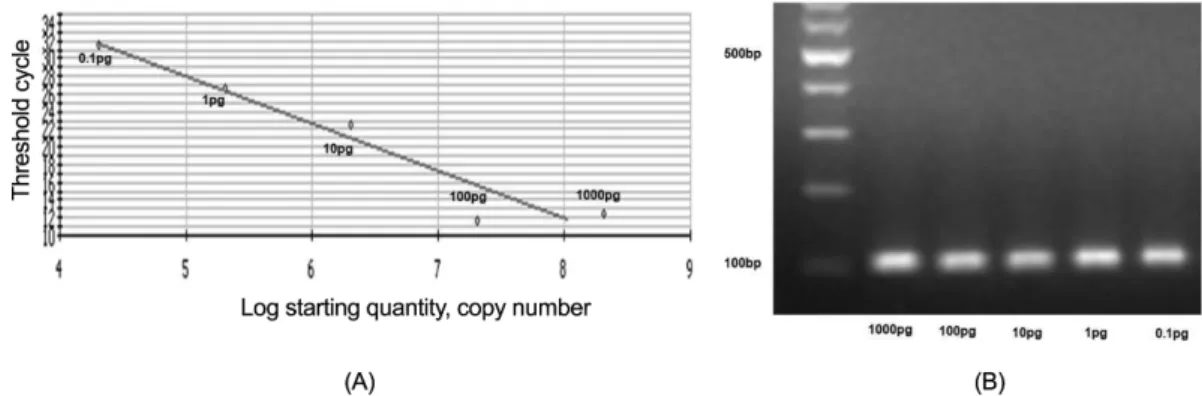
Real-time PCR. 1000 pg부터 0.1 pg까지 10배 단위 농 도로 희석된 TYLCV 외피단백질 유전자를 주형으로 하 여 real-time PCR을 수행한 결과, 주형의 농도에 따른
Threshold Cycles(Ct) 값들의 회귀직선(Regression equation) 은 Y = −5.309X + 54.559로 계산되었으며, 회귀상수 (Regression coefficient)는 R2= 0.964로 계산되었다(Fig.
1A). PCR 후 각각의 PCR 반응액 5 µl를 다시 회수하여 전기영동한 결과 검출한계보다 높은 농도인 1 ng에서 0.1 pg 까지의 모든 시료에서 예상한 109 bp의 위치(Fig. 1B)에 band가 나타남으로써 제작된 프라이머가 정확하게 작동 하였음을 확인하였다. 본 실험에서 얻어진 ultra-rapid real- time PCR의 검출한계는 0.1 pg(Fig. 1A)으로 PCR과 real- time PCR의 100 ag에 비해 1/1,000 수준이었지만(data not shown) 이는 반응시간을 극단적으로 단축하였기 때문에 얻어진 결과로 추정하며, 현장에서 TYLCV를 진단하기에 는 전혀 문제가 없는 수준의 감도로 생각한다.
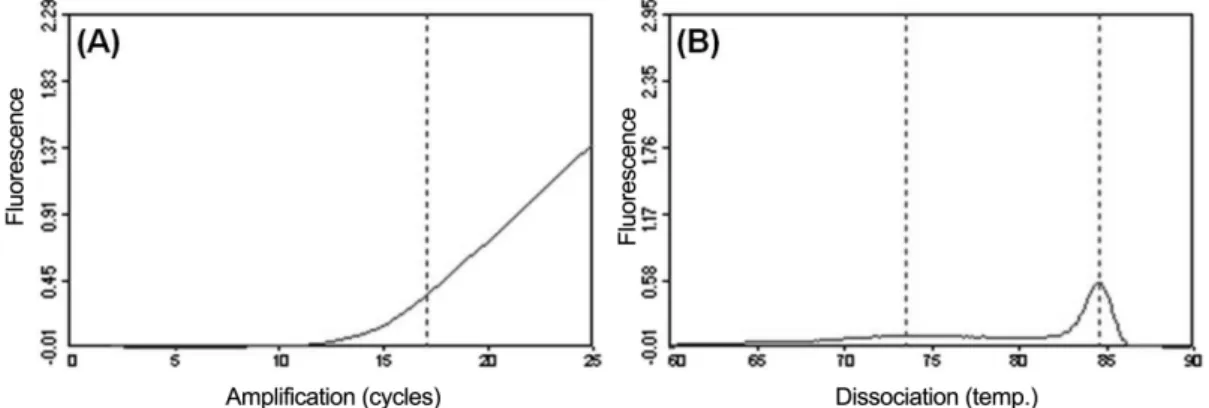
Ultra-rapid real-time PCR. 100 pg의 농도로 조정된 주형 DNA를 이용하여 ultra-rapid real-time PCR을 수행 한 결과, denaturation/annealing/extenstion의 과정을 각각 10초/10초/10초, 5초/5초/5초, 3초/3초/3초 처리한 경우, 용 융온도분석(Tm; Melting temperature analysis)을 포함한 소 요시간이 37분 35초, 28분 20초, 15분 29초로 모두 PCR 이나 real-time PCR에 비해 현저하게 단축됨을 확인할 수 있었다(Table 2). 반응시간을 3초/3초/3초로 처리한 경우 17.0의 Ct 값을 얻었으며, Tm 분석 결과 84.5oC에서 단 일 peak를 형성하는 것을 확인하였다(Fig. 2). 동일한 결 과를 포장에서 채집한 토마토 시료의 ultra-rapid real-time PCR에서도 얻었으며(Fig. 3), 이 결과를 토대로 ultra-rapid real-time PCR을 이용해 15분대에 TYLCV의 진단을 완 료할 수 있다는 결론을 얻었다.
Lee 등(2007)의 연구에서 annealing 온도를 56oC와 60oC 로 달리 처리한 경우 60oC 처리구에서 4oC의 편차만큼 PCR이 빨리 진행됨을 확인하였는데, 본 연구에서는 annealing 온도를 56oC로 처리하였기 때문에, CG 함량이
Fig. 1. Ct value of real-time PCR products and agarose gel electrophoresis of PCR products. Templates were 10-folded serially diluted TYLCV coat protein gene. (A) Standard curve for 10-fold serial dilution of templates. Regression equation was calculated as Y = −5.309X + 54.559 and regression coefficient (R2) was 0.964. (B) Same size PCR products were shown in agarose gel electrophoresis (109 bp).
보다 높은 프라이머를 디자인해 사용한다면 반응시간을 보다 단축할 수 있을 것으로 생각한다.
Ct 값은 반응시간이 길어질수록 낮아졌는데(Table 2), 이는 반응시간이 길어질수록 유전자의 증폭이 더 많이 일 어나는 것을 의미하는 것이라 추측하지만, HIV를 대상으 로 한 기존의 연구에서 반응시간을 충분하게 하는 것이 PCR에서 결코 유리한 것이 아니라는 고찰(Lee 등, 2007)
과는 다소 다른 결과이기에 면밀한 검토가 필요할 것으 로 생각한다. Tm 값은 각 처리별로 다소 편차가 있었는 데, 이에 대해서는 Lee 등(2007)의 연구와 동일한 경향이 었으며, 잔류 프라이머 등이 Tm 값에 미치는 영향에 대 해서는 추후 분석을 통해 보다 정밀한 조건 확립이 필요 할 것으로 생각한다.
Ultra-rapid real-time PCR의 주 목적은 고감도로 신속하 Table 2. Result of ultra-rapid real-time PCR for TYLCV detection
Sample Reaction time (sec.)
Total time Ct valuea Tm valueb Denaturation Annealing Extension
TYLCV coat protein gene
(100 pg)
10 10 10 37:35 13.09 83.45
5 5 5 28:20 16.56 83.78
3 3 3 15:29 17.0 84.50
aThreshold cycle (Ct) reflects the cycle number at which the fluorescence generated within a reaction crosses the threshold. It is inversely correlated to the logarithm of the initial copy number.
bMelting curve analysis is an assessment of the dissociation-characteristics of double-stranded DNA during heating. As the temperature is raised, the double strand begins to dissociate leading to a rise in the absorbance intensity, hyperchromicity. The temperature at which 50% of DNA is denatured is known as the melting point, though it is an inaccurate term as it has very little to do with a traditional melting point.
Fig. 2. The amplification of TYLCV specific gene by ultra-rapid real-time PCR. Ultra-rapid real-time PCR was set up with 3 steps (denaturation, annealing and extension) and 30 cycles. Times of 3 steps were 3, 3 and 3 seconds, respectively. (A) Ct value curve. Ct value was recorded around 17.0 cycles. (B) Melting temperature analysis. Reduction of fluorescence and −dF/dt in 60−90oC.
Fig. 3. Diagnosis of TYLCV from tomato leaves using PCR and ultra-rapid real-time PCR. (A) agarose gel electrophoresis of PCR products amplified using two kind of primer pairs (Lane 1; TYLCV-1f, TYLCV-1r-2 and Lane 3; TYLCV-f2, TYLCV-r2-1), Lane 2 and 4; Negative control. (B) The CT values of infected plant sample were computed 15.25. (C) Melting temperature was analyzed from 70oC to 90oC. Tm values were calculated as 84.43oC.
게 바이러스를 진단하는 데 있으며, 여기에 더해 이동식 장비를 이용해 현장에서 바로 바이러스를 진단할 수 있 다면 최고의 효율성을 확보할 수 있을 것이다. 본 연구의 진단대상인 TYLCV는 DNA를 핵산으로 가지기 때문에 역전사 과정이 필요없지만 대부분의 식물 바이러스는 RNA를 핵산으로 가지기 때문에 역전사 과정을 포함하는 전체 반응시간을 단축하는데 초점을 맞추어 연구가 진행 되어야 할 것이다(Yoo 등, 2012). 이와 병행하여, 포장에 서 식물체 시료로부터 바이러스 핵산을 추출하는 시간을 단축하기 위해 Cho 등(2006)에 의해 개발된 간이핵산추 출법을 ultra-rapid real-time PCR에 접목한다면 전체적으 로 1시간 이내의 짧은 시간에 식물 바이러스를 정밀진단 할 수 있을 것으로 기대된다. Ultra-rapid real-time PCR 진단용 마이크로칩은 현재 단가가 1점당 7천원 정도로 고 가이기 때문에 전체적인 진단비용은 PCR이나 real-time PCR에 비해 1.5배 정도 비싸지만, 향후 수요가 증가하고 대량생산이 된다면 진단비용을 크게 낮출 수 있을 것으 로 기대한다. 본 연구에서 사용된 GenSpector TMC- 1000(Samsung, Korea) 기기는 일반 PCR 기기와 비슷한 크기이며 휴대용으로 사용하기에는 다소 크지만 승용차 에는 충분히 탑재가 가능하며, 향후 기기의 소형화 연구 가 동반된다면 농업 현장이나 검역 현장 등에서 바이러 스의 정밀진단을 위해 유용하게 실용화될 수 있을 것으 로 생각한다.
요 약
토마토황화잎말림바이러스(Tomato yellow leaf curl virus;
TYLCV)는 온실가루이(Bemisia tabaci)에 의해서 영속전 염되는 DNA 바이러스로 토마토에 발생하는 가장 중요한 병 중 하나이다. 우리나라에서 TYLCV는 2008년 최초로 보고된 이래 급속하게 전국적으로 확산되어 토마토 생산 에 심각한 경제적 손실을 일으키고 있다. 토마토 생산과 정에서 TYLCV의 확산을 최소화하기 위해 바이러스의 조 기진단이 매우 중요하다. 본 연구에서는 바이러스의 신속 진단을 위해 초고속 정밀 PCR 진단기술을 개발하였으 며, 이는 마이크로칩을 기반으로 하여 5 µl의 시료만으로 PCR을 수행할 수 있도록 고안된, 휴대가 가능할 정도의 소형 GenSpectorTM TMC-1000 PCR 기기를 이용한 새로 운 기술이다. 본 연구에서 개발된 초고속 정량 PCR을 이 용하였을 때 TYLCV 진단을 위한 30 cycle의 PCR과 용 융점분석(melting curve analysis)에 15분 이내의 시간이 소요되었으며, GenSpectorTM TMC-1000 PCR을 이용한 초 고속 정밀진단 기술은 향후 TYLCV의 대발생을 모니터
링하는데 유용하게 사용될 수 있을 것으로 생각한다. 본 연구결과는 GenSpectorTM TMC-1000 PCR기반의 초고속 정량 PCR 기술을 이용한 식물 바이러스의 진단기술 개 발로는 최초의 보고이다.
Acknowledgement
This study was carried out with the support of “Cooperative Research Program for Agriculture Science & Technology Development (Project No. PJ0074502012)”, National Academy of Agricultural Science, Rural Development Administration, Republic of Korea.
References
Cho, J. D., Kim, J. S., Kim, H. R., Chung, B. N. and Ryu, K. H.
2006. Convenient nucleic acid detection for Tomato spotted wilt virus: virion captured/RT-PCR (VC/RT-PCR). Res. Plant Dis. 12: 139−143. (In Korean)
Cho, J. D., Kim, T. S., Kim, J. H., Choi, G. S., Chung, B. N., Choi, H. S. and Kim, J. S. 2008. Convenient virion capture (VC)/
PCR for Tomato yellow leaf curl geminivirus occurring on Tomato in Korea. Res. Plant Dis. 14: 233−237. (In Korean) Cho, Y. K., Kim, J., Lee, Y., Kim, Y. A., Namkoong, K., Lim, H., Oh, K. W., Kim, S., Han, J., Park, C., Pak, Y. E., Ki, C. S., Choi, J. R., Myeong, H. K. and Ko, C. 2006. Clinical evaluation of micro-scale chip-based PCR system for rapid detection of hepatitis B virus. Biosens. Bioelectron. 21: 2161− 2169.
deMello, A. J. 2003. Microfluidics: DNA amplication moves on.
Nature 422: 28−29.
Hanssen, I. M., Lapidot, M. and Thomma, P. H. J. 2010.
Emerging viral diseases of tomato crops. MPMI 23: 539−548.
Kim, E. H., Lee, D. W., Han, S. H., Kwon, S. H. and Yoon, B. S.
2007. Rapid detection of avian influenza subtype H5N1 using quick real-time PCR. Korean J. Microbiol. 43: 23−30. (In Korean)
Kim, J. S., Lee, S. H., Choi, H. S., Kim, M. K., Kwak, H. R., Cho, J. D., Choi, G. S. and Kim, J. Y. 2009. Occurrence of virus diseases on major corps in 2008. Res. Plant Dis. 15: 1−7. (In Korean)
Kim, J. S., Lee, S. H., Choi, H. S., Kim, M. K., Kwak, H. R., Nam, M., Kim, J. S., Choi, G. S., Cho, J. D., Cho, I. S. and Chung, B. N. 2011. Occurrence of virus disease on major crops in 2010. Res. Plant Dis. 17: 334−341. (In Korean) Kwak, H. R., Kim, M. K., Lee, G. S., Kim, C. S., Kim, M. J., Kim,
J. D., Lee, S. H., Kim, J. S., Lee, S. C. and Choi, H. S. 2008.
Molecular characterization of Tomato yellow leaf curl virus (TYLCV) isolated firstly in Korea. Res. Plant Dis. 24:
238. (In Korean)
Lee, D. W., Kim, E. H., Yoo, M. S., Han, S. H. and Yoon, B. S.
2007. Ultra-rapid real-time PCR for the detection of human immunodeficiency virus (HIV). Korean J. Microbiol. 43: 91−
99. (In Korean)
Navas-Castillo, J., Fiallo-Olivé, E. and Sánchez-Campos, S. 2011.
Emerging virus diseases transmitted by whiteflies. Annu. Rev.
Phytopathol. 49: 219−248.
Ohnishi, J., Kitamura, T., Terami, F. and Ken-ichiro, H. 2009. A selective barrier in the midgut epithelial cell membrane of the nonvector whitefly Trialeurodes vaporariorum to Tomato yellow leaf curl virus uptake. J. Gen. Plant Pathol. 75: 131−
139.
Papayiannis, L. C., Iacovides, T. A., Katis, N. I. and Brown, J. K.
2010. Differentiation of Tomato yellow leaf curl virus and
Tomato yellow leaf curl Sardinia virus using real-time TaqMan® PCR. J. Virol. Methods 165: 238−245.
Sinisterra, X. H., McKenzie, C. L., Hunter, W. B., Powell, C. A.
and Shatters, Jr. R. G. 2005. Differential transcriptional activity of plant-pathogenic begomoviruses in their whitefly vector (Bemisia tabaci, Gennadius: Hemiptera Aleyrodidae).
J. Gen. Virol. 86: 1525−1532.
Yoo, M. S., Thi, K. C. N., Nguyen, P. V., Han, S. H., Kwon, S. H.
and Yoon, B. S. 2012. Rapid detection of sacbrood virus in honeybee using ultra-rapid real-time polymerase chain reaction. J. Virol. Methods 179: 195−200.
Yoon, D. S., Lee, Y. S., Cho, H. J., Sung, S. W., Oh, K. W., Cha, J.
H. and Lim, G. B. 2002. Precise temperature control and rapid thermal cycling in a micro machined DNA polymerase chain reaction chip. J. Micromech. Microeng. 12: 813−823.