토마토황화잎말림바이러스(Tomato yellow leaf curl virus, TYLCV)는 Geminiviridae과, Begomovirus속이며 미국, 남미, 유
럽, 동남아시아, 일본, 중국 등 전 세계 토마토재배지에 피해 를 초래하고 있다(Czosnek와 Laterrot, 1997; Hanssen 등, 2010;
Navas-Castillo 등, 2011). 국내에서는 경상남도 통영의 토마토 농가에서 2008년 5월 처음 발생되었고(Ji 등, 2008; Kwak 등, 2008), 2010년에는 경남 통영 등 16개 시군, 경북 10개, 충남 4
©The Korean Society of Plant Pathology
cc
This is an open access article distributed under the terms of the Creative Commons Attribution Non-Commercial License (http://creativecommons.org/ licens- es/by-nc/4.0/), which permits unrestricted non-commercial use, distribution, and reproduction in any medium, provided the original work is properly cited.
토마토품종의 토마토황화잎말림바이러스병에 대한 저항성 평가
Resistance Evaluation of Commmercial Tomato Cultivars against Tomato yellow leaf curl virus
*Corresponding author Tel: +82-61-330-2512 Fax: +82-61-336-4076 E-mail: [email protected]
고숙주1*ㆍ김효정1ㆍ이진희1ㆍ마경철1ㆍ최덕수1ㆍ박영훈2ㆍ최승국3ㆍ김미경4ㆍ최홍수4
1전라남도농업기술원 친환경농업연구소, 2부산대학교 원예생명과학과, 3농촌진흥청 국립원예 특작과학원 원예특작환경과, 4농촌진흥청 국립농업과학원 작물보호과
Sug-Ju Ko
1*, Hyo-Jeong Kim
1, Jin-Hee Lee
1, Kyung-Cheol Ma
1, Duck-Soo Choi
1, Young-Hoon Park
2, Seung-Kook Choi
3, Mi Kyeong Kim
4, and Hong-Soo Choi
41
Environment-friendly Agricultural Research Institute, Jeonnam Agricultural Research & Extension Services, Naju 58213, Korea
2
Department of Horticultural Bioscience, Pusan National University, Miryang 50463, Korea
3
Horticultural and Herbal Crop Environment Division, National Institute of Horticultural and Herbal Science, Rural Development Administration, Wanju 55365, Korea
4
Crop Protection Division, National Institute of Agricultural Sciences, Rural Development Administration, Wanju 55365, Korea
Received September 10, 2016 Revised November 10, 2016 Accepted November 11, 2016
Tomato yellow leaf curl virus (TYLCV) is a viral disease causing severe economic losses on tomato.
Practical prevention of the TYLCV disease is to control tabacco whitefly (Bemisia tabaci) or to cultivate TYLCV-resistant tomato cultivars, because no agrochemical products are available to control TYLCV. In this study, TYLCV resistance of the commercial tomato cultivars were evaluated using the DNA markers tightly linked to TYLCV resistance genes Ty-1 and Ty-3 and infection with the TYLCV clones mediated by Agrobacterium. In marker genotyping, resistance alleles were detected from 4 oval type tomato cultivars (Titichal, TY tinny, TY saengsaeng II, TY sense Q). Four cheery type cultiavrs (TY endorphin, TY smartsama, Tiara TY, Olleh TY) and 6 round type cultivars (TY kingdom, TY ace, TY homerun, TY altorang, Dotaerang TY winner, Styx TY). The seedling bioassay indicated that tomato cultivars of the oval type and cherry type showed consistancy in marker genotype and phenotype while slight disease symptom was observed from some round type cultivras (TY ace, TY homerun, Styx TY) with resistance marker genotype. For fruit yields, TY tinny was greater than its control cultivar Titichal in oval types, TY smartsama was greater than its control Smile in cherry type, and TY ace and TY kingdom were greater than their control Dabok. These cutliavrs can be a good choice for high-yielding TYLCV- resistant tomato cultivars.
Keywords: Cultivar, Resistance, Tobacco whitefly, Tomato, Tomato yellow leaf curl virus
Research in Plant Disease pISSN 1598-2262, eISSN 2233-9191 www.online-rpd.org
297 Open Access
Note
개, 충북 2개, 전남 13개, 전북 11개, 제주도 2개 시군 등 전국 적으로 급속히 확산되었다(Kim 등, 2011). TYLCV는 1964년 이스라엘에서 처음 보고된 후 분리 지역, 병징 차이 등에 따 라 10여 종의 계통이 확인되었다(Abhary 등, 2007; Cohen과 Harpaz, 1964; Fauquet 등, 2003). TYLCV에 감염되면 황화, 잎 말림 및 위축 등의 증상을 보이고, 담배가루이가 TYLCV를 직 접 매개하며, 즙액, 종자 및 접촉 전염은 하지 않는다고 하였 다(Czosnek, 1999; Diener와 Raymer, 1971). 담배가루이는 고 온기에 세대가 짧아지고, 발생횟수가 많아져 살충제에 대 한 약제저항성이 발달하여 방제가 잘되지 않으므로(Devine 와 Denholm, 1998; Lee 등, 2012; Nauen 등, 2002) 방충망을 이 용한 시설 내 유입차단 방법과 트랩식물을 이용한 방제법이 보고되었다(Choi 등, 2016; Chung 등, 2013). 하지만 방충망 이 용 방법은 고온기에 온도관리의 한계가 있어 근본적인 바이 러스 방제대책이 되지 않는다. 품종을 선택할 때 매개충의 주발생시기를 고려하여 촉성재배는 품종의 저항성 여부에 제한을 두지 않고, 담배가루이 밀도가 증가하는 7월 이후 정 식시에는 저항성품종 재배를 권장하였다(Ko 등, 2014).
지금까지 알려진 TYLCV 저항성유전자는 Ty-1, Ty-2, Ty-3, Ty-
3a, Ty-4, Ty-5이며, 최근 유전자지도 분석에 따르면 Ty-1과 Ty-3
이 매우 근접하게 위치하여 동일한 유전자좌의 대립유전 자일 가능성이 있다고 하였다(Anbinder 등, 2009; Garcia 등, 2007; Hoogstraten과 Braun, 2005; Ji와 Scott, 2006; Ji 등, 2007, 2009; Verlaan 등, 2011). TYLCV 저항성품종 개발을 위한 유전 자 마커 Ty-1, Ty-2, Ty-3, Ty-3a가 육종에 이용되고 있다(Hoog- straten과 Braun, 2005; Ji 등, 2007). 현재 시중에 유통되고 있는 TYLCV 내병성품종들이 농가에서 재배되고 있으나 이에 대 한 연구로는 Kim 등(2013)이 발표한 유럽계 34품종에 대한 저항성 정도와 수량성 등에 대한 보고뿐이다.본 연구는 전남지역에서 재배되고 있는 토마토 품종의 TYLCV 저항성 유전자 보유 여부와 TYLCV를 접종하였을 때 표현형을 조사하고자 하였으며, 내병성품종들의 원예형질 특성을 조사하여 영농현장에서 품종선택의 기초자료로 제 공하고자 하였다.
TYLCV 저항성 검정. 토마토 품종은 일반(완숙)형, 방울 형, 대추형 3가지 형태로 구분하여 총 14개 내병성품종과 8 개 감수성품종을 대상으로 실시하였다. 일반(완숙)형은 과 중이 150
–
250 g 크기의 원형이고, 방울형은 15–
20 g 크기의 작은 원형이며, 대추형은 15–
20 g 크기의 타원형이다. TYLCV 접종은 국립원예특작과학원 바이러스실에서 TYLCV 감염 성클론을 분양받아 Choi 등(2013)의 방법에 따라 실시하였다. 형질전환된 Agrobacterium tumefaciens를 Kanamycin 등 3 종의 항생제를 첨가한 Luria-Bertani (LB) 배지에서 28oC, 24시 간 진탕배양하였다. 배양액 10 μl를 10 ml의 LB 배지에 첨가 한 후 28oC, 8시간 진탕배양하였다. 배양액을 4,500 rpm에서 10분간 원심분리 후 회수하여 OD600 0.7
–
0.8 농도로 현탁하 였다. 현탁된 균에 10 mM MgCl2, 200 μM acetosyringone, 10 mM MES를 넣어서 상온에서 2시간 가량 둔 후에 1 ml 주사 기를 사용하여 아그로주입법(Choi 등, 2013)으로 접종하였 다. 토마토 종자를 파종하여 2–
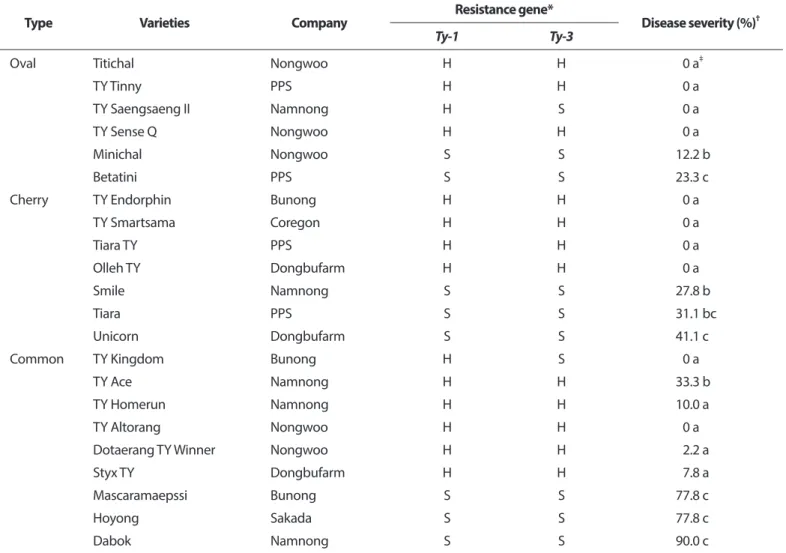
3엽기에 개체당 떡잎 2개의 잎 뒷면에 균 1 ml를 주입하여 접종하였다. 접종한 식물체는 25oC±5oC로 유지되는 온실에서 30일 동안 재배하면서 병징 을 조사하였다. 바이러스 접종은 품종당 10주씩 3반복으로 실시하였다. 바이러스 조사는 Choi 등(2013)의 방법을 변형 하여 증상 없음(0), 약한 증상(1), 황화증상(2), 위축과 황화 잎 말림(3)의 4단계로 구분하고 다음과 같이 발병도로 환산하 였다. 발병도(%)=[∑(발병수×발병계수)/3×개체수]×100. TY- LCV 내병성 유전자를 확인하기 위한 검정은 Hwang 등(2012) 과 Kim 등(2013)의 방법에 따라 수행되었다. 품종별로 유묘 기 식물체의 본엽에서 total genomic DNA를 추출한 후 TYLCV 저항성 유전자 Ty-1과 Ty-3과 연관된 분자마커(Kim 등, 2013) 를 이용하여 확인한 결과(Table 1), 대추형은 티티찰, TY 티니, TY 센스큐 3품종에서 Ty-1과 Ty-3을 확인하였고, TY 생생 II에 서는 Ty-1만 확인되었다. 방울형은 TY 엔도르핀, TY 스마프사 마, 티아라 TY, 올레 TY 4종에서 Ty-1과 Ty-3 유전자를 확인하 였다. 완숙형은 TY 에이스, TY 홈런, TY 알토랑, 도테랑 TY 위 너, 스틱스 TY 등 5종에서 Ty-1과 Ty-3 유전자를 확인하였으나 TY 킹덤은 Ty-1 유전자만 확인되었다. 따라서 Ty계통에서는 모두 Ty 유전자가 이형접합으로 존재함이 확인되었으나 조 사된 8개 감수성품종에서는 모두 저항성 유전자가 확인되 지 않았다(Table 1). 생물검정에서는 대추형 티티찰, TY 티니, TY 생생 II, TY 센스큐 등 저항성품종 4종에서 병징이 나타나 지 않았으나 감수성 품종 미니찰에서 12.2%, 베타티니에서 23.3%의 발병도를 나타냈다. 방울형은 TY 엔도르핀, TY 스마 프사마, 티아라 TY, 올레 TY 등 저항성품종 4종에서 병징이 나 타나지 않았으나 감수성품종인 스마일 27.8%, 티아라 31.1%, 유니콘 41.1%의 발병도를 보였다. 완숙형은 저항성품종 중 TY 킹덤과 TY 알토랑에서는 병징을 보이지 않았으나 TY 에 이스는 33.3%, TY 홈런 10.0%, 도테랑 TY 위너 2.2%, 스틱스 TY 7.8%의 발병도를 나타냈다. 감수성품종에서는 마스카라맵 시 77.8%, 호용 77.8%, 다복 90.0%의 발병도를 나타냈다. 완숙 형 4종의 저항성품종에서 병징이 발현된 원인은 정확히 알 수 없으나 저항성 유전자가 존재하더라도 병원균의 밀도가높거나 병원성이 증가되는 환경에서는 병징이 나타난다는 보고도 있다(Kim 등, 2013). 또한 사용된 마커가 저항성 유전 자 기반의 마커가 아닌 유전자 연관 마커임을 고려할 때 이 들 품종에서는 마커-유전자 간 재조합이 일어났을 가능성 이 있다. 하지만 감수성품종에 비해서는 발병도가 매우 낮 게 나타난 사실을 볼 때 전자의 가능성이 보다 높을 것으로 판단된다.
품종별 생육 및 수량성 검정. 본 시험은 대추형 품종 인 TY 생생 II, TY 티니, TY 센스큐, 티티찰 4종, 방울형인 TY 스 마프사마, 티아라 TY 2종, 완숙형인 도테랑 TY 위너, TY 킹 덤, TY 홈런, TY 에이스, TY 알토랑 5종을 공시하여 전남 나주 시 소재 전남농업기술원 비닐하우스에서 수행하였다. 정
식은 2014년 4월 17일에 1화방의 1번 꽃이 개화하기 직전 에 70×25 cm의 재식거리로 2열로 정식한 후 점적호스를 설 치하고 흑색비닐로 멀칭하였다. 토마토는 5화방까지 재배 하여 적심하였고 모든 측지는 제거하였다. 수분은 나투벌 (Koppert, Monster, The Netherlands)을 이용하였으며, 재배지 의 토양은 식양토로 시비방법은 밑거름 11.6-10.3-4.1-2000 (N-P-K-퇴비) kg/10 a 시용하였고, 추비는 8.8-8.1 (N-K) kg/10 a 3회에 걸쳐 분시하였다. 수확기간은 6월 9일부터 9월 5일까 지이며, 과실의 무게와 상품수량을 화방별로 분리하여 조 사하였고 수용성 고형물 함량(당도)은 굴절당도계(ATC-20E;
Atago, Tokyo, Japan)를 사용하여 측정하였다. 생육 특성은 초 장, 절간장, 엽장, 엽폭을 조사하였고, 완전임의배치 3반복으 로 하여 반복당 20주를 공시하였다.
Table 1. Results of bioassay and molecular marker evaluation of tomato cultivars for the resistance to Tomato yellow leaf curl virus
Type Varieties Company Resistance gene*
Disease severity (%)
†Ty1 Ty3
Oval Titichal Nongwoo H H 0 a
‡TY Tinny PPS H H 0 a
TY Saengsaeng II Namnong H S 0 a
TY Sense Q Nongwoo H H 0 a
Minichal Nongwoo S S 12.2 b
Betatini PPS S S 23.3 c
Cherry TY Endorphin Bunong H H 0 a
TY Smartsama Coregon H H 0 a
Tiara TY PPS H H 0 a
Olleh TY Dongbufarm H H 0 a
Smile Namnong S S 27.8 b
Tiara PPS S S 31.1 bc
Unicorn Dongbufarm S S 41.1 c
Common TY Kingdom Bunong H S 0 a
TY Ace Namnong H H 33.3 b
TY Homerun Namnong H H 10.0 a
TY Altorang Nongwoo H H 0 a
Dotaerang TY Winner Nongwoo H H 2.2 a
Styx TY Dongbufarm H H 7.8 a
Mascaramaepssi Bunong S S 77.8 c
Hoyong Sakada S S 77.8 c
Dabok Namnong S S 90.0 c
*H, heterozygous marker genotype indicating dominant effect of resistance; S, homozygous maker genotype for susceptible allele.
†
Disease severity from 0 to 3. 0, healthy looking; 1, mild symptom; 2, yellowing symptom; 3, stunt with severe symptom. Disease severity (%)=[∑(number of diseased plant×disease index)/3×number of plant]×100.
‡
Means followed by a common letter are not significantly different at the 5% by Duncan’s multiple range test.
생육 특성을 살펴보면 초장은 TY 생생 II 236 cm, 티티찰 203 cm, TY 티니 193 cm, TY 센스큐 183 cm 순이었고, 대비품 종인 미니찰은 176 cm로 가장 작았다. 방울형은 티아라 TY 194 cm, TY 스마프사마 191 cm, 대비품종인 유니콘 197 cm, 스마일 154 cm였다. 완숙형은 TY 킹덤 200 cm, TY 알토랑 193 cm, TY 홈런 177 cm, 도테랑 TY 위너 173 cm, TY 에이스 167 cm, 대비품종인 마스카라맵시 197 cm, 다복 191 cm였다. 절 간장도 비슷한 경향이었다(Table 2).
과중은 대추형은 TY 티니 17.6 g, 티티찰 16.6 g, TY 생생 II 16.0 g, TY 센스큐 15.8 g, 대비품종인 미니찰 15.7 g 순이었으 나 유의차는 없었다. 방울형은 TY 스마프사마 16.7 g, 티아라 TY 16.3 g, 대비품종인 스마일 14.7 g, 유니콘 13.4 g이었으며, TY 스마프사마와 티아라 TY가 대비품종에 비해 큰 것으로 유의차가 있었다. 완숙형은 TY 킹덤 224.1 g, TY 알토랑 189.3 g, TY 에이스 170.7 g, TY 홈런 159.4 g, 도테랑 TY 위너 136.6 g, 대비품종인 다복 184.1 g, 마스카라맵시 159.2 g이었으며, TY 킹덤 224.1 g과 TY 알토랑은 다복과 비슷한 대과종, TY 에이 스와 TY 홈런은 마스카라맵시와 비슷한 중과종, 도테랑 TY 위너는 소과종이었다(Table 3).
당도는 대추형인 TY 생생 II 7.6oBx, TY 티니 7.2, 티티찰 7.2, TY 센스큐 7.1, 대비품종인 미니찰 7.5로 TY 생생 II를 제외하
고 모두 낮았다. 방울형인 티아라 TY 6.2, TY 스마프사마 5.7로 대비품종인 스마일 7.0, 유니콘 6.8에 비해 모두 낮았다. 완숙 형인 TY 킹덤 4.4, TY 알토랑 4.4, TY 에이스 3.9, TY 홈런 3.6, 도 테랑 TY 위너 4.8, 대비품종인 다복 4.4, 마스카라맵시 4.8이었 으며, 도테랑 TY 위너와 TY 킹덤은 대비품종과 유사하였으 나 TY 에이스와 TY 홈런은 대비 품종에 비해 낮은 편이었다 (Table 3).
수량은 대추형인 티티찰 3,656 kg, TY 티니 3,419 kg, TY 센 스큐 3,124 kg, TY 생생 II 1,733 kg, 대비품종인 미니찰 2,549 kg 으로 티티찰, TY 티니, TY 센스큐는 미니찰보다 많았다. 방울 형인 TY 스마프사마 2,880 kg, 티아라 TY 2,861 kg, 대비품종 인 스마일 1,439 kg, 유니콘 621 kg이었으며, TY 스마프사마 와 티아라 TY가 대비품종에 비해 많았다. 완숙형인 TY 에이 스 4,476 kg, TY 킹덤 4,196 kg, TY 홈런 3,863 kg, TY 알토랑 3,503 kg, 도테랑 TY 위너 2,577 kg, 대비품종인 다복 3,972 kg, 마스 카라맵시 2,106 kg이었으며, TY 에이스, TY 킹덤, TY 홈런은 다 복과 비슷하였다(Table 3).
Ko 등(2014)이 제시한 경종적 방제법을 고려한다면 TYLCV 주발생시기에는 저항성품종을 재배하여야 한다. 수량성을 고려한다면 대추형은 TY 티니, 방울형은 TY 스마프사마, 티 아라 TY, 완숙형은 TY 에이스, TY 킹덤을 우수한 품종으로 추
Table 2. Growth characteristics of tomato cultivars evaluated for the resistance to Tomato yellow leaf curl virus (TYLCV)
Type Varieties Plant height
(cm) Internode length
(mm) Stem diameter
(mm) Position of
first fruit set Leaf length
(cm) Leaf range (cm)
Oval TY Saengsaeng II 235.8 a* 73.2 a 13.0 b 9.3 a 42.4 ab 37.7 a
TY Tinny 193.3 bc 52.7 c 17.5 ab 7.1 b 44.5 ab 37.5 a
TY Sense Q 182.8 bc 50.4 c 16.6 ab 6.7 b 40.5 ab 36.4 a
Titichal 203.1 b 60.4 b 17.8 a 6.2 b 45.5 a 38.3 a
Minichal 175.7 c 50.2 c 18.2 a 6.9 b 39.1 b 38.3 a
Cherry TY Smartsama 190.8 a 60.9 ab 14.5 a 6.1 a 35.5 b 33.7 b
Tiara TY 193.6 a 65.2 ab 16.4 a 5.9 a 37.1 ab 30.8 b
Smile 154.3 b 46.7 b 17.3 a 4.7 a 41.7 a 44.6 a
Unicorn 196.6 a 61.9 ab 14.9 a 6.0 a 37.9 ab 34.5 b
Common Dotaerang TY Winner 173.1 bc 75.0 bc 15.3 ab 6.9 a 39.9 a 42.1 ab
TY Kingdom 200.2 a 84.6 ab 16.9 a 7.1 a 41.5 a 44.3 ab
TY Homerun 177.7 bc 71.7 c 14.6 ab 8.2 a 37.2 a 37.5 b
TY Ace 166.5 c 66.9 c 13.8 b 6.5 a 40.2 a 41.1 ab
TY Altorang 193.1 ab 88.9 a 15.8 ab 7.4 a 43.0 a 48.9 a
Dabok 190.6 ab 82.3 ab 14.5 ab 6.5 a 40.1 a 44.1 ab
Mascaramaepssi 197.1 a 82.6 ab 14.2 b 7.8 a 39.3 a 44.7 ab
*Means followed by a common letter are not significantly different at the 5% by Duncan’s multiple range test.
천한다.
요 약
토마토황화잎말림바이러스(TYLCV)는 토마토에서 큰 경 제적 손실을 초래하는 바이러스 병이다. 이병은 약제방제 가 되지 않기 때문에 매개충인 담배가루이를 방제하거나 저 항성 품종을 재배해야 한다. 본 시험은 시중에 유통 중인 토 마토 품종에 대해 토마토황화잎말림바이러스에 저항성을 평가하였다. 토마토 품종별로 TYLCV 저항성 마커로 유전자
Ty-1과 Ty-3 분석을 실시하였고, 아그로주입법으로 생물검정
을 실시하였다. 대추형은 티티찰, TY 티니, TY 생생 II, TY 센스 큐 등 4종, 방울형은 TY 엔도르핀, TY 스마프사마, 티아라 TY, 올레 TY 등 4종, 완숙형은 TY 킹덤, TY 에이스, TY 홈런, TY 알 토랑, 도테랑 TY 위너, 스틱스 TY 등 6종에서 저항성유전자를 확인하였다. 유묘검정은 대추형과 방울형은 모두 유전자 분 석결과와 일치하였으나, 완숙형은 저항성 품종에서도 일부 병징이 발현되는 경향이었다. 품종별 수량성은 대추형은 티 티찰 대비 TY 티니가 우수하였고, 방울형은 스마일 대비 TY 스마프사마, 티아라 TY이 우수하였으며, 완숙형은 다복 대 비 TY 에이스, TY 킹덤 등이 우수한 품종이었다.Conflicts of Interest
No potential conflict of interest relevant to this article was re- ported.
Acknowledgement
This study was carried out with the support of Cooperative Research program for Agricultural Science & Technology Devel- opment (Project No. PJ01011307) Rural Development Adminis- tration, Republic of Korea.