pISSN 2288-0585⋅eISSN 2288-6850
Diagnostic Accuracy and Detection Rate of Real-Time PCR for Detection of Group B Streptococcal Colonization in Pregnant
Women: Systemic Review of Literature and Meta-Analysis
Sun Young Park
1, So Young Kim
1, Won Jung Choi
1, Seok-Hyun Kim
1, Seong Geun Hong
21
Division of New Health Technology Assessment, National Evidence-Based Healthcare Collaborating Agency, Seoul,
2Department of Laboratory Medicine, CHA Bundang Medical Center, CHA University, Seongnam, Korea
Background: Group B streptococcus (Streptococcus agalactiae, GBS) was reported as a major cause of neonatal infection and death. To prevent vertical transmission, CDC recommended that all women in week 35-37 of pregnancy should receive the GBS colonization test. We conducted a systematic review and meta-analysis to evaluate diagnostic accuracy and detection rate of real-time PCR for GBS in preg- nant women.
Methods: The literature review for GBS using re- al-time PCR was done including KoreaMed, Ovid- MEDLINE, Ovid-EMBASE, and Cochrane Library on November 3, 2015. 443 articles were collected. Two authors select articles and evaluated the quality of studies using Scottish Intercollegiate Guidelines Net- work tool independently.
Results: Diagnostic accuracy of the real-time PCR
was assessed by meta-analysis through 34 articles (13,516 for real-time PCR, 1,815 for culture and oth- er comparison test). The GBS colonization was as- sessed through 34 articles, which reported varying values of 2.0-69.2% using real-time PCR. The re- al-time PCR for GBS was shown to have overall sensitivity of 0.93 (95% CI 0.92-0.94, I2=86.3%), overall specificity of 0.96 (95% CI 0.96-0.96, I2= 90.2%), SROC AUC of 0.99.
Conclusion: Real-time PCR is an effective test for detecting GBS colonization in pregnant women, re- sulted in preventing the infection in a new born baby.
(Ann Clin Microbiol 2017;20:42-51)
Key Words: Group B streptococcus, Pregnant women, Real-time polymerase chain reaction, Streptococcus agalactiae
42
Received 12 April, 2017, Revised 22 May, 2017, Accepted 5 June, 2017
Correspondence: Seong Geun Hong, Department of Laboratory Medicine, CHA Bundang Medical Center, CHA University, 59 Yatap-ro, Bundang-gu, Seongnam 13496, Korea. (Tel) 82-31-780-5463, (Fax) 82-31-780-5476, (E-mail) [email protected]
ⓒ The Korean Society of Clinical Microbiology.
This is an Open Access article distributed under the terms of the Creative Commons Attribution Non-Commercial License (http://creativecommons.org/licenses/by-nc/4.0) which permits unrestricted non-commercial use, distribution, and reproduction in any medium, provided the original work is properly cited.
INTRODUCTION
B군 사슬알균(Group B streptococcus, GBS)은 신생아에서 패혈증, 뇌수막염, 사망의 주요 원인균으로[1], 감염 후 생존자 의 30%에서 정신운동 발달의 저하가 나타난다[2]. 분만 시 모 체의 생식기관 접촉에 의해 발생하며[3], 모체에 GBS 집락이 있는 경우 수직감염률은 평균 50% (29-85%)로 알려져 있다[4].
세계적으로 임신 여성에서 GBS의 집락화율은 15-40%정도 이다[3]. 우리나라 산모에서의 유병률은 미국에 비해서 현저히 낮지만, 10년 전 집락화율이 2.6%로 보고된 이후[5,6], 2009년 부터 2013년까지 5.5-12.6%로 보고되어 점점 증가하고 있는 추 세이다[6-9].
미국의 질병통제예방센터(Centers for Disease Control and Prevention, CDC)는 임신 35-37주의 여성에서 질-직장의 GBS
집락화 유무를 산전 검사로 시행을 권고하고 있으며, 검사법으 로 배양, 라텍스 응집법(latex agglutination test) 또는 핵산 증폭 검사(nucleic acid amplification test) 중 한가지를 시행하도록 제시하고 있다[10,11].
신속 검사로서 실시간 중합효소연쇄반응법의 진단정확성에 대해 체계적 문헌고찰이 시행되었으나 2편의 문헌만으로 평가 되었으며[2], 전체 핵산 증폭 검사의 민감도(62.5-98.5%)와 특 이도(64.5-99.6%)의 범위가 넓다는 제한점이 있었다[12]. 이에 본 연구에서는 체계적 문헌고찰과 메타분석을 이용하여 GBS 집락화 확인을 위한 실시간 중합효소연쇄반응법의 진단정확성 과 검출률을 조사하여 동 검사의 유효성을 확인하였다.
Table 1. Levels of evidence (SIGN criteria) [19]
1++
1+
1−
2++
2+
2−
3 4
High quality meta-analyses, systematic reviews of RCTs, or RCTs with a very low risk of bias Well conducted meta-analyses, systematic reviews, or RCTs with a low risk of bias
Meta-analyses, systematic reviews, or RCTs with a high risk of bias High quality systematic reviews of case control or cohort studies
High quality case control or cohort studies with a very low risk of confounding or bias and a high probability that the relationship is causal
Well conducted case control or cohort studies with a low risk of confounding or bias and a moderate probability that the relationship is causal
Case control or cohort studies with a high risk of confounding or bias and a significant risk that the relationship is not causal Non-analytic studies, e.g. case reports, case series
Expert opinion
Fig. 1. Literature search flow diagram.
MATERIALS AND METHODS
1. 문헌검색 전략
문헌검색은 KoreaMed, Ovid-MEDLINE, Ovid-EMBASE 및 Cochrane Library의 데이터베이스를 이용하였다. 검색전략에 따라 ‘{(Group B Streptococcus.mp OR Group B Streptococcal.mp OR Streptococcus agalactiae/ OR agalactiae.mp OR GBS.mp) AND (real time polymerase chain reaction/ OR real-time PCR.mp OR real-time reverse transcriptase-polymerase chain reaction.mp OR RT PCR.mp OR RTPCR.mp OR NAAT.mp OR nucleic acid amplification/ OR rapid PCR-test.mp OR idi-strep b test.mp OR cepheid.mp OR BD MAX.mp OR Xpert.mp)}’의 검색어로 2015년 11월 3일에 검색하였다.
총 441편의 문헌이 검색되었으며 수기검색으로 2편의 문헌 이 추가되었다. 중복검색된 문헌 128편을 제외한, 총 315편을 토대로 선택 및 배제기준을 적용하여 진단법 평가연구 34편이 최종평가에 포함되었다(Fig. 1).
2. 문헌 선택 및 배제기준
일차적으로 두 명의 저자가 문헌의 제목과 초록을 바탕으로 선택 및 배제 기준을 적용하여 해당 문헌을 확인하였으며, 중 복문헌은 수기로 배제하였다. 초록 내용만으로 문헌선택 여부 확인이 불가능한 경우 전문(full text)을 찾아 확인하였으며, 평 가자 간 선택사항에 이견이 있는 경우 합의를 통해 선택 여부 를 결정하였다.
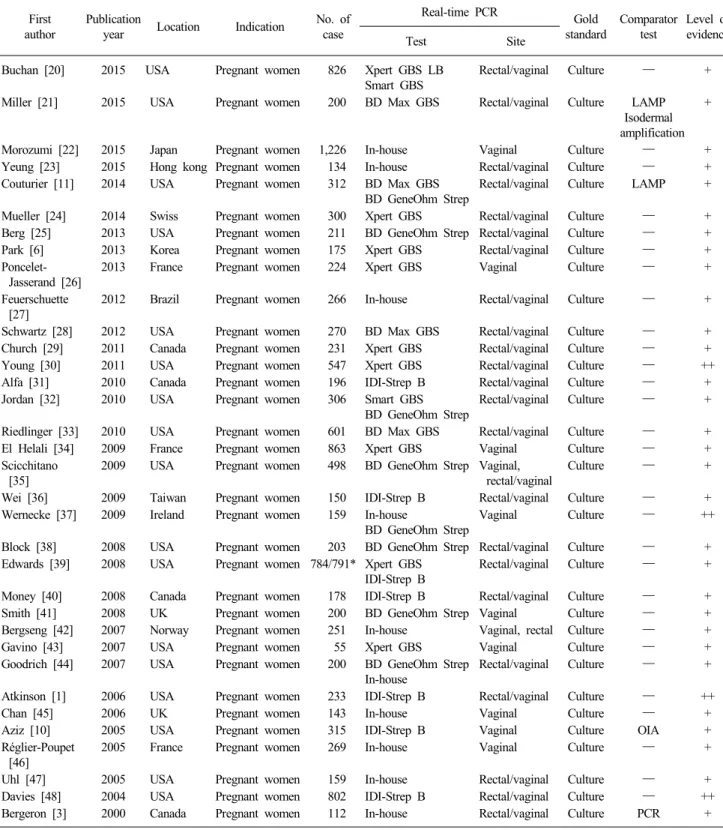
Table 2. Main characteristics of selected studies First
author
Publication
year Location Indication No. of case
Real-time PCR Gold
standard
Comparator test
Level of evidence Test Site
Buchan [20] 2015 USA Pregnant women 826 Xpert GBS LB Smart GBS
Rectal/vaginal Culture ― +
Miller [21] 2015 USA Pregnant women 200 BD Max GBS Rectal/vaginal Culture LAMP Isodermal amplification
+
Morozumi [22] 2015 Japan Pregnant women 1,226 In-house Vaginal Culture ― +
Yeung [23] 2015 Hong kong Pregnant women 134 In-house Rectal/vaginal Culture ― +
Couturier [11] 2014 USA Pregnant women 312 BD Max GBS BD GeneOhm Strep
Rectal/vaginal Culture LAMP +
Mueller [24] 2014 Swiss Pregnant women 300 Xpert GBS Rectal/vaginal Culture ― +
Berg [25] 2013 USA Pregnant women 211 BD GeneOhm Strep Rectal/vaginal Culture ― +
Park [6] 2013 Korea Pregnant women 175 Xpert GBS Rectal/vaginal Culture ― +
Poncelet- Jasserand [26]
2013 France Pregnant women 224 Xpert GBS Vaginal Culture ― +
Feuerschuette [27]
2012 Brazil Pregnant women 266 In-house Rectal/vaginal Culture ― +
Schwartz [28] 2012 USA Pregnant women 270 BD Max GBS Rectal/vaginal Culture ― +
Church [29] 2011 Canada Pregnant women 231 Xpert GBS Rectal/vaginal Culture ― +
Young [30] 2011 USA Pregnant women 547 Xpert GBS Rectal/vaginal Culture ― ++
Alfa [31] 2010 Canada Pregnant women 196 IDI-Strep B Rectal/vaginal Culture ― +
Jordan [32] 2010 USA Pregnant women 306 Smart GBS
BD GeneOhm Strep
Rectal/vaginal Culture ― +
Riedlinger [33] 2010 USA Pregnant women 601 BD Max GBS Rectal/vaginal Culture ― +
El Helali [34] 2009 France Pregnant women 863 Xpert GBS Vaginal Culture ― +
Scicchitano [35]
2009 USA Pregnant women 498 BD GeneOhm Strep Vaginal, rectal/vaginal
Culture ― +
Wei [36] 2009 Taiwan Pregnant women 150 IDI-Strep B Rectal/vaginal Culture ― +
Wernecke [37] 2009 Ireland Pregnant women 159 In-house
BD GeneOhm Strep
Vaginal Culture ― ++
Block [38] 2008 USA Pregnant women 203 BD GeneOhm Strep Rectal/vaginal Culture ― +
Edwards [39] 2008 USA Pregnant women 784/791* Xpert GBS IDI-Strep B
Rectal/vaginal Culture ― +
Money [40] 2008 Canada Pregnant women 178 IDI-Strep B Rectal/vaginal Culture ― +
Smith [41] 2008 UK Pregnant women 200 BD GeneOhm Strep Vaginal Culture ― +
Bergseng [42] 2007 Norway Pregnant women 251 In-house Vaginal, rectal Culture ― +
Gavino [43] 2007 USA Pregnant women 55 Xpert GBS Vaginal Culture ― +
Goodrich [44] 2007 USA Pregnant women 200 BD GeneOhm Strep In-house
Rectal/vaginal Culture ― +
Atkinson [1] 2006 USA Pregnant women 233 IDI-Strep B Rectal/vaginal Culture ― ++
Chan [45] 2006 UK Pregnant women 143 In-house Vaginal Culture ― +
Aziz [10] 2005 USA Pregnant women 315 IDI-Strep B Vaginal Culture OIA +
Réglier-Poupet [46]
2005 France Pregnant women 269 In-house Vaginal Culture ― +
Uhl [47] 2005 USA Pregnant women 159 In-house Rectal/vaginal Culture ― +
Davies [48] 2004 USA Pregnant women 802 IDI-Strep B Rectal/vaginal Culture ― ++
Bergeron [3] 2000 Canada Pregnant women 112 In-house Rectal/vaginal Culture PCR +
*Xpert GBS, n=784, IDI-Strep B, n=791.
Abbreviations: LAMP, loop-mediated isodermal DNA amplification; OIA, optical immunoassay; PCR, polymerase chain reaction.
1) 선택기준(inclusion criteria)
▪ 임신한 여성을 대상으로 한 연구
▪ 실시간 중합효소연쇄반응법으로 GBS 집락화 여부를 확
인한 연구
▪ 중재검사의 진단정확성, 검출률이 보고된 연구
▪ 한국어 및 영어로 출판된 연구
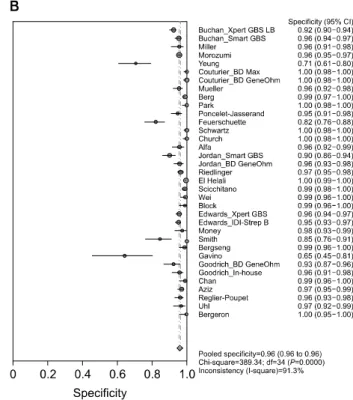
Fig. 2. Forest plot of real-time PCR for GBS detection (Evidence level of articles: 2++). Pooled sensitivity (A), pooled specificity (B) and summary receiver operating characteristic area under the curve (C). Abbreviations: CI, confidence interval; Q*, heterogeneity sta- tistic; SE, standard error; SROC AUC, summary receiver operating characteristic area under the curve.
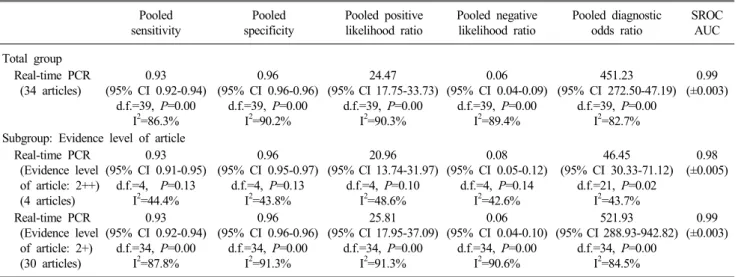
Table 3. Pooled diagnostic accuracy of real-time PCR for GBS detection Pooled
sensitivity
Pooled specificity
Pooled positive likelihood ratio
Pooled negative likelihood ratio
Pooled diagnostic odds ratio
SROC AUC Total group
Real-time PCR (34 articles)
0.93 (95% CI 0.92-0.94)
d.f.=39, P=0.00 I2=86.3%
0.96 (95% CI 0.96-0.96)
d.f.=39, P=0.00 I2=90.2%
24.47 (95% CI 17.75-33.73)
d.f.=39, P=0.00 I2=90.3%
0.06 (95% CI 0.04-0.09)
d.f.=39, P=0.00 I2=89.4%
451.23 (95% CI 272.50-47.19)
d.f.=39, P=0.00 I2=82.7%
0.99 (±0.003)
Subgroup: Evidence level of article Real-time PCR
(Evidence level of article: 2++) (4 articles)
0.93 (95% CI 0.91-0.95)
d.f.=4, P=0.13 I2=44.4%
0.96 (95% CI 0.95-0.97)
d.f.=4, P=0.13 I2=43.8%
20.96 (95% CI 13.74-31.97)
d.f.=4, P=0.10 I2=48.6%
0.08 (95% CI 0.05-0.12)
d.f.=4, P=0.14 I2=42.6%
46.45 (95% CI 30.33-71.12)
d.f.=21, P=0.02 I2=43.7%
0.98 (±0.005)
Real-time PCR (Evidence level of article: 2+) (30 articles)
0.93 (95% CI 0.92-0.94)
d.f.=34, P=0.00 I2=87.8%
0.96 (95% CI 0.96-0.96)
d.f.=34, P=0.00 I2=91.3%
25.81 (95% CI 17.95-37.09)
d.f.=34, P=0.00 I2=91.3%
0.06 (95% CI 0.04-0.10)
d.f.=34, P=0.00 I2=90.6%
521.93 (95% CI 288.93-942.82)
d.f.=34, P=0.00 I2=84.5%
0.99 (±0.003)
Abbreviations: CI, confidence interval; d.f., degree of freedom; I2, heterogeneity statistic; PCR, polymerase chain reaction; SROC AUC, summary receiver-operating characteristic area under the curve.
2) 배제기준(exclusion criteria)
▪ 동물 실험(non-human) 및 전임상시험 연구(pre-clinical studies)
▪ 종설과 같은 환자를 대상으로 연구하지 아니한 경우(non- systematic reviews, editorial, letter and opinion pieces,
etc.)
▪ 회색문헌(thesis, congress or conference material, abstract, etc.)
Fig. 3. Forest plot of real-time PCR for GBS detection (Evidence level of articles: 2+). Pooled sensitivity (A), pooled specificity (B) and summary receiver operating characteristic area under the curve (C). Abbreviations: CI, confidence interval; Q*, heterogeneity sta- tistic; SE, standard error; SROC AUC, summary receiver operating characteristic area under the curve.
3. 자료추출
평가에 필요한 모든 자료를 추출하기 위하여 기본서식을 작 성하여 시범적으로 수행하였고, 이후 1편의 평가자가 자료를 추출하였다. 일반적으로 오류를 예방하기 위하여 2명의 평가자 가 자료추출을 한 후 일치성을 확인하게 되어 있어, 1명이 수행 함에 따라 발생할 수 있는 오류를 해결하기 위하여 시간 간격 을 두고 평균 2회 이상 자료추출을 반복하였다.
4. 문헌의 질평가
문헌에 대한 질 평가는 Scottish Intercollegiate Guidelines Network (SIGN)의 방법론적 체크리스트(methodology checklist.
2006년 3월판)를 이용하여[13] 두 명의 평가자가 독립적으로
시행하였다. 이후 판정 결과에 차이가 있는 경우, 논의를 통해 이견을 조정하였다. SIGN의 질 평가는 연구유형에 따라 평가 기준을 선정하고, 거의 모든 또는 모든 기준이 충족되었을 경 우 ‘++’로, 몇 가지 기준이 충족되었을 경우 ‘+’로, 대부분 기준 이 충족되지 않았을 경우 ‘−’로 평가한다[14]. 진단법 평가연 구는 환자-대조군 또는 코호트 연구와 동일한 근거의 수준으로 간주하여 ‘2++’ 이하에서 평가하였다. 본 연구에서는 선택된 문헌이 질 평가 항목을 모두 만족하면서 ‘1) 중재검사와 참조 검사 시행 시 맹검이 시행된 경우, 2) 검체 채취 과정이 CDC 가이드라인을 따르거나 이에 준하는 경우, 3) 중재검사와 참조 검사 결과에 차이가 있을 때 추가검사가 시행된 경우, 4) 직장- 질 검체로 검사를 시행한 경우’를 추가로 모두 만족하면 ‘++’
로 평가하였다(Table 1).
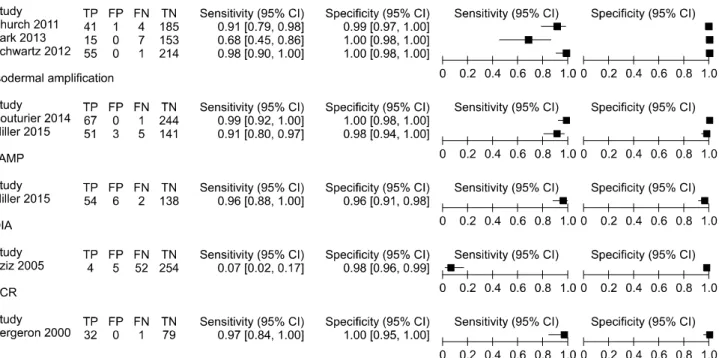
Fig. 4. Forest plot of comparator/reference test for GBS detection. Abbreviations: CI, confidence interval; FN, false negative; FP, false positive;
LAMP, loop-mediated isodermal DNA amplification; OIA, optical immunoassay; PCR, polymerase chain reaction; TN, true negative; TP, true positive.
5. 통계분석
개별 일차 연구들의 진단정확성 결과를 통합하기 위하여 메 타분석을 시행하였다. 민감도, 특이도, 양성예측도, 음성예측 도, SROC AUC (summary receiver operating characteristic area under the curve)를 이용하여 진단정확성을 확인하였다. 선택 문헌에서 참고표준검사를 기준으로 중재검사와 비교검사별로 2×2 표를 작성한 다음, MetaDiSc 1.4 version (Hospital Univer- stario Ramon Y Cajal, Madrid, Spain)와 Revman 5.0 version (Cochrane Community, Oxford, UK)을 이용하여 진단정확성 지 표 별 통합 추정치(summary point)를 확인하였다.
통합하고자 하는 개별연구의 다양성으로 인하여 연구간 이 질성이 존재한다면 요약 추정치를 해석하기 곤란하므로, 이질 성이 있는 경우 랜덤효과모형(random effect model)을 이용하 여 메타분석을 실시하였고, 문헌 간 이질성은 I2를 통해 확인하 였다. I2가 50% 이상이면, 이질성의 정도가 높은 것으로 해석한 다[15]. 메타분석 후 통합추정치와 함께 95% 신뢰구간(confi- dence interval)을 제시하였다.
RESULTS
1. 체계적 문헌고찰 대상 문헌의 일반적 특성
임산부에서 실시간 중합효소연쇄반응법을 이용한 GBS 검사
의 유효성 평가에 선택된 문헌은 총 34편으로, 모두 국외에서 발표된 문헌이었다. 연구유형은 모두 진단법 평가연구였으며, 평가에 포함된 문헌의 구체적인 목록은 Table 2와 같다. 선택된 문헌에서 사용된 검사장비는 BD Max GBS Assay (Becton Dickinson, Oxford, UK), BD GeneOhm StrepB Assay (Becton Dickinson, Oxford, UK), Xpert GBS LB (Cepheid, CA, USA), Xpert GBS (Cepheid, CA, USA), Smart GBS Assay (Cepheid, CA, USA), IDI-Strep B Assay (Infectio Diagnostic, Quebec, Canada)이었으며 그밖에 In-house real-time PCR을 이용한 문 헌이 평가되었다.
문헌의 질을 평가한 결과, 진단법 평가연구 4편이 ‘++’였으 며, 나머지 진단법 평가연구 30편이 ‘+’로 평가되었다(Table 2).
2. 진단정확성
GBS 집락화 유무를 확인하는 실시간 중합효소연쇄반응법의 진단정확성을 확인하기 위한 메타분석은 34편의 문헌(검체 총 13,516개)을 근거로 평가되었다.
배양검사가 참고검사일 때, 실시간 중합효소연쇄반응법의 통합 민감도는 0.93 (95% CI 0.92-0.94, I2=86.3%)이며, 통합 특 이도는 0.96 (95% CI 0.96-0.96, I2=90.2%), 통합 양성우도비는 24.47 (95% CI 17.75-33.73, I2=90.3%), 통합 음성우도비는 0.06 (95% CI 0.04-0.09, I2=89.4%), 통합 진단교차비는 451.23 (95%
CI 272.50-747.19, I2=82.7%), SROC AUC는 0.99 (±0.003)이었
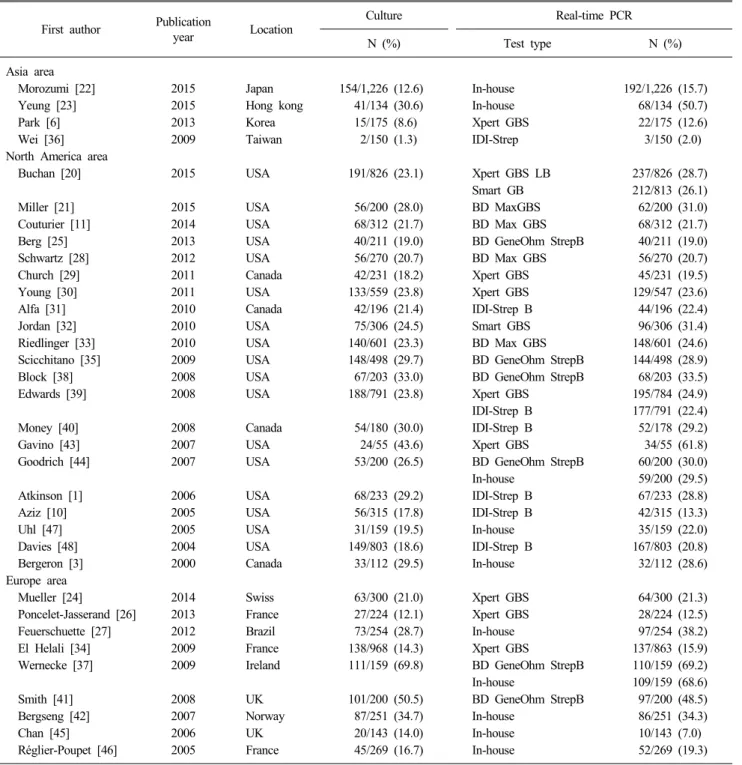
Table 4. Detection rate of real-time PCR for GBS First author Publication
year Location Culture Real-time PCR
N (%) Test type N (%)
Asia area
Morozumi [22] 2015 Japan 154/1,226 (12.6) In-house 192/1,226 (15.7)
Yeung [23] 2015 Hong kong 41/134 (30.6) In-house 68/134 (50.7)
Park [6] 2013 Korea 15/175 (8.6) Xpert GBS 22/175 (12.6)
Wei [36] 2009 Taiwan 2/150 (1.3) IDI-Strep 3/150 (2.0)
North America area
Buchan [20] 2015 USA 191/826 (23.1) Xpert GBS LB 237/826 (28.7)
Smart GB 212/813 (26.1)
Miller [21] 2015 USA 56/200 (28.0) BD MaxGBS 62/200 (31.0)
Couturier [11] 2014 USA 68/312 (21.7) BD Max GBS 68/312 (21.7)
Berg [25] 2013 USA 40/211 (19.0) BD GeneOhm StrepB 40/211 (19.0)
Schwartz [28] 2012 USA 56/270 (20.7) BD Max GBS 56/270 (20.7)
Church [29] 2011 Canada 42/231 (18.2) Xpert GBS 45/231 (19.5)
Young [30] 2011 USA 133/559 (23.8) Xpert GBS 129/547 (23.6)
Alfa [31] 2010 Canada 42/196 (21.4) IDI-Strep B 44/196 (22.4)
Jordan [32] 2010 USA 75/306 (24.5) Smart GBS 96/306 (31.4)
Riedlinger [33] 2010 USA 140/601 (23.3) BD Max GBS 148/601 (24.6)
Scicchitano [35] 2009 USA 148/498 (29.7) BD GeneOhm StrepB 144/498 (28.9)
Block [38] 2008 USA 67/203 (33.0) BD GeneOhm StrepB 68/203 (33.5)
Edwards [39] 2008 USA 188/791 (23.8) Xpert GBS 195/784 (24.9)
IDI-Strep B 177/791 (22.4)
Money [40] 2008 Canada 54/180 (30.0) IDI-Strep B 52/178 (29.2)
Gavino [43] 2007 USA 24/55 (43.6) Xpert GBS 34/55 (61.8)
Goodrich [44] 2007 USA 53/200 (26.5) BD GeneOhm StrepB 60/200 (30.0)
In-house 59/200 (29.5)
Atkinson [1] 2006 USA 68/233 (29.2) IDI-Strep B 67/233 (28.8)
Aziz [10] 2005 USA 56/315 (17.8) IDI-Strep B 42/315 (13.3)
Uhl [47] 2005 USA 31/159 (19.5) In-house 35/159 (22.0)
Davies [48] 2004 USA 149/803 (18.6) IDI-Strep B 167/803 (20.8)
Bergeron [3] 2000 Canada 33/112 (29.5) In-house 32/112 (28.6)
Europe area
Mueller [24] 2014 Swiss 63/300 (21.0) Xpert GBS 64/300 (21.3)
Poncelet-Jasserand [26] 2013 France 27/224 (12.1) Xpert GBS 28/224 (12.5)
Feuerschuette [27] 2012 Brazil 73/254 (28.7) In-house 97/254 (38.2)
El Helali [34] 2009 France 138/968 (14.3) Xpert GBS 137/863 (15.9)
Wernecke [37] 2009 Ireland 111/159 (69.8) BD GeneOhm StrepB 110/159 (69.2)
In-house 109/159 (68.6)
Smith [41] 2008 UK 101/200 (50.5) BD GeneOhm StrepB 97/200 (48.5)
Bergseng [42] 2007 Norway 87/251 (34.7) In-house 86/251 (34.3)
Chan [45] 2006 UK 20/143 (14.0) In-house 10/143 (7.0)
Réglier-Poupet [46] 2005 France 45/269 (16.7) In-house 52/269 (19.3)
다(Table 3).
진단정확성 항목의 I2가 82.7% 이상으로 이질성이 높아 원인 을 확인하기 위해 문헌의 질 평가 결과 별로 세부군 분석을 시 행하였다. 질 평가 결과가 ‘++’인 연구(4편)에서 중재검사는 통 합 민감도 0.93 (95% CI 0.91-0.95, I2=44.4%), 통합 특이도 0.96 (95% CI 0.95-0.97, I2=43.8%), 통합 SROC AUC는 0.98이 었으며, 질 평가 결과가 ‘+’인 연구(30편)에서 중재검사의 진단
정확성은 통합 민감도 0.93 (95% CI 0.92-0.94, I2=87.8%), 통합 특이도 0.96 (95% CI 0.96-0.96, I2=91.3%), 통합 SROC AUC는 0.99이었다(Fig. 2, 3).
비교검사와 참고검사의 진단정확성은 7편에서 확인되었다.
참고검사법인 배양검사(3편)의 진단정확성은 민감도 0.68-0.98, 특이도 0.99-1.00이었다. 비교검사의 진단정확성은 등온증폭법 (loop-mediated isodermal DNA amplification, 3편)의 경우 민감
도 0.91-0.99, 특이도 0.96-1.00이었고, 광학면역분석법(optical immunoassay, 1편)은 민감도 0.07, 특이도 0.98이었다(Fig. 4).
3. GBS 집락화율
GBS 집락화율은 34편의 연구에서 실시간 중합효소연쇄반응 법을 이용했을 때 2.0-69.2%, 배양으로 확인한 경우 1.3-69.8%
로 상이하게 보고되었다. 국내 임산부의 집락화율은 1편에서 배양검사 시행 시 8.6%, 실시간 중합효소연쇄반응법 시행 시 12.6%로 보고되었다(Table 4) [6].
DISCUSSION
신생아에서 GBS 감염을 예방하기 위하여 임산부에서 GBS 집락화에 대한 산전검사에 대한 중요성이 대두되고 있다. 이에 이번 연구에서는 산모를 대상으로 GBS의 집락화 여부를 확인 하기 위한 검사법 중 하나인 실시간 중합효소연쇄반응법의 진 단정확성과 검출률을 평가하기 위하여 체계적 문헌고찰과 메 타분석을 시행하였다.
실시간 중합효소연쇄반응법의 진단정확성은 배양검사를 참 고기준으로 하였을 때 통합 민감도 0.93 (I2=86.4%), 통합 특이 도 0.96 (I2=90.2%), SROC AUC 0.99로 보고되었다. 문헌 간 I2 값이 82% 이상으로 이질성이 높게 확인되어, 문헌의 질이 높은 문헌을 대상으로 세부군 분석을 시행하였다. 세부군 분석 후 I2 값은 민감도 44.4%, 특이도 43.8%로 많이 감소하여 이질성이 해소되었으며, 통합 민감도, 통합 특이도, SROC AUC값은 변 화 없이 높게 유지되었다.
이번 문헌분석에 포함되지 않았지만, 중재검사 이외의 검사 법에 대한 진단정확성을 보고한 Honest 등[2]의 연구에 의하면, 광학면역분석법의 경우 민감도 0.37-0.79, 특이도 0.91-0.98, 효 소면역법(enzyme immunoassay)은 민감도 0.11-0.69, 특이도 0.95-1.00, 라텍스응집법은 민감도 0.15-0.92, 특이도 0.87-1.00 로 보고되었다.
본 연구의 경우 비교검사법인 등온증폭법은 민감도 0.91- 0.99, 특이도 0.96-1.00이었고, 면역분석법은 민감도 0.07, 특이 도 0.98이었으며, 참고검사법인 배양검사의 진단정확성은 민감 도 0.68-0.98, 특이도 0.99-1.00로 보고되어, 실시간 중합효소연 쇄반응법의 진단정확성이 더 우수한 것을 확인 할 수 있었다.
GBS 집락화율은 연구 34편에서 1.3-69.8%로 상이하게 보고 되었으며, 아시아 여성의 검출률은 1.3-30.6%로 북미 또는 유 럽 여성의 GBS 집락화율보다 낮았다. 국내 임산부를 대상으로 실시간 중합효소연쇄반응법을 시행했을 때 GBS 집락화율은 1 편의 문헌에서 12.6%로 보고되었다[6].
국내 임산부에서 GBS 집락화율이 1996년부터 2002년까지 2.0-5.9% [16-18]에서 2006년 이후 7.9-12.6% [4,6,19]로 증가하 고 있음을 감안하면, 집락화가 확인된 경우 예방적 항균제 치
료 여부를 결정하고 신생아로의 수직감염을 예방하기 위하여 산전에 동 검사를 시행하여야 할 것이다.
따라서 실시간 중합효소연쇄반응법을 이용한 GBS 검사는 신생아의 GBS 감염을 예방하기 위하여, 임신한 여성을 대상으 로 GBS의 감염여부를 진단하는 검사로서 유효성이 있는 검사 로 평가하였다.
본 연구의 제한점은 한국인 대상의 선택문헌이 1편으로 적 었다는 점이다. 이는 실시간 중합효소연쇄반응법을 시행한 문 헌을 선택하고 배양검사로 산모에서 집락화율을 보고한 문헌 은 평가에 선택하지 않았기 때문이다. 산모에서 GBS 집락화율 이 국가별로 상이하고, 한국에서는 감염역학이 잘 알려지지 않 은 생후 7-90일 사이에 발생하는 지발형(late-onset) GBS 감염 의 발생이 국외보다 상대적으로 더 많으므로 모든 산모에게 실 시하는 선별검사로 임상에 적용할지에 대해서는 임상의사의 판단에 따라야 할 것이다.
그럼에도 불구하고, 본 연구는 현존하는 문헌을 근거로 실시 간 중합효소연쇄반응법의 진단정확성이 높고, 기존 검사인 배 양검사에 비해 신속한 방법으로, 임신부에서 GBS 집락화 여부 를 확인하고 그 결과에 따라 항균제 사용 여부를 선택하는 데 유효성이 있는 검사임을 확인하였다.
ACKNOWLEDGMENTS
본 연구는 보건복지부의 재원으로 신의료기술평가사업 지원 에 의하여 수행되었다(신의료기술평가보고서 HTA-2016-42).
REFERENCES
1. Atkins KL, Atkinson RM, Shanks A, Parvin CA, Dunne WM, Gross G. Evaluation of polymerase chain reaction for group B streptococcus detection using an improved culture method. Obstet Gynecol 2006;108:488-91.
2. Honest H, Sharma S, Khan KS. Rapid tests for group B Streptococcus colonization in laboring women: a systematic review. Pediatrics 2006;117:1055-66.
3. Bergeron MG, Ke D, Ménard C, Picard FJ, Gagnon M, Bernier M, et al. Rapid detection of group B streptococci in pregnant women at delivery. N Engl J Med 2000;343:175-9.
4. Choi CW. Neonatal group B streptococcal diseases. Korean J Perinatol 2012;23:133-42.
5. Oh CE. Group B streptococcal disease in Korean neonates. Korean J Pediatr Infect Dis 2012;19:43-54.
6. Park JS, Cho DH, Yang JH, Kim MY, Shin SM, Kim EC, et al.
Usefulness of a rapid real-time PCR assay in prenatal screening for group B streptococcus colonization. Ann Lab Med 2013;33:
39-44.
7. Lee SH, Park KU, Lee HK, Kim MY, Kim JY, Kwon WK, et al.
Perineal colonization rate and antimicrobial susceptibility of group B streptococcus in pregnant and non-pregnant Korean women.
Korean J Clin Microbiol 2009;12:180-5.
8. Kim EJ, Oh KY, Kim MY, Seo YS, Shin JH, Song YR, et al. Risk
factors for group B streptococcus colonization among pregnant women in Korea. Epidemiol Health 2011;33:e2011010.
9. Choi SJ, Park SD, Jang IH, Uh Y, Lee A. The prevalence of vaginal microorganisms in pregnant women with preterm labor and preterm birth. Ann Lab Med 2012;32:194-200.
10. Aziz N, Baron EJ, D'Souza H, Nourbakhsh M, Druzin ML, Benitz WE. Comparison of rapid intrapartum screening methods for group B streptococcal vaginal colonization. J Matern Fetal Neonatal Med 2005;18:225-9.
11. Couturier BA, Weight T, Elmer H, Schlaberg R. Antepartum screening for group B Streptococcus by three FDA-cleared molecular tests and effect of shortened enrichment culture on molecular detection rates. J Clin Microbiol 2014;52:3429-32.
12. Verani JR, McGee L, Schrag SJ; Division of Bacterial Diseases, National Center for Immunization and Respiratory Diseases, Centers for Disease Control and Prevention (CDC). Prevention of perinatal group B streptococcal disease--revised guidelines from CDC, 2010. MMWR Recomm Rep 2010;59:1-36.
13. Scottish intercollegiate guidelines network. Methodology checklist.
http://www.sign.ac.uk/checklists-and-notes.html/ [Online] (last visited on 12 June 2017).
14. Scottish intercollegiate guidelines network. SIGN 50: a guideline developer’s handbook. http://www.sign.ac.uk/sign-50.html/ [Online]
(last visited on 12 June 2017).
15. Higgins JP, Thompson SG, Deeks JJ, Altman DG. Measuring inconsistency in meta-analyses. BMJ 2003;327:557-60.
16. Uh Y, Jang IH, Kwon JY, Kim NS, Kim MC, Park DW, et al.
Studies on the usefulness of new Granada selective medium for the detection of group B streptococci in pregnant women. J Wonju Med Coll 1996;9:7-15.
17. Park LS, Seo K, Kim SK, Park YW, Jung HY, Chong YS, et al.
A study of group B streptococcal infection in Korean pregnant women. Korean J Obstet Gynecol 1999;42:2038-42.
18. Choi KU, Koh SK, Lee JY, Park JH, Hwang SO, Lee BI, et al.
Clinical significance of group B streptococcal infection in pregnant women. Korean J Obstet Gynecol 2002;45:811-5.
19. Kim MW, Jang HO, Chang DY, Cho JR, Kim YA, Choi HM, et al. Group B streptococcal colonization rate in Korean pregnant women. Korean J Obstet Gynecol 2006;49:337-44.
20. Buchan BW, Faron ML, Fuller D, Davis TE, Mayne D, Ledeboer NA. Multicenter clinical evaluation of the Xpert GBS LB assay for detection of group B Streptococcus in prenatal screening specimens. J Clin Microbiol 2015;53:443-8.
21. Miller SA, Deak E, Humphries R. Comparison of the AmpliVue, BD Max System, and illumigene Molecular Assays for Detection of Group B Streptococcus in antenatal screening specimens. J Clin Microbiol 2015;53:1938-41.
22. Morozumi M, Chiba N, Igarashi Y, Mitsuhashi N, Wajima T, Iwata S, et al. Direct identification of Streptococcus agalactiae and capsular type by real-time PCR in vaginal swabs from pregnant women. J Infect Chemother 2015;21:34-8.
23. Yeung SW, Cheung PT, Chau SL, Ip M, Lao TT, Leung TY, et al. Evaluation of an in-house real-time polymerase chain reaction method to identify group B streptococcus colonization in pregnancy. J Obstet Gynaecol Res 2015;41:1357-62.
24. Mueller M, Henle A, Droz S, Kind AB, Rohner S, Baumann M, et al. Intrapartum detection of Group B streptococci colonization by rapid PCR-test on labor ward. Eur J Obstet Gynecol Reprod Biol 2014;176:137-41.
25. Berg BR, Houseman JL, Garrasi MA, Young CL, Newton DW.
Culture-based method with performance comparable to that of PCR-based methods for detection of group B Streptococcus in
screening samples from pregnant women. J Clin Microbiol 2013;
51:1253-5.
26. Poncelet-Jasserand E, Forges F, Varlet MN, Chauleur C, Seffert P, Siani C, et al. Reduction of the use of antimicrobial drugs following the rapid detection of Streptococcus agalactiae in the vagina at delivery by real-time PCR assay. BJOG 2013;120:
1098-108.
27. Feuerschuette OM, Serratine AC, Bazzo ML, Martins TR, Silveira SK, da Silva RM. Performance of RT-PCR in the detection of Streptococcus agalactiae in the anogenital tract of pregnant women. Arch Gynecol Obstet 2012;286:1437-42.
28. Schwartz J, Robinson-Dunn B, Makin J, Boyanton BL Jr.
Evaluation of the BD MAX GBS assay to detect Streptococcus group B in LIM broth-enriched antepartum vaginal-rectal speci- mens. Diagn Microbiol Infect Dis 2012;73:97-8.
29. Church DL, Baxter H, Lloyd T, Miller B, Gregson DB. Evaluation of the XpertⓇ group B streptococcus real-time polymerase chain reaction assay compared to StrepB Carrot BrothTM for the rapid intrapartum detection of group B streptococcus colonization. Diagn Microbiol Infect Dis 2011;69:460-2.
30. Young BC, Dodge LE, Gupta M, Rhee JS, Hacker MR. Evaluation of a rapid, real-time intrapartum group B streptococcus assay. Am J Obstet Gynecol 2011;205:372.e1-6.
31. Alfa MJ, Sepehri S, De Gagne P, Helawa M, Sandhu G, Harding GK. Real-time PCR assay provides reliable assessment of intra- partum carriage of group B Streptococcus. J Clin Microbiol 2010;48:3095-9.
32. Jordan JA, Hall G, Davis T. Multicenter study evaluating performance of the Smart Group B Streptococcus (GBS) assay using an enrichment protocol for detecting GBS colonization in patients in the antepartum period. J Clin Microbiol 2010;48:
3193-7.
33. Riedlinger J, Beqaj SH, Milish MA, Young S, Smith R, Dodd M, et al. Multicenter evaluation of the BD Max GBS assay for detection of group B streptococci in prenatal vaginal and rectal screening swab specimens from pregnant women. J Clin Microbiol 2010;48:4239-41.
34. El Helali N, Nguyen JC, Ly A, Giovangrandi Y, Trinquart L.
Diagnostic accuracy of a rapid real-time polymerase chain reaction assay for universal intrapartum group B streptococcus screening.
Clin Infect Dis 2009;49:417-23.
35. Scicchitano LM and Bourbeau PP. Comparative evaluation of the AccuProbe Group B Streptococcus Culture Test, the BD GeneOhm Strep B assay, and culture for detection of group B streptococci in pregnant women. J Clin Microbiol 2009;47:3021-3.
36. Wei CF, She BC, Liang HS, Ling QD, Tsai CY, Yen CW, et al.
Prenatal group B Streptococcus test using real-time polymerase chain reaction. Taiwan J Obstet Gynecol 2009;48:116-9.
37. Wernecke M, Mullen C, Sharma V, Morrison J, Barry T, Maher M, et al. Evaluation of a novel real-time PCR test based on the ssrA gene for the identification of group B streptococci in vaginal swabs. BMC Infect Dis 2009;9:148.
38. Block T, Munson E, Culver A, Vaughan K, Hryciuk JE. Com- parison of carrot broth- and selective Todd-Hewitt broth-enhanced PCR protocols for real-time detection of Streptococcus agalactiae in prenatal vaginal/anorectal specimens. J Clin Microbiol 2008;
46:3615-20.
39. Edwards RK, Novak-Weekley SM, Koty PP, Davis T, Leeds LJ, Jordan JA. Rapid group B streptococci screening using a real-time polymerase chain reaction assay. Obstet Gynecol 2008;111:
1335-41.
40. Money D, Dobson S, Cole L, Karacabeyli E, Blondel-Hill E,
Milner R, et al. An evaluation of a rapid real time polymerase chain reaction assay for detection of group B streptococcus as part of a neonatal group B streptococcus prevention strategy. J Obstet Gynaecol Can 2008;30:770-5.
41. Smith D, Perry JD, Laine L, Galloway A, Gould FK. Comparison of BD GeneOhm real-time polymerase chain reaction with chromogenic and conventional culture methods for detection of group B Streptococcus in clinical samples. Diagn Microbiol Infect Dis 2008;61:369-72.
42. Bergseng H, Bevanger L, Rygg M, Bergh K. Real-time PCR targeting the sip gene for detection of group B streptococcus colonization in pregnant women at delivery. J Med Microbiol 2007;56:223-8.
43. Gavino M and Wang E. A comparison of a new rapid real-time polymerase chain reaction system to traditional culture in determining group B streptococcus colonization. Am J Obstet Gynecol 2007;197:388.e1-4.
44. Goodrich JS and Miller MB. Comparison of culture and 2 real-time polymerase chain reaction assays to detect group B
Streptococcus during antepartum screening. Diagn Microbiol Infect Dis 2007;59:17-22.
45. Chan KL, Levi K, Towner KJ, Weston VC, Ramsay MM, Kean LH. Evaluation of the sensitivity of a rapid polymerase chain reaction for detection of group B streptococcus. J Obstet Gynaecol 2006;26:402-6.
46. Réglier-Poupet H, Quesne G, Le Théo E, Dommergues M, Berche P, Trieu-Cuot P, et al. Prospective evaluation of a real-time PCR assay for detection of group B streptococci in vaginal swabs from pregnant women. Eur J Clin Microbiol Infect Dis 2005;24:355-7.
47. Uhl JR, Vetter EA, Boldt KL, Johnston BW, Ramin KD, Adams MJ, et al. Use of the Roche LightCycler Strep B assay for detection of group B streptococcus from vaginal and rectal swabs.
J Clin Microbiol 2005;43:4046-51.
48. Davies HD, Miller MA, Faro S, Gregson D, Kehl SC, Jordan JA.
Multicenter study of a rapid molecular-based assay for the diagnosis of group B Streptococcus colonization in pregnant women. Clin Infect Dis 2004;39:1129-35.
=국문초록=
임신 여성에서 B군 사슬알균 검사[실시간 중합효소연쇄반응법]의 진단정확성과 검출률: 체계적 문헌고찰과 메타분석
1한국보건의료연구원 신의료기술평가사업부, 2차의과학대학교 분당차병원 진단검사의학교실 박선영1, 김소영1, 최원정1, 김석현1, 홍성근2
배경: B군 사슬알균(Group B streptococcus, GBS)은 신생아의 감염과 사망의 주요 원인균이다. 미국의 질병예방통제센터 는 GBS의 수직감염을 예방하기 위하여 35-37주 임산부를 대상으로 배양, 라텍스 응집법(latex agglutination test) 또는 핵 산 증폭 검사(nucleic acid amplification test)와 같은 검사법을 이용하여 GBS의 집락화 여부를 확인하고, 필요시 항균제를 사용하도록 권고하고 있다. 본 연구에서는 임신한 여성을 대상으로 GBS 검출을 위한 실시간 중합효소연쇄반응법 (real-time polymerase chain reaction)의 진단정확성과 검출률을 조사하여 임상적 유효성을 확인하였다.
방법: 문헌검색은 KoreaMed, Ovid-MEDLINE, Ovid-EMBASE, Cochrane Library의 데이터베이스를 이용하여 2015년 11월 3일에 이루어졌다. 검색전략에 따라 ‘Group B Streptococcus’, ‘real time polymerase chain reaction’ 등의 단어로 검색하고, 수기검색된 2편을 포함하여 총 443편의 문헌이 확인되었다. 두 명의 연구자가 독립적으로 문헌을 선택하였으며, Scottish Intercollegiate Guidelines Network의 방법론적 체크리스트를 사용하여 문헌의 질을 확인하였다.
결과: 선택된 총 34편의 문헌에서 실시간 중합효소연쇄반응법의 진단정확성에 대한 메타분석이 수행되었다(실시간 중합 효소연쇄반응법: 13,516건, 배양검사 및 기타검사: 1,815건). 문헌에서 실시간 중합효소연쇄반응으로 확인된 임산부의 GBS 집락화율을 2.0-69.8%였다. 중재검사의 진단정확성은 통합 민감도 0.93 (95% CI 0.92-0.94, I2=86.3%), 통합 특이도 0.96 (95% CI 0.96-0.96, I2=90.2%), SROC AUC (summary receiver operating characteristic area under the curve)가 0.99로 보고 되었다.
결론: 임신부를 대상으로 GBS를 검출하는 실시간 중합효소연쇄반응법은 진단정확성이 높아 신생아 수직감염을 예방하 는데 있어 유효성이 있는 검사로 판단된다. [Ann Clin Microbiol 2017;20:42-51]
교신저자 : 홍성근, 13496, 경기도 성남시 분당구 야탑로 59 차의과학대학교 분당차병원 진단검사의학교실 Tel: 031-780-5463, Fax: 031-780-5476 E-mail: [email protected]
![Table 1. Levels of evidence (SIGN criteria) [19] 1++ 1+ 1− 2++ 2+ 2− 3 4](https://thumb-ap.123doks.com/thumbv2/123dokinfo/5166252.104386/2.892.77.619.468.931/table-levels-evidence-sign-criteria.webp)