• 검색 결과가 없습니다.

National Culture and Leadership Style on Restaurant Employees' Affective Commitment

N/A
N/A
Protected

Academic year: 2021

Share "National Culture and Leadership Style on Restaurant Employees' Affective Commitment"

Copied!
5
0
0

로드 중.... (전체 텍스트 보기)

전체 글

(1)

http://www.culinary.re.kr

INTRODUCTION

Leadership skills are important for the hospitality industry be- cause the hospitality industry has a dynamic environment, a service orientation, and a labor-intensive nature (Gillet & Morda, 2003). Indeed, leadership style has a remarkable influence on employees’ behavior in the customer service industry (Ahmed &

Parasuraman, 1994; Clark, Hartline, & Jones, 2009). For instance, transformational leadership style improves employee dedication, social behavior, role clarity, and satisfaction (Gill & Mathur, 2007).

However, although different leadership styles can influence em- ployees, we know little about the most appropriate leadership style in the restaurant industry.

Testa (2007, p. 469) has pointed out “shifts in demographics over the past decade combined with increasing internationalization are creating significant challenges for hospitality organizations.” Accor- ding to Weaver, Wilborn, McCleary, and Lekagul (2007), managing a multicultural workforce continues to be a pressing concern for hospitality organizations because of the increased presence of minorities. Testa (2007) insisted that leaders should meet the needs of workers with culturally diverse backgrounds in order to ma- ximize employee performance. Therefore, managers in the hospi- tality organization need to understand the cultural background of their workers.

While the links between leadership and performance and between culture and performance have been examined inde- pendently, few studies have investigated the association among

the three concepts (Ogbonna & Harris, 2000).

The primary purpose of this study is to assess the relative effects of specific leadership styles on employees’ affective commitment.

This study investigates the extent to which different leadership styles influence non-managerial restaurant employees. In addition, this study examines how employees evaluate their leaders from different national cultures and how cultural similarity influences employees’ affective commitment. Finally, the researchers identify the leadership style that is most appropriate for the culturally diverse restaurant industry.

This study makes two main contributions. First, this study contributes to the theoretical literature by explaining the links between the leadership and culture and the impact that such an association might have on affective commitment. Second, no previous study makes specific reference to both leadership and national culture in the restaurant context. Therefore, the results of the study can assist restaurant managers in developing their leadership style with attention to the differences in national culture among their employees.

LITERATURE REVIEW

Leadership and Affective Commitment

There is a direct link between leadership and organizational performance, and changes in leadership can improve organiza- tional performance. Clark, Hartline, and Jones (2009) suggest that leadership enables individuals’ and groups’ success in their

National Culture and Leadership Style on Restaurant Employees’

Affective Commitment

Yong Joong Kim

Dept. of Hotel & Tourism Management, Kyungsung University, Busan 608-736, Korea

ABSTRACT: The topics of leadership and culture have attracted substantial interest from both academics and practitioners. This study examines the effects of leadership styles and national culture on affective commitment in samples of the restaurant employees in US. In detail, this study examines how employees evaluate their leaders with different national cultures and the ways in which cultural similarity influences employees’ affective commitment. The findings suggest that participative leadership style and supportive leadership style have effects on affective commitment but instrumental leadership style does not. In addition, the findings show that employees evaluate differently leaderships of their leaders with different national culture. Finally, in order to increase the employees’ affective commitment, it is recommended for managers to employ supportive leadership style toward employees of different national cultures. Participative leadership style is more effective when a manager is familiar with his or her employees’ national culture.

Keywords: Leadership Style, National Culture, Restaurant Industry

* This research was supported by Kyungsung University Research Grants in 2014.

§ Corresponding Author: Yong Joong Kim, Dept. of Hotel & Tourism Management, Kyungsung University, 309, Suyeong-ro, Nam-gu, Busan 608-736, Korea, Tel. +82- 51-663-4466, Fax. +82-51-627-6830, E-mail: [email protected]

Received: 20 August, 2014, Revised: 29 September, 2014, Accepted: 20 October, 2014.

(2)

organization. Fiedler (1996) argued that the effectiveness of a leader is a main determinant of the success or failure of an or- ganization.

Organizational commitment is the major determinant of orga- nizational performance (Angle, 1981; Riketta, 2002). Organizational commitment is defined as a situation in which an individual identifies with an organization and its goals and wishes to maintain membership in order to reach these goals (Mowday, Steers, &

Porter, 1979). However, leadership styles influence employees’

organizational commitment. For example, Walumbwa and Lawler (2003) found that transformational leaders are able to motivate their followers to become more involved in their work and to show higher levels of organizational commitment.

This study selected affective organizational commitment becau- se it is the form of commitment that is most likely to reflect employees’ attitudes to the way their organization manages cul- tural diversity (Leveson, Joiner, & Bakalis, 2009). Affective co- mmitment is defined as an employee’s sense of belonging and identification that increases his or her involvement in the or- ganization’s activities and their desire to remain with the or- ganization (Meyer & Allen, 1991; Mowday, Porter, & Steers, 1982). It is reasonable to assume that there is a link between leadership and affective commitment.

Leadership and National Culture

Leaders must be concerned with their followers’ national culture (Testa, 2007). Hofstede (1991) suggests that an employee’s culture can influence his or her perception of work environment and its components. Indeed, based on cultural background, an employee may make assumptions about his or her leader in relation to the leader’s leadership prototype (Shaw, 1990). According to Pizam, Pine, Mok, and Shin (1997), national culture has a greater impact on managerial behavior than industry culture. The researchers found significant differences in the managerial practices of hotel managers from Hong Kong, Japan and Korea. Meanwhile, Mwaura, Sutton, and Roberts (1998) found that divergence between national and hotel corporate culture caused miscommunication, conflict, and delayed work processes in China where a strong national culture is prevalent.

Hofstede (1991) defined national culture as the values, beliefs and assumptions learned in early childhood that distinguishes one group of people from another. Testa (2002) insisted that national culture has impact on an employee’s appraisal of the work en- vironment and on employee-related outcomes. Using a sample of congruent and incongruent leadership dyads from a cruise or- ganization, Testa (2002) found that subordinates within congruent dyads evaluated their leaders significantly higher on consideration behaviors than did subordinates in incongruent dyads. Further, subordinates within congruent dyads reported significantly higher levels of trust and satisfaction with their supervisor than did members within incongruent dyads. Engle and Lord (1997) su- pport that positive affect will develop among leaders and followers when cultures are similar. Newman and Nollen (1996) suggested that national culture is an important key for employees’ under- standing of and approach to their work. Therefore, the employees are likely to be willing to perform well if management practices are consistent with their deeply held values.

Testa (2002) pointed out that few studies have looked at di- fferences in perceived leadership styles and outcomes when the leader and a follower have the same or different national origins.

Furthermore, no research has examined this topic in the context of the restaurant industry.

METHODOLOGY Sample and Data Collection

The target population of this study is employees in restaurants in the United States. The restaurant industry was selected because the restaurants in US consist of heterogeneous employees and because restaurants provide many opportunities for managers and employees to interact. According to Clark, Hartline, and Jones (2009, p. 218), “the level of close interaction creates an environ- ment where employee’s job actions are likely to be affected by their manager’s leadership style.” The researchers contacted 53 restaurant owners or managers to explain the research and ask for the managers’ support. A database of the names, email addresses and mail addresses of the restaurants had been obtained from a publicly available database purchased by the School of Hotel and Restaurant Administration at Oklahoma State University. Twenty- seven restaurant owners agreed to participate. The researchers distributed questionnaires to the restaurants’ owners or managers and managers were instructed to distribute the surveys to their employees. After answering the questionnaire, respondents were asked to return them to a specific box in a self-sealing envelope provided by the researchers.

The data were collected from June 17, 2010 to September 3, 2010. The researchers received at least one questionnaire from an employee at 27 different restaurants (50.9%). Restaurant managers or owners returned 119 surveys. Out of 119 responses, 13 were eliminated because of an excessive amount of missing data. After elimination, 106 responses (89.1%) were coded and analyzed.

Measurement

This study used a two-part questionnaire to collect data. The questionnaire items are largely derived from the literature review and the instrument (Ogbonna & Harris, 2000; Rhoades, Eisenberger,

& Armeli, 2001; Testa, 2002; Testa, 2009). The first part of the questionnaire comprises demographic questions about the res- pondent’s gender, age, education department type, years in the same restaurant, and years in the restaurant industry. Respondents were also asked where his or her supervisor was born and raised, in order to identify employees and managers with the same country of origin. In the second part, respondents were asked to answer questions related to perceived leadership style and affective co- mmitment using a seven-point Likert scale ranging from 1, “st- rongly disagree”, to 7, “strongly agree.” (Ogbonna & Harris, 2000).

Data Analysis

All statistical analyses were carried out using the SPSS statistical

computer package, Version 17. Frequency analysis was performed

to provide profiles of the respondents. Responses to the items

measuring perceived leadership style and affective commitment

were factor analyzed. The principle axes method of factor ex-

traction was used with varimax rotation. The obtained factor scores

(3)

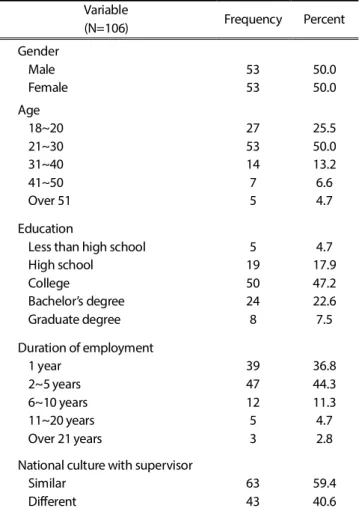
Table 1. Descriptive statistics of respondents’ characteristics

Variable

(N=106) Frequency Percent

Gender

Male 53 50.0

Female 53 50.0

Age

18~20 27 25.5

21~30 53 50.0

31~40 14 13.2

41~50 7 6.6

Over 51 5 4.7

Education

Less than high school 5 4.7

High school 19 17.9

College 50 47.2

Bachelor’s degree 24 22.6

Graduate degree 8 7.5

Duration of employment

1 year 39 36.8

2~5 years 47 44.3

6~10 years 12 11.3

11~20 years 5 4.7

Over 21 years 3 2.8

National culture with supervisor

Similar 63 59.4

Different 43 40.6

were used for subsequent data analysis. Regression analyses were used to examine the extent to which respondents’ affective com-

mitment can be predicted from the leadership style and national culture variables.

RESULTS

The respondents for the empirical investigation included a similar distribution of males (50.0%) and females (50.0%) and a broad cross-section of age groups. About two-thirds (77.3%) of respondents had received at least a college degree or had been in college while 22.7% of respondents had attended or graduated from high school. In relation to work experience, 36.8% had worked in the restaurant for one year or less and 44.3% for 2-5 years. Among the 106 respondents, 59.4% reported having the same nationality as their supervisor and 40.6% indicated that they

were different.

Table 2 presents the principal components analysis of the ada- pted items of Ogbonna and Harris (2000) measure of leadership style. Factor analysis yielded three factors that were readily interpreted in terms of the original subscales, that measure partici- patory leadership, supportive leadership, and instrumental leader- ship. The first items which comprise this solution are geared to the measurement of leadership participation: a non-directive form of role-clarifying behavior which is gauged by the extent to which leaders allow subordinates to influence decisions by requesting input and contribution (Ogbonna & Harris, 2000). The second factor was most strongly defined by three items derived from the supportive leadership subscales which account for over 15 % of the variance. According to Ogbonna and Harris (2000), this mea- sure focuses on the degree to which the behavior of a leader can be viewed as sympathetic and considerate of subordinates’ needs.

The third factor was defined by items indicating instrumental leadership. This items measure the extent to which leaders specify expectations, establish procedures, and allocate tasks (Ogbonna &

Table 2. Results of factor analysis of leadership style

Factor Factor

loading

Eigen value

Variance explain %

FACTOR 1: Participative leadership 4.94 44.97

My supervisor asks subordinates for their suggestions. .895

My supervisor listens to subordinate’s advice on which assignments should be made.

.859 When faced with a problem, my supervisor consults with subordinates. .783 Before taking action, my supervisor consults with subordinates. .682 Before making decisions, my supervisor considers what her/his

subordinates have to say.

.611

FACTOR 2: Supportive leadership 1.72 15.61

My supervisor treats all group members as equals. .802

My supervisor looks out for the personal welfare of group members. .790 My supervisor helps people to make working on their tasks more

Pleasant.

.698

FACTOR 3: Instrumental leadership 1.38 12.56

My supervisor decides what and how things shall be done. .878 My supervisor maintains definite standards of performance. .813

My supervisor schedules the work to be done. .609

Total variance explained 73.15

(4)

Harris, 2000).

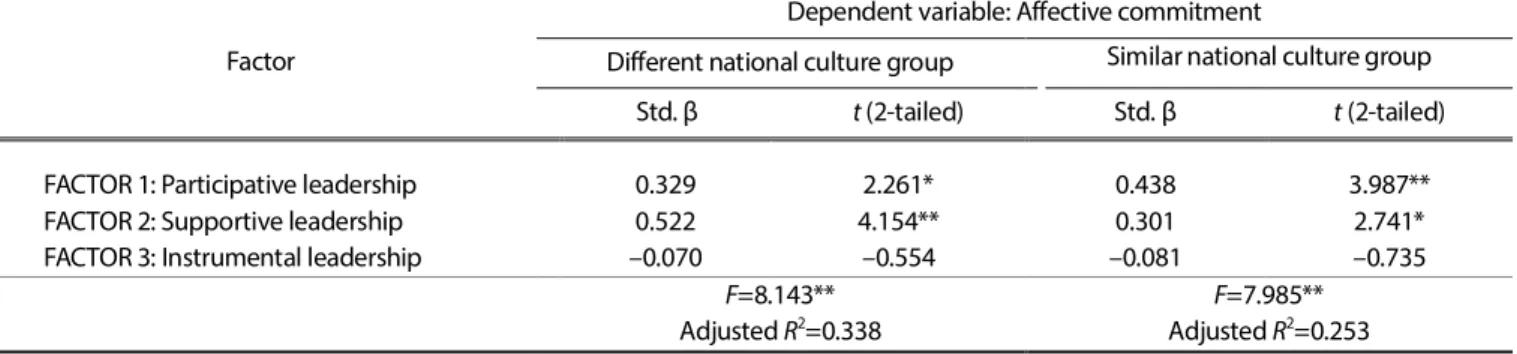
Regression analysis was used to investigate the prediction of affective commitment based on the leadership style and national culture variables. Table 3 reports the results of the multiple reg- ression analysis. When affective commitment is the dependent variable, the difference in the regression coefficients across the two subgroups reflecting similar and different national culture is sta- tistically significant. A statistically significant change in R 2 occurred with the introduction of the culture variable.

Table 3 shows a similar pattern of regression coefficients with positive effects of participative leadership and supportive leader- ship on affective commitment. However, the instrumental leader- ship variable was found to have no significant effect on affective commitment. For different national groups, supportive leadership has the most significant effect on affective commitment, followed by participative leadership. Meanwhile, in similar national culture group, participative leadership has a more significant effect than supportive leadership.

DISCUSSION

The pattern of the findings supports the primary assumption of this study: restaurant employees’ affective commitment is related to the leadership styles of their supervisors. Interestingly, both participative leadership style and supportive leadership style have effects on affective commitment but instrumental leadership style does not. In addition, the findings show that employees evaluate leaders with a different national culture differently. Finally, the researchers conclude that supportive leadership is the appropriate leadership style between managers and employees from different national cultures.

The findings suggest that restaurant managers should be particularly considerate when interacting with employees from a different national culture. For example, managers should be sym- pathetic and considerate of their subordinates’ needs. In contrast, an instrumental leadership style can have a negative effect on employees’ affective commitment. Therefore, in order to increase the employees’ affective commitment, managers should adopt a supportive leadership style toward employees from a different national culture. A participative leadership style is more effective when a manager is familiar with his or her employees’ national culture. The managers or owners can provide a leadership edu- cation and development program that helps their employees to be

successful leaders who have supportive leadership style or par- ticipative leadership style.

The following limitations should be taken into consideration when interpreting the findings of this study. The first limitation to the study is the use of a convenience sample of respondents who decided to participate in the survey. Self-selection could result in a non-representative sampling bias. Second, the relatively small sample size precluded other advanced types of analysis such as multivariate analysis of variance.

REFERENCES

Ahmed, I., & Parasuraman, A. (1994). Environmental and positional antecedents of management commitment to service quality:

A conceptual framework. In T. A. Swartz, D. A. Bowen, & S. W.

Brown, Advances in Services Marketing and Management (pp.

69-93). Greenwich, CT: JAI.

Angle, H. (1981). An empirical assessment of organisational co- mmitment and organisational effectiveness. Administrative Science Quarterly, 26(1)., 1-14.

Clark, R. A., Hartline, M. D., & Jones, K. C. (2009). The effects of leadership style on hotel employees' commitment to service quality. Cornell Hospitality Quarterly, 50(2), 209-231.

Engle, E. M., & Lord, R. G. (1997). Implicit theories, self-schemas, and and leader-member exchange. Academy of Management Journal, 40: 988-1010.

Fiedler, F. E. (1996). Research on leadership selection and training:

one view of the future. Administrative Science Quarterly, 41:

241-250.

Gill, A. S., & Mathur, N. (2007). Improving employee dedication and pro-social behavior. International Journal of Contemporary Hospitality Management, 19(4) : 328-334.

Gillet, S. R., & Morda, R. (2003). Effective leadership in tourism and hospitality organizations in the 21st century. In S. Kusluvan, Managing Employee Attitudes and Behaviors in the Tourism and Hospitality Industry (pp. 599-630). New York: Nova Science Publishers.

Hofstede, G. (1991). Culture and Organizations: Software of the Mind. New York: McGraw-Hill.

Leveson. L., Joiner, T. A., & Bakalis, S. (2009). Managing cultural diversity and perceived organizational support: Evidence from Australia. International Journal of Manpower, 30 (4) : 377- 392.

Table 3. Results of regression analysis

Factor

Dependent variable: Affective commitment

Different national culture group Similar national culture group Std. β t (2-tailed) Std. β t (2-tailed)

FACTOR 1: Participative leadership 0.329 2.261* 0.438 3.987**

FACTOR 2: Supportive leadership 0.522 4.154** 0.301 2.741*

FACTOR 3: Instrumental leadership –0.070 –0.554 –0.081 –0.735

F=8.143** F=7.985**

Adjusted R 2 =0.338 Adjusted R 2 =0.253

* p<0.01, ** p<0.001.

(5)

Lok, P., & Crawford, J. (2004). The effect of organizational culture and leadership stlye on job satisfaction and organizational commitment: A cross-national comparison. Journal of Ma- nagement Development, 23 (4) : 321-338.

Meyer, J., & Allen, N. (1991). A three-component conceptuali- zation of organizational commitment. Human Resource Mana- gement Review, 1: 61-89.

Mowday, R. T., & Porter, L. W., & Steers, R. M. (1982). Employee- Organization Linkages: The Psychology of Commitment, Absen- teeism and Turnover. New York, NY: Academic Press.

Mowday, R., Steers, R., & Porter, L. (1979). The measurement of organizational commitment. Journal of Vacational Behaviour, 14: 224-227.

Mwaura, G., Sutton, J., & Roberts, D. (1998). Corporate and na- tional culture - an irreconcilable dilemma for the hospitality manager? International Journal of Contemporary Hospitality Management, 10: 212-220.

Newman, K. L., & Nollen, S. D. (1996). Culture and congruence: the fit between managment practices and national culture.

Journal of International Business, 27(4) : 753-779.

Ogbonna, E., & Harris, L. C. (2000). Leadership style, organiza- tional culture and performance: empirical evidence from UK companies. International Journal of Human Resource Ma- nagement, 11(4) : 766-788.

Pizam, A., Pine, R., Mok, C., & Shin, J. Y. (1997). Nationality vs.

industry cultures: which has a greater effect on managerial behaviors? International Journal of Hospitality Management, 16:

127-145.

Rhoades, L., Eisenberger, R., & Armeli, S. (2001). Affective commit- ment to the organization: The contribution of perceived organizational support. Journal of Applied Psychology, 86(5) : 825-836.

Riketta, M. (2002). Attitudinal organizational commitment and job performance: a meta-analyis. Journal of Organizational Behavior, 23: 257-266.

Shaw, J. B. (1990). A cognitive categorization model for the study of intercultural management. Academy of Management Re- view, 15(4) : 626-645.

Testa, M. R. (2007). A deeper look at national culture and lea- dership in the hospitality. International Journal of Hospitality Management, 26: 468-484.

Testa, M. R. (2002). Leadership dyads in the cruise industry: the impact of cultural congruency. International Journal of Hos- pitality Management, 21: 425-441.

Testa, M. R. (2009). National culture, leadership and citizenship:

Implications for cross-cultural management. International Journal of Hospitality Management, 28: 78-85.

Walumbwa, F. O., & Lawler, J. J. (2003). Building effective organi- zations: transformational leadership, collectivist orientation, work-related attitudes, and withdrawal behaviors in three emerging economies. International Journal of Human Resource Management, 14: 1083-1101.

Weaver, P., Wilborn, L., McCleary, K., & Lekagul, A. (2007). Diversity

training management initiatives in the lodging industry: an

exploratory analysis of underlying dimensions. Journal of Hos-

pitality & Tourism Research, 27(2) : 237-253.

수치

Table 1. Descriptive statistics of respondents’ characteristics  Variable                                                                                    (N=106)  Frequency  Percent  Gender  Male  53  50.0  Female  53  50.0  Age  18~20  27  25.5  21~30
Table  3  shows  a  similar  pattern  of  regression  coefficients  with  positive  effects of participative  leadership  and  supportive  ship on affective commitment

참조

관련 문서

If some properties have been set for the same selector in different style sheets, the values will be inherited from the more specific style sheet!. Cascading Order

 Employee-oriented versus results-oriented (focus on people) (focus on goals).  Parochial (employees identify with employer) versus professional (employees

How Defined, Effective, and Accountable Leadership Affects Alignment CII defines leadership as “the process of providing a clear, unambiguous vision for a project,

생산요소에 대한 차별적 접근- 접근비용이 낮은 경우 (Differential low cost access to productive inputs) -생산요소(productive input): 생산 및 기업활동을 위해 필요한

Based on the results, a study model was developed and a hypothesis that transformational and transactional leadership would significantly affect organizational

Fifth, this survey shows us that higher perception of the marital conflict lowers children‘s social ability and their competence and leadership abilities.. Furthermore, they

Fifth, in the influence that the communicative style exerts on the level of marital satisfaction, the Global Distress by Talking, problem-solving, Spite

This research shows that there are the success factors of foreign hidden champions such as leadership and goals, self production, high-performance