• 검색 결과가 없습니다.

First Record of Discothyrea sauteri Forel (Hymenoptera: Formicidae: Proceratiinae) from Korea

N/A
N/A
Protected

Academic year: 2021

Share "First Record of Discothyrea sauteri Forel (Hymenoptera: Formicidae: Proceratiinae) from Korea"

Copied!
3
0
0

로드 중.... (전체 텍스트 보기)

전체 글

(1)

The members of the genus Discothyrea are relatively cryptic ants, which form small colonies (10-20 workers), and are mainly found in rotten wood, leaf litter, and under the stones (Brown, 1958). Brown (1958) first reported that they could be specialized predators of arthropod eggs, since their closely related genus Proceratium exhibits such a trophic speciali- zation, and was further able to provide evidence for his theory on the basis of the research conducted by him on an Australian Discothyrea species (Brown, 1958). These ants were shown to prefer spider eggs, although one species was also located in the nests of other ants (Brown, 1980). Queens of one African

species formed their nests within the spider egg sacks, which was shown to provide both food and lodging for the first generation of workers (Dejean and Dejean, 1998). In this paper, the genus Discothyrea Roger and Discothyrea sauteri Forel are recorded for the first time. In this study, the morphological characteristics of these species, and a taxonomic key of the genera of the Korean Proceratiinae are provided.

Materials and Methods

The specimens examined in this study were deposited at Sangji University, South Korea. The images of these specimens were captured using the Leica DMS 1000 microscope and the S8AP0 microscope (Leica Microsystem, Germany). Images

Short communication KOREAN JOURNAL OF APPLIED ENTOMOLOGY

한국응용곤충학회지 ⓒ The Korean Society of Applied Entomology

Korean J. Appl. Entomol. 59(2): 79-81 (2020) pISSN 1225-0171, eISSN 2287-545X

DOI: https://doi.org/10.5656/KSAE.2020.02.0.011

First Record of Discothyrea sauteri Forel (Hymenoptera: Formicidae:

Proceratiinae) from Korea

Dong Oh Shin 1 , Sun Woo Yoon 1 and Dong Pyeo Lyu*

Department of Forest sciences, Sangji University, Wonju 26339, Korea

1

Pureunsol Ant Research Center, Daegu 42814, Korea

한국미기록종 Discothyrea sauteri Forel(벌목: 개미과:

배굽은침개미아과)의 보고

신동오 1 ㆍ윤선우 1 ㆍ류동표*

상지대학교 산림과학과, 1푸른솔개미연구센터

ABSTRACT: The species, Discothyrea sauteri Forel, 1912 (Hymenoptera: Formicidae: Proceratiinae), was documented for the first time in Korea. In this study, the morphological characteristics, representative images of this species, and a taxonomic key of the genera of the Korean Proceratiinae are provided.

Key words: Formicidae, Proceratiinae, Discothyrea sauteri, Taxonomic key, Korea

초 록 : 한국산 개미과 배굽은침개미아과의 미기록종인 Discothyrea sauteri Forel을 보고한다. 종에 대한 형질과 사진, 한국산 배굽은침개미아과 속 검색표를 제공한다.

검색어: 개미과, 배굽은침개미아과, Discothyrea sauteri, 분류키, 한국

*Corresponding author: [email protected] Received February 4 2020; Revised February 24 2020 Accepted March 5 2020

79

This is an Open-Access article distributed under the terms of the Creative Commons Attribution Non-Commercial License (http://creativecommons.org/licenses/by-nc/3.0) which permits unrestricted non-commercial use, distribution, and reproduction in any medium, provided the original work is properly cited.
(2)

80 Korean J. Appl. Entomol. 59(2) 79~81 (2020)

were further enhanced and analyzed using the Leica Appli- cation Suite v. 4.9 (Leica Microsystems) and Deltabio MOT Leica software v. 4.0 to obtain multi-focus images. The terminology used to describe the worker individuals was followed as described by Bolton (2003).

The following abbreviations for insect castes and provinces in which specimens were collected and examined were used: q (queen); w (worker); TL (type locality); and JJ (Jeju-do).

Results

Systematic accounts

Family Formicidae Latreille, 1809 개미과

Subfamily Proceratiinae Emery, 1895 배굽은침개미아과

Key to the Genera of Korean Proceratiinae

1. Apical segment of antenna extremely large and bulbous;

antennal sockets on shelf protruding over mandibles ···

··· Discothyrea

- Apical segment of antenna moderately enlarged, but not bulbous; antennal sockets not protruding over mandibles

··· Proceratium

Genus Discothyrea Roger, 1863

Discothyrea: Roger, J., 1863: 176. Type-species: Discothyrea testacea Roger.

Prodiscothyrea Wheeler, W.M., 1916: 33. Type-species:

Prodiscothyrea velutina Wheeler.

Pseudosysphincta Arnold, 1916: 161. Type-species: Pseu- dosysphincta poweri Arnold.

Diagnosis. Small strong ants are the ones with notable excessive expansion of their apical antennal segment. The antennal segments are segmented at least 6–12 times. Mandibles are without teeth and are overhanging with the help of a projecting clypeus. Thorax is short and sutureless dorsally (Brown, 1958; Bolton, 1994)

A B

C D

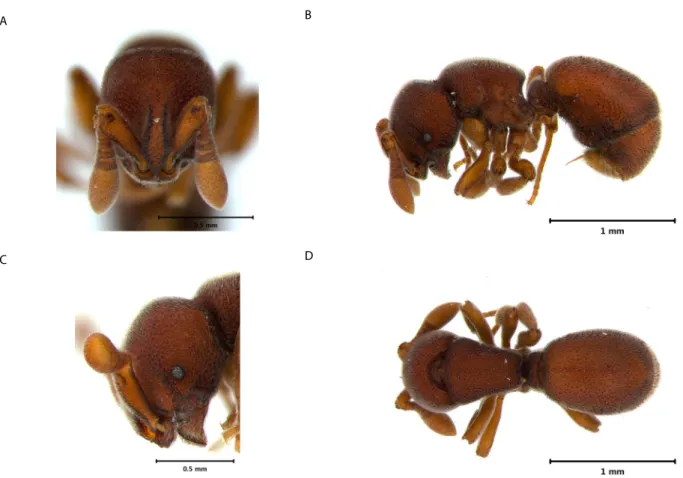
Fig. 1. Discothyrea sauteri Forel. A: frontal view of the head; B: lateral view of the body; C: lateral view of the head; D: Dorsal view of the body.

(3)

First Record of Discothyrea sauteri Forel from Korea 81 Discothyrea sauteri Forel, 1912 달마배굽은침개미(신칭)

Discothyrea globus var. sauteri Forel, 1912: 47 (w.q.). TL:

Taiwan.

Discothyrea sauteri- Brown, 1958: 253 (Raised to species).

Description: Worker ants. (fig. 1A and C): Head shape is subglobose; occipital carina is low but distinct, which is extended up to the ventral surface. Mandibles are small and subtriangular. Masticatory margin is edentate, in which the inner surface is with a series of minute peg- . Palp formula is usually 4; 4 or 4; 3 (Brown, 1958). Clypeus is fused to the frontal region medially, forming a subrectangular projection anteriorly, which partly covers the mandibles. Frontal carinae are fused together to form a median longitudinal platform, with distinct antennal scrobes. Antennal insertion is almost exposed and is situated anteriorly. Antennal segments vary in number but are normally less than 10; they are scape short, clavate, and somewhat depressed dorsoventrally. Apical segments are large and bulbous, mostly equal to or longer than the total length of the funiculus. Compound eyes are small to minute and are situated anterior to the middle of the sides of the head.

Alitrunk is compact, which lacks any dorsal sutures, with short and flattened nodes. They are normally located at the posterior declivity of propodeum concave and are weakly marginate, with a pair of angulate corners or teeth situated dorsoposteriorly, whereas the ventral processes are absent.

Legs are short and robust, and the tibial spurs of all the legs are pectinate. Petiole is small, compressed anteroposteriorly, and broadly attached to the gaster, whereas the subpetiolar processes are low and rounded. Anterior margins of the first gastric sternum are weakly developed. First and second gastric terga are large and swollen; gastric apex is directed forward, and the sting is well developed.

Material examined: Korea: 1w, Donneko, Seogwipo, JJ, 18.

Ⅵ. 2019. (SW Yoon & DO Shin); 1w, Donneko, Seogwipo, 19. Ⅵ. 2019. (DP Lyu.)

Distribution: Korea (new record), Taiwan, China, Japan.

저자 직책 & 역할

류동표 : 상지대, 교수; 실험설계 현미경 분석 및 논문작성 신동오 : 푸른개미연구소, 소장; 시료준비 및 자료분석 윤선우 : 푸른개미연구소, 연구원; 시료준비 및 분석 모든 저자는 원고를 읽고 투고에 동의하였음.

Acknowledgements

This study was supported by the Sangji University Research Fund 2018.

Literature Cited

Arnold, G. 1916. A monograph of the formicidae of South Africa.

Part II. Ponerinae, Dorylinae. Ann. S. Afr. Mus. 14, 159-270.

Bolton, B. 1994. Identification guide to the ant genera of the world.

Harvard University Press, Cambridge, Mass., pp. 222.

Bolton, B. 2003. Synopsis and Classification of Formicidae. Mem.

Am. Entomol. Inst. 71, 370.

Brown, W.L. Jr. 1958. Contributions toward a reclassification of the Formicidae. II. Tribe Ectatommini (Hymenoptera). Bull.

Mus. Comp. Zool. 118, 173-362.

Brown, W.L. Jr. 1980. A remarkable new species of Proceratium, with dietary and other notes on the genus (Hymenoptera:

Formicidae). Psyche 86, 337-346.

Dejean, A., Dejean, A. 1998. How a ponerine ant acquired the most evolved mode of colony foundation. Insectes Soc. 45, 343-346.

Emery, C. 1895. Die Gattung Dorylus Fab. und die systematische eintheilung der formiciden. Zool. Jahrb. Abt. Syst. Geogr. Biol.

Tiere 8, 685-778.

Forel, A. 1912. H. Sauter's Formosa-Ausbeute. Formicidae (Hym.).

Entomol. Mitt. 1, 45-61.

Latreille, P.A. 1809. Genera crustaceorum et insectorum secundum ordinem naturalem in familias disposita, iconibus exemplisque plurimus explicata. Tomus4. Parisiis et Argentorati [=Paris and Strasbourg]: A. Koenig, 399 pp.

Roger, J. 1863. Die neu aufgeführten Gattungen und Arten meines Formiciden-Verzeichnisses, nebst Ergänzung einiger früher gegeben Beschreibungen. Berl. Entomol. Z. 7, 131 –214.

Wheeler, W. M. 1916. Prodiscothyrea, a new genus of ponerine ants

from Queensland. Trans. R. Soc. S. Aust. 40, 33-37.

수치

Fig. 1.  Discothyrea sauteri Forel. A: frontal view of the head; B: lateral view of the body; C: lateral view of the head; D: Dorsal view of the body.

참조

관련 문서

In the current context, where the interconnectedness of the global economy has intensified greatly and the importance of a collective response to

The case study of Samsung’s first CDMA (2G) mobile phone development shows that the dynamic combination mode and the functional combination mode are

If the volume of the system is increased at constant temperature, there should be no change in internal energy: since temperature remains constant, the kinetic

Common fruits that are sometimes classified as epigynous berries include bananas, coffee, members of the genus Vaccinium (e.g., cranberries and blueberries), and members

1 John Owen, Justification by Faith Alone, in The Works of John Owen, ed. John Bolt, trans. Scott Clark, "Do This and Live: Christ's Active Obedience as the

The differences found in these concepts of human resources and HRD originate from their diverse subjects and objectives. In the narrow definition of the concept, the subjects of

Skilled workers at DaimlerChrysler are not only expected to manufacture products of flawless quality. Given the cost of the production systems which manufacturing

• Symmetric beams under the action of arbitrary loadings which are in the plane of symmetry and oriented normal to the center line of the beam. •