Abstract
BACKGROUND: Among the biomass conversion techniques of livestock manure, composting process is a method of decomposing organic matter through microorganisms, and converting it into fertilizer in soil. The aerobic composting process is capable of treating cow manure in large quantities, and produces greenhouse gas as CO2 and N2O, although it has economical benefit. By using the activated rice hull biochar, which is a porous material, it was intended to mitigate the greenhouse gas emissions, and to produce the compost of which quality was high. Objective of this experiment was to estimate CO2 and N2O emissions through composting process of cow manure with different cooperated biochar contents.
METHODS AND RESULTS: The treatments of activated rice hull biochar were set at 0%, 5%, 10% and 15%, re- spectively, during composting cow manure. The CO2 emis- sion in the control was 534.7 L kg-1, but was 385.5 L kg-1 at 15% activated rice hull biochar. Reduction efficiency of CO2 emission was estimated to be 28%. N2O emission was 0.28 L kg-1 in the control, but was 0.03 L min-1 at 15% of activated rice hull biochar, estimating about 89% reduc- tion efficiency.
CONCLUSION: Greenhouse gas emissions during the composting process of cow manure can be reduced by mixing with 15% of activated rice hull biochar for eco-friendly compost production.
Key words: Activated rice Hull biochar, Adsorption, compost, Cow manure, Greenhouse gases
*Corresponding author: JoungDu Shin Phone: +82-63-238-2494; Fax: +82-63-238-24;
E-mail: [email protected]
Korean J Environ Agric. 2020;39(3):222-227. Korean Online ISSN: 2233-4173
Published online 2020 September 9. https://doi.org/10.5338/KJEA.2020.39.3.26 Print ISSN: 1225-3537
왕겨 활성 바이오차 혼합 비율에 따른 우분 호기소화 시 온실가스 발생 특성
노연희1, 정우진2, 정석주3, 정인호3, 나홍식3, 김민수4, 신중두5*
1경기대학교 일반대학원 환경에너지공학과, 2경기대학교 창의공과대학 환경에너지공학과, 3(주)누보,
4서울시립대학교 환경공학과, 5농촌진흥청 국립농업과학원 농업환경부 기후변화생태과
Characteristics of Greenhouse Gas Emissions with Different Combination Rates of Activated Rice Hull Biochar during Aerobic Digestion of Cow Manure
YeonHee Ro1, WooJin Chung2, SeokJoo Chung3, InHo Jung3, HongSik Na3, MinSoo Kim4 and JoungDu Shin5*
(1Department of Environmental Energy Engineering, Graduate School, Kyonggi University, Suwon 16227, Korea,
2Department of Environmental Energy Engineering, College of Creative Engineering, Kyonggi University, Suwon 16227, Korea, 3Nousbo Co., Ltd, Suwon 16614, Korea, 4Department of Environmental Engineering, University of Seoul, Seoul 02504, Korea, 5Climate Change & Agroecology Division, Department of Agricultural Environment, National Institute of Agricultural Sciences, Rural Development Administration, Wanju 55365, Korea)
Received: 19 August 2020/ Revised: 26 August 2020/ Accepted: 2 September 2020 Copyright ⓒ 2020 The Korean Society of Environmental Agriculture
This is an Open-Access article distributed under the terms of the Creative Commons Attribution Non-Commercial License (http://creativecommons.org/licenses/by-nc/3.0) which permits unrestricted non-commercial use, distribution, and reproduction in any medium, provided the original work is properly cited.
ORCID JoungDu Shin
https://orcid.org/0000-0002-5941-3438 YeonHee Ro
https://orcid.org/0000-0002-5572-2508 WooJin Chung
https://orcid.org/0000-0003-2699-9361
222
Research Article Open Access
Characteristics of Greenhouse Gas Emissions, Activated Rice Hull Biochar, Aerobic Digestion 223
서 론
경제 성장에 따라 국민의 삶의 질이 높아질수록 육류 소 비가 증가하고 있다. 국민 1인당 육류소비량은 2005년 기준 31.9 kg에서 2016년 49.5 kg으로 약 10년 동안 155% 증가 하는 추세를 보였다[1]. 국내 축산업은 기업형 사육 형태로 확대되고 있으며 발생하는 가축분뇨의 양도 증가하고 있다.
런던 협약에 따라 가축분뇨의 해양투기가 단계적으로 금지 되었으며, 2012년 가축분뇨 해양투기 전면 중단 선언에 따 라 가축분뇨의 처리 및 자원화 연구가 활발히 진행되고 있 다[2-4]. 가축분뇨 자원화 방법에는 퇴비화, 액비화 및 바이 오가스화 등이 있고, 2017년 농림축산식품부에 따르면 퇴비 화는 가축분뇨의 자원화 중 82%로 가장 높은 비중을 차지 하고 있다. 가축분뇨 퇴비화는 미생물을 이용하여 분뇨에 있 는 유기물질을 분해하고 퇴비로 전환하는 기술이다[5]. 특히, 가축분뇨는 일반폐기물과 달리 질소와 인산 등의 영양염류 가 풍부하여 작물 생육에 필요한 영양원으로 적합하다[6].
그러나 자원화를 통해 퇴비뿐만 아니라 악취 물질과 온실가 스가 발생한다.
가축분뇨 퇴비화 과정 중 발생 가스는 CO2, N2O, NH3
및 H2S 등이 있으며, 이 중 CO2와 N2O는 퇴비화 공정에서 미생물의 유기물과 질소화합물 분해로 인해 발생한다[7]. 발 생 된 CO2는 퇴비의 부숙 진행상태를 파악할 수 있는 지표로 활용될 수 있으나[8], 대기에서는 화학적으로 안정한 물질로 대표적인 온실가스이다. 더욱이 N2O는 대류권에서 감소하지 않으며 지구의 온도를 상승시키고, 성층권에서 산소와 반응하 여 오존층을 파괴하는 이차오염물질을 발생시키기도 한다[9].
이와 같은 이유로 최근 전 세계적으로 온실가스 저감을 위해 다양한 정책을 펼치고 있다. 국내 정부에서는 2020년까지 농 업 부문 감축 목표는 BAU (Business As Usual) 대비 5.2%
인 148만 5천 톤을 목표로 하고 있으며, 2030년 농업 부문 감축 목표는 2020년 대비 비슷하나 확대될 전망이다. 이와 같 은 정책에 따라 퇴비화 중 발생 가스에 대한 모니터링과 처리 방법에 관한 연구가 필요한 실정이다.
퇴비화 중 발생 가스 처리 방법 중 흡착제 첨가에 따른 악 취 및 온실가스의 저감 연구가 진행되고 있으며 흡착제로써 제올라이트, 활성탄소 등의 물질들이 사용된다[10-12]. 그러 나 최근에는 농촌에서 발생하는 바이오매스를 이용한 바이오 차에 관한 연구들이 진행되고 있으며, 또한 버려지는 폐 바이 오매스를 다공성물질로 전환하여 환경오염원 처리 소재로서 적용하고 있다[13]. 바이오차는 바이오매스를 공기가 거의 없 는 상태에서 고온 열분해시켜 생산되며, 물리ㆍ화학적으로 안정한 구조를 가진다. 토양 주입 시 미생물에 의한 분해가 이루어지지 않아 토양 내에 탄소를 격리하고, 질소순환을 통 해 유발되는 아산화질소의 배출을 완화는 것으로 알려져 있 다[14,15]. 이와 같은 결과는 CO2 및 N2O를 바이오차 내부 기공에 흡착하여 탄소와 질소를 반영구적으로 저장함으로써 전체적인 CO2와 N2O의 발생량을 저감 시킬 수 있다[16]. 또 한 퇴비화 반응에는 질소와 인 등 영양염류의 손실을 줄이며,
공극에 수분을 함유하여 수분조절과 미생물의 성장에 도움을 줄 수 있다[17,18].
따라서 본 연구는 우분 호기성 퇴비화 시 혼합한 왕겨 활 성 바이오차의 함량에 따라 기후변화에 영향을 미치는 온실 가스 CO2 및 N2O의 저감량을 평가하기 위해 수행하였다.
재료 및 방법 실험 재료
본 실험에 사용된 우분은 경기도 여주시에 있는 축사로부 터 채취하였다. 모든 처리구의 수분함량을 약 65%로 조절하 기 위해 소나무 톱밥을 사용하며, 초기 수분함량을 측정한 후 각 처리구에 동일한 양의 소나무 톱밥을 투여하였다. 왕겨 바 이오차는 전라북도 고창군에 있는 바이오차 제조사 ㈜유기산 업에서 구매하였으며, 왕겨 활성 바이오차 제조를 위해 왕겨 바이오차와 6 M의 KOH 용액을 1:1 wt% 비율로 왕겨 바이 오차에 살포하고 하루 동안 충분히 흡수 및 건조 시켰다. 그 후 탄화를 위해 5 mL min-1의 속도로 N2를 흘려 10℃ min-1 로 850℃까지 상승시켰으며, 탄화 후 잔류 KOH 제거를 위해 약 3회 증류수로 세척 후 105℃에서 48시간 동안 건조 후 사 용하였다.
실험 장치 및 방법
본 실험에 사용된 호기 소화 반응기는 Fig. 1에 나타냈다.
반응기는 원통형으로 아크릴 재질을 사용하였으며 내부의 총 부피는 30 L로 제작하였다. 반응기 하단에는 퇴비화 반응 시 생기는 침출수의 배출을 위해 스테인리스 지지대를 배치하였 다. 호기성 조건을 유지하기 위하여 Air pump를 사용하였 고, 공기 주입량은 0.8 L min-1로 설정하였다. 퇴비의 부숙도 를 높이고 Dead zone을 없애기 위해 퇴비의 혼합은 일주일 에 1회씩 수행하였다. CO2 측정은 Gas tech Co의 Biogas 5000 model과 Gas Tech Korea Co의 3M, 3 HM model 을 사용하였으며, N2O는 Gas Analyzer (T320U,Teledyne) 를 통해 분석하였다. 가스의 측정은 일일 1회 같은 시간대에 진행되었다. 발생한 CO2와 N2O의 총량은 아래와 같은 수식 을 이용하여 계산하였다.
바이오차 함량에 따른 가스 발생량 평가를 위해 시료의 첨 가 비율은 Table 1에 나타냈다. 왕겨 활성 바이오차를 첨가 하지 않은 무처리구를 대조구(Control)로 설정하였으며, 왕 겨 활성 바이오차의 혼합 비율을 1:5 (T1), 1:10 (T2) 그리고 1:15 (T3) 무게비로 구성하였다.
× ×
Ci : i일에 측정된 가스 농도 Q : 주입 가스 유량 t : 24 hr
d : 퇴비화 장치 운영일 수
Fig. 1. Digram of aerobic digestion reactor.
Materials used Control T1 T2 T3
Cow manure 6.8 kg 6.8 kg 6.8 kg 6.8 kg
sawdust 1.2 kg 1.2 kg 1.2 kg 1.2 kg
Biochar - 0.4 kg (1:5 wt %) 0.8 kg (1:10 wt %) 1.2 kg (1:15 wt %)
Moisture contents 65.1% 65.0% 64.9% 65.2%
T1; Combination rate of 5% activated rice hull biochar, T2; Combination rate of 10% activated rice hull biochar, and T3; Combination rate of 15% activated rice hull biochar.
Table 1. Aerobic digestion system with different treatments
분석 방법
왕겨 활성 바이오차의 화학적 특성으로 C, H, O, N 등 의 함량은 원소분석기(Elemental Analyzer, EA, EA2000, Thermofinnigan, USA)를 이용하여 정량하였다. 또한, 왕겨 활성 바이오차의 비표 면적 및 공극 분석을 위해 비표 면적 분석기(Brunauer Emmett Teller, BET, TristarII 3020, Micromeritics, USA)를 이용하였다.
결과 및 고찰 바이오차 특성
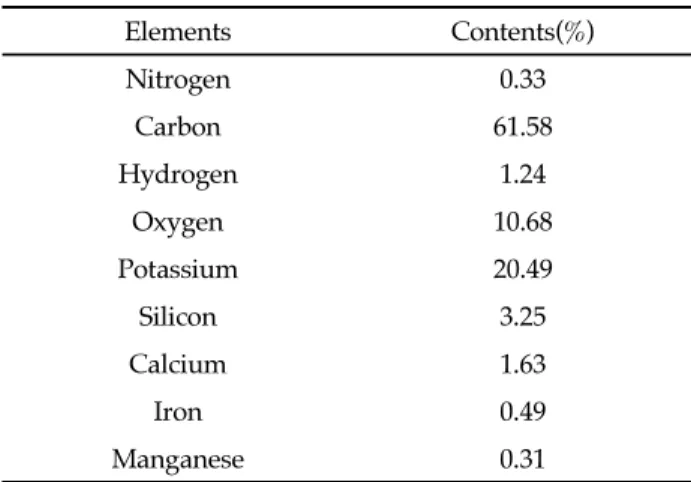
왕겨 활성 바이오차의 원소 함량을 Table 2에 나타냈 다. 왕겨 활성 바이오차의 탄소 함량은 61.52%로 가장 높 은 비율을 차지하였으며 칼슘, 산소, 실리콘 순으로 높은 비율을 차지하였다. 또한, BET분석을 통해 비표 면적, 총 공극 부피, 평균 공극 크기는 각각 206 m2 g-1, 0.16 cm3 g-1, 3.2 nm임을 확인하였다. 이는 타 바이오차와 비교하 여 더 넓고 큰 공극 부피 및 공극 크기를 가지는 것을 확인 하였다[19].
CO2 발생 양상
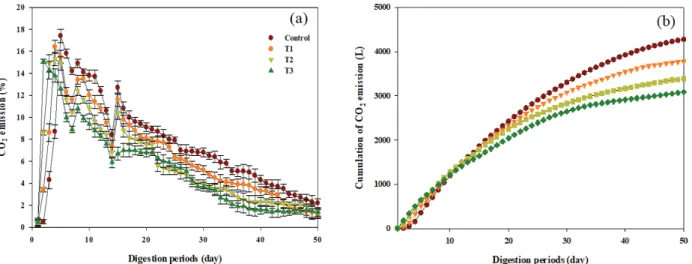
CO2의 발생 특성은 Fig. 2에 나타내었다. 퇴비화 실험 시 작 약 5일까지 CO2의 발생량이 급격하게 증가하여 발생량의
Elements Contents(%)
Nitrogen 0.33
Carbon 61.58
Hydrogen 1.24
Oxygen 10.68
Potassium 20.49
Silicon 3.25
Calcium 1.63
Iron 0.49
Manganese 0.31
Table 2. Chemical characteristics of activated rice hull biochar
최대치인 17.4%를 나타냈다. 퇴비화 과정 초기 미생물의 빠른 유기물질의 분해로 인해서 CO2의 발생량이 높은 것을 확인할 수 있다. 또한, 퇴비 부숙도를 높이기 위해 주 1회 수행된 퇴 비의 혼합 때문에 8일 15일 차 전후로 CO2의 농도가 감소하 였다가 증가하는 경향이 나타났다. 이는 퇴비의 혼합으로 분해 되지 못했던 유기물질이 미생물에 의해 분해되어 CO2가 발생 되었다고 판단하였다[20]. 퇴비화 실험 15일 차 이후부터는 CO2가 점차 감소하는 것을 확인하였으며 이를 통해 유기물질
Characteristics of Greenhouse Gas Emissions, Activated Rice Hull Biochar, Aerobic Digestion 225
이 대부분 분해되었다고 판단하였다.
Control과 처리 간에는 퇴비화 실험 약 12일 차까지 누적 CO2발생량이 비슷한 것으로 나타났지만, 12일 차 이후부터 왕겨 활성 바이오차의 함량에 따라 CO2 저감량이 많아졌다.
퇴비화 실험 시 Control, T1, T2, T3의 CO2 발생 총 양은 각 각 4,277 L, 3,776 L, 3,389 L, 3084 L 으로 나타났으며, T3 는 Control과 비교하여 약 28%의 가장 높은 CO2저감 효율 을 보였다(P<0.05). 이는, 왕겨 활성 바이오차의 함량에 따라 흡착 가능한 CO2의 함량이 높아져 CO2의 발생량이 저감 되 었다고 판단하였다. 단위 함량 당 왕겨 활성 바이오차의 CO2
흡착량을 Table 3에 나타냈다. 왕겨 활성 바이오차의 투입 함량이 증가할수록 단위 질량 당 CO2의 흡착량이 감소하는 현상이 나타났다. 이는 일정량 이상의 왕겨 활성 바이오차가 투입되면 왕겨 활성 바이오차 표면의 흡착층의 중첩현상으로 인하여 흡착에 사용되는 활성점을 보호하여 제거율이 감소하 는 것으로 판단하였다[21,22].
N2O 발생 양상
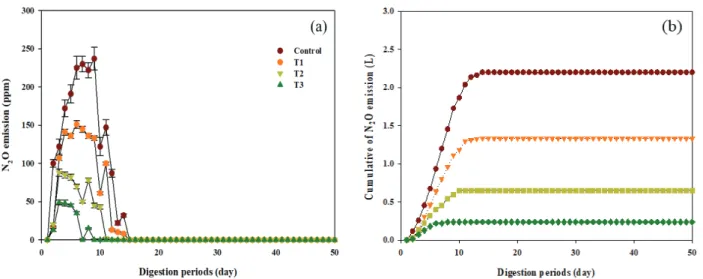
N2O 발생량 특성은 Fig. 3에 나타내었다. 퇴비화 실험 시 작 후 약 9일 이후에 가장 높은 양의 N2O 발생량 약 147 ppm이 발생하였다. N2O 또한 CO2와 같은 경향으로 주 1회 수행한 퇴비 혼합 이후 퇴비화 8일 차 전후로 발생한 N2O의 양이 감소하다가 증가하는 경향을 확인할 수 있다. 그 이후 N2O의 발생량은 급속도로 감소하여 약 15일 이후부터는 발생 하지 않았다. 퇴비화 공정 중 발생한 총 N2O의 양은 Control,
T1, T2, T3 각각 2.2 L, 1.3 L, 0.6 L, 0.2 L로 T3에서 약 90.9%의 N2O 저감 효율을 보였다(P<0.05). 이는 우분에서 발생하는 NH3를 왕겨 활성 바이오차가 흡착하여 N2O로 전 환되지 못하게 함으로써 N2O의 발생량이 감소하였다고 판단 하였다[23].
왕겨 활성 바이오차 단위 질량 당 감소하는 N2O의 양을 확인했으며 CO2와 같은 발생 특성을 보이는 것을 확인하였 다(Table 3).
결과 및 고찰
본 실험은 왕겨 활성 바이오차 혼합 비율에 따른 우분 퇴 비화 시 CO2및 N2O 발생 양상을 구명하기 위해 수행하였 다. 퇴비화 실험 시 Control, T1, T2, T3의 CO2 발생 총 양 은 각각 4,277 L, 3,776 L, 3,389 L, 3084 L으로 나타났으 며, T3는 Control과 비교하여 약 28%의 가장 높은 CO2 저 감 효율을 보였다. 또한, 퇴비화 공정 중 발생한 총 N2O의 양은 Control, T1, T2, T3 각각 2.2 L, 1.3 L, 0.6 L, 0.2 L 로 T3에서 약 90.9%의 N2O 저감 효율을 보였다. 따라서 본 연구를 통해 퇴비화 공정 시 왕겨 활성 바이오차의 투입은 온실가스 배출을 줄이게 할 수 있는 가능성을 평가하였다.
추후 바이오차 첨가 시 퇴비의 미생물 군집의 변화 및 부숙 도 평가 부분에 대한 보다 세부적인 연구가 필요할 것으로 판단된다.
Fig. 2. Effects of CO2 emissions to different combination rates of activated rice hull biochar during composting of cow manure; change of CO2 concentrations (a) and amount of CO2 emission (b). The values were average of three replications, and error bars display standard deviation (p<0.05).
Gases T1 T2 T3
CO2 1252.8 L kg-1 1110.0 L kg-1 994.6 L kg-1
N2O 216.3 L kg-1 193.8 L kg-1 163.6 L kg-1
Table 3. Gas adsorption per unit mass with different combination rates of activated rice hull biochar
Fig. 3. Effects of N2O emissions to different combination rates of activated rice hull biochar during composting of cow manure; change of N2O concentrations (a) and amount of N2O emission (b). The values were average of three replications, and error bars display standard deviation (p<0.05).
Note
The authors declare no conflict of interest.
Acknowledgement
This work was supported by the National Institute of Agricultural Sciences, Rural Development Administration, Republic of Korea [Project No: PJ 01381401].
Reference
1. Lee SH, Jeong GH, Lee DJ, Lee DH, Kwang JH (2020) Evaluation of parameters affecting composting of Hanwoo manure. Journal of Korea Society of Waste Management, 37(2), 124-132.
https://doi.org/10.9786/kswm.2020.37.2.124.
2. Jeon CJ, Park SY, OH DY, Jang ES, Song HW (2017) Estimation of characteristics treatment for food waste using ultra thermophilic aerobic composting process.
Journal of the Korea Organic Resources Recycling Association, 25(1), 23-33,
https://doi.org/10.17137/korrae.2017.25.1.23.
3. Noorollahi Y, Kheirrouz M, Farabi-Asl H, Yousefi H, Hajinezhad A (2015) Biogas production potential from livestock manure in Iran. Renewable and Sustainable Energy Reviews, 50, 748-754,
https://doi.org/10.1016/j.rser.2015.04.190.
4. Qian X, Shen G, Wang Z, Guo CX, Liu Y, Lei Z, Zhang Z (2014) Co-composting of livestock manure
with rice straw: Characterization and establishment of maturity evaluation system. Waste Management, 34(2), 530-535. https://doi.org/10.1016/j.wasman.2013.10.007.
5. Chan YC, Shnha RK, Wang W (2011) Emission of greenhouse gases from home aerobic composting, anaerobic digestion and vermicomposting of household wastes in Brisbane (Australia). Waste Management & Research, 29(5), 540-547. https://doi.org/10.1177/0734242X10375587.
6. Chung SJ, Balasubramani R, Kim JT (2020) A study on CO2 and NH3 reduction during composting of chicken manure by activated carbon addition. Journal of Korea Society of Waste Management, 37(1), 69-75.
https://doi.org/10.9786/kswm.2020.37.1.69.
7. Kim SU, Choi EJ, Jeong HC, Lee JS, Hong CO (2017) The influence of composted animal manure application on nitrous oxide emission from upland soil. Korean Journal of Soil Science and Fertilizer, 50(6), 530-537.
https://doi.org/10.7745/KJSSF.2017.50.6.530.
8. Lee HG, Cho JS, Park HG, Heo JS (2001) Effect of zeolite and livestock manure in composting materials on composting of seafood processing wastewater sludge.
Journal of the Korea Organic Resources Recycling Association, 9(2), 93-100.
9. Jiang T, Ma X, Tang Q, Yang J, Li G, Schuchardt F (2016) Combined use of nitrification inhibitor and struvite crystallization to reduce the NH3 and N2O emissions during composting. Bioresource Technology, 217, 210-218.
https://doi.org/10.1016/j.biortech.2016.01.089.
10. Akdeniz N (2019) A systematic review of biochar use
Characteristics of Greenhouse Gas Emissions, Activated Rice Hull Biochar, Aerobic Digestion 227
in animal waste composting. Waste Management, 88, 291-300. https://doi.org/10.1016/j.wasman.2019.03.054.
11. Kumagai S, IKAWA K, Takeda K (2006) Ammonia gas adsorption by carbonized rice husk. International Journal of the Society of Materials Engineering for Resources, 13(2), 92-95.
https://doi.org/10.5188/ijsmer.13.92.
12. Witter E, Lopez-Real J (1988) Nitrogen losses during the composting of sewage sludge, and the effectiveness of clay soil, zeolite, and compost in adsorbing the volatilized ammonia. Biologicla Wastes, 23(4), 279-294.
https://doi.org/10.1016/0269-7483(88)90016-X.
13. Igalavithana AD, Choi SW, Dissanayake PD, Shang J, Wang CH, Yang X, Kim SM, Tsang DCW, Lee KB, Ok YS (2020) Gasification biochar from biowaste (food waste and wood waste) for effective CO2 adsorption.
Journal of Hazardous Materials, 391, 121147.
https://doi.org/10.1016/j.jhazmat.2019. 121147.
14. Jung S, Park YK, Kwon EE (2019) Strategic use of biochar for CO2 capture and sequestration. Journal of CO2 Utilication, 32, 128-13.
https://doi.org/10.1016/j.jcou.2019.04.012.
15. Hagemann N, Kammann CI, Schmidt HP, Kappler A, Behrens S (2017) Nitrate capture and slow release in biochar amended compost and soil. PloS One, 12(2), e0171214.
https://doi.org/10.1371/journal.pone.0171214.
16. Godlewska P, Schmidt HP, Ok YS, Oleszcuk P (2017) Biochar for composting improvement and contaminants reduction. A review, Bioresource Technology, 246, 193-202. https://doi.org/10.1016/j.biortech.2017.07.095.
17. Jia X, Want M, Yuan W, Ju X, Yang BZ (2016) The
influence of biochar addition on chicken manure composting and associated methane and carbon dioxide emissions. BioResource, 11(2), 5255-5264.
18. Woo SH (2013) Biochar for soil carbon sequestration.
Clean Technologies, 19(3), 201-211.
https://doi.org/10.7464/ksct.2013.19.3.201.
19. Chen W, Liao X, Wu Y, Jiang JB, Mi J, Huang J, Zhang H, Wu Y, Qiao Z, Li X, Wang Y (2017) Effects of different types of biochar on methane and ammonia mitigation during layer namure composting. Waste Management, 61, 506-515.
https://doi.org/10.1016/j.wasman.2017.01.014.
20. Park SH (1999) Effect of the lowest setting temperature and mixing condition on aerobic composting of food wastes in vessel system. Journal of Applied Science and Technology, 8(1), 21-34.
21. Choi YS, Hong SG, Kim SC, Shin JD (2015) Adsorption characteristics of aqueous phosphate using biochar derived from oak tree. Journal of the Korea Organic Resources Recycling Association, 23(3), 60-67.
https://doi.org/10.17137/korrae.2015.23.3.060.
22. Kizito S, Wu S, Kipkemoi Kirui W, Lei M, Lu Q, Bah H, Dong R (2015) Evaluation of slow pyrolyzed wood and rice husks biochar for adsorptionof ammonium nitrogen from piggery manure anaerobic digestate slurry. Science of The Total Environment, 505, 102-112, https://doi.org/10.1016/j.scitotenv.2014.09. 096.
23. Phuong NTK, Khoi CM, Ritz K, Sinh NV, Tarao M, Toyota K (2020) Potential use of rice husk biochar and compost to improve P availability and reduce GHG emissions in acid sulfate soil. Agronomy, 10(5), 685. https://doi.org/10.3390/agronomy10050685.