366
Copyright © 2017 The Korean Society of Fisheries and Aquatic Science pISSN:0374-8111, eISSN:2287-8815
서 론
해삼은우리나라를비롯한중국및일본등에서수요가높은 종이며
,
비교적고가로판매되고있는수산물이다.
중국은해삼 양식을위한종자생산및양성기술을확립하여세계해삼생산량의대부분을차지하고있다
.
국내해삼생산량은2016
년에
2,385
톤이었으며대부분어획생산에의한것이다(Statistics Korea, 2016).
해삼은2004
년부터자원회복을위한방류품종 으로지정되면서종자생산및어린해삼생산이활성화되고있 다.
특히해삼은중국의수요가높아수출전망이높은양식종이 며,
국내에서도해삼양식을시도하는양어가들이증가하는추 세이다.
현재국내해삼양식의대부분은종자생산및어린해삼육성위주로이루어지고있으며
,
중국해삼종자생산기술자 들을채용하여종자생산을실시하는양식장이상당수를차지 하고있다.
그러나국내사료회사에서의해삼전용배합사료개 발및생산은미비한실정이다.
해조류분말은해삼배합사료에 필수적인사료원료이며(Xia et al., 2012),
지충이는해삼양식 가들이선호하는해조류이다.
국내해삼양식장에서사용되고 있는지충이분말은대부분중국에서수입된것이며,
수입산지 충이분말은고가로판매되고있어사료가격상승및외화낭비 등의문제점을초래하고있다.
따라서국내해삼양식활성화를 위해서는경제적인해삼배합사료개발이필요하며,
이를위해 서는지충이를대신할수있는경제적이고공급이안정적인해 조류분말의사용이필요하다.
어린 해삼(Apostichopus japonicus)용 사료 개발을 위한 실험사료의 사육효능 평가
김경덕*·배기민
1·김강웅·이봉주·허상우·장지원·한현섭
국립수산과학원 사료연구센터, 1강원도내수면자원센터
Evaluation of Experimental Practical Diets for Juvenile Sea Cucumber Apostichopus japonicus
Kyoung-Duck Kim, Ki-Min Bae1, Kang-Woong Kim, Bong-Joo Lee, Sang-Woo Hur, Ji Won Jang and Hyon-Sob Han
Aquafeed Research Center, National Institute of Fisheries Science, Pohang 37517, Korea
1Gangwondo Inland Resource Center, Chuncheon 24210, Korea
Six experimental diets for juvenile sea cucumbers Apostichopus japonicus were evaluated and compared with current commercial diets. Sea cucumbers (50 per tank; initial mean weight 2.3±0.1g) in three replicates of seven groups were fed one of six experimental diets (ED1, 20% wild-harvested Sargassum thunbergii powder; ED2, 20% commercial S. thunbergii powder; ED3, 20% Undaria pinnatifida and Ascophyllum nodosum powders; ED4, 40% U. pinnatifida and A. nodosum powders; ED5, 10% brewer’s yeast; and ED6, 10% sea shell powder) or a commercial diet (CD) for 28 weeks. The survival rate in all groups was 85-94%, with no significant difference among the experimental groups.
The mean body weight of the sea cucumbers was significantly different among the experimental groups 6 weeks after the feeding trial. The final mean weight of the sea cucumbers was highest in ED1, ED3, and ED4, followed by ED6, ED5, ED2, and CD, in decreasing order. The results of this study suggest that U. pinnatifida and A. nodosum powders could provide a substitute for the S. thunbergii powder commonly used in commercial sea cucumber diets. Thus, the EP4 diet formulation, which contains no S. thunbergii , could be used as a practical feed for juvenile sea cucumbers.
Key words: Sea cucumber Apostichopus japonicus , Practical feed, Sargassum thunbergii , Growth
This is an Open Access article distributed under the terms of the Creative Commons Attribution Non-Commercial Licens (http://creativecommons.org/licenses/by-nc/3.0/) which permits unrestricted non-commercial use, distribution, and reproduction in any medium, provided the original work is properly cited.
https://doi.org/10.5657/KFAS.2017.0366
Korean J Fish Aquat Sci 50(4) 366-371, August 2017
Received 17 May 2017; Revised 10 June 2017; Accepted 26 July 2017
*Corresponding author: Tel: +82. 54. 230. 3630 Fax: +82. 54. 232. 3697
E-mail address: [email protected]
양식에있어사료비는양식총생산비의많은부분을차지하 므로경제적으로중요하며
,
양식에의한수질오염은공급된사 료에영향을받기때문에적합한사료의사용은양식생산성과 환경보호측면에서가장우선적으로고려되어야할사항이다.
배합사료개발을위해서는양식대상종이요구하는단백질,
지 질,
탄수화물및에너지등과같은필수영양소요구량을규명하 는연구가선행되어야하며,
이러한결과들을토대로공급이안 정적이며품질이우수하고가격이저렴한원료를선정하여경 제적인사료가만들어질수있도록해야한다.
해삼양식용사 료개발을위한연구로는어린해삼의단백질및지질과같은필 수영양소요구량(Seo et al., 2008; Seo and Lee, 2011)
과사료 원료이용성(Seo et al., 2011a; 2011b)
에관한연구들이보고되 었으나,
어린해삼육성용실용배합사료개발에관한연구는제 한적인실정이다.
그래서본연구에서는고가의수입해삼사료를대체할수있 는경제적인해삼용사료개발을위하여주요사료원료를다르 게사용하여제조한실험용사료와시판사료로어린해삼의사 육효능을비교하였다
.
재료 및 방법
실험사료
실험사료제조에사용된주요사료원료인지충이
(Sargassum thunbergii)
분말,
미역(Undaria pinnatifida)
분말 및 켈프밀(kelp meal, Ascophyllum nodosum)
의영양성분분석결과를Table 1
에나타내었다.
지충이분말은경북포항연안에서채취하여건조및분쇄한것과중국에서수입되어상업용으로시판
되는
2
종류를사용하였다.
미역분말(
미진자연식품,
한국)
및 켈프밀(Acadian Seaplants Ltd., Canada)
은상업용제품을사 용하였다.
어린해삼의사육효능비교를위하여총
7
종류의실험사료를 설정하였으며,
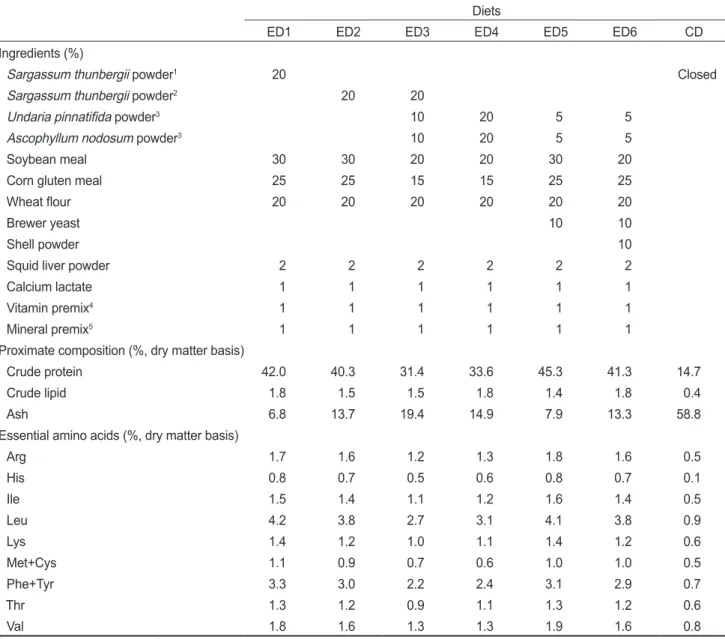
실험사료의원료조성및일반성분분석결과를
Table 2
에나타내었다.
주요사료원료로채집한지충이분말과시판수입산지충이분말의효과를비교하기위하여사료
1
은채집한지충이분말20%,
사료2
는시판지충이분말을20%
첨가하였고
,
지충이분말대체원으로미역분말과켈프밀의이 용성을조사하기위하여사료3
은미역분말과켈프밀을10%
씩 첨가하였으며,
사료4
는미역분말과켈프밀을20%
씩첨가하였 다.
사료5
는맥주효모10%
를,
사료6
은조개패각분말을10%
첨가하였다
.
사료7
은상업용시판해삼사료(
중국산)
를사용하 였다.
모든실험사료에는단백질원으로대두박과콘글루텐밀 을사용하였으며,
탄수화물원으로는소맥분을사용하였다.
이 와같이설계된실험사료는각원료들을잘혼합한후,
분쇄기(Pulverisette 16, Fritsch, Germany)
를사용하여150 μm
이하 의입자도로분쇄하여사육실험에사용하였다.
사육실험
해삼양식장
(
전북군산)
에서종자생산된어린해삼을구입하 여,
실험용사육수조에서2
주간순치시켰다.
사육실험은외형 적으로건강한어린해삼(
평균체중2.3±0.1 g)
을총21
개의400 L
원형수조에각수조당50
마리씩3
반복으로수용하여유수식으로
28
주간실시하였다.
각실험수조에는검은색플라스 틱사각은신처(shelter)
를3
개씩넣어해삼이은신할수있는사 육환경을만들어주었다(Seo et al. 2009).
사육수는자연해수 를10
톤사각수조에수용하여해수찌꺼기를침지시킨후,
각Table 1. Nutrient contents of the dietary ingredients
Sargassum thunbergii1 Sargassum thunbergii2 Undaria pinnatifida3 Ascophyllum nodosum3 Proximate composition (%, dry matter basis)
Crude protein 17.3 7.2 17.0 10.6
Crude lipid 1.9 0.5 1.9 5.4
Ash 16.8 52.5 26.1 19.5
Essential amino acids (%, dry matter basis)
Arg 0.6 0.2 0.7 0.3
His 0.2 0.1 0.3 0.1
Ile 0.7 0.2 0.7 0.3
Leu 1.0 0.4 1.2 0.5
Lys 0.8 0.3 0.8 0.4
Met+Cys 0.5 0.2 0.4 0.3
Phe+Tyr 1.1 0.4 1.1 0.5
Thr 0.7 0.2 0.7 0.3
Val 0.9 0.4 0.9 0.5
1Collected in Pohang, Korea. 2Imported from China (commercial feed). 3Supplied by E-wha Oil and Fat Ind. Co., Busan, Korea.
실험수조로분당
3 L
로조절하여흘려주었으며,
각수조에에어 를공급하였다.
사육기간동안의평균수온은19.5±3.9(12.4-
24.8)℃
였다.
사육기간동안사육실험장에빛을최대한차단시켜어두운조건에서사육실험을실시하였으며
,
사육기간중 죽은개체는매일제거하였고,
이틀에한번씩수조청소를실시 하였다.
실험사료는각사육수조별로50 mL
튜브에1
일공급 량을측량하고,
이를해수에혼탁하여사료가물에잘풀리도록준비하여
1
일1
회공급하였다(14:00).
사료공급후에는2
시간 동안사육수공급을중단시켜사료가바닥에가라앉아,
해삼의 사료섭취가원활하도록하였다.
일일사료공급량은사료공급 후다음날사료공급전까지해삼이사료를섭취하고사육수조 바닥에소량남아있을정도로조절하였다.
사육실험기간동안 의일일사료공급량은사료1-6
은해삼체중의1-2.5%
였으며,
사료7
은해삼체중의4-6%
였다.
Table 2. Ingredients and nutrient contents of the experimental diets
Diets
ED1 ED2 ED3 ED4 ED5 ED6 CD
Ingredients (%)
Sargassum thunbergii powder1 20 Closed
Sargassum thunbergii powder2 20 20
Undaria pinnatifida powder3 10 20 5 5
Ascophyllum nodosum powder3 10 20 5 5
Soybean meal 30 30 20 20 30 20
Corn gluten meal 25 25 15 15 25 25
Wheat flour 20 20 20 20 20 20
Brewer yeast 10 10
Shell powder 10
Squid liver powder 2 2 2 2 2 2
Calcium lactate 1 1 1 1 1 1
Vitamin premix4 1 1 1 1 1 1
Mineral premix5 1 1 1 1 1 1
Proximate composition (%, dry matter basis)
Crude protein 42.0 40.3 31.4 33.6 45.3 41.3 14.7
Crude lipid 1.8 1.5 1.5 1.8 1.4 1.8 0.4
Ash 6.8 13.7 19.4 14.9 7.9 13.3 58.8
Essential amino acids (%, dry matter basis)
Arg 1.7 1.6 1.2 1.3 1.8 1.6 0.5
His 0.8 0.7 0.5 0.6 0.8 0.7 0.1
Ile 1.5 1.4 1.1 1.2 1.6 1.4 0.5
Leu 4.2 3.8 2.7 3.1 4.1 3.8 0.9
Lys 1.4 1.2 1.0 1.1 1.4 1.2 0.6
Met+Cys 1.1 0.9 0.7 0.6 1.0 1.0 0.5
Phe+Tyr 3.3 3.0 2.2 2.4 3.1 2.9 0.7
Thr 1.3 1.2 0.9 1.1 1.3 1.2 0.6
Val 1.8 1.6 1.3 1.3 1.9 1.6 0.8
1 Collected in Pohang, Korea. 2 Imported from China (commercial feed). 3 Supplied by E-wha Oil and Fat Ind. Co., Busan, Korea. 4Vitamin premix contained the following amount which were diluted in cellulose (g/kg premix): L-ascorbic acid, 121.2; DL-α-tocopheryl acetate, 18.8; thiamin hydrochloride, 2.7; riboflavin, 9.1; pyridoxine hydrochloride, 1.8; niacin, 36.4; Ca-D-pantothenate, 12.7; myo-inositol, 181.8;
D-biotin, 0.27; folic acid, 0.68; p-aminobenzoic acid, 18.2; menadione, 1.8; retinyl acetate, 0.73; cholecalciferol, 0.003. 5Mineral premix contained the following ingredients (g/kg premix): NaCl, 43.3; MgSO4·7H2O, 136.5; NaH2PO4·2H2O, 86.9; KH2PO4, 239; CaHPO4, 135.3;
Ferric citrate, 29.6; ZnSO4·7H2O, 21.9; Ca-lactate, 304; CuCl, 0.2; AlCl3·6H2O, 0.15; KI, 0.15; MnSO4·H2O, 2.0; CoCl2·6H2O, 1.0. ED, experimental diet; CD, commercial diet.
해삼측정 및 성분분석
해삼의체중측정을위하여사육실험시작시와종료시에측정 전일
48
시간절식시킨후,
각수조에수용된해삼의전체무게 를측정하였다.
최초성분분석용으로해삼50
마리를샘플하였 으며,
실험종료시에는각실험수조에서생존한해삼중중간크 기의해삼을10
마리씩성분분석용으로샘플하여-25℃
에보관 하였다.
실험사료와해삼어체의성분중수분은135℃
에서2
시간건조후측정하였고,
조단백질(N×6.25)
은Auto Kjeldahl System (Gerhardt VAP50SC/KBL20, Germany)
을사용하여 분석하였다.
조지질은조지질추출기(Velp SER148, Italy)
를사용하여
ether
로추출한후측정하였으며,
회분은회화로를사용하여
550℃
에서4
시간동안태운후측정하였다. 통계처리
결과의 통계처리는
SPSS
프로그램을 사용하여One-way ANOVA-test
를실시한후Duncan’s multiple range test (Dun- can, 1955)
로평균간의유의성(P<0.05)
을검정하였다.
결과 및 고찰
실험사료에사용된주요사료원료의영양성분을분석한결 과
(Table 1),
채집한지충이분말은조단백질이17.3%,
조지질1.9%
및조회분은16.8%(
건물기준)
였으나,
상업용지충이분 말은조단백질이7.2%,
조지질0.5%
및조회분은52.5%
로동일한영양소종류간에도그함량은두종류의지충이분말간에현 저한차이를보였다
.
이와같이상업용지충이분말은채집한지 충이분말에비하여조단백질과조지질함량은현저히낮았으 나,
조회분함량은3
배이상으로월동히높게나타났으며,
상업 용해삼사료도조회분함량이58.8%(Table 2)
로상당히높아,
중국에서수입된상업용지충이분말과해삼사료에는해삼양 어가들이선호하여사료에혼합하여사용하고있는펄이상당 량함유되어있을가능성을시사하고있다.
실험용사료와상품사료를공급하며어린해삼을
28
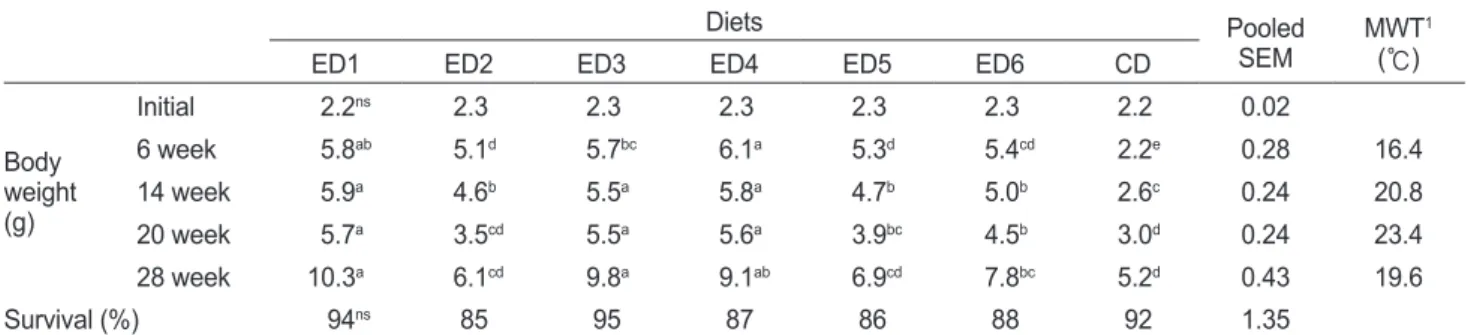
주간사육한결과를
Table 3
에나타내었다.
생존율은모든실험구에서85-94%
였으며,
실험구간에유의한차이는없었다.
사료별해삼의평균체중은사육실험
6
주후부터실험구간에유의한차이 를보였으며(P<0.05),
사육실험28
주후의최종체중은사료1(
채집지충이
),
사료3(
미역+
켈프밀+
시판지충이)
및사료4(
미역+
켈프밀)
실험구가가장높았으며,
다음에는사료6(
조개패각),
사료5(
맥주효모),
사료2(
시판지충이)
및 사료7(
시판사료)
의 순을보였다.
본연구에서채집지충이,
미역+
켈프밀+
시판지 충이및미역+
켈프밀실험구가가장좋은성장을보였으며,
이 실험구들간에는유의한차이가없었다.
본연구에서지충이분 말대체원료로가격이다소경제적이며안정적으로사용할수 있는해조류중미역분말과켈프밀의이용성을비교한결과,
미 역분말및켈프밀혼합실험구들과채집지충이분말첨가실험 구간에유사한성장을보여해삼배합사료에사용되고있는지 충이분말을미역분말및켈프밀로대체하여도좋을것으로판Table 4. Proximate composition (%) of whole body in juvenile sea cucumber Apostichopus japonicus fed the experimental diets for 28 weeks
Diets Pooled
ED1 ED2 ED3 ED4 ED5 ED6 CD SEM
Moisture 90.8ab 90.7ab 91.0ab 91.0ab 90.5b 90.6b 91.2a 0.67
Crude protein 3.9b 4.6a 3.9b 4.0ab 4.4ab 4.2ab 3.9b 0.08
Crude lipid 0.32a 0.28ab 0.27ab 0.16d 0.18cd 0.25ab 0.23bc 0.01
Ash 3.7a 3.6a 3.7a 3.6a 3.4b 3.6a 3.5ab 0.03
ED, experimental diet; CD, commercial diet. Values (mean of three replications) in each row with a different superscript are significantly different (P<0.05). Pooled standard error of means, SD/√n. ns Not significant (P>0.05).
Table 3. Growth performance of juvenile sea cucumber Apostichopus japonicus fed the experimental diets for 28 weeks
Diets Pooled
SEM MWT1
ED1 ED2 ED3 ED4 ED5 ED6 CD (℃)
Body weight (g)
Initial 2.2ns 2.3 2.3 2.3 2.3 2.3 2.2 0.02
6 week 5.8ab 5.1d 5.7bc 6.1a 5.3d 5.4cd 2.2e 0.28 16.4
14 week 5.9a 4.6b 5.5a 5.8a 4.7b 5.0b 2.6c 0.24 20.8
20 week 5.7a 3.5cd 5.5a 5.6a 3.9bc 4.5b 3.0d 0.24 23.4
28 week 10.3a 6.1cd 9.8a 9.1ab 6.9cd 7.8bc 5.2d 0.43 19.6
Survival (%) 94ns 85 95 87 86 88 92 1.35
1Mean water temperatures. ED, experimental diet; CD, commercial diet. Values (mean of three replications) in each row with a different superscript are significantly different (P<0.05). Pooled standard error of means, SD/√n. nsNot significant (P>0.05).
단된다
.
다양한해조류분말과펄및황토분말을혼합한먹이 로어린해삼을사육한기존연구에서도(Liu et al., 2010; Xia et
al., 2012)
해삼사료의해조류분말원료로써다시마와갈파래(Ulva lactuca)
는가격이비싸고생산이제한적인지충이를대체할수있는것으로보고되었다
.
본연구에서상업용지충이 분말실험구는채집지충이분말실험구에비해낮은성장을보였는데
(P<0.05),
이러한결과는상업용지충이분말의조단백질과같은필수영양소함량이채집지충이에비하여현저히낮 기때문으로판단된다
.
또한상업용지충이분말의조회분함량은
52.5%
로상당히높았는데,
이는중국에서수입된상업용지충이분말에는지충이분말외에다른원료들이상당량혼합되 어있을것으로판단된다
.
본연구에사용된자체제조한
6
종류의실험용사료모두시 판사료에비하여유의하게높은성장을보였다.
이러한결과는시판사료의조단백질함량은
14.7%
로실험용사료의31-45%
에비하여현저히낮기때문으로판단되며
,
기존에보고된해삼 의단백질요구량에관한연구에서어린해삼의적정성장을위 한단백질요구량은사료내20%
인것으로보고되었다(Seo and
Lee, 2011).
일반적으로사료종류별사육효과비교를위해서는사료의단백질및에너지함량이유사하도록설계하지만
,
본연 구에사용된실험사료의원료조성은실용적인면을우선적으로 고려하여α
려cellulose
와같은filler
를사용하지않았다.
실험용으로제조한사료
6
종의단백질함량은31-45%
로차이를보였으나
,
해삼의단백질요구량이20%
인점을감안할때이와같 은사료단백질함량의차이는해삼의성장에현저한영향을미 치지는않았을것으로판단된다.
본연구의사육실험기간중사육
14
주및20
주후의실험구별 해삼의평균체중은사육6
주후의평균체중과유사하거나오 히려감소하는결과를보였다.
체중증가가거의이루어지지않 은사육실험6-14
주및15-20
주의평균수온은각각20.8℃
및23.4℃
였다.
이와같은해삼의성장저하는여름철의높은수온에영향을받은것으로판단된다
.
그러나사육실험20-28
주의평균수온은
19.6℃
이었으나실험구별해삼의평균체중은증가하여평균수온이
20.8℃
였던6-14
주의성장결과와차이를보였다
.
이러한차이는사육실험6-14
주의수온은대부분20℃
전후였으나
,
사육실험20-28
주의경우4
주동안은수온이15- 20℃
로저하되었으며,
이기간동안에해삼의성장이원활히이 루어진것으로판단된다.
수온에따른해삼의성장도변화를조 사한Dong et al. (2006)
의연구에서수온21℃
에서사육된해삼은수온
15℃
및18℃
에서사육된해삼에비하여성장이감소하였으며
,
해삼의성장을위한최적수온은16-18℃
로보고되었다
. Yang et al. (2005)
의연구에서해삼의사료섭취및성장을 위한최적수온은14-15℃
이었으며,
수온20℃
이상에서는사 료섭취및성장이감소하고, 25℃
이상에서는하면(aestivation)
하는것으로보고되었다.
사육실험종료시,
해삼의일반성분분 석결과를표4
에나타내었다.
해삼어체의수분,
조단백질,
조지질및회분함량은실험구간에유의한차이를보였다
(P<0.05).
그러나해삼사료내식물성사료원료의이용성을조사한기존 의연구에서해삼어체의일반성분은사료원료에따라유의한 차이를보이지않았다
(Seo et al., 2011b).
본연구의결과에서실험용으로제조한사료
6
종모두시판사 료에비해우수한성장을보였으며,
해삼사료내지충이분말은 미역분말과켈프밀로대체가가능할것으로판단된다.
또한본 실험에사용된사료4
의사료원료조성비는어린해삼용실용배 합사료의조성으로사용하여도좋을것으로판단된다.
사 사
이논문은국립수산과학원수산과학연구사업
(R2017021)
및 해양수산부의지원으로수행된연구이며연구비지원에감사 드립니다.
References
Dong Y, Dong S, Tian X, Wang F and Zhang M. 2006. Effects of diel temperature fluctuations on growth, oxygen consump- tion and proximate body composition in the sea cucumber
Apostichopus japonicus Selenka. Aquaculture 255, 514-
521. http://doi.org/10.1016/j.aquaculture.2005.12.013.Duncan DB.1955. Multiple-range and multiple F tests. Biomet- rics 11, 1-42.
Liu Y, Dong S, Tian X, Wang F and Gao Q. 2010. The effect of different macroalgae on the growth of sea cucumbers (Apos-
tichopus japonicus Selenka). Aquac Res 41, 881-885.
Seo JY and Lee SM. 2011. Optimum dietary protein and lipid levels for growth of juvenile sea cucumber Apostichopus
japonicus. Aquacult Nutr 17, 56-61. http://dx.dol.10.1111/
j.1365-2095.2009.00728.x.
Seo JY, Choi J, Kim GU, Cho SS, Park HG and Lee SM. 2008.
Effects of dietary protein and lipid levels on growth and body composition of juvenile sea cucumber Stichopus ja-
ponicus. J Aquacult 21, 19-25.
Seo JY, Kim DG, Kim GU, Cho SS, Park HG and Lee SM.
2009. Effect of different substrates in the rearing tank on growth and body composition of juvenile sea cucumber
Apostichopus japonicus. J Aquacult 22, 118-121.
Seo JY, Shin IS and Lee SM. 2011a. Effect of various protein sources in formulated diets on the growth and body com- position of juvenile sea cucumber Apostichopus japoni-
cus. Aquac Res 42, 623-627. http://dx.dol.10.1111/j.1365-
2109.2010.02653.x.Seo JY, Shin IS and Lee SM. 2011b. Effect of dietary inclusion of various plant ingredients as an alternative for Sargassum
thunbergii on growth and body composition of juvenile sea cu-
cumber Apostichopus japonicus. Aquacult Nutr 17, 549-556.http://dx.doi.10.1111/j.1365-2095.2010.00849.x.
Statistics Korea. 2016. Fishery production survey. Korean Sta-
tistical Information Service, Daejeon, Korea. Retrieved from http://kosis.kr on Apr 12, 2017.
Xia S, Yang H, Li Y, Zhou Y and Zhang Y. 2012. Effects of dif- ferent seaweed diets on growth, digestibility, and ammonia- nitrogen production of the sea cucumber Apostichopus ja-
ponicus (Selenka). Aquaculture 338, 304-308. http://dx.doi.
org/10.1016/j.aquaculture.2012.01.010.
Yang H, Yuan X, Zhou Y, Mao Y, Zhang T and Liu Y. 2005. Effects of body size and water temperature on food consumption and growth in the sea cucumber Apostichopus japonicus (Selenka) with special reference to aestivation. Aquac Res 36, 1085-1092.
http://doi: 10.1111/j.1365-2109.2005.01325.x.