• 검색 결과가 없습니다.

Dutch Listeners' Perception of Korean Stop Consonants

N/A
N/A
Protected

Academic year: 2021

Share "Dutch Listeners' Perception of Korean Stop Consonants"

Copied!
7
0
0

로드 중.... (전체 텍스트 보기)

전체 글

(1)

Journal of the Korean Society of Speech Sciences Vol.7 No.1 (2015.03.31) www.speechsciences.or.kr

ISSN 2005-8063, pp. 89~95 http://dx.doi.org/10.13064/KSSS.2015.7.1.089

Dutch Listeners’ Perception of Korean Stop Consonants

Choi, Jiyoun

1)

ABSTRACT

We explored Dutch listeners’ perception of Korean three-way contrast of fortis, lenis, and aspirated stops. The three Korean stops are all voiceless word-initially, whereas Dutch distinguishes between voiced and voiceless stops, so Korean voiceless stops were expected to be difficult for the Dutch listeners. Among the three Korean stops, fortis stops are phonetically most similar to Dutch voiceless stops, thus they were expected to be the easiest to distinguish for the Dutch listeners. Dutch and Korean listeners carried out a discrimination task using three crucial comparisons, i.e., fortis-lenis, fortis-aspirated, and lenis-aspirated stops. Results showed that discrimination between lenis and aspirated stops was the most difficult among the three comparisons for both Dutch and Korean listeners. As expected, Dutch listeners discriminated fortis from the other stops relatively accurately. It seems likely that Dutch listeners relied heavily on VOT but less on F0 when discriminating between the three Korean stops.

Keywords: Discrimination, Dutch, Korean stops, non-native listeners, phoneme perception

1. Introduction

In the present study, we investigate how native listeners of Dutch perceive the Korean three-way contrast of fortis, lenis, and aspirated stops on bilabial, alveolar, and velar places of articulation.

The Korean fortis, lenis, and aspirated stop consonants are all voiceless in word-initial position, and these stops differ mainly in terms of voice onset time (VOT) and fundamental frequency (F0) on vowels following the stops. Regarding VOT, it has been typically reported that fortis stops are unaspirated with shortest VOT (approximately 20 ms on average), lenis stops slightly aspirated with medium VOT (70 ms), and aspirated stops are strongly aspirated with longest VOT (120 ms) (Cho, Jun, &

Ladefoged, 2002). More recent studies, on the other hand, demonstrated that VOT values for the aspirated stops decreased

1) Hanyang Phonetics & Psycholinguistics Laboratory, Hanyang University. Max Planck Institute for Psycholinguistics, The Netherlands. [email protected], corresponding author Received: October 31, 2014

Revised: December 13, 2014 Accepted: March 16, 2015

for young Korean speakers (born after the late 1970s) (Kang &

Guion, 2008; Silva, 2006), so that VOT differences between the aspirated and lenis stops became considerably smaller for young speakers (70 ms), compared to older speakers (94 ms) (Silva, 2006). In short, VOT values are likely to be distinctively short for the fortis stops, but those for the lenis and aspirated stops are likely to overlap (especially for a young generation).

Regarding F0, it has been consistently shown that the F0 is lowest for the lenis stops, intermediate for the fortis, and highest for the aspirated stops (Cho et al., 2002; Kang & Guion, 2008;

Silva, 2006).

Unlike the Korean three-way contrast, Dutch exhibits a

two-way laryngeal contrast among stops (on bilabial and alveolar

places of articulation, and only voiceless stops exist on velar

place of articulation) (Gussenhoven, 1999). While the Korean

stops are all voiceless word-initially, Dutch distinguishes voiced

and voiceless stops; specifically, Dutch distinguishes stops with

negative VOT (i.e., prevoiced stops) against stops with short-lag

VOT of about 25 ms (i.e., voiceless, unaspirated stops). For

Dutch listeners, prevoicing is a strong primary cue for the

voicing contrast, and F0 is a secondary acoustic cue only for the

bilabial place of articulation (van Alphen & Smits, 2004).

(2)

Given the fact that Korean has three voiceless stop categories (fortis, lenis, and aspirated stops) while Dutch has only one, the Korean three-way stop should be difficult for Dutch listeners.

Broersma (2010) showed that this is indeed the case. In the study, native listeners of Dutch were asked to identify the Korean fortis, lenis, and aspirated stops with a forced-choice identification task. The results showed that their performance was substantially less accurate than that for native listeners of Korean, with percentages of correct responses ranging from 55 to 79 % (here, chance level of 50%). In the present study, we again explore the perception of the Korean three-way stop by native Dutch listeners now using a different task, a discrimination task. It has been suggested that phoneme identification and discrimination tasks require different perception processes. Although it is so far not clear what exactly the two tasks measure, several studies have demonstrated that they sometimes yielded different results, and that a correlation between the identification and discrimination results was relatively weak (Broersma, Dediu, & Choi, 2013; Gerrits &

Schouten, 2004; Sadakata & McQueen, 2013). Thus, the question investigated here is whether the Dutch listeners also have difficulties in the perception of the Korean stops when a discrimination task is used.

There are some studies investigating the perception of the Korean three-way contrast by non-native listeners of other languages rather than Dutch, such as English and Mandarin listeners. English and Mandarin are aspiration languages, where stops with short-lag VOT (i.e., voiceless, unaspirated stops) contrast against stops with long-lag VOT (i.e., voiceless, aspirated stops), and thus aspiration is a primary phonetic cue for the stop contrast. The studies have shown that the aspiration languages’ listeners (English and Mandarin listeners) mainly used VOT to perceive the Korean three-way contrast as they do for their native language (Holliday, 2014; Kwon, 2013). Unlike Enlgish and Mandarin, however, Dutch is a true voice language, such that (as described above) it distinguishes between prevoiced stops and voiceless unaspirated stops, and prevoicing is the primary phonetic cue for the contrast. Based on the fact that a primary cue for the native stop contrasts differs between the aspiration and the true voice languages, the perception of the Korean stop contrast may be different for Dutch listeners than for the English and Mandarin listeners. Further, while the aspiration languages (e.g., English and Mandarin) have two categories for voiceless stops in their phonological system, there is only one voiceless stop category in Dutch. Thus, the

perception of the Korean three-way voiceless stop may be more difficult for Dutch listeners than for Enlgish and Mandarin listeners.

Among the three Korean stops, the fortis stops are phonetically most similar to Dutch voiceless stops. Thus, Dutch listeners are expected to distinguish Korean fortis stops more easily from lenis and aspirated stops than the latter two from each other (Best, 1994; Best & Tyler, 2007). We explore whether this is indeed the case. To that end, native listeners of Dutch carried out a discrimination task with three critical comparison types: fortis vs. lenis, fortis vs. aspirated, and lenis vs. aspirated. Further, in order to see whether certain comparison type(s) is intrinsically more difficult than the others (that is, acoustic cues are relatively weaker for certain comparisons than for another) regardless of the Dutch phonology system, native listeners of Korean also carried out the discrimination task. Their results were compared with those for the Dutch listeners.

2. Method

2.1 Participants

Twenty-nine native Dutch participants (16 female, 13 male, M

age

= 32.03 years, range: 19-47 years) and 25 native Korean participants (14 female, 11 male, M

age

= 29.56 years, range:

27-37 years) took part in the present study. The Dutch participants had not learnt Korean. None reported any hearing loss, uncorrected visual loss, or reading disability. All participants received a monetary reward for their participation.

2.2 Materials

The crucial contrast was the Korean three-way stop contrast, of fortis, lenis, and aspirated stops. There were three sets of stimuli; the first for bilabial stops [p*, p, p

h

], the second for alveolar stops [t*, t, t

h

], and the third for velar stops [k*, k, k

h

].

All sets contrasted fortis, lenis, and aspirated manner of articulation.

For each of the three sets, three minimal triplets of consonant-vowel-consonant-vowel (CVCV) Korean pseudowords were created (see <Table 1>). Within each triplet, items varied only in word-initial fortis, lenis, and aspirated stops. The initial syllables consisted of the crucial stops followed by the vowels [a], [i], or [u]. The final syllables were always [mi].

A female native speaker of standard South Korean (22 years old) recorded multiple tokens of all 27 items (i.e., nine triplets).

Four tokens of each item were selected for the test (with a total

(3)

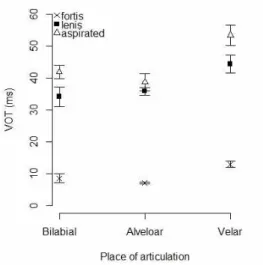
Figure 1. Voice onset time (VOT) for stop consonants. Error bars represent standard errors of 108 tokens). The items were recorded in a soundproof booth

with a Sennheiser microphone at a sampling rate of 44 kHz. The tokens were excised from the recording with the speech editor PRAAT (Boersma, 2001).

In each set, 36 tokens were used four times to form 72 pairs:

36 pairs in the Same condition, and 36 pairs in the Different condition. Of the pairs in the Different condition, 18 were experimental pairs that differed in the crucial stop contrast; the other 18 pairs were filler pairs that differed in the vowels in the first syllable. For the 18 Different experimental pairs, each consonant type was paired with every other consonant type (i.e., fortis-lenis, fortis-aspirated, lenis-aspirated) in both orders three times. For the 18 Different filler pairs, similarly, each first vowel was paired with every other first vowel (i.e., [a]-[i], [a]-[u], [i]-[u]) in both orders three times. The pairs in the Same condition always consisted of two different tokens of the same item, i.e., the same token was never repeated within a pair. All items and tokens occurred in the first and second position of a pair an equal number of times.

Place of articulation Fortis Lenis Aspirated

[p*ami] [pami] [p

h

ami]

Bilabial [p*imi] [pimi] [p

h

imi]

[p*umi] [pumi] [p

h

umi]

[t*ami] [tami] [t

h

ami]

Alveolar [t*imi] [timi] [t

h

imi]

[t*umi] [tumi] [t

h

umi]

[k*ami] [kami] [k

h

ami]

Velar [k*imi] [kimi] [k

h

imi]

[k*umi] [kumi] [k

h

umi]

Table 1. Minimal triplets

2.2.1 Acoustic properties of stimuli

For the selected 108 tokens, VOT of the target stops and F0 on the vowels following the stops were measured.

As shown in <Figure 1>, VOT was shortest for the fortis stops, longest for the aspirated, and in between for the lenis stops, on three places of articulation alike. An Analysis of Variance (ANOVA) was carried out with variables Place of articulation (bilabial, alveolar, velar) and Manner of articulation (fortis, lenis, aspirated). Indeed, there was a significant main effect of Manner of articulation, F(2, 22) = 214.828, p < .05, η

p2

= .951, such that VOT was shortest for the fortis,

intermediate for the lenis, and longest for the aspirated stop (ps

< .001), consistent with previous studies (Cho et al., 2002; Choi, 2002). There was also a significant main effect of Place of articulation, F(2, 22) = 14.144, p < .05, η

p2

= .563, so that the VOT of the velar stop was significantly longer than that of the alveolar and bilabial stop (ps < .001), whereas there was no significant difference between the alveolar and bilabial stop, in line with previous studies (Cho et al., 2002; Choi, 2002). An interaction between Place of articulation and Manner of articulation was significant, F(4, 44) = 2.778, p < .05, η

p2

= .202; as can be seen in <Figure 1>, the interaction stemmed from the fact that the VOT difference was significant for all comparisons except for lenis vs. aspirated comparison on alveolar place of articulation (ps < .05). Finally, it is worthy to note that in line with recent studies (Kang & Guion, 2008; Silva, 2006), VOT difference between the aspirated and lenis stop was small, such that the difference was only 7.8 ms on average for the bilabial, 2.8 ms for the alveolar, and 9.0 ms for the velar stops.

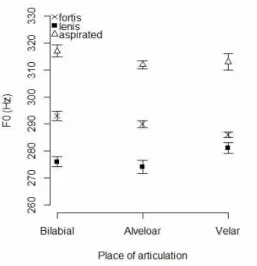
Next, as in VOT, similar ANOVA was carried out with F0 values. There was a significant main effect of Manner of articulation, F(2, 22) = 205.200, p < .05, η

p2

= .949; in line with previous studies (Cho et al., 2002; Choi, 2002; Kang & Guion, 2008), F0 was lowest for the lenis, intermediate for the fortis, and highest for the aspirated stops (ps <.001). Also, there was an interaction between Place of articulation and Manner of articulation, F(4, 44) = 4.820, p < .05, η

p2

= .305. The

interaction was mainly due to the fact that the F0 difference was

significant for all comparisons (ps < .05), whereas fortis vs. lenis

comparison on velar place of articulation just missed the

significance (p = .055).

(4)

Figure 2. Fundamental frequency (F0) on following vowels. Error bars represent standard

errors.

2.3 Procedure

A discrimination task was used. The test consisted of three blocks. Those three blocks tested the contrasts at alveolar, bilabial and velar place of articulation, respectively, in that order for all participants. Each block started with a written instruction, followed by eight practice trials, a break during which participants could ask questions, and the main test phase.

Participants were informed that they would hear two non-words. They were asked to determine whether the two non-words were the same or different. Each trial started with a fixation mark on the computer screen for 400 ms, followed by a 400 ms delay, auditory presentation of the first stimulus, an interstimulus interval (ISI) of 500 ms, and auditory presentation of the second stimulus. Participants pressed one of two keys on the computer keyboard to give their response: "H" if they thought that the two words were the same, or "A" if they thought that the two words were different. There was no time-out for responses. For all participants, in each test session, all 72 pairs were presented, in a random order.

The eight practice trials were identical to the test trials except that feedback was given after each practice trial. The practice trials contained stimuli that were used during the test, but that were paired differently. Presentation software (from the 14 series, Neurobehavioral Systems Inc.) was used for constructing and running the experiment.

3. Results

First, using the results from all experimental pairs (i.e., for the Same pairs and the Different experimental pairs together), the Dutch participants’ performance is compared with that for the Korean participants. Second, using the results from the Different experimental pairs only, we explore how participants perceive the differences between fortis vs. lenis, fortis vs. aspirated, and lenis vs. aspirated stop comparisons, and how the Dutch and Korean groups differ in it.

3.1 Overall sensitivity

<Table 2> shows the native Dutch participants’ and the native Korean participants’ overall percentage of correct responses for all experimental pairs (i.e., the Same pairs and the Different experimental pairs together). As the table shows, the Dutch participants scored much less than the Korean participants who performed almost perfect.

Dutch participants Korean participants

% correct 78.65 (1.05) 95.68 (0.41)

Table 2. Percentage correct for all experimental pairs across all three places of articulation (and standard error), separately for

Dutch participants and Korean participants.

As a measure of perceptual sensitivity, d’ (d-prime) values were used as dependent variable (McNicol, 1972). d' was calculated for each participant, test, and place of articulation separately, using the Same and Different experimental pairs (see

<Table 3>). When ‘Hits’ or ‘False alarms’ were either 0.00 or 1.00, those values were substituted by 0.01 and 0.99, respectively (Macmillan & Creelman, 1991). Responses with reaction times (RTs) longer than 5,000 ms (293, 1.0 % of all responses) were considered as outliers and excluded from analysis.

The two groups are compared. ANOVA on d' was carried out across participants with the variables Place of articulation (bilabial, alveolar, velar), and Group (Dutch, Korean). Indeed, as

<Table 3> already suggests, there was a significant main effect

of Group, F(2, 51) = 111.287, p < .05, η

p2

= .814, with no

interactions. In short, not surprisingly, the native Korean

listeners’ perceptual sensitivity is significantly higher than that

for the native Dutch listeners.

(5)

Figure 3. Percentage correct for Fortis-Lenis, Fortis-Aspirated, and Lenis-Aspirated comparisons, separately

for Dutch and Korean participants on alveolar, bilabial, and velar places of articulation. Error bars represent

standard errors.

Dutch participants Korean participants

Bilabial 1.57 (0.06) 3.94 (0.06)

Alveolar 1.61 (0.11) 3.59 (0.07)

Velar 1.57 (0.11) 3.39 (0.09)

Overall 1.54 (0.09) 3.55 (0.10)

Table 3. d’ (and standard error) for alveolar, bilabial, and velar targets, separately for Dutch participants and Korean participants.

(Higher values of d’ indicate greater sensitivity.)

3.2 Comparison types

To investigate how participants perceive the differences between fortis vs. lenis, fortis vs. aspirated, and lenis vs.

aspirated stop comparisons, and how the Dutch and Korean groups differ in it, additional analyses were done with the Different experimental pairs only. Therefore, proportions of correct responses for the Different experimental pairs were used as the dependent variable. Again, responses with RTs longer than 5,000 ms (105, 1.0 % of all responses) were excluded from analysis.

As expected, the Korean participants outperformed the Dutch participants. As <Figure 3> and <Table 4> show, for both groups alike, percentage of correct responses was lower for the lenis-aspirated comparisons than for the other two types of comparisons (fortis-lenis and fortis-aspirated). For the lenis-aspirated pairs, the Dutch participants were most accurate for the velars, and most inaccurate for alveolars; the Korean participants were more accurate for the bilabials than for the alveolars and velars.

ANOVA was carried out across participants with the variables Place of articulation (bilabial, alveolar, velar), Comparison type (fortis-lenis, fortis-aspirated, lenis-aspirated), and Group (Dutch, Korean). As expected, the Korean participants performed significantly better than the Dutch participants, F(1, 52) = 67.343, p < .05, η

p2

= .564. Importantly, there was a significant main effect of Comparison type, F(2, 104) = 45.272, p < .05, η

p2

= .465, and a three-way interaction among Place of articulation, Comparison type, and Group, F(4, 208) = 3.340, p < .05, η

p2

= .06.

Dutch participants Korean participants

Fortis-Lenis 65.0 (4.8) 99.6 (0.3)

Fortis-Aspirated 64.5 (4.8) 99.6 (0.3) Lenis-Aspirated 40.0 (4.7) 80.4 (3.2)

Overall 56.5 (4.0) 93.1 (1.5)

Table 4. Percentage correct (and standard error) for Fortis-Lenis, Fortis-Aspirated and Lenis-Aspirated comparisons across all three places of articulation, separately for Dutch and

Korean participants.

Follow-up analyses confirmed that the lenis-aspirated pairs received significantly fewer correct responses than the other two comparison types, for both groups alike (fortis-lenis vs.

lenis-aspirated for Dutch: F(1, 28) = 30.375, p < .05, η

p2

= .520; fortis-aspirated vs. lenis-aspirated for Dutch: F(1, 28) = 20.225, p < .05, η

p2

= .419; fortis-lenis vs. lenis-aspirated for Korean: F(1, 24) = 38.703, p < .05, η

p2

= .617; fortis-aspirated vs. lenis-aspirated for Korean: F(1, 24) = 39.733, p < .05, η

p2

= .623), whereas there was no difference between the fortis-lenis and the fortis-aspirated pairs.

To investigate further the three-way interaction, six separate

ANOVAs were undertaken with the variable Place of articulation

(bilabial, alveolar, velar), separately for each comparison pair and

for each participant group. Results showed that there was a

(6)

significant main effect of Place of articulation with the lenis-aspirated pairs for the Korean participants and a definite trend toward significance for the Dutch participants (for Korean participants: F(2, 48) = 4.688, p < .05, η

p2

= .163; for the Dutch participants: F(2, 56) = 2.770, p = .07, η

p2

= .09): For the Korean participants, accuracy was significantly better for the bilabials than for the alveolars and velars (ps < .05), whereas for the Dutch participants, accuracy was significantly better for the velars than for the alveolars (p < .05). Interpretation of the results will be discussed in the Discussion section.

Next, the two groups were compared at each place of articulation for each comparison type; 9 t-tests were carried out (3 places of articulation * 3 comparison types), using Bonferroni correction. All the comparisons showed significant effects (Bonferroni corrected ps < .05), confirming that the native Korean participants performed better than the Dutch participants in all the comparisons.

In short, these analyses show that fortis consonants were easier to distinguish from the lenis and aspirated consonants than the other two from each other, both for the Dutch and Korean participants, and for all places of articulation alike. Second, for the lenis versus aspirated stops, the Dutch participants’

discrimination accuracy was the worst for the alveolar place of articulation.

4. Discussion

In the present study, we explored how native listeners of Dutch perceive the Korean three-way contrast of fortis, lenis, and aspirated stops, and we compared the results of the Dutch listeners to those for native listeners of Korean. The Dutch and Korean participants carried out a discrimination task with three critical comparison types, i.e., fortis-lenis, fortis-aspirated, and lenis-aspirated. The most important finds are summarized below.

First, the results showed that, not surprisingly, the Korean participants outperformed the Dutch participants for all comparison types.

Second, both the Korean and Dutch listeners showed a similar pattern for the comparison types, such that the lenis-aspirated comparison was the most difficult to distinguish while the fortis-lenis and fortis-aspirated comparisons were relatively easy.

That is, the Korean fortis stops were more easily distinguishable from lenis and aspirated stops than the latter two from each other, for all groups alike. For the Dutch participants, this is probably explained by the similarities/differences between Korean

and Dutch phonology. Fortis stops could be expected to be easiest to distinguish for Dutch listeners because they are most similar to Dutch stops (namely voiceless stops) in terms of VOT.

Given the fact that fortis stops are most similar to Dutch stops, the Perceptual Assimilation Model (Best, 1994; Best & Tyler, 2007) would predict the fortis stops to be the easiest to discriminate for native listeners of Dutch.

However, another possible explanation (and, given the results of the Korean participants, a more likely one) could be that the lenis-aspirated contrast is intrinsically more difficult than the other two contrasts. All participants had difficulty discriminating the lenis from the aspirated stops. The Dutch participants scored below chance level (i.e., 50%), and the Korean participants had only 80.4% correct for the lenis-aspirated pairs, whereas their performance was almost flawless for the fortis-lenis (99.6%) and the fortis-aspirated comparisons (99.6%). The worst performance on the lenis-aspirated pairs was also demonstrated in Broersma (2010) in that both Dutch and Korean listeners performed worst on identification of the lenis vs. aspirated stops. Taken together, it suggests that the acoustic cues (possibly including VOT, see section 2.2.1) distinguishing between lenis and aspirated stops are relatively weak, making it a relatively difficult distinction even for native listeners of Korean.

Our results also suggest that the Dutch listeners might have used F0 cue for the discrimination to some extent but not very effectively. <Figure 2> showed that the difference in F0 was maximized for the lenis-aspirated pairs comparing to the other comparisons, suggesting that F0 is probably the most reliable acoustic cue for the lenis-aspirated distinction. However, the Dutch participants performed worst for the distinction and even performed lowered than a chance level. Thus, it seems likely that the participants did not effectively use the F0 cue for the discrimination.

Next, for the lenis-aspirated pairs, the Dutch participants were most inaccurate for the alveolar place of articulation. This may be due to the small difference in VOT between the lenis and aspirated alveolar stops. As shown in <Figure 1>, VOT made clear distinctions for all comparison types at all places of articulation, except for the lenis vs. aspirated alveolar stops, where some VOT values for the lenis alveolar stops overlapped with those for the aspirated alveolar stops. Thus, it seems likely that such small VOT difference made the discrimination of the lenis vs. aspirated alveolar stops difficult for the Dutch listeners.

Overall, the present study showed that the Dutch listeners may

rely heavily on VOT but less on F0. The pattern of cue

(7)

weighting is similar to that for native English listeners (Kwon, 2013). Importantly, however, the pattern of discrimination accuracy differs between the two studies; the lenis-aspirated pairs received the lowest accuracy in the present study, while the fortis-lenis pairs received the lowest accuracy in another (Kwon, 2013). This discrepancy is possibly caused by different acoustic properties for stimuli used in experiments. Thus, it seems crucial for future studies to provide acoustic characteristics for stimuli along with experimental results.

References

Best, C. T. (1994). The emergence of native-language phonological influences in infants: A perceptual assimilation model. In J. C.

Goodman & H. C. Nusbaum (Eds.), The Development of Speech Perception: The Transition from Speech Sounds to Spoken Words (pp. 167-224). Cambridge, MA: MIT.

Best, C. T., & Tyler, M. D. (2007). Nonnative and second-language speech perception: Commonalities and complementarities. In M.

J. Munro & O. S. Bohn (Eds.), Second Language Speech Learning: The Role of Language Experience in Speech Perception and Production (pp. 13-34). Amsterdam: John Benjamins.

Boersma, P. (2001). Praat, a system for doing phonetics by computer. Glot International, 5, 341-345.

Broersma, M. (2010) Dutch listeners' perception of Korean fortis, lenis, and aspirated stops: First exposure. Proceedings of the Sixth International Symposium on the Acquisition of Second Language Speech (New Sounds 2010), Poznań, Poland (DVD).

Broersma, M., Dediu, D., & Choi, J. (2013). Individual differences in learning to perceive novel phonetic contrasts: How stable are they across time and paradigms? Journal of the Acoustical Society of America, 134, 4107 (Abstract).

Cho, T. H., Jun, S. A., & Ladefoged, P. (2002). Acoustic and aerodynamic correlates of Korean stops and fricatives. Journal of Phonetics, 30, 193-228. doi: 10.1006/jpho.2001.0153

Choi, H. (2002). Acoustic cues for the Korean stop contrast - Dialectal variation. ZAS Papers in Linguistics, 28, 1-12.

Gerrits, E., & Schouten, M. E. H. (2004). Categorical perception depends on the discrimination task. Perception & Psychophysics, 66, 363-376.

Gussenhoven, C. (1999). Dutch. Handbook of the International Phonetic Association: A Guide to the Use of the International

Phonetic Alphabet (pp. 74-77). Cambridge: Cambridge University Press.

Holliday, J. J. (2014). The perceptual assimilation of Korean obstruents by native Mandarin listeners. Journal of the Acoustical Society of America, 135(3), 1585-1595.

Kang, K. H., & Guion, S. G. (2008). Clear speech production of Korean stops: Changing phonetic targets and enhancement strategies. Journal of the Acoustical Society of America, 124(6), 3909-3917.

Kwon, N. (2013). Acoustic observation for English speakers’

perception of a three-way laryngeal contrast of Korean stops.

Proceedings of the 44th Conference of the Australian Linguistics Society.

Macmillan, N. A., & Creelman, C. D. (1991). Detection Theory: A User's Guide. Cambridge: Cambridge University Press.

McNicol, D. (1972). A Primer of Signal Detection Theory. Sydney:

George Allen & Unwin.

Sadakata, M., & McQueen, J. M. (2013). High stimulus variability in nonnative speech learning supports formation of abstract categories: Evidence from Japanese geminates. Journal of the Acoustical Society of America, 134, 1324-1335.

Silva, D. J. (2006). Acoustic evidence for the emergence of tonal contrast in contemporary Korean. Phonology, 22, 287-308.

van Alphen, P. M., & Smits, R. (2004). Acoustical and perceptual analysis of the voicing distinction in Dutch initial plosives: The role of prevoicing. Journal of Phonetics, 32, 455-491.

•최지연 (Choi, Jiyoun)

한양대학교 수행인문학 연구소

서울시 성동구 행당동 17 인문관 104호

Tel: 02-2220-2507 Fax: 02-2220-0741

Email: [email protected]

현재 박사 후 연구원

수치

Figure  1.  Voice  onset  time  (VOT)  for  stop  consonants.  Error  bars  represent  standard  errorsof  108  tokens)
Figure  2.  Fundamental  frequency  (F0)  on  following  vowels.  Error  bars  represent  standard
Table  3.  d’  (and  standard  error)  for  alveolar,  bilabial,  and  velar  targets,  separately  for  Dutch  participants  and  Korean  participants

참조

관련 문서

A Study on the Effects of the Native Language on Perception of the Syllable Coda consonants of Korean: With Focus on the Learners of Japanese and Chinese.. A

This study investigated three acoustic cues in order to differentiate the typologically unusual three-way laryngeal contrast in Korean stops in terms of

First, the degree of lip constriction (as measured by the lip aperture between the upper and lower lips) was smaller for the lenis /p/ and larger for the fortis/aspirated /p*,p

The current study explored the question by examining the perceptual accommodation of the three-way laryngeal contrast of Korean stops for Kyungsang dialect speakers