1. Introduction
It has been reported that Korean listeners perceive English /s/
as either plain /s/ or fortis /s*/ depending on the characteristics of particular tokens of English /s/, as they vary according to its syllabic affiliation. According to Kim (1999) and Kim & Curtis (2001), English /s/ in consonant clusters maps into a plain /s/
while English single /s/ and word final /s/ maps into a fortis /s*/
in Korean. They hypothesized that the durational properties of English /s/ vary depending on syllable type, single or cluster onsets, and that Korean listeners use this durational differences as a cue in their perception of English /s/. This result is indeed consistent with other previous studies on fricatives in general,
1) Hankuk University of Foreign Studies, [email protected]
Received: September 7, 2015 Revised: September 16, 2015 Accepted: September 19, 2015
where differential perception of fricatives is attributed to acoustic properties of the frication noise, including duration (e.g., You, 1979; Klatt, 1987; Behrens and Blumstein, 1988a; Schadle, 1985;
Kim, 1999; Kim & Curtis, 2001; among others). However, the phoneme mapping pattern provided by Kim (1999) and Kim &
Curtis (2001) does not match with the Korean native grammar, where both plain and fortis fricatives appear as a single consonant without any phonotactic restrictions.
This inconsistency can be connected to the fact that frication noise itself may not provide enough cues to phoneme identification, as other studies have reported (Moon, 1997; Lee, 2001; Jang, 2001 for Korean-English /s/ mapping; Behrens &
Blumstein, 1988b for English fricatives). In addition, studies on Korean obstruents, considering categorization among lenis, aspirated, and fortis consonants, show that the Korean fricatives influence their following vowels in a linguistically significant way (Cho, 1996; Lee, 2001). The fact that the vowel plays an important role in the perception of Korean fricatives is consistent Journal of the Korean Society of Speech Sciences Vol.7 No.3 (2015.09.30) ksss.jams.or.kr
ISSN 2005-8063, pp. 117~128 http://dx.doi.org/10.13064/KSSS.2015.7.3.117
Segmental Interpretation of Suprasegmental Properties in Non-native Phoneme Perception
Kim, Miran1)
ABSTRACT
This paper investigates the acoustic-perceptual relation between Korean dent-alveolar fricatives and the English voiceless alveolar fricative /s/ in varied prosodic contexts (e.g., stress, accent, and word initial position). The denti-alveolar fricatives in Korean show a two-way distinction, which can be referred to as either plain (lenis) /s/ or fortis /s*/. The English alveolar voiceless fricative /s/ that corresponds to the two Korean fricatives would be placed in a one-to-two non-native phoneme mapping situation when Korean listeners hear English /s/. This raises an interesting question of how the single fricative of English perceptually maps into the two-way distinction in Korean. This paper reports the acoustic-perceptual mapping pattern by investigating spectral properties of the English stimuli that are heard as either /s/ or /s*/ by Korean listeners, in order to answer the two questions: first, how prosody influences fricatives acoustically, and second, how the resultant properties drive non-native listeners to interpret them as segmental features instead of as prosodic information. The results indicate that Korean listeners’ responses change depending on the prosodic context in which the stimuli are placed. It implies that Korean speakers interpret some of the information provided by prosody as segmental one, and that the listeners take advantage of the information in their judgment of non-native phonemes.
Keywords: perceptual mapping, alveolar fricative /s/, segmental vs. suprasegmental phonetic information
with studies on English fricatives, where vowel information is implicated in the perception of fricatives (Behrens & Blumstein, 1988b; Klatt, 1987; Lambacher at al., 2001).
In parallel with the importance of vowel information in fricative perception, the current study examines prosodic effects on /sV(C)/ syllables in English, whose subsequent acoustic properties may also influence the categorization of English /s/ as one of the two fricatives by Korean listeners. Prosodic boundary differences, for instance utterance-initial vs. utterance-medial, affect segments quantitatively or qualitatively, as reported in Cho, McQueen & Cox, 2007) for the case of domain-initial strengthening in English. It has been also noted that the quality of segments can be affected by stress. Stress effects are not limited to vowels and are also found in consonants (Klatt, 1974;
Cho & Keating, 2001; Keating, Cho, Fougeron, and Hsu, 2003;
Cho & McQueen, 2005).
Given that Korean has two voiceless alveolar fricatives which correspond to English /s/, an interesting question arises as to how Korean listeners perceive English /s/ that does not perfectly match any of their phonemes. Considering the findings in the literature together, the current study hypothesizes that prosodic effects on English /s/ influence Korean listeners' perception of this non-native phoneme. One implication behind this hypothesis is that Korean listeners interpret prosodic information associated with English /s/ as a part of the segmental properties of English /s/ instead of attributing them to prosodic effects.
This paper is organized as follows. Section 2 overviews previous studies on phonetic, perceptual, and prosodic aspects of the English alveolar fricative and the denti-alveolar fricatives in Korean. Section 3 details a perceptual experiment to test the hypothesis and discusses the results. An acoustic analysis is also provided in this section regarding the English /s/ varied in prosodic contexts. Finally, section 4 will summarize the findings and discuss some of the important implications regarding acoustic-perceptual mapping relation in non-native phoneme perception contexts.
2. Voiceless alveolar fricatives in Korean and English
Most studies on English fricatives have dealt with the acoustic and perceptual aspects in terms of different manner or place of articulation (Hughes & Halle, 1956; Harris, 1958; Strevens, 1960;
Heinz & Stevens, 1961; Shadle, 1985,1990, 1997; MaCastle, 1978, 1979a, 1979b; Nartey, 1982; Klatt, 1987; Behren &
Blumstein, 1988a, 1988b; among others). On the other hand,
Korean fricative studies have focused on comparing the phonetic and perceptual distinctions between phonemes that are identical in terms of manner and place of articulation.
The phonetic-perceptual relation associated with the three-way distinction for Korean stops has been extensively researched in the literature. They introduce typologically uncommon phonemic contrasts among them in terms of lenis, aspirated, and fortis, and also provide an interesting relation between different acoustic properties and multiple cues in the perceptual distinction from one another (Kim, 1965; Han and Weitzman, 1970; Halle and Stevens 1971; Hardcastle, 1973; Kagaya, 1974; Hirose, Lee, &
Ushijima, 1974; Baik 1998; Cho, Jun, and Ladefoged, 2002;
Park, 2002b; among others). Studies of the Korean fricative /s/, on the other hand, shows another interesting distinction; here the lenis-aspirated distinction disappears, and one phoneme /s/
contrasts with its fortis counterpart /s*/. Therefore, many studies have focused on which category Korean-/s/ belongs to, lenis or aspirated (Kim, 1970; Iverson, 1983; Cho, 1996; Kang, 2000;
Park, 2002a; Yoon, 1999, 2002; Oh, 2003, among others).
Perception of speech sounds is assumed to be influenced by speakers' experience with their native language system, and the investigation of the phonetic properties of Korean fricatives is the basis for predicting which properties of the native sound system play a role in perceptual categorization of non-native sounds. For Korean fricatives, articulatory, acoustic, and perceptual aspects of each fricative will be discussed.
2.1 Phonetic properties of Korean fricatives
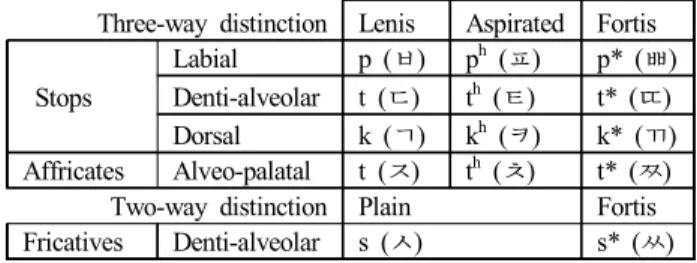
The phonemic inventory of Korean obstruents is shown in
<Table 1>, where the lenis-aspirated contrast becomes neutralized in fricatives, yielding an idiosyncratic distinction from the other obstruents' distribution.
Three-way distinction Lenis Aspirated Fortis
Stops
Labial p (ㅂ) ph (ㅍ) p* (ㅃ) Denti-alveolar t (ㄷ) th (ㅌ) t* (ㄸ) Dorsal k (ㄱ) kh (ㅋ) k* (ㄲ) Affricates Alveo-palatal t (ㅈ) th (ㅊ) t* (ㅉ)
Two-way distinction Plain Fortis
Fricatives Denti-alveolar s (ㅅ) s* (ㅆ)
Table 1. Korean phonemic inventory (obstruents)
<Table 1> shows that stops and affricates have counterparts in terms of lenis, aspirated, and fortis while fricatives are contrasted in fortis vs. non-fortis counterparts, but lacking the contrast between lenis and aspirated. This gap has motivated a number of
studies to investigate how to best describe /s/.
Korean orthography, which is a highly phonemic transcription, represents /s/ as a lenis, as evidenced by the fact that it shares the same representational convention with other lenis obsturents;
lenis consonants are transcribed with a single letter, while fortis consonants are represented in an orthographical gemination of a lenis counterpart (e.g. the labial fortis stop ('ㅃ') is from its lenis counterpart ('ㅂ'), and so forth). This seems to suggest that /s/
belongs to a lenis category. One other piece of evidences is that /s/ undergoes fortition after syllable-final stops just as other lenis obstruents do, in contrast to the aspirated series (i.e., 'picking' /tɕip.ki/ → [tɕip.k*i], /tɕipsi/ → [tɕips*i], but not 'house-key' /tɕipkhi/ → *[tɕipk*i]), as discussed in Kim-Renaud (1976) and Cho, Jun, and Ladefoged (2002). However, there are studies which suggest that acoustic properties of Korean-/s/ are close to those of the aspirated category in terms of glottal opening or vocal fold tension (Kagaya, 1974), or that they have intermediate status between lenis and aspirated in terms of Voice Onset Time (VOT; Iverson, 1983), in comparison to contrasts in the same dimension in Korean obstruents. Thus, it can be said that /s/
behaves like the lenis series phonologically, but shows the phonetic properties neither of lenis nor of fortis.2)
The focus in looking for distinctive properties for the two Korean fricatives is usually either in frication noise (Iverson, 1983; Kim, 1999; Kang, 2000; Kim & Curtis 2001, among others), or in the aspiration between the fricative and vowel (Yoon, 1999, 2002). However, there have been studies reporting that vowels adjacent to the fricative differ in duration in terms of plain and fortis in Korean (Moon, 1997; Lee 2001; Park, 2002). This, combined with the spectral differences reported by Cho, Jun, and Ladefoged (2002), suggests that post-fricative vowels carry important cues in the identification of the two fricatives in Koreans' perception.
2.2 Perceptual mapping
There have been three relevant studies on phoneme mapping between the two languages, and the studies show different results. The first two studies, Kim (1999) and Kim & Curtis (2001), entertain the hypothesis that syllable type in English has a phonetic reflex in terms of [s] duration, and that Korean listeners use the durational difference as a main cue when they categorize English [s]. The hypothesis is based on Kim’s (1999) survey with 10 native speakers. She reports /s/ loanword patterns
2) This paper will use "plain" for /s/ rather than identifying it as lenis or aspirated fricatives.
by Korean listeners as in (1).
(1) English loan word to Korean with voiceless dental fricatives /s/ (Kim, 1999; 51):3)
a. English /s/ to Korean plain /s/: scale, schedule, slang, slide, small, smart, snack, snow, special, speech, square, stage, stand, student, super, sweater, sweet, (supermarket), (Sri Lanka), etc.
b. English /s/ to Korean fortis /s*/: saccharin, salad, sausage, season, secret, sensation, seminar, sign, submarine, symbol, swimming, syrup, system, cigar, (cider), (Cinderella), (soda), (Satan), etc.
The pattern given in (1) suggests that English /s/ in consonant clusters maps into the Korean plain /s/ while the English single /s/ maps into the Korean fortis /s*/. One problem here is that foreign word transcription in Korean has an instructed rule, which forces Koreans not to adopt fortis consonants in transcription.4) For example, 'supermarket' is often transcribed with the Korean lenis letter due to the transcriptional restriction.
As Kim (1999) noted, the judgment for this form was not agreed upon by the subjects (Kim, 1999; p. 51). Another problem is that when Korean listeners hear a foreign word as a whole, they have a bias toward a lenis, which is likely to influence the listeners' judgment of what they hear. In other words, what they answered in her survey can either be based on their perception of the sound or based on the "correct" transcription for foreign words that they have learned prescriptively. Therefore, degree of familiarity with the word is possibly involved in her results.
A perception test was also conducted in Kim (1999) with stimuli varied in the duration of frication noise for /s/. The frication noise was followed by 50 ms of the vowel [a] excised from the word "sock". 16 subjects heard the stimuli with 35 trials yielding a total of 560 responses. The result shows that longer duration gradually changes the responses of English /s/
perception from plain to fortis. A drastic change of the responses from 110 ms to 140 ms is observed: 17.5% increase for /s*a/
response. This result in general confirms her duration hypothesis.
However, the response change around 110-140 ms is striking
3) Kim (1999) reports that words in parenthesis indicate disagreement among subjects.
4) The bulletin distributed by the Ministry of Education instructs as follows: 'In principle, stops in foreign words are not transcribed as fortis. (Item 85-11).' Fricatives may presumably follow this rule, and one example is found in the description;
'setback' /setbek/, not with fortis /s*/ in Korean.
when we consider the mean duration of Korean fricatives: for instance, Lee (2001) obtained the mean duration of /s/ and /s*/
as 139.8 ms (SD: ±2.96) and 138.6 ms (SD: ± 10.01) in word-initial positions. Thus, we see that the actual durations of the native language consonants were not reflected in the perception experiment in Kim (1999), and the findings in Kim (1999) can be understood that Korean speakers show a preference for short plain and long fortis fricatives in non-native phoneme perception.
For the perception of native phonemes, Lee (2001) found that Korean listeners do not show a critical change in their responses for the changes in duration. Lee's (2001) perception test used /sa-s*a/ stimuli, which were manipulated in the duration of frication noise (from 40 ms to 120 ms at 10 ms intervals). Her results showed that the duration factor did not change Korean listeners' responses (with only a 10% response change from 110-120 ms). When the duration is less than 50 ms, we find 20% mismatching responses to the stimuli, and for the rest of the stimuli, listeners perceived the stimuli 100% correctly.
Based on the results, Lee (2001) concludes that Korean subjects are not sensitive in their perception of native /s/ and /s*/ sounds when only duration changes. The results indicate that /s-s*/
perception is very stable regardless of different duration of frication noise when vowels are controlled. One implication we find from the results is that fricative durations of 60-110ms may carry enough information to identify the fricatives. This interpretation is also consistent with Jongman's (1988) study, where English /s/ was perceived more than 80% correctly with 50 ms duration of fricative noise in his stimuli.
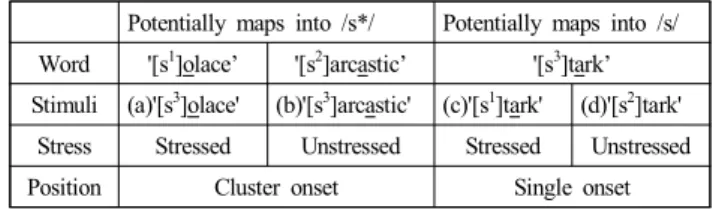
Another study by Jang (2002) examined the durational cue in the perception of English /s/ by Koreans, considering lexical stress effects on the English fricative. He conducted two perception experiments with stimuli where either the frication noise or the vowel was spliced between stress conditions. For instance, one stimulus includes frication noise from a stressed syllable, keeping the vowel unstressed as it was. Another stimulus keeps the vowel under stress and frication noise is replaced with frication noise from an unstressed syllable. <Table 2> shows the stimuli used in Jang (2002).
The stimuli (a) and (b) have shortest [s] from a cluster-onset, stimulus (c) has longest duration [s] replaced by a stressed single onset [s], and stimulus (d) has intermediate duration of the fricative which comes from unstressed single onset. If fricative duration varied by syllable type, as hypothesized in Kim (1999) and Kim & Curtis (2001), then the result is supposed to show a
cut line between (a)-(b) and (c)-(d) in pairs, because the stimuli (a) and (b) include the shortest /s/ from an onset cluster, while (c) and (d) now have frication noises that come from single onsets. The result shows that there is no response change with the /s/- replacement stimuli. This implies that the durational change does not play a strong role in the perception of English /s/ unless duration is manipulated beyond natural length.
The second perception test in Jang (2002) gives us another important implication regarding English /s/ perception. In the second perception test, he replaced the vowel portion in both stressed syllables and unstressed syllables with the one from 'stark', which is stressed with cluster onset /s/. The paired stimuli differ only in the vowels, as shown in <table 3>.
Potentially maps into /s*/ Potentially maps into /s/
Word 's[a1]lace' (stressed)
's[a2]rcastic' (unstressed)
'st[a3]rk' (stressed)
'st[a3]rk' (stressed) Stimuli (a)'s[a3]lace' (b)'s[a3]rcastic' (c)'st[a1]rk' (d)'st[a2]rk'
Table 3. V-replacement stimuli used in Jang (2002)
The result shows no response change with the stimuli (a) and (c). This is expected if vowel context plays a role in the perception, because both vowels are stressed. If the vowel effect is present in /s/ perception, the responses to stimulus (b) should involve more /s*/ responses than the original, which again would support the hypothesis that vowel context is indeed important in [s] perception. Jang (2002) interpreted that vowel change in stimulus (b) lead the subjects to more /s*/ responses while the same change in stimulus (d) to more /s/ responses. From Jang's (2002) study, we can draw two conclusions: first, vowel context in different stress conditions influences English [s] perception by Korean listeners, and second, the duration of frication noise may not play a critical role.
In summary, the results of previous studies bring up two questions.5) First, if the durational range of Korean fricatives is around 140 ms on average, then why does duration cue a change
Potentially maps into /s*/ Potentially maps into /s/
Word '[s1]olace’ '[s2]arcastic’ '[s3]tark’
Stimuli (a)'[s3]olace' (b)'[s3]arcastic' (c)'[s1]tark' (d)'[s2]tark' Stress Stressed Unstressed Stressed Unstressed
Position Cluster onset Single onset
Note: Longer duration in the order of s1> s2> s3 (Jang,2002);
stressed vowels are underlined.
Table 2. /s/-replacement stimuli used in Jang (2002)
in perception if both plain and fortis have similar duration? In other words, is the durational cue really responsible for the Korean listeners' perception of English /s/, as reported in Kim (1999) and Kim & Curtis, 2001? Second, if Korean listeners rely on the durational differences of English [s] only, then, "do Korean listeners use a durational cue when they hear non-native sounds, and do they use different cues when they hear native ones, as reported in Lee (2001)?" The second question can be answered if there are no other cues in the stimuli than the durational differences, but as we will see in later sections, vowels adjacent to fricatives also carry potential cues in the perception of English /s/.
2.3 Prosodic effects on sV(C) syllables
Stress effects on vowels are a well-known example of a prosody-segment interaction. In particular, lexical stress changes vowel duration as well as vowel quality. As Klatt (1974) reports, the lexical stress effect does not limit its scope to vowels, and it extends to adjacent consonants. As Jang (2002) also showed, the duration of English [s] varies depending on lexical stress on the following vowel ([s]V>[s]V>[s]CV), and it may be involved in the /s/ perception under investigation. Prosodic effects on segments are not limited to lexical stress. In addition to stress effects on segments, many studies have reported that prosodic boundaries (i.e., Utterance or Intonational Phrase boundaries) also influence the phonetic properties of segments. In particular, prosodic domain initial position is a place for segment strengthening effects (Cho & Keating 2001, Keating, Cho, Fougeron, and Hsu 2003, Cho & McQueen 2005).
Based on the potential prosodic effects on segments, English /s/ perception needs to be investigated further in various prosodic positions. The spectral properties of post-fricative vowels may play an important role in perception. As Cho, Jun, and Ladefoged (2002) report, Korean fricatives show significantly different acoustic properties in terms of adjacent vowels as well as frication noise. These results can shed light on the relations between vowel contexts in various prosodic positions and English /s/ phoneme perception by Korean listeners. In other words, Koreans use their knowledge of native sounds in the perception of English /s/, in which the properties of vowel vary depending on different prosodic effects from lexical stress and prosodic
5) In addition, the response change with the stimuli whose fricative duration is beyond 170 ms is not likely to be based on Korean listeners' experience with Korean, and rather it seems attributable to something about the unnatural stimuli.
boundaries.
One assumption here is that the degree of prosodic effects can be involved in Koreans' fortis /s*/ identification if a prosodic context changes the properties of English /s/ in such a way to provide acoustically similar attributes to the consonant /s*/ in Korean. Thus, if similar acoustic effects are found between a vowel following fortis /s*/ in Korean and a vowel affected by prosodic strengthening in English, then more frequent /s*/
responses can be explained with the stimuli placed in the scope of prosodic strengthening.
Prosodic effects, in particular, the lexical stress effect, can be characterized as relative prominence. It influences segments in a phonetically gradient way, even though these effects are phonologically distinctive in a language-specific way; for instance, lexical stress in English is one of the distinctive features, semantically distinguishing words. On the other hand, the plain-fortis pair in Korean is segmentally distinctive.
It is clear that prosodic contrasts in English and phoneme contrasts in Korean are not comparable from a phonological perspective. However, non-native phonemes as input do not limit non-native listeners' interpretation of the stimuli in terms of the native language source dimension. Phonetically complex stimuli leave the information about prosody to the listeners' interpretation, and if the non-native input provides any linguistically meaningful information accessible to their native knowledge, the listeners may take advantage of that information in the perception of any speech input. This predicts that different phonetic dimensions are cross-interpretable in non-native phoneme perception. Prosodic information in English /s/ could be interpreted as segmental properties by Koreans. While prosodic differences may affect the segmental properties of English /s/, this does not mean that non-native listeners must interpret their segment effects as having a prosodic source, when their native language does not have the same pattern.
The current study hypothesizes that the acoustic properties of English /sV/ vary depending on prosodic contexts such as lexical stress and prosodic boundary, and Korean listeners perceive this prosodically varied English [s] and perceptually categorize it, referring to their native phonetic grammar for /s-s*/ distinction.
This is summarized in (2).
(2) Hypothesis: Korean listeners interpret certain prosodically derived phonetic properties as consonantal quality (fortis /s*/ or plain /s/) rather than as prosodic information when they hear English sounds.
The above hypothesis yields the prediction that prosodic variation in English /s/ drives the segmental perception pattern of Korean listeners. A perception experiment in the following section will test the hypothesis.
3. Perception experiment
3.1 Methods
One female speaker of American English produced target words in sentences.6) The word set consists of 75 words (34 target words and 41 filler words), and the sentence set includes the same 75 words both sentence initially and medially. A carrier sentence was used for sentence production; [target word1
has n syllables and the nth syllable of the word target word1 is
“___”].7) For instance, with the word 'sympathy', the sentence is composed as [Sympathy has three syllables and the first syllable of sympathy is "sym"]. The words in isolation were shown on a separate card for each word. Syllables including onset /s/ varied in lexical stress in terms of primary and secondary stress, and unstressed. The words were placed in sentence-initial and medial positions to evaluate different prosodic boundary effects, specifically, strengthening sentence-initially but not sentence- medially. The production data were produced with three repetitions, and recorded in a sound-proof room on a digital recorder using a 44100 kHz sampling rate, through a Shure SM48 uni-directional microphone.
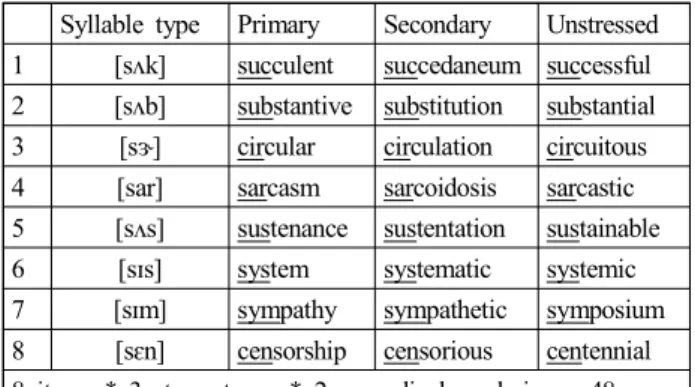
The perception stimuli were extracted as a mono-syllabic form from the target words included in sentence initial and –medial positions. For example, 'su(k)' syllables are extracted from 'succulent' (primary stressed 'su(k)'), 'succedaneum' (secondary stressed 'su(k)'), and 'successful' (unstressed /su(k)/). The stimuli are 48 mono syllables including onset [s], whose acoustic properties hypothetically vary depending on their lexical stress and prosodic boundaries (sentence initial vs. medial).
Syllable-unit stimuli were designed to avoid the word recognition effects discussed, such as 'word familiarity' or 'the specially
6) A phonetically trained female informant (Age: 26) participated in the recording. She described her accent as Mid-western American English.
7) In the test material, no target word is marked with any line or quotation marks in order to avoid other prosodic effect such as citation intonation or contrastive focus. The latter factor was controlled by changing the designated syllable asked in the sentence. For instance, the underlined parts varied in the following sentence; [Analysis] has four syllables and the fourth syllable of the word [analysis] is "sis".
instructed transcription rule (the fortis restriction on foreign word transcription in Korean).'
Acoustic syllables were extracted manually, through an examination of both waveforms and spectrograms. For the beginning of frication noise, cursors were placed at the beginning of the aperiodic wave and at the end of the vowel, which includes a transition to its coda consonant. The end of the vowel was marked at the point including the last periodic cycle, whose shape is consistent with the preceding ones for the vowel. By including the vowel-to-coda transition, the syllable stimuli can carry a similar effect to the unreleased obstruent coda effect in Korean. For instance, when [sɪs] is extracted, the coda [s] is excluded. The resultant syllable sounds like [sɪtㄱ], which includes an unreleased final coda, and this is a natural sounding for mono syllable words in Korean. Thus, the coda consonants are expected not to distract the subjects from perception of onset targets.8)
The stimuli can be grouped as follows: 1) by stress type, 8 (primary stress), 8 (secondary stress), and 8 (unstressed) in either sentence-initial or –medial position, 2) by prosodic boundary, 24 stimuli sentence-initially and the other 24 sentence-medially. The perception test included 5 complete blocks of stimuli, yielding 5 judgments for each stimulus. Each block of stimuli was differently randomized for the 48 stimuli: 8 (syllables) * 2 (prosodic boundary) * 3 (stress types).
The stimuli vary in vowel quality and coda consonants: 5 different vowels [ʌ, ɝ/ɚ, a, ɪ, ɛ] and 6 different coda consonants [k, b, r, s, m, n], as exemplified in <table 4> (See Appendix for the full wordlist). Stimuli were presented in blocks of four at an interval of 3 seconds between each stimulus. A one minute break was given between two blocks. The answer sheets consisted of 6 pages including a practice set on the first page. All instructions were written in Korean, and the two phonemes were written in
8) When the syllables were extracted, coda consonants were not fully included. This is because coda consonants can also influence the perception of onset /s/ when the coda is fricative /s/, which is a part of the target words, as in 'sustenance' or 'system'. To control the stimuli in terms of syllable structure as of /sV(C)/, other coda consonants are also excluded in the construction of the stimuli. However, the extracted syllables include the V-to-C transitional portion, which cues some coda information. The potential unnaturalness of the stimuli seem reduced due to Korean phonological rules such as 'coda neutralization' and 'coda unreleased.' For instance, 'su(k)' syllables can sound like [sʌkㄱ], due to the 'coda unrelease' rule, and 'su(s)' sounds like [sʌtㄱ], due to both 'coda neutralization' and 'coda unrelease' rules. Both syllables are familiar to Korean listeners as legitimate syllables.
Korean orthography 'ㅅ' for plain /s/ and 'ㅆ' for fortis /s*/. The perception test was conducted in a quiet room and all subjects were instructed that it was a forced choice task. A total of seven subjects (4F/3M) participated in the perception test.
Syllable type Primary Secondary Unstressed
1 [sʌk] succulent succedaneum successful
2 [sʌb] substantive substitution substantial
3 [sɝ] circular circulation circuitous
4 [sar] sarcasm sarcoidosis sarcastic
5 [sʌs] sustenance sustentation sustainable
6 [sɪs] system systematic systemic
7 [sɪm] sympathy sympathetic symposium
8 [sɛn] censorship censorious centennial
8 items * 3 stress types * 2 prosodic boundaries = 48 Table 4. Perception stimuli (target syllables are underlined)
Each subject individually heard 320 stimuli (64*5 bolcks), through SONY MDR-CD380 headphones. The volume was adjusted to a comfortable level to individual subjects and the stimuli were played on the Praat program. All subjects are Korean native speakers (25~32) with no known hearing or speech impairments.9)
3.2 Results
The stimuli in the perception test are all /sV(C)/ syllables in English, and a total of 1680 responses were obtained (48 items * 7 subj * 5 Reps = 1680). The result shows that there are 1030 responses (147 on the average) for /s/ and 1100 (170 on the average) for /s*/, showing slightly more responses of /s*/.
<Table 5> summarizes this result. The difference in the observations is not statically significant according to a Chi-squared test (χ2=2.3, df=1, p=0.13).
Sentence-initial Response
count
/s/ /s*/ Total
1030 1100 1680
Table 5. Overall /s-s*/ responses
9) 6 subjects are Seoul dialect speakers and the other one speaks a Pusan dialect. They had spent 1 to 5 years in the US.
Human subjects' rights were informed, and consent was obtained after the subjects read the provided research consent form. All subjects volunteered for the experiment. English proficiency of the subjects vary from beginner to intermediate levels. However, the instruction was not to specify which language they will listen to.
More responses of /s*/ indicates that there is a tendency that single onsets are more likely to be heard as fortis /s*/ by Korean listeners. However, it is not the case that the responses are dominantly /s*/ and but that plain responses takes 48% of the responses. This result proves that the perception of English /s/ by Korean listeners is not purely phonotactically-driven, as proposed in Kim (1999) and Kim & Curtis (2001). According to their phonotactic prediction, single onsets, all the stimuli in the current experiment, should be heard as /s*/ by Korean listeners.
Since the stimuli are controlled in terms of syllable types as /sV(C)/, there must be other critical factors that influence the Korean listeners' perception of English /s/ tokens.
In the following sections, we will look at how lexical stress and prosodic boundary independently influence the Koreans' perception of English /s/ by looking at the relation between prosodic contexts and perception responses.
3.2.1 Boundary effects
The stimuli include two categories in terms of boundary position: sentence-initial vs. -medial. Each of the two positional groups include 840 tokens (8 items * 3 stress types * 7 subjects
* 5 reps).
The result is summarized in <Figure 1>. The association plot scales the differences between expected and observed frequencies and we see this relation by looking at the boxes located either on the upper side from the dotted line or on the lower side of the line. Note that the dotted line in the middle represents the expected frequency in the initial and medial positions (e.g., 50%). The black boxes represents more observation patterns while the gray boxes posited below the dotted line represent less observation patterns than the expected value. The actual number of responses are indicated inside individual boxes.
Figure 1. Association plot: /s-s*/ responses by boundary position.
In the given figure, we see that more fortis /s*/ responses are recorded with the sentence-initial stimuli and more plain /s/ with
the sentence-medial stimuli. According to McNemar's Chi-squared test, the responses are significantly changed between stressed and unstressed stimuli (McNemar χ2=4.606, df=1, p=0.03*).10) The residual and contribution (residual2) values are summarized in Table <6> from Pearson's Chi-squared test as a reference of data description. In each response distribution in Table <6>, the residual of Initial position are positive for /s*/ responses (4.17) and negative for /s/ responses (-4.17), indicating that more /s*/
responses are observed more frequently for the stimuli in the Initial. The opposition trend is found for Medial position, where more /s/ responses are highly linked to that position.
Residuals /s/ /s*/ Residuals^2 /s/ /s*/
Initial -4.17 4.17 Initial 17.42 17.42
Medial 3.85 -3.85 Medial 14.8 14.8
Table 6. Chi-Squared statistics: residuals and contribution
The contribution values on the right side in <Table 6>
indicate that the Initial position is more responsible for the significantly different observations in <Figure 1>. That is, more /s*/ responses and less /s/ responses in Initial position are highly linked, indicating that the acoustic changes in Initial position drives more /s*/ and less /s/ responses in the result.
In summary, utterance initial position changes the perception responses, and this position seems to bear the properties signaling fortis /s*/ in Koreans' perception. This prosodic effect was consistent across the different blocks.
3.2.2 Lexical stress effect
Lexical stress is subdivided as primary, secondary, and unstressed in the stimuli. First, primary and secondary stresses are grouped together as "Stressed stimuli" in contrast to
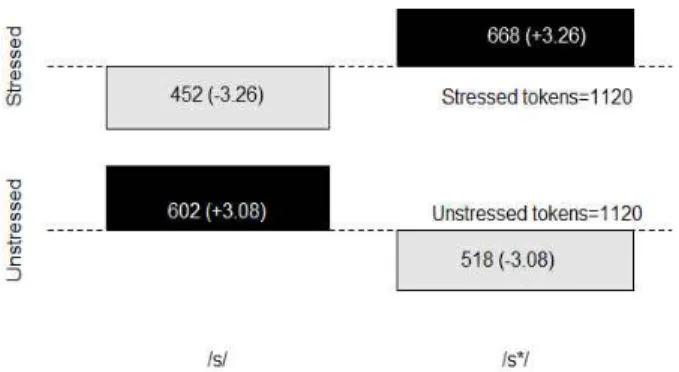
"Unstressed stimuli". The responses are summarized in <Figure 2>, where more /s*/ responses are obtained for Stressed stimuli while more /s/ responses for Unstressed stimuli. The numbers inside individual boxes indicate the total responses.11) The
10) McNemar's Chi-squared test is used since the data points were measured repeatedly from the same subjects. Pearson's Chi-squared test result is not appropriate to conclude the result as the experiment collected data repeatedly. However, as McNemar's Chi-squared test reports the significant change in the responses between stressed and unstressed stimuli, we will consider the residuals from the Pearson's Chi-squared test in order to observe which of the two positions contribute more to the change.
11) The numbers in brackets inside each bar indicates the residuals calculated by a Pearson's Chi-squared test (χ
change from /s/ to /s*/ depending on the stress condition is marginally significant according to a McNemar's Chi-squared test (McNemar's χ2=3.43, p=0.064).
Figure 2. Association plot: responses by stress conditions
The contribution values for the response distribution in
<Figure 2>, which are used as references in this paper, are higher for the stressed stimuli with /s*/ (10.67) as well as for the unstressed stimuli with /s/ (9.48), indicating that the observed responses depend more on the preferences of /s*/ when stressed.
In other words, the stressed condition changes English /s/
properties into Korean /s*/ properties and drives Korean listeners to perceive more /s*/ with the stimuli.
3.2.3 Cumulative effects of prosodic strength
In the stimuli, we have three groups sorted by stress type: 8 primary stressed syllables, 8 secondary stressed, and the other 8 unstressed, placed in two different positions, yielding 280 tokens for each condition. In order to see the cumulative effect, we can compare stimulus groups in terms of stress and prosodic boundary. First, we take intermediately influenced groups of stimuli, which are primary stressed in a sentence medial position and unstressed group in a sentence-initial position. Then, we compare these groups to the two extreme groups of stimuli, which are sentence-initial stressed stimuli and sentence-medial unstressed stimuli. If a cumulative effect exists, we would expect to see the response changes as we hypothesized; an increase of /s*/ responses from the intermediate groups to the extreme group that is influenced by both positive lexical stress and boundary strengthening, whereas a decrease of /s*/ responses from the intermediate groups to the extreme group with (in principle) no prosody effect, that is sentence-medially unstressed stimuli.
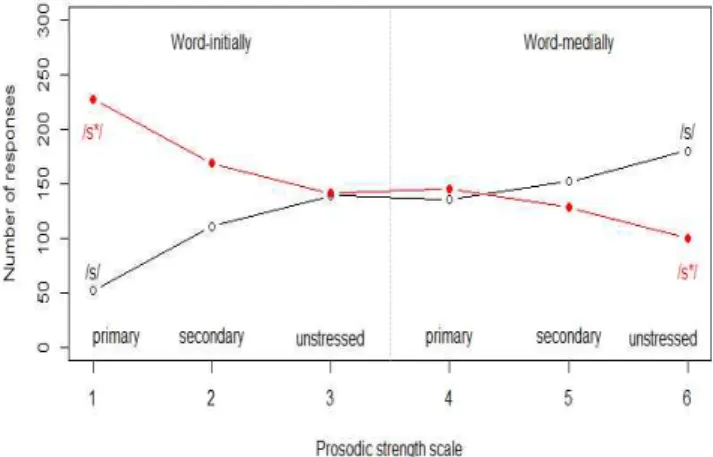
Figure <3> shows the response result in the scale of 6
2=40.32, df=1, p<0.001**). Note that the Pearson's Chi-squared result is not for a conclusive statistical analysis but for a descriptive purpose.
combinatory prosodic strength: two prosodic position (initial vs.
medial) * three stress types. It is clearly seen in <Figure 3> that /s/ responses increase as the prosodic condition becomes weaker (left-to-right) while /s*/ responses increase as the prosodic condition becomes stronger (right-to-left). The responses in conditions 3 and 4 are almost identical having similar number of responses of /s/-/s*/ contrast. This result indicates that prosodic strength can be cumulative: that is, the combination of boundary-initial and stress conditions drive Korean listeners' to perceive English /s/ more as /s*/.
Figure 3. Response changes depending on the prosodic conditions
The opposite scale also holds such that the combination of weaker boundary (medial) and unstressed conditions induce more /s/ responses. The decrease in /s*/ responses as the strength of stress decreases from primary to secondary and from stressed to unstressed, also tells us that the stress effect in the English /s/
perception can be gradient. This result confirms that lexical stress information in the stimuli is interpreted by Korean listeners as consonantal information in the perception of non-native phonemes.
According to Cho & Keating (2001), domain initial strengthening occurs in segments independently of stress conditions. They find that the effects of prosodic boundary positions and of stress can often be distinguished even though this is not always the case. Considering their findings, the prosodic boundary effect and the lexical stress effect on /sV(C)/
syllables can be additive. In other words, the two effects interact resulting in a bigger effect with sentence initial primary stress.
In summary, we find a relation between prosody effects in the stimuli and Koreans' perception of English [s], in terms of the effect of prosodic boundaries and lexical stress. The results support the hypothesis proposed in this paper. They also predict
that prosodic strengthening, which might have been applied to the stimuli, correlate with the perception pattern of /s-s*/.
3.3 Prosodic effects and the perception result
The perception results documented in this paper indicate that prosodic influences on segments may correlate with Korean listeners' perception of English /s/. In particular, prosodic boundaries, sentence-initial and sentence-medial, and stress condition showed changes in the subjects' /s-s*/ categorization.
Prosodic effects in the literature and the current results of /s/
perception are discussed below.
Firstly, the response change caused by the adjacency to prosodic boundary can be related to the fact that sentence-initial position shows a bigger effect on segment duration for both the fricative and the vowel. This can be interpreted as domain-initial strengthening as documented in the literature (Klatt, 1974; Cho
& Keating, 2001; Keating, Cho, Fougeron, and Hsu, 2003; Cho
& McQueen, 2005; among others). In particular, the effect of prosodic boundaries shows that Korean listeners hear tokens of English /s/ that are influenced by domain strengthening more often as their fortis phoneme /s*/ while they tend to hear the stimuli that is outside of the domain of the strengthening effect, or those that exhibit weak influence from the prosody effect, as their plain /s/.
Secondly, the lexical stress condition also influences the responses, which tells us that prominence manifestation by stress plays a role in Korean's /s-s*/ perceptual categorization. For instance, we have seen that the stressed stimuli including both primary and secondary stress show more /s*/ responses than those we find with the unstressed stimuli. In addition, between primary and secondary stress conditions, more /s*/ responses were obtained with primary stress. This implies that primary stress may involve relatively greater prominence manifestation compared to secondary stress. Segments under primary/secondary stresses bear different acoustic properties from the segments without stress, which can be responsible for the different perceptual responses by Korean listeners' /s-s*/ categorization.
The prosodic manifestation of lexical stress and boundary strengthening occur in multiple acoustic dimensions, such as duration, pitch, and intensity. This means that the two contexts may independently influence acoustic properties, and/or they may be overlapped. By comparing groups of the stimuli, which can be characterized as a combination of boundary and stress effects, we found that when the two effects are concurrent (stressed and phrase-initial), the stimuli showed more /s*/ responses. On the
other hand, when the two effects are absent (unstressed phrase-medial), the stimuli are associated with more /s/
responses. The intermediate groups (either stressed and word-medial or unstressed and word-initial) confirmed that the existence or absence of one of the prosodic factors variably influences /s-s*/ responses (<Figure 3>).
The question we raised at the outset was how and why prosody effects in English /s/ can be associated with consonant perception by Korean listeners. As the spectral analysis of fricatives in the literature have indicated, the acoustic properties of English /s/ as it varies with prosodic effects are similar to those of Korean consonant contrasts between /s/ and /s*/. In addition, Korean does not have lexical stress in its phonology and as a result, the prosodic information is phonologically redundant to Korean listeners. However, since the prosodic information contributes to the segmental properties of English /s/, it is possible for Korean listeners to take advantage of the additional information in their non-native phoneme perception, not interpreting the segmental information as coming from its original source, which was a contrast from non-native phonology.
Therefore, the interpretation of prosody effects as consonantal properties is not surprising because the overlapping of segmental and prosodic properties would provide useful information to Korean listeners' identification of consonants.
4. Conclusion
Based on the assumption that prosody influences the acoustic properties of segments, the perception of the English fricative /s/
by Korean listeners was investigated in this paper. Perception results show that both variation in prosodic boundaries and lexical stress correlate with the perception pattern of English /s/
by Korean listeners. The results from the perception experiment lead us to a conclusion that prosody effects indeed play an important role in the non-native consonant perception. In particular, prosodic strengthening in domain-initial position and lexical stress seem to influence the acoustic properties of the fricative and possibly the adjacent vowels. These strengthening effects drive Korean listeners' perception of English /s/ to perceptually categorize the stimuli either /s/ or /s*/, which is close to their phonetic knowledge on the native sounds.
As Kim (1999) and Kim & Curtis (2001) documented, the durational change by syllable type of English can be one of the factors that are responsible for the Korean's perception results.
We know this based on the overall result where we obtained /s*/
responses (Note that the difference between /s/ and /s*/ was not statistically significant). However, their hypothesis cannot properly predict the /s/ perception pattern reported in this paper because all the stimuli were controlled in terms of syllable type.
The discussion presented here explains how Korean listeners interpret the prosodically driven acoustic properties of English /s/
as a part of the information associated with it segmentally. The results reported in this paper confirm the hypothesis that Korean listeners interpret certain phonetic properties as consonantal quality rather than prosodic information when they hear English sounds.
In conclusion, the fact that Korean listeners' responses change influenced by the prosodic context in which the stimuli are placed, suggests that Korean speakers interpret some of the information provided by prosody, and that the listeners take advantage of the information in their judgment of non-native phonemes. In native phoneme perception, the lexical stress effect is to be interpreted distinctively by English listeners, with reference to their native phonology, as Korean listeners interpret different acoustic properties categorically in their native /s-s*/
perception. However, in perception of non-native phonemes, phonologically different sources may not restrict non-native listeners' interpretation of acoustic information. Instead, acoustic substance, from segmental or suprasegmental, can influence acoustic-perceptual mapping of non-native sounds.
References
Baik, W. (1997). On tensity of Korean fricatives (electropalatographic study). Speech Sciences 4, 135-145.
Behrens, Susan & Sheila E. Blumstein. (1988a). Acoustic characteristics of English voiceless fricatives: A descriptive analysis. Journal of Phonetics 16. 295-298.
Behrens, Susan & Sheila E. Blumstein. (1988b). On the role of the amplitude of the fricative noise in the perception of place of articulation in voiceless fricative consonants. Journal of the Acoustic Society of America 84.3. 861-867.
Cho, Taehong. (1996). Vowel Correlates to Consonant Phonation:
An Acoustic-Perceptual Study of Korean Obstruents. M.A.
Thesis, The University of Texas at Arlington.
Cho, Taehong & Patricia Keating. (2001). Articulatory and acoustic studies of domain-initial strengthening in Korean. Journal of Phonetics 29, 155-190.
Cho, Taehong, S.A. Jun & P. Ladefoged. (2002). An acoustic and aerodynamic correlates to Korean stops and fricatives. Journal
of Phonetics 30.2, 193-228.
Cho, Taehong & James McQueen. (2005). Prosodic infulences on consonant production in Dutch: Effects of prosodic boundaries, phrasal accent and lexical stress. Journal of Phonetics 33 (2), 121-157.
Cho, Taehong, James McQueen & Ethan Cox (2007). Prosodically driven phonetic detail in speech processing: The case of domain-initial strengthening in English. Journal of Phonetics 35(2), 210-243.
Halle, M. and Kenneth N. Stevens. (1971). A note on laryngeal features. Quarterly Progress Report. Research Laboratory, MIT.
No. 101.
Han, M. S. & Weitzman, R. S. (1970). Acoustic features of Korean /P, T, K/, /p, t, k/ and /ph, th, kh/, Phonetica 22, 112-128.
Han, J.-I. (1996). The Phonetics and Phonology of ‘Tense’ and
‘Plain’ Consonants in Korean. Ph.D. dissertation, Cornell University.
Hardcastle, W. J. (1973). Some observations on the tense-lax distinction in initial stops in Korean. Journal of Phonetics 1, 263-272.
Harris, K. S. (1958). Cues for discrimination of American English fricatives in spoken syllables. Language and speech 1, 1-17.
Heinz, J.M., and Stevens, K. N. 1961. On the properties of fricative consonants. Journal of the Acoustic Society of America 33, 589-596.
Hirose, H., C. Y. Lee & T. Ushijima. (1974). Laryngeal control in Korean stop production. Journal of Phonetics 2, 145-152.
Hughes, G.W., Halle, M. 1956. Spectral properties of voiceless fricative consonants. Journal of the Acoustic Society of America 28, 303-310.
Iverson, G. K. (1983). Korean s. Journal of Phonetics 11, 191-200.
Jang, Youngsoo. (2002). A study on the Koreans’ perception of English voiceless fricative. MA thesis, Korea University.
Jongman, A. (1988). Duration of frication noise required for identification of English fricatives. Journal of the Acoustical Society of America 85, 1718-1725.
Kagaya, R. (1974). Fiberscopic and acoustic study of the Korean stops, affricates, and fricatives. Journal of Phonetics 2, 161-180.
Klatt, D. (1974). The duration of s in English words. Journal of Speech and Hearing Research 17.1, 51-63.
Klatt, D. (1987). Voiceless fricatives. (Unpublished manuscript).
Kang, K.-S. (2000). On Korean fricatives. Speech Sciences 7(3), 53-68.
Keating, Patricia, Taehong Cho, Ce�cile Fougeron, and C. Hsu.
(2003). Domain-initial strengthening in four langauges.
Laboratory Phonology 6, 145-163.
Kim, Chin-Woo. (1965). On the autonomy of the tensity feature in stop classification (with special reference to Korean stops).
Word 21, 339-359.
Kim, Chin-Woo. (1970). A Theory of Aspiration. Phonetica 21, 107-116.
Kim-Renaud, Y. –K. (1976). Korean Consonant Phonology, Ph.D.
dissertation, University Hawaii.
Kim, Soohee & Emily Curtis. (2001). Phonetic duration of English /s/ and its borrowing in Korean. Proceedings of the 10th Japanese/Korean Linguistics Conference.
Kim, Soohee. (1999). Subphonemic Duration Difference in English /s/ and Few-to-Many Borrowing from English to Korean. Ph. D.
dissertation, University of Washington.
Lambacher, S., Martens, W., Nelson, B., and Berman, J.(2001).
Identification of English voiceless fricatvies by Japanese listeners: the influence of vowel context on sensitivity and response bias. Acoustic Science & Technology 22, 334-43 Lee, K. -H. (2001). Korean fricatives. Ph. D. dissertation, Korea
University.
MaCasland, G.P. (1979b). Noise intensity cues of spoken fricatives.
Journal of the Acoustic Society of America, Suppl. 1 66, S88.
McCasland, G. (1978). Stridency as a distinctive feature of American fricatives. Paper presented at the Modern Language Association, New York.
McCasland, G. P. (1979a). Noise intensity and spectrum cues for spoken fricatives. Journal of the Acoustic Society of America, Suppl.1 65, S78-S79.
Moon, S.-J. (1997). Acoustic study on Korean ‘s’. Malsori 33-34, 11-22.
Nartey, J. N. A. (1982). On Fricative Phones and Phonemes:
Measuring the Phonetic Differences Within and Between Languages, UCLA Working Papers in Phonetics Vol. 55.
Oh, Mira. (2003). English Fricatives in Loanword Adaptation. In Explorations in Korean Language and Linguistics. G. Iverson &
S.-C. Ahn (eds.), 471-487, Seoul: Hankookmunhwasa.
Park, H. (2002a). The phonetic nature of the phonological contrast between the lenis and fortis fricative in Korean. Malsori, Special Issue, 24-32.
Park, H. (2002b). Temporal and Spectral Characteristics of Korean Phonation. Ph. D dissertation. The University of Texas at Austin.
R Core Team. 2014. R: A language and environment for statistical computing. R Foundation for statistical compputing, Vienna, Austria. (URL-http://www.R-project.org.)
Shadle, Christine H. (1985). The Acoustics of Fricative Consonants. RLE Tech. Rep. 506. MIT; Cambridge, MA.
Shadle, Christine H. (1990). Articulatory-acoustic relationships in fricative consonants. In Speech Production and Speech Modelling, W.J. Hardcastle & A. Marchal (eds.), 187-209, Dordrecht: Kluwer Academic Publishers.
Shadle, Christine H. (1997). The aerodynamics of speech. In The Handbook of Phonetic Sciences, W. Hardcastle & J. Laver (eds.), 33-64, Oxford: Blackwell Publishers.
Silverman, Daniel. (1992). Multiple scansions in loanword phonology: evidence from Cantonese. Phonology 9, 289-328.
Stevens, K. N. & S.J. Keyser. (1989). Primary features and their enhancement in consonants. Language 65, 81-106.
Stevens, K. N. (1971). Airflow and turbulence noise for fricative and stop consonants: Static considerations. Journal of the Acoustic Society of America 50, 1180-1192.
Strevens, P. (1960). Spectra of fricative noise in human speech.
Language and speech 3. 32-49.
Yoon, K. (1999). A Study of Korean Alveolar Fricatives: An Acoustic Analysis, Synthesis, and Perception Experiment. M.A.
Thesis, University of Kansas.
Yoon, K. (2002). A production and perception experiment of Korean alveolar fricatives. Speech Sciences 9.3, 169-184.
You, Han-Yong. (1979). An Acoustic and Perceptual Study of English Fricatives. (Unpublished M.A. thesis), Edmonton;
Canada.
∙ Kim, Miran
Graduate School of Education Hankuk University of Foreign Studies 107, Imun-ro, Dongdaemun-gu, Seoul, 02450, Korea
Email: [email protected]
Appendix
Stimuli used in the perception test: syllables in bold were extracted as mono syllable forms of /sV(C)/.
<Abbreviation notes>
Str (1) = primary stress; Str (2) = secondary stressed;
Str (0) = unstressed;
SI = sentence-initial; SM = sentence-medial;
WI = word-initial; WM = word-medial
Str (1); SI; WI Str (2); SI; WI
1 succulent 17 succedaneum
2 substantive 18 substitution
3 circular 19 circulation
4 sarcasm 20 sarcoidosis
5 sustenance 21 sustentation
6 system 22 systematic
7 sympathy 23 sympathetic
8 censorship 24 censorius
Str (1); SM; WI Str (2); SM; WI
9 succulent 25 succedaneum
10 substantive 26 substitution
11 circular 27 circulation
12 sarcasm 28 sarcoidosis
13 sustenance 29 sustentation
14 system 30 systematic
15 sympathy 31 sympathetic
16 censorship 32 (censorius)
Str(0); SI; WI Str(0); SI; WM
33 successful 49 unsuccessful
34 substantial 50 condensable
35 circuitous 51 dissertation
36 sarcastic 52 affixal
37 sustainable 53 consensus
38 systemic 54 sarcoidosis
39 symposium 55 asymptote
40 centennial 56 medicine
str(0); SM; WI str(0); SM; WM
41 successful 57 unsuccessful
42 substantial 58 condensable
43 circuitous 59 dissertation
44 sarcastic 60 affixal
45 sustainable 61 consensus
46 systemic 62 sarcoidosis
47 symposium 63 asymptote
48 centennial 64 medicine