• 검색 결과가 없습니다.

Some Notes on Articulatory Correlates of Three-way Bilabial Stop Contrast in /Ca/ Context in Korean: An Electromagnetic Articulography (EMA) Study

N/A
N/A
Protected

Academic year: 2021

Share "Some Notes on Articulatory Correlates of Three-way Bilabial Stop Contrast in /Ca/ Context in Korean: An Electromagnetic Articulography (EMA) Study"

Copied!
9
0
0

로드 중.... (전체 텍스트 보기)

전체 글

(1)

말소리와 음성과학 제2권 제4호 (2010) pp. 119~127

Some Notes on Articulatory Correlates of Three-way Bilabial Stop Contrast in /Ca/ Context in Korean: An Electromagnetic Articulography

(EMA) Study

Son, Minjung 1) ․Cho, Taehong 2)

ABSTRACT

Recently, we have launched a large-scale articulatory study to investigate how the three-way contrastive stops (i.e., lenis, fortis, and aspirated) in Korean are kinematically expressed (i.e., in terms of articulatory movement characteristics) in various contexts, using a magnetometer (Electromagnetic Articulography). In this paper, we report some preliminary results about how the three-way bilabial series /p,p

h

,p*/ produced in /Ca/ context in isolation are kinematically characterized not only during the lip closure but also during the following vocalic articulation. Some important notes could be made from the results. First, the degree of lip constriction (as measured by the lip aperture between the upper and lower lips) was smaller for the lenis /p/ and larger for the fortis/aspirated /p*,p

h

/, showing a two-way distinction during the closure. Second, the tongue lowering for the following vowel was more extreme after the lenis /p/ than after the fortis/aspirated /p*,p

h

/. Regarding this vocalic articulatory difference in the tongue height, we discussed the possibility that the articulatory tension associated with the fortis/aspirated stops is further reflected in the lingual vocalic movement maintaining the tongue position to a certain level for the following vowel /a/, while the lenis consonant does not impose such articulatory constraints, resulting in more tongue lowering. Finally, the temporal relationship between the release of the stop closure and the lowest tongue position of the following vowel remained constant, suggesting that CV coordination is invariantly maintained across the consonant type. This pattern was interpreted as supporting the view that the consonant and vowel gestures are coordinated in much the same way across languages.

Keywords: Korean bilablal stops, lenis, fortis, aspirated, kinematics, supralaryngeal articulation, Electromagnetic Articulography, EMA, CV coordination

1. Introduction

Korean has three-way contrastive stops: lenis, fortis and aspirated stops as in /pul/ ‘fire’, /p*ul/ ‘horn’, and /p

h

ul/ ‘grass'.

Phonetic studies on the Korean stops documented in the literature

1) Hanyang University, [email protected]

2) Hanyang University, [email protected], corresponding author This work was supported by the Korea Research Foundation Grant funded by the Korean Government (MOEHRD, Basic Research Promotion Fund) (KRF-2007-327-A00312) to the corresponding author (T. Cho).

Received: November 30, 2010 Revision received: December 5, 2010 Accepted: December 15, 2010

in the last half century have shown that the phonetic manifestation of the three-way stop contrast is evident primarily in laryngeal settings (Kim, 1965, 1970; Han & Weitzman, 1970;

Abberton, 1972; Abramson & Lisker, 1973; Hardcastle, 1973;

Kagaya, 1974; Hirose, Lee & Ushijima, 1974; Dart, 1987;

Ladefoged & Maddieson, 1996; Jun, Beckman & Lee, 1998; Cho,

Jun & Ladefoged, 2002; Silva, 2006; among others). For

examples, fortis stops /p*, t*, k*/ have been known to be

produced with stiff vocal folds, constricted glottis, and heightened

subglottal pressure during the closure (but low transglottal airflow

at the release), while none of these laryngeal characteristics are

involved in production of lenis counterparts /p, t, k/ (see Cho,

Jun & Ladefoged, 2002 for a review). Aspirated stop series /p

h

,

(2)

t

h

, k

h

/ are primarily different from fortis or lenis stops in that they are produced with spread glottis during the closure and substantial transglottal airflow at the release. The fortis and the aspirated stops, however, are often grouped together as strong or tense consonants (e.g., Kim, 1965) as opposed to lenis (weak) stops, as fortis and aspirated stops share, among others, the heightened subglottal pressure and laryngeal tension.

Such differences in laryngeal settings between consonants are generally known to be reflected in several parameters in acoustic dimension such as VOT (longer for the aspirated, intermediate for the lenis and shorter for the fortis stops), H1-H2 (higher for the lenis stop due to its breathiness and lower for the fortis stop due to its creakiness associated with stiff and constricted glottis), F0 (higher for fortis and aspirated stops due to their laryngeal tension), Intensity Rise Time (more abrupt intensity build-up due to its respiratory strength) (e.g., Kim, 1965; 1970; Han &

Weitzman, 1970; Hardcastle, 1973; Cho et al., 2002, among others). Previous studies have thus provided ample phonetic evidence for the importance of laryngeal configurations for differentiating the three-way contrastive stops in Korean, and phonological descriptions of the stop contrast have therefore often been based on laryngeal features such as [spread glottis], [constricted glottis], [stiff vocal folds], or [tense] (e.g., Halle &

Stevens, 1971; Lombardi, 1991; Han, 1996; Cho, et al., 2002).

The three-way stop contrast, however, can also be considered in terms of its suparlaryngeal articulatory characteristics. For example, lip muscular activities are stronger for fortis and aspirated labial stops /p*, p

h

/ than for lenis /p/ (Kim, 1965); the linguopalatal contact (the contact between the tongue and the palate) is larger for fortis and aspirated /t*, t

h

/ than for lenis /t/

(Shin, 1997; Cho & Keating, 2001); the articulatory constriction duration is longer for fortis /k*/, intermediate for aspirated /k

h

/ and shorter for lenis /k/ (Brunner, Fuchs & Perrier, submitted);

and V-to-V coarticulatory resistance is greater for fortis and aspirated stops than for lenis stops (Shin, 1997). These studies thus suggest that supralaryngeal articulatory characteristics are other important phonetic correlates of the three-way contrastive stops in Korean. But only a handful of systematic articulatory studies have been conducted up until now, and our understanding of the stop contrast at the supralaryngeal level has been extremely limited, especially in terms of their dynamic aspects of articulatory movement characteristics.

In an effort to obtain a more comprehensive understanding of the supralaryngeal characteristics of the three-way stops in Korean, we have launched a large-scale articulatory phonetics

project, using a magnetometer (EMA, Electromagnetic Articulography). In this paper, we report some preliminary results, focusing on the articulatory characteristics of labial stop series /p, p

h

, p*/ produced in isolation in CV context where V was limited to /a/. In what follows, we will discuss three specific research questions to be addressed in this report.

1.1 Research questions

The first question is how the labial stops in /pa, p

h

a, p*a/ are articulatorily manifested during the lip closure. As discussed above, some studies have reported that denti-alveolar stop series /t, t

h

, t*/ are produced with differential constriction degrees as measured by linguopalatal contact (e.g., Cho & Keating, 2001). In the present study, in order to understand how the three-way contrast is reflected in the lip constriction, we will measure the lip constriction degree as a function of the consonant type by examining lip compression between the upper and lower lips.

The second question is whether, and how, the labial stop contrast is further reflected kinematically (i.e., in terms of the movement characteristics) during the vocalic movements of the following vowel. In the literature, many of the acoustic correlates of different laryngeal configurations for Korean stops have been found in the following vowels (e.g., H1-H2, Intensity Rise Time, F0), but to our best knowledge, few studies have investigated the kinematic (movement) characteristics associated with the following vocalic gesture in connection with the preceding stop contrast.

Given that consonantal characteristics are likely to influence vocalic articulation (Öhman, 1967; Recasens, 1984, 1987), we will therefore explore whether the vocalic articulation is indeed constrained by the identity of the preceding consonant, and if so, how the constraint is kinematically reflected in the vocalic articulation.

Finally, we ask whether or not C-V gestural coordination

(intergestural timing relationship between the consonantal gesture

and the vocalic gesture) is maintained similarly across the

consonant type in the context of /pa, p

h

a, p*a/. Looking at the

data obtained with English and Japanese in an articulatory study,

Löfqvist (2006) found invariant relative timing of intervocalic C

with respect flanking V-V sequences. For example, related to CV

articulation in Japanese, he found that the temporal interval

between the stop closure release and the target of the tongue

body movement for the following vowel remained invariant even

though the stop closure duration varies as a function of

mono-moraic versus bi-moraic consonant type. In the present

study, we will further examine CV coordination patterns in

(3)

Korean, so that we can discuss whether the invariant CV coordination in the articulatory dimension can be considered as universally-applicable versus language-specific phenomenon.

2. Method

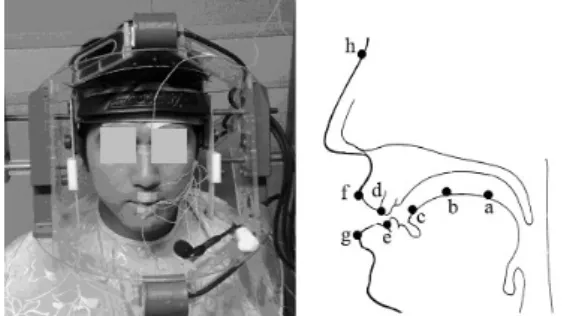
Kinematic data of the lips and the tongue body were obtained, using an EMA (Carstens Articulography AG200) at the Hanyang Phonetics and Psycholinguistics Lab (HPPL). The magnetometer device is equipped with a three-transmitter assembly built in a plastic helmet, being lined up in the midsagittal plane: one on the front, the other on the rear, and the third on the top as can be seen in the left panel of Figure 1. For all speakers, five pellets (sensors) were attached inside the vocal tract as shown in the right panel of Figure 1: three on the tongue at an approximately equal distance from each other (a-c: the tongue dorsum, the tongue midsection, the tongue tip) and two on the maxillary and mandibular central incisors (d-e). Three more transducers were attached outside the vocal tract. One was attached on the bridge of the nose (h) and two on the upper and lower lips (f-g). The two pellets on the lips were vertically separated by approximately 1 cm when the lips were comfortably closed. All pellets were all aligned in the midsagittal plane for each subject’s vocal tract.

Among them, two pellets (the one at the nose ridge (h) and one at the maxillary central incisors (d)) were used as reference points so that head movements inside the helmet could be corrected.

Figure 1. Locations of pellets: (a) the tongue dorsum; (b) the tongue midsection; (c) the tongue tip; (d-e) the maxillary (upper) and mandibular (lower) central incisors; (f-g) the upper and lower

lips; and (h) the nose bridge.

The obtained raw data were then rotated to match the x axis with the occlusal plane and the y axis perpendicular to it. For this, a flat plastic bite plate was used with two extra pellets attached to it, so that the maxillary occlusal plane obtained by the two coordinate points on the bite plate became the horizontal (x) axis of the data, and the y axis became perpendicular to the

occlusal plane (see Westbury 1994; de Jong, 1995; Tabain, 2003 and Cho, 2005, for similar data processing procedures). All the filtering and rotation processes were performed by the TAILOR program (Carstens’ data processing program).

Note that the alternating voltages generated by the pellets (attached to articulators) were inversely proportional to the distance to the three-transmitters (attached to the helmet). These voltages were converted into sample-by-sample positions in a Cartesian coordinate system, providing the positional information of each pellet. The voltage outputs of each sensor coil were sampled at 200Hz. After smoothing the pellet position data by a low pass filter at 20Hz, dynamic correction of unwanted head movement was conducted by using the two reference points. The output of data was further smoothed at a low pass filter at 25Hz using MVIEW (Tiede, 2005), a software for data processing and measuring developed by Haskins Laboratories.

2.1 Participants

Seven native Seoul-Korean (four male and three female) speakers voluntarily participated. All subjects were naïve to the purpose of the experiment and none had suffered from any speech impairment. They were either undergraduates or graduates, ranging from early-twenties to mid-twenties. All subjects were paid for their participation.

2.2 Speech materials

Bilabial three-way contrastive stops /p/, /p

h

/, and /p*/ were used as test consonants in an /a/ context: /pa/, /p

h

a/, and /p*a/.

They were presented to speakers on a computer screen in random order. Speakers were instructed to read a target word on the computer screen as comfortable and natural as possible. Each word was repeated four times except for one speaker, who produced each word three times due to technical errors that occurred in the middle of the experiment. Each speaker produced a total of twelve tokens, except for one speaker who produced 9 tokens, resulting in 84 tokens for further analysis.

2.3 Measurements

We analyzed lip aperture and vertical tongue body movement with MVIEW which helps identify important gestural landmarks such as constriction maxima, lip opening onset, peak velocity, and lip opening target.

Lip aperture. The lip opening and closing movement data were

obtained by combining horizontal and vertical position signals for

the upper and the lower lip pellets into one dimension—i.e., Lip

(4)

Aperture (Byrd & Saltzman, 1998; Byrd, 2000; Cho, 2006, 2008;

Son, Kochetov, & Pouplier, 2007). The Euclidean distance between the two lip pellets was used as an index of Lip Aperture. As shown in Figure 2, there were two areas in which lip kinemetics were measured: during the constriction (closure) and during the lip opening movement. The relevant kinematic measures are as follows:

(a) Constriction maxima during the lip constriction (Fig. 2a).

(b) Constriction degree at the lip opening onset (the right edge of the constriction) (Fig. 2b).

(c) Peak velocity of the lip opening movement (Fig.2c).

(d) Amount of lip opening (Lip Aperture) at the target achievement of the lip opening movement (Fig. 2d).

(e) Lip opening maxima after the target attainment (Fig. 2e).

(f) Displacement as the spatial difference between the lip opening onset and lip opening target (Fig. 2f).

(g) Time-to-peak velocity (acceleration duration) from the lip opening onset to the peak velocity of the movement (Fig.

2g).

(h) Deceleration duration from the time point of the peak velocity to the lip opening target (Fig. 2h).

(i) Movement duration as the temporal interval from the lip opening onset to the target of the movement (Fig. 2i).

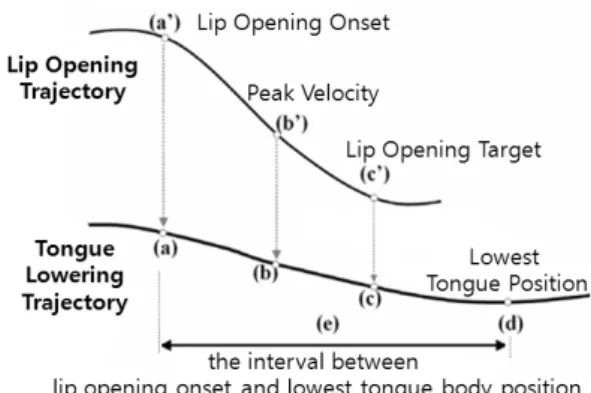
Kinematics of the tongue body movement at some gestural landmarks. We made some spatial and temporal measurements of the tongue body movement at some gestural landmarks of the lip opening movement in order to examine the change of the vertical tongue posture (the tongue height) for /a/ as the lip opening movement progresses. A set of kinematic measures for tongue body movement is shown in Figure 3.

Figure. 2 Schematized lip aperture trajectory in lip opening movement (/p/).

Figure 3. Schematized vertical tongue body movement trajectory with measurement points in alignment with articulatory landmarks of the lip opening movement. (a)-(d) are the points in which the tongue position values were taken; and (d) is the interval between

the lip opening onset and the lowest tongue body position.

(a) The vertical tongue position (the tongue height) at the lip opening onset (Fig. 3a)

(b) The vertical tongue position (the tongue height) at the peak velocity of the lip opening movement (Fig. 3b).

(c) The vertical tongue position (the tongue height) at the lip opening target (Fig. 3c).

(d) The lowest tongue body position value that has been reached during the following vowel for /a/ (Fig. 3d).

(e) The temporal interval between the onset of the lip opening movement and the lowest tongue body position (Fig. 3e).

2.4 Statistical analysis

In data analysis, repeated measures analyses of variance (henceforth, RM ANOVA) were employed. In this model, each data point corresponds to the mean score of stop consonant types for each subject. F-ratios and p-values generated from Huynh-Feldt corrected degrees of freedom (cf. Huynh & Feldt, 1970) and error terms are reported in RM ANOVAs at the significance level of 0.05. Posthoc pairwise comparisons were conducted, whenever it was necessary to determine the difference between levels within a factor at the significance level of p<0.05.

In some cases, Pearson product-moment correlation and linear

regression analyses were conducted in order to examine

spatio-temporal relationship between two dependent variables, for

example, how the lowest tongue body position of /a/ (the spatial

magnitude) is related to the temporal interval between the lip

opening onset and the lowest tongue body (the temporal distance).

(5)

3. Results

3.1 Kinematics of the lip movement

The degrees of constriction both at the constriction maximum point and the lip opening onset (the right edge of the constriction) generated significant effects of Consonant Type (F[2, 12]=10.12, p=0.003; F[2, 12]=7.01, p=0.01, respectively). As shown in Figure 4, the lenis /p/ was less constricted than the aspirated and fortis /p

h

, p*/ at both measurement points during the lip closure (Figure 4). However, no significant consonant effect was found for the degrees of lip opening amount during the lip opening movement such as those measured at the time points of the lip opening peak velocity, the target attainment and the lip opening maxima (F(2, 12)=2.44, F[1.4, 8.3]=1.85, F[1.6, 9.6]=1.99, respectively, all at p>0.05).

Figure 4. Effects of Consonant Type on constriction maxima and lip opening onset. (Note that ** refers to p<0.01.)

Figure 5. Lip opening kinematic variables as a function of Consonant Type in (a) movement duration, (b) peak velocity, and

(c) displacement.

All other kinematic measures such as movement duration, time-to-peak velocity, deceleration duration, displacement as shown in Figure 5 (movement duration, time-to-peak velocity, deceleration duration, displacement) did not generate any significant effect of Consonant Type at all.

3.2 The kinematics of the tongue body with reference to some lip movement landmarks

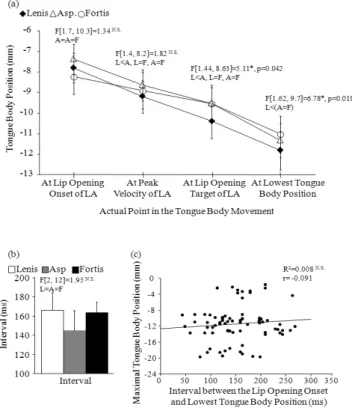
Figure 6a shows the vertical tongue body positions (the tongue heights) at four different measurement points: at the lip opening onset (the right edge of the lip closure), at the peak velocity of the lip opening movement, at the lip opening target attainment point and at the lowest tongue body position. As can be seen from the figure, there were no effects of Consonant Type on the vertical tongue position at the first two measurement points (i.e., at the lip opening onset and at the peak velocity), but the consonantal effect became significant at the last two measurement points (i.e., at the lip opening target attainment and at the lowest tongue body position; F[1.4,8.6]=5.11, F[1.6,9.7]=6.78, respectively, both at p<0.05). The consonantal effect was due to the fact that the tongue body position was significantly lower after the lenis /p/ than after the aspirated and fortis /p

h

,p*/.

Figure 6. Effects of Consonant Type on (a) tongue body position, (b) interval between the lip opening onset and lowest tongue body position, and (c) covariate relation between lowest tongue body position and interval between two time points in (b). (Note

that * refers to p<0.05.)

(6)

Given the significant consonantal effect on the tongue body position at later times during the vocalic articulation, we further examined whether the consonantal effect was driven by a durational factor−i.e., whether the lower tongue position was due to a longer time given for the tongue lowering movement. As shown in Figure 6b, there was no significant effect of Consonant Type on the interval between the consonantal release (the onset of the lip opening) and the lowest tongue body positoin (F[1,12]=1.95, p>1). Furthermore, the results of regression analyses showed that there is no significant correlation between the tongue position and the interval (R

2

=0.008, F[1, 79]=0.65

N.S.

, r=-0.091) (Figure 6.c). These two additional measures showed that the lower tongue position associated with the lenis /p/ in /pa/

context was not ascribable to the amount of the given time.

4. Summary and Discussion

In the present study, we investigated some kinematic characteristics of CV articulation for /pa, p

h

a, p*a/ produced in isolation. In the following subsections, we will summarize and discuss some important points that have emerged from the results of the articulatory (EMA) study with special reference to each research question that was introduced at the outset of the paper.

4.1 Are the stops in /pa, p

h

a, p*a/ differentiated by the constriction degree during the closure?

As for the degrees of constriction estimated with Lip Aperture values, results showed that aspirated and fortis stops /p

h

, p*/ were produced with a greater degree of constriction during the lip closure than the lenis /p/, while no additional kinematic differences of the consonants were found in the course of the lip opening movement. These results showed that the constriction degree makes at least a two-way distinction demarcating the weak consonant, the lenis /p/ (less constricted), versus the strong consonants, the aspirated and fortis /p

h

, p*/ (more constricted), but the latter two consonants were not differentiated from each other. This result is in line with previous results obtained by an EPG study (Cho & Keating, 2001) which showed that the linguopalatal contact between the tongue and the palate was smaller for the lenis /t/ and larger for the aspirated and fortis /t

h

, t*/, while the latter two were again not differentiated by the linguopalatal contact amount. This result, however, failed to show a three-way distinction of /t

h

/>/t*/>/t/ in the linguopalatal contact reported in Shin (1997). Given that Shin (1997)'s data were collected in VCV context embedded in a frame sentence, it still

remains to be seen how invariantly the three-way distinction is made in constriction degree during the stop closure across different context and place of articulation.

4.2 Are the stops in /pa, p

h

a, p*a/ further differentiated kinematically during the vocalic movements?

For the vocalic articulation, we have included kinematic measures in two dimensions, the lip opening movement dimension and the tongue height dimension.

In the lip opening movement dimension, kinematic measures did not reveal any significant difference as a function of consonant type, suggesting that the consonant type does not influence the lip opening movement at least in /pa, p

h

a, p*a/

contexts produced in isolation.

In the tongue height dimension, however, the consonantal differences were further reflected during the vocalic articulation−

i.e., the tongue position was lower after lenis /p/ than after aspirated and fortis /p

h

, p*/. This result thus confirms the view that the stop contrast, which has been traditionally known to be characterized mainly by the difference in the laryngeal settings, is indeed further differentiated in the course of the vocalic articulation at the supralaryngeal articulatory level, although the distinction between the two strong consonants, the aspirated and the fortis stops, is still observable in the current data.

Now a question arises as to why the tongue position was lower after the lenis stop than after the fortis or the aspirated stop. One might consider it in terms of the spatio-temporal relationship−i.e., the longer the vowel duration, the more closely the vowel reaches its target, which can be linked to the theory of Target Undershoot (Lindblom, 1963; Moon & Lindblom, 1994).

But recall that we found no effect of consonant type on the vocalic interval (between the release of the closure and the lowest tongue body point), nor did we observe any correlation between the interval and the tongue height. This indicates that the vocalic duration factor was not the driving force for the tongue height difference as a function of consonant type.

Another possibility is that the difference in the tongue position

is driven by the difference in the articulatory tension associated

with the lenis versus the aspirated/fortis stops. Some researchers

have indeed suggested that both the aspirated and the fortis stops

have been considered as tense consonants not only due to the

tension of laryngeal muscles but also due to the tension of the

supralaryngeal articulators (e.g. Kim, 1965, 1970; see Cho, et al.,

2002, for a review). It is then possible that the muscular tension

of relevant supralaryngeal articulators such as the jaw and the

(7)

tongue body arises with the tense (fortis/aspirated) consonants (e.g. Kim, 1965, 1970). Such an articulatory tension have an effect of constraining the movement of the jaw and the tongue to remain at a certain level, whereas lax consonants may impose no such articulatory constraints coming from tension, resulting in more lowered tongue position. But note that this explanation again must be considered with caution, because the data examined in the present study were limited to /pa, p

h

a, p*a/ contexts in isolation.

4.3 Do the different CV sequences /pa, p

h

a, p*a/ lead to invariant CV coordination?

Acoustically, the vowel duration is in general inversely related with the preceding consonant duration (Halle & Stevens, 1971;

Chen, 1970; Lisker, 1974; Maddieson & Gandour, 1976;

Maddieson, 1997). The three-way contrastive stops in Korean often pattern with the acoustic duration of the following vowel (Cho, 1996; Broersma, 2010), showing a tendency that the vowel is longer after the fortis stop, intermediate after the lenis stop and shorter after the aspirated stop. However, the results of our articulatory study showed that the articulatory vocalic duration (measured as the interval between the release of the lip closure and the lowest tongue body position) does not vary as a function of preceding consonant type.

The invariant vocalic interval implies that, although the stops may be differentiated at both the laryngeal and supralaryngeal levels, the consonant-vowel coordination remains invariant. More broadly, this in turn supports the universally-applicable hypothesis of CV coordination invariance, that the temporal CV coordination remains invariant regardless of the consonant type as found in English and Japanese (Löfqvist, 2006).

4. Conclusion

In this paper, we have reported some results from a large-scale articulatory study that has launched to investigate supralaryngeal articulatory characteristics of the three-way stop contrast in Korean. In this paper, we have focused on how the bilabial stops produced in CV in isolation (/pa, p

h

a, p*a/) are kinematically differentiated both during the consonantal closure and during the following vocalic articulation. The results showed that the bilabial stops are largely divided into the lenis versus the fortis/aspirated stops in terms of its supralaryngeal articulatory characteristics. Lip constriction degree (lip compression) was smaller for the lenis than for the fortis/aspirated stops, and the tongue body for /a/

was lower after the lenis stop. These results build on the existing articulatory data on Korean stops, suggesting that Korean stops are indeed differentiated at the supralaryngeal level, not only during the consonantal articulation but also during the vocalic articulation. Furthermore, the results showed that the intergestural CV coordination remained constant, supporting the invariant view of CV coordination that may be applicable cross-linguistically.

However, this study has failed to show a clear-cut three-way kinematic distinction between labial stops. Given that we have reported results limited to CV context produced in isolation, it appears premature to make any decisive conclusions, but it is our hope that as we investigate more data in various contexts including those that are produced in VCV contexts embedded in frame sentences, we will be able to fill the empirical gap on the articulatory properties of Korean stops and their influence on adjacent vocal gestures, so that we can achieve balanced-out knowledge of the typologically unusual Korean stops at both laryngeal and supralaryngeal articulatory levels.

Acknowledgement

We thank speakers for volunteering to participate in the study.

Special thanks go to Yeomin Yoon, Yoonjung Lee, and Jiseung Kim for their assistance in conducting the EMA experiments with the authors in this paper.

References

Abberton, E. (1972). “Some laryngographic data for Korean stops”, Journal of International Phonetic Association, Vol. 2, pp. 67-78.

Abramson, A. S. & Lisker, L. (1973). “Voice timing in Korean stops”, Proceedings of the International Congress of Phonetic Sciences, Vol. 11, pp. 439-446.

Brunner, J., Fuchs, S. & Perrier, P. (Submitted). “Supralaryngeal control in Korean velar stops”.

Broersma, M. (2010). “Korean lenis, fortis, aspirated stops: Effect of place of articulation on acoustic realization”, Interspeech, 2010 pp. 941-944.

Byrd, D. (2000). “Articulatory vowel lengthening and coordination at phrasal junctures”, Phonetica, Vol. 57, pp. 3-16.

Byrd, D. & Saltzman, E. (1998). Byrd, D., & Saltzman, E. (1998).

“Intragestural dynamics of multiple prosodic boundaries”,

Journal of Phonetics, Vol. 26, pp. 173-199

(8)

Chen, M. (1970). “Vowel length variation as a function of the voicing of consonant environment”, Phonetica, Vol. 22, pp.

129-159.

Cho, T. (1996). “Vowel correlates to consonant phonation: An acoustic-perceptual study of Korean obstruents”, M.A. Thesis, University of Texas.

Cho, T. (2005). “Prosodic strengthening and featural enhancement:

Evidence from acoustic and articulatory realizations of /a, i/ in English”, Journal of the Acoustical Society of America, Vol. 117, pp. 3867-3878.

Cho, T. (2006). “Manifestation of Prosodic Structure in Articulation:

Evidence from Lip Kinematics in English”, in L. Goldstein, D.

H. Whalen & C. T. Best (Eds.), Laboratory Phonology VIII. (pp.

519-548). Berlin/New York: Mouton de Gruyter.

Cho, T. (2008). “Prosodic strengthening in transboundary V-to-V lingual movement in American English”, Phonetica, Vol. 65, pp.

45-61.

Cho, T. & Keating, P. (2001). “Articulatory and acoustic studies of domain-initial strengthening in Korean”, Journal of Phonetics, Vol. 29, pp. 155-190.

Cho, T., Jun, S-A. & Ladefoged, P. (2002). “Acoustic and aerodynamic correlates of Korean stops and fricatives”, Journal of Phonetics, Vol. 30, pp. 193-228.

Dart, S. N. (1987). “An aerodynamic study of Korean stop consonants: Measurements and modeling”, Journal of the Acoustical Society of America, Vol. 81, pp.138-147.

de Jong, K. (1995). “On the status of redundant features: The case of backing and rounding in American English”, in B. Connell, &

A. Arvaniti (Eds.), Phonology and phonetic evidence: Papers in laboratory phonology IV. (pp. 68-86). Cambridge: Cambridge University Press.

Han, J.-I. (1996). “The phonetics and phonology of 'tense' and 'plain' consonants in Korean”, Ph.D. Dissertation, Cornell University.

Hirose, H., Lee, C. Y. & Ushijima, T. (1974). “Laryngeal control in Korean stop production”, Journal of Phonetics, Vol. 2, pp.

145-152.

Han, M. S. & Weitzman R. S. (1970). “Acoustic features of Korean /P, T, K/, /p, t, k/ and /ph, th, kh/”, Phonetica, Vol. 22, pp.

112-128.

Halle, M. & Stevens, K. N. (1971). “A note on laryngeal features”, Quarterly Progress Report (Research Laboratory of Electronics, MIT), Vol. 101, pp. 198-212.

Hardcastle, W. J. (1973). “Some observations of the tense-lax distinction in initial stops in Korean”, Journal of Phonetics, Vol.

1, pp. 263-271.

Huynh, H. & Feldt, L. S. (1970). “Conditions under which mean square ratios in repeated measurements designs have exact F-distributions”, Journal of the American Statistical Association, 65, Vol. pp. 1582-1589.

Jun, S.-A., Beckman M. & Lee, H. (1998). “Fiberscopic evidence for the influence on vowel devoicing of the glottal configurations for Korean obstruents”, UCLA Working Papers in Phonetics, Vol.

96, pp. 43-68.

Kagaya, R. (1974). “A fiberscopic and acoustic study of the Korean stops, affricates and fricatives”, Journal of Phonetics, Vol. 2, pp.

161-180.

Kang, K.-H. & Guion, S. G. (2008). “Clear speech production of Korean stops: Changing phonetic targets and enhancement strategies”, Journal of the Acoustical Society of America, Vol.

124, pp. 3909-3917.

Kim, C.-W. (1965). “On the autonomy of the tensity feature in stop classification”, Word, 21, pp. 339-359.

Kim, C.-W. (1970). “A theory of aspiration”, Phonetica, Vol. 21, pp. 107-116.

Ladefoged, P. & Maddieson, I. (1996). The sounds of the world's languages. Oxford: Blackwells.

Lindblom, B. (1963). “Spectrographic study of the vowel reduction”, Journal of the Acoustical Society of America, Vol.

35, pp. 1773-1781.

Lisker, L. (1974). “On 'explaining' vowel duration variation”, Glossa, Vol. 8, pp. 233-246.

Löfqvist, A. (2006). “Interarticulator programming: Effects of closure duration on lip and tongue coordination in Japanese”, Journal of Acoustical Society of America, Vol. 120, pp.

2872-2883.

Lombardi, L. (1991). Laryngeal features and laryngeal neutralization. Ph.D. Dissertation, University of Massachusetts, Amherst.

Maddieson, I. (1977). “Further studies on vowel length before aspirated consonants”, UCLA Working Papers in Phonetics, Vol.

38, pp. 82-90.

Maddieson, I. & Gandour. J. (1976). “Vowel before aspirated consonants”, UCLA Working Papers in Phonetics, Vol. 31, pp.

46-52.

Moon, S. J. & Lindblom, B. (1994). “Interaction between duration, context, and speaking style in English stressed vowels”, Journal of the Acoustical Society of America, Vol. 96, pp. 40-55.

Öhman, S. (1967). “Numerical model of coarticulation”, Journal of

the Acoustical Society of America, Vol. 41, pp. 310-320.

(9)

Recasens, D. (1984). “Vowel-to-vowel coarticulation in Catalan VCV sequences”, Journal of the Acoustical Society of America, Vol. 76, pp. 1624-1635.

Recasens, D. (1987). “An acoustic analysis of V-to-C and V-to-V coarticulatory effects in Catalan and Spanish VCV sequences”, Journal of Phonetics, Vol. 15, pp. 299-312.

Shin, J. (1997). “Consonantal production and coarticulation in Korean”, PhD dissertation, University of London.

Silva, D. J. (2006). “Acoustic evidence for the emergence of tonal contrast in contemporary Korean”, Phonology, Vol. 23, pp.

287-308.

Son, M., Kochetov, A. & Pouplier, M. (2007). “The role of gestural overlap in perceptual place assimilation: Evidence from Korean”, in J. Cole & J. I. Hualde (Eds.), Papers in Laboratory Phonology IX. (pp. 507-534). Mouton de Gruyter.

Tabain, M. (2003). “Effects of prosodic boundary on /aC/

sequences: articulatory results”, Journal of the Acoustical Society of America, Vol. 113, pp. 2834-2849.

Tiede, M. (2005). “MVIEW: Software for visualization and analysis of concurrently recorded movement data”, Hanskins Laboratory.

Westbury, J.R. (1994). “On coordinate systems and the representation of articulatory movements”, Journal of the Acoustical Society of America, Vol. 95, pp. 2271-2273.

∙Minjung Son

Department of English Language and Literature Hanyang University,

Haengdang-dong 17, Seongdong-gu, Seoul (133-791), Korea Email: [email protected]

∙Taehong Cho (corresponding author)

Department of English Language and Literature Hanyang University,

Haengdang-dong 17, Seongdong-gu, Seoul (133-791), Korea

Email: [email protected]

수치

Figure 1. Locations of pellets: (a) the tongue dorsum; (b) the  tongue midsection; (c) the tongue tip; (d-e) the maxillary (upper)  and mandibular (lower) central incisors; (f-g) the upper and lower
Figure 3. Schematized vertical tongue body movement trajectory  with measurement points in alignment with articulatory landmarks  of the lip opening movement
Figure 5. Lip opening kinematic variables as a function of  Consonant Type in (a) movement duration, (b) peak velocity, and

참조

관련 문서

– Aperture stop: The real aperture in an optical system that limits the size of the cone of the rays accepted by the system from an axial object point – Entrance pupil: The image

Modern Physics for Scientists and Engineers International Edition,

In each subfigure, the value of p

glen plaids 글렌 플레이드와 캐시미어 카디건, 캐리지 코트, 그리고 케이프 -&gt; 격자무늬의 캐시미어로 된 승마용 바지, 마부용 코트, 말 그림이 수

If the volume of the system is increased at constant temperature, there should be no change in internal energy: since temperature remains constant, the kinetic

The index is calculated with the latest 5-year auction data of 400 selected Classic, Modern, and Contemporary Chinese painting artists from major auction houses..

1 John Owen, Justification by Faith Alone, in The Works of John Owen, ed. John Bolt, trans. Scott Clark, &#34;Do This and Live: Christ's Active Obedience as the

For nongyroscopic conservative systems and for those of the purely and completely dissipative type, P 1 still marks the transition between the stable