Journal of the Korean Society of Speech Sciences Vol.6 No.4 (2014.12.31) www.speechsciences.or.kr
ISSN 2005-8063, pp. 47~52 http://dx.doi.org/10.13064/KSSS.2014.6.4.047
Effects of attention on the perception of L2 phonetic contrast
Lee, Hyunjung
1)
ABSTRACT
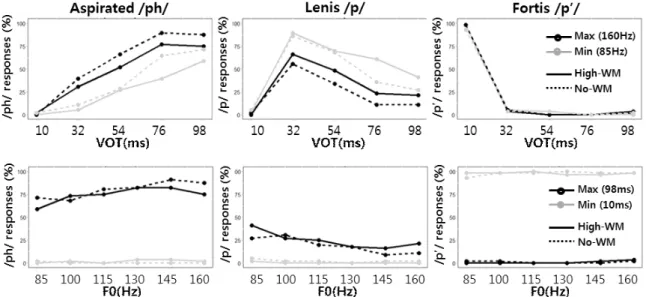
This study investigated how the degree of attention modulates English learners’ perception of Korean stop contrasts. The contributions of VOT and F0 in perceiving Korean stops were examined while availability of attentional resources was manipulated using a dual-task paradigm. Results demonstrated the attentional modulation in the use of VOT, but not in F0:
under less attention, the contribution of VOT to the perception of aspirated stops decreased, whereas that of lenis stops increased, which suggests more native-like performance. This implies that the role of attention in perceiving non-native contrasts might differ depending on how equivalent the acoustic and perceptual cues are between L1 and target L2 contrasts.
Keywords: L2 speech perception, Korean stops, attention, working memory
1. Introduction
The coding of acoustic information into linguistic categories during speech perception varies depending on numerous factors.
Using a dual-task paradigm (i.e., speech recognition while performing another task), some studies demonstrated that the amount of attention given to speech sounds is also a source of the variation (Gordon et al., 1993; Matty and Wiget, 2011). In the dual-task paradigm, the distracting situation to the primary speech recognition task is intentionally given by a secondary task (e.g., letter recall or arithmetic) that increases working memory demands. Working memory (WM) is defined as the information process system used in holding multiple information including visual images or verbal information. The importance of working memory for speech processing has been demonstrated in Francis and Nusbaum (2009) by showing that increasing working memory load slowed down spoken word recognition.
Accordingly, the dual-task paradigm with a distracting situation for speech processing provides the condition increasing the WM load. This experimental paradigm is used to examine effect of
Received: November 3, 2014 Revised: December 9, 2014 Accepted: December 14, 2014
attention on the relative contribution of multiple acoustic cues (Gordon et al., 1993) or lexical and sub-lexical information to speech recognition (Matty and Wiget, 2011). For example, Gordon et al. (1993) showed that in the perception of the voicing distinction and vowel contrasts in English, as the use of strong cues such as VOT and formant frequency decreases, weak cues such as F0 and vowel duration are given more weight;
crucially, this trading relationship is stronger under distracting listening conditions, compared to non-distracting conditions.
Through a simulated model treating the multiple acoustic cues
and attention independently, Gordon et al. (1993) suggested that
strong cues need careful attention, and argued that the distracting
condition reduces competitions from primary cues (VOT, formant
frequency), which allows listeners to rely more on secondary
cues (F0, vowel duration). Mattys and Wiget (2011) tested how
different attentional demands affect a Ganong effect. The Ganong
effect is a lexical bias on phoneme identification; for example,
an ambiguous sound between /k/ and /g/ is more likely to be
perceived as /k/ when it is embedded in /_iss/, given that kiss is
a word, but giss is not. Mattys and Wiget (2011) showed an
increased Ganong effect under distracting conditions compared to
non-distracting. That is, the distracting condition or the WM
overload led listeners to rely more on lexical information
compared to an optimal listening condition, and presumably the
WM overload prevented listeners from accessing to acoustic