Complete genome sequence of Marinobacter salarius HL2708#2 isolated from a lava sea water environment on Jeju Island
Hyun-Myung Oh
1* , Dae-Hyun Kim
2, Seong-Jeong Han
2, Jong-Ho Song
3, Kukhyun Kim
3, and Dongil Jang
21
Institute of Liberal Arts Education, Pukyong National University, Busan 48513, Republic of Korea
2
Cotde Inc., Cheonan 31252, Republic of Korea
3
Cotde Inc., Jeju 63359, Republic of Korea
제주용암 해수 환경에서 분리한 Marinobacter salarius HL2708#2의 유전체 해독
오현명
1* ・ 김대현
2・ 한성정
2・ 송종호
3・ 김국현
3・ 장동일
21
부경대학교 기초교양교육원,
2(주)콧데,
3(주)콧데 제주 천연유기농화장품 사업부
(Received January 2, 2019; Revised January 13, 2019; Accepted January 16, 2019)
*For correspondence.
E-mail: [email protected];Tel.: +82-51-629-6869; Fax: +82-51-629-6949
During screening of microbes for compounds having cosmetic benefits, we isolated Marinobacter salarius HL2708#2 from lava seawater on Jeju Island, Republic of Korea. The complete genome sequence was determined. Strain HL27080#2 features a circular chromosome of 4,304,603 bp with 57.21% G+C content and a 244,163 bp plasmid with 53.14% G+C. There were 4,180 protein coding sequences identified, along with 49 transfer RNA and 18 ribosomal RNA noncoding genes. The genome harbored genes for the utilization of alcohol, maltose/starch, and monosaccharide as sole carbon sources. Genes responsible for halophilic characteristics and heavy metal resistance could be annotated, as well as aromatic and alkane hydrocarbons.
Contrary to the prior report that M. salarius is negative for nitrate and nitrite reduction, nitrate/nitrite reductase along with nitrate/nitrate transporters and nitronate monooxygenase were evident, suggesting that strain HL2708#2 may be able to denitrify extracellular nitroalkenes to ammonia.
Keywords: Marinobacter salarius, complete genome sequence, lava, seawater
Marinobacter salarius strain HL2708#2 is a Gram-negative, rod-shaped, and chemoheterophic bacterium that was isolated from lava seawater on Jeju Island (Handong Lava, N 33.5327°, E 126.8204°) during our investigation of the cosmetic potential of marine microbial species (Koo et al., 2018). Using 16S ribosomal RNA (rRNA) similarity and genome analysis, strain HL2708#2 was identified as Marinobacter salarius species (Koo et al., 2018).
The type species of this genus is M. hydrocarbonoclasticus, which was isolated as a halotolerant hydrocarbon-degrading bacterium (Gauthier et al., 1992). Halotolerant M. salarius was previously isolated from a seawater sample contaminated by radionuclides collected from Chazhma Bay, Russia, near the East Sea of Korea (Ng et al., 2014).
Here we report the complete genome of M. salarius strain HL2708#2 collected from an isolated lava seawater environment on Jeju Island. This isolate may differ from the Chazhma Bay strain R9SW1.
Genomic DNA was extracted using the i-genomic BYF mini kit (iNtRON Biotechnology) following the manufacturer’s protocols.
Genome sequencing of strain HL2708#2 was performed using
PacBio RS II single-molecule real-time (SMRT) sequencing
technology (Pacific Biosciences). A standard PacBio library with inserts averaging 20 kb were prepared using 5 µg of genomic DNA and were sequenced, yielding over 113 × genome coverage. De novo assembly of the 113,192 reads with 7,066 nucleotides on average (799,861,839 bp total) was conducted using the hierar- chical genome-assembly process pipeline of the SMRT analysis v2.3.0 (Chin et al., 2013). To correct sequencing errors that can occur at both ends of a contig, the SMRT resequencing protocol was performed with an assembly in which the first half of the contig was switched with the second half.
Protein coding genes were predicted by Prodigal v.2.6.3 (Hyatt et al., 2010). Signal peptides and transmembrane regions of predicted genes were predicted using SignalP v4.1 (Petersen et al., 2011) and TMHMM v2.0 (Krogh et al., 2001), respectively.
BLAST searches were performed against UniProt (Wu et al., 2006), Pfam (Finn et al., 2014), and COG (Tatusov et al., 2003) databases to functionally annotate the predicted genes. The rRNA, transfer RNA (tRNA), and miscellaneous features were predicted using Rfam v12.0 (Griffiths-Jones et al., 2005). The antiSMASH web-based tool was used for the prediction of secondary metabolite biosynthesis gene clusters (Medema et al., 2011). The graphical circular map of the complete genome was constructed and visualized using Circos v0.67 (Krzywinski et al., 2009).
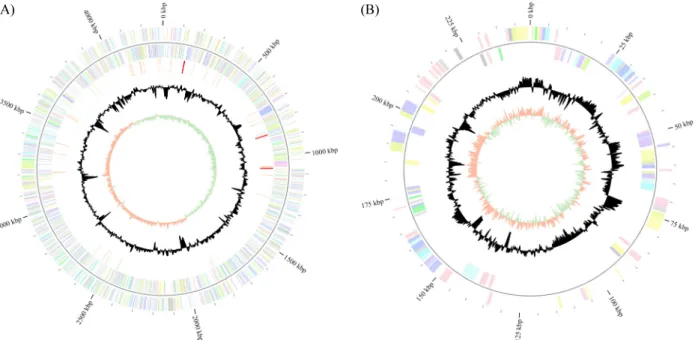
The genome was found to comprise a circular chromosome of 4,304,603 bp with 57.21% G+C content, and a 244,163 bp plasmid (pHL2708Z5) with 53.14% G+C content. A total of 4,241 genes were predicted in the genome. Of these, 4,180 are protein coding genes. The total length of coding regions is 4,145,862 bp. Putative functions were assigned to 2,720 of the protein coding genes and the remainder were annotated as hypothetical proteins. The genome also has 18 rRNA genes (three operons of 5S, 16S, and 23S) and 49 tRNA genes. The properties and the statistics of the genome are summarized in tables on the genome feature page and a COG functional category table on the gene prediction and annotation page.
Chemoheterotrophic M. salarius strain HL2708#2 harbors full gene sets for glycolysis via the embden-meyerhof-parnas pathway, with the production of pyruvate, the pentose phosphate pathway that produces NADPH and pentoses, as well as ribose 5-phosphate, tricarboxylic acid cycle and oxidative phosphory- lation system.
The strain contains genes encoding maltose alpha-D- glucosyltransferase (MTMN5_03192) with the maltodextrin/
maltose transport system (MTMN5_03188 to MTMN5_03190) and alpha-amylase (MTMN5_01691). Additional genes that were identified include those encoding acetyl-CoA synthetase from acetate to acetyl-CoA, aldehyde dehydrogenase, alcohol dehydrogenase 1/7, and alcohol dehydrogenase that converts ethanol to acetate (MTMN5_00558, MTMN5_01466, MTMN5_
03642, and MTMN5_04050, respectively). These results imply that the strain is able to oxidize alcohol and utilize maltose/
maltodextrin and starch as sole carbon sources as well as monosaccharides such as glucose and fructose. Amino acid- auxotrophic characteristics were not found.
The rod shape-determining mreBCD operon (MTMN5_02860 to MTMN5_02862) was identified with the genes encoding the rod shape-determining protein rodA and penicillin-binding protein2 (MTMN5_00727 and MTMN5_00728). Gene clusters involved in flagellar biosynthesis, assembly, and chemotaxis for motility were identified (MTMN5_02947 to MTMN5_02952, MTMN5_03001 to MTMN5_03021, MTMN5_03025 to MTMN5_
03034, respectively). In addition, the gene clusters related to sec-independent protein translocation, type II general secretion pathway, and type VI secretion were identified (MTMN5_
02272 to MTMN5_02274, MTMN5_03732 to MTMN5_03740, and MTMN5_01948 to MTMN5_01961, respectively). Genes responsible for halophilic characteristics were identified. These included Na
+/H
+antiporter (MTMN5_02734 to MTMN5_02739), K
+transporter, glycine betaine uptake system (MTMN5_00494 to MTMN5_00497), ectoine synthase (MTMN5_00497, MTMN5_
03635, and MTMN5_04058), and 5-hydroxyectoine synthase (MTMN5_02464). Gene clusters related to heavy metal resistance were identified and included copper-resistance (MTMN5_00266 to MTMN5_00268) and cobalt/zinc/cadmium-resistance (MTMN5_
04178 to MTMN5_04180). Two core biosynthetic gene sets for the synthesis of non-ribosomal peptides were identified, putatively including the pyoverdine siderophore (MTMN5_
00679 to MTMN5_00680 and MTMN5_03394 to MTMN5_
03395).
Marinobacter previously isolated from a hydrocarbon polluted
site was found to degrade hydrocarbon. The strain was shown to
harbor three gene clusters consisting of eight genes for catechol
degradation. One cluster was located in the chromosome
(A) (B)
Fig. 1. Graphical circular map of the chromosome (A) the pHL2708Z5 (B) of HL2708#2. From outside to the center: Genes on forward strand (color by COG categories), Genes on reverse strand (color by COG categories), RNA genes (tRNAs orange, rRNAs red, other RNAs green), GC content (black), and GC skew (light green/orange).
Table 1. General feature of genome
Attribute Chromosome pHL2708Z5
Value % of Total Value % of Total
Genome size (bp) 4,304,603 100.00% 244,163 100.00%
Protein coding (bp) 3,938,379 91.49% 208,419 85.36%
DNA G+C (bp) 2,462,499 57.21% 129,751 53.14%
DNA scaffolds 1 1
Total genes 3,983 100.00% 258 100.00%
Protein coding genes 3,922 98.47% 258 100.00%
RNA genesa,b 61 1.53% 0 0.00%
Genes with function prediction 2,610 65.53% 110 42.64%
Genes assigned to COGs 3,041 76.35% 130 50.39%
Genes with Pfam domains 3,307 83.03% 172 66.67%
Genes with signal peptides 409 10.27% 33 12.79%
Genes with transmembrane helices 1,032 25.91% 58 22.48%
a No. of rRNA operon: 3 copies
b No. of tRNA gene: 49 genes
(MTMN5_01390 to MTMN5_01397) and the other two were in a plasmid (MTMN5_04009 to MTMN5_04016 and MTMN5_
04140 to MTMN5_04147). In addition, the gene clusters involved in the degradation of phenol and benzoate were identified (MTMN5_01399 to MTMN5_01404 and MTMN5_
04135 to MTMN5_04138, respectively). Furthermore, two gene clusters with identical synteny composed of five genes were
identified (MTMN5_03640 to MTMN5_03644 and MTMN5_
04052 to MTMN5_04048). Four genes of the cluster were
identified as alkane 1-monooxygenase, rubredoxin dehydrogenase,
aldehyde dehydrogenase, and medium-chain-fatty-acid-CoA
ligase. They are involved in the degradation of alkane. One
gene contains the GMC oxidoreductase domain. Other genes
essential for degrading alkane, including 3-phenylpropionate/
trans-cinnamate dioxygenase ferredoxin reductase (MTMN5_
03648) and rubredoxin-NAD (+) reductase (MTMN5_02109 and MTMN5_04054) were identified. Moreover, the strain contains genes encoding nitronate monooxygenase (MTMN5_
00498, MTMN5_02514) and nitrilase (MTMN5_01287), which hydrolyze nitroalkene compounds to acetaldehyde compounds and nitrite and nitriles to carboxylic acids and ammonia, respectively. These results imply that the strain is an important decomposer that utilizes aromatic and alkane hydrocarbon as a carbon and energy source in hydrocarbon polluted sites, and degrades nitroalkane and nitrile compounds, such as 3-nitropropionic acid, benzonitrile, phenylpropionitrile, and others, which are common in legumes and fungi.
M. salaries was reported to be unable to reduce nitrate and nitrite (Ng et al., 2014). However, we identified the presence of the genes responsible for the transport of extracellular nitrate/nitrite (MTMN5_01533, MTMN5_01534, MTMN5_
01535), nitrate reductase (MTMN5_01531), and nitrite reductase (MTMN5_01537, MTMN5_01538, and MTMN5_01539). These results suggest that the strain is able to reduce extracellular nitrate/nitrite and nitrite producing from denitrification of nitroalkenes to ammonia by nitronate monooxygenase.
Nucleotide sequence and strain accession numbers The genome sequence of M. salarius HL2708#2 was depo- sited at GenBank under the accession numbers CP021333 and CP021334. The strain is available from Cotde Inc. (daniel@
cotde.co.kr).
적 요
향장원료 개선을 위한 미생물 탐색 실험을 통하여 Marinobacter salarius HL2708#2을 제주도의 용암 해수 환경에서 분리하였 다. 균주 HL278#2의 완전한 게놈 서열을 분석하였으며, 원형 염색체는 4,304,603 bp이고 57.21% G+C이고 플라스미드는 244,163 bp이고 53.14% G+C였다. 4,180개의 단백질 코딩서열 이 과 49개의 tRNA와 18개의 rRNA 유전자와 함께 확인되었 다. 균주 HL2708# 2의 게놈은 알콜, 말토덱스트린/전분 및 단 당류 대사 유전자를 보유하고 있었다. 호염성 및 중금속 저항성 을 담당하는 유전자와 방향족 및 알칸 계열 탄화수소를 대사하 는 유전자를 가지고 있는 것으로 분석되었다. Marinobacter
salarius가 질산염 및 아질산염 환원능력이 없다고 알려져 있 는 것과 달리, HL2708#2 균주는 질산염/아질산염 환원 효소, 질산염/질산염 운반체 및 질산염 모노 옥시게나제를 가지고 있는 것으로 보아 세포 체외의 니트로알켄을 활용할 수 있는 능력을 가진 것으로 사료된다.
Conflict of Interest
The authors declare no conflict of interest.
Acknowledgements
This research was supported by the Collaborative Genome Program of the Korea Institute of Marine Science and Tech- nology Promotion (KIMST) funded by the Ministry of Oceans and Fisheries (MOF) (No. 20180430). This research also received support from the National Research Foundation (NRF-2017R1D1A1B03034706).
References
Chin CS, Alexander DH, Marks P, Klammer AA, Drake J, Heiner C, Clum A, Copeland A, Huddleston J, Eichler EE, et al. 2013.
Nonhybrid, finished microbial genome assemblies from long- read SMRT sequencing data. Nat. Methods 10, 563.
Finn RD, Bateman A, Clements J, Coggill P, Eberhardt RY, Eddy SR, Heger A, Hetherington K, Holm L, Mistry J, et al. 2014. Pfam:
the protein families database. Nucleic Acids Res. 42, D222–
D230.
Gauthier MJ, Lafay B, Christen R, Fernandez L, Acquaviva M, Bonin P, and Bertrand JC. 1992. Marinobacter hydrocarbonoclasticus gen. nov., sp. nov., a new, extremely halotolerant, hydrocarbon- degrading marine bacterium. Int. J. Syst. Evol. Microbiol. 42, 568–576.
Griffiths-Jones S, Moxon S, Marshall M, Khanna A, Eddy SR, and Bateman A. 2005. Rfam: annotating non-coding RNAs in complete genomes. Nucleic Acids Res. 33, D121–D124.
Hyatt D, Chen GL, LoCascio PF, Land ML, Larimer FW, and Hauser LJ. 2010. Prodigal: prokaryotic gene recognition and translation initiation site identification. BMC Bioinformatics 11, 119.
Koo CS, Sookyung S, Kim D, and Jang D. 2018. A novel marine- derived bacterium, and cosmetic compositions using the same.
Vol. KR101918673B1, Republic of Korea.
Krogh A, Larsson B, von Heijne G, and Sonnhammer ELL. 2001.
Predicting transmembrane protein topology with a hidden markov model: application to complete genomes. J. Mol. Biol. 305, 567–
580.
Krzywinski MI, Schein JE, Birol I, Connors J, Gascoyne R, Horsman D, Jones SJ, and Marra MA. 2009. Circos: An information aesthetic for comparative genomics. Genome Res. 19, 1639–
1645.
Medema MH, Blin K, Cimermancic P, de Jager V, Zakrzewski P, Fischbach MA, Weber T, Takano E, and Breitling R. 2011.
antiSMASH: rapid identification, annotation and analysis of secondary metabolite biosynthesis gene clusters in bacterial and fungal genome sequences. Nucleic Acids Res. 39, W339–W346.
Ng HJ, López-Pérez M, Webb HK, Gomez D, Sawabe T, Ryan J, Vyssotski M, Bizet C, Malherbe F, Mikhailov VV, et al. 2014.
Marinobacter salarius sp. nov. and Marinobacter similis sp.
nov., isolated from sea water. PLoS One 9, e106514.
Petersen TN, Brunak S, von Heijne G, and Nielsen H. 2011. SignalP 4.0: discriminating signal peptides from transmembrane regions.
Nat. Methods 8, 785.
Tatusov RL, Fedorova ND, Jackson JD, Jacobs AR, Kiryutin B, Koonin EV, Krylov DM, Mazumder R, Mekhedov SL, Nikolskaya AN, et al. 2003. The COG database: an updated version includes eukaryotes. BMC Bioinformatics 4, 41.
Wu CH, Apweiler R, Bairoch A, Natale DA, Barker WC, Boeckmann B, Ferro S, Gasteiger E, Huang H, Lopez R, et al. 2006. The universal protein resource (UniProt): an expanding universe of protein information. Nucleic Acids Res. 34, D187–D191.