Alleviating Effect of the Application of the Easily Decomposable Carbohydrate on Ammonium Toxicity in Chinese Cabbage ( Brassica rapa var. chinensis)
Hyun-Hwoi Ku, and Sang-Eun Lee
1*
Research Center of Climate Change, Hankyong National University, 327 Chungang-ro, Anseong-si, Gyeonggi-do 17579, Republic of Korea
1
Department of Plant Life and Environmental Sciences, Hankyong National University, 327 Chungang-ro, Anseong-si,
Gyeonggi-do 17579, Republic of Korea
(Received: June 19 2015, Revised: October 15 2015, Accepted: October 15 2015)
An excess application of N fertilizer causes physiological and morphological disorder known as ammonium (NH 4 +
) toxicity in Chinese cabbage and it has been to be an issue for appropriate N fertilizer management.
Hence, the pot experiment was conducted in order to evaluate the alleviating effect of the application of the easily decomposable carbohydrate on NH 4 +
toxicity in Chinese cabbage. Four levels of urea at 0, 160, 320, and 640 kg N ha -1 , represented as T1, T2, T3, and T4, respectively, were applied. In order to evaluate the alleviating effect of the application of the easily decomposable carbohydrate (sucrose) at T3 and T4 where NH 4 + toxicity had occurred, five levels of sucrose were applied to meet C/N ratios of 0, 2, 4, 6, and 10, respectively. Our results showed that the NH 4 + toxicity was observed at T3 and T4 at 5 days after treatment (DAT). NH 4 +
toxicity contributed to decrease fresh weight, length of leaves, length of root, and number of leaves significantly (p<0.05). The application of sucrose as a source of mitigating NH 4 +
toxicity had a good performance at T3 with the alleviating effect as 73 % and reduced in NH 4 +
-N content in soil at 29 DAT. In the maximum N rate of T4, however, sucrose application recovered it as 32 % only compared to T2 even though the same C/N ratio was treated. Consequently, sucrose as the easily decomposable carbohydrate played crucial role to reduce NH 4 + concentration in soil and finally alleviated NH 4 + toxicity in plant.
Key words: Chinese cabbage, NH 4 +
toxicity, Easily decomposable carbohydrate, C/N ratio, Sucrose
An easily decomposable C source for the alleviating effect on NH
4+toxicity was applicable.
The maximum rate of the recovery effect was 73% relative to the healthy plant at 10 of C/N ratio.
1)
*Corresponding author : Phone: +82316705085, Fax: +82316705089, E-mail: [email protected]
§
Acknowledgement : This study was carried out with the support of “Cooperative Research Program for Agricultural Science & Technology
Development” (Project number: PJ00930204), Rural Development Administration (RDA), Republic of Korea.
Introduction
In agricultural soils, an appropriate application of N is the most crucial for improving crop growth. However, excess application of N fertilizer resulted in not only phy- siological and morphological disorder such as ammonium toxicity symptom (Britto and Kronzucker, 2002), but also environmental pollution because most farmers applied it based on their empirical N practice without technical information of N dosage in relation to soil environmental condition (Savci, 2012).
Plant can uptake inorganic N (NH
4+and NO
3-) formed through microbial N transformation such as hydrolysis, ammonification, nitrification, and mineralization in soils.
Microbes also utilize N source for their population growth.
Meanwhile, excess concentration of ammonium N causes the toxicity seriously when urea, fresh animal manure or unstable manure compost are applied to excessive level (Gerendás et al., 1997). For instance of visual symptoms, NH
4+toxicity inhibits seed germination, seedling establish- ment, the chlorosis of leaves, and yield depressions, and even plant dying (Kirkby and Mengel, 1967; Gerendás et al., 1997; de Graaf et al., 1998). In addition, ionic im- balances in the plant induced by NH
4+exposure result in total tissue depression, compared with NO
3--fed plants, which declines in essential cations such as potassium, calcium, and magnesium, physiologically (Kirkby, 1968;
Gloser and Gloser, 2000).
There were several evidences that increasing N appli- cations usually tended to increase the risk of the physiological disorder known as internal tip-burn and restricted root growth (Lee and Lim, 1984; Marschner and Marschner, 2012). The optimum N addition for marketable yield in Chinese cabbage has been suggested as low as 200 kg N ha
-1, or between 200 and 300 kg ha
-1in cases (Goodlass et al., 1997). Probably, the actual optimal N rate might be expected to depend upon soil physical and chemical properties in relation to the avail- ability of other nutrient elements.
For alleviation of NH
4+toxicity, there were diverse research results; for instance, maintaining neutral to slightly alkaline pH can prevent it (Goodchild and Givan, 1990), optimization of light regimes to avoid high light effects is more critical with NH
4+grown plants than with NO
3-or organic N grown plants (Britto and Kronzucker, 2002), maintaining high levels of cations known to be depressed in plant tissue when NH
4+is used as a sole N source, the supply levels of potassium have been shown to alleviate toxicity both in solution and field (Barker, 1995), and co-provision of NH
4+with NO
3-can alleviate it (Gill and Reisenauer, 1993).
Ku et al. (2010) reported that easily decomposable carbo-
hydrates (i.e. glucose, sucrose, or starch) contributed to rapid decrease of soil inorganic N content (i.e. NH
4+and NO
3-) within three days through immobilization by microbial process in soil. Based on the results, it assumed that the microbial process alleviated NH
4+availability for plant uptake, contributing recovery effect on NH
4+toxicity.
Thus, this experiment was conducted in order to examine the hypothesis on the alleviating effect of the application of the easily decomposable carbohydrate on the NH
4+toxicity of Chinese cabbage under excess N application.
Materials and Methods
Pot preparation and treatment Pot experiment was conducted at glasshouse in Hankyong National University (HKNU) in order to evaluate the effect of the application of easily decomposable carbohydrate to the soil on the growth of Chinese cabbage affected by NH
4+toxicity.
A soil used in this experiment was collected from the surface layer (0-30 cm) of the field at experimental farm station in HKNU, and air-dried. The prepared soil was filled up at 20 cm depth of 1/5000 a Wagner pot (16 cm diameter and 25 cm height). The soil chemical properties had 7.6 of pH (1:5), 1.1 dS m
-1of electrical conductivity (EC), and inorganic nitrogen (N) contents: NH
4+-N, 38.6 mg kg
-1and NO
3--N, 12.4 mg kg
-1, respectively.
Four levels at 0, 160, 320, and 640 kg N ha
-1of urea fertilizer as a NH
4+source were applied to the pot soil for the observation of NH
4+toxicity in Chinese cabbage plants. When two N levels at 320 and 640 kg N ha
-1showed typical symptom of NH
4+toxicity at Chinese cabbage plants, five levels of carbon to meet C/N ratio of 0, 2, 4, 6, and 10 were treated immediately. The amounts of C were calculated based on the N rates of treatments.
Sucrose was used as a carbon source and dissolved in deionized water of 400 mL prior to the application. The solutions were treated into each pots at 5 DAT (Table 1).
Cultivation of Chinese cabbage and NH
4+toxicity Seedlings of Chinese cabbage (Brassica rapa var. chinensis) grown at a fertilized seed bed were transplanted into the pots 25 days after sowing (DAS). One seedling per pot was planted with triplicates.
Based on P
2O
5-K
2O (78-198 kg ha
-1) fertilizers application rate for Chinese cabbage, super single phosphate (SSP) and potassium chlorice (KCl) as PK sources were applied.
And boric acid (H
3BO
3) was also applied at 15 kg ha
-1to prevent the physiological B deficiency during early growth.
KCl was basally applied by 60 % of the total doses at one
day before transplanting. SSP and H
3BO
3were also applied
basally at one day after transplanting (DAT).
Table 1. Detail information of N and C levels with various C/N ratios applied in the treatments.
Treatment N rates C/N ratio (C rate, kg C ha
-1)
†(kg N ha
-1) (g N pot
-1) 0 2 4 6 10
T1 0 0
not applied
T2 160 0.73
T3 320 1.46 (0) (384) (768) (1,152) (1,920)
T4 640 2.92 (0) (768) (1,536) (2,304) (3,384)
†
The sucrose was applied at 5 DAT.
Note: boric acid of 15 kg ha
-1was also applied at -1 DAT in all treatments.
T1 T2
T3 T4
T1 T2
T3 T4
(A) 5 DAT (B) 29 DAT
Fig. 1. The symptom of NH
4+toxicity occurred at 320 (T3) and 640 (T4) kg N ha
-1by excess N applications, but no symptom at 0 (T1) and 160 (T2) kg N ha
-1at 5 and 29 DAT, respectively.
Table 2. Inorganic N concentrations affected by N rates at 5 DAT in the treatment.
Treatment N rates (kg ha
-1)
NH
4+-N (mg kg
-1)
NO
3--N (mg kg
-1)
T1 0 5d
†1c
T2 160 81c 27b
T3 320 175b 74a
T4 640 227a 67a
†
Denotes that mean values of three replicates with the same letter within the column are not significantly different at p<0.05.
Soil analysis and crop growth measurement Triplicate soil samples at 5 and 29 DAT were taken from the depth of 15 cm of the pot, air-dried for 1 week, and sieved through 2 mm aperture prior to the analysis. Inorganic nitrogen (NH
4+and NO
3-) in the soil extracts with 2M KCl solution was determined by Kjeldahl method (Bremner, 1996).
For the determination of crop growth, fresh weight (FW), length of leaves (LOL), length of root (LOR), and number of leaves (NOL) per plant were measured at 29 DAT with triplicates. For measurement of LOR, whole soil and plant in the pot were pulled out then washed with flowing water.
Statistical analysis One-way analysis of variance (ANOVA) for statistical evaluation of analytical results and Duncan’s multiple range test (DMRT) at 5% of probability for significant difference between mean values of treatments was employed by using the STAR V. 2.0.1 (IRRI, 2013) computer program.
Results and Discussion
The symptom of NH
4+toxicity in Chinese cabbage The symptom of NH
4+toxicity in the treatments was
observed in T3 and T4 where leaves turned dark green and poorly developed as compared with T1 and T2 at 5 DAT (Fig. 1A), and was continued until 29 DAT (whole experiment period) (Fig. 1B). The significant difference of NH
4+-N concentration in soils of 5, 81, 175, and 227 mg N kg
-1at T1, T2, T3, and T4 was observed, respectively.
The more N application resulted in the higher amount of NH
4+-N in soil (p<0.05). Moreover, amount of NO
3--N which is another form of inorganic N in soil tended to increase, but there was no significant difference between T3 and T4 treatments (Table 2).
In Table 3, as compared to the treatment of T1 and
Table 3. Effect of excess N rates and occurrence of NH
4+toxicity on the growth of Chinese cabbage at 29 DAT in T3 and T4 treatments.
Treatment N rates (kg ha
-1)
FW
†(g plant
-1)
LOL LOR NOL
(cm plant
-1) (plant
-1)
T1 0 20b
‡14a 15b 11a
T2 160 28a 16a 24a 11a
T3 320 11c 11b 18b 9b
T4 640 1d 4c 7c 3c
†
FW: fresh weight; LOL: length of leaves; LOR: length of root; NOL: number of leaves.
‡
Denotes that mean values of three replicates with the same letter within the column are not significantly different at p<0.05.
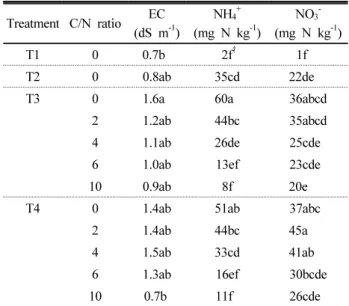
Table 4. Effect of the control of C/N ratios by the application of sucrose as a carbon source on reduction of the NH
4+-N and NO
3--N concentrations in soils at 29 DAT .
Treatment C/N ratio EC (dS m
-1)
NH
4+(mg N kg
-1)
NO
3-(mg N kg
-1)
T1 0 0.7b 2f
†1f
T2 0 0.8ab 35cd 22de
T3 0 1.6a 60a 36abcd
2 1.2ab 44bc 35abcd
4 1.1ab 26de 25cde
6 1.0ab 13ef 23cde
10 0.9ab 8f 20e
T4 0 1.4ab 51ab 37abc
2 1.4ab 44bc 45a
4 1.5ab 33cd 41ab
6 1.3ab 16ef 30bcde
10 0.7b 11f 26cde
†