1. INTRODUCTION
Soil erosion is a major environmental and forest management problem worldwide.
With increasing mechanization of forest har- vesting operations the impacts on soil have in- creased quite dramatically (Greacen and Sands, 1980). Responsibly managed timber harvest causes only minor increases in forest soil ero- sion, usually from channels and logging roads,
but irresponsible timber harvest can increase erosion of soil to unacceptable levels (Patric, 1976). In forest slope, soil erosion occurs main- ly due to the poor structural stability of the soil. The regulation of soil structure mainly de- pends on the organic matter content of soil (Bissonnais and Arrouays, 1997).
Forest manager could minimize rain- fall-induced soil losses by the stringent use of minibasins and buried runoff pipes: however,
Original Article
Effects of Lignocellulosic Growing Media to The Prevention of Forest Soil Erosion
1Jong-Soo Jo
2⋅Si Young Ha
3⋅Ji Young Jung
3⋅Ji-Su Kim
3⋅Jeong Bin Nam
3⋅Jae-Kyung Yang
3,†ABSTRACT
The forest slopes cause substantial local changes in soil properties and an increase in soil erosion after extreme rainstorms. The high soil erosion rates on forest slopes need the effective use of growing media to control the soil runoff. Therefore, we prepared six different lignocellulosic growing media such as peat, perlite, and wood meal as the base materials and carboxymethyl cellulose (CMC), glucomannan, starch, old corrugated containerboard, and computer printout as the additional materials for the prevention of simulated rainfall-induced runoff. The growing media containing old corrugated containerboard efficiently reduced the percentage of soil runoff; however, it could not completely cushion the influence of crust. The best results for plant growth, except in the leaf area, were also obtained with the growing media containing old corrugated containerboard, suggesting an interesting way of paper recycling and an economic benefit for plant or crop growth in forest slope.
Keywords : soil runoff, growing media, wood mill, plant growth, paper recycle
1Date Received March 7, 2017, Date Accepted June 15, 2017
2Department of Interior Materials Engineering, Gyeongnam National University of Science and Technology, Jinju 52725, Republic of Korea
3Division of Environmental Forest Science, Institute of Agriculture & Life Science, Gyeongsang National University, Jinju 52828, Republic of Korea
† Corresponding author: Jae-Kyung Yang (e-mail: [email protected])
these techniques are often too cumbersome or costly for adequate adoption (Orts et al., 2000).
Furthermore, these techniques do not contribute to the improvement of organic matter. Kern and Johnson (1991) proposed increasing the input of organic matter by providing the stabilized exog- enous organic matter to solve this problem. One of the organic matters is the steam-treated wood meal, which might become a basic component of forest soil and provide nutrients to the plants from the rotten wood chip in future (Jung et al., 2015).
Moreover, recently, an easy and effective tool has been added to these soil-loss minimizing measures by adding the quantities of materials, which play the role of stabilizers, to the grow- ing media (Tian et al., 2015). The soil-loss control matter used additives, such as CMC, starch, and glucomannan, in the growing media.
Smith et al. (1958) reported that the additive material CMC prevented soil erosion. Materials such as starch, sugar, cellulose, and other com- pounds obtained from wheat are commonly used as additives (Parker and Ring, 2005).
Several studies have reported the effectiveness of recycled paper, one of the lignocellulosic materials, for preventing soil erosion (Nemati et al., 1999; Barriga et al., 2010). Campbell et al.
(1995) demonstrated that a recycled paper mix- ture could be used as a soil amendment for pre- venting soil erosion and sustaining plant growth. Therefore, steam-treated wood meal and lignocellulosic additives, such as CMC and re- cycled paper, are expected to play important roles in the development of the growing media
for reducing soil loss in forest slope.
The objective of this study was to evaluate the effect of growing media mixed with ligno- cellulose on preventing the simulated rain- fall-induced soil runoff and sustaining plant growth. Furthermore, we determined the grow- ing media characteristics that affected the runoff percentage and plant growth. Thus, we analyzed the correlation between the characteristics of growing media and runoff percentage and plant growth.
2. MATERIALS and METHODS 2.1. Growing Media Preparation
The growing media was prepared by mixing the basic materials, such as peat, perlite, and wood meal (Quercus mongolica), with the addi- tives such as CMC, glucomannan, starch, old corrugated containerboard, and computer printout. The raw materials used in this study included commercial peat, classified as brown peat (pH 3.5-4.5, Satis International Co., Ltd.
LA FLORA, Europe), and commercial perlite
(particle size 2 mm; Landscape Architecture
Co., Ltd., Korea). The wood chip and recycled
paper (old corrugated containerboard and com-
puter printout) were collected by Gyeongsang
National University, Jinju City, Korea. We pur-
chased the commercial CMC, glucomannan, and
starch from. GL CHEM Co., Ltd., Korea. The
wood chip was steam treated at 1.5 kg/cm
2and
225 ℃ for 5 min (Jung et al., 2015). The re-
cycled paper of 605 g was disintegrated for 10
min at the recycled paper/water ratio of 1/20.
The peat and steam-treated wood chip were sieved to separate the particles below 2 mm.
The growing media are shown in Table 1. The growing media were prepared by mixing three raw materials (peat, perlite, and wood meal) with one of the additives (CMC, glucomannan, starch, old corrugated cardboard, and computer printout) at the ratio of 3 : 1 : 4 : 2 (w/w/w/w).
The control media comprised of peat, perlite, and wood meal at the ratio of 3 : 1 : 6 (w/w/w), and all raw materials were used after air drying for 48 h.
2.2. Analytical Methods of Growing Media
The porosity of the growing media was cal- culated by the following equation: (1 - Bulk density / Particle density) × 100 (Atiyeh et al., 2001). The bulk density was measured using the core method (Blake and Hartge, 1986). A metallic core of 5 cm inner diameter and 5 cm height was inserted into the packed pots to take out the undisturbed samples of growing media.
The samples were dried in an oven at 105 ℃ for 24 h or till the weight of samples became constant. The ratio of the oven-dry weight of
the sample in the core and the internal volume of metallic core was expressed as bulk density.
The particle density was determined by the method of Ribeiro et al. (2007). The wa- ter-holding capacity was determined using the loosely packed cores and methods adapted from Evans et al. (1996). The pH of the growing media was analyzed in a water-soluble extract or suspension (1 : 5, v/v) (European Standard 13037, 1999). The C and N concentrations were analyzed by Kjeldahl digestion (Bremner and Mulvaney, 1982) using macro elemental ana- lyzer (vario MACRO cube, USA). Samples were analyzed directly with no sample prepara- tion other than drying and fine grinding.
2.3. Simulated Rainfall
The runoff rates were calculated using a rain- fall simulator (Moreno-Ramón et al., 2014). The rainfall simulator was composed of a woody structure of the following dimensions: 30 cm height × 2 cm width × 15 cm length. A water emitter with a precipitation rate of 122 mm/h and an average droplet diameter of 5.7 mm and a device with droppers were placed at the side of the woody structure. The rainfall simulation
Growing media Composition
Control Peat, perlite and wood meal (3 : 1 : 6, w/w/w) M1 Peat, perlite, wood meal and CMC (3 : 1 : 4 : 2, w/w/w/w) M2 Peat, perlite, wood meal and glucomannan (3 : 1 : 4 : 2, w/w/w/w) M3 Peat, perlite, wood meal and starch (3 : 1 : 4 : 2, w/w/w/w)
M4 Peat, perlite, wood meal and old corrugated containerboard (3 : 1 : 4 : 2, w/w/w/w) M5 Peat, perlite, wood meal and computer printout (3 : 1 : 4 : 2, w/w/w/w) Table 1. Composition of the growing media tested.
was carried out on air-dried growing media samples with different compositions as listed in Table 1. Growing media were deposited in the woody structure by volume and we put growing media weight record respectively. The runoff percentage was calculated by determining the weight of growing media in dropper after artifi- cial rain. Percent of runoff was calculated using the following equation:
Runoff percent (%) =
Air-dry weight of growing media after artificial rain (g)
× 100 Air-dry weight of growing
media before artificial rain (g)
2.4. Plant Growth Experiment
The growth experiment was carried out to evaluate the potential use of growing media (Table 1) in Chinese cabbage (Brassica cam- pestris ssp. pekinensis) growth. Chinese cab- bage was selected because of its rapid growth and ability to keep growing after being cut several times. Growing media were put into each 9 cm diameter petri dish by the volume.
Subsequently, the Chinese cabbage seeds were transferred into the growing media, with 50 seeds per dish and 1 cm or larger distance between the seeds (Yang and Watts, 2005).
Petri dishes were covered after adding distilled water and sealed with Parafilm, and placed in an incubator. After incubating the petri dishes at 20 ℃ for seven days in the dark, the germi- nation was halted and the number of germi- nated seeds was counted. The seed germination
rate was calculated using the following equa- tion:
Germination (%) =
Number of germinated seeds
× 100 Total number of seeds
The stem lengths of the Chinese cabbage seedlings were measured immediately after har- vest at seven days after seeding. The stem length was measured from the top of the root to the top of the leaf using a Vernier Caliper.
The leaf area was calculated as the product of the total length and the breadth at the broadest point of the longest leaf on the plant. Area of leaf was calculated using the following equation (Pan, 2006):
Leaf area (cm
2) =
Lamina length × Maximum width
2.5. Correlation Analysis
The data values from the experiments used to
determine the physical and chemical properties
of the growing media were compared with the
runoff percent and plant growth properties by
correlation analysis. The aim was to determine
whether the methods used to determine the
physical and chemical properties of the growing
media were effective in predicting the plant
growth. Pearson analysis (R program, i386 3.2.2
version) was performed for each substrate and
variations were assessed based on the variations
in the physical and chemical properties of the
growing media.
2.6. Significance Analysis
Each treatment was conducted with three rep- licates, and the results were presented as mean
± SD (standard deviation). The statistical analy- sis of the experimental data was performed us- ing the Duncan’s test. Each of the experimental values was compared to its corresponding control. The statistical significance was ac- cepted when the probability of the result assum- ing the null hypothesis (p) was less than 0.05.
The significance analysis was conducted using the SAS software, version 9.4.
3. RESULT and DISCUSSION 3.1. Characteristic of Growing Media
The growing media characteristics are among the parameters which must be defined and con- trolled, to ensure that they are not growth limiting. Therefore, the growing media must
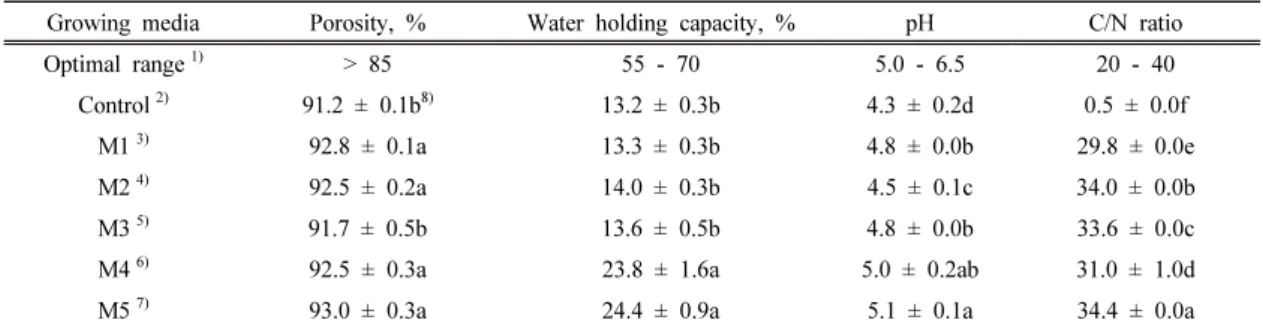
have optimal physical and chemical character- istics (porosity, water holding capacity, pH, and C/N). Characteristics of the all growing media are listed in Table 2. All growing media were evaluated as highly porous materials with their porosities varying from approximately 91.2 to 93.0%. All growing media, except M3, showed an increase in the porosity when mixed with additives. The higher media porosity might pro- mote the higher biomass growth (Show and Tay, 1999). The additives provided a high air porosity and exceptional water-holding capacity to the growing media (Beardsell et al., 1979).
Therefore, the growing media M1, M2, M4, and M5 showed higher porosity than control, and were found to be beneficial to plant growth. The water-use efficiency of both dry and irrigated lands will need to be substantially improved in order to meet the growing demand of crops (Oki and Kanae, 2006). Therefore, the water-holding capacity was an important charac-
Growing media Porosity, % Water holding capacity, % pH C/N ratio
Optimal range1) > 85 55 - 70 5.0 - 6.5 20 - 40
Control2) 91.2 ± 0.1b8) 13.2 ± 0.3b 4.3 ± 0.2d 0.5 ± 0.0f
M13) 92.8 ± 0.1a 13.3 ± 0.3b 4.8 ± 0.0b 29.8 ± 0.0e
M24) 92.5 ± 0.2a 14.0 ± 0.3b 4.5 ± 0.1c 34.0 ± 0.0b
M35) 91.7 ± 0.5b 13.6 ± 0.5b 4.8 ± 0.0b 33.6 ± 0.0c
M46) 92.5 ± 0.3a 23.8 ± 1.6a 5.0 ± 0.2ab 31.0 ± 1.0d
M57) 93.0 ± 0.3a 24.4 ± 0.9a 5.1 ± 0.1a 34.4 ± 0.0a
1) Goh and Haynes, 1977
2) Peat, perlite and wood meal (3 : 1 : 6, w/w/w)
3) Peat, perlite, wood meal and CMC (3 : 1 : 4 : 2, w/w/w/w)
4) Peat, perlite, wood meal and glucomannan (3 : 1 : 4 : 2, w/w/w/w)
5) Peat, perlite, wood meal and starch (3 : 1 : 4 : 2, w/w/w/w)
6) Peat, perlite, wood meal and old corrugated containerboard (3 : 1 : 4 : 2, w/w/w/w)
7) Peat, perlite, wood meal and computer printout (3 : 1 : 4 : 2, w/w/w/w)
8) Values with different alphabets in the same column are significantly different at p < 0.05
Table 2. Physical and chemical properties of growing media
teristic of the growing media. In this study, the water-holding capacity of M4 and M5 were the highest among all growing media; however, it was not the optimal range for plant growth.
With low water-holding capacity, water should be applied frequently, and in small amounts, as leaching might occur easily (Garcia-Gomez et al., 2002). Therefore, the growing media M4 and M5 were relatively optimal for the crop or plant growth. Furthermore, the pH values of both M4 and M5 were within the optimal range for plant growth, i.e., between 5.0 and 6.5 (Goh and Haynes, 1977). The pH of the growing me- dia was closely correlated with water alkalinity (Bunt, 1988), and thus, it is an important factor for crop or plant growth. Therefore, among all growing media, M4 and M5 were the most suitable for crop or plant growth. Rosen et al.
(1993) suggested that the growing media C/N ratio for ideal plant growth ranged between 15
: 1 and 20 : 1, whereas Ozores-Hampton et al.
(1998) suggested a 25 : 1 ratio or less, and Ingelmo et al. (1998) obtained optimal results for the growth of Cupressus sempervirens using different substrates with biosolid components and C/N ratios of approximately 25 : 1. In the present study, all growing media, except con- trol, showed high C/N ratios and optimal Chinese cabbage growth because the optimal C/N ratio ranged from 20-40 (Ostos et al., 2008). Moreover, this could be an advantage to avoid N immobilization due to high C/N ratio (García et al., 1992), and thus, all growing me- dia, except control, were available for crop or plant growth. The C/N ratio of the control me-
dia (C/N : 0.5) was the lowest among all grow- ing media. The crop or plant production was also affected by the C/N ratio of the growth media, and the extent of these effects also de- pended on the N source used, particularly at low C/N ratio (Engelkes et al., 1997).
3.2. Growing Media Runoff on Simulated Rainfall
In spite of the disadvantages, such as prob-
lems in extrapolating the results to conditions,
rainfall simulations are widely used because of
their low cost and ease of operation (Walsh et
al., 1998), and also because of the possibility
for study under controlled condition (Navas et
al., 1990). The results of the rainfall simulation
tests can be used for comparative purposes
(Foster et al., 2000). The growing media runoff
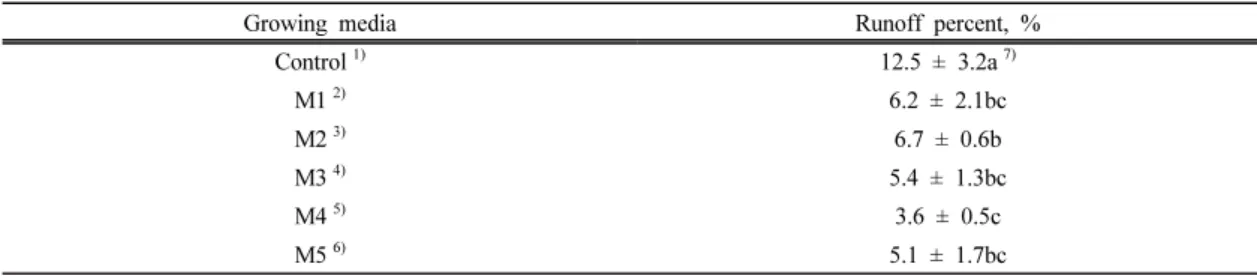
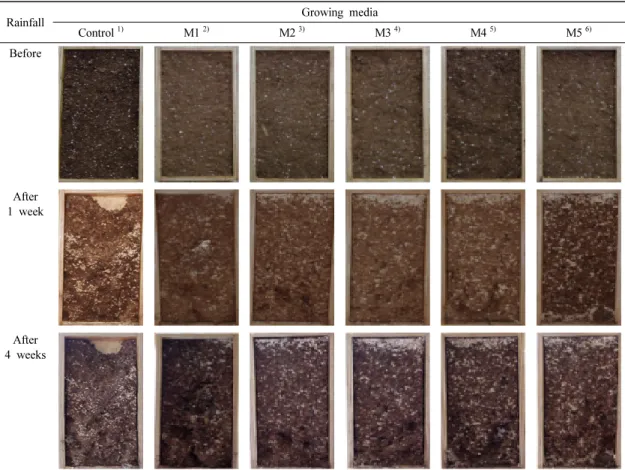
patterns shown in Fig. 1 and Table 3 indicated
that the runoff percentages of all growing me-
dia, except control, decreased with the in-
corporation of all additives. Control was runoff
by a tenth part of the surface after 1 week (as
determined through visual approximation). On
the other hand, the runoff of the growing media
with old corrugated containerboard was found
to be slightly prevented with rainfall as vi-
sualized by the naked eye. Among all growing
media, the average runoff was the lowest in the
media containing old corrugated containerboard
(M4) (Table 3). The average runoff of the con-
trol media was statistically significantly higher
than all growing media, in which the average
runoff was reduced by 1.9-3.5 times with the
addition of additives. The comparative data be-
tween the control and M4 media revealed that the runoff was reduced on an average by 71%.
Therefore, M4 was one of the most effective growing media for preventing soil loss. Chepil et al. (1962) reported that the starch treatments were ineffective to control soil erosion under the experimental conditions. However, our re- sults showed that starch was relatively effective in preventing soil loss (56.8% reduced soil loss). The application of polysaccharides, such as starch and cellulose, might accelerate the soil macro-aggregate formation related to soil loss (Mizuta et al., 2015). The old corrugated con- tainerboard was a lignocellulosic material;
therefore we speculated that it was effective in preventing soil loss. Biopolymers are known to reduce soil loss and runoff (Sojka et al., 2005);
however, the effects of lignocellulosic materials, such as old corrugated containerboard, on soil loss are not yet clear. In this study, we con- firmed the potential of old corrugated container- board to prevent soil loss.
3.3. Growth of Plant (Chinese cabbage) Growth
In general, the germination rate of the Chinese cabbage seeds grown in control media was significantly lower than that of the seeds grown with additives in all growing media (Fig.
2). The germination rate of the control media was lower (66.5%) than that of the other grow- ing media with additives. Germination of Chinese cabbage in M4 media was the highest among all growing media and approximately 1.2 times higher than that in the control media.
The starch (77.8%) and computer printout paper (74.6%) were also relatively effective in in- creasing seed germination. The lowest seed ger- mination rate in the control media might have resulted because of the low pH of the mixture of peat, perlite, and wood meal (Table 2).
Warman (1999) confirmed that the Chinese cab- bage seeds showed low germination rate in the low pH condition. In acidic growing media, the high concentration of soluble ion is the primary
Growing media Runoff percent, %
Control1) 12.5 ± 3.2a7)
M12) 6.2 ± 2.1bc
M23) 6.7 ± 0.6b
M34) 5.4 ± 1.3bc
M45) 3.6 ± 0.5c
M56) 5.1 ± 1.7bc
1) Peat, perlite and wood meal (3 : 1 : 6, w/w/w)
2) Peat, perlite, wood meal and CMC (3 : 1 : 4 : 2, w/w/w/w)
3) Peat, perlite, wood meal and glucomannan (3 : 1 : 4 : 2, w/w/w/w)
4) Peat, perlite, wood meal and starch (3 : 1 : 4 : 2, w/w/w/w)
5) Peat, perlite, wood meal and old corrugated containerboard (3 : 1 : 4 : 2, w/w/w/w)
6) Peat, perlite, wood meal and computer printout (3 : 1 : 4 : 2, w/w/w/w)
7) Values with different alphabets in the same column are significantly different at p < 0.05
Table 3. Runoff percent of growing media surface layer after rainfall simulation
cause of plant germination restriction (Foy et al., 1978). Therefore, our results suggested that the high germination rate of M4 media was caused by its relatively high pH (Table 2).
The effects of growing media additives on stem length and leaf area were shown in Fig. 3 and 4, respectively. The stem length obtained with M4 was significantly higher than that ob- tained with the other growing media. The same effect could be achieved in the germination rate
of Chinese cabbage seeds. M1 and M3 showed higher leaf area than the other growing media, and all growing media with additives showed sig- nificantly higher leaf area than the control media.
Yasunori et al. (2000) determined the effect of low pH on the growth of lettuce seedlings. The growth (stem and root length) of lettuce seed- lings was highly suppressed with the lowering of the media pH. Hidenori et al. (2003) hypothe- sized that auxin and ethylene were involved in
Rainfall Growing media
Control1) M12) M23) M34) M45) M56)
Before
After 1 week
After 4 weeks
Fig. 1. Characteristic of soil surface layer after rainfall simulation (1)peat, perlite and wood meal (3 : 1 : 6, w/w/w); 2)peat, perlite, wood meal and CMC (3: 1: 4: 2, w/w/w/w); 3)Peat, perlite, wood meal and glucomannan (3 : 1: 4 : 2, w/w/w/w); 4)Peat, perlite, wood meal and starch (3: 1: 4: 2, w/w/w/w); 5)Peat, perlite, wood meal and old corrugated containerboard (3 : 1 : 4 : 2, w/w/w/w); 6)Peat, perlite, wood meal and computer printout (3 :
1 : 4 : 2, w/w/w/w)).
the process of low-pH-induced root hair initiation. Therefore, pH was considered an im- portant factor for plant growth. Our results also suggested that the low pH of the control media was favorable for Chinese cabbage growth.
Furthermore, Bellamy et al. (1993) reported that the paper waste was effectively applied to plant growth. Campbell et al. (1995) confirmed that the paper waste had a potential for the amendment of low-quality growing media or soil. Ostos et al. (2008) reported that the re- cycled paper with a certain pH value and high organic matter was useful for plant germination and growth. Our results also showed that the addition of paper waste to the growing media led to an increase in Chinese cabbage growth.
Fig. 3. Changes in stem length of growing media during the growing period. Control: Peat, perlite and wood meal (3 : 1 : 6, w/w/w); M1: Peat, perlite, wood meal and CMC (3 : 1 : 4 : 2, w/w/w/w); M2:
Peat, perlite, wood meal and glucomannan (3 : 1 : 4 : 2, w/w/w/w); M3: Peat, perlite, wood meal and starch (3: 1: 4: 2, w/w/w/w); M4: Peat, perlite, wood meal and old corrugated containerboard (3: 1:
4: 2, w/w/w/w); M5: Peat, perlite, wood meal and computer printout (3 : 1 : 4 : 2, w/w/w/w).
* Values with different alphabets in the same col- umn are significantly different at p < 0.05.
Fig. 4. Changes in leaf area of growing media dur- ing the growing period. Control: Peat, perlite and wood meal (3 : 1 : 6, w/w/w); M1: Peat, perlite, wood meal and CMC (3 : 1 : 4 : 2, w/w/w/w); M2:
Peat, perlite, wood meal and glucomannan (3 : 1 : 4 : 2, w/w/w/w); M3: Peat, perlite, wood meal and starch (3 : 1 : 4 : 2, w/w/w/w); M4: Peat, perlite, wood meal and old corrugated containerboard (3 : 1 :
4 : 2, w/w/w/w); M5: Peat, perlite, wood meal and computer printout (3 : 1 : 4 : 2, w/w/w/w).
* Values with different alphabets in the same col- umn are significantly different at p < 0.05.
Fig. 2. Changes in seed germination of growing me- dia during the growing period. Control: Peat, perlite and wood meal (3 : 1 : 6, w/w/w); M1: Peat, perlite, wood meal and CMC (3 : 1 : 4 : 2, w/w/w/w); M2:
Peat, perlite, wood meal and glucomannan (3 : 1 : 4 : 2, w/w/w/w); M3: Peat, perlite, wood meal and starch (3 : 1 : 4 : 2, w/w/w/w); M4: Peat, perlite, wood meal and old corrugated containerboard (3 : 1 :
4 : 2, w/w/w/w); M5: Peat, perlite, wood meal and computer printout (3 : 1 : 4 : 2, w/w/w/w).
* Values with different alphabets in the same col- umn are significantly different at p < 0.05.
3.4. Correlation Analysis
Considering the key characteristics of grow- ing media, it is necessary to identify the factors that directly or indirectly affect plant growth (Letey, 1958). The results of a correlation anal- ysis involving the characteristics of growing media and the calculated indices of runoff percent and Chinese cabbage growth properties are presented in Table 4. The water-holding capacity showed the highest correlation with the runoff percent (r = 0.78, p < 0.01). The slope of the land, soil composition, and extent of vegetative cover influenced the rate of erosion, and the water-holding capacity influenced the soil productive capacity (Pimentel et al., 1995).
In this study, the water-holding capacity was most correlated with the germination rate (r = 0.84, p < 0.01) and the stem length (r = 0.66, p < 0.01). Akhter et al. (2004) found a correla- tion between the water-holding capacities of growing media and seed germination rates.
In this study, we tested six growing media with different additives such as CMC, gluco- mannan, starch, old corrugated containerboard, and computer printout. Our results confirmed
that these materials could be used effectively to enhance crop or plant growth. The major im- pact of adding old corrugated containerboard to the growing media was an increase its porosity, water-holding capacity, pH, and C/N ratio, re- sulting in the positive effects on plant growth, especially on the germination and growth of Chinese cabbage. The outcomes of this study showed clearly that the growing media could be applied to reduce soil erosion problems. The growing media with old corrugated container- board could be used as an erosion protector be- cause it decreased the stimulated rain- fall-induced runoff percentage. The correlation analysis proved the relationships between the water-holding capacity of the growing media and the runoff percent as well as the germina- tion and stem length of Chinese cabbage.
4. CONCLUSION
While the growing media containing old cor- rugated containerboard are rarely used in the current commercial practices, their frequent use might lead to the immediate and obvious bene- fits in crop production. This is true, particularly
Runoff percent Seed germination Stem length Leaf area
Pearson Significance1) Pearson Significance Pearson Significance Pearson Significance
Porosity, % -0.51 * 0.83 ** 0.63 ** -0.21 ns
Water holding
capacity, % 0.78 ** 0.84 ** 0.66 ** 0.22 ns
pH, 1:5 (v/v) -0.21 ns -0.09 ns -0.05 ns -0.19 ns
C/N -0.44 * 0.37 ns 0.35 ns 0.52 *
1)ns: p > 0.05; * p < 0.05; **p < 0.01
Table 4. Correlation between growing media characteristic and runoff percent and plant growth properties
if they are readily available, because old corru- gated containerboard is a common and less ex- pensive material than the traditional growing media materials. In the long term, the increased usage of recycled paper in response to the envi- ronmental conditions will position the growing media industry at the top of the environ- mentally friendly chart for being proactive in managing recycled paper.
ACKNOWLEDGEMENT
This work was supported by Gyeongnam National University of Science and Technology Grant in 2016.
REFERENCES
Akhter, J., Mahmood, K., Malik, K.A., Mardan, A., Ahmad, M., Iqbal, M.M. 2004. Effect of hydro- gel amendment on water storage of sandy loam and loam soils and seedling growth of barley wheat and chickpea. Plant Soil and Environment 50(10): 463∼469.
Atiyeh, R.M., Edwards, C.A., Subler, S., Metzger, J.D. 2001. Pig manure vermicompost as a com- ponent of a horticultural bedding plant medium.
effects on physicochemical properties and plant growth. Bioresource Technology 78(1): 11∼20.
Barriga, S., Méndez, A., Cámara, J., Guerrero, F., Gascó, G. 2010. Agricultural valorisation of de-inking paper sludge as organic amendment in different soils. Journal of Thermal Analysis and Calorimetry 99(3): 981∼986.
Beardsell, D.V., Nichols, D.G., Jones, D.L. 1979.
Physical properties of nursery potting-mixtures.
Scientia Horticulturae 11(1): 1∼8.
Bellamy, K.L., Chong, C., Cline, R.A. 1993. Paper
sludge utilization in agriculture and container nursery culture. Journal of Environmental Quality 24(6): 1074∼1082.
Bissonnais, Y.L.E., Arrouays, D. 1997. Aggregate stability and assessment of soil crustability and erodibility: Ⅱ. Application to humic loamy soils with various organic carbon contents - European Journal of Soil Science 48(1): 39∼48.
Blake, G.R., Hartge, G.E. 1986. Bulk density. Klute, A. (Ed.), Methods of Soil Analysis, Part 1.
Physical and Mineralogical Methods, Agronomy Monography no. 9, 2nd ed. American Society of Agronomy, Madison, WI, USA, 363∼375.
Bremner, J.M., Mulvaney, C.S. 1982. Nitrogen-total.
Methods of soil analysis. Part 2. Chemical and microbiological properties (methods of soil an 2). 595∼624.
Bunt, A.C. 1988. Media and mixes for contain- er-grown plants. 2nd ed. Unwin Hyman, London.
Campbell, A.G., Zhang, X., Tripepi, R.R. 1995.
Composting and evaluating a pulp and paper sludge for use as a soil amendment/mulch.
Compost Science & Utilization 3(1): 84∼95.
Chepil, W.S., Woodruff, N.P., Siddoway, F.H., Fryrear, D.W., Armbrust, D.V. 1962. Vegetative and nonvegetative materials to control wind and water erosion. Soil Science Society of America Journal 27(1): 86∼89.
Engelkes, C.A., Nuclo, R.L., Fravel, D.R. 1997.
Effect of carbon, nitrogen, and C/N ratio on growth, sporulation, and biocontrol efficacy of Talaromyces flavus. Phytopathology 87(5): 500
∼505.
European Standard 13037. 1999. Determination of pH.
Soil improvers and growing media, European com- mittee for standardization, Brussels.
Evans, M.R., Konduru, S., Stamps, R.H. 1996.
Source variation in physical and chemical prop- erties of coconut coir dust. HortScience 31(6):
965∼967.
Foster, I.D.L., Fullen, M.A., Brandsma, R.T., Chapman, A.S. 2000. Drip-Screen rainfall simu- lators for hydro- and pedo-geomorphological re- search: the Coventry experience. Earth Surface Processes Landforms 25(7): 691∼707.
Foy, C.D., Chaney, R.L., White, M.C. 1978. The physiology of metal toxicity in plants. Annual Review of Plant Physiology 29(1): 511∼566.
García, C., Hernández, T., Costa, F., Ayuso, M.
1992. Evaluation of the maturity of municipal waste compost using simple chemical parameters. Communications in Soil Science &
Plant Analysis 23(13-14): 1501∼1512.
Garcia-Gomez, A., Bernal, M.P., Roig, A. 2002.
Growth of ornamental plants in two composts prepared from agroindustrial wastes. Bioresource Technology 83(2): 81∼87.
Goh, K.M., Haynes, R.J. 1977. Evaluation of potting media for commercial nursery production of con- tainer grown plants: 1. Physical and chemical characteristics of soil and soilless media and their constituents. New Zealand Journal of Agricultural Research 20(3): 383∼393.
Greacen, E.L., Sands, R. 1980. Compaction of forest soils: a review. Australian Journal of Soil Research. 18(2): 163∼189.
Hidenori, T., Aiko, K., Yasunori, I. 2003. Ethylene promotes the induction by auxin of the cortical microtubule randomization required for low-pH-induced root hair initiation in lettuce (Lactuca sativa L.) seedlings. Plant and Cell Physiology 44(9): 932∼940.
Ingelmo, F., Canet, R., Ibañez, M.A., Pomares, F., García, J. 1998. Use of MSW compost, dried sewage sludge and other wastes as partial sub- stitutes for peat and soil. Bioresource Technology 63(2): 123∼129.
Jung, J.Y., Lim, K.B., Kim, J.S., Park, H.M., Yang,
J.K. 2015. Utilization of wood by-product and development of horticultural growing media.
Korea Journal of Horticulture Science Technology 33(3): 435∼442.
Kern, J.S., Johnson, M.G. 1991. Conservation tillage impacts on national soil and atmospheric carbon levels. Soil Science Society of America Journal 57(1): 200∼210.
Letey, J.O.H.N. 1958. Relationship between soil physical properties and crop production.
Advances in Soil Science 1: 277∼294.
Mizuta, K., Taguchi, S., Sato, S. 2015. Soil ag- gregate formation and stability induced by starch and cellulose. Soil Biology & Biochemistry 87:
90∼96.
Moreno-Ramón, H., Quizembe, S.J., Ibáñz-Asensio, S. 2014. Coffee husk mulch on soil erosion and runoff: experiences under rainfall simulation experiment. Solid Earth Discussions 5(2). 851∼ 862.
Navas, A., Alberto, F., Machín, J., Galán, A. 1990.
Design and operation of a rainfall simulator for field studies of runoff and soil erosion. Soil Technology 3(4): 385∼397.
Nemati, M.R., Caron, J., Gallichand, J. 1999. Using paper de-inking sludge to maintain soil structural form field measurements. Soil Science Society of America Journal 64(1): 275∼285.
Oki, T., Kanae, S. 2006. Global hydrological cycles and world water resources. Science 313(5790):
1068∼1072.
Orts, W.J., Sojka, R.E., Glenn, G.M. 2000.
Biopolymer additives to reduce erosion-induced soil losses during irrigation. Industrial Crops and Products 11(1): 19∼29.
Ostos, J.C., López-Garrido, R., Murillo, J.M., López, R. 2008. Substitution of peat for municipal solid waste- and sewage sludge-based composts in nursery growing media: Effects on growth and
nutrition of the native shrub Pistacia lentiscus L.
Bioresource Technology 99(6): 1793∼1800.
Ozores-Hampton, M., Obreza, T.A., Hochmuth, G.
1998. Using composted wastes on florida vegeta- ble crops. HortTechnology 8(2): 130∼137.
Pan, S.L. 2006. Bupleurum Species. Scientific Evaluation and Clinical Applications. Traditional Herbal Medicines for Modern Times. CRC Press.
Parker, R., Ring, S.G. 2005. The physical chemistry of starch. S. Dumitriu (Ed.), Polysaccharides:
Structural diversity and functional versatility (second ed.), Marcel Dekker, New York. 591∼ 604.
Patric, J.H. 1976. Soil erosion in the eastern forest.
Journal of Forestry. 74(10): 671∼677.
Pimentel, D., Harvey, C., Resosudarmo, P., Sinclair, K., Kurz, D., McNair, M., Crist, S., Shpritz, L., Saffouri, R., Blair, R. 1995. Environmental and economic costs of soil erosion and conservation benefits. Science 267(5201): 1117∼1123.
Ribeiro, H.M., Romero, A.M., Pereira, H., Borges, P., Cabral, F., Vasconcelos, E. 2007. Evaluation of a compost obtained from forestry wastes and solid phase of pig slurry as a substrate for seed- lings production. Bioresource Technology 98(17): 3294∼3297.
Rosen, C.J., Halbach, T.R., Swanson, B.T. 1993.
Horticultural uses of municipal solid waste composts. HortTechnology 3(2): 167∼173.
Show, K.Y., Tay, J.H. 1999. Influence of support media on biomass growth and retention in anae- robic filters. Water Research 33(6): 1471∼1481.
Smith, H.E., Schwartz, S.M., Gugliemelli, L.A.,
Freeman, R.G., Russel, C.R. 1958. Soil-con- ditioning properties of modified agricultural resi- dues and related materials: Ⅰ. Aggregated stabi- lization as a function of type and extent of chemical modification. Soil Science Society of America Journal 22(5): 405∼409.
Sojka, R.E., Entry, J.A., Orts, W.J., Morishita, D.W., Ross, C.W., Home, D.J. 2005. Synthetic- and bio-polymer use for runoff water quality man- agement in irrigated agriculture. Water Science
& Technology 51(3-4): 107∼115.
Tian, P., Tang, C., Chen, Q., Lu, H. 2015.
Application of new-type soil stabilizer Q2 in subgrade construction. Agricultural engineering and agricultural machinery 16(2): 384∼390.
Walsh, R.P.D., Coelho, C., Elmes, A., Ferreira, A.J.D., Goncalves, A.J.B., Shakesby, R.A., Ternan, J.L., Williams, A.G. 1998. Rainfall sim- ulation plot experiments as a tool in overland flow an soil erosion assessment, North-Central Portugal. GEOÖKODYNAMIK 19, 139∼152.
Warman, P.R. 1999. Evaluation of seed germination and growth tests for assessing compost maturity.
Compost Science & Utilization 7(3): 33∼37.
Yang, L., Watts, D.J. 2005. Particle surface charac- teristics may play an important role in phytotox- icity of alumina nanoparticles. Toxicology Letters 158(2): 122∼132.
Yasunori, I., Keiko, Y., Kyoko, K., Kaori, S., Takashi, A. 2000. Effect of low pH on the in- duction of root hair formation in young lettuce (Lactuca sativa L. cv. Grand Rapids) seedlings.
Journal of Plant Research 133(1): 39∼44.